You found a string of negative results for your name or business and typed “Reputation com reviews” to see whether a big brand can fix it. That search is common — professionals and small businesses often want a fast signal: is this the vendor that will solve my problem?
This article walks through what reputation platforms do, how to judge third‑party services, realistic cost ranges, and the concrete steps you should take next. We use “Reputation com reviews” as shorthand for evaluating large reputation vendors alongside small firms and independent consultants.
You’ll get a practical checklist for vetting providers, an honest look at when removal is feasible (and when suppression is the only realistic path), and a stepwise crisis plan you can follow in the first 24–72 hours after a damaging post or review.
Table of Contents
- Is Reputation a Good Company? How to Read Reputation com reviews
- How Much Does Reputation Defender Cost Per Month?
- Is Reputation Resolutions A Legitimate Company?
- How Much Do Reputation Management Services Typically Cost?
- Removal vs Suppression: What To Try First When Removal Isn’t Available
- When A Former Employee Becomes Your Biggest Search Result
- Rapid Online Crisis: 24–72 Hour Steps After A Viral Complaint
- Monitoring, Contracts, and Red Flags When Choosing a Vendor
- Removal vs Suppression — Quick Comparison
- Hypothetical Scenario: A Clinic and a Viral Complaint
- Common Mistakes Professionals Make When Responding
- Best Practices For Handling Negative Search Results
- Expert Tips
- Conclusion
- Why Businesses Choose Your Reputation Agency
- Frequently Asked Questions
Is Reputation a Good Company? How to Read Reputation com reviews
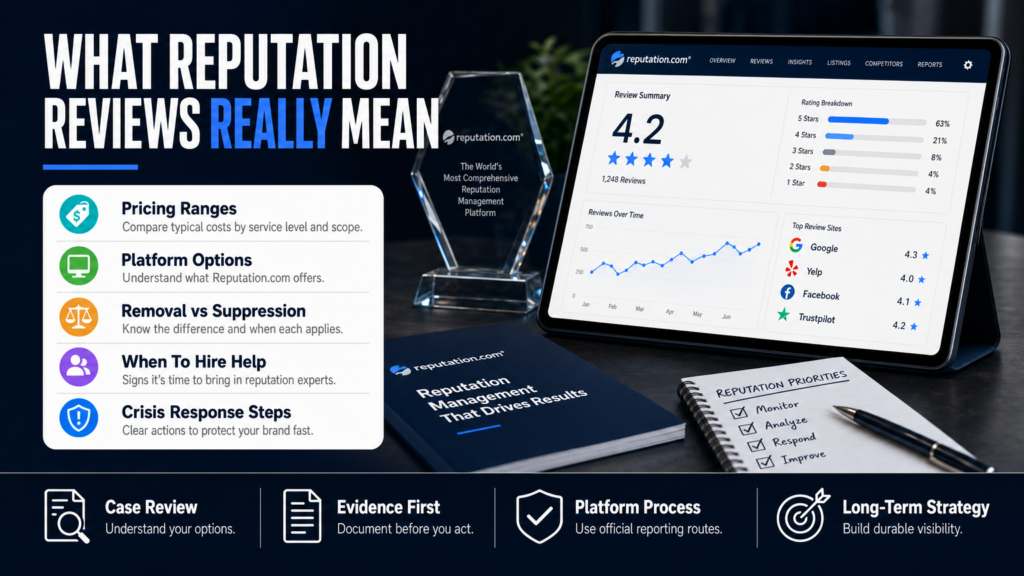
When people ask “Is Reputation a good company?” they usually mean the enterprise platform Reputation.com and whether large reputation vendors deliver value. Online reviews for any vendor — including Reputation.com — typically mix product feedback (software and monitoring) with service feedback (managed remediation and campaign support).
Important distinctions: software that helps you solicit and monitor reviews is not the same as a full-service firm that pursues removals, suppression, or legal coordination. Read reviews to separate software stability, customer service responsiveness, and success at complex tasks like takedowns or legal referrals.
Practical checklist when you read Reputation com reviews: verify whether the reviewer praises the platform’s monitoring features or the company’s managed-remediation team; look for recent complaints about billing or slow support; and confirm whether the feature set covers the platforms you actually need (Google, Yelp, industry sites).
- Search for the vendor’s reviews on multiple sites (G2, Capterra, Trustpilot, BBB).
- Request a case study or anonymized example similar to your situation.
- Ask the vendor to describe their escalation path for takedowns and legal coordination.
- Check review dates — product and policy changes can make older reviews irrelevant.
- Distinguish software performance from managed services outcomes.
- Ask for references that match your use case (physician, restaurant, law firm).
How Much Does Reputation Defender Cost Per Month?
A common People Also Ask is “How much does Reputation Defender cost per month?” There is no single published monthly price that fits every client. ReputationDefender and firms that use that brand model typically offer tiered, customized packages.
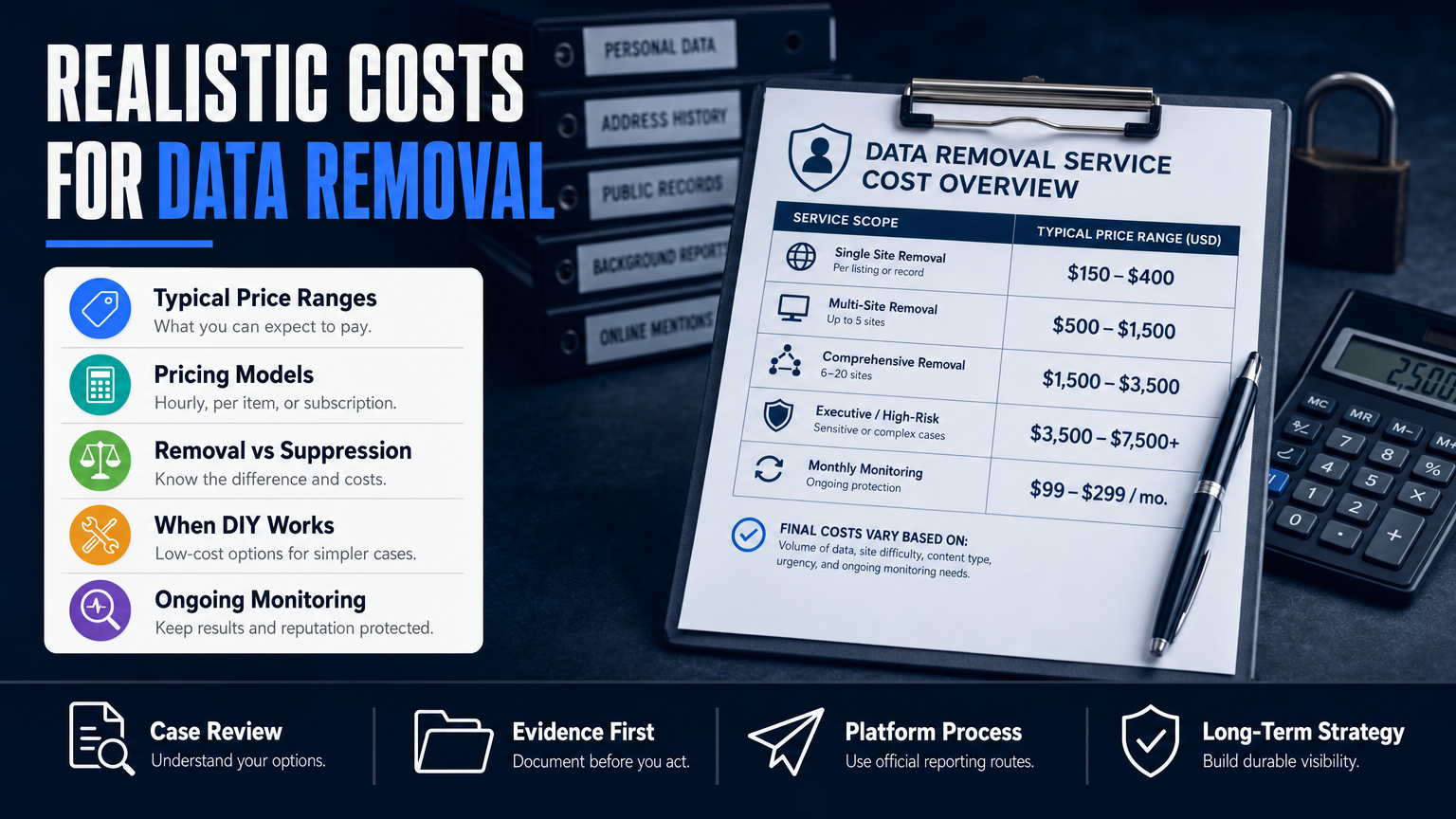
To set expectations: smaller, software‑only plans or DIY tool subscriptions can be under $100/month. Full-service remediation retainers from national firms usually start in the low hundreds and commonly sit in the $400–$1,200/month range for small businesses; more intensive cases that require legal coordination, removal attempts, or aggressive SEO suppression can cost several thousand per month.
If you want an apples‑to‑apples comparison for your situation, ask for an itemized scope and a statement of work. For a deeper look at how one vendor handles viral complaints and career risk, read Can ReputationDefender Fix a Viral Complaint and Save Your Career?.
- Identify the exact services you need (removals, suppression, monitoring, PR).
- Request a written SOW with deliverables and reporting cadence.
- Compare at least three vendors on identical scopes to see price variance.
- DIY tools: <$100/month (monitoring, basic review invites).
- Managed reputation packages: $400–$1,200/month (typical SMB retainers).
- High‑intensity remediation: $1,500–$5,000+/month (legal, PR, SEO suppression).
Is Reputation Resolutions A Legitimate Company?
People ask “Is Reputation Resolutions a legitimate company?” when they see a small or mid‑sized firm they don’t recognize. Legitimacy is a matter of verifiable business practices, not marketing claims.
How to verify legitimacy: confirm the business is registered in its stated jurisdiction, check the Better Business Bureau and state attorney general complaint databases, search for recent court dockets if legal claims are involved, and ask for client references that match your industry.
A legitimate vendor should provide a clear contract, an outline of what they will and will not do, and an escalation process when platforms refuse removals. If a company refuses to put scope or pricing in writing, treat that as a red flag.
- Search the company name in the state business registry and BBB.
- Request a sample contract and redaction policy.
- Ask for a written list of platforms they work with and past outcomes.
- Look for a physical business address and corporate registration.
- Check independent reviews (not only testimonials on the company site).
- Ask for anonymized case outcomes and references in your sector.
How Much Do Reputation Management Services Typically Cost?
The broader question — “How much do reputation management services typically cost?” — matters because the market covers a wide range of offerings. Prices depend on scope, intensity, and whether the work is one‑time (a takedown attempt) or ongoing (SEO suppression and monitoring).
Key cost drivers are the number of negative assets to address, the authority of the publishers involved (a major news outlet vs. a low‑authority blog), whether legal action is needed, and the geographic and regulatory complexity (state medical boards, for example).
Below is a short cost framework to help you estimate budgets before you request proposals.
- Inventory negative assets (URLs, screenshots, platform names).
- Classify each asset by type: review, article, people‑search listing, multimedia.
- Ask vendors to price each line item so you can choose priority actions.
- One‑time takedown attempt (single publisher, straightforward policy violation): $300–$1,500.
- Targeted suppression SEO campaign (3–6 months): $1,000–$6,000 total.
- Comprehensive crisis response (first 72 hours + ongoing PR/SEO): $2,000–$15,000+ depending on scope.
- Mugshot/records clean‑up and opt‑outs: usually billed per‑site or as a package; expect variable pricing.
Removal vs Suppression: What To Try First When Removal Isn’t Available
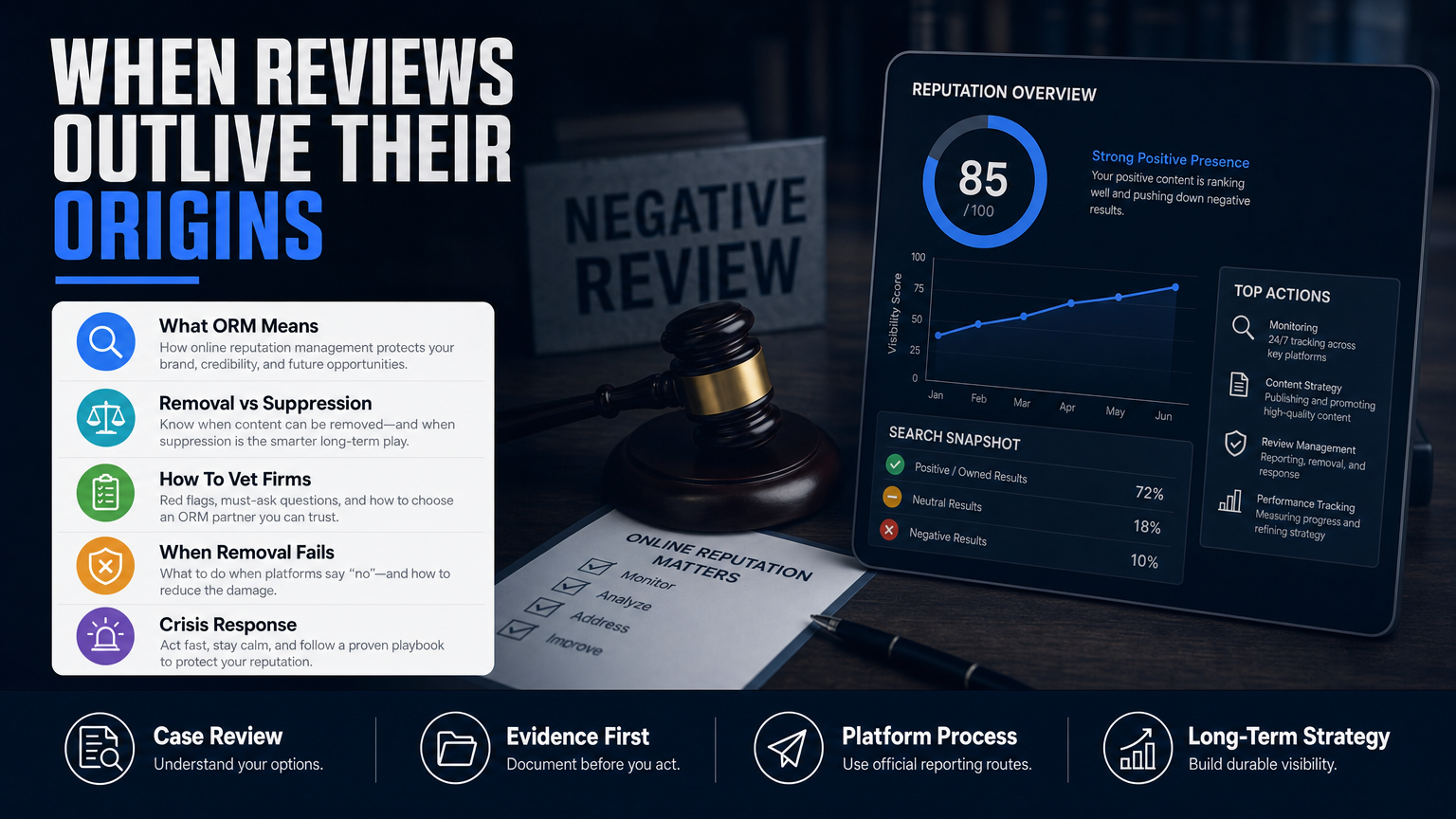
When removal is not available — because the publisher refuses, the content is lawful, or platform policy doesn’t apply — suppression is the practical alternative. Suppression means creating and promoting authoritative content that pushes the unwanted results lower in search pages.
Suppression strategies include building high‑quality profiles on LinkedIn and local directories, producing helpful content on your own site, using press releases or contributed articles on credible outlets, and targeted SEO to rank those pages above the negative asset.
Which route is best depends on the asset. Harassment, doxxing, impersonation, and policy‑violating content should always be evaluated for takedown avenues first. For truthful but harmful articles or complaints, suppression plus corrective messaging is usually the most realistic option.
- Map the search results you want to change (desktop and mobile).
- Identify quick wins (owners of controllable pages you can edit).
- Plan a 3–6 month content/SEO calendar focused on ranking signals.
- Removal first if content violates platform policy or privacy law.
- Suppression when content is lawful but damaging.
- Combine suppression with reputation building and PR for best effect.
DIY suppression checklist
If you start suppression on your own, prioritize controlled assets: your website (About page, press page), established social profiles, and professional directories.
- Optimize page titles and meta descriptions with your name/business.
- Publish at least one long-form authoritative page addressing the issue.
- Create or claim local listings (Google Business Profile, Bing Places).
When A Former Employee Becomes Your Biggest Search Result
Former employees, ex‑clients, and aggrieved insiders can produce posts or reviews that dominate search. When that happens, the first task is triage: identify whether the content is defamatory, a review, an opinion, or a privacy/doxxing incident.
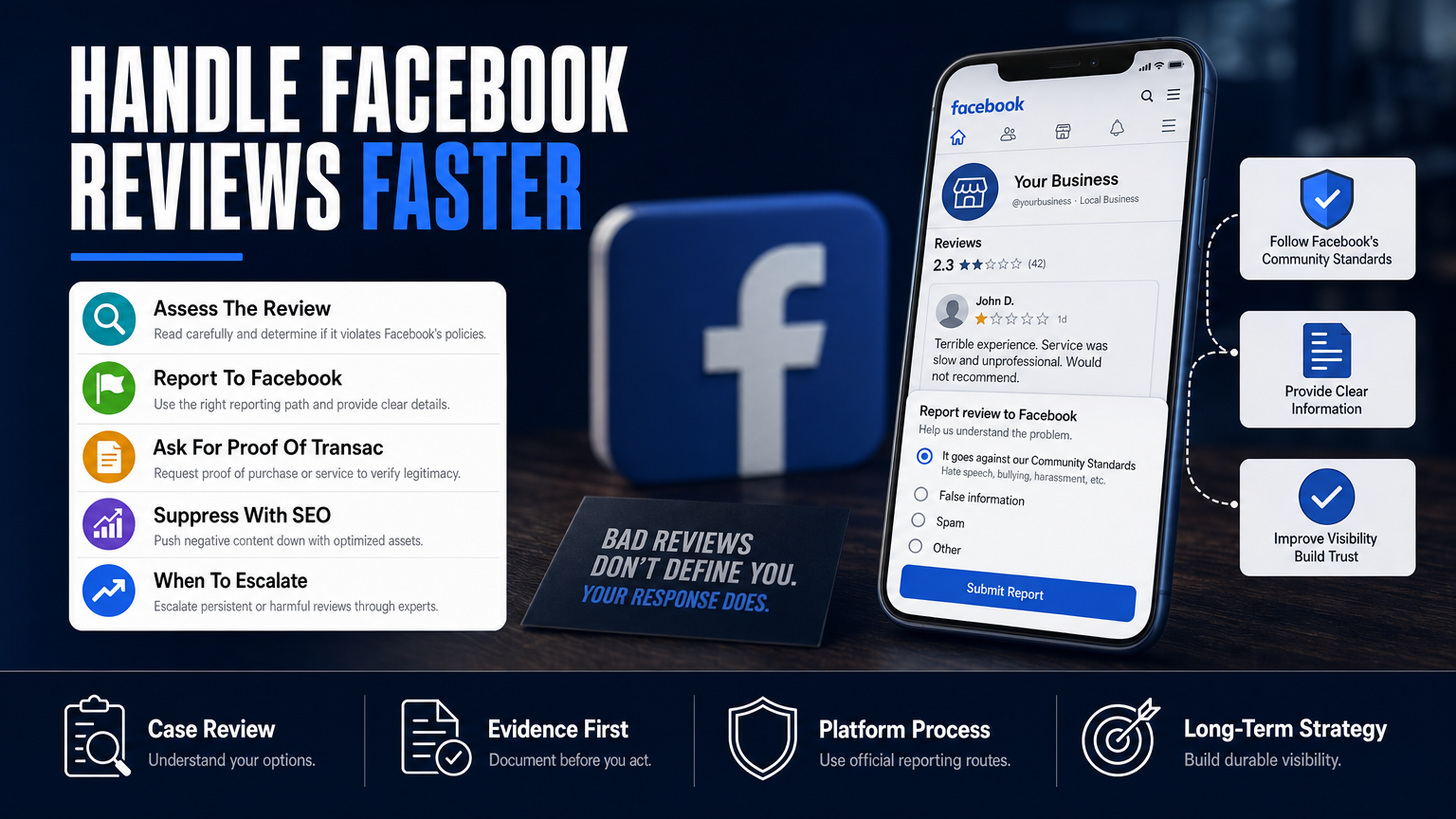
If the content is a negative review, use the platform’s dispute and reporting channels; if it is harassment or privacy invasion, escalate to platform abuse processes and consider law enforcement when the threat is credible. When the problem is complex and affects hiring or licensure, consider coordinated legal and PR advice.
This topic is covered in depth for employers and professionals in When a Former Employee Becomes a Brand’s Biggest Search Result, which lays out employer responses and remediation steps.
- Preserve evidence (screenshots with timestamps and URLs).
- Attempt platform reporting with a clear, factual statement of policy violations.
- If necessary, prepare a public-facing corrective statement and controlled content to outrank the negative item.
- Classify the content (review vs. article vs. forum post vs. social).
- Document timestamps, authors, and any evidence of coordinated activity.
- Use platform reporting but prepare a suppression and reputation‑building plan concurrently.
Rapid Online Crisis: 24–72 Hour Steps After A Viral Complaint
When a complaint or post goes viral you need a calm, prioritized response. Immediate actions are triage, containment, and messaging. Do not speculate publicly — inaccurate or defensive posts can make matters worse.
A clear, conservative first 24–72 hour checklist helps protect licensing, clients, and hiring outcomes while you evaluate longer‑term remediation options.
Understanding whether the viral item is likely to be removed or to persist will shape whether you pursue emergency takedowns, suppression campaigns, or PR and legal coordination.
- Hour 0–6: Preserve evidence, secure relevant accounts, notify internal stakeholders.
- Day 1: Submit platform reports and begin outreach to hosting sites for removal review.
- Day 2–3: Deploy suppression content, contact PR counsel, and consider legal review.
- Triage: identify the highest‑impact links and platforms (Google, Twitter/X, Facebook, Reddit, industry boards).
- Containment: secure accounts, change passwords, and remove related personal info if doxxed.
- Messaging: prepare a calm, factual internal and external statement; avoid admission of wrongdoing unless advised by counsel.
When to involve counsel or PR
Call a qualified attorney if there are threats, accusations of criminal conduct, or potential regulatory/licensure exposure. Call a PR professional when public perception and client trust are at immediate risk. Both may be necessary.
- Counsel for legal takedown letters and regulatory risk assessment.
- PR for controlled messaging, media outreach, and reputation rebuilding.
Monitoring, Contracts, and Red Flags When Choosing a Vendor
Ongoing monitoring is a core service you should expect from any managed option. Ask what alerts they send, what triggers escalation, and whether monitoring covers both web and dark‑web signals where appropriate.
Contracts should show a clear scope, cancellation terms, and reporting cadence. Beware of open‑ended guarantees, vague claims of “permanent removal,” or pressure tactics that insist on long‑term commitments without milestones.
Key red flags include vendors who ask you to provide login credentials for third‑party platforms without a secure process, refuse to sign a written agreement, or recommend deceptive tactics (which you should never use).
- Compare the monitoring scope across vendors and verify whether alerts include search engine ranking changes.
- Request at least one anonymized example of a campaign they ran for a similar client.
- Confirm security and confidentiality commitments in the contract.
- Ask for sample reports and an explanation of KPIs.
- Demand written SOW and cancellation terms before paying.
- Avoid any vendor that suggests fake reviews, misrepresentation, or other deceptive practices.
Removal vs Suppression — Quick Comparison
When you need a negative result addressed, choose the approach that fits the content, publisher, and legal context.
| Removal | Suppression |
|---|---|
| Goal | Push negative links below the first page |
| When feasible | When content is lawful or publisher refuses takedown |
| Typical methods | SEO, content creation, PR placements |
| Timeframe (typical) | Weeks to months for durable changes |
| Costs | Per‑site takedown fees or legal costs |
| Control | Less direct control; relies on earned authority |
| Risk | Lower legal risk; ongoing maintenance required |
Hypothetical Scenario: A Clinic and a Viral Complaint
A small specialty clinic finds that a single complaint posted on an industry forum plus a Reddit thread now appears on page 1 of Google for the clinic director’s name. The clinic is worried about patient cancellations and credentialing committees seeing these results.
Step one was triage: the clinic preserved screenshots, identified the highest‑traffic URLs, and secured social accounts that were receiving messages. Step two involved platform reporting: they filed policy reports for harassment and impersonation where applicable and requested review of the forum post for potential policy violations.
Because the forum host and Reddit denied removal, the firm shifted to a suppression plan: optimizing the clinic website’s bio, publishing two authoritative articles addressing the complaint context, and building high‑authority directory and news placements to outrank the unwanted pages.
- Day 1: Evidence preservation, account security, and platform reports.
- Week 1–4: Publish controlled content and claim professional profiles (LinkedIn, Healthgrades, Doximity).
- Month 1–3: Targeted outreach to industry outlets for neutral coverage and continue SEO to lower visibility of the complaint.
- Preserve evidence and document dates and URLs.
- Attempt policy takedown for harassment and doxxing first.
- Simultaneously start a suppression campaign focused on authoritative pages.
Common Mistakes Professionals Make When Responding
Several repeat mistakes make bad situations worse. Below are common errors and how to avoid them.
Reacting publicly without a plan
An emotional or defensive post can galvanize critics and create new shareable content. Prepare a short, factual holding statement and coordinate with counsel before substantive responses.
Chasing absolute removal promises
Vendors who promise guaranteed removal or fixed timelines should be treated skeptically. Removal depends on publisher policies, law, and platform discretion; reputable firms describe options and likely outcomes, not certainties.
Ignoring controlled assets
Failing to claim and optimize your own profiles (Google Business Profile, LinkedIn, industry directories) leaves easy ranking ground to the negative assets. Controlled assets are the lowest‑cost, fastest wins.
Hiring the cheapest vendor without SOW
Low initial price with vague scope often leads to poor prioritization and hidden fees. Always require a written SOW and milestone reporting before payment.
Using deceptive tactics
Never use fake reviews, fake identities, or misrepresentation. Those tactics violate platform rules and can escalate the problem legally and reputationally.
Best Practices For Handling Negative Search Results
These durable steps reduce risk and create options if a crisis appears.
Inventory and classify every negative asset
Start by listing URLs, screenshots, who posted them, and why they matter (licensure, revenue, hiring). Classification drives whether you focus on takedown, suppression, or legal paths.
- Tag each item as review, article, forum, or data‑broker listing.
Control what you can first
Claim your Google Business Profile, LinkedIn, and other core profiles. Optimize titles and bios so they rank above problem URLs when possible.
- Publish a detailed About page that addresses professional credentials and context.
Document everything
Screenshots with timestamps, saved HTML, and records of platform reports are essential if a legal or regulatory escalation becomes necessary.
- Store evidence in a secure, access‑controlled place.
Use coordinated tactics
Combine platform reports, SEO suppression, PR, and legal coordination as appropriate. No single tactic is a silver bullet.
- Set clear milestones and measure visibility changes monthly.
Vet vendors thoroughly
Require a written SOW, ask for anonymized examples, and check for clear cancellation terms before signing on.
- Avoid vendors that demand payment before providing an SOW.
Expert Tips
- Prioritize assets by potential harm — licensure and safety risks first, then hiring/economic harms.
- A single authoritative corrective article can sometimes outrank multiple low‑quality negative links.
- Preserve evidence immediately—platforms and courts prefer contemporaneous records.
- Ask vendors to estimate both best‑case and worst‑case scenarios, with reasons why.
- Insist on a written communications protocol for any public statements.
- If legal risk exists, get an attorney involved before detailed public responses.
- Monitor search results on mobile and desktop; rankings often differ.
- Keep a simple internal incident checklist so non‑technical staff can act fast.
Conclusion
Searching “Reputation com reviews” is a sensible first step, but the most important work is case‑specific: inventorying the problem, classifying each item, and choosing a mix of takedown, suppression, legal, and PR actions that fit the evidence and risk.
If removal isn’t achievable, suppression and reputation rebuilding remain powerful and legal options. Start with controlled assets and clear documentation; if the issue threatens licensure, revenue, or hiring, escalate to legal and PR counsel and consider a managed reputation partner who provides a written SOW and clear reporting.
Why Businesses Choose Your Reputation Agency
Managing your reputation takes more than monitoring reviews or publishing the occasional blog post. It takes a strategy built around your situation, your industry, and what is actually showing up in search.
Your Reputation Agency works with businesses, executives, healthcare professionals, attorneys and growing brands. Our services include:
- Remove defamatory content and false posts (news, blogs, listings)
- Remove or challenge negative reviews (Google, Yelp, TripAdvisor, industry sites)
- Mugshot and arrest record removal
- Remove videos, images, and other multimedia that damage reputation
- Remove personal data from people‑search and data‑broker sites (opt‑outs)
- Search result suppression (SEO to bury negative links)
- Social media takedowns and impersonation removal
- Rapid online crisis management and incident response
- Ongoing monitoring and alerting of reputation signals
- Coordination with legal counsel and use of legal tactics when required
Frequently Asked Questions
1. Is reputation a good company?
If you mean the vendor Reputation.com, opinions vary by buyer need. Read recent reviews, separate software feedback from managed‑service outcomes, and check references for your industry. Evaluate whether the platform’s features match the scope you actually need.
2. How much does Reputation Defender cost per month?
There’s no single published monthly fee. Similar firms offer DIY tools under $100/month, typical managed retainers in the $400–$1,200/month range for SMBs, and higher pricing for intensive legal/SEO work. Ask vendors for an itemized scope to compare.
3. Is Reputation Resolutions a legitimate company?
Legitimacy depends on verifiable business practices: registration, independent reviews, clear contracts, and references. Check the state business registry, BBB complaints, and request an anonymized case example before hiring.
4. How much do reputation management services typically cost?
Costs vary by scope: one‑time takedown requests can be a few hundred to a few thousand dollars, suppression campaigns commonly run $1,000–$6,000 for initial work, and comprehensive crisis responses with legal/PR support can exceed $10,000 depending on complexity.
5. What should I do first if a complaint goes viral?
Triage: preserve evidence, secure accounts, identify the highest‑impact links, and prepare a short holding statement. Submit platform reports and start a suppression plan while you evaluate legal and PR needs.
6. Can any company guarantee removal of a negative result?
No reputable company can guarantee removal. Removal depends on publisher policy, applicable law, and platform discretion. Ethical vendors will evaluate removal options and present a range of possible outcomes.
7. What happens if removal isn’t possible?
When removal isn’t available we pursue mitigation: suppression via SEO and content, corrective public messaging, and ongoing monitoring. Suppression is often effective but requires maintenance and realistic expectations.
8. How do I vet a reputation management vendor?
Ask for a written scope of work, sample reports, anonymized examples in your industry, and references. Verify their business registration, review contract terms (including cancellation), and confirm they will not use deceptive tactics.
9. Where can I learn whether a viral complaint can end a career?
Assessments are case‑specific. For discussion on career risk from viral complaints, see Can One Viral Complaint End a Professional Career. When licensure or employment is at risk, coordinate with counsel and reputation specialists immediately.
Past examples do not guarantee future results. Removal, correction, deindexing, and search-position changes depend on third parties and circumstances outside Your Reputation Agency’s control.