When a former employee becomes a brand search result
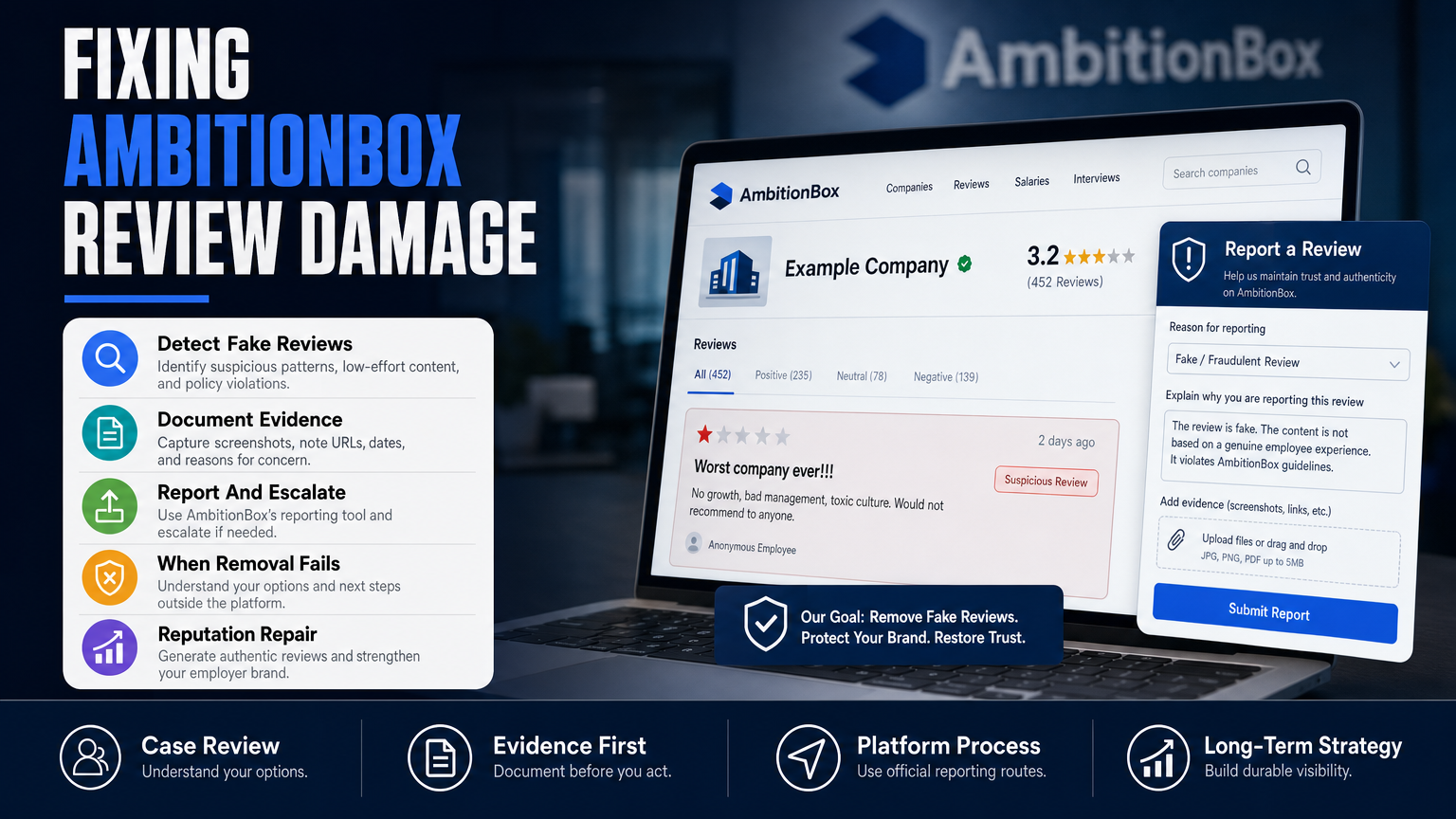
A former employee brand search result can gain visibility when a post attracts engagement, links, or repeated discussion. The right response depends on whether the content is accurate criticism, a policy violation, confidential information, or a provably false statement.
Seven response steps
- Preserve the page, URL, publication date, screenshots, and search position.
- Verify each factual claim against records and applicable obligations.
- Separate protected opinion from statements that may be demonstrably false.
- Use platform reporting tools only for genuine policy violations.
- Correct inaccuracies with concise evidence and a professional tone.
- Publish stronger pages about culture, leadership, and verified workplace practices.
- Monitor name and brand searches for changes or republication.
Do not disclose private employment information in a public rebuttal. Coordinate communications, HR, security, and legal review when the issue involves threats, confidential data, or potentially defamatory claims.
You just found a former employee’s post, a hostile LinkedIn thread, or an arrest page ranking above your website. It’s visible to clients, hiring committees, or patients — and you need options that actually change what people see.
This article explains how a Reputation Agency evaluates those problems, what removal attempts look like, when we move to search-engine suppression, and how much you should expect to pay for a professional team. The phrase Reputation Agency appears here because these are the services and language you should expect when you hire a specialist.
You’ll get step-by-step decisions, realistic timeframes, and the precise platform processes that matter — Google, Yelp, Facebook, YouTube, Reddit, data-brokers and niche review sites such as Healthgrades or Trustpilot.
If removal is not available we cover mitigation strategies that are routinely effective and legally safe.
Table of Contents
- Is Reputation A Good Company? How To Vet Any Reputation Agency
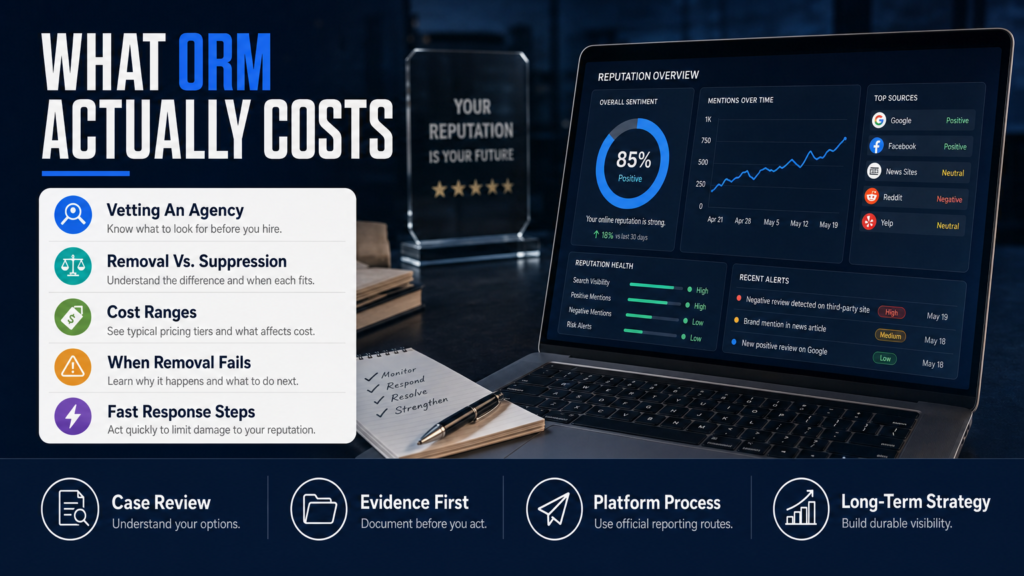
- How Much Does A Reputation Team Cost?
- What Are The Big 4 PR Agencies?
- What Is The Best Reputation Management Company?
- Removal Vs. Suppression: Which Strategy To Use
- When Removal Is Not Available: Mitigation And Suppression Plans
- Rapid Response: First 72 Hours Checklist
- Monitoring, Reporting, And When To Escalate
- Removal vs Suppression — Quick Comparison
- Hypothetical Example: The Ex-Employee LinkedIn Post
- Common Mistakes Companies Make When Addressing Online Harm
- Best Practices For Working With A Reputation Agency
- Expert Tips
- Conclusion
- Why Businesses Choose Your Reputation Agency
- Frequently Asked Questions
Is Reputation A Good Company? How To Vet Any Reputation Agency
When a searcher asks “Is reputation a good company?” they’re usually asking whether a reputation firm can be trusted, will be transparent, and has documented processes. You can’t rely on marketing claims alone; vetting matters.
A reputable Reputation Agency is clear about the limits of removal and suppression, uses documented platform processes, and coordinates with legal counsel when necessary. They explain the difference between removal, legal takedowns, and SEO suppression up front.
- Request a written scope showing the channels they will pursue and estimated time ranges.
- Ask for references that describe process (not results) and verify those references independently.
- Confirm data handling and confidentiality terms in a service agreement before sharing sensitive evidence.
- Check for written processes: intake, evidence collection, escalation, and reporting.
- Look for transparent pricing bands and what those fees cover (technical, platform reporting, legal coordination, PR).
- Ask whether they use in-house legal staff or coordinate with outside counsel — and what that coordination costs.
Red flags to avoid
Promises of guaranteed removal or permanent suppression are red flags. No firm controls publishers or search engines.
Pressure to use deceptive tactics (fake accounts, false DMCA claims, paid astroturfing) is a contract breaker — decline and document the offer.
- No guarantees of removal or ranking.
- No requests to falsify documents or fabricate evidence.
How Much Does A Reputation Team Cost?
Cost varies wildly because cases differ: a single false social post is simpler than multi-site defamation, mugshot pages, or coordinated review-bombing. A Reputation Agency will evaluate the content, platforms, and legal complexity before giving an estimate.
Below are typical cost bands and what they usually include. These are ranges — exact pricing depends on evidence, jurisdiction, and the number of publishers involved.
- Initial case assessment: agency reviews links, screenshots, and publisher details — expect this to be free or a small fee.
- Scope and quote: a written plan that separates platform reporting, legal escalation, and SEO suppression work.
- Work begins after signed agreement and deposit; agencies then collect authenticated evidence and submit takedown or content disputes.
- Single-item platform takedown (social post, YouTube clip): $500–$2,500 for managed reporting and follow-up.
- Niche site or review removal (1–3 reviews or listings): $1,500–$6,000 depending on complexity and platforms.
- Full-site suppression + multi-channel remediation (several negative pages, data-broker opt-outs, SEO work): $6,000–$30,000+.
- Ongoing monitoring and rapid-response retainers: $500–$3,000/month depending on alert volume and SLA.
Cost drivers to watch
Legal escalation (cease-and-desist, subpoena, litigation hold) increases costs substantially.
Niche publishers and legacy news archives often require negotiated retractions or corrections and can take weeks to months.
International content or cross-jurisdictional cases require local counsel and add expense and time.
- Number of offending links/pages
- Publisher type (social platform vs. independent blog vs. newspaper)
- Need for forensic evidence or legal filings
When reviews are the crisis
Review platforms are a common cost driver because each has different policies, appeal paths, and levels of responsiveness. A firm handling reviews will map platform-specific workflows and escalate when appropriate.
- Google and Yelp have standard dispute tools with variable outcomes.
- Industry sites (Healthgrades, RateMDs, RealSelf) often require verified complaint documentation.
- Bulk review-bombs need combined platform appeals and reputation PR to counter the narrative.
What Are The Big 4 PR Agencies?
When you escalate a reputation crisis into PR, many organizations expect to work with large firms. The commonly cited ‘Big 4’ global PR networks are Edelman, Weber Shandwick, BCW (Burson Cohn & Wolfe), and FleishmanHillard.
These firms have scale, international footprint, and broad media relationships — but scale isn’t always the right fit for urgent, hands-on remediation. Smaller specialist agencies or boutique reputation firms often move faster on digital takedowns, legal coordination, and SEO suppression.
- Decide whether you need global media strategy (big firm) or technical/legal takedown work (specialist firm).
- If choosing a large PR firm, confirm they will partner with technical reputation specialists rather than attempt technical fixes in-house.
- Edelman — global communications and public affairs.
- Weber Shandwick — media relations and digital practice.
- BCW (Burson Cohn & Wolfe) — integrated communications network.
- FleishmanHillard — reputation, crisis, and digital.
Choosing PR vs. Reputation Specialists
PR firms excel at narrative, media placement, and investor or regulator communications. Reputation specialists focus on platform rules, legal takedowns, SEO suppression, and monitoring.
Often the best outcomes combine both: a reputation firm handling the technical removal/suppression and a PR firm handling messaging and stakeholder outreach.
- PR firm = narrative control, press, crisis statements.
- Reputation firm = takedowns, platform appeals, SEO for suppression.
What Is The Best Reputation Management Company?
There is no single ‘best’ company for every situation. The right reputation management company depends on your objectives, the platforms involved, the legal complexity, and whether you need crisis PR, takedowns, or SEO suppression.
Evaluate firms by process, transparency, and how they will coordinate legal and technical work rather than by broad claims about rankings or removals.
- List the platforms and URLs you want addressed and ask each candidate to explain how they would approach each one.
- Request sample timelines (ranges only) for platform appeals, publisher contact, and SEO suppression.
- Compare contracts for confidentiality, data handling, and cancellation terms.
- Ask for a written plan separating removal attempts from mitigation and SEO suppression.
- Confirm whether they will coordinate with counsel when content may require legal action.
- Look for firms that provide monitoring and a clear escalation ladder for platform refusals.
How we evaluate ‘best’ claims
Claims like ‘best’ or ‘top’ are often marketing. Instead insist on documented evidence of methods: templates for takedown requests, escalation records, and a reporting cadence.
A practical test is how they handle a simple item — a single false social post — before you commit to larger projects.
- Demand process documentation.
- Insist on clear reporting metrics (actions taken, platform responses, next steps).
Removal Vs. Suppression: Which Strategy To Use
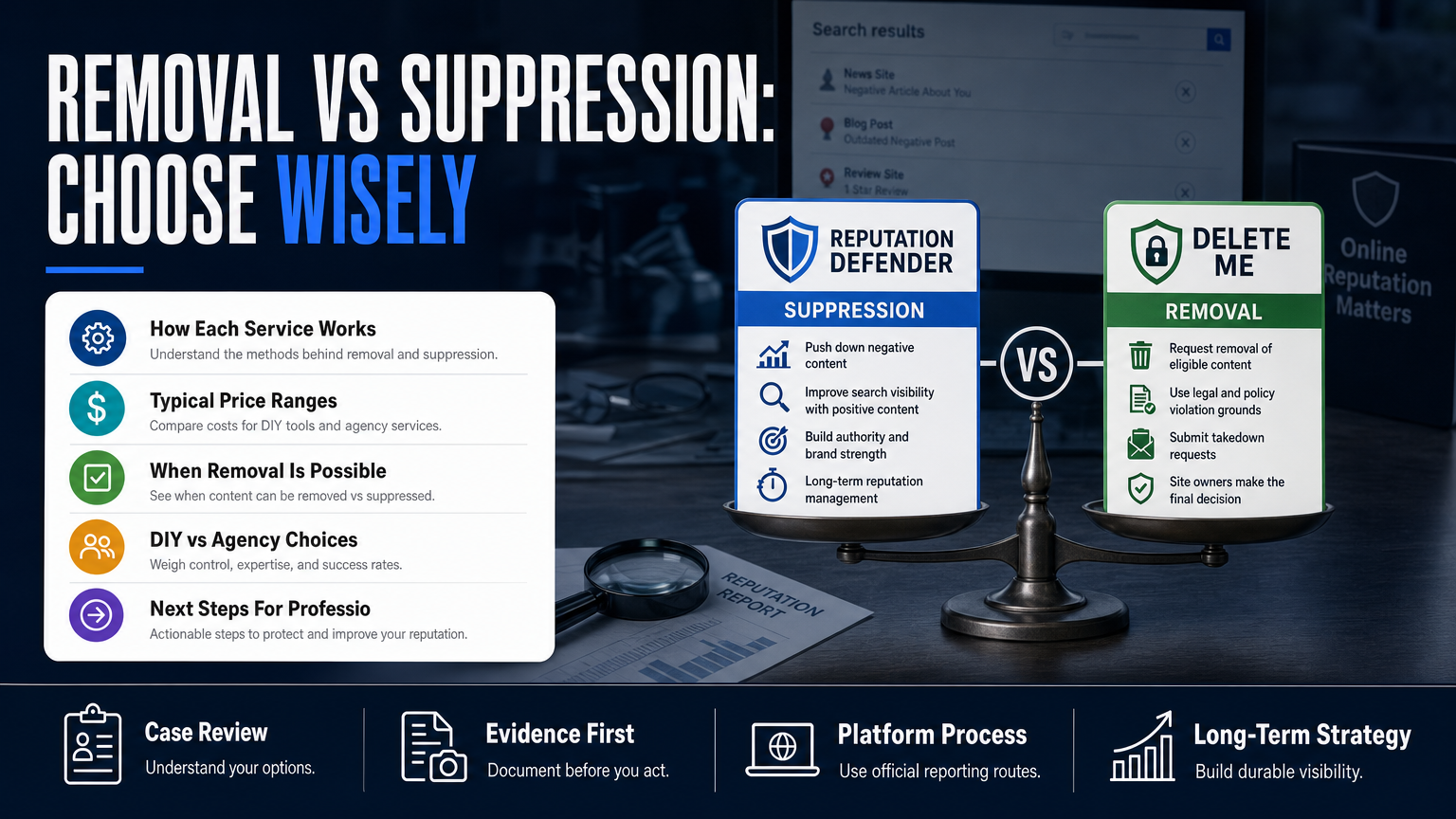
Removal and suppression are different tools. A Reputation Agency evaluates whether content may qualify for removal or review, and if removal is unlikely, pursues suppression with SEO and reputation content strategies.
Platform policy, publisher cooperation, the nature of the content (opinion, factual allegation, public record), and jurisdiction all determine which route is realistic.
- Assess content type and platform policy for removal eligibility.
- Attempt platform reporting and publisher contact with evidence.
- If removal fails or is unlikely, implement a suppression plan: create and optimize authoritative pages, earn links, and use social profiles to outrank the negative result.
- Removal: target is to have the publisher or platform delete or hide the content.
- Suppression: target is to push negative results off the first page using authoritative, positive content and technical SEO.
- Mitigation: correct factual errors, get clarifications, or publish contextual responses.
Comparison table: Removal vs Suppression
Use this quick comparison when deciding which approach to prioritize.
When Removal Is Not Available: Mitigation And Suppression Plans
Not every harmful page can be removed. Public records, opinion pieces, and some news archives are resistant to takedown. In those cases we pursue mitigation, correction, and search-engine suppression.
Suppression strategies are not guarantees: we develop SEO reputation strategies intended to improve the visibility of relevant and credible information, but search results may change for reasons beyond our control.
- Map current first-page results and identify what can realistically be outranked.
- Prioritize high-ROI assets: LinkedIn, institutional bios, Wikipedia (if eligible), major publisher guest posts.
- Begin link-building and authoritative content publication to push negatives down over time.
- Publish authoritative pages (bio, professional profiles, press coverage) and optimize them to rank for your name or brand.
- Create content that closes the narrative gap: factual timelines, third-party validations (awards, board memberships), and client testimonials where appropriate.
- Engage in targeted PR to generate new, higher-authority results that displace older negatives.
Practical timeframes and expectations
Timing depends on the platform, publisher, evidence, legal complexity, and search-engine behavior. Some cases may begin to show changes within an estimated range of several weeks to a few months, but there is no universal timeframe.
An estimated timeline can be provided after an individual assessment.
- Minor social removals: days to weeks (platform-dependent).
- Publisher retractions or corrections: weeks to months (negotiation dependent).
- Search suppression via SEO: months to a year for durable changes.
A note on search visibility
We develop SEO reputation strategies intended to improve the visibility of relevant and credible information. Results vary according to the strength of the negative content and the authority of competing sources.
Rapid Response: First 72 Hours Checklist
How you act in the first 72 hours can change the arc of a reputation incident. The priority is evidence preservation, controlled public response, and quick platform reporting.
This checklist is what most agencies will do in the first three days once engaged or when advising a client on immediate steps.
- 1. Evidence: Capture high-resolution screenshots and archive URLs (use a reputable web-archive or save HTML).
- 2. Triage: Identify which platforms are the source and which audiences are impacted (clients, regulators).
- 3. Platform reporting: Submit official reports to Facebook/Instagram, Twitter/X, LinkedIn, YouTube, Reddit using the platform’s abuse or legal tools.
- 4. Messaging: Coordinate a short holding statement if public messaging is required, and escalate to PR if amplification is likely.
- 5. Monitor: Set alerts for brand/name mentions and rank changes.
- Preserve screenshots, timestamps, and the original URLs (do not edit the content yourself).
- Collect witness information and any corroborating evidence (emails, messages).
- Lock and review social accounts for impersonation and change passwords to reduce escalation risk.
When to involve legal counsel immediately
The content may warrant legal review if it contains false factual allegations, sensitive personal data, or if the publisher refuses to engage. A qualified attorney can determine whether a legal claim may be available.
We coordinate with qualified legal professionals when a matter requires legal analysis.
- Threats of litigation or regulatory complaints
- Publication of private or intimate images
- Persistent impersonation that damages business operations
Monitoring, Reporting, And When To Escalate
A reputation campaign is not a single action — it’s an ongoing process of monitoring, reporting, and escalating when platforms or publishers refuse to act. Platforms decide outcomes using their policies, and platform decisions remain under the platform’s control.
Reputation agencies build playbooks for common outcomes and a reporting cadence so clients see what was tried, what the platform responded, and what the next steps are.
- Set up monitoring for exact-name matches and high-traffic keyword combinations.
- Route high-risk incidents to a rapid-response queue with a designated point of contact.
- If platform reporting fails, document the refusal and prepare the legal or PR escalation materials.
- Automated alerts for new mentions on Google, social media, and review sites.
- Weekly or biweekly action reports showing submissions, publisher contacts, and platform responses.
- Escalation ladder: platform appeal, publisher contact, legal demand, PR response.
Privacy, confidentiality, and data handling
We handle matters confidentially and apply appropriate privacy and security controls. Specific confidentiality obligations are defined in the service agreement.
Do not share passwords or sensitive documents through unsecured channels; agencies should instruct secure upload methods.
Removal vs Suppression — Quick Comparison
Which approach to prioritize depends on the content and platform. Use this at-a-glance compare.
| Removal | Suppression |
|---|---|
| Goal | Push down ranks with new content |
| Primary method | SEO, new authoritative pages |
| Typical platforms | Google search results, content publishers |
| When realistic | When content breaches platform policy or is demonstrably false |
| Timeframe | Platform-dependent; weeks to months |
| Risk | Publisher may refuse; legal cost if escalated |
| Durability | Variable; suppression requires ongoing content strategy |
Hypothetical Example: The Ex-Employee LinkedIn Post
Situation: A mid-size clinic discovers a former employee’s LinkedIn post alleging misconduct. The post is shared and ranks high for the clinic director’s name. Removal is uncertain because the post is framed as the author’s opinion and references public events.
Process: The agency performs an intake, preserves evidence, and pursues platform reporting while simultaneously implementing suppression tactics to reduce visibility.
Outcome: After platform reporting is denied (platform cites personal opinion), the agency published authoritative profiles, an FAQ page addressing the timeline factually without litigation language, and pushed new press coverage and earned links to outrank the post.
- 1. Intake and evidence capture (Day 0–2).
- 2. Platform reporting and author contact (Day 2–10).
- 3. Launch suppression assets: optimized bios, press, and a fact page (Week 1–4).
- 4. Monitor rankings and repeat SEO pushes for 3–6 months.
- Preserved multiple screenshots and archived the original URL.
- Submitted formal abuse report to LinkedIn with evidence of impersonation and timeline errors.
- Prepared an official correction request to the author and their employer (if applicable).
Common Mistakes Companies Make When Addressing Online Harm
These mistakes slow outcomes and sometimes create additional exposure. Avoid them.
Reacting Without Evidence
Deleting or altering posts without preserving the original evidence eliminates proof required for appeals or legal action. Always archive before you act.
- Take screenshots and save HTML before editing.
- Record timestamps and witness statements when relevant.
Relying Solely On One Channel
Submitting the same report to one platform and assuming it will cascade is a mistake. Each platform has different policies and appeal processes; manage them separately.
- Tailor appeals to platform policy language.
- Document each submission and the platform response.
Using Vague Contracts
Agreeing to work without documented scope and reporting expectations leads to mismatched outcomes. Insist on a written plan with deliverables and confidentiality terms.
- Define what counts as ‘success’ (action taken vs. content removed vs. visibility improved).
- Clarify billing cadence and cancellation rights.
Acting Illegally or Unethically
Attempts to fabricate evidence, use fake accounts, or manipulate systems can lead to legal exposure and platform bans. Legitimate agencies refuse such tactics and will terminate the relationship if pressured.
- Never ask for fake reviews or false DMCA claims.
- Report any vendor proposing deception and seek alternate counsel.
Ignoring Long-Term Monitoring
Reputation work is not a one-off fix; new negative content can appear. Ongoing monitoring prevents surprises and reduces response time.
- Set up alerts for name, brand, and high-risk keywords.
- Review monitoring outputs weekly during crisis periods.
Best Practices For Working With A Reputation Agency
These are durable steps that protect your options and improve the chances of a favorable outcome.
Preserve Evidence First
Capture screenshots, archive pages, and gather any emails or messages. Evidence is the currency for appeals and legal review.
- Use reputable archiving tools and store copies securely.
- Keep an evidence log with dates and actor names.
Demand Clear Scopes And Reporting
Ask for a scope that separates platform reporting from SEO suppression and legal coordination. Weekly action reports should list submissions and responses.
- Define success metrics and acceptable timelines as ranges.
- Ensure confidentiality terms are explicit in the contract.
Coordinate PR, Legal, And Technical Teams
A combined approach often works best: a reputation team for technical takedowns, an attorney for legal steps, and PR for public narrative. Confirm who will own each piece.
- Create a single point of contact to avoid mixed messages.
- Document approval processes for public statements.
Prepare A Post-Incident Plan
After initial remediation, plan for reputation rebuilding: new content, earned media, and client outreach. This reduces the impact of any residual negatives.
- Schedule follow-up monitoring for at least six months.
- Invest in authoritative content that strengthens positive search results.
Expert Tips
- Preserve evidence before you speak to anyone publicly — screenshots and archived URLs are essential.
- Use platform policy language in reports; cite specific terms when requesting removal.
- If a platform refuses, document the refusal and escalate with a detailed appeal.
- Treat review-bombing as both a technical and a PR problem — respond publicly where appropriate and pursue platform tools privately.
- Don’t conflate negative but true public records with removable content; focus on mitigation when needed.
- Insist on a written escalation ladder in your contract so you know when legal steps will be recommended.
- Keep monitoring after initial work — many incidents recur or evolve over months.
- If multiple platforms are involved, map them and address the highest-visibility ones first (Google, YouTube, major review sites).
Conclusion
A Reputation Agency brings processes and expertise that most organizations lack in-house: evidence handling, platform workflows, legal coordination, and SEO suppression. But no reputable agency will promise guaranteed removals or fixed timelines — outcomes depend on platform policies, publisher cooperation, and the legal environment.
If removal is available, it will be pursued; when it isn’t, well-executed suppression and mitigation can restore balance in search results and public perception. Start with documented evidence, demand transparent scopes, and combine legal, technical, and PR tactics as the situation requires.
Why Businesses Choose Your Reputation Agency
Managing your reputation takes more than monitoring reviews or publishing the occasional blog post. It takes a strategy built around your situation, your industry, and what is actually showing up in search.
Your Reputation Agency works with businesses, executives, healthcare professionals, attorneys and growing brands. Our services include:
- Remove or challenge defamatory content and false posts across news sites, blogs and social platforms
- Remove negative reviews from Google, Yelp, Facebook, Trustpilot, Glassdoor and industry review sites (e.g., Healthgrades, RateMDs, RealSelf, Vitals, Angi)
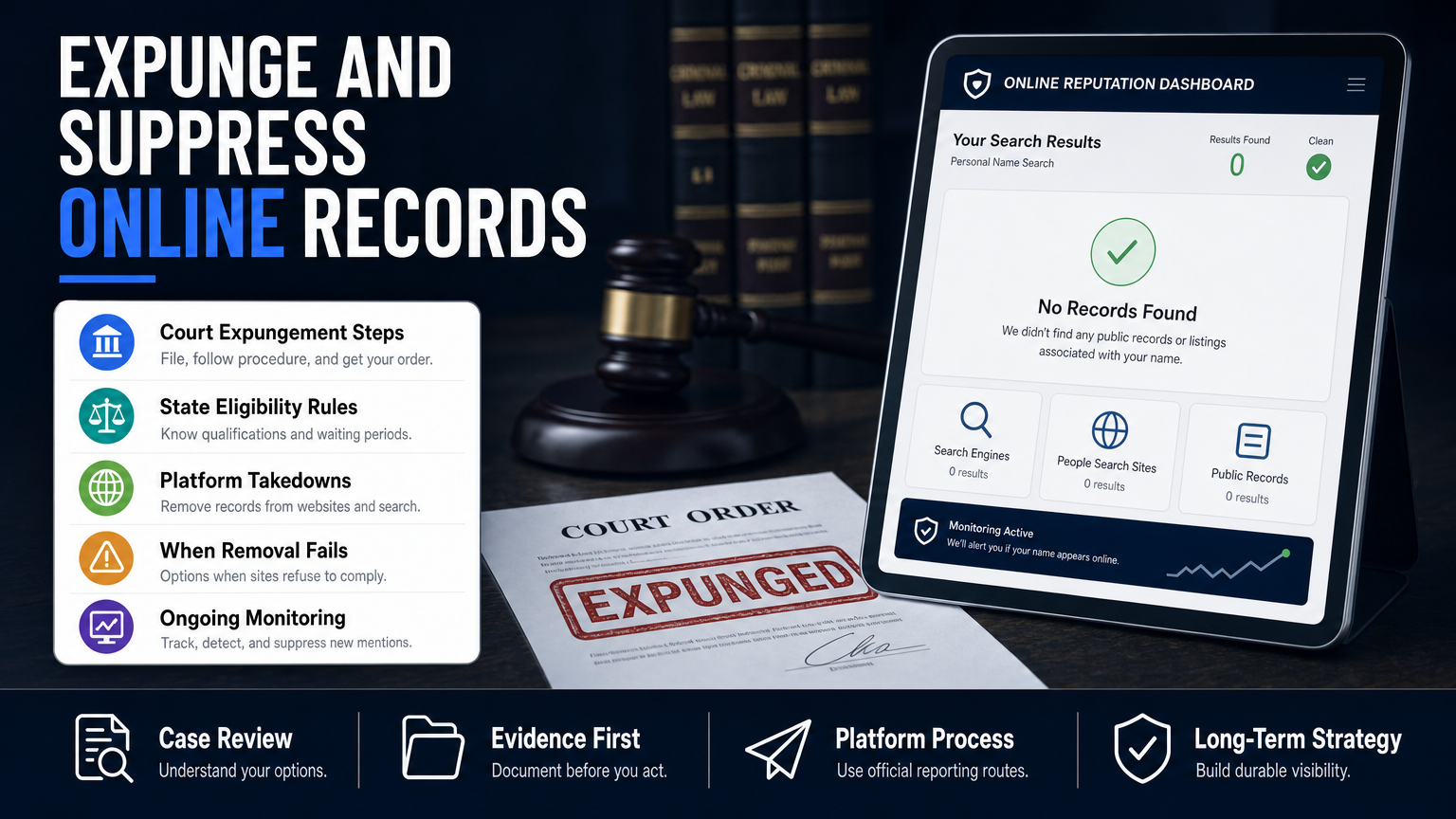
- Mugshot and arrest-record removal and remediation
- Remove or takedown negative videos, YouTube content, TikTok clips and other harmful multimedia
- Remove or suppress negative search results and implement search-engine suppression strategies (SEO to bury bad results)
- Remove personal information and opt-out from people-search and data-broker sites (address, phone, phone number removal)
- Social media impersonation and fake account takedown (reporting and removal on Facebook, Instagram, Twitter/X, LinkedIn, TikTok)
- Reddit and community forum post/comment removal and visibility reduction
- Online crisis management and reputation PR to respond to viral incidents
- Monitoring and alerting for negative content, fake reviews and emerging reputation threats
Frequently Asked Questions
1. Is Reputation a good company?
If you mean ‘is a reputation company legitimate?’: evaluate firms by their documented processes, transparency about limits, and willingness to coordinate with legal counsel. If you mean a specific company named ‘Reputation’, check public reviews, corporate filings, and independent third-party references; avoid firms that promise guaranteed removals.
2. How much does a reputation team cost?
Typical ranges: $500–$2,500 for a single-item takedown, $1,500–$6,000 for a few reviews or listings, and $6,000–$30,000+ for full-site suppression and multi-channel remediation. Ongoing monitoring retainers commonly run $500–$3,000/month. Exact costs depend on the number of items, platforms, legal complexity, and international work.
3. What are the big 4 PR agencies?
The commonly cited global ‘Big 4’ PR networks are Edelman, Weber Shandwick, BCW (Burson Cohn & Wolfe), and FleishmanHillard. They offer scale and media reach, but a specialist reputation firm may be a better fit for hands-on takedowns and technical remediation.
4. What is the best reputation management company?
There’s no universal best. The right firm matches your needs: legal escalation, takedowns, SEO suppression, or crisis PR. Choose on process, transparency, and documented methods rather than marketing superlatives.
5. What should I do when removal is not available?
Pursue mitigation and suppression: publish authoritative profiles and factual pages, earn positive coverage and links, and optimize technical SEO. We develop SEO reputation strategies intended to improve visibility, but search results can change for reasons outside our control.
6. How long does a reputation remediation campaign take?
Timing depends on platform, publisher, evidence, and legal complexity. Some platform actions occur in days; publisher corrections and SEO suppression usually take weeks to months. An estimated timeline can be provided after assessment, but no firm can promise universal timeframes.
7. Can a reputation agency provide legal services?
Reputation agencies are not law firms. The content may warrant legal review, and a qualified attorney can determine whether a legal claim may be available. Agencies coordinate with outside counsel when legal steps are required.
8. How do I handle a review-bombing attack?
Treat it as both a technical and PR incident: document the pattern, submit platform-specific bulk-dispute processes, and deploy a communications plan to contextualize the situation. For more detail on platform workflows and patterns see The Anatomy of a Review-Bombing Attack on Local Businesses.
9. What role does Google search play in reputations?
The first page of Google often acts as your public storefront; improving what’s shown there is frequently essential. A reputation plan should include mapping the first page and building authoritative assets to replace negatives — learn more about treating search as your homepage in The First Page of Google Is Your Real Homepage.
This content provides general information and does not constitute legal advice. The available options and likely outcomes depend on the facts, evidence, platform policies, applicable law, jurisdiction, and public-interest considerations.
Past examples do not guarantee future results. Removal, correction, deindexing, and search-position changes depend on third parties and circumstances outside Your Reputation Agency’s control.