You just found an ugly item on page one of Google and typed Reputation Defender free to see whether there’s a no-cost fix. That search makes sense: people want immediate, inexpensive answers the moment reputation risk appears.
This article walks through what a free Reputation Defender offering actually includes, how ReputationDefender (the commercial service) structures pricing, whether it’s legitimate, and realistic alternatives for busy US professionals who need quick containment and long‑term remediation. The phrase Reputation Defender free appears in the opening because many readers first look for a no‑cost route — we’ll show what that gets you and what it doesn’t.
Read on for clear monthly cost ranges, the platform and legal limits you should expect, step‑by‑step actions to check the reputation of a phone number, and a practical plan for when removal isn’t available. Expect concrete timelines as ranges with caveats, plus a sample scenario that shows the full workflow.
Table of Contents
- How much does ReputationDefender cost per month?
- Is Reputation Defender legitimate?
- What are some good alternatives to Reputation Defender?
- How can I check the reputation of a phone number?
- What to do when removal is NOT available
- DIY vs hiring a reputation agency: which to choose?
- How to handle a former employee or smear campaign
- DIY vs Agency: Quick Comparison
- Hypothetical Case: A Viral Complaint About a Clinic
- Common Mistakes Professionals Make
- Best Practices for Rapid Remediation
- Expert Tips
- Conclusion
- Why Businesses Choose Your Reputation Agency
- Frequently Asked Questions
How much does ReputationDefender cost per month?
ReputationDefender does not publicly list a single flat price for every customer. Like most reputation-management firms, they tier services based on the problem type (review removal, search‑engine suppression, legal escalation, PR), the number of negative items, and the intensity of monitoring and response required.
Typical market ranges you should expect for managed online-reputation work in the US are: entry-level monitoring and a one‑time cleanup (often $100–$400), mid-tier packages including active suppression and removal requests ($400–$1,500/month), and full-service crisis programs with legal and PR coordination ($1,500–$10,000+/month) depending on complexity. These are market ranges, not promises of what any specific vendor will charge.
- Get a free audit: have the vendor deliver a named list of offending URLs and an estimated scope of work.
- Ask for a written scope that lists deliverables, assumptions, and cancellation terms.
- Request a range of possible timelines and what would move the matter from “mitigation” to “legal escalation.”
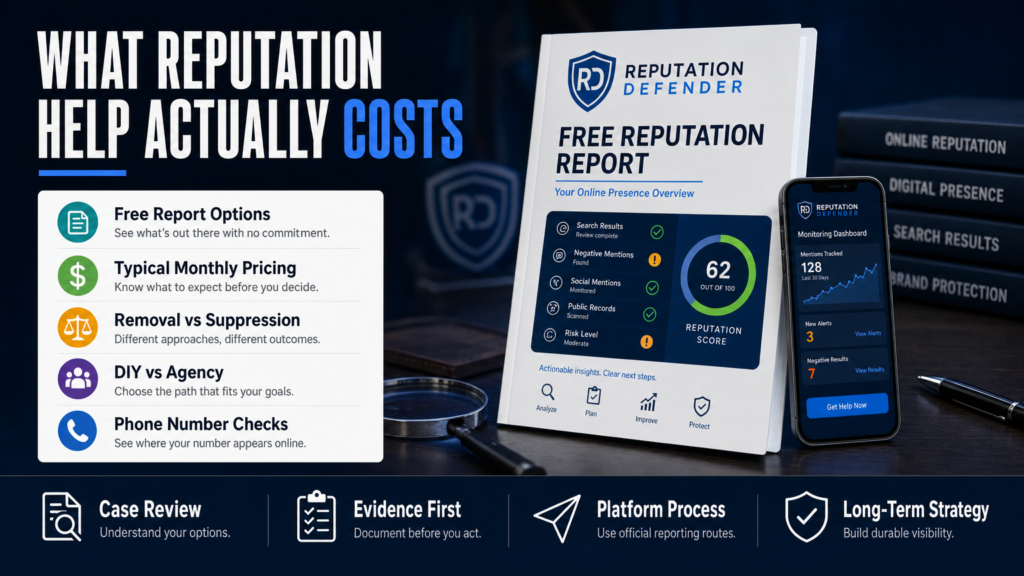
- Some companies offer a “free” audit or report — often a limited snapshot of search results.
- Free reports generally do not include active takedowns, legal work, or full SEO suppression.
- Contract length, platform fees (for legal takedowns), and scope drive monthly pricing.
What a free audit usually includes
Free audits—often labeled “Reputation Defender free report”—typically scan the first two pages of Google for a name or business and generate a PDF with found links, a basic reputation score, and suggested next steps. They are useful as a diagnostic but not a remediation plan.
- List of found URLs and snippets
- Basic visibility score or risk indicator
- Suggested remediation options (removal, suppression, PR)
How to use the audit before you sign
Treat a free audit as an input. Compare multiple audits, ask for clarifications on what tasks are included, and confirm whether legal coordination or takedown templates are part of the monthly fee.
Is Reputation Defender legitimate?
ReputationDefender (the brand) is a legitimate commercial service in the reputation-management market; there are multiple established vendors in this space. Legitimacy is about whether a provider operates transparently, follows platform rules, and uses permitted legal and technical options rather than deceptive tactics.
A reputable vendor describes methods clearly, discloses limits (for example, that removal depends on platform policy and the publisher), and coordinates with qualified counsel when a legal claim might be present. If you’re evaluating any provider, insist on a written scope, data‑handling and confidentiality terms, and references from clients in similar industries.
If you want to compare how ReputationDefender handles a viral complaint versus alternatives, see our analysis in Can ReputationDefender Fix a Viral Complaint and Save Your Career?.
- Request written confirmation of all methods the vendor will use (platform reports, legal actions, PR outreach, SEO).
- Ask how they will handle confidentiality and whether they will coordinate with your attorney.
- Get a portfolio or anonymized examples that show similar work; industry peers are most helpful.
- Legitimacy signals: clear contracts, documented escalation processes, named points of contact, and documented platform-compliant tactics.
- Red flags: promises of guaranteed removal, use of fake accounts or fake reviews, or pressure to sign long automatic renewals without clear deliverables.
What are some good alternatives to Reputation Defender?
Alternatives fall into three buckets: DIY tools and audits (free or low-cost), boutique firms that focus on niche platforms (medical, legal, hospitality), and full‑service agencies. Each path has tradeoffs in speed, cost, and control.
For many professionals, combining a DIY audit with targeted paid services is the most cost‑effective approach: do the initial containment yourself, then hire specialists if legal or PR escalation is required. For other organizations with licensure or investor risk, a managed program is often appropriate.
- List the offending links and classify them (defamatory, false, opinion, public record, listing mistake).
- Match the classification to an action: report to platform, submit opt-out to data brokers, or escalate to legal counsel.
- If you need suppression, ask for an SEO plan with content creation and link-building to outrank negative items.
- DIY: Use free reputation report tools, Google Alerts, and platform-specific opt-outs to handle low-severity items.
- Boutique vendors: specialists for Google reviews, medical licensure issues, or industry review sites.
- Full-service agencies: coordinate takedowns, suppression SEO, legal notices, and PR outreach.
Specific vendor types and when to choose them
If the problem is mugshots or arrest records, specialized removal services and state-specific legal counsel are often required. If the issue is review removal, a reputation vendor with experience on Google, Yelp, and industry review sites is appropriate. For smear campaigns or leaks, coordinate an agency with PR and legal experience.
- Mugshot removal: specialized providers with state‑law knowledge
- Review problems: vendors who document pattern abuse and file platform claims
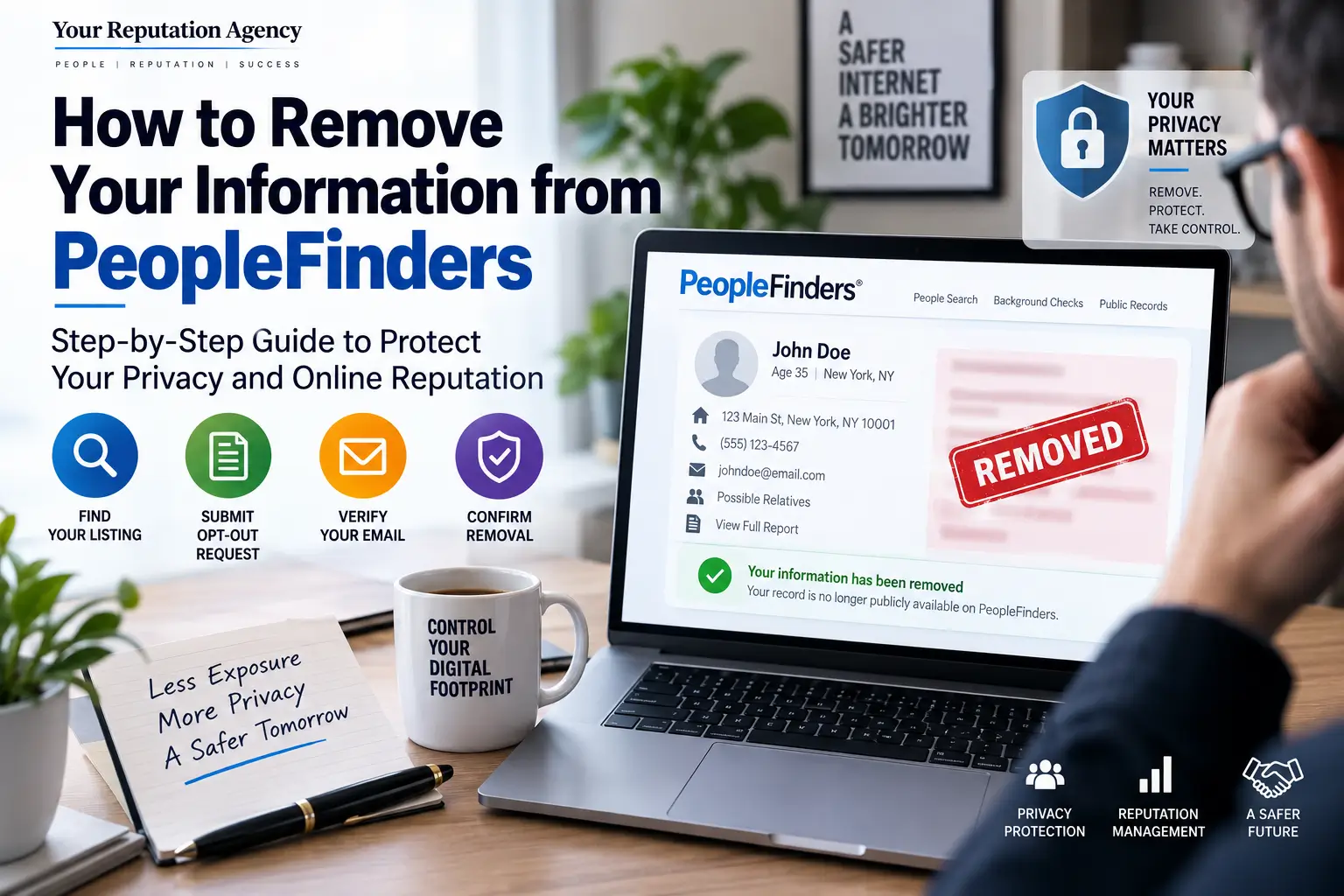
- Data brokers: services that run systematic opt-outs
Further reading on suppression vs removal
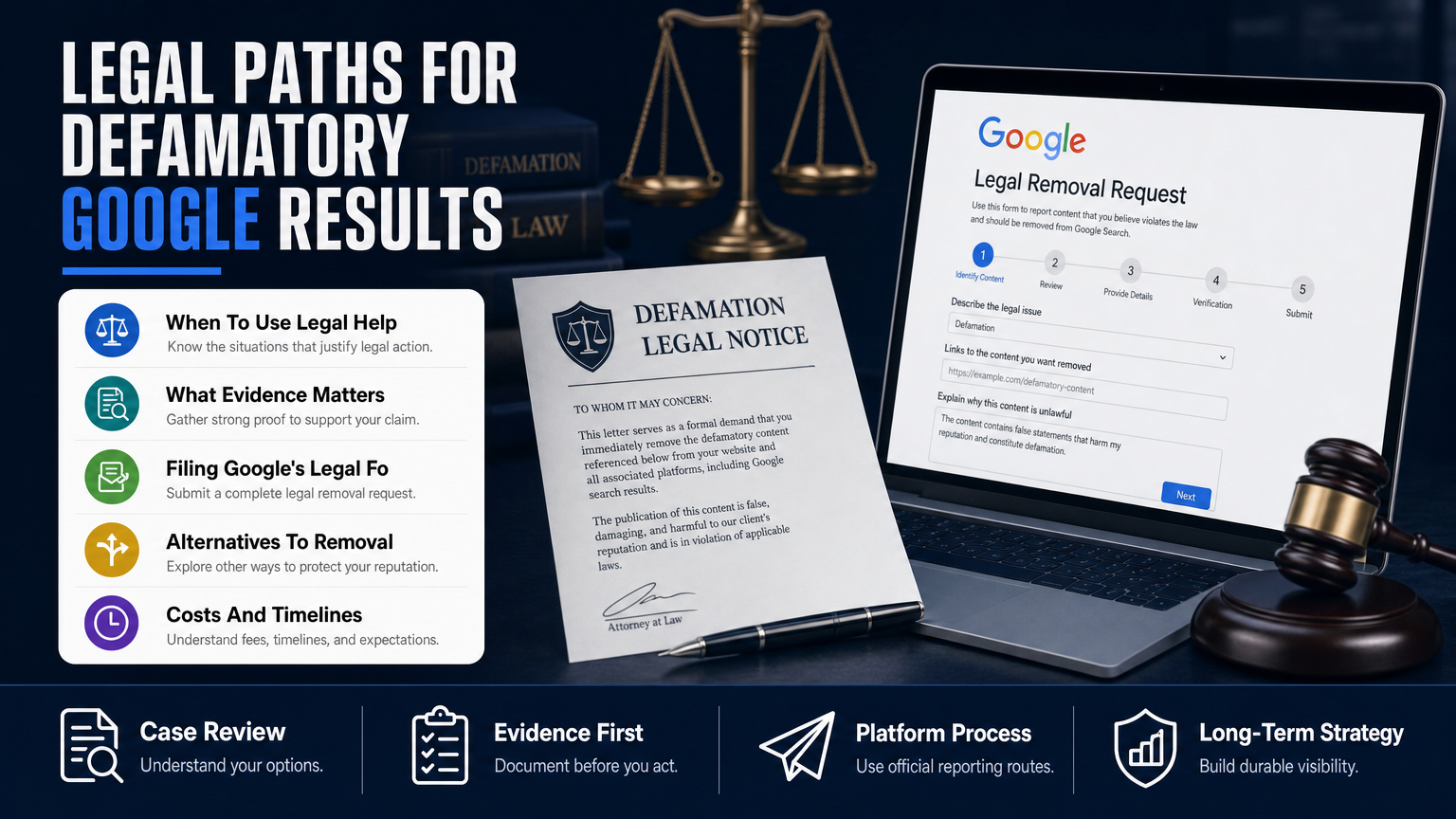
If one negative result controls your presence online, suppression can be as important as removal; for a deep dive on that scenario see When One Negative Result Controls Your Google Presence.
How can I check the reputation of a phone number?
A phone number’s reputation matters when calls to clients, patients, or partners come from unknown or flagged numbers. Use a combination of free checks, reputation tools, and operational controls to assess risk.
Begin with public lookups, then review call-record patterns and platform reports. This section provides step-by-step checks you can run immediately.
- Step 1 — Quick web check: Search the number in quotes and scan the first two pages for complaints or repeated mentions.
- Step 2 — Reverse lookup apps: Install or use TrueCaller/Hiya on a test phone to see crowd-sourced labels.
- Step 3 — Industry checks: If the number relates to your business line, check CRM call logs for patterns of missed calls or complaints.
- Step 4 — Report/opt-out: If the number is misused (spoofing or impersonation), report it to your carrier and to the FCC and add the number to block lists where possible.
- Run the number through Google and place quotes around it to find forum threads and complaints.
- Use free reverse‑lookup services (TrueCaller, Hiya, Whitepages, Spy Dialer) to see common labels.
- Check caller ID services and app reviews to see if the number is labeled as spam or scam.
When the number is impersonating your business
If someone is spoofing your number or creating malicious outbound calls that appear to come from you, preserve call records and timestamps, notify your telecom provider, and consider a legal review. Telecom providers and the FCC have processes to address caller-ID spoofing.
- Preserve recordings and logs where permitted by law
- Alert internal security and customer-service teams
- Notify your telecom provider and file an FCC complaint if spoofing persists
What to do when removal is NOT available
Not all negative content qualifies for removal. Truthful reporting, court records, and opinion pieces are frequently non-removable under platform policies and US law. When removal is unavailable, suppression, correction, and reputation reconstruction are your practical options.
Suppression uses SEO and content publishing to push negative items down in search results. Correction uses public responses, factual clarifications, or press to contextualize the issue. Both approaches require steady effort and do not guarantee results.
- Step 1 — Classify: Determine why removal is not available — platform policy, public record, or opinion.
- Step 2 — Prioritize targets for suppression: identify 5–10 pages you can realistically outrank.
- Step 3 — Execute: create or refresh authoritative pages, use content distribution and link building, monitor changes monthly.
- Build authoritative profiles (LinkedIn, corporate bio pages) and keep them updated.
- Publish factual content that addresses the issue directly (press release, blog post, or FAQ).
- Use targeted SEO (optimizing on‑page signals, building links) to improve the ranking of positive content.
Short-term containment tactics
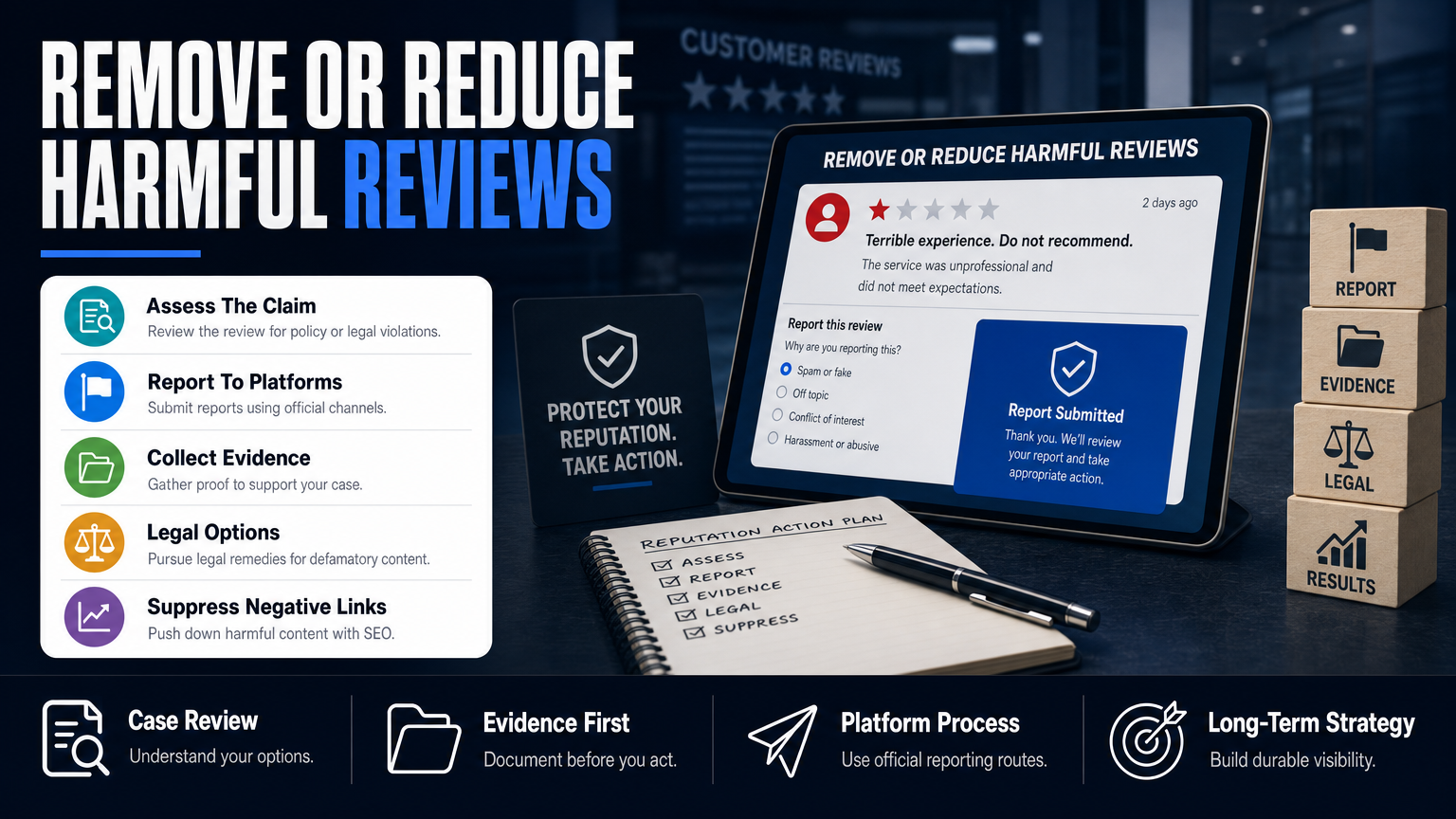
Use platform reporting to request review where policy violations exist (harassment, doxxing, impersonation). For content that stays, consider paid ads or a promoted post to control the narrative in the short term.
- File platform policy reports where applicable
- Use targeted paid placements if immediate visibility control is needed
- Coordinate with PR for public statement if the event is high-profile
DIY vs hiring a reputation agency: which to choose?
Choosing between a DIY approach and hiring a firm depends on the stakes, your time, and the complexity of the issue. Low-severity problems or single incorrect listings are often solved directly. Complex matters—smear campaigns, licensure risk, or multi-platform viral content—usually need an experienced team.
The comparison below helps you decide quickly whether start-to-finish agency help is worth the cost for your situation.
- Assess the business impact (revenue, licensure, hiring) of the negative content.
- Estimate your available time and tolerance for visibility while you learn platform rules.
- If the issue threatens revenue or professional standing, consult a reputable agency for a scoped proposal.
- DIY is cost‑effective for straightforward listings, single bad reviews, and basic monitoring.
- An agency brings platform experience, legal coordination, PR support, and sustained SEO capability.
- Hybrid: DIY the initial work and escalate to an agency if progress stalls.
Cost versus risk matrix
Low cost/low risk: DIY and monitoring. High cost/high risk: engage agency. Middle cases: a short (90-day) contract with defined deliverables is often prudent.
- Low risk examples: single incorrect listing, one negative review
- High risk examples: viral misinformation, accusal of professional wrongdoing, ongoing doxxing
How to handle a former employee or smear campaign
Former employees can create some of the most damaging search results because they often know specific details that make claims look authentic. Treat these situations as combined legal, platform, and PR matters.
If your issue involves a former employee, our focused guidance outlines documentation, platform reporting, and messaging strategies. For a fuller discussion of when a former employee becomes the central online result, see When a Former Employee Becomes a Brand’s Biggest Search Result.
- Step 1 — Preserve evidence: save URLs, screenshots with timestamps, and internal records.
- Step 2 — Evaluate platform policy: identify harassment, impersonation, or privacy violations that may be removable.
- Step 3 — Coordinate response: craft a factual, non-defamatory public message if appropriate and consult counsel for legal options.
- Do not publicly argue with the former employee — that can amplify the content.
- Preserve all communications, employment records, and termination documents in case legal review is needed.
- Document patterns: multiple posts with the same false claim strengthen platform or legal escalation.
DIY vs Agency: Quick Comparison
A short look at the practical differences so you can choose based on time, cost, and risk.
| DIY | Agency |
|---|---|
| Cost | Lower upfront; time cost higher |
| Speed | Slower for complex issues |
| Platform know‑how | Expertise across platforms and escalation |
| Legal coordination | Provides coordination with counsel |
| Scalability | Handles multi-channel, ongoing crises |
| Control over messaging | Professional PR support available |
Hypothetical Case: A Viral Complaint About a Clinic
Situation: A mid-sized clinic received an anonymous post on a local forum alleging poor care; the post was shared on Facebook and one local blog picked it up. The clinic’s name became the top search result for three queries and patient calls dropped by 20% over a week. This example illustrates an anonymized workflow (not a real client).
Process: The clinic ran a quick free audit to identify the three URLs driving visibility, preserved screenshots, and assigned internal staff to track calls. They escalated to a reputation agency for platform reports, an SEO suppression campaign, and PR outreach to local media to provide context.
- Day 0–3: Audit, preserve, and request platform reviews
- Day 3–14: Deploy corrective content and initial SEO work (optimize clinic page, create supporting pages)
- Week 3–8: Continue link building to support suppression; monitor visibility weekly
- Month 2–3: Evaluate changes in search rankings and patient call volume; escalate legally if defamatory statements persist
- Step 1: Free audit and classification (defamatory vs opinion vs public record)
- Step 2: Preservation of evidence and internal tracking
- Step 3: Platform policy reports for harassment, data removal requests where appropriate
- Step 4: Publish corrective content (clinic statement, patient-care explanation) and optimize pages
- Step 5: SEO suppression campaign plus targeted local PR outreach
Common Mistakes Professionals Make
Below are frequent errors we see from professionals handling reputation problems themselves. Each mistake can slow remediation or make problems worse.
Mistake 1 — Treating a free audit as a full solution
Many people assume a free Reputation Defender report equals remediation. A free audit is diagnostic. It identifies visible problems but does not perform takedowns, coordinate legal action, or execute an SEO suppression plan.
- Use the audit to prioritize work, not as the final step
Mistake 2 — Publicly arguing with the poster
Replying angrily or exposing private information can escalate visibility and give search engines more content to index. Public disputes often make the issue last longer.
- Prefer factual, calm responses if a response is necessary; otherwise pursue platform reports and legal counsel
Mistake 3 — Chasing guaranteed removal claims
Avoid vendors who promise guaranteed removal or permanent suppression. Those guarantees are not credible—platform decisions and search rankings are outside any vendor’s unilateral control.
- Insist on clear, written methods instead of blanket guarantees
Mistake 4 — Ignoring documentation
Failing to preserve screenshots, links, and dates reduces the effectiveness of platform reports and legal options. Documentation matters if you later need to show a pattern or escalate.
- Immediately save URLs, use the Wayback Machine for stubborn pages, and keep internal logs of client calls
Mistake 5 — Assuming all negative content is removable
Truthful reporting and court records are often non-removable. Expect to use suppression and contextual content rather than assuming removal is automatic.
- Plan for suppression and correction when removal is not available
Best Practices for Rapid Remediation
These are durable, actionable approaches that reduce risk and speed recovery.
Practice 1 — Classify each item quickly
Separate content into categories: false/defamatory, opinion, factual public record, listing error, or impersonation. Each category has a different remediation path.
- Defamatory/false: consider legal review and platform policy reports
- Opinion: respond only when it corrects factual errors
- Public record: suppression, not removal, is usually the path
Practice 2 — Preserve evidence immediately
Take dated screenshots, export call logs, save messages, and document internal impact metrics (lost calls, revenue drops). Evidence strengthens platform and legal actions.
- Use timestamped screenshots and archive URLs with the Wayback Machine
Practice 3 — Use authoritative assets for suppression
Create or optimize high-authority content (your bio page, professional profiles, press releases) and use them to outrank negative items through on-page SEO and link-building.
- Prioritize owned domains and official profiles for quick wins
Practice 4 — Coordinate legal and PR early when risk is high
If the issue could affect licensure, employment, or investor relations, involve counsel and PR before publishing a defensively worded statement. Coordination reduces tone mistakes that create liability.
- Ask vendors whether they coordinate with attorneys as part of escalation
Practice 5 — Monitor continuously
Set up Google Alerts, platform monitors, and weekly reporting. Reputation issues can reappear or evolve; continuous monitoring shortens response time.
- Daily monitoring for active crises, weekly for ongoing mitigation
Expert Tips
- A free reputation report is only as useful as the follow-up plan you attach to it.
- Preserve evidence immediately; once a page changes, a fresh screenshot is your strongest artifact.
- If a review is false, ask for the poster’s contact information via the platform before escalating publicly.
- For non-removable public-record items, invest in authoritative content that addresses the issue directly.
- Never sign long automatic renewal contracts without an exit clause tied to deliverables.
- Track business metrics (calls, bookings) alongside search visibility to measure real impact.
- Use email-safe language for any public responses — factual, concise, and non-accusatory.
- When in doubt about legal exposure, consult qualified counsel before publishing defensive statements.
Conclusion
Searching for Reputation Defender free is a logical first step, but free reports have limits. Treat them as diagnostics that help you prioritize and budget the right follow-up—whether DIY, boutique help, or a full-service agency.
If removal is possible, vendors will evaluate the content against platform policy, evidence, publication, and jurisdiction. If removal is not available, suppression, correction, and coordinated PR are the practical alternatives. The right plan depends on the stakes: triage with a free audit, then escalate with clear scope, documented evidence, and legal coordination when required.
Why Businesses Choose Your Reputation Agency
Managing your reputation takes more than monitoring reviews or publishing the occasional blog post. It takes a strategy built around your situation, your industry, and what is actually showing up in search.
Your Reputation Agency works with businesses, executives, healthcare professionals, attorneys and growing brands. Our services include:
- Remove defamatory content and false posts (news, blogs, listings)
- Remove or challenge negative reviews (Google, Yelp, TripAdvisor, industry sites)
- Mugshot and arrest record removal
- Remove videos, images, and other multimedia that damage reputation
- Remove personal data from people‑search and data‑broker sites (opt‑outs)
- Search result suppression (SEO to bury negative links)
- Social media takedowns and impersonation removal
- Rapid online crisis management and incident response
- Ongoing monitoring and alerting of reputation signals
- Coordination with legal counsel and use of legal tactics when required
Frequently Asked Questions
1. How much does ReputationDefender cost per month?
ReputationDefender pricing is tiered and not universally published; market ranges for reputation services in the US run from about $100–$400 for entry tasks up to $1,500–$10,000+ per month for full-service crisis programs. Exact pricing depends on scope, platforms affected, and whether legal or PR coordination is needed.
2. Is Reputation Defender legitimate?
Yes—ReputationDefender (and other established vendors) are legitimate commercial services. Legitimacy depends on transparent methods, clear contracts, and compliance with platform rules. Avoid providers that promise guaranteed removals or use deceptive tactics.
3. What are some good alternatives to Reputation Defender?
Alternatives include DIY audits and monitoring tools, boutique vendors who specialize in specific platforms or industries, and full-service agencies. Choose based on the problem’s complexity: simple listing errors can be DIY, while viral misinformation often needs an agency with legal and PR capability.
4. How can I check the reputation of a phone number?
Search the number in quotes on Google, use reverse-lookup apps like TrueCaller or Hiya, and check forum threads and caller‑ID apps for crowd-sourced labels. If the number is impersonating you, preserve call logs and contact your telecom provider and the FCC about spoofing.
5. Does a free Reputation Defender report mean the problem will be fixed for free?
No. Free reports are diagnostics that identify visible issues. Remediation—takedowns, legal actions, suppression SEO, and PR—usually requires paid services. Use the audit to prioritize and get multiple quotes before committing.
6. What should I do if removal is impossible?
When removal isn’t available, focus on suppression (publishing authoritative content and SEO), correction (public statements or factual clarifications), and monitoring. For high-risk matters, coordinate with legal counsel and PR to minimize ongoing damage.
7. How long does suppression or remediation usually take?
Timing varies by platform, the authority of competing pages, and search‑engine behavior. Some initial changes can appear in weeks; meaningful suppression often requires months of SEO and content work. No vendor can promise a fixed timeline.
8. Should I involve legal counsel immediately?
If the content alleges professional misconduct, threatens licensure, or contains false factual claims that harm your business, consult a qualified attorney early. Legal counsel can advise on defamation, cease-and-desist letters, or litigation, and a reputable agency will coordinate with counsel when appropriate.
9. Can I rely on vendor guarantees?
Be skeptical of absolute guarantees. Reputable vendors will describe methods and likely outcomes and will explain the dependencies (platform policies, publisher cooperation, and search algorithms). Insist on a written scope rather than blanket promises.
This content provides general information and does not constitute legal advice. The available options and likely outcomes depend on the facts, evidence, platform policies, applicable law, jurisdiction, and public-interest considerations.
Past examples do not guarantee future results. Removal, correction, deindexing, and search-position changes depend on third parties and circumstances outside Your Reputation Agency’s control.