You’re facing a specific reputation problem — a defamatory article, a review storm, a mugshot, or a viral post — and you’re asking: What are some alternatives to NetReputation? That question is the right place to start, because the best fit depends on the platform, the legal context, and the result you need.
This guide shows which firms and approaches are suited to different problems (privacy/data brokers, negative search results, review crises, mugshots, impersonation), what realistic cost and timeline ranges look like, and how to vet vendors so you don’t trade one headache for another. It also explains what to do when removal isn’t available.
If you want a quick map: some firms specialize in data-broker opt-outs and privacy; others focus on SEO suppression; a few combine platform takedowns with legal coordination and PR. I’ll explain how those choices play out for physicians, lawyers, small businesses, and executives.
Read the sections that match your immediate problem first, then use the checklist at the end to compare vendors. Expect concrete next steps you can implement today.
Table of Contents
- Is NetReputation a reliable option for my case?
- Who actually owns NetReputation and why ownership matters
- How much does a service like NetReputation cost?
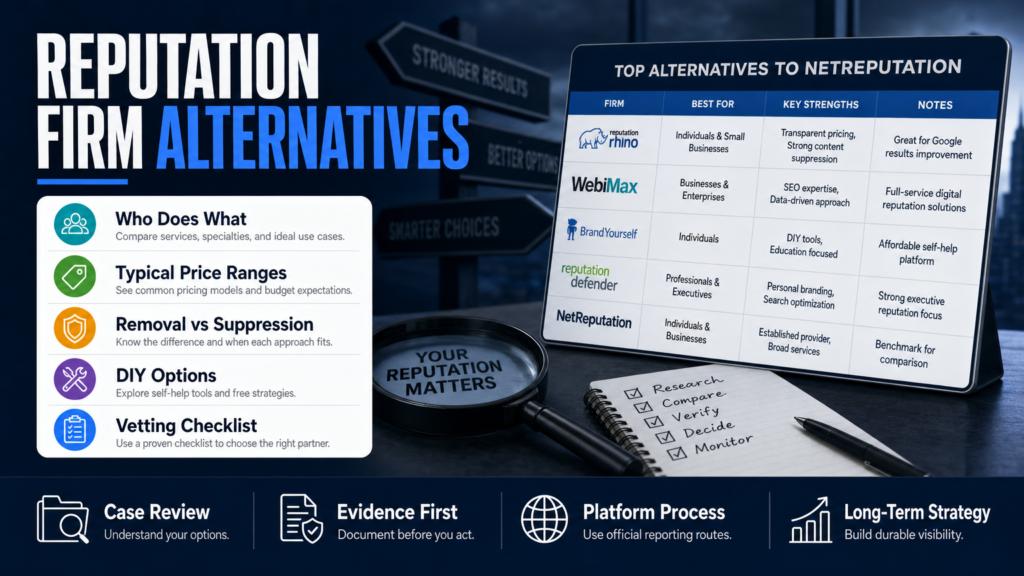
- Practical alternatives to NetReputation and what they specialize in
- When removal is not available: suppression, correction, and PR
- DIY options versus hiring an agency — when to choose each
- How to vet a reputation vendor: due diligence checklist
- Takedown (Removal) vs Search-Result Suppression
- Hypothetical scenario: a surgeon and a viral article
- Common mistakes organizations make when switching vendors
- Best practices for replacing or suppressing damaging content
- Expert Tips
- Conclusion
- Why Businesses Choose Your Reputation Agency
- Frequently Asked Questions
Is NetReputation a reliable option for my case?
Many professionals start by asking whether NetReputation is “good” because it shows up in search and advertises takedowns, review management and suppression. Whether any single provider is right depends on the match between your problem and the vendor’s strengths.
Reliability is multi-dimensional: technical skill (SEO, takedown requests), legal coordination (working with counsel on defamation or privacy claims), platform experience (Google, Facebook, YouTube, data brokers) and client service (transparency, reporting). Ask for examples of the vendor’s experience with the exact problem you have — e.g., mugshots, Business Profile reviews, or third‑party articles.
- Describe your problem in writing and ask the vendor for a case outline showing likely options.
- Request sample reports and a scope that specifies what they will attempt and what they will not attempt.
- Verify claim specifics: whether they’ll pursue platform reporting, publisher contact, legal referrals, SEO suppression, or PR.
- No single firm is best at everything; some focus on privacy opt-outs, others on suppression or review response.
- A reliable vendor follows platform processes and coordinates legal counsel when necessary — they don’t promise guaranteed removals or fixed timelines.
- Look for clear reporting, escalation paths, and a scope of work that spells out responsibilities and limits.
Red flags to avoid
Vendors who promise immediate removal, guaranteed first‑page results, or partnerships that imply special access to Google are unreliable and make legally problematic promises.
Also be wary of companies that pressure you to sign long contracts before a scoped assessment; a short discovery engagement is reasonable.
- Guaranteed removal or fixed timelines
- Claims of special access to platforms
- Pressure to sign without a documented plan
Who actually owns NetReputation and why ownership matters
NetReputation is a privately held reputation-management company. For many buyers ownership won’t change the service you receive, but corporate structure can matter for enterprise procurement, dispute resolution, and continuity of service.
If ownership or corporate history is important to you, check state business filings, the company’s website, and independent industry coverage. A vendor’s team, documented processes, and legal relationships usually matter more than precise ownership.
- Search the secretary of state business registry for registered agents and filing history.
- Ask the vendor directly for corporate structure and whether they use subcontractors.
- Confirm how client files and ongoing campaigns would be handled if the vendor changes ownership.
- Ownership details are often available in state records or on a company’s About page.
- Ask vendors how they handle custody of client data, subcontractors, and confidentiality if corporate changes occur.
- Request references or case types that match your industry or issue.
How much does a service like NetReputation cost?
Pricing varies by scope: one-off removals and opt-outs cost differently than ongoing suppression and crisis management. Typical market ranges for US-focused reputation work are broad because cases differ so much.
If you want benchmarks as you budget, start with a scoped assessment. Our breakdown below explains common pricing bands and when they apply.
- Get a written scope: what platforms and domains will be addressed, and whether legal or PR work is included.
- Compare fixed-fee project options vs monthly retainers and check termination/renewal clauses.
- Request an itemized quote to separate removal outreach, legal coordination, SEO work, and monitoring.
- Small, focused opt-outs (data brokers, listings) can range from a few hundred to a couple thousand dollars as a one-time fee.
- Moderate projects (removing or suppressing a handful of articles, targeted SEO) often span $2,000–$10,000 depending on complexity.
- Comprehensive, ongoing ORM retainers for sustained suppression, review management and monitoring typically start in the low thousands per month and increase with scope and legal coordination.
A resource for pricing context
For a deeper look at cost expectations for professionals — particularly healthcare providers — see this article on pricing benchmarks that maps typical ranges and what drives them: How Much Should You Pay To Fix A Doctor’s Online Reputation.
Practical alternatives to NetReputation and what they specialize in
Below are commonly considered alternatives, grouped by the type of work they typically perform. This is a starting list — verify each firm’s current service set and ask for examples that match your problem.
When evaluating them, focus less on marketing copy and more on documented platform experience, legal relationships, and client references for similar issues.
- List the single biggest outcome you need (remove a mugshot, suppress an article, manage a review storm).
- Match that need to the vendor specialty above and short-list three vendors for interviews.
- Ask each short-listed vendor for a one-page plan showing the tactics they would try first.
- ReputationDefender / Privacy firms — Strong on data‑broker opt‑outs and personal-data removal processes; useful for privacy and people‑search cleanups.
- Reputation.com — Enterprise-focused review and listing management with integrations for multi‑location businesses and review funneling.
- BrandYourself — Offers DIY tools and managed services with a focus on SEO and personal-branding content creation.
- Reputation X and other SEO-first firms — Specialize in search-result suppression by creating high-authority alternative content.
- Full-service ORM boutiques — Smaller firms that combine legal, PR and technical takedown experience for urgent incidents.
How to check each vendor’s real strengths
Ask for non‑confidential anonymized examples and ask how they escalated when a platform refused a takedown. Vendors should describe their standard platform workflows (e.g., reporting to Google, filing copyright or privacy claims, direct publisher outreach) and how they work with outside counsel.
Also check independent reviews, Better Business Bureau records, and the vendor’s own site for case descriptions.
- Request examples specific to your industry (healthcare, legal, hospitality).
- Confirm whether the vendor uses subcontractors for content creation or legal outreach.
- Verify their monitoring and reporting cadence.
When removal is not available: suppression, correction, and PR
Sometimes content cannot be removed because it’s on a site that won’t take it down, it’s truthful public record, or the publisher refuses. In those cases you have defensible, practical alternatives.
Those alternatives include search-result suppression (SEO), publishing corrective content, strategic PR to change the narrative, and review-response strategies to limit damage.
- Map the first page of Google for the target name and identify quick wins (social profiles, directory listings) you control.
- Prioritize creating or optimizing five properties you control (LinkedIn, About page, professional profiles, YouTube, press release).
- Launch a coordinated content and SEO push plus ongoing monitoring to measure movement.
- Suppression: Create and optimize authoritative content (site pages, profiles, press releases) to rank above the negative item.
- Correction: Request factual corrections from publishers and, if necessary, involve legal counsel to evaluate legal avenues.
- PR & messaging: Use earned and owned channels to present context, responses, or updates that address the issue.
Special case: former employee content
If the negative content was posted by a former employee, you’ll need a blended approach: platform reporting where policy fits, publisher outreach for removal or correction, and SEO/PR to reduce visibility. Consider reading this practical briefing on how former-employee content can become a dominant search result: When a Former Employee Becomes a Brand’s Biggest Search Result.
DIY options versus hiring an agency — when to choose each
Some problems are solvable without hiring a firm: people-search opt-outs, correcting directory listings, and crafting a handful of optimized profiles are often do‑it‑yourself tasks. Complex issues — coordinated review attacks, legal takedown needs, or high-stakes media coverage — usually benefit from professional help.
Be realistic about time and expertise. DIY can be cost-effective, but poorly executed suppression or public responses can make things worse.
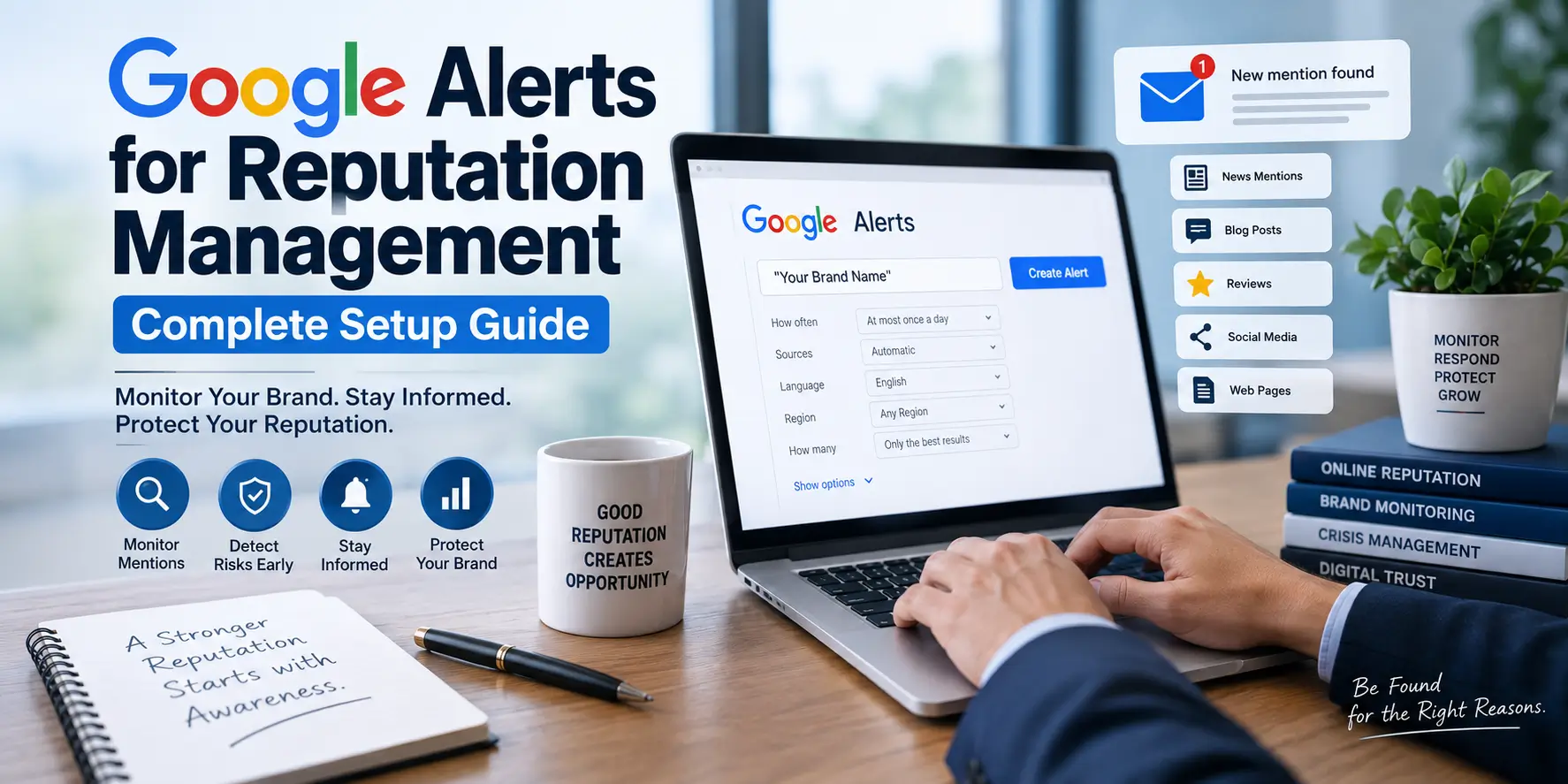
- If DIY: document every action, keep screenshots and dates, and set up Google Alerts and paid monitoring for the name.
- If hiring: get a written discovery and a one-page strategy before signing a longer contract.
- Always include an exit plan in contracts describing how ongoing monitoring and credentials are handled.
- Good DIY candidates: data-broker opt-outs, updating your own profiles, regular legitimate review responses.
- Hire an agency when: the problem affects licensure, has legal exposure, includes widespread third-party content, or you need rapid multi-channel coordination.
- If you hire, insist on a short discovery phase and a clear scope before committing to a long retainer.
When reviews escalate into a crisis
Review attacks can threaten revenue and licensing. If you’re publicly responding to reviews, follow best practices for tone and accuracy. If the situation escalates beyond your capacity, consider professional intervention that includes review-response workflows, platform escalation, and local PR. For guidance on review crises, see this piece on review-driven incidents: When Google Reviews Become a Brand’s Biggest Crisis.
How to vet a reputation vendor: due diligence checklist
Vetting reduces risk. The right vendor will explain trade-offs, document processes, and coordinate with legal counsel when necessary. Use the checklist below in your vendor interviews.
Don’t let marketing replace written deliverables — require a scope, reporting schedule, and clear escalation path for legal issues.
- Request an NDA before sharing sensitive information.
- Ask vendors to explain the exact platform processes they will use (e.g., DMCA, privacy claims, publisher outreach, SEO tactics).
- Compare three written proposals on scope, pricing, reporting, and termination terms.
- Ask for a scoped plan tailored to your specific URLs and platforms.
- Get references for similar industries or issue types and ask how the vendor handled refusals.
- Confirm what’s handled in-house vs subcontracted, and how they protect client data.
Takedown (Removal) vs Search-Result Suppression
Key differences to help you decide which approach to prioritize.
| Removal (Takedown) | Suppression (SEO / PR) |
|---|---|
| Goal | Goal |
| Eliminate the content from the host | Push the content lower in search results |
| Often requires publisher cooperation or legal claim | Requires creating higher-authority alternative content |
| Best for privacy violations, copyrighted content, impersonation | Best for truthful but harmful articles or public records |
| Outcome depends on publisher/platform decision | Outcome depends on SEO effort, content quality, and competition |
| May be faster if publisher complies | Usually takes longer and requires maintenance |
| Can be cost-effective for single items | Better for ongoing visibility control |
Hypothetical scenario: a surgeon and a viral article
Situation: A local news blog publishes a critical article about a surgeon that contains a mix of factual reporting and contested assertions. The article ranks on page one for the surgeon’s name alongside a professional profile and patient reviews. The surgeon is concerned about referrals and state board attention.
Planned approach (hypothetical): The vendor conducts a discovery phase, documents the URLs and screenshots, and evaluates whether any content meets platform removal policies (privacy violations, doxxing, inaccuracies that can be corrected). They also recommend parallel strategies — publisher outreach for correction, legal review for possible defamation claims, and an SEO suppression campaign to create positive or neutral authoritative pages.
- Document everything with timestamps and source links.
- Try publisher correction requests before legal escalation; document replies.
- Launch a prioritized SEO content build (3–7 properties you control) to compete with the article.
- Maintain monitoring and be prepared to pivot if the publisher removes or updates the article.
- Step 1: Discovery — capture screenshots, note dates, and list affected platforms.
- Step 2: Platform and publisher outreach — request corrections where factual errors exist; file platform reports if policy violations apply.
- Step 3: Legal coordination — counsel reviews whether a legal notice is warranted and feasible.
- Step 4: SEO suppression — build and optimize content (site pages, professional profiles, press statements) targeting relevant queries.
- Step 5: Monitoring — set alerts and weekly reporting to measure visibility shifts.
Common mistakes organizations make when switching vendors
Changing vendors or trying to fix reputation problems without a plan can waste time and money. Below are mistakes to avoid and the real consequences.
1) Chasing guaranteed removals
Mistake: Hiring a vendor because they promise immediate or guaranteed removal. Reality: platform and publisher decisions are out of any vendor’s direct control.
Consequence: You may pay upfront and get little besides vague status updates. Choose a vendor that explains likely paths and documents attempts instead of promising outcomes.
2) Ignoring the legal dimension
Mistake: Treating a potentially defamatory or privacy‑violating post as only an SEO problem.
Consequence: You lose leverage. Some content requires legal notices or counsel involvement; a vendor that coordinates with an attorney when appropriate provides stronger options.
3) Over-reliance on fake or deceptive tactics
Mistake: Using fake reviews, bogus takedown claims, or deceptive SEO to bury content.
Consequence: These tactics can violate platform policies, expose you to penalties, and damage trust. Use legitimate, documented methods.
4) Hiring solely on price
Mistake: Choosing the lowest-cost vendor without checking experience or references.
Consequence: Inexperienced vendors can cause delays, improper filings, or insufficient reporting. Compare three proposals and require a discovery phase.
5) Publicly arguing with reviewers or publishers
Mistake: Responding emotionally to negative reviews or articles in public comments.
Consequence: Escalation often amplifies the problem. Use calm, factual responses and reserve complex disputes for private outreach or counsel.
Best practices for replacing or suppressing damaging content
These practices help you achieve durable improvements without overreaching promises or risky tactics.
1) Start with a documented discovery and triage
Gather URLs, screenshots, dates, and the impact (licensure risk, lost clients, revenue). Prioritize items that are actionable (policy violations, personal data exposure) over things that are merely embarrassing.
A short written triage reduces wasted effort and makes vendor comparisons meaningful.
2) Use layered tactics — legal, technical, and reputational
Combine publisher outreach, platform reporting, SEO suppression, and PR. For example, request corrections where factual errors exist while building authoritative content to suppress the item in search results.
Coordinate with legal counsel when allegations and public records intersect with defamation or privacy claims.
3) Keep communications factual and non‑retaliatory
When responding to reviews or public posts, be professional, correct facts, and offer to take offline where appropriate. Emotional or punitive responses can fuel additional coverage.
Document all outreach and retain copies of correspondence.
4) Measure outcomes and set realistic KPIs
Ask for metrics tied to visibility and engagement (search-rank positions for key URLs, impressions on replacement content, review sentiment), and expect variability because algorithms and competitors change.
Use monitoring tools and weekly or monthly reports to track progress and adjust tactics.
5) Budget for maintenance
Suppression is not always permanent. Schedule ongoing monitoring and occasional refreshes of owned content to maintain visibility advantages.
Include an exit/continuation plan with any vendor contract so you know how monitoring and credentials will be handled if you change providers.
Expert Tips
- Document everything at the first sign of a reputational event — screenshots, timestamps, and URLs are your primary evidence.
- Prioritize control of high-authority profiles you already own (LinkedIn, company site, state licensure pages).
- Ask potential vendors how they would handle a platform refusal; their escalation path reveals their practical experience.
- For sensitive matters, coordinate platform options with legal counsel before filing formal requests.
- Consider a short discovery engagement to compare vendors on apples-to-apples scope rather than committing to a long retainer immediately.
- Use monitoring alerts (Google Alerts, Mention, or a paid monitoring tool) to detect secondary spread quickly.
- When publishing corrective content, use structured data and clear author attribution to improve credibility.
- Do not attempt or approve fake reviews or deceptive takedown claims — they carry reputational and platform risks.
Conclusion
If NetReputation doesn’t look like the right match for your problem, there are well‑established alternatives — some focused on privacy opt‑outs, some on SEO suppression, and others on crisis coordination that blends legal, technical and PR work. The right choice depends on the precise nature of the content, the platforms involved, and the stakes for your business or licensure.
Evaluate vendors by scope and documented experience, insist on a discovery phase, and prepare for layered work: platform reporting and publisher outreach where appropriate, plus suppression and PR when removal isn’t feasible. That realistic, evidence-based approach preserves options and reduces the risk of wasted spend.
Why Businesses Choose Your Reputation Agency
Managing your reputation takes more than monitoring reviews or publishing the occasional blog post. It takes a strategy built around your situation, your industry, and what is actually showing up in search.
Your Reputation Agency works with businesses, executives, healthcare professionals, attorneys and growing brands. Our services include:
- Remove defamatory content and false posts (news, blogs, listings)
- Remove or challenge negative reviews (Google, Yelp, TripAdvisor, industry sites)
- Mugshot and arrest record removal
- Remove videos, images, and other multimedia that damage reputation
- Remove personal data from people‑search and data‑broker sites (opt‑outs)
- Search result suppression (SEO to bury negative links)
- Social media takedowns and impersonation removal
- Rapid online crisis management and incident response
- Ongoing monitoring and alerting of reputation signals
- Coordination with legal counsel and use of legal tactics when required
Frequently Asked Questions
1. Is NetReputation a good company?
NetReputation is one of several private reputation-management firms. Whether a company is “good” depends on how well its services match your specific problem, the vendor’s platform experience, and clear documentation of its processes. Ask vendors for case types, references, and a written scope before deciding.
2. What is the best online reputation management company?
There isn’t a single ‘best’ company for every need. The best choice depends on the issue: privacy opt-outs, review management, SEO suppression, or crisis PR. Match vendor specialty to your problem and evaluate on documented experience, legal coordination, and reporting transparency.
3. Who owns NetReputation?
NetReputation is privately held. For precise ownership or corporate-structure inquiries, consult state business filings or the company’s website. Ownership may matter for procurement and continuity, but the vendor’s team and documented processes usually matter more operationally.
4. How much does NetReputation cost?
Costs vary widely by scope. Typical market ranges: one-off opt-outs of data brokers can be a few hundred to a few thousand dollars; targeted suppression or removal projects often fall in the low‑thousands to tens of thousands; ongoing retainers for enterprise-level ORM are higher. Get a scoped quote to compare accurately and see this pricing overview for additional context: How Much Should You Pay To Fix A Doctor’s Online Reputation.
5. What do I do if the publisher refuses to remove content?
When removal isn’t available, pursue correction requests, legal review for potential claims, and suppression through SEO and PR. Build authoritative content you control and monitor the search results. Suppression is often a practical response when removal is unavailable.
6. Can I handle this myself or should I hire an agency?
You can handle straightforward tasks (opt-outs, updating your profiles, responding to reviews) yourself. Hire an agency when the issue threatens licensure, revenue materially, involves widespread third‑party content, or needs legal coordination and rapid multi-channel response.
7. How do I verify a vendor’s claims?
Request a short discovery phase, ask for anonymized examples of similar work, check independent reviews and references, and insist on a written scope and reporting cadence. Be wary of vendors who promise guarantees, immediate removals, or special platform access.
8. What are common tactics used when removal is impossible?
Common tactics include search-result suppression via optimized content, publishing factual corrections or statements, targeted PR to change the narrative, and ongoing monitoring. These are legitimate, documented strategies that rely on creating and promoting higher-authority content.
9. How long will it take to see results?
Timing depends on platform responsiveness, the strength of the negative item, SEO competition, and whether legal steps are needed. Some changes may appear within weeks, others take months. A vendor should provide an estimated timeline only after a discovery assessment and should not promise fixed deadlines.
This content provides general information and does not constitute legal advice. The available options and likely outcomes depend on the facts, evidence, platform policies, applicable law, jurisdiction, and public-interest considerations.
Past examples do not guarantee future results. Removal, correction, deindexing, and search-position changes depend on third parties and circumstances outside Your Reputation Agency’s control.