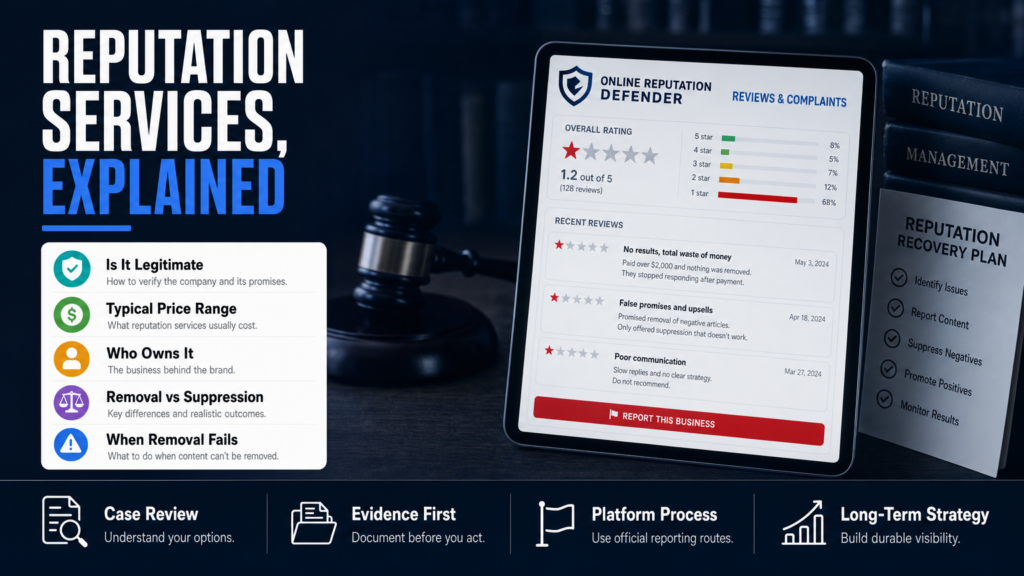
You found negative coverage — a blog post, a bad review, or a Reddit thread — and you searched for ‘Online reputation defender reviews complaints’ to see whether a commercial service can fix this. That exact query is what this article answers: legitimacy, price signals, ownership, and realistic next steps.
This guide is for busy professionals and small businesses who need concrete, vendor‑level answers and an action plan they can start today. We assess ReputationDefender specifically, compare alternatives, and explain what you can reasonably expect from removal, takedown requests, and SEO suppression.
We’ll be direct about limits: removal depends on platform rules, the publisher, and applicable law. Where removal isn’t available, we cover mitigation and search‑engine suppression tactics that are commonly used.
Table of Contents
- Is ReputationDefender Legitimate?
- How Much Does ReputationDefender Cost Per Month?
- Who Owns ReputationDefender?
- What Are Some Good Alternatives to ReputationDefender?
- Removal vs Suppression: Which Do You Need?
- What To Do When Removal Is Not Available
- How to Evaluate an Online Reputation Company Before You Hire
- Rapid Response Checklist for Viral Complaints
- Removal vs Suppression — Quick Comparison
- Hypothetical: A Doctor, A Negative Article, and a Recovery Plan
- Common Mistakes Professionals Make When Hiring a Reputation Service
- Best Practices When Responding to Reviews and Complaints
- Expert Tips
- Conclusion
- Why Businesses Choose Your Reputation Agency
- Frequently Asked Questions
Is ReputationDefender Legitimate?
Short answer: yes — ReputationDefender has operated for many years as a commercial reputation‑management brand that sells removal, suppression, and monitoring services to individuals and businesses. That does not mean every review or complaint you read online is accurate, nor does it mean every claim is removable.
ReputationDefender is a for‑profit business that offers paid services. We evaluate whether the content may qualify for removal or review using platform rules, publisher relationships, and legal options when appropriate.
Legitimacy here means a track record of delivering services, not a guarantee of outcomes. Platform decisions and legal rulings remain under the control of platforms, publishers, and courts, not vendors.
- Assess what the content is (review, news, forum post, mugshot, people‑search listing).
- Document dates, URLs, screenshots, and any identifying errors.
- Request a preliminary evaluation from a provider that explains possible routes (platform takedown, legal, or suppression).
- Operates commercially — sells plans and services to clients
- Uses platform reporting, opt‑outs, SEO, and legal coordination
- Does not control platform decisions or court outcomes
How to verify a vendor’s legitimacy quickly
Look for clear pricing or pricing ranges, a written scope of services, and whether the vendor explains what they cannot do.
Check for recent, verifiable press coverage and independent complaint listings (BBB, consumer forums, Reddit). Search for the vendor name plus ‘complaints’ or ‘reviews.’
Ask for a written intake checklist and a sample service agreement before paying. A legitimate firm will describe options and risks without promising a specific outcome.
- Request sample work scopes
- Search complaints and independent reviews
- Confirm whether they coordinate with lawyers when needed
How Much Does ReputationDefender Cost Per Month?
There is no single monthly price that fits every client. Prices vary by service type (data‑broker opt‑outs versus full search‑engine suppression), case complexity, and whether legal intervention is needed.
Publicly available packages from reputation vendors across the industry commonly range from lower‑tier monitoring plans (usually under a few hundred dollars per month) to proactive suppression and takedown programs that can run several hundred to several thousand dollars per month for enterprise or high‑priority cases.
Any provider who quotes a single flat monthly fee without assessing the content, publisher, and desired outcomes is underestimating the work involved.
- Start with a free or low-cost intake assessment to scope the problem.
- Request a written proposal that lists deliverables, estimated timeline ranges, and reporting cadence.
- Compare proposals side-by-side for services included (SEO, legal coordination, PR, monitoring).
- Monitoring-only plans: often under $200/month
- Takedown + suppression for an individual: typically $200–$1,000+/month depending on scope
- High-priority, legal-coordinated campaigns: can be $1,000+/month and above
Cost traps to watch for
Automatic recurring billing for services you don’t understand is a common complaint. Make sure the contract spells out what happens if the content is removed or the project scope changes.
Some vendors charge extra for rapid response or taking legal steps; ask where legal fees are billed and whether they coordinate with your counsel.
- Undefined monthly retainer without deliverables
- Hidden fees for legal work or court filings
- No exit or refund policy for unmet expectations
Who Owns ReputationDefender?
Corporate ownership can change over time. ReputationDefender is a long‑standing brand in the reputation space and has been associated with larger reputation and tech firms. For current ownership, confirm the information on the company’s official About page or recent corporate filings.
Whether a brand is owned by a private equity group, a public company, or an independent operator matters for procurement and service levels but does not change the fundamental constraints imposed by platforms and the law.
- Check the vendor’s About page and press releases for acquisition announcements.
- Search business registries and recent news for changes in ownership.
- Ask the vendor in writing to confirm corporate ownership and billing entity before contracting.
- Ownership may affect pricing, enterprise support, and service bundles
- Always verify current ownership via the company’s public statements or filings
- Ask your vendor to disclose whether they are a reseller, franchise, or company subsidiary
Why ownership matters to you
If a brand is part of a larger company, they may have different escalation paths for enterprise incidents. For high‑risk professionals, knowing whether a vendor has in‑house legal and PR resources or relies on external partners is useful.
- Escalation procedures
- Access to in-house vs external legal/PR
- Contract and billing stability
What Are Some Good Alternatives to ReputationDefender?
Alternatives fall into three categories: similar full‑service vendors, niche specialists (mugshot removal, data‑broker opt‑outs, legal-only), and DIY tools. Good alternatives include companies that transparently explain removals vs suppression, provide documented processes, and coordinate with counsel when needed.
Examples of alternative approaches: working with a firm that focuses on legal takedowns and court filings, using a data‑broker removal service for opt‑outs, or hiring an SEO specialist for search result suppression.
Compare vendors by documented experience with the specific platforms involved in your case (Google, Facebook, Yelp, Reddit, news publishers).
- List which platforms host the damaging content.
- Match each platform to a vendor type (e.g., Reddit → moderation + PR; people‑search → opt‑out specialist).
- Request references or case outlines specific to similar platform work.
- Full-service vendors: monitoring, takedowns, SEO, PR
- Niche vendors: data‑broker opt‑outs, mugshot specialists, review disputers
- In-house counsel + SEO firm: legal plus organic suppression
Alternatives worth evaluating now
NetReputation, DeleteMe/Abine for data‑broker opt‑outs, specialized mugshot removal firms, and boutique SEO firms are standard alternatives. Each has a different cost profile and scope.
For review disputes, consider services that specialize in consumer review platforms or consult your industry association first — see our analysis in When Google Reviews Become a Brand’s Biggest Crisis.
- Compare scope, not just price
- Confirm vendor experience with the exact platform(s)
- Ask how they handle reps and refunds
Removal vs Suppression: Which Do You Need?
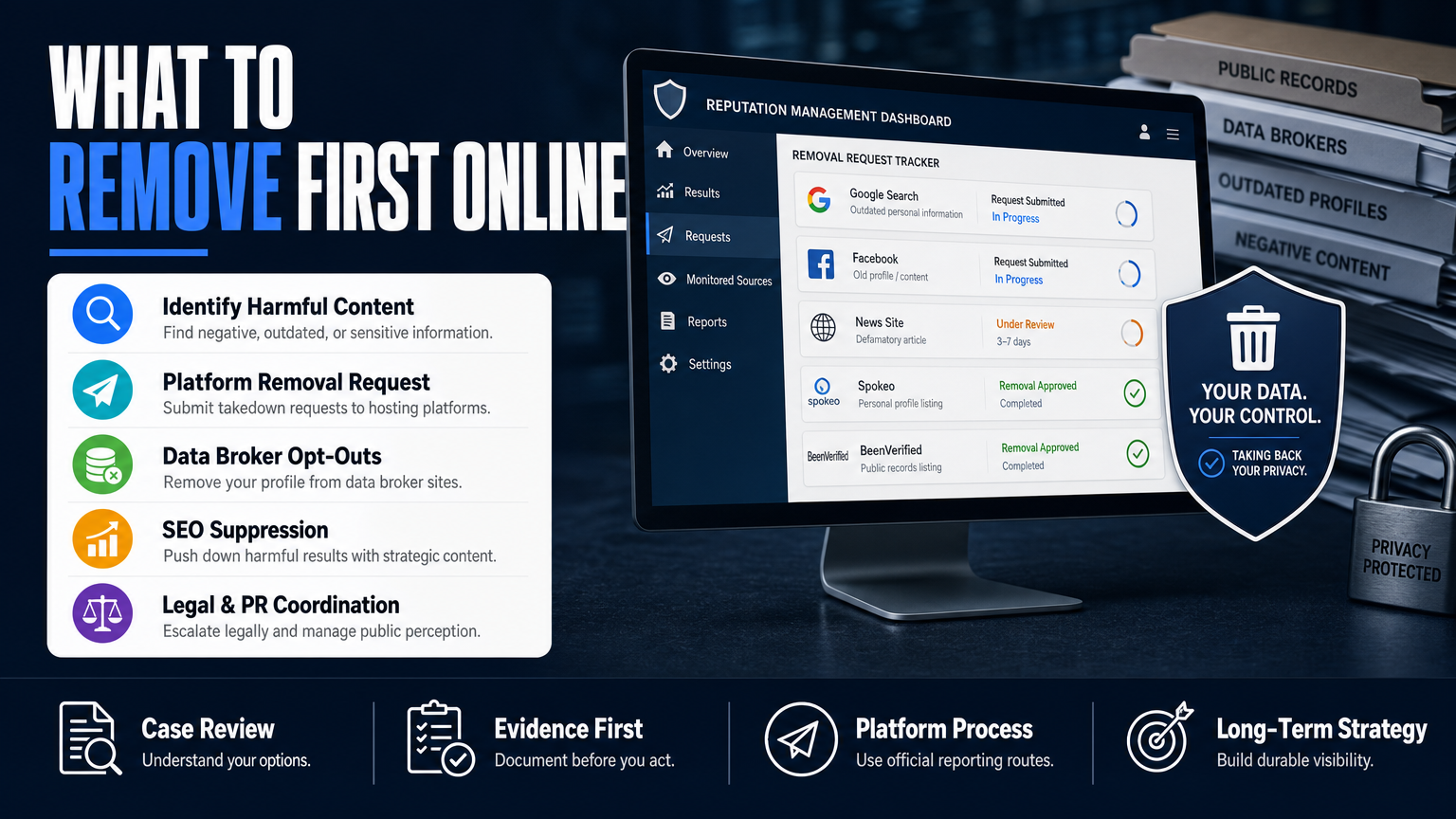
Removal means convincing a platform or publisher to take content down (or persuading a publisher directly). Suppression means using SEO and new content to push negative links lower in search results.
We pursue the legal, technical, platform‑based, and reputational options available. Which path to prioritize depends on the content type, publisher willingness, and whether the content violates platform policy or the law.
- Classify the content: defamatory, false factual claim, opinion, public record, personal data, impersonation, or review.
- If the content may violate platform policy, file a formal report per that platform’s process.
- If removal is unlikely (true, public record, or protected opinion), plan a suppression strategy with credible countercontent.
- Removal: platform policies, legal claims, publisher cooperation
- Suppression: content production, authority building, targeted SEO
- Both are often used together for the best outcome
Quick decision checklist
If it’s an opinion or truthful reporting, removal is unlikely; use suppression and correction instead. If it’s a privacy violation or clearly false, pursue platform reporting and legal review.
When you face review‑based damage, see our section linked analysis of review crises and the approaches that work best.
- Opinion = suppression/correction
- False factual claim = platform + legal review
- Privacy violation = platform reporting + policy escalation
What To Do When Removal Is Not Available
Removal is not always possible. In those cases, immediate mitigation and a long‑term visibility strategy are the practical options. We develop SEO reputation strategies intended to improve the visibility of relevant and credible information.
Mitigation reduces the practical harm by changing what people see when they search for you or your business; it does not erase the record.
- Map the first two pages of search results for your name/brand.
- Prioritize five to seven high‑authority properties you can control (LinkedIn, company page, press release, legal statement, industry directories).
- Execute a content and link plan to grow those pages’ authority and relevance.
- Create authoritative profiles (LinkedIn, professional bios, popular industry sites)
- Publish factual, timely content that addresses the issue transparently if appropriate
- Use targeted SEO to rank positive pages for your name or branded queries
When to use PR and legal coordination together
If the issue is factual and damaging to licensure, hiring, or revenue, combine a factual public statement with legal coordination. We coordinate with qualified legal professionals when a matter requires legal analysis.
- Short corrective press release for factual corrections
- Legal review before any admissions or disclosures
- Ongoing monitoring to measure effect
How to Evaluate an Online Reputation Company Before You Hire
You want a written scope, transparent pricing ranges, a stated process for escalation, and an explanation of when they will recommend legal counsel. Ask for these in the proposal — a vendor that avoids these questions should raise a red flag.
Also verify they will use the official reporting and review processes made available by platforms, and that they describe risks and platform constraints clearly.
- Request a sample statement of work and intake form.
- Ask how they handle legal referrals and whether legal fees are included or separate.
- Get a proposed timeline range, not a promise, and written progress reporting cadence.
- Ask for documented deliverables and KPIs
- Request references for similar cases and platforms
- Confirm billing entity and contract termination terms
Red flags in proposals
Promises of guaranteed removal or permanent suppression, requests for deceptive credentials, and no clear refund or exit policy are common red flags.
- Guaranteed removal/suppression language
- Unexplained recurring fees
- No written scope or exit terms
Rapid Response Checklist for Viral Complaints
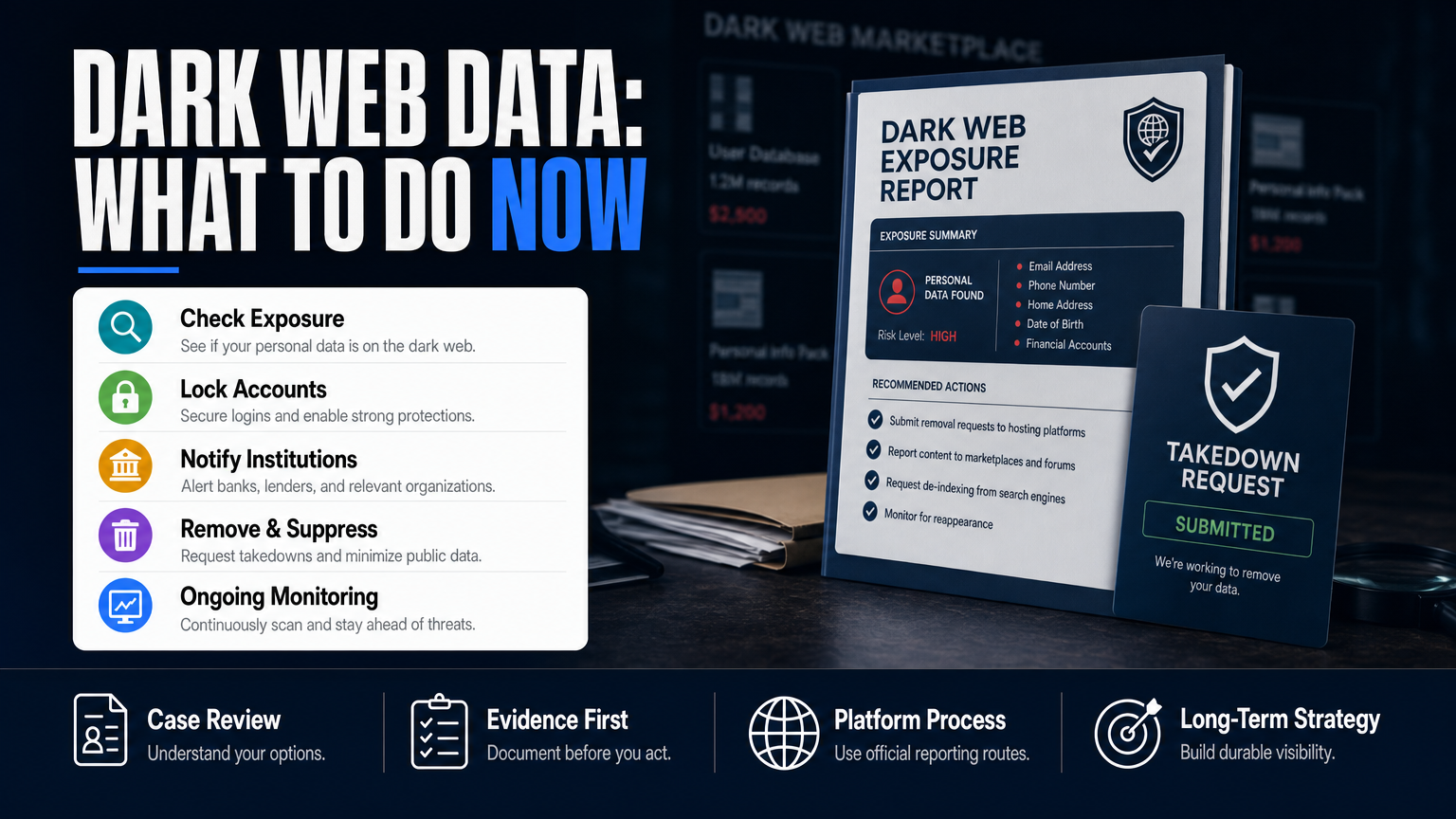
If you wake up to a viral complaint, acting quickly and deliberately matters. Immediate steps protect evidence and prepare you for platform reporting or PR.
These are triage actions you can take in the first 24–72 hours.
- 1) Document: Save timestamps, URLs, and screenshots; use an evidence log.
- 2) Contain: Lock down affected accounts and patch any security issues to prevent doxxing.
- 3) Notify: If the content threatens licensure, employee safety, or revenue, notify counsel and consider a coordinated legal/PR response.
- 4) Report: File platform reports where policy violations apply (harassment, impersonation, privacy).
- 5) Plan: Ask your reputation provider for a short written action plan and estimated timeline ranges.
- Capture screenshots and archive URLs
- Disable comments or public replies where appropriate
- Contact the publisher/moderator with a factual correction request
Where to report platform violations
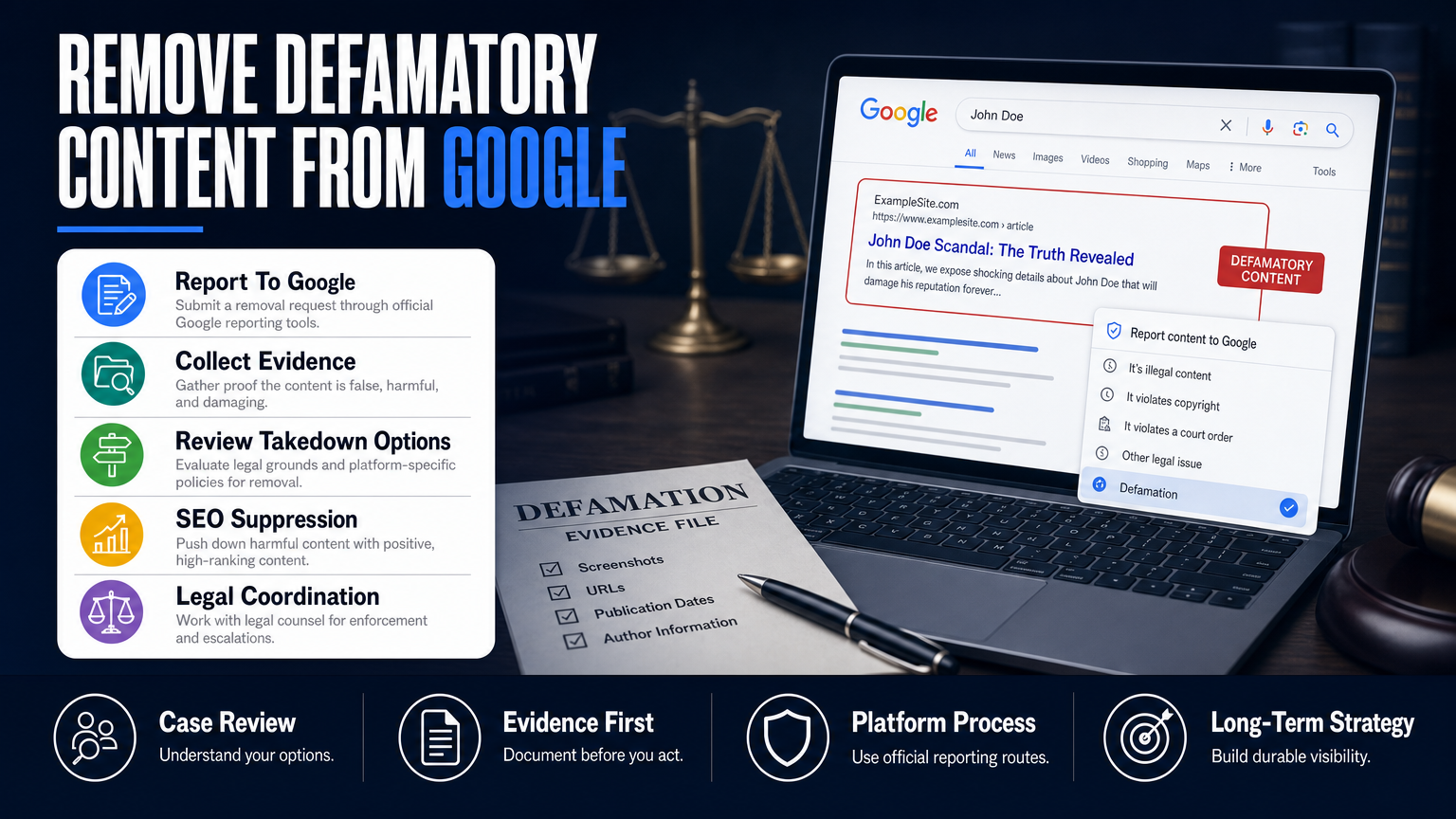
Each platform has a different report process (Google for search results and reviews, Facebook/Instagram for harassment and impersonation, Reddit moderators for subreddit removals). Know the right path for each platform and escalate with documented evidence.
- Google: policy report and ‘legal removal’ forms for certain content
- Yelp/TripAdvisor: business dispute processes for reviews
- Reddit: moderator reports and site abuse forms
Removal vs Suppression — Quick Comparison
When to pick each approach and what to expect.
| Removal | Suppression |
|---|---|
| Goal is to take content offline | Goal is to push content lower in search |
| Requires platform or publisher action or legal remedy | Requires publishing and SEO work you control |
| Faster if publisher cooperates, uncertain if not | Slower; visibility improves over weeks–months |
| Best for policy violations or privacy breaches | Best when content is lawful but damaging |
| Outcome controlled by third parties | Outcome controlled largely by your content and links |
Hypothetical: A Doctor, A Negative Article, and a Recovery Plan
Scenario: A physician finds a local blog article alleging malpractice details that the physician disputes. The article is indexed on page one for the physician’s name and is being shared on social media. Removal is uncertain because the publisher claims it reported public record.
This is a hypothetical example, not a real client engagement, intended to show a typical end‑to‑end approach a reputation firm might take.
- 1) Intake (Day 0‑2): Client provides URLs, screenshots, and a statement outlining factual inaccuracies. Counsel is notified to evaluate potential legal claims.
- 2) Publisher Outreach (Day 3‑14): The firm sends a fact‑check and correction request to the publisher with supporting evidence and a proposed correction.
- 3) Platform Reporting (Day 3‑14): If policy applies (privacy, doxxing), file platform reports. Track reference numbers and responses.
- 4) SEO Suppression (Week 1 onward): Build authoritative pages—professional bio, clinic page, press release, and guest articles—optimized for the physician’s name.
- 5) Monitoring & Adjustment (Month 1–6): Monitor search rankings and social shares. If the publisher refuses correction and the claim is demonstrably false, counsel evaluates legal referral. If removal is impossible, continue suppression and prepare a public statement as advised by counsel and PR.
- Initial triage: document, archive, and flag immediate harms to licensing boards
- Evaluation: classify content (allegation vs fact), identify publisher, and check platform policy
- Plan: pursue publisher correction request, explore privacy/legal options, and build suppression assets
Common Mistakes Professionals Make When Hiring a Reputation Service
Hiring the wrong vendor or expecting guarantees are the two most common errors. Here are other mistakes that cost time and money.
Mistake 1: Believing Any Negative Post Is Removable
Explanation: Truthful reporting, opinions, and many public records are not removable solely because they are negative. Removal depends on publisher policy, platform terms, and law.
- Don’t assume removal because something is embarrassing
- Ask for a clear legal rationale before pursuing takedown
Mistake 2: Accepting Vague Pricing and No Scope
Explanation: If a vendor cannot describe the steps they will take or what success looks like, you risk ongoing billing without results.
- Insist on a written statement of work
- Define reporting intervals and deliverables
Mistake 3: Not Preserving Evidence Early
Explanation: Screenshots, archived pages, and saved URLs are essential for platform reports and legal analysis. Waiting can lose critical evidence.
- Archive pages with timestamps
- Keep a clear evidence log
Mistake 4: Using Retaliatory or Deceptive Tactics
Explanation: Posting fake positive reviews or requesting removals via false claims can backfire and violate platform policies. Use legitimate, documented methods.
- Never use fake accounts or false claims
- Follow platform rules and legal guidance
Mistake 5: Ignoring Long‑Term Visibility Work
Explanation: Even if a takedown occurs, the record or copies can resurface. A long‑term SEO plan is often required to maintain a professional presence.
- Combine takedown efforts with sustained content
- Monitor search results regularly
Best Practices When Responding to Reviews and Complaints
These are durable, practical steps for professionals who need to protect licensure, hiring prospects, and client trust.
Practice 1: Triage Immediately, Then Slow Down
Act quickly to preserve evidence and secure accounts, but avoid impulsive public reactions. Rapid, emotional posts often amplify damage.
- Capture evidence in the first 24 hours
- Draft public responses with counsel for sensitive cases
Practice 2: Use Platform Reporting Correctly
File reports with the exact policy section you believe the content violates. Generic abuse reports get slower responses.
- Cite the platform policy in your report
- Follow up with documented evidence
Practice 3: Build Authority Pages You Control
Create and optimize profiles and content on high‑authority sites that rank for your name and brand. This is the backbone of suppression strategies.
- LinkedIn and professional directories
- Press releases on recognized distribution channels
- Well‑optimized clinic or company pages
Practice 4: Coordinate PR, Legal, and SEO
For high‑stakes incidents, coordinate public statements with legal counsel and an SEO plan. This prevents conflicting messages and legal exposure.
- Legal reviews before any public admission
- PR language aligned with SEO keywords
Practice 5: Monitor Continuously
Set alerts and weekly monitoring to catch reshares, copy posts, or new reviews quickly so you can react before a narrative hardens.
- Automated alerts for key terms
- Monthly reporting on visibility changes
Expert Tips
- If a review is false but not violative of policy, request a correction and then plan suppression rather than counting on removal.
- Archive harmful pages immediately using web.archive.org and save direct screenshots with timestamps.
- Get a written scope and monthly report schedule before signing a retainer.
- For review disputes, use the platform’s dispute form and keep all replies professional and factual.
- If your case could affect licensure or employment, notify counsel before making public statements.
- Track every URL and its search position; progress is measured by pages moved, not promises.
- Avoid public arguments with complainants; short, factual replies are safer than long rebuttals.
- When a vendor proposes legal action, ask them to outline costs and who holds fee risk.
Conclusion
Searching ‘Online reputation defender reviews complaints’ is the right first step. ReputationDefender and other vendors can be legitimate options — but the right path depends on the content, platform, and whether legal or PR steps are needed.
Make vendor selection a process: verify ownership and resources, demand a written scope, confirm pricing ranges, preserve evidence, and plan for both removal and suppression. If removal isn’t feasible, a thoughtful suppression and authority‑building program is the practical path to restoring a professional digital presence.
Why Businesses Choose Your Reputation Agency
Managing your reputation takes more than monitoring reviews or publishing the occasional blog post. It takes a strategy built around your situation, your industry, and what is actually showing up in search.
Your Reputation Agency works with businesses, executives, healthcare professionals, attorneys and growing brands. Our services include:
- Remove defamatory content and false posts (news, blogs, listings)
- Remove or challenge negative reviews (Google, Yelp, TripAdvisor, industry sites)
- Mugshot and arrest record removal
- Remove videos, images, and other multimedia that damage reputation
- Remove personal data from people‑search and data‑broker sites (opt‑outs)
- Search result suppression (SEO to bury negative links)
- Social media takedowns and impersonation removal
- Rapid online crisis management and incident response
- Ongoing monitoring and alerting of reputation signals
- Coordination with legal counsel and use of legal tactics when required
Frequently Asked Questions
1. Is Reputation Defender legitimate?
Yes — ReputationDefender is a long‑standing commercial brand offering reputation services. Legitimacy means they provide paid services and processes; it does not guarantee removal or any specific result.
2. How much does Reputation Defender cost per month?
Costs vary by service. Monitoring plans are often under a few hundred dollars per month; active takedown and suppression campaigns commonly range from several hundred to several thousand dollars per month depending on scope and whether legal work is needed.
3. Who owns Reputation Defender?
Corporate ownership can change over time. For current ownership, check the company’s official About page or recent corporate filings. Ownership affects procurement details but not platform or legal constraints.
4. What are some good alternatives to Reputation Defender?
Alternatives include other full‑service reputation firms, niche opt‑out services like data‑broker firms, specialized mugshot removal companies, and SEO specialists. Match the vendor to the platform and problem type.
5. Can a review be removed just because it’s negative?
No. Negative opinions are usually protected and are not removable simply because they are unfavorable. Removal depends on platform policy violations, demonstrable falsehoods, or legal claims.
6. What should I do first if a Reddit thread is damaging my practice?
Document the thread with screenshots and timestamps, identify the subreddit moderators and platform report paths, and consider a coordinated response with PR and legal counsel. For a deeper analysis of handling Reddit incidents, see When a Reddit Thread Becomes a Professional Crisis.
7. Does suppression work and how long does it take?
Suppression can work but timing varies. We develop SEO reputation strategies intended to improve the visibility of credible information; results depend on the authority of competing pages and typically take weeks to months.
8. Can an agency promise that the content will be removed?
No reputable agency should promise removal. We evaluate whether the content may qualify for removal or review and pursue legal, platform, and reputational options, but platform and legal outcomes remain outside the agency’s sole control.
9. Where can I learn more about handling negative Google reviews specifically?
Negative review crises require a distinct approach. For a focused discussion on review incidents and remediation approaches, see When Google Reviews Become a Brand’s Biggest Crisis.
This content provides general information and does not constitute legal advice. The available options and likely outcomes depend on the facts, evidence, platform policies, applicable law, jurisdiction, and public-interest considerations.
Past examples do not guarantee future results. Removal, correction, deindexing, and search-position changes depend on third parties and circumstances outside Your Reputation Agency’s control.