You just found a public search result or a Google-hosted page that accuses you of wrongdoing, repeats falsehoods, or links to an embarrassing post—and it’s showing on the first page for your name or business. Your immediate question is likely: How do I remove defamatory content from Google?
This article lays out exactly what you can and cannot expect when you ask Google to remove defamation, the evidence Google and publishers require, the paperwork and platform flows to follow, and realistic alternatives when direct removal is not available. We evaluate whether the content may qualify for removal or review and explain the follow-up paths: publisher takedowns, Google legal requests, and reputation suppression strategies.
You’ll get concrete checklists, sample steps to submit reports and legal notices, timelines with caveats, and clear next actions you can take alone or with a specialist. Where legal action may be relevant, we explain how we coordinate with counsel and why that matters for complex or high‑stakes cases.
Table of Contents
- How to Request Google to Remove Defamatory Content
- How to Report or Disable Inappropriate Content on Google
- How to Remove a Slanderous Google Review
- How to Remove Other Negative Information from Google Search Results
- What Evidence to Collect Before Filing Anything
- Legal Options and Coordination With Counsel
- When Removal Is Not Available: Mitigation and Recovery
- Monitoring, Timelines, and What to Expect
- Remove (Takedown) vs Suppress (SEO)
- Hypothetical example: A false blog post about a clinic
- Common Mistakes Professionals Make
- Best Practices For Handling Defamatory Content
- Expert Tips
- Conclusion
- Why Businesses Choose Your Reputation Agency
- Frequently Asked Questions
How to Request Google to Remove Defamatory Content
Google does not remove content simply because it is negative or inconvenient. You must show a policy violation (harassment, doxxing, intimate images), a legal basis (court order, defamation in limited circumstances), or that the content violates Google’s product policies. We pursue the legal, technical, platform-based, and reputational options available — removal depends on the content, publisher, platform policies, evidence, jurisdiction, and circumstances.
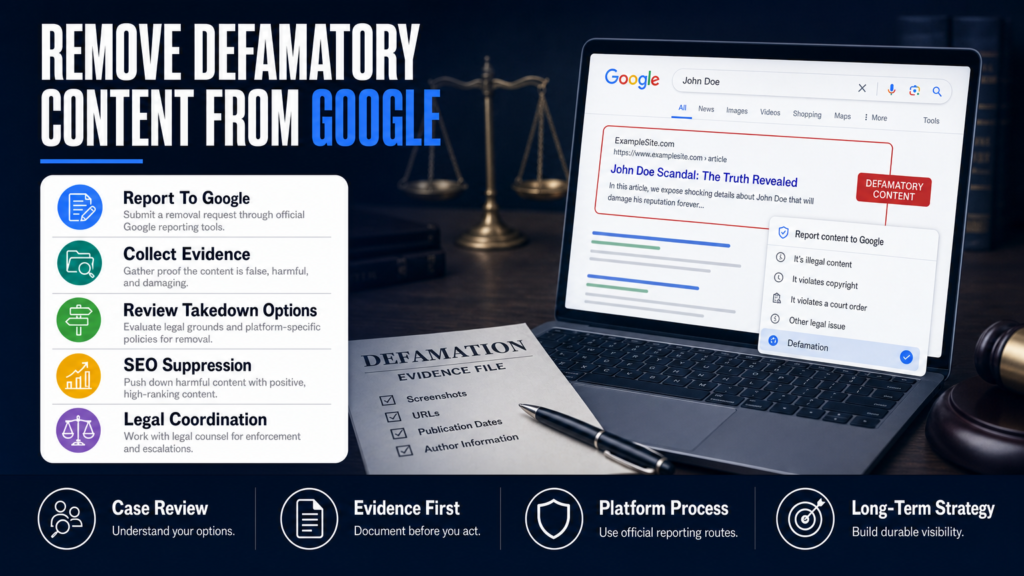
Start by documenting the exact URL(s), a timestamped screenshot, and the search query that surfaces the content. Google’s primary intake routes are: the product-specific report flows (e.g., Search results report, Google Maps, YouTube), and the Google Legal Removal Requests page.
- 1) Capture evidence: full-page screenshot, exact URL, search query, and the date/time.
- 2) Identify the platform owner (publisher, hosting provider, social platform) and use their takedown/report flow first.
- 3) File an appropriate Google product report (e.g., YouTube abuse report for video, Maps report for fake business listing) or a legal removal request at Google’s policies portal.
- 4) If the publisher ignores requests, escalate with a DMCA (for copyrighted material) or work with counsel to prepare a legal notice where defamation is clear and actionable.
- Use the Google Legal Help page to file requests for content that may be illegal or violates Google’s policies.
- For Search results that merely *link* to problematic content, you can request removal of the cached snippet or the result under certain privacy or copyright rules, but not for general defamation alone.
- We evaluate whether the content may qualify for removal or review before filing — unnecessary or weak requests waste time and can complicate later legal steps.
Where to submit a legal request to Google
Google’s official pages are the starting point: use the relevant product reporting flow (Maps, YouTube, Reviews) or the Google Legal Removal Request form when the content may be unlawful. Platform decisions remain under the platform’s control.
Read the forms carefully — Google asks for jurisdiction, links, and an explanation of why the content violates policy or law. If you suspect a public-record or newsworthy element, note that Google often defers to publishers unless a court order or clear legal basis exists.
- Search & Google index issues: use the Search removal forms found via Google Legal Help.
- YouTube videos: use the Copyright/Harassment/Defamation reporting flows inside YouTube Studio or the web forms.
- Maps and Google Business Profiles: use the ‘Suggest an edit’ or ‘Report a problem’ flows.
Tip on wording a legal request
Stick to verifiable facts: identify the false statement, why it is false, and provide supporting documents. Do not plead the case with emotion. We coordinate with legal counsel when a matter requires legal analysis.
- Do: cite the exact sentences and explain factual errors with evidence.
- Don’t: make broad claims like ‘this is defamatory’ without showing the false assertion and evidence.
How to Report or Disable Inappropriate Content on Google
If content violates Google’s product policies — revenge porn, doxxing, impersonation, hate speech, or other prohibited content — Google has product-specific options to request removal or to request de-indexing of those URLs. ‘How do I disable inappropriate content on Google?’ is often answered by using those flows.
Note that policy removals are different from defamation claims. Policy removals can be faster when the content clearly breaks Google’s rules; defamation is a legal question that may require a court order or publisher cooperation.
- 1) Identify the product (Search, Maps, YouTube, Images).
- 2) Use the product-specific ‘Report’ or ‘Legal’ form.
- 3) Provide supporting documentation per the form’s checklist.
- 4) Follow up if you receive an automatic denial — some cases may need escalation with counsel.
- Impersonation on Google Accounts or Business Profiles: report via account recovery and impersonation forms.
- Non-consensual intimate images: use Google’s dedicated removal request for sexual content.
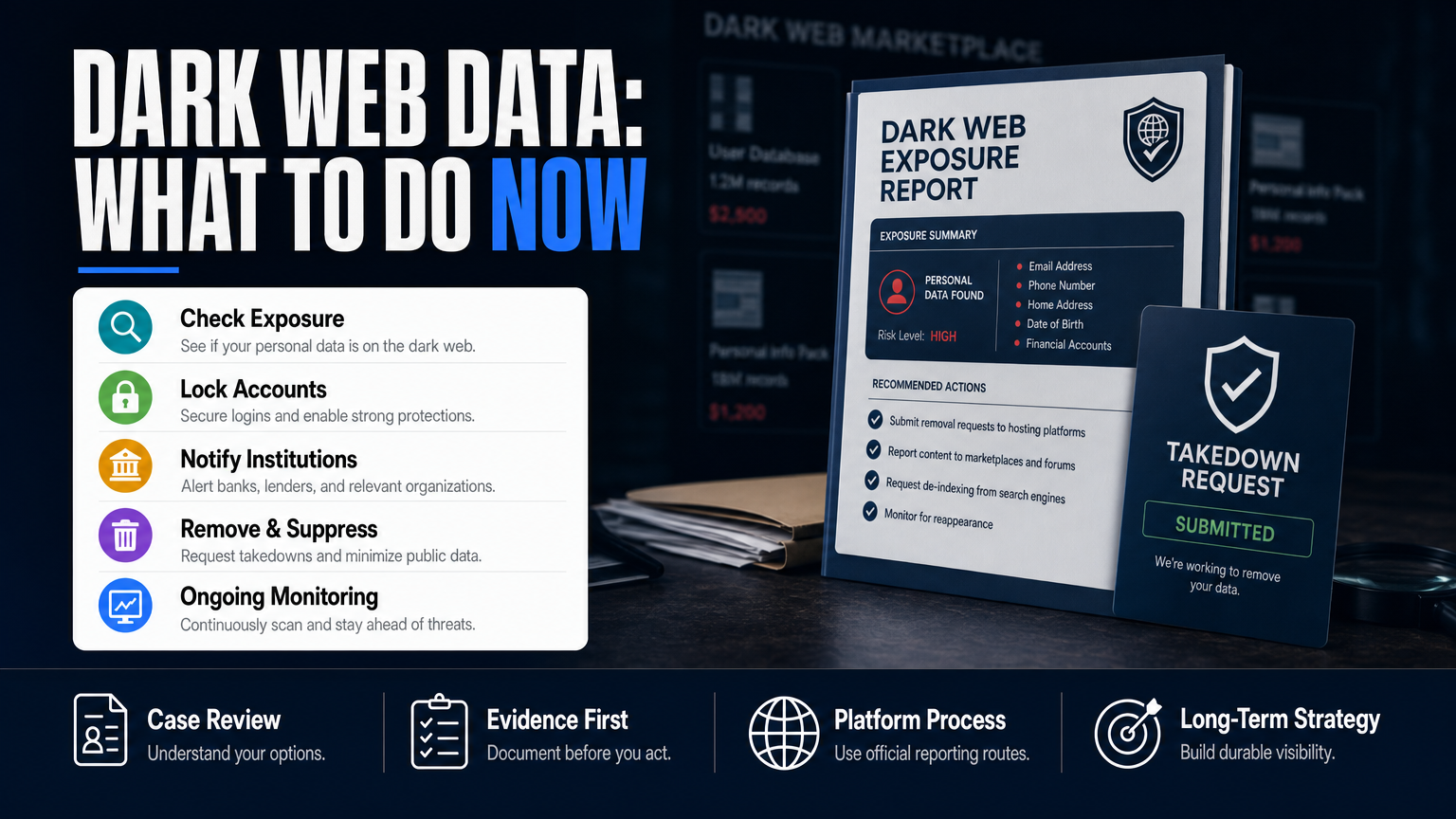
- Personal data exposure (SSN, bank account, full DOB): use the ‘remove personal info’ forms under Google Legal Help.
Personal data and people-search sites
For doxxing and exposed personal data, Google can remove search results that directly expose highly sensitive information. For broader removals from people-search or data-broker websites, you will usually opt out at the publisher level first and then request de-indexing.
See What Content Will Google Remove? A Complete Guide for a deeper breakdown of what Google will consider for removal.
- Collect the URL where the data appears and a screenshot.
- Use Google’s ‘remove personal info’ flow and the publisher’s opt-out procedures.
How to Remove a Slanderous Google Review
Slanderous or fake Google reviews are handled differently from web pages. Google has a reviews policy and a removal flow for reviews that violate content policies (harassment, conflict of interest, false claims). However, simply disagreeing with a negative review is not a basis for removal.
How to get a slanderous Google review removed depends on whether the review is false, a targeted smear, or a legitimate opinion. We evaluate whether the review may qualify for removal or review, and often pursue a mix of platform reporting and reputation management.
- 1) Flag the review in Google Business Profile and choose the policy reason.
- 2) If the review breaks policy, submit evidence in the business profile support chat or via the Google Business support form.
- 3) If Google declines, gather evidence and consider a legal demand to the reviewer (if identifiable) or a subpoena in coordination with counsel.
- 4) Use review response and reputation-building content to reduce the review’s impact while pursuing removal.
- If the review contains false factual claims (e.g., ‘I was charged $500 for a procedure that never occurred’), document receipts, dates, and witness statements.
- If the reviewer is a competitor or an impersonation, report it under Conflict of Interest or Impersonation policies.
- For mass fake reviews, collect patterns (IP addresses if possible, timing, identical text) and escalate to Google.
Sample response while pursuing removal
Respond publicly and professionally to every review. A measured response helps prospective clients and can reduce damage while you pursue removal.
Template: ‘We take this allegation seriously. We have no record matching your details. Please contact our office at [phone/email] so we can investigate.’ Keep the tone factual and avoid accusations.
- Do not threaten the reviewer publicly.
- Keep records of any direct communications with the reviewer as evidence.
How to Remove Other Negative Information from Google Search Results
Negative information covers a wide range: news articles, blog posts, forum comments, images, videos, and business listings. ‘How to get negative information removed from Google’ starts with assessing whether the content is unlawful, violates Google policy, or is simply negative but lawful. Removal is more likely when there is an applicable policy or a legal order.
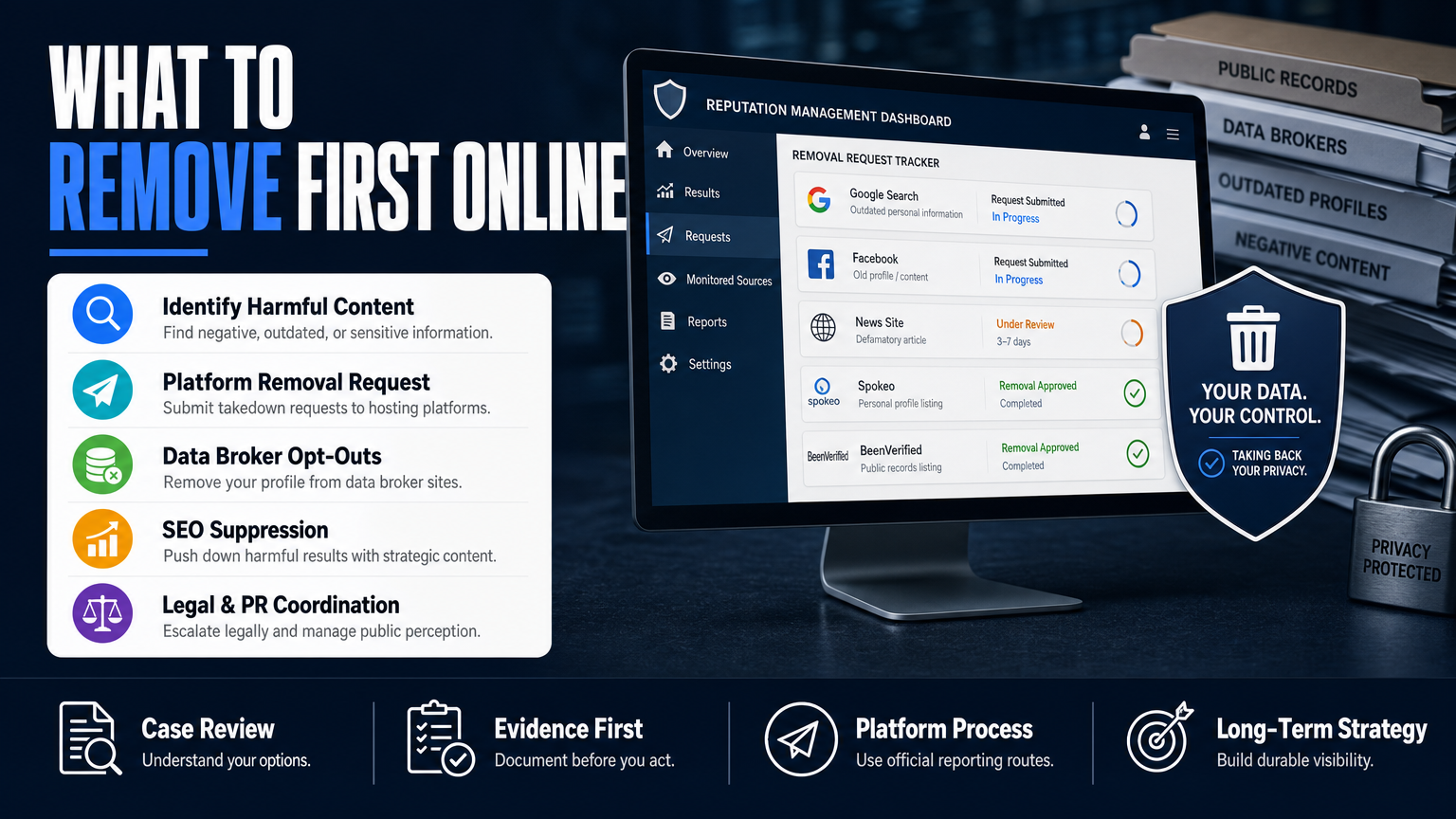
If removal is unavailable or unlikely, we develop SEO strategies to suppress the negative links with authoritative, factual content — we develop SEO reputation strategies intended to improve the visibility of relevant and credible information.
- 1) Catalog every negative URL, its publisher, and its position in organic search.
- 2) Send a publisher takedown or correction request with supporting evidence.
- 3) If the publisher refuses, consider escalation with counsel.
- 4) Simultaneously, publish and optimize new content to push negative items off the first page.
- Publisher takedowns: request corrections or removal from the hosting site. A publisher’s cooperation is the most direct route to removal.
- Legal demands and court orders: appropriate when content is false and harmful; a qualified attorney can determine whether a legal claim may be available.
- Search suppression (SEO): create and promote authoritative content that outranks the negative result.
DIY vs. professional suppression
If you choose the DIY route, focus on building content you control: a professional website, LinkedIn, press releases, and industry profiles. For high-stakes names or complex cases, an agency can accelerate authority-building and coordinate legal and PR actions.
If you want a detailed walkthrough of tactics and timelines for suppression, see Remove Negative Content from Google | Expert Guide.
- DIY: lower cost, slower, requires content and SEO skills.
- Agency: faster execution, coordinated legal/PR integration, but no guaranteed outcomes.
What Evidence to Collect Before Filing Anything
Strong evidence materially improves the chance of publisher cooperation and platform action. Before you submit reports to Google or start legal steps, assemble the documents that show falsity or illegality.
We evaluate whether the content may qualify for removal or review using these materials and coordinate with legal counsel when required.
- 1) Capture and store evidence in a secure folder (PDFs and high-resolution images).
- 2) Create a one-page timeline of events linking claims to dates and evidence.
- 3) Prepare a short, factual cover letter for platform forms or publisher requests.
- Full-page screenshots with URL, date/time, and the browser address bar visible.
- Search-engine snapshots showing the result tied to your name or business.
- Documents disproving inaccurate factual claims (invoices, contracts, medical records redacted appropriately).
- Logs of communications with the publisher, moderator, or reviewer.
- IP, account, or metadata if available and legally obtained through counsel or platform tools.
Privacy and security when handling evidence
Do not post private documents publicly. Use secure file-sharing (encrypted links) when sharing with counsel or an agency. Specific confidentiality obligations are defined in the service agreement.
- Avoid emailing sensitive documents without encryption.
- Limit access to case files to only those who need it.
Legal Options and Coordination With Counsel
Defamation is a legal claim that depends on jurisdiction, the plaintiff’s status (private person vs. public figure), and whether the statement is verifiable falsehood. The content may warrant legal review. A qualified attorney can determine whether a legal claim may be available.
We are an independent reputation-management company and coordinate with qualified legal professionals when a matter requires legal analysis. Only an attorney can file suit, seek a subpoena, or obtain a court order compelling a publisher or search engine to remove content in many cases.
- 1) Ask counsel to review your evidence and advise on the strength of a claim.
- 2) Consider non-litigation options first (publisher correction, retraction, negotiated settlement).
- 3) If litigation is pursued, coordinate PR to manage reputational fallout and maintain factual messaging.
- Common legal steps: cease-and-desist letters, takedown demands, subpoena for account records, or civil defamation suits.
- Courts may require proof of falsity and harm; public-figure plaintiffs face higher standards in many jurisdictions.
- Even with strong legal grounds, timing and outcomes depend on courts and publisher responses.
When subpoenas matter
If a publisher claims a reviewer is anonymous, a subpoena to the platform or hosting provider may be necessary to reveal the identity. Subpoenas should be handled by counsel — we coordinate with attorneys to obtain relevant account data when lawful and appropriate.
- Subpoenas can be time-consuming and costly.
- Some platforms push back or require foreign legal process depending on hosting jurisdiction.
When Removal Is Not Available: Mitigation and Recovery
Removal is not always possible: truthful negative reporting, opinion, public records, or stubborn publishers may refuse to take content down. When removal is not available, we may recommend mitigation, correction, or reduced visibility through SEO and PR.
If an old article threatens a professional’s licensing or patient trust, a combination of correction requests, authoritative content, and direct outreach often produces the best results. See the practical example in When an Old Article Threatens a Doctor’s Practice for a scenario-specific approach.
- 1) Map the first page for your name and prioritize which negative URLs to address by impact.
- 2) Publish or update authoritative pages that answer the searcher’s question and include your name.
- 3) Promote the new content via earned media, social channels, and link-building to shift rankings over time.
- Publish factual, authoritative content you control (firm site bios, professional profiles, primary sources) and optimize them for your name and key queries.
- Use targeted press releases, contributed articles, and interviews to generate new, positive links.
- Leverage Google’s structured data (schema) and claim your knowledge panel and Google Business Profile to surface accurate facts.
When to involve PR
If the content is viral or tied to a high-impact incident (investigations, allegations, litigation), coordinate PR with legal steps. Public messaging should be factual and aligned with counsel. We coordinate messaging to rebuild trust after events while pursuing technical and legal remediation.
- Prepare a short, consistent statement for media and clients.
- Prioritize transparency where appropriate; avoid over-sharing details that could complicate legal matters.
Monitoring, Timelines, and What to Expect
Timing depends on the platform, publisher, evidence, legal complexity, and search-engine behavior. An estimated timeline can be provided after an individual assessment. Some policy removals may be handled in days; publisher negotiations and legal actions often take weeks to months.
Monitor search results and content continuously. We handle ongoing monitoring and alerting of reputation signals so you catch reappearances or new negative items quickly.
- 1) Set up alerts (Google Alerts, third-party monitoring) for your name and variants.
- 2) Re-check targeted search queries weekly during active remediation.
- 3) Keep an evidence and communications log for any escalation with platforms or counsel.
- Quick wins: removals for clear policy violations (intimate images, explicit doxxing) — days to weeks.
- Publisher cooperation: weeks to months depending on publisher responsiveness.
- Legal proceedings: months to years depending on jurisdiction and court backlog.
- SEO suppression: measurable changes commonly begin within weeks but durable suppression can take 3–12 months.
What success looks like
Success may be full removal, partial de-indexing, corrected content, or effective suppression where damaging links no longer appear on the first page for important queries. Search results may change because algorithms, competitors, publishers, and user behavior are outside our control.
- Removal: content disappears from Google or the hosting site.
- Correction: publisher issues retraction or correction that materially reduces harm.
- Suppression: negative link drops to page two or lower for key queries.
Remove (Takedown) vs Suppress (SEO)
Choose the path that matches your case; each has trade-offs.
| Removal (Takedown) | Suppression (SEO) |
|---|---|
| Goal | Goal |
| Content disappears from the web or platform | Negative links remain but drop off page one |
| Best when content violates policy or is unlawful | Best when content is lawful or publisher refuses removal |
| Often requires publisher cooperation or court order | Requires content creation, promotion, and time |
| Can be fast for clear policy violations | Slower but scalable for multiple links |
| May not be possible for news or public records | Works even when removal isn’t legally available |
Hypothetical example: A false blog post about a clinic
Scenario: A regional blog publishes an article claiming a clinic performed negligent procedures on patients. The post is not supported by public records and contains demonstrably false statements tied to the clinic owner’s name. The article sits on page one for branded searches.
Process we would follow (hypothetical, anonymized):
- 1) If the publisher refuses to correct and the article causes license risks, consult an attorney about a demand letter or legal action.
- 2) Continue monitoring and refine SEO strategy to push the article down for branded searches.
- 3) If successful removal occurs, confirm deletion and request Google to remove cached copies and Search snippets.
- Step 1 — Evidence collection: capture screenshots, patient records redacted, scheduling logs showing no overlapping appointments, and a timeline linking the allegations to dates.
- Step 2 — Publisher request: send a concise correction/takedown request with evidence and a deadline for response.
- Step 3 — Platform escalation: if the blog is hosted on a platform with abuse policies, submit a policy takedown with the same evidence.
- Step 4 — Google legal request: if the publisher refuses and content is demonstrably false and harmful, file a Google Legal Removal Request describing the falsity and attaching evidence.
- Step 5 — Parallel strategy: publish authoritative content (press release, professional bios, third‑party articles) to build positive results and begin suppression.
Common Mistakes Professionals Make
Avoid these errors that slow remediation or worsen outcomes.
Mistake 1 — Acting emotionally and publicly
Posting angry replies, threats, or legal bluster on public threads often amplifies the content and creates new records. Keep public responses professional and factual; private follow-ups are more effective.
Mistake 2 — Skipping evidence collection
Filing reports without screenshots, timelines, or supporting documents reduces your chances with platforms and publishers. Document everything before you report.
Mistake 3 — Treating Google as the publisher
Google indexes and surfaces content but usually defers to the original publisher. Starting with Google instead of contacting the host or author first often slows the process.
Mistake 4 — Believing removal is always possible
Assuming that a negative but lawful article will be taken down leads to disappointment. Have a mitigation plan ready in case removal isn’t available.
Mistake 5 — Using deceptive or retaliatory tactics
Buying fake positive reviews or creating spammy pages to bury content can backfire and violate platform policies. Never recommend fake, deceptive, or retaliatory tactics.
Best Practices For Handling Defamatory Content
Follow these durable practices to maximize the chance of a good outcome while protecting yourself legally and reputationally.
Collect and preserve evidence first
Save screenshots, URLs, and any related communications before anything is removed or altered. This preserves proof for publishers, platforms, and counsel.
- Use a secure folder and export web pages to PDF with timestamps.
Use the publisher’s correction process
Request corrections directly from the author or host before escalating to Google or legal action. Publishers can often fix inaccuracies faster than platforms can act.
- Be factual, concise, and attach supporting documents.
File the correct Google product report
Choose the right Google form (Reviews, Maps, YouTube, Legal). Misfiled reports are delayed or rejected.
- Include clear evidence and reference relevant policy sections.
Coordinate legal and PR responses when needed
When allegations threaten licensure or significant business harm, coordinate legal review with public messaging. Message consistency is crucial during litigation or investigation.
- We coordinate with qualified legal professionals when a matter requires legal analysis.
Plan for mitigation if removal fails
Build authoritative content, claim profiles, and use search-optimization tactics to reduce the visibility of negative links.
- Prioritize the highest-impact search queries and pages.
Expert Tips
- Always take screenshots with the full URL and browser chrome visible — that matters to platforms and counsel.
- When contacting a publisher, lead with documentary proof, not emotion; a precise email often produces quicker corrections.
- For defamatory reviews, respond publicly, document everything, and escalate to Google Business Profile support if policy applies.
- If the content is on a small hosting site, a hosting-provider abuse report can sometimes get content removed faster than a legal route.
- Use schema and clear titles on your own pages to help Google understand authoritative sources about you.
- Keep a running incident log with dates of all submissions, support case numbers, and outcomes.
- Avoid paid or fake content to bury links — it risks platform penalties and legal exposure.
- Ask an attorney to draft any subpoena or legal demand; organizations often require counsel to act on legal process.
Conclusion
Removing defamatory content from Google is rarely a single step. It’s a process that combines evidence gathering, publisher outreach, platform reporting, possible legal action, and reputation mitigation. We evaluate whether the content may qualify for removal or review and pursue the mix of actions that best fits the facts and the stakes.
If removal is available, acting promptly and precisely increases your chances. If it is not, a deliberate suppression and messaging strategy can reduce harm and restore trust. If you’re time-sensitive or facing licensure, hiring experienced coordination between a reputation agency and counsel can accelerate results — while still being clear that platforms and courts control outcomes.
Why Businesses Choose Your Reputation Agency
Managing your reputation takes more than monitoring reviews or publishing the occasional blog post. It takes a strategy built around your situation, your industry, and what is actually showing up in search.
Your Reputation Agency works with businesses, executives, healthcare professionals, attorneys and growing brands. Our services include:
- Remove defamatory content and false posts (news, blogs, listings)
- Remove or challenge negative reviews (Google, Yelp, TripAdvisor, industry sites)
- Mugshot and arrest record removal
- Remove videos, images, and other multimedia that damage reputation
- Remove personal data from people‑search and data‑broker sites (opt‑outs)
- Search result suppression (SEO to bury negative links)
- Social media takedowns and impersonation removal
- Rapid online crisis management and incident response
- Ongoing monitoring and alerting of reputation signals
- Coordination with legal counsel and use of legal tactics when required
Frequently Asked Questions
1. How do I request Google to remove defamation content?
Collect evidence (screenshots, URLs, supporting documents), contact the publisher for a correction, and file the appropriate Google product or legal removal form. We evaluate whether the content may qualify for removal or review before filing to avoid unnecessary or weak requests.
2. How do I disable inappropriate content on Google?
Use the product-specific reporting flows (Search, YouTube, Maps, Images) or Google’s legal removal forms for personal data or non-consensual intimate images. Policy removals are faster when content clearly violates Google rules, but lawful negative content often remains.
3. How to get a slanderous Google review removed?
Flag the review in Google Business Profile under the relevant policy reason, collect evidence that it’s false or conflicts of interest, and escalate through support channels. If Google declines and the reviewer is identifiable, legal options with counsel may be available.
4. How to get negative information removed from Google?
If the content violates policy or is unlawful, use publisher takedowns and Google’s legal forms. If removal is unavailable, use SEO and PR to suppress the negative content by creating authoritative pages that outrank the harmful links.
5. How long does Google take to remove content?
Timing varies: policy violations can be resolved in days to weeks, publisher takedowns often take weeks, and legal processes can take months. An estimated timeline can be provided after an individual assessment.
6. Can Google remove a true but embarrassing article?
Google generally will not remove truthful, lawful content simply because it is embarrassing. Private data, intimate images, or certain privacy violations may be removable. For truthful articles, mitigation through suppression and correction is the common path.
7. Do I need a lawyer to remove defamatory content from Google?
Not always. Many publisher corrections and policy reports can be handled without counsel. However, when allegations are legally actionable, or when identity/account records are needed, a qualified attorney should be involved; we coordinate with legal counsel when required.
8. What if the publisher refuses to remove the false content?
If the publisher refuses, options include escalation to the hosting provider, a legal demand or court order in coordination with counsel, or a suppression strategy to limit visibility. We pursue the legal, technical, platform-based, and reputational options available.
9. Will deleting a post from a site remove it from Google immediately?
No — deletion by a publisher is often followed by Google eventually dropping the URL from its index, but cached copies and snippets can persist until re-crawled. Requesting cache removal through Google can speed that process, but timing depends on search-engine behavior.
This content provides general information and does not constitute legal advice. The available options and likely outcomes depend on the facts, evidence, platform policies, applicable law, jurisdiction, and public-interest considerations.
Past examples do not guarantee future results. Removal, correction, deindexing, and search-position changes depend on third parties and circumstances outside Your Reputation Agency’s control.