You found a damaging post, review, or image ranking above your website and you’re reading every vendor pitch you can find. This article explains what ORM companies do, which services are realistic, and how to pick a vendor based on your actual problem — not marketing claims. The primary keyword ‘ORM companies’ appears throughout because it’s the search term you used to find help.
If you need fast action (for an impending hearing, licensing review, or a client pitch), this guide gives the operational checklist most helpful to US professionals and small businesses: what to expect, when removal might be possible, and when suppression is the appropriate route.
We lay out the difference between removal and mitigation, the questions to ask any prospective firm, typical timelines as ranges with caveats, and a do-this-now set of steps you can take yourself while you evaluate options.
Your Reputation Agency is an independent reputation-management company that assists clients with takedowns, suppression, crisis response, and legal coordination. We describe industry practice and decision points here without promising any specific outcome.
Table of Contents
- What Is ORM In A Company?
- What Does ORM Mean In Marketing — And How Is It Different From PR?
- What Does ‘ORM Agency’ Mean — Services And Deliverables
- Who Is The Best Digital Reputation Management Company? How To Evaluate Vendors
- Removal Versus Suppression: Which Do You Need?
- Comparison: DIY Versus Hiring An ORM Company
- What To Do When Removal Is Not Available
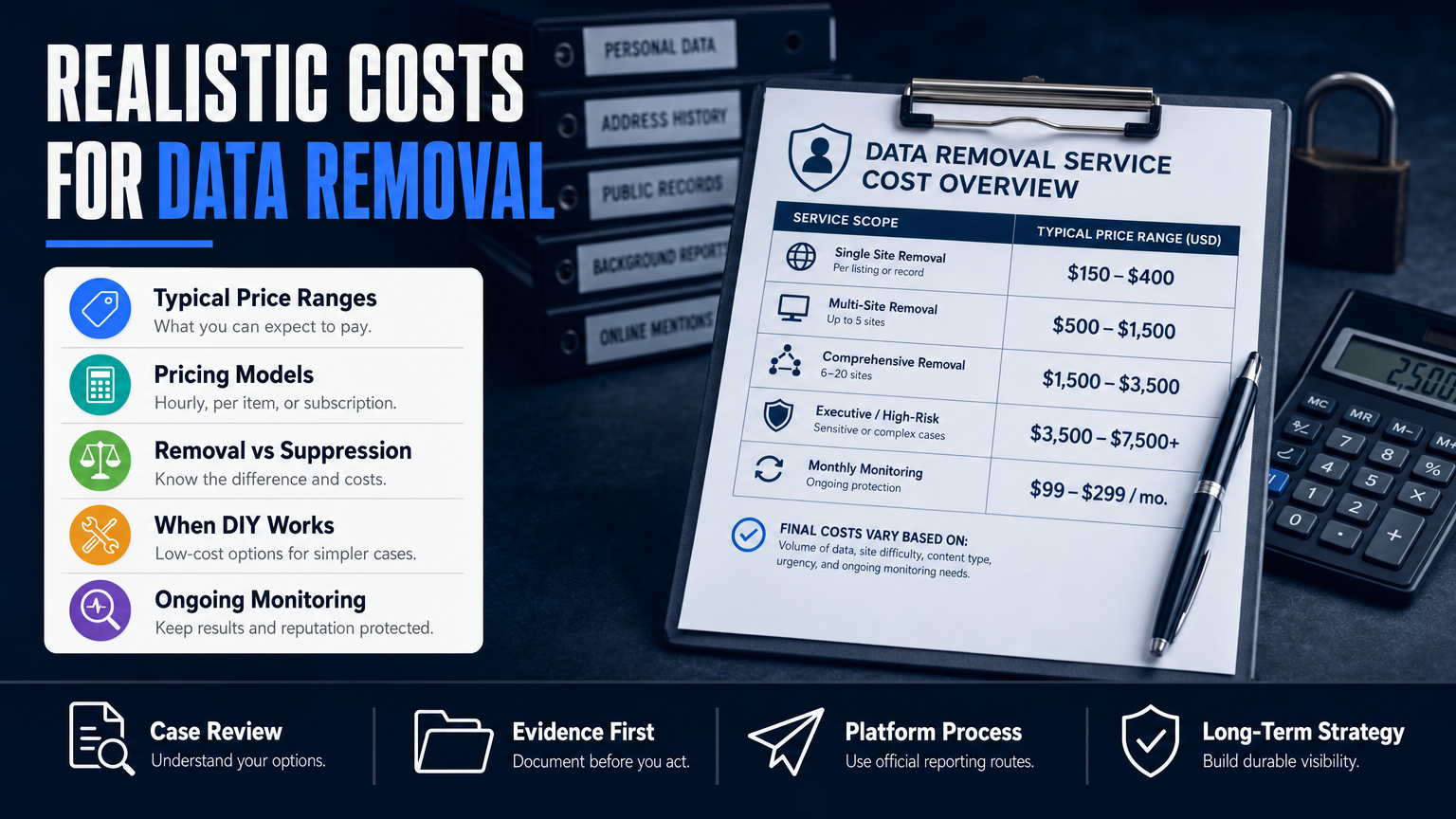
- Typical Timelines, Pricing Ranges, And What To Expect
- Tools, Signals, And The Vendor Checklist
- Rapid Response Checklist For Viral Incidents
- Removal vs Suppression — Quick Comparison
- Hypothetical Scenario: A Clinic With A Persistent One‑Star Review
- Common Mistakes Organizations Make With ORM
- Best Practices When Working With ORM Companies
- Expert Tips
- Conclusion
- Why Businesses Choose Your Reputation Agency
- Frequently Asked Questions
What Is ORM In A Company?
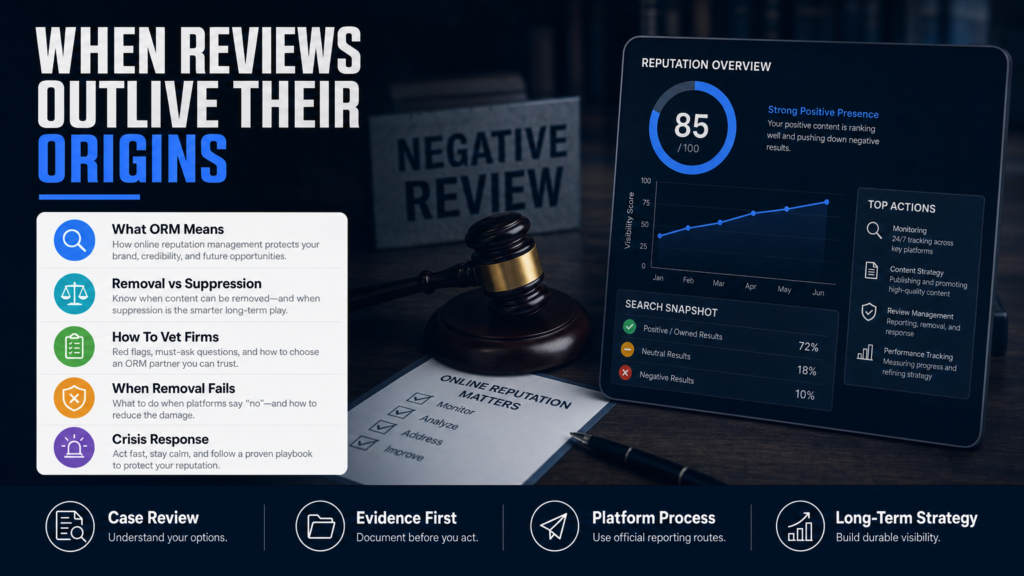
ORM — online reputation management — for a company is the set of practices that actively shape how an organization and its people appear across search engines, review sites, social platforms, and news sources. ORM companies combine technical SEO, platform reporting, legal options, and public relations to address harmful results.
Operationally, ORM firms evaluate content to classify it (defamatory, private data, opinion, review, public record) and select an appropriate mix of removal requests, suppression SEO, corrections, or reputational messaging.
Because the same problem can have different remedies, ORM companies typically run an intake analysis before recommending a plan. Removal depends on the content, publisher, platform policy, evidence, jurisdiction, and circumstances — not simply the desire to have something taken down.
- Initial audit: identify harmful links and volume of exposure
- Classification: categorize each item (review, privacy leak, defamation, public record)
- Strategy: propose removal, suppression, or combined approach with estimated ranges and dependencies
- Scope: search results, reviews, social posts, news, images, video, people-search listings
- Common tactics: platform reports, publisher outreach, SEO suppression, legal demand letters, PR placements
- Outcome types: content removed, content demoted, corrective content published, or monitoring for recurrence
What Does ORM Mean In Marketing — And How Is It Different From PR?
In marketing, ORM is about protecting and promoting the signals potential customers see when they search for your brand or people. It uses content creation and SEO to ensure favorable or neutral assets outrank negative ones.
PR and ORM overlap — both handle messaging — but ORM is search-centric and technical: it aims to change what appears on page one of Google, directory listings, or platform profiles. PR shapes narrative; ORM shapes discoverability and metadata.
An effective campaign often blends both: SEO-driven content to bury negatives, plus targeted PR to correct or reframe factual narratives where appropriate.
- Map the first two search-result pages for key queries
- Identify assets you control (site, profiles, press mentions)
- Prioritize content to publish and platforms to strengthen
- Marketing-focused ORM: create and optimize positive content (press, bios, case studies)
- PR-focused ORM: manage public statements, interviews, and media corrections
- Technical ORM: metadata, authority signals, link acquisition, and structured data
What Does ‘ORM Agency’ Mean — Services And Deliverables
An ‘ORM agency’ is a vendor that offers the combination of services businesses need to manage search and platform visibility. Typical deliverables include a discovery report, takedown requests, opt-outs from data brokers, SEO suppression campaigns, reputation monitoring, and crisis support.
Not all agencies do everything. Some focus on takedowns and legal coordination, others on SEO and content, and some provide rapid-response crisis teams. Ask each provider for a written scope showing what they will do and what remains the client’s responsibility.
We evaluate whether the content may qualify for removal or review and pursue the legal, technical, platform-based, and reputational options available; platform decisions remain under the platform’s control.
- Request a sample scope of work for your specific problem
- Confirm whether legal coordination is included or recommended
- Ask about escalation paths for urgent incidents
- Intake and evidence gathering
- Platform reporting and publisher outreach
- SEO campaigns to suppress negative links
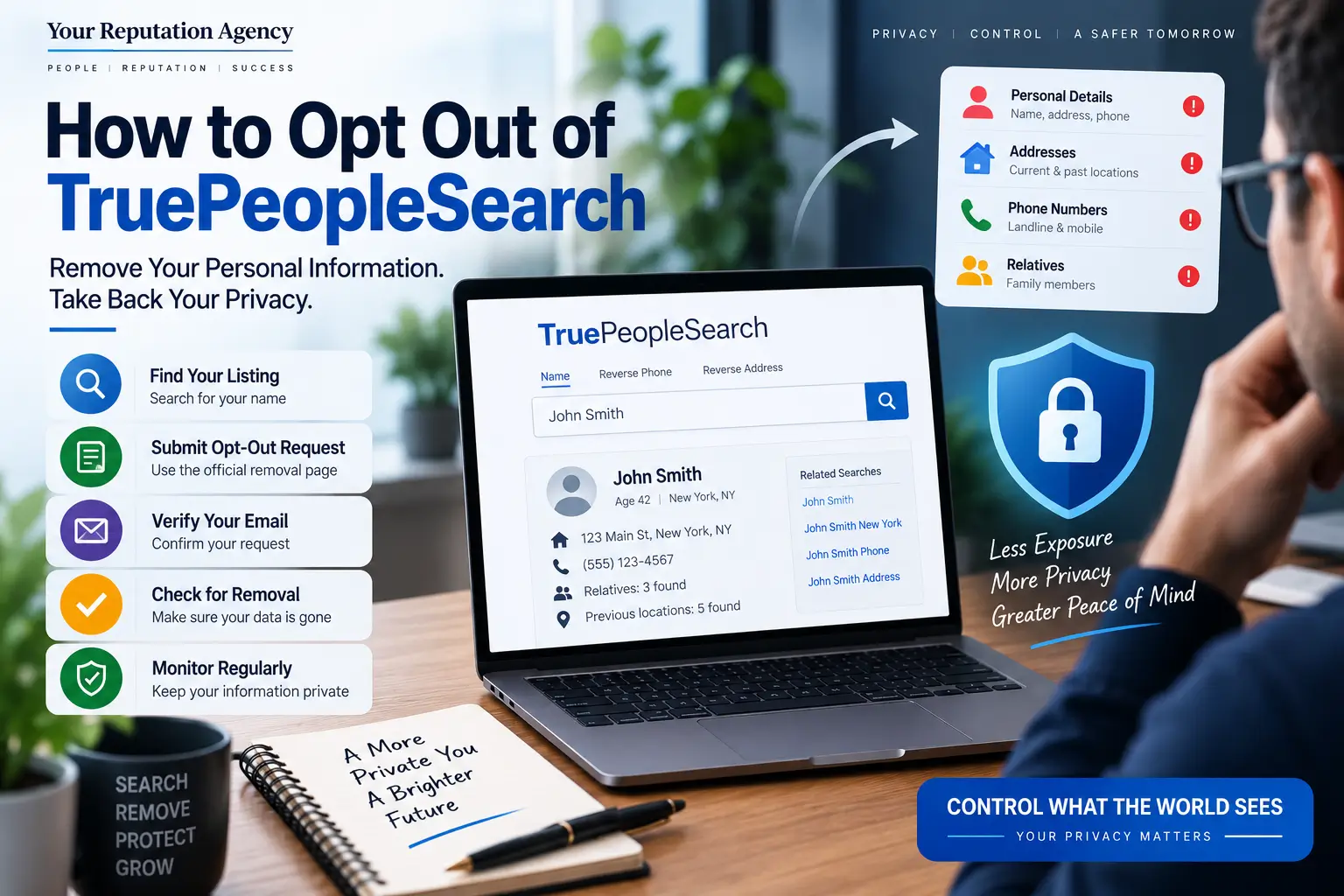
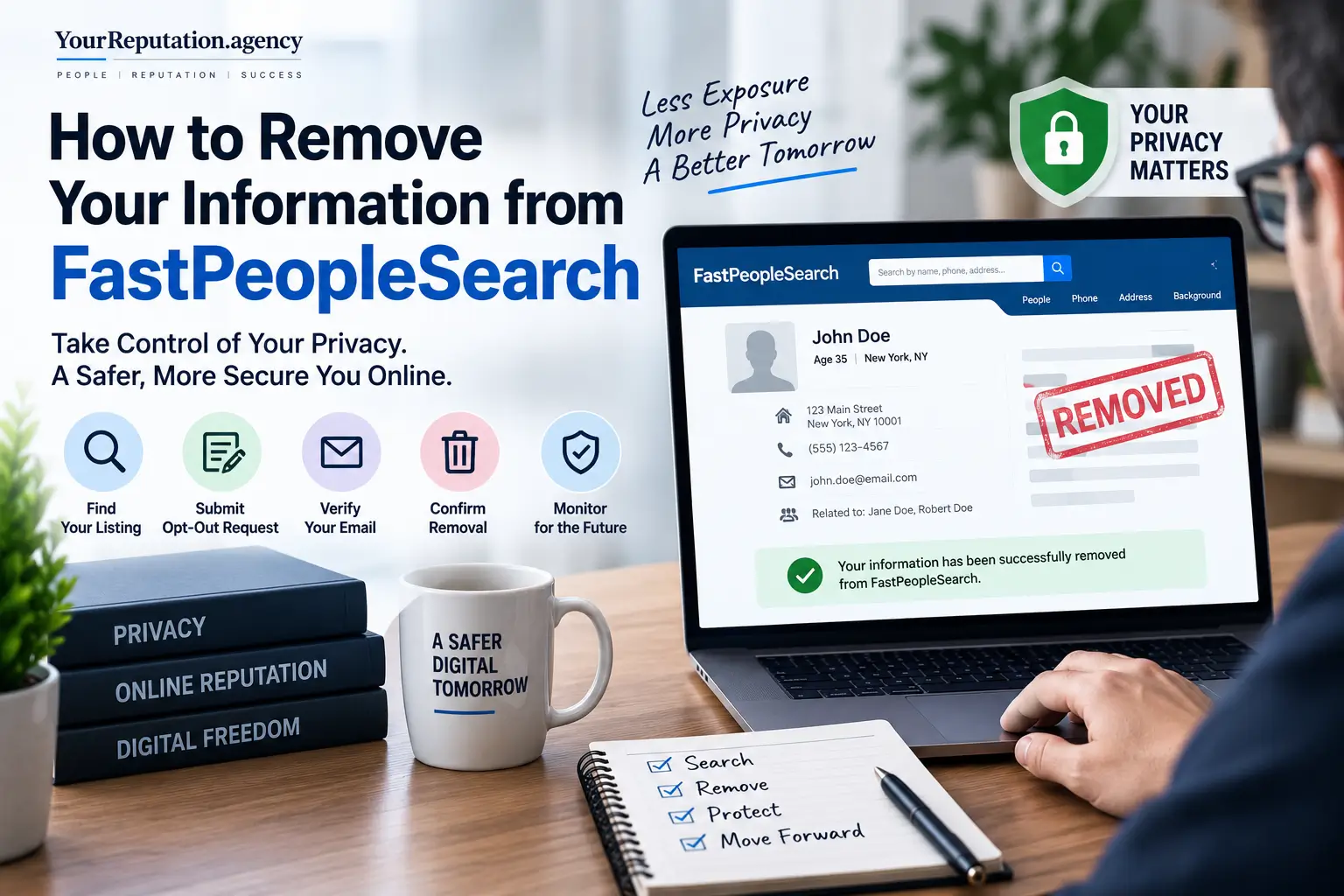
- Data-broker opt-outs and privacy remediation
- Monitoring and alerting for new mentions
How agencies charge
Common pricing models: monthly retainers for ongoing monitoring, fixed-fee projects for discrete takedown campaigns, and hourly/legal coordination fees. Avoid vendors who refuse to show a sample contract or scope.
- Retainer: ongoing service and monitoring
- Project fee: one-off suppression/removal attempts
- Hybrid: project plus optional retainer for monitoring
Who Is The Best Digital Reputation Management Company? How To Evaluate Vendors
There is no single ‘best’ firm for every case; the best company for you depends on the problem type, required speed, and whether legal work is needed. Look for demonstrated experience with your industry (healthcare, legal, SaaS, restaurants) and transparent processes.
Ask for references or anonymized examples of similar work, not generic testimonials. A credible vendor will explain limitations: they won’t guarantee removal, rankings, or legal outcomes, and they will describe the factors that affect timelines.
When you vet options, use a checklist that scores competence in technical SEO, platform processes, legal coordination, and crisis PR. Also confirm that they respect confidentiality and provide a written escalation plan.
- Create a shortlist of 3–5 vendors
- Request an intake audit and sample plan for the same negative item
- Compare proposed tactics, timelines (as ranges), and total costs
- Industry experience and published procedures
- Clear communication of dependencies and risks
- Written scope, KPIs (process-focused), and reporting cadence
- Evidence-based approach to takedowns and suppression
Red flags to avoid
Vendors who promise guaranteed removal, claim special access to platforms, or refuse to put service details in writing should be avoided. Also be wary of firms recommending deceptive or retaliatory tactics.
- Guarantees of outcome or rankings
- No written scope or evasive answers on methods
- Pressure to sign long retainers without a pilot project
Removal Versus Suppression: Which Do You Need?
Deciding between removal and suppression is one of the first strategic choices an ORM company makes. Removal seeks to have content taken down by a publisher or platform; suppression aims to push negative items below the first page of search results using SEO and content.
Removal depends on platform policy, publisher willingness, evidence of defamation/privacy violation, or legal action. Suppression depends on your ability to publish authoritative competing content and the search landscape’s competitiveness.
When removal is unavailable, we may recommend mitigation, correction, or reduced visibility through sustained SEO and PR.
- Classify the item (privacy, defamation, review, public record)
- Attempt platform/publisher takedown if policy or law supports it
- Begin SEO suppression campaign for remaining items
- Removal: ideal for doxxing, exposed private data, clear policy violations, or false factual claims
- Suppression: used for truthful but damaging items, old negatives, or public records not subject to removal
- Hybrid: attempt removal while running suppression to limit exposure during review
Comparison: DIY Versus Hiring An ORM Company
Some organizations can handle limited issues in-house; others need a vendor because of scale, technical complexity, or urgency. Below is a short comparison to help you decide.
- Assess internal bandwidth and expertise
- Estimate cost of in-house hours vs vendor fees
- Pilot a vendor on a single high-priority item before committing to a retainer
- DIY is feasible for a few low-authority listings and basic opt-outs
- Hire an agency for complex cases, ongoing monitoring, or when coordination with counsel and PR is required
What To Do When Removal Is Not Available
Removal is often the preferred outcome, but it is not always available — truthful reporting, public records, and some reviews are not removable. When removal is not available, the effective options are suppression, correction, context, and reputation building.
A realistic remediation plan blends SEO to demote negatives, targeted content to correct misinformation, and PR to regain trust. For sector-specific examples and longer-term reputation work, see When a One-Star Review Follows a Clinic for Years.
If you need immediate containment (for licensing or hiring deadlines), prioritize tasks you control: update profiles, publish a clear FAQ or statement, and push authoritative pages with structured data.
- Day 1–7: Secure accounts, take screenshots, publish a holding statement if necessary
- Week 1–4: Launch targeted SEO and content pieces; optimize site metadata
- Month 1–3: Build links to new assets and continue outreach for corrections
- Publish authoritative content on owned domains
- Optimize profiles (Google Business Profile, LinkedIn, industry directories)
- Use targeted press or contributed articles to create authoritative pages
- Request updates or corrections where facts are demonstrably wrong
When to involve legal counsel
The content may warrant legal review if it contains demonstrably false factual claims or threats. A qualified attorney can determine whether a legal claim may be available. Your vendor should coordinate with counsel when a matter requires legal analysis.
- Defamation risk assessment
- Cease-and-desist or demand letter drafting
- Court filing if litigation is appropriate
Typical Timelines, Pricing Ranges, And What To Expect
Timing and cost vary widely. Platform reviews and publisher responsiveness can take days to months; legal actions add further delay. We can provide estimated timelines only after an assessment — universal guarantees are not possible.
Below are typical ranges you’ll see in the market for U.S.-based cases. These are examples, not promises: actual results depend on content type, platform, and legal complexity.
Your Reputation Agency is an independent reputation-management company and will describe dependencies and estimated ranges during intake.
- Request a written estimate with ranges and escalation routes
- Agree on reporting cadence (weekly for crisis, monthly for ongoing monitoring)
- Reassess strategy after 30–90 days based on measurable movement
- Simple opt-outs and data-broker removals: 2–8 weeks (varies by publisher)
- Platform policy removals (harassment, doxxing, explicit violations): days to several weeks
- Suppression campaigns (SEO + content): 3–9 months to establish demotion trends
- Legal takedown efforts or litigation: months to years depending on court schedules
Tools, Signals, And The Vendor Checklist
Vendors should use a mix of platform-specific tools and enterprise monitoring: Google Search Console for owned sites, review-alerting tools (Google Alerts, Mention, Brand24), and people-search scans for privacy leaks.
A practical checklist helps compare firms: who does intake, how evidence is stored, whether they coordinate with counsel, and what controls exist for confidentiality.
For a narrative on how deleted posts can persist via screenshots and archives, consult The Screenshot Effect: Why Deleted Posts Never Disappear — understanding persistence is crucial for expectations.
- Request a vendor’s monitoring list and alert examples
- Confirm data security and confidentiality practices
- Ask how they handle recurring incidents and appeals
- Monitoring: alerting thresholds and coverage (search engines, social, review sites)
- Intake: documented evidence-gathering and chain-of-custody for screenshots
- Escalation: platform appeals, publisher outreach, legal coordination
- Reporting: clear metrics (visibility, movement, actions taken) and cadence
Rapid Response Checklist For Viral Incidents
When a post or incident goes viral, speed and structure matter. Immediate steps reduce harm and preserve evidence for later takedown attempts or legal action.
A concise checklist helps triage: secure accounts, take screenshots, set up monitoring, and prepare a controlled public message if appropriate.
For product-specific or technical incidents that spill into developer communities, see how reputation escalates in practical scenarios like When a GitHub Issue Becomes Your SaaS Company’s Headline.
- First 24 hours: evidence capture, account lockdown, and internal communications
- 24–72 hours: publish a controlled statement, engage vendor and counsel, file platform reports
- 72 hours–2 weeks: sustained outreach, monitor spread, and begin reputation-building content
- Secure accounts and change credentials
- Take time-stamped screenshots and archive URLs
- Implement a holding statement or Q&A for staff
- Begin platform takedown requests and publisher outreach simultaneously
Removal vs Suppression — Quick Comparison
A side‑by‑side look at whether you should seek to remove content or bury it with SEO and PR.
| Removal | Suppression |
|---|---|
| Goal | Goal |
| Have the content taken down | Push content off page one |
| Depends on platform/publisher policy or law | Depends on ability to publish authoritative competing pages |
| Possible faster visibility improvement if successful | Often requires months of content and links |
| May need legal action or publisher cooperation | Mostly marketing/SEO and PR work |
| Not guaranteed; platform decisions control outcome | Not guaranteed; search algorithms and competition control outcome |
Hypothetical Scenario: A Clinic With A Persistent One‑Star Review
Situation: A small medical clinic finds a one‑star review from three years ago that includes a false factual claim and ranks above the clinic’s own site for searches by the clinic name. Removal is unlikely because the review is an opinion; however, portions of the review mention private patient data that may violate platform policy.
Approach: The clinic works with an ORM company to (1) capture evidence and identify elements that violate platform policy, (2) file a targeted platform report for the privacy violation, (3) publish corrected, authoritative content on the clinic website and local news outlets, and (4) launch an SEO suppression campaign to push the review below page one.
Outcome: The platform removed the privacy-specific line within a month after evidence was submitted (platform action depends on their review). The remaining review stayed live. Over the next 4–6 months, newly published pages (clinic FAQ, staff bios, contributed health articles) and targeted link building demoted the review from the top two results to the second page for branded searches. This scenario is illustrative and not a real client case.
- Day 0: Audit and evidence capture
- Week 1: File privacy-focused platform report; publish corrective content
- Months 1–6: Run SEO and PR to create and promote authoritative pages; monitor movement
- Capture evidence immediately (screenshots, archived URLs)
- Classify review elements (opinion vs privacy violation)
- Simultaneously pursue platform policy reports and suppression SEO
Common Mistakes Organizations Make With ORM
Avoid these frequent errors when engaging ORM companies or running remediation in-house.
Mistake: Treating All Negative Content The Same
Explanation: A single negative item can be an opinion, a factual error, a privacy violation, or a public record — each needs a different response. Applying the wrong tactic wastes time and budget.
Mistake: Chasing Immediate Guarantees
Explanation: Vendors who promise removal or fixed ranking positions are overpromising. Platform decisions, search algorithms, and competitors are outside an agency’s control.
Mistake: Not Preserving Evidence
Explanation: Failing to archive screenshots, timestamps, and URLs weakens both platform appeals and any potential legal claims. Preserve everything before you ask for removals or corrections.
Mistake: Ignoring Internal Security
Explanation: Reputational incidents often start with a security lapse. Ignoring account security or access controls can allow attackers to re-create the same damage after a takedown.
Mistake: Doing Nothing Long Term
Explanation: Even after a successful removal, negative content can resurface in archives, screenshots, or new complaints. Ongoing monitoring and reputation-building are necessary.
Best Practices When Working With ORM Companies
Follow these durable practices to get the most value and keep risk manageable.
Practice: Start With A Clear Audit
Action: Require a documented intake audit that classifies each harmful asset, lists owners, and proposes a prioritized approach. Do not proceed without this.
Practice: Insist On Written Scopes And Reporting
Action: Get a written scope that lists actions, dependencies, reporting cadence, and estimated ranges for timelines. This reduces surprises and helps compare vendors objectively.
Practice: Preserve Evidence Immediately
Action: Capture screenshots, archive URLs (e.g., Internet Archive), and export review threads. This helps platform appeals and legal review if needed.
Practice: Coordinate With Counsel For Legal Risks
Action: If allegations include false factual claims or privacy breaches, involve a qualified attorney early so the ORM firm can coordinate appropriately.
Practice: Pair Suppression With Reputation Building
Action: Use SEO to demote negatives while simultaneously publishing authoritative content — bios, patient resources, case studies, and local pages.
Expert Tips
- Capture and archive every harmful item the moment you find it — platforms are more responsive to time‑stamped evidence.
- Ask vendors for a sample remediation plan for a single item before signing a retainer.
- If a review includes private data, flag that immediately; many platforms have specific privacy-removal paths.
- Create and optimize all owned profiles (Google Business Profile, LinkedIn, industry directories) before launching suppression content.
- Insist on coordination with legal counsel when claims include factual allegations or potential defamation.
- Monitor for derivatives like screenshots and reuploads — deletion rarely removes all copies.
- Measure vendor performance on process metrics (tickets filed, publisher outreach) rather than promises of specific rankings.
- Use a short pilot with clear acceptance criteria before a long-term contract.
Conclusion
Choosing an ORM company is a practical risk-management decision: match the vendor’s strengths to your problem — takedown complexity, need for legal coordination, or long-term search suppression. Insist on documented scopes, evidence preservation, and realistic timelines.
When removal isn’t possible, effective reputational work combines suppression, corrective content, and PR while monitoring for recurrence. A methodical intake, transparent vendor evaluation, and immediate evidence preservation are the fastest ways to reduce harm and regain control of your search presence.
Why Businesses Choose Your Reputation Agency
Managing your reputation takes more than monitoring reviews or publishing the occasional blog post. It takes a strategy built around your situation, your industry, and what is actually showing up in search.
Your Reputation Agency works with businesses, executives, healthcare professionals, attorneys and growing brands. Our services include:
- Remove defamatory content and false posts (news, blogs, listings)
- Remove or challenge negative reviews (Google, Yelp, TripAdvisor, industry sites)
- Mugshot and arrest record removal
- Remove videos, images, and other multimedia that damage reputation
- Remove personal data from people‑search and data‑broker sites (opt‑outs)
- Search result suppression (SEO to bury negative links)
- Social media takedowns and impersonation removal
- Rapid online crisis management and incident response
- Ongoing monitoring and alerting of reputation signals
- Coordination with legal counsel and use of legal tactics when required
Frequently Asked Questions
1. What is ORM in company?
ORM for a company means the set of practices used to manage how the business and its principals appear online — across search engines, review sites, and social platforms. It includes technical SEO, platform takedown attempts, data‑broker opt‑outs, monitoring, and PR to influence discoverability and context.
2. Who is the best digital reputation management company?
There is no universal ‘best’ firm; the best choice depends on your industry, the type of content, and whether legal or PR support is needed. Evaluate vendors on relevant experience, transparent methods, written scopes, and references for similar cases.
3. What does ‘ORM agency’ mean?
An ORM agency is a company offering services to remove, suppress, or mitigate harmful online content. Services often include audits, platform reports, publication outreach, SEO suppression, data-broker opt-outs, monitoring, and crisis response. Confirm the agency’s exact deliverables in writing.
4. What does ORM mean in marketing?
In marketing, ORM emphasizes visibility management: creating and optimizing positive content so it ranks higher than negatives. It blends SEO, content marketing, and PR to shape search‑results narratives rather than focusing solely on takedowns.
5. How long does removal or suppression take?
Timing varies. Simple platform removals can take days to weeks; suppression via SEO typically takes 3–9 months to show sustained movement. Legal routes add further delay. Vendors should provide timeline ranges after assessing the specific items.
6. Can any negative review be removed?
No. Reviews that are opinions or truthful accounts are often not removable. Content with policy violations (privacy, hate, threats) or demonstrably false factual claims may be eligible for removal or correction. Each case requires assessment.
7. Should I try to fix reputation issues myself or hire an agency?
If the problem is limited and you have in‑house SEO and time, a DIY approach can work for basic opt-outs and profile updates. Hire an ORM company for complex cases, large volumes, urgent crises, or when coordination with counsel and PR is needed.
8. What immediate steps should I take after a viral incident?
Secure accounts, capture evidence (screenshots, archived URLs), issue a controlled internal statement, file platform reports for policy violations, and engage a vendor or counsel if legal exposure exists. Rapid containment preserves options.
9. Will an ORM company guarantee removal or ranking?
No reputable ORM company will guarantee removal or fixed rankings. Platform decisions, search algorithms, and legal outcomes are outside an agency’s control. Expect vendors to explain dependencies and provide estimated ranges instead of promises.
This content provides general information and does not constitute legal advice. The available options and likely outcomes depend on the facts, evidence, platform policies, applicable law, jurisdiction, and public-interest considerations.
Past examples do not guarantee future results. Removal, correction, deindexing, and search-position changes depend on third parties and circumstances outside Your Reputation Agency’s control.