Introduction
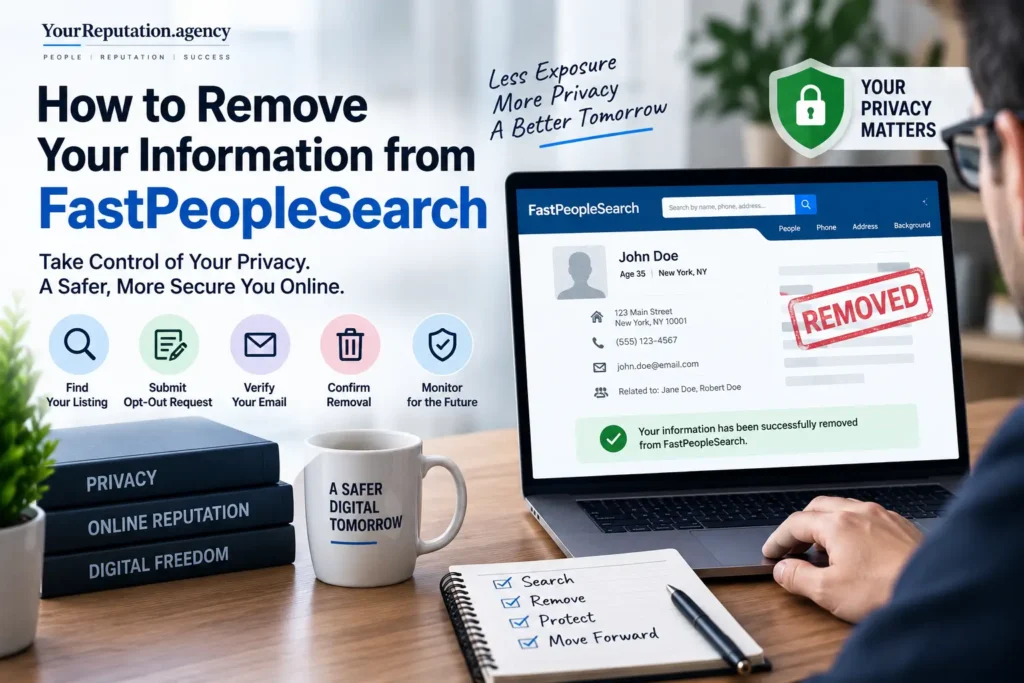
If your name, phone number, home address, relatives, or other personal details appear on FastPeopleSearch, you may be wondering How to Remove Your Information from FastPeopleSearch and reduce your public digital footprint.
FastPeopleSearch is a people-search website that can display information compiled from public records and other data sources. Depending on the listing, people-search profiles can expose details such as names, addresses, phone numbers, email addresses, relatives, and other identifying information.
For a private individual, this can create unwanted privacy concerns. For a business owner, CEO, doctor, lawyer, real estate professional, or public-facing entrepreneur, the issue can go further. Personal information appearing online can make it easier for strangers to connect a professional identity with a home address or other personal details.
The good news is that FastPeopleSearch provides an opt-out process. However, removing one listing does not necessarily remove your information from the entire internet, and people-search records can reappear after data sources are refreshed.
This guide explains the current FastPeopleSearch removal process, what to do after submitting an opt-out, how to deal with Google search results, common mistakes to avoid, and how professional reputation and privacy monitoring can help you manage the wider problem.
What Is FastPeopleSearch?
FastPeopleSearch is a people-search platform that allows users to search for individuals using identifying information such as a name, phone number, or address.
Like other people-search and data-broker websites, it can compile information from multiple sources and present it in an easy-to-search profile. Current opt-out guides report that profiles may include names, current and previous addresses, phone numbers, email addresses, relatives, and other associated information.
The important distinction is that FastPeopleSearch is not necessarily the original source of every piece of information in a profile.
That matters because removing a profile from FastPeopleSearch does not automatically delete the underlying public record.
For example, your address could still exist in:
- Public property records
- Government databases
- Professional directories
- Business registrations
- Other people-search websites
- Archived webpages
- Social media profiles
- Other data-broker databases
As Forbes has noted in its reporting on people-search and data-broker ecosystems, publicly available information can be aggregated from multiple sources and made much easier to discover through searchable profiles.
Why Is Your Information on FastPeopleSearch?
You may never have created an account with FastPeopleSearch and still find a profile associated with your name.
That is because people-search services can obtain information from public records and other data sources rather than relying on information you directly submitted to the website. Current removal research indicates that FastPeopleSearch’s database can be refreshed from public records and commercial sources.
This can create a frustrating situation.
You remove a profile today.
Several months later, you search again.
The information is back.
That does not necessarily mean your original opt-out failed. It can mean that new or refreshed source data was added to the database.
This is one reason data removal should be viewed as an ongoing privacy-management process, rather than a one-time task.
How to Remove Your Information from FastPeopleSearch
FastPeopleSearch currently provides an online removal process. Current guides referencing the site’s removal workflow direct users to the FastPeopleSearch removal page and describe a verification process before the request can be completed.
Step 1: Find Your FastPeopleSearch Profile
Start by searching FastPeopleSearch for your own information.
Try combinations such as:
- Full name + city
- Full name + state
- Full name + ZIP code
- Name + previous location
- Phone number
- Address
You may find more than one listing.
Pay attention to variations involving:
- Middle names
- Previous addresses
- Former names
- Different cities
- Old phone numbers
- Similar names
Do not assume the first profile you find is the only one.
Step 2: Go to the FastPeopleSearch Removal Page
Use the dedicated FastPeopleSearch removal page:
Current guides report that the removal workflow may require a CAPTCHA or human-verification step.
Follow the instructions displayed on the page rather than relying on an old screenshot or outdated tutorial.
Websites can change their privacy interfaces, so always verify the current instructions directly.
Step 3: Enter Your Email Address
The current removal workflow uses an email address as part of the request process.
Use an email account that you can access because the process may require email verification before you can complete the request. Current removal guides report that a verification email is part of the workflow.
If you do not see the message:
- Check your spam folder.
- Check promotional folders.
- Search your inbox for FastPeopleSearch.
- Make sure the email address was entered correctly.
- Restart the process if the verification link has expired.
Step 4: Locate the Correct Record
Once you enter the removal process, locate the profile that belongs to you.
This step requires attention because people-search sites can contain multiple people with similar names.
Compare information such as:
- Age
- City
- Previous addresses
- Phone number
- Relatives
- Other identifying details
Make sure you select your own record.
Step 5: Submit the Removal Request
Follow the site’s instructions to submit the removal request for the matching record.
Current guides describe selecting the relevant record and submitting the removal request through the FastPeopleSearch workflow.
Keep a record of what you submitted.
A simple spreadsheet can include:
| Information | What to Record |
|---|---|
| Website | FastPeopleSearch |
| Profile URL | Exact listing URL |
| Date submitted | Date of request |
| Email used | Email address |
| Status | Pending / Removed |
| Follow-up date | Date to check again |
This becomes particularly useful when you are managing multiple data-broker removals.
Step 6: Confirm the Request
Complete any email verification or confirmation step provided by FastPeopleSearch.
Do not assume that starting the process means the removal is complete.
Look for a confirmation message and keep it for your records.
Current third-party guides report that the FastPeopleSearch process can take up to approximately 72 hours, although processing times can vary.
What Happens After You Submit an Opt-Out?
After submitting the request, check the original listing again.
Do not immediately panic if you still see the profile.
There can be a processing period.
A useful approach is:
- Record the original profile URL.
- Submit the opt-out.
- Save the confirmation.
- Wait for the stated processing period.
- Check the profile again.
- Search Google for the same listing.
- Record what changed.
- Schedule a future check.
The most important point is that removing a FastPeopleSearch listing does not necessarily erase the underlying information from its original sources.
Current research on FastPeopleSearch notes that data may reappear when the service receives new public records or refreshes its database.
What If Your Information Appears Again?
This is one of the most important parts of the process.
Your information can potentially return after a successful opt-out.
Why?
Because FastPeopleSearch may receive new or refreshed information from its underlying data sources.
Therefore, think about the process in two stages:
Stage 1: Removal
Get the current listing removed.
Stage 2: Monitoring
Check periodically to determine whether a new listing has appeared.
This is where broader Reputation Monitoring can become useful for people whose online visibility matters professionally.
For executives, entrepreneurs, doctors, lawyers, and other public-facing professionals, monitoring should extend beyond one people-search website.
Removing FastPeopleSearch Results From Google
There is an important distinction between removing your information from FastPeopleSearch and removing a FastPeopleSearch page from Google.
They are two different actions.
If FastPeopleSearch removes the information from its website, Google may eventually update its search index.
However, Google explains that removing a result from Google Search does not necessarily remove the information from the original website. The source website must generally be addressed separately if you want the information removed there.
Google also provides a Results about you feature that can help users find certain personal information appearing in search results and request removal where eligible. Google says this can include information such as a home address, phone number, or email address.
You can also use Google’s official process here:
Google — Find and Remove Personal Information
Remember the Difference
FastPeopleSearch removal: Addresses the listing on the source website.
Google removal: Addresses how an eligible result appears in Google Search.
Complete privacy management: Requires looking at other websites and sources where your information may also appear.
Microsoft similarly explains that Bing may remove certain sensitive personal information from search results in limited circumstances, but removal from a search engine does not necessarily remove the information from the original website.
Real Example: Removing a Professional’s Personal Information
Imagine a real estate entrepreneur named Michael.
Michael has a professional website and a strong public profile. When he searches his name, he discovers a FastPeopleSearch listing showing:
- His full name
- Current city
- Previous address
- Phone number
- Names of relatives
Michael completes the FastPeopleSearch opt-out process.
The listing disappears.
However, a month later, he discovers another people-search page showing similar information.
He also notices that an old FastPeopleSearch result is still appearing in Google.
Instead of repeating only the first removal step, Michael creates a broader privacy strategy.
He:
- Identifies all people-search listings.
- Removes the current FastPeopleSearch profile.
- Checks Google for cached or indexed results.
- Reviews other data-broker websites.
- Updates outdated professional profiles.
- Monitors his name and personal information.
- Reviews what appears for his name in search.
- Establishes a recurring privacy and reputation review.
This illustrates an important lesson:
Removing one profile is useful, but managing your overall digital footprint is more comprehensive.
Common Mistakes When Removing Your Information
1. Assuming One Opt-Out Removes Everything
It does not.
Each data broker operates independently.
Removing information from FastPeopleSearch does not automatically remove it from other people-search websites.
2. Forgetting Old Addresses
People-search profiles may contain previous locations.
Check for multiple records rather than focusing only on your current address.
3. Ignoring Search Engines
Your profile may disappear from the source website while an outdated search result remains temporarily visible.
Google explains that search-result updates can take time after the source content changes.
4. Using Outdated Instructions
Privacy workflows change.
An old blog post may tell you to click an option that no longer exists.
Always check the current removal process.
5. Removing the Profile Once and Forgetting About It
Data can be refreshed.
Current FastPeopleSearch removal research specifically warns that information may reappear after new public records are received.
6. Focusing Only on Privacy and Ignoring Reputation
For professionals, personal information can become part of a larger reputation problem.
Someone searching your name may see a combination of:
- Data-broker profiles
- Reviews
- Social media
- News
- Business listings
- Professional profiles
- Negative content
That is why privacy cleanup and reputation management often work best together.
Best Practices for Protecting Your Digital Footprint
Removing information from FastPeopleSearch is only one part of a broader strategy.
Search Yourself Regularly
Search your:
- Full name
- Name + city
- Name + profession
- Name + company
- Name + reviews
Also check common variations of your name.
Keep Professional Profiles Accurate
Your professional website and profiles should clearly establish your identity and professional information.
For small businesses, our Online Presence & Local SEO for Small Businesses resource explains why a consistent digital presence matters.
Monitor Data-Broker Listings
Keep a list of major people-search websites where you find your information.
Do not rely on one removal request to solve the entire problem.
Protect Executive Information
Business owners and executives can have additional exposure because personal and professional information often overlap.
For high-profile individuals, privacy protection should be part of a wider Executive Reputation Management strategy.
Build a Stronger Search Presence
Privacy protection does not mean disappearing from the internet.
For many professionals, the goal is to control unnecessary personal exposure while maintaining a strong professional presence.
Your website, professional profiles, thought leadership, media mentions, and business information can all contribute to that professional identity.
Expert Tips for Long-Term Reputation & Privacy Protection
Tip 1: Create a Digital Footprint Inventory
Maintain a simple list of:
- Data-broker profiles
- Social accounts
- Business directories
- Professional profiles
- Review websites
- Search results
- News mentions
This gives you a clearer picture of your exposure.
Tip 2: Separate Personal and Professional Information
Where appropriate, avoid unnecessarily publishing your home address, personal phone number, or private email address on professional websites.
Use business contact information when it makes sense for your work.
Tip 3: Monitor Your Name Automatically
Manual searches are useful, but ongoing monitoring can help you identify changes faster.
Our guide on How to Monitor Your Name on Google Automatically provides additional guidance.
Tip 4: Treat Data Removal as Maintenance
Data removal is not always permanent.
Search periodically and repeat opt-out requests where necessary.
Tip 5: Think Beyond FastPeopleSearch
Other people-search websites can contain overlapping information.
Our related guide, How to Remove Your Information from USSearch: Complete Opt-Out Guide, covers another major people-search platform.
You can also explore:
- How to Remove Your Information from Intelius: Complete Opt-Out Guide
- How to Remove Your Information from PeopleFinders
- The Anatomy of a People-Search Listing and How to Fix It
- How TruthFinder and People Search Sites Aggregate Data: What You Need to Know
- The Hidden Risk of People Search Sites Like Spokeo and Whitepages
- The Truth About People Search Websites
When Should You Consider Professional Help?
Manual opt-outs can work when you only have a few listings and enough time to manage them yourself.
However, the process becomes more complicated when:
- Your information appears across many data brokers.
- Listings repeatedly return.
- You are a high-profile professional.
- Your home address is publicly exposed.
- You have a large online presence.
- Negative content appears alongside personal information.
- Your professional and personal identities are strongly connected.
- You need ongoing monitoring.
- You are dealing with a broader reputation issue.
YourReputation.agency can help with the larger digital picture through Remove Personal Information from Data strategies and broader reputation protection.
For a more comprehensive approach, our Online Reputation Protection Services can help businesses and professionals assess and manage their wider online exposure.
Frequently Asked Questions
1. How to Remove Your Information from FastPeopleSearch?
To remove your information, visit the FastPeopleSearch removal page, follow the current opt-out workflow, locate the profile that belongs to you, submit the removal request, and complete any required email verification. Current guides report that the process is free, although listings can reappear after database updates.
2. Is FastPeopleSearch removal free?
Current removal guides report that the FastPeopleSearch opt-out process is free. Be cautious of third-party websites that charge for instructions that FastPeopleSearch itself provides through its removal process.
3. How long does FastPeopleSearch removal take?
Current guides commonly report that removal can take up to approximately 72 hours, although actual processing time can vary. Always follow the current instructions provided during the FastPeopleSearch removal process.
4. Why did my information return after I removed it?
FastPeopleSearch can receive new or refreshed public-record information. Current research indicates that a previously removed profile can reappear after the database is refreshed. This is why periodic monitoring is important.
5. Does removing FastPeopleSearch remove my information from Google?
Not necessarily. Removing information from FastPeopleSearch addresses the source website. Google separately controls its search index. If an eligible personal-information result remains in Google, you can use Google’s removal tools to request removal from Search.
6. Can I remove my information from every people-search website at once?
Generally, no single FastPeopleSearch opt-out removes your information from every independent people-search website. You may need to submit separate requests to other services or use a broader data-removal solution.
7. Can FastPeopleSearch still have my information after an opt-out?
Your information may reappear after new data is received or existing sources are refreshed. Current FastPeopleSearch removal research recommends periodically refreshing opt-out requests.
8. What information can FastPeopleSearch show?
Depending on the available data, people-search profiles may contain names, addresses, phone numbers, email addresses, relatives, and other associated information. The exact information can vary between records.
9. Should business owners remove their personal information from people-search websites?
Business owners should evaluate their personal exposure based on their circumstances. Publicly accessible residential information can create privacy and security concerns, particularly for executives and high-profile professionals. Forbes has discussed how aggregated public information can increase personal exposure for executives and other individuals.
10. What should I do if my information keeps appearing online?
Start with a broader digital-footprint audit. Identify the websites publishing your information, submit appropriate opt-out requests, monitor the results, and address Google or Bing search visibility separately where applicable.
For ongoing issues, professional reputation and privacy monitoring can help reduce the amount of manual work involved.
Conclusion
Learning How to Remove Your Information from FastPeopleSearch is an important first step toward reducing unnecessary personal exposure online.
However, one opt-out request should not be treated as a complete digital privacy solution.
FastPeopleSearch is only one part of a much larger data ecosystem. Your information may also appear on other people-search websites, directories, social networks, public records, and search engines.
Google provides tools for finding and requesting removal of certain personal information from Search, while Microsoft notes that Bing may remove certain sensitive information in limited circumstances. However, both make an important distinction between removing a search result and removing information from the original website.
For that reason, the most sustainable approach combines:
- Data-broker opt-outs
- Search-result monitoring
- Digital-footprint audits
- Professional profile management
- Privacy-conscious publishing
- Ongoing reputation monitoring
Your online reputation is not limited to what you publish yourself. It also includes what other websites make discoverable about you.
Protect Your Privacy and Online Reputation
If you have already removed your FastPeopleSearch profile but continue finding your personal information elsewhere, the problem may be larger than one website.
YourReputation.agency helps professionals, executives, entrepreneurs, business owners, and personal brands take a broader approach to online reputation and digital exposure.
From personal information removal and reputation monitoring to search-result management and long-term reputation protection, our strategies are designed around your specific online footprint.
You can explore our Reputation Management Services to understand how professional ORM can support your broader digital presence.
If your name is associated with unwanted personal information, negative search results, or a growing privacy concern, Contact Us to discuss your situation with our reputation experts.
Don’t wait until your personal information becomes a bigger reputation or privacy problem. Start with a professional assessment and build a strategy for protecting what people can discover about you online.
You can also review independent customer feedback through Trustpilot.
Related Reputation & Privacy Resources
Personal Privacy & Data Removal
- Remove Personal Information from Data
- How to Remove Your Information from USSearch: Complete Opt-Out Guide
- How to Remove Your Information from Intelius: Complete Opt-Out Guide
- How to Remove Your Information from PeopleFinders
- The Anatomy of a People-Search Listing and How to Fix It
- How TruthFinder and People Search Sites Aggregate Data: What You Need to Know
- The Hidden Risk of People Search Sites Like Spokeo and Whitepages
- The Truth About People Search Websites
- How to Protect Your Brand Name in Google Search
Reputation Monitoring & Search
- Reputation Monitoring
- How to Monitor Your Name on Google Automatically
- Why Does My Business Name Show Negative Results on Google? Expert ORM Guide
- Why Business Owners Panic After Seeing Their Name Online
- 7 Things That Happen When You Google Your Name and Find Negative Results
- Removing Name From Radaris: 7 Brutal Steps to Reclaim Privacy
Reputation Protection
- Online Presence & Local SEO for Small Businesses
- Online Reputation Protection Services
- CEO Reputation Management
- Crisis Reputation Management
- Executive Reputation Management
- Expert Reputation Management
- Personal Reputation Management
- Reputation Management
- Reputation Management Agency
- Reputation Management Consultants
- Reputation Management Firm
- Social Media Reputation Management
- Wikipedia Consulting & Reputation Management