Introduction
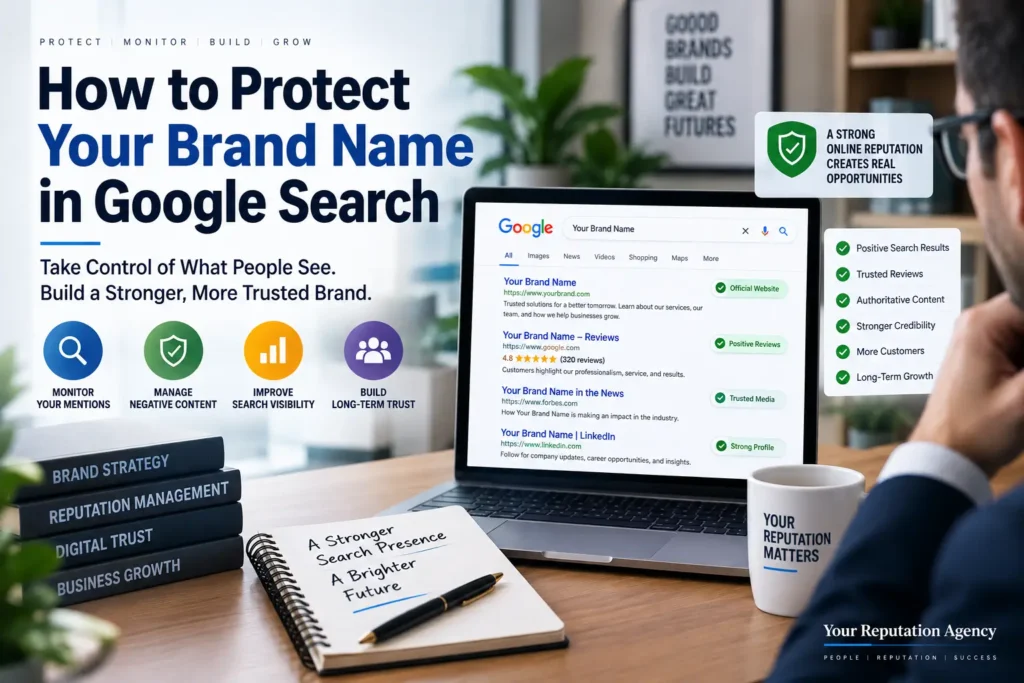
When someone searches your company, name, or personal brand on Google, the results often become the first impression they have of you. That is why learning How to Protect Your Brand Name in Google Search is not simply an SEO task. It is an important part of reputation management, customer trust, and long-term business growth.
A potential customer may search your business before contacting you. A prospective client may check your reviews before hiring you. An investor may search your CEO. A patient may research a doctor. A recruiter, partner, or journalist may also look at what appears under your name.
The challenge is that you do not fully control what other websites publish about your brand.
Negative reviews, outdated articles, misleading information, complaints, social media discussions, duplicate profiles, and unfavorable search results can all influence perception.
The good news is that protecting your brand in Google is possible through a strategic combination of monitoring, high-quality content, SEO, local presence, review management, and proactive online reputation management.
This guide explains exactly how to approach it—and when professional ORM support can make the process more effective.
Table of Contents
- Why Your Brand Name Matters in Google Search
- What Can Damage Your Brand Search Results?
- How to Protect Your Brand Name in Google Search
- Step-by-Step Brand Protection Strategy
- Google Search, AI Overviews, and AI Platforms
- Real-World Example
- Common Mistakes to Avoid
- Best Practices for Long-Term Brand Protection
- Expert Tips From an ORM Perspective
- When to Hire a Reputation Management Agency
- Frequently Asked Questions
- Conclusion
- Strong CTA
Why Your Brand Name Matters in Google Search
Your branded search results can influence whether someone decides to trust you.
For example, imagine two businesses offering the same service. One has a Google page filled with useful articles, positive reviews, authoritative mentions, and accurate company information.
The other has outdated information, unanswered complaints, inconsistent profiles, and negative third-party pages ranking prominently.
Even if both businesses provide excellent services, the second company may lose opportunities before the prospect ever makes contact.
Search reputation matters because people increasingly research organizations and professionals before making decisions.
Search Engine Journal describes online reputation management as an ongoing process of monitoring mentions and responding proactively to reputation issues rather than waiting for a crisis.
That is why your Google results should be treated as part of your brand’s digital assets.
What Can Damage Your Brand Search Results?
A brand’s search presence can be affected by many different sources.
Negative Reviews
Unfavorable reviews can influence potential customers, especially when they appear prominently for branded searches.
However, not every negative review should be removed. Legitimate customer feedback should be handled professionally. Removal requests should generally focus on content that violates the relevant platform’s policies.
Negative News or Articles
A negative article can continue ranking for your name long after the original event has faded from public attention.
The problem becomes more serious when the article is highly authoritative or continues receiving links and engagement.
Outdated Information
Old addresses, previous executives, discontinued services, outdated business descriptions, or old controversies can create an inaccurate picture of your current brand.
Inconsistent Business Information
Different names, addresses, phone numbers, biographies, or company descriptions across websites can make your online identity less consistent.
Social Media Problems
Old posts, controversial discussions, fake accounts, impersonation, or poorly handled complaints can become part of your branded search landscape.
Third-Party Websites
Forums, directories, review platforms, blogs, news websites, and industry publications can all influence what people see when they search your name.
AI-Generated Answers
Your reputation is no longer limited to traditional search results.
AI systems such as ChatGPT and Gemini can summarize information from multiple public sources. HubSpot notes that brand mentions increasingly occur across news, social platforms, reviews, forums, podcasts, and AI-generated answers.
That means protecting your brand now requires thinking beyond Google’s traditional blue links.
How to Protect Your Brand Name in Google Search
The most effective strategy is not to manipulate Google or simply try to hide negative information.
Instead, build a stronger, more accurate, trustworthy digital presence around your brand.
A comprehensive strategy typically includes:
- Monitoring branded search results
- Identifying reputation risks early
- Optimizing official brand properties
- Publishing useful, original content
- Strengthening authoritative third-party mentions
- Managing legitimate customer feedback
- Correcting inaccurate information where possible
- Improving local SEO
- Building positive search assets
- Monitoring executives and key employees
- Preparing for reputation crises
- Tracking visibility across AI search platforms
Google’s own guidance emphasizes helpful, reliable, people-first content rather than content created primarily to manipulate search rankings. That principle is particularly important when building a long-term brand reputation strategy.
Step-by-Step Brand Protection Strategy
Step 1: Search Your Brand Like a Customer
Start with a simple Google search.
Search for:
- Your company name
- Your exact brand name
- Brand name + reviews
- Brand name + complaints
- Brand name + scam
- Brand name + CEO
- Brand name + founder
- Brand name + location
- Your personal name
- Common misspellings of your brand
Do not only look at the first result.
Review at least the first two or three pages and record what appears.
Pay attention to:
- Positive results
- Neutral results
- Negative results
- Outdated information
- Duplicate profiles
- News coverage
- Review websites
- Social profiles
- Forum discussions
- Competitor comparisons
For ongoing visibility, businesses can establish a structured Reputation Monitoring process to identify changes before they become major problems.
Step 2: Build and Optimize Your Official Search Assets
Your website should clearly establish who you are, what you do, who you serve, and why customers should trust you.
Important brand assets include:
- Official website
- About page
- Leadership pages
- Service pages
- Author profiles
- Company social profiles
- Google Business Profile
- Industry profiles
- Professional directories
- Relevant media coverage
Keep your information consistent across these properties.
Your website should also publish genuinely useful content that demonstrates expertise.
This is especially important for businesses operating in high-trust industries such as healthcare, law, finance, consulting, real estate, and professional services.
Step 3: Create Content Around Your Brand
One of the strongest ways to strengthen branded search results is to create useful content that deserves to rank.
Consider publishing:
- Detailed service guides
- Expert articles
- Founder interviews
- Industry insights
- Customer education content
- Case studies
- FAQs
- Research-based articles
- Company announcements
- Thought leadership
The objective is not to publish dozens of low-quality pages.
Instead, create authoritative resources that answer questions your customers actually ask.
Bing’s current webmaster guidance similarly emphasizes discoverability, page quality, and established search optimization practices across Microsoft search and AI experiences.
Step 4: Strengthen Your Local Search Presence
For businesses serving specific locations, Google Maps and local search can be just as important as traditional organic rankings.
Make sure your business information is accurate and consistent.
Focus on:
- Google Business Profile
- Local citations
- Customer reviews
- Location pages
- Local service content
- Relevant business directories
- Local media
- Community involvement
A strong local presence can also support your broader branded search visibility.
For small and local businesses, our guide to Online Presence & Local SEO for Small Businesses explains how local visibility and reputation can work together.
Step 5: Manage Reviews Professionally
Reviews are often one of the first things people look for after searching a company.
Your objective should not be to eliminate every negative review.
Instead:
- Monitor new reviews.
- Identify legitimate customer concerns.
- Respond professionally.
- Resolve genuine service problems.
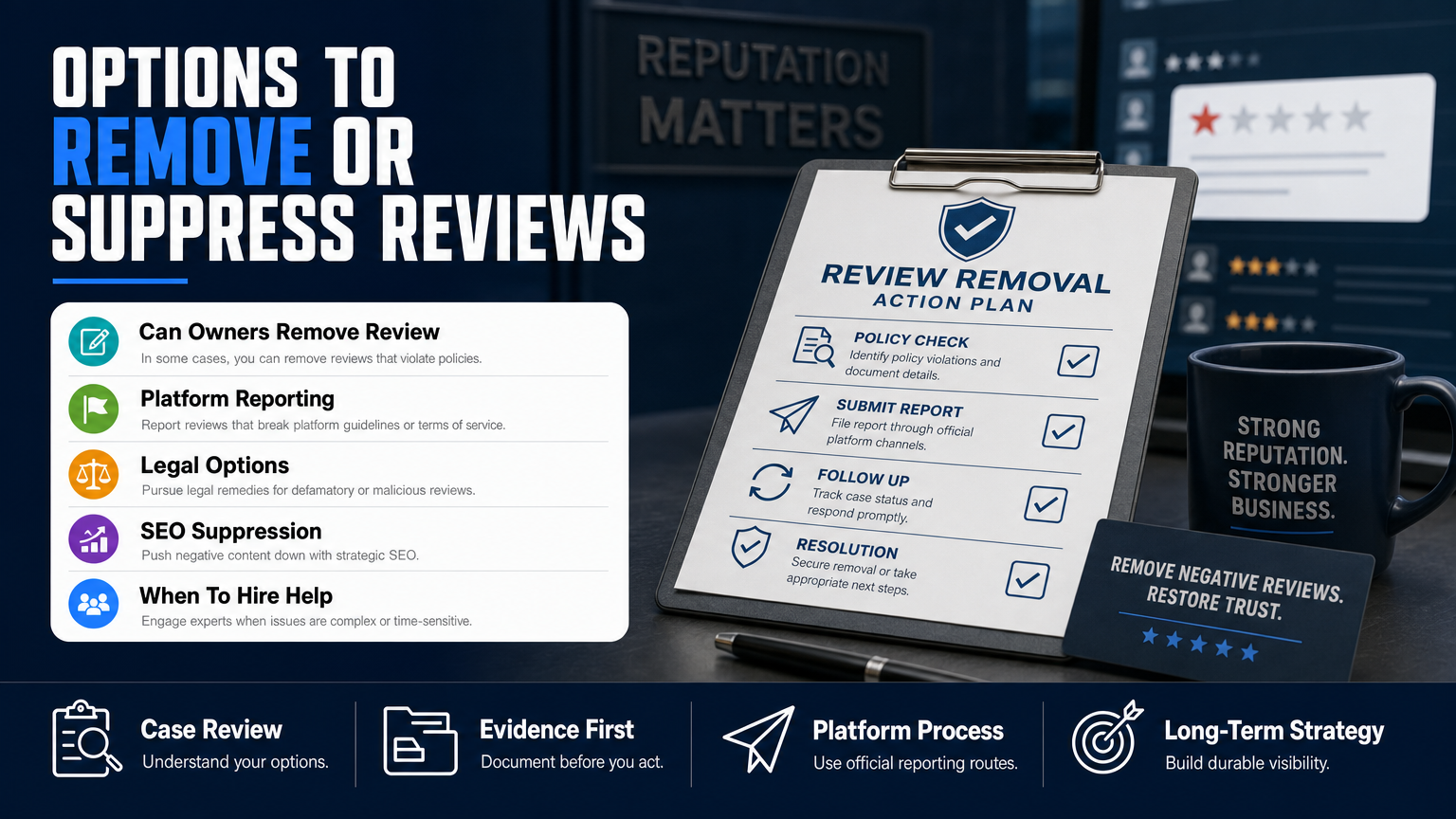
- Report reviews that violate platform policies.
- Encourage satisfied customers to leave honest feedback.
- Look for recurring problems.
A professional response can sometimes demonstrate more credibility than having no negative feedback at all.
Transparency matters.
Step 6: Develop Positive Third-Party Authority
Your own website is important, but third-party sources can strengthen credibility.
Potential sources include:
- Industry publications
- Professional associations
- Reputable business directories
- Interviews
- Podcasts
- News coverage
- Educational websites
- Partner websites
- Conference profiles
The focus should be quality rather than quantity.
Bing explicitly recommends organically earned, high-quality links and notes that trusted sites linking to useful content can contribute to authority and discoverability.
Google Search and AI Overviews: Protecting Your Brand Beyond Traditional SEO
Brand protection has expanded beyond Google’s standard search results.
Today, your brand may also be discussed or summarized by AI systems.
Potential surfaces include:
- Google AI Overviews
- ChatGPT
- Gemini
- Microsoft Copilot
- Perplexity
- Other answer engines
HubSpot’s current AEO documentation describes AI visibility in terms of how often brands are mentioned in tracked answer-engine responses and what sources those systems use.
This creates a new reputation challenge.
If public information about your business is inconsistent, outdated, or dominated by negative sources, AI systems may produce an incomplete or unfavorable summary.
That is why your ORM strategy should focus on making accurate, authoritative information available across the web.
This does not mean trying to control what an AI system says.
It means improving the quality, consistency, and credibility of the information available to those systems.
Real Example: How a Brand Can Recover Its Search Presence
Consider a fictional consulting company called Northstar Advisory.
A potential client searches:
“Northstar Advisory reviews”
The first page contains:
- The company’s official website
- Several positive industry mentions
- A professional LinkedIn profile
- An old complaint
- A review platform with mixed feedback
- An outdated directory profile
The company could react emotionally and demand that everything negative disappear.
That would be the wrong approach.
Instead, the company could:
- Audit the entire search landscape.
- Identify which results are actually harmful.
- Correct outdated business information.
- Improve its website’s authority and content depth.
- Respond professionally to legitimate reviews.
- Report policy-violating reviews where appropriate.
- Build relevant third-party authority.
- Publish useful expert content.
- Strengthen executive profiles.
- Monitor the search results continuously.
Over time, the goal is to create a more accurate and useful search environment where high-quality brand assets have a stronger opportunity to appear prominently.
This is the foundation of sustainable ORM.
Common Mistakes When Protecting a Brand Name
1. Ignoring the Problem
A negative result rarely becomes less important simply because you stop looking at it.
2. Trying to Remove Everything Negative
Not every negative result is removable.
Legitimate journalism, criticism, or customer feedback may remain online.
The better strategy is often to respond appropriately and strengthen the overall search ecosystem.
3. Publishing Low-Quality Content
Creating dozens of thin pages with your company name repeatedly can make your website look artificial rather than authoritative.
4. Keyword Stuffing
Repeating your company name unnaturally throughout content does not create trust.
Write for people first.
5. Buying Low-Quality Links
Cheap link packages can create unnecessary SEO risk.
Prioritize relevance, editorial value, and genuine authority.
6. Ignoring Executives
A company may have a strong corporate profile while its CEO or founder has damaging search results.
Executive reputation should be part of the wider brand strategy.
7. Waiting Until a Crisis Happens
Reactive reputation management is usually more difficult than proactive monitoring.
8. Forgetting AI Search
Traditional Google rankings are only one part of modern brand visibility.
Best Practices for Long-Term Brand Protection
A sustainable brand protection strategy should include the following:
| Area | Best Practice |
|---|---|
| Google Search | Monitor branded results regularly |
| Website | Publish useful, authoritative content |
| Reviews | Respond professionally and consistently |
| Local SEO | Keep business information accurate |
| Social Media | Maintain active, professional profiles |
| PR | Build credible third-party coverage |
| Executives | Monitor key people’s search presence |
| Content | Demonstrate real expertise |
| AI Search | Track brand mentions and citations |
| Crisis | Have a response plan before problems occur |
Google recommends creating helpful, reliable, people-first content, while Bing continues to emphasize quality, discoverability, and trustworthy information.
For brands operating in competitive markets, reputation should therefore be treated as an ongoing business function—not a one-time SEO project.
Expert Tips From an ORM Professional
Monitor More Than Your Exact Brand Name
Track variations, abbreviations, misspellings, product names, executive names, and important services.
Separate Reputation Problems From SEO Problems
A low ranking and a damaging result are not necessarily the same issue.
You need to understand why a result appears before deciding what action to take.
Focus on Search Intent
Someone searching:
“Company Name”
has a different intent from someone searching:
“Company Name reviews”
or:
“Company Name CEO”
Your reputation strategy should account for these different searches.
Track Sentiment, Not Just Rankings
A brand ranking #1 is not automatically successful if the surrounding search environment creates distrust.
Monitor:
- Positive mentions
- Negative mentions
- Review trends
- Search-result composition
- Brand visibility
- AI mentions
- Competitor visibility
HubSpot recommends tracking metrics such as mention volume, sentiment, share of voice, conversions, and AI visibility when evaluating brand mentions.
Protect Your Brand Before a Crisis
The strongest reputation strategy is often the one that starts before there is a serious problem.
Our Online Reputation Protection Services are designed around proactive monitoring, strategic content, search visibility, and reputation protection.
When Should You Hire a Reputation Management Agency?
DIY monitoring can work for a small personal brand with limited online exposure.
However, professional support becomes especially valuable when:
- Negative results rank prominently.
- Your business is receiving damaging reviews.
- A negative article is gaining visibility.
- Your CEO is facing reputation issues.
- False or misleading information is spreading.
- Your company is experiencing a public crisis.
- Your brand operates in a highly competitive industry.
- Your search results are inconsistent across platforms.
- You need ongoing monitoring and strategic content.
- Your reputation directly affects revenue.
For complex cases, a professional Reputation Management Agency can evaluate the entire search landscape instead of focusing on one isolated result.
Different situations also require different strategies.
A CEO may need executive-focused reputation work. A law firm may need review management. A doctor may need patient-review and professional-profile monitoring. A real estate professional may need local reputation protection.
The strategy should match the risk.
Reputation Protection Is a Long-Term Strategy
Protecting your brand name in Google is not about trying to make the internet say only positive things about you.
That is neither realistic nor sustainable.
The objective is to build a digital presence that accurately reflects your expertise, credibility, experience, and current brand.
That requires consistent work across:
- Search
- Content
- Reviews
- Local SEO
- Social media
- Public relations
- Third-party websites
- Executive profiles
- AI search visibility
For executives and founders, CEO Reputation Management can help address the personal search presence that often influences the perception of the company itself.
Similarly, organizations facing sudden negative attention may need Crisis Reputation Management rather than a standard SEO campaign.
Frequently Asked Questions
1. How to Protect Your Brand Name in Google Search?
To protect your brand name in Google Search, monitor branded results, maintain accurate online profiles, publish authoritative content, manage reviews professionally, strengthen trusted third-party mentions, and respond quickly to reputation threats. A long-term ORM strategy can help improve the quality and accuracy of information associated with your brand.
2. Can I remove a negative result from Google?
Sometimes, but not always. Google may remove certain content when it meets specific removal criteria, while other content must be addressed through the website owner, publisher, platform, or appropriate legal process. If removal is not possible, reputation management may focus on improving the overall search environment.
3. How long does it take to protect a brand’s Google search results?
There is no universal timeline. Results depend on the authority of negative pages, competition, existing brand assets, content quality, technical SEO, and how quickly new authoritative information can be established. Reputation management should therefore be treated as an ongoing process rather than a guaranteed short-term fix.
4. Should I respond to negative Google reviews?
Generally, legitimate negative reviews should be handled professionally rather than ignored. A thoughtful response can demonstrate accountability and customer care. However, reviews that violate platform policies may be eligible for reporting or removal through the appropriate process.
5. Does SEO help protect a brand name?
Yes. Strong SEO can help important, authoritative pages become more discoverable for branded searches. However, reputation protection requires more than rankings. Reviews, third-party mentions, social profiles, news coverage, and other online signals should also be considered.
6. Can AI search affect my online reputation?
Yes. AI systems can summarize information available across the public web. Inaccurate, outdated, inconsistent, or negative information may therefore influence how a brand is represented in AI-generated answers. Monitoring AI visibility is becoming an increasingly useful part of modern reputation management.
7. How often should I monitor my brand name on Google?
The ideal frequency depends on your industry and risk level. High-profile companies, executives, doctors, lawyers, and public-facing professionals may benefit from more frequent monitoring. Businesses with lower risk can establish a regular weekly or monthly review schedule.
For a deeper monitoring framework, see How Often Should You Monitor Your Online Reputation?.
8. Can I protect my personal name as well as my business name?
Yes. Personal reputation management can address search results associated with founders, executives, professionals, and personal brands. In many cases, protecting the individual’s search presence also supports the broader business reputation.
9. What should I do if I Google my name and find negative results?
First, do not react emotionally. Document the results, identify where they originate, determine whether the information is accurate, and assess whether removal, correction, response, or search visibility work is appropriate.
You can also review 7 Things That Happen When You Google Your Name and Find Negative Results for a practical framework.
10. Is brand reputation management the same as deleting negative content?
No. Deletion is only one possible solution. Reputation management can involve monitoring, correction, review response, content strategy, SEO, public relations, search suppression, and proactive brand protection.
Featured Snippet Answer
How to Protect Your Brand Name in Google Search: Monitor branded searches regularly, keep business information accurate, publish helpful and authoritative content, manage reviews professionally, strengthen trusted third-party mentions, protect executive profiles, and respond quickly to reputation threats. A professional ORM strategy can help build a stronger and more trustworthy search presence over time.
Conclusion: How to Protect Your Brand Name in Google Search
Knowing How to Protect Your Brand Name in Google Search is increasingly important for businesses, executives, entrepreneurs, professionals, and personal brands.
Your search results can influence trust before a customer ever speaks with you.
The most effective approach is not to chase every negative result or publish endless promotional content. Instead, build a strong digital ecosystem around your brand.
Monitor what people see.
Correct inaccurate information where possible.
Respond professionally to legitimate criticism.
Create genuinely useful content.
Strengthen authoritative third-party mentions.
Maintain consistent local and social profiles.
And monitor how your brand appears across both traditional search and emerging AI answer engines.
For businesses that depend heavily on credibility, reputation should be treated as an asset that deserves continuous protection.
Protect Your Brand Before Search Results Become a Business Problem
If your company name, CEO name, or personal brand is producing concerning results on Google, don’t wait for the problem to become more difficult to manage.
At Your Reputation Agency, we help businesses, executives, professionals, and personal brands understand what is appearing online and develop strategic reputation protection plans based on their specific situation.
Our approach can include reputation monitoring, search visibility strategy, content development, review management, executive reputation protection, and crisis response.
If you are ready to take control of your digital reputation, Contact Us for a professional reputation assessment.
You can also review our broader Reputation Management Services to understand how a comprehensive ORM strategy can support your brand.
Your reputation is already being searched. Make sure the information people find reflects the brand you have worked to build.
You can also review independent client feedback on Trustpilot.