You sell marketing, listings, or PR services and a client calls because a negative search result or review is costing them clients. White label reputation management services promise an instant offering you can resell, but the reality is more complex.
This article explains what white label reputation management services are, how pricing and delivery typically work, which CRMs you can white label, and how to integrate takedowns, suppression and crisis response into your agency offering. The phrase white label reputation management services appears because you need clear language to evaluate vendor contracts and client expectations.
I’ll lay out realistic cost ranges, implementation steps, and what to do when removal is not an option. You’ll get concrete onboarding checklists and vendor-selection criteria so you can offer a trustworthy service without overpromising.
Table of Contents
- What Are White Label Services — And How Do They Apply to Reputation?
- How Much Do Reputation Management Services Typically Cost?
- How Much Does An ORM Typically Cost?
- What CRMs Can You White Label?
- How To Choose A White‑Label Reputation Partner
- What To Do When Removal Is Not Available
- Implementation: Onboarding, Reporting, and Pricing Models
- Legal Limits, Platform Policies, and When To Escalate
- How To Present White‑Label Reputation Services To Your Clients
- Removal vs Suppression: Which To Use?
- Hypothetical Example: A Clinic, A Viral Post, And A White‑Label Partner
- Common Mistakes Agencies Make When Reselling ORM
- Best Practices For Reselling White‑Label Reputation Services
- Expert Tips
- Conclusion
- Why Businesses Choose Your Reputation Agency
- Frequently Asked Questions
What Are White Label Services — And How Do They Apply to Reputation?
White label services let one company resell another company’s product or platform under the reseller’s brand. In reputation management that can mean software (review-collection dashboards, monitoring), managed services (takedown work, opt-outs, escalation), or a combination.
For an agency, white label reputation management services typically bundle software, reporting, and backend operational work (research, legal referrals, takedown requests) that you rebrand and present to clients as your capability.
Important: white labeling changes the customer relationship but not platform policy. The vendor still performs the underlying work and platform decisions remain under the platform’s control.
- Confirm scope: which tasks the vendor performs versus your agency responsibilities.
- Review SLAs: ensure response times, reporting cadence, and confidentiality clauses are explicit.
- Ask about escalations: legal coordination, PR support, and high-priority incidents.
- Software-only white label: rebrand a SaaS dashboard for reviews, monitoring, and reports.
- Managed white label: the vendor performs remediation (opt-outs, takedown requests) on your behalf.
- Hybrid: software plus a defined number of managed tasks per month.
When white label is appropriate
You lack the bandwidth or deep technical/legal knowledge to perform ORM in-house but want to keep client billing and branding. White label is efficient for recurring review solicitation, monitoring, and low-to-medium complexity removals.
- Recurring monitoring and review management
- Standardized opt-outs from data brokers
- Routine takedown requests for policy violations
When white label is not enough
High-stakes litigation, defamation claims, or large-scale viral crises often require direct legal counsel and bespoke PR. A white-label vendor may help, but you should coordinate with outside counsel.
- Allegations that risk licensure or criminal exposure
- Complex media law or multi-jurisdictional litigation
- Coordinated reputation attacks requiring bespoke investigation
How Much Do Reputation Management Services Typically Cost?
Pricing for white label reputation work varies with service depth. Core drivers are whether the offering is software-only or includes managed labor, the geographic scope (single state vs national publishers), and how many seats or clients you run through the system.
Below are typical ranges you’ll encounter when evaluating vendors. These are industry ranges intended to set expectations — final pricing depends on the vendor, the case complexity, and negotiated contract terms.
- Request a detailed SKU list showing what’s included at each tier.
- Ask for sample white-label reports and API documentation for branding.
- Confirm billing model: per-seat, per-client, per-task, or revenue share.
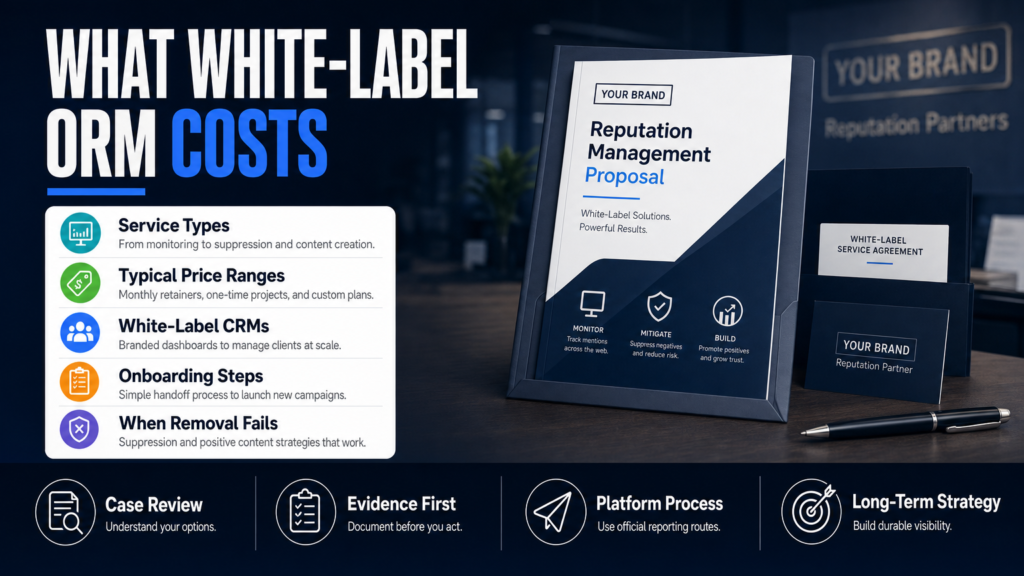
- Software-only (white label dashboard, monitoring, review collection): $50–$400/month per client seat.
- Basic managed packages (monitoring + review responses + opt-outs): $400–$1,500/month per client.
- Mid-tier managed (includes takedowns, data broker opt-outs, monthly SEO suppression): $1,500–$5,000/month per client.
- High-touch crisis management (rapid incident response, PR, legal coordination): $5,000–$20,000+/month or project retainers.
Hidden costs to watch for
Some vendors charge for review responses, manual takedowns, or per-publisher fees. Also confirm who pays for ad spend, content creation, or PR placement if those services are used.
- Per-takedown fees for manual work
- Extra charges for legal coordination
- Setup fees for white labeling and custom reporting
How Much Does An ORM Typically Cost?
Online Reputation Management (ORM) as a standalone engagement is often priced differently than white-label software. ORM implies strategy, content creation, SEO suppression, and sometimes legal coordination.
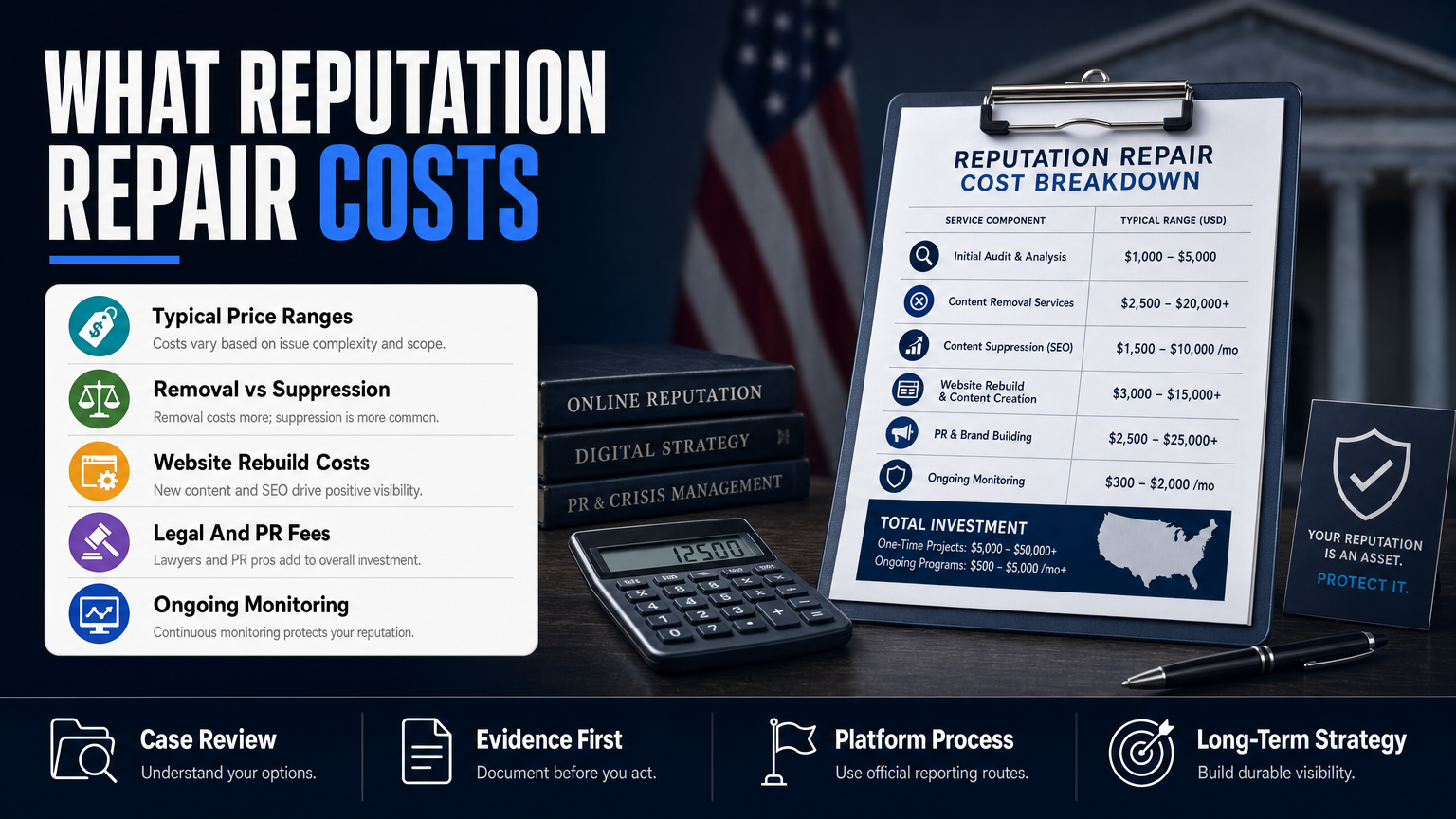
Typical ORM retainer ranges for small-to-medium businesses in the U.S. are: monthly retainers between $2,000 and $10,000, with one-time project fees for intensive suppression programs that can be $5,000–$50,000 depending on complexity.
- Estimate hours: map required work — takedowns, SEO content, link-building, PR outreach.
- Add platform costs: paid placements, monitoring tools, and software licenses.
- Include contingency: legal referrals or expedited removal requests may add cost.
- Small business (targeted suppression + monitoring): $2,000–$4,000/month
- Professional or multi-location business: $4,000–$10,000/month
- Major incidents or enterprise suppression programs: $10,000+/month or project-based pricing
What affects the bill
Volume of negative items, the authority of the publishers, the need for original positive content, and geographic reach all increase time and cost. ORM is a continuous process — not a one-off fix.
- High-authority publishers (news outlets) require more PR/legal effort
- Large numbers of listings or reviews increase manual work
- International exposure adds jurisdictional complexity
What CRMs Can You White Label?
CRM choice depends on whether you need only client relationship features or integrated reputation workflows (reviews, tickets, tasks, reporting). Many platforms offer white-label or reseller programs.
Common choices that agencies white label or integrate with include HubSpot (paid tiers), Zendesk, Freshdesk, Agency-specific platforms like Grade.us, Reputation.com (partner programs), BirdEye, and dedicated review-collection tools like EmbedReviews/EmbedMyReviews.
- Define required features: client portals, automated reports, review invites, integrations (Google/Yelp/TripAdvisor).
- Check white-label options: custom domain, logo, email templates, and API access.
- Verify billing and seat management for your reseller model.
- HubSpot: strong API and branding options for agencies on paid tiers
- Zendesk/Freshdesk: ticketing-first CRMs that integrate review alerts
- Grade.us / EmbedMyReviews: built for agencies with white-label dashboards
- Custom dashboards via vendor APIs if you need bespoke branding
Integration notes
If you plan to resell review responses or takedown work, ensure the CRM supports task assignments, evidence uploads, and audit trails. This is crucial for compliance and later legal coordination.
- Audit logs for takedown requests
- Evidence attachments and version history
- Role-based access for your team and vendor
How To Choose A White‑Label Reputation Partner
Picking a vendor is both technical and operational. Evaluate their platform, escalation processes, experience with the publishers you care about (Google, Yelp, Trustpilot, news publishers), and contract terms.
Ask for references, ask about average response times, and confirm who owns client data and branding assets after contract termination.
- Run a short pilot: pick 2–3 clients and test monitoring, report templates, and a single takedown flow.
- Measure time-to-first-action and the completeness of reporting.
- Negotiate exit clauses so you retain client access to their data on termination.
- Proof of process: sample reports, redaction logs, and documented escalation paths
- Transparency of work: who will perform takedowns, and what evidence is required
- Data ownership & portability: can you export client data and client-branded reports?
Contract clauses to insist on
Service-level commitments (not absolute guarantees), confidentiality terms, non-solicit clauses, and a clear scope for legal referrals or PR work.
- Explicit list of included services per price tier
- Clear limits on per-takedown fees and pass-through expenses
- Data export and branding-reversion rights
What To Do When Removal Is Not Available
Sometimes platforms or publishers refuse removal: the content is truthful, a public record, or the publisher denies policy violations. When removal is unavailable, effective white label reputation management services shift to mitigation and suppression.
Mitigation is a mix of technical SEO, new authoritative content, correction requests, and PR. The goal is to reduce visibility and contextualize the record, not to pretend it never happened.
- Audit search landscape: identify pages on page one and their ranking signals.
- Create a suppression plan: set goals for replacing 3–7 search results with owned, high-quality content.
- Execute and monitor: publish content, build links, and measure SERP movement; adjust strategy quarterly.
- SEO suppression: publish and promote authoritative pages that outrank the negative item
- Correction requests: ask publishers for clarifications or updates when factual errors exist
- Contextualization: responses, statements, and FAQs hosted on owned channels
A word on apologies and public statements
Public apologies or statements can help, but they must be handled carefully. Poorly framed videos or reactive social posts sometimes amplify the issue rather than quiet it; see our analysis on Why An Apology Video On TikTok Often Makes Crises Worse.
- Coordinate legal and PR review before publishing
- Avoid reactive, unvetted messaging that repeats allegations
- Use owned channels first (website, email) before mass public posts
Implementation: Onboarding, Reporting, and Pricing Models
A repeatable onboarding process separates reputable vendors from those that sell features without operational depth. A white label agreement should include a clear technical onboarding (DNS for custom domain, SSO if needed), client onboarding checklist, and reporting cadence.
Reporting must be brandable and auditable so your client sees the work. Decide whether you bill clients directly or resell at a markup — both are common.
- Collect client permissions and logins securely; do not store passwords in public channels.
- Run a baseline reputation audit and present a 30/90/180-day plan.
- Agree KPIs: reduction in negative visibility, time-to-first-action, or review-response SLAs.
- Onboarding: client intake form, evidence collection templates, access permissions
- Reporting: monthly branded PDF, live client portal, executive incident brief
- Pricing: subscription per-seat, per-client retainer, or revenue-share reseller
Billing and margins
Margins on white-label services vary; many agencies look for 20–50% markup on monthly software and 30–100% on labor where appropriate. Be transparent with clients about outsourced work when required by contract or ethics.
- Factor in support hours and escalation handling
- Price crisis retainers separately
- Avoid hidden pass-throughs that erode trust
Legal Limits, Platform Policies, and When To Escalate
White label vendors use platform reporting tools and existing legal pathways. Platform decisions remain under the platform’s control and timelines vary. The content may warrant legal review; coordinate with counsel when necessary.
Escalate to legal counsel when you have alleged defamation, subpoenas, doxxing that threatens safety, or when a publisher demands settlement or threatens litigation.
- Collect and preserve all evidence in an access-controlled system.
- Ask the vendor if they include legal referrals or a counsel coordination process.
- If safety is at risk, involve law enforcement and counsel immediately.
- Use platform reporting processes first for policy violations
- Preserve evidence: screenshots, timestamps, and links
- Coordinate with a qualified attorney when content involves potential defamation or criminal threats
When Google Reviews escalate into a crisis
Google Reviews can become a brand’s biggest operational problem when they affect patient intake, hiring, or licensing. For an overview of review-driven crises and response protocols, review our piece on When Google Reviews Become a Brand’s Biggest Crisis.
- Document each review and response
- Use legitimate correction requests for factual errors
- Avoid incentivizing fake reviews — it violates platform policies
How To Present White‑Label Reputation Services To Your Clients
Sell outcomes you can control: response time, reporting quality, and escalation processes — not promises of removal or guaranteed rankings. Define success metrics that matter to the client (reduction in negative leads, time to mitigate false claims, response SLAs).
Be transparent about what is handled in-house versus outsourced, and ensure contract language permits you to disclose vendor involvement if ethical or legal issues demand it.
- Show a sample client portal and report during sales meetings.
- Include an emergency contact and escalation flow in proposals.
- Create a standard consent form for evidence collection and platform access.
- Sell process and transparency, not impossible guarantees
- Offer tiered options: monitoring-only, managed, and crisis retainer
- Match SLAs to client risk — physicians and lawyers often need faster response windows
Use cases and client education
Educate clients on what constitutes a platform-policy violation versus an opinion. This reduces unrealistic expectations and speeds decision-making when incidents occur. If the issue started with an employee or insider, see our analysis of When a Former Employee Becomes a Brand’s Biggest Search Result.
- Differentiate defamation vs negative opinion
- Explain the data-broker opt-out process
- Demonstrate suppression vs removal with examples
Removal vs Suppression: Which To Use?
Choose removal when policy or law supports it; choose suppression when removal is unlikely.
| Removal | Suppression |
|---|---|
| Goal | Goal |
| Eliminate the specific item from a platform | Reduce visibility by outranking the item |
| Best for policy violations or illegal content | Best for truthful but damaging content |
| Depends on platform decisions or publisher cooperation | Depends on content creation, SEO, and link building |
| Potentially faster if policy triggers apply | Takes weeks to months and requires ongoing work |
| May require legal steps for private publishers | Avoids litigation but requires budget for content/PR |
Hypothetical Example: A Clinic, A Viral Post, And A White‑Label Partner
A fictional clinic (Midtown Dermatology) finds a 2019 blog post alleging malpractice appearing on page one for its lead surgeon. The clinic hires an agency that resells a white-label reputation platform with managed takedown and suppression services.
Process: the agency runs a baseline audit, collects evidence showing factual errors, and submits a policy takedown to the publisher and to aggregators. The publisher refuses removal because it cites a public court docket. The vendor then begins a suppression campaign: new bios, patient stories, press releases, and targeted SEO to rank owned pages above the blog post.
Outcome: within three months the clinic controls three of the top seven search results. The original blog remains but receives less traffic; the clinic also secured corrected information on a secondary aggregator, reducing repeated citations.
- 1) Run a search result snapshot and preserve evidence
- 2) Submit publisher correction and platform reports for policy violation
- 3) If denied, deploy SEO suppression: high-quality pages, citations, and links
- 4) Monitor and report monthly; adjust tactics if new results appear
- Audit and evidence collection first
- Attempted removal when policy/legal grounds exist
- Suppression when removal is denied
Common Mistakes Agencies Make When Reselling ORM
Avoid these frequent errors when evaluating or operating white-label reputation offerings.
Mistake 1 — Overpromising Removals
Claiming guaranteed removal or fixed timelines damages trust. Platform decisions and publisher cooperation are outside your absolute control. Promise process and escalation, not outcomes.
- Use language like: ‘We evaluate whether content may qualify for removal or review.’
- Provide realistic ranges and document dependencies
Mistake 2 — Choosing Software Without Operational Depth
A flashy dashboard is not the same as experienced takedown operators. Ensure the vendor has human teams for complex removals and legal referral pathways.
- Ask for examples of publisher-level escalations
- Verify manual takedown staffing and expertise
Mistake 3 — Skipping a Pilot
Signing a long-term white-label deal without a pilot hides operational problems until after you’ve resold the service to clients. Always trial the vendor on a small set of accounts.
A pilot reveals real response times, reporting quality, and hidden fees.
- Run a 60–90 day pilot on 2–3 clients
- Measure delivery against SLAs before scaling
Mistake 4 — Poor Client Consent and Access Procedures
Failing to obtain clear client consent or secure access can create legal and privacy risks. Use documented consent forms, and limit access to necessary personnel.
Also confirm who stores evidence and how long it’s retained.
- Use secure credential handover procedures
- Define retention and export rights in the contract
Mistake 5 — Treating ORM as One-Off
Reputation is ongoing. Treating remediation as a single project leaves clients exposed to repeat incidents. Offer monitoring retainers and escalation pricing.
- Sell monitoring + incident retainer packages
- Schedule quarterly audits and refresh suppression content
Best Practices For Reselling White‑Label Reputation Services
Implement these durable practices to protect your clients and your agency’s reputation.
Documented Intake And Evidence Procedures
Use a consistent intake form that captures URLs, screenshots, dates, and client statements. Preserve evidence immediately and store it in an access-controlled folder to support takedown requests or legal review.
- Immediate screenshots and archival URLs
- Standardized incident intake for each client
Clear, Honest SLAs
Publish clear SLAs that describe response times, reporting cadence, and escalation paths. Distinguish between ‘first action’ and ‘resolution’ to avoid confusion.
- First action SLA (e.g., 24–72 hours)
- Resolution timelines described as estimates, not guarantees
Regular Client Education
Teach clients how platform policies work, what constitutes a policy violation, and why some items cannot be removed. This reduces surprises and speeds approvals when responses are needed.
- Quarterly training calls
- One-page summaries for clients on policies and expected outcomes
Tight Security And Data Controls
Limit access to client credentials and use SSO or tokenized access where possible. Maintain role-based access control for all vendor staff working on client files.
- Use password managers and limited-view credentials
- Define breach response plan in contracts
Coordinate With Legal And PR Early
When issues risk licensure, litigation, or serious reputational harm, involve counsel and PR before public statements. Vendors should have documented legal referral procedures.
- Pre-approved counsel contact in emergency
- Shared playbooks for media statements
Expert Tips
- Pilot every white-label vendor with low-risk clients for 60–90 days.
- Negotiate data portability and export rights in your vendor contract.
- Price crisis response as a separate retainer with guaranteed first-response windows.
- Require role-based access and use SSO where possible to protect credentials.
- Ask vendors for anonymized redaction logs to verify takedown activity.
- Measure success by client business outcomes, not just removed URLs.
- Avoid promising removal — promise a proven process and transparent reporting.
- Keep a vetted list of local counsel for rapid escalation in key jurisdictions.
Conclusion
White label reputation management services let agencies expand offerings quickly, but only if you pair technology with documented processes, pilot testing, and honest client communication. Treat vendors as operational partners — insist on evidence, clear SLAs, and exportable data.
If removal is the goal, evaluate whether policy, evidence, and jurisdiction support it; if removal is unavailable, have a suppression and messaging plan ready. The best resellers sell a predictable process and clear escalation paths, not miracle fixes.
Why Businesses Choose Your Reputation Agency
Managing your reputation takes more than monitoring reviews or publishing the occasional blog post. It takes a strategy built around your situation, your industry, and what is actually showing up in search.
Your Reputation Agency works with businesses, executives, healthcare professionals, attorneys and growing brands. Our services include:
- Remove defamatory content and false posts (news, blogs, listings)
- Remove or challenge negative reviews (Google, Yelp, TripAdvisor, industry sites)
- Mugshot and arrest record removal
- Remove videos, images, and other multimedia that damage reputation
- Remove personal data from people‑search and data‑broker sites (opt‑outs)
- Search result suppression (SEO to bury negative links)
- Social media takedowns and impersonation removal
- Rapid online crisis management and incident response
- Ongoing monitoring and alerting of reputation signals
- Coordination with legal counsel and use of legal tactics when required
Frequently Asked Questions
1. How much do reputation management services typically cost?
Typical costs depend on scope. Software-only white-label platforms run $50–$400/month per client seat. Managed packages range from $400–$5,000/month per client depending on tasks. High-touch crisis retainers start higher. Always confirm what’s included and watch for per-takedown fees.
2. How much does an ORM typically cost?
ORM retainers for U.S. professionals commonly run $2,000–$10,000/month. One-time suppression projects can be $5,000–$50,000 depending on content authority and the volume of work. Exact pricing depends on the need for legal coordination, PR, and original content creation.
3. What CRMs can you white label?
Agencies commonly white label platforms like HubSpot (paid tiers), Zendesk, Freshdesk, Grade.us, Reputation.com partner programs, and dedicated review tools like EmbedMyReviews. Choose a CRM that supports branding, API access, and audit logs for takedowns.
4. What are white label services?
White label services are products or services created by one company and rebranded by another for resale. In reputation management, that can mean reselling dashboards, monitoring, or managed takedown and opt-out work under your agency’s brand.
5. Can you guarantee removal or permanent suppression?
No—reputable firms do not guarantee removal or permanent suppression. Platform decisions, publisher cooperation, and search algorithms are outside an agency’s full control. Promise a documented process and realistic timeframes instead.
6. How do you handle a crisis that requires legal action?
Coordinate with qualified legal counsel. White-label vendors may offer legal referrals or coordinate evidence packages, but a licensed attorney should assess defamation claims, subpoenas, and jurisdictional issues before litigation begins.
7. What do I do if a white-label vendor fails to deliver?
Use your pilot data and SLA reports to document breaches. Rely on contract exit clauses, request immediate data export, and move clients to alternative providers as needed. Always retain copies of client-facing reports and archived evidence.
8. Are there affordable white-label options for small agencies?
Yes—software-only white-label dashboards and review-collection tools can be affordable. However, be honest with clients about what the inexpensive tiers don’t include: manual takedowns, PR, or legal coordination usually cost extra.
9. How long does suppression take if removal is unavailable?
Suppression timelines vary. You may see movement in weeks for low-authority pages, but replacing high-authority results (news outlets, established blogs) can take months to a year. Timing depends on SEO work, content authority, and competing pages.
This content provides general information and does not constitute legal advice. The available options and likely outcomes depend on the facts, evidence, platform policies, applicable law, jurisdiction, and public-interest considerations.
Past examples do not guarantee future results. Removal, correction, deindexing, and search-position changes depend on third parties and circumstances outside Your Reputation Agency’s control.