Introduction
If you are a business owner, CEO, entrepreneur, doctor, lawyer, real estate professional, agency owner, or personal brand, people may search your name on Google before they decide to work with you.
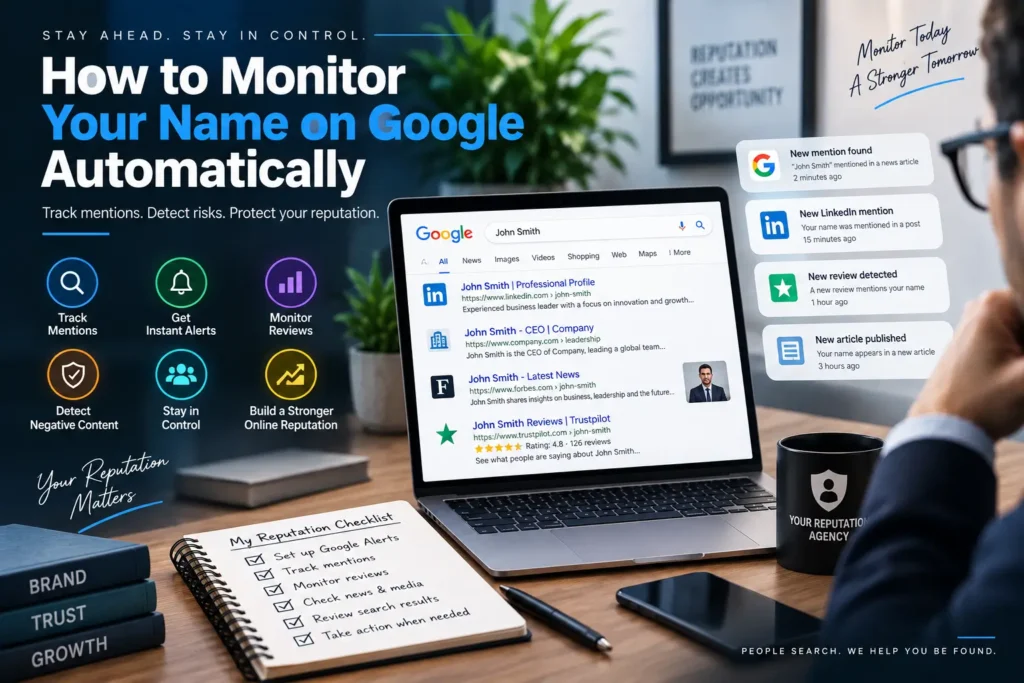
That is why learning how to monitor your name on Google automatically is more than a convenience. It is a practical part of protecting your digital reputation.
A new review, article, social media mention, forum post, or news story can appear without your knowledge. Sometimes the information is positive. Sometimes it is neutral. And sometimes it can create a serious reputation problem.
The good news is that you do not need to search your name manually every day.
You can build an automated monitoring system using Google Alerts, search monitoring, review tracking, social listening, and regular reputation checks. However, alerts are only the first step. The real value comes from understanding what a new result means and deciding what to do next.
Google recommends helpful, reliable, people-first content and emphasizes making important content discoverable through appropriate links and clear site structure.
For reputation management, that means monitoring what already exists while continuously building an accurate, trustworthy digital presence.
Table of Contents
- What Does It Mean to Monitor Your Name on Google?
- Why Automatic Name Monitoring Matters
- How to Monitor Your Name on Google Automatically
- What Should You Monitor?
- Google Alerts vs. Professional Reputation Monitoring
- How to Monitor Your Name Across Google, Bing, and AI Search
- Real Example: Monitoring a CEO’s Reputation
- Common Reputation Monitoring Mistakes
- Best Practices for Automatic Reputation Monitoring
- Expert Tips for Business Owners and Professionals
- When You Need Professional Reputation Management
- Frequently Asked Questions
- Conclusion
- Strong CTA
What Does It Mean to Monitor Your Name on Google?
Online reputation monitoring means keeping track of what people can discover about you or your organization across search engines and other digital platforms.
When you monitor your name, you are looking for changes such as:
- New search results
- News coverage
- Customer reviews
- Social media mentions
- Blog articles
- Forum discussions
- Business directory listings
- Videos
- Images
- Public complaints
- Negative or misleading information
Automatic monitoring means creating systems that notify you when something new appears.
For example, Google Alerts can notify you when Google finds new search results related to a topic you specify. You can create alerts for your name, company, brand, product, or other important terms.
However, your exact name should not be the only thing you monitor.
A complete monitoring strategy should consider your personal identity, company, executives, brand, products, locations, and reputation-related search terms.
Why Automatic Name Monitoring Matters
Your online reputation can influence whether someone decides to contact you, purchase from you, hire you, recommend you, or investigate your company further.
For a CEO, the personal name and company brand are often connected. For a doctor or lawyer, reviews and search results can influence whether a potential client makes an appointment. For an entrepreneur or personal brand, search visibility can influence partnerships and opportunities.
Forbes has described online reputation as an important digital asset for modern executives because what people discover online can affect stakeholder trust and professional opportunities.
Early detection gives you more options
Imagine a negative article appears today.
If you discover it quickly, you may have time to:
- Verify the information
- Contact the publisher
- Request a correction when appropriate
- Report policy-violating content
- Prepare a professional response
- Publish accurate supporting information
- Strengthen relevant positive content
- Monitor its search visibility
The longer a reputation issue goes unnoticed, the harder it can become to understand and manage.
Automatic monitoring does not guarantee that harmful content can be removed. Instead, it gives you something extremely valuable:
Early awareness.
How to Monitor Your Name on Google Automatically
The easiest place to start is Google Alerts.
Step 1: Create a Google Alert for your name
Create an alert using your full name.
For example:
"John Michael Smith"
You can also create alerts without quotation marks when you want broader matching.
Google allows users to customize alert settings, including frequency, sources, language, region, and the number of results.
Step 2: Create multiple alerts
Do not rely on one alert.
Consider monitoring:
"Your Full Name""Your Full Name" + company"Your Full Name" + reviews"Your Full Name" + complaint"Your Full Name" + news"Your Company Name""Your Brand Name"- Common misspellings
- Important executives
- Product or service names
You do not need dozens of alerts.
The objective is to identify meaningful reputation changes without creating unnecessary notification noise.
Step 3: Search your name manually
Automation should support manual search rather than replace it.
Periodically search your name and review:
- Google Search
- News
- Images
- Videos
- Local results
- Reviews
- Social profiles
- Third-party websites
Search results can differ based on factors such as location, personalization, device, and search context. Therefore, one search should not be treated as a perfect representation of what everyone sees.
Step 4: Maintain a reputation monitoring log
Create a simple spreadsheet or internal document.
| Information | What to Record |
|---|---|
| Search term | Name, company, brand |
| URL | Source of the mention |
| Date | When it was discovered |
| Sentiment | Positive, neutral, negative |
| Visibility | Page 1, Page 2, etc. |
| Source type | News, review, social, forum |
| Risk | Low, medium, high |
| Action | Monitor, respond, report, escalate |
This makes your monitoring process repeatable instead of reactive.
For businesses that want a more structured approach, professional Reputation Monitoring can help identify important mentions and potential reputation risks before they become larger problems.
What Should You Monitor?
A strong reputation monitoring system starts with the right search terms.
Personal reputation terms
Monitor:
- Full name
- Name variations
- Nicknames used professionally
- Common spelling mistakes
- Professional title
- Certifications
- Public usernames
- Previous professional identities
Business reputation terms
For companies, monitor:
- Company name
- Brand name
- Product names
- Founder name
- CEO name
- Company + reviews
- Company + complaints
- Company + news
- Company + customer service
Reputation-risk terms
Depending on your industry, you may also monitor combinations involving terms such as:
- Review
- Complaint
- Scam
- Fraud
- Lawsuit
- Warning
- Investigation
- Controversy
- Experience
- Problems
The important point is to keep your monitoring relevant.
More alerts do not necessarily mean better monitoring.
Better monitoring means better signal.
Google Alerts vs. Professional Reputation Monitoring
Google Alerts is useful for basic awareness, but it is not a complete ORM system.
| Capability | Google Alerts | Professional ORM |
|---|---|---|
| Name alerts | Yes | Yes |
| Basic web mentions | Yes | Yes |
| Search-result analysis | Limited | Yes |
| Review monitoring | Limited | Yes |
| Social monitoring | Limited | Yes |
| Sentiment analysis | Limited/No | Often available |
| Reputation risk assessment | No | Yes |
| Strategic response | No | Yes |
| Crisis management | No | Yes |
| Search-result strategy | No | Yes |
| Long-term reputation planning | No | Yes |
This is why businesses often use alerts as an early-warning mechanism while relying on a broader ORM strategy for analysis and response.
If you need a broader service framework, Reputation Management Services can combine monitoring with reputation strategy, search visibility, content, reviews, and other protective measures.
How to Monitor Your Name Across Google, Bing, and AI Search
Google is important, but it is no longer the only place where people discover information.
Today, your digital reputation can appear through:
- Google Search
- Google AI features
- Bing
- Microsoft Copilot
- ChatGPT
- Gemini
- Social networks
- Review platforms
- News websites
- Forums
- Industry publications
Microsoft’s current Webmaster Guidelines state that core SEO fundamentals also support Bing, Copilot, and AI-powered search experiences. Microsoft specifically highlights crawlable internal links, clear content structure, useful content, authority, and trust.
Bing also provides an AI Performance report that shows how pages from a site are cited in supported AI-generated answers across Microsoft Copilot and Bing’s AI experiences.
What should you check?
Search questions that a real customer might ask.
For example:
- “Who is [Name]?”
- “What is [Name] known for?”
- “Is [Company] reputable?”
- “What do people say about [Company]?”
- “Is [Professional] trustworthy?”
- “What are the reviews for [Business]?”
The purpose is not to manipulate AI systems.
Instead, you want to understand what information they can discover and whether important facts about your identity, company, expertise, and reputation are represented accurately.
Real Example: Monitoring a CEO’s Reputation
Consider a hypothetical CEO named Michael.
Michael runs a growing technology company.
His Google results look mostly positive, but he has never actively monitored his name.
He creates alerts for:
"Michael Johnson""Michael Johnson" CEO"Michael Johnson" company"Michael Johnson" reviews- Company name
- Common spelling variations
Several weeks later, a website publishes an article containing outdated information about his company.
Michael receives an alert.
Instead of discovering the article months later, his team reviews it immediately.
They determine that:
- Some information is outdated.
- The publisher is legitimate.
- A correction request may be appropriate.
- The company’s current information should be clearly published elsewhere.
- The result should be monitored over time.
The team documents the issue and takes an appropriate response.
This is the real benefit of automatic monitoring.
You gain time to make a thoughtful decision.
Common Reputation Monitoring Mistakes
1. Monitoring only your exact name
Your reputation can be influenced by your company, executives, products, reviews, social profiles, and other entities connected to you.
2. Monitoring only Google
Important conversations can start on social media, review sites, forums, and news publications.
3. Ignoring positive mentions
Positive coverage can become valuable reputation assets.
Keep track of:
- Positive press
- Interviews
- Awards
- Customer stories
- Expert contributions
- Industry publications
4. Responding emotionally
A negative review or article can feel personal.
Do not immediately argue with the author.
First determine:
- Is the statement factual?
- Is it opinion?
- Is it inaccurate?
- Does it violate platform rules?
- Does it have significant visibility?
- Is a response necessary?
5. Trying to remove legitimate criticism
Ethical reputation management is not about hiding genuine customer feedback.
If criticism is legitimate, the better response may involve addressing the underlying issue and responding professionally.
Removal or reporting should be based on legitimate grounds, such as applicable platform policies or inaccurate content—not simply because the information is unfavorable.
6. Receiving alerts but taking no action
A monitoring system is only useful if someone reviews and acts on important alerts.
Best Practices for Automatic Reputation Monitoring
1. Use multiple monitoring layers
A strong system can include:
Layer 1 — Automated alerts
Monitor names, brands, companies, and important terms.
Layer 2 — Search reviews
Periodically examine important Google and Bing searches.
Layer 3 — Review monitoring
Track relevant review platforms.
Layer 4 — Social monitoring
Watch public conversations about your business or personal brand.
Layer 5 — AI visibility checks
Periodically review how AI search experiences describe important entities.
Layer 6 — Reputation response
Create an escalation process for significant issues.
2. Establish a monitoring schedule
Not every person needs to perform a manual search every day.
Your schedule should depend on:
- Industry
- Public visibility
- Reputation risk
- Business size
- Number of reviews
- Current reputation issues
- Media exposure
For a practical framework, see How Often Should You Monitor Your Online Reputation?.
3. Use the right monitoring tools
Different tools serve different purposes.
Google Alerts can help with basic web notifications.
Other systems may provide:
- Review tracking
- Social listening
- Search-result monitoring
- Brand mention tracking
- Sentiment analysis
- Competitor monitoring
- Reputation reporting
Our guide to Best Tools for Monitoring Online Reputation – Expert Guide provides a deeper look at the monitoring technology businesses can use.
Expert Tips for Business Owners and Professionals
Build a reputation keyword map
Instead of monitoring random phrases, organize keywords into groups.
Identity
- Name
- Name variations
- Professional title
Brand
- Company
- Product
- Service
Trust
- Reviews
- Testimonials
- Reputation
Risk
- Complaint
- Lawsuit
- Scam
- Investigation
This structure makes monitoring easier to manage.
Monitor the people behind the brand
For many businesses, the founder or CEO is closely associated with the company.
A separate CEO Reputation Management strategy can help executives think beyond simple name alerts and focus on long-term credibility, authority, and search visibility.
For senior leaders, Executive Reputation Management can also provide a broader framework for protecting an executive’s public-facing digital presence.
Strengthen your personal search presence
Personal brands should not wait for a reputation crisis before thinking about search visibility.
A stronger digital footprint can include:
- Professional profiles
- Author pages
- Company biographies
- Industry contributions
- Interviews
- Educational content
- Speaking profiles
- Relevant media coverage
For individuals who need a more dedicated strategy, Personal Reputation Management can help create a structured approach to protecting and strengthening a personal digital identity.
Monitor your social reputation
Your Google results are only one part of your online presence.
Public conversations on social platforms can influence how customers perceive your business.
A dedicated Social Media Reputation Management strategy can help businesses track public conversations, protect brand consistency, and respond appropriately to reputation risks.
Keep important information consistent
Your name, company description, professional title, location, services, and other important facts should be consistent across legitimate profiles and websites.
Inconsistent information can create confusion for both users and search systems.
Google’s Search Essentials recommends making links crawlable and using language that people actually use when searching for your content.
Reputation Monitoring for Small Businesses
Small businesses often have fewer resources to manage reputation issues.
One negative review may have a greater proportional impact when a company has only a small number of reviews.
That makes proactive monitoring especially useful.
A small business should consider monitoring:
- Business name
- Owner name
- Google reviews
- Local search results
- Social media
- Local directories
- Industry websites
- Customer complaints
Strong local visibility can also help customers find accurate business information.
For a broader local strategy, see Online Reputation Management for Small Businesses.
How Reputation Monitoring Connects With Local SEO
Reputation and local search visibility often work together.
When someone searches for a local company, they may encounter:
- Google Business Profile information
- Reviews
- Website pages
- Local directories
- Social profiles
- Third-party websites
- News or community mentions
That is why monitoring should not focus exclusively on traditional organic rankings.
Your broader digital presence matters too.
Our guide to Online Presence & Local SEO for Small Businesses explains how businesses can strengthen the digital footprint that customers encounter during local searches.
When Reputation Monitoring Becomes Reputation Management
Monitoring tells you what changed.
Reputation management determines what to do about it.
That difference matters.
Suppose you discover a negative review.
The appropriate response could be:
- Respond professionally
- Investigate the customer’s concern
- Correct inaccurate information
- Report a policy violation
- Improve the underlying customer experience
- Monitor the result
Now consider a larger crisis involving news coverage, social media, reviews, and search results.
That may require Crisis Reputation Management rather than simple monitoring.
For broader organizational reputation needs, Reputation Management Agency support can bring monitoring, strategy, content, search visibility, and response planning into one coordinated process.
Different Reputation Problems Need Different Strategies
Not every reputation issue should be handled the same way.
Search visibility problem
You may need stronger, more relevant content and better search-result positioning.
Negative review problem
You may need review monitoring, professional responses, customer-service improvements, and policy-based reporting when appropriate.
Personal reputation problem
You may need stronger professional profiles and accurate content about your experience and expertise.
Executive reputation problem
You may need a strategy covering the executive’s name, company connection, media presence, social accounts, and search results.
Expert or professional reputation problem
Doctors, lawyers, consultants, financial professionals, and other specialists may need to establish credible information around their expertise.
In these cases, Expert Reputation Management can be relevant to building a trustworthy professional search presence.
Wikipedia or knowledge-profile concerns
For established people and organizations, public knowledge resources may also affect how people understand an entity.
When appropriate and policy-compliant, Wikipedia Consulting & Reputation Management can help organizations understand the requirements and reputation considerations surrounding Wikipedia.
What If You Already Have a Reputation Problem?
If you discover harmful information, do not panic.
Start by documenting:
- The exact URL
- Search query
- Screenshot
- Date discovered
- Search position
- Publisher
- Content type
- Potential business impact
Then determine what kind of issue you are dealing with.
For example:
| Problem | Possible First Response |
|---|---|
| Legitimate negative review | Professional response |
| Fake review | Platform reporting |
| Incorrect article | Publisher correction request |
| Outdated information | Update/correction request |
| Negative search result | Search-result analysis |
| Reputation crisis | Crisis response strategy |
| Multiple negative assets | Comprehensive ORM assessment |
Bing’s current guidance also makes clear that content removal is generally handled at the source where possible, with search engines updating results after changes are made.
This is why ethical ORM should focus on solving the underlying problem rather than promising instant deletion of anything unfavorable.
What Professional Reputation Management Can Add
A professional team can look beyond individual alerts and evaluate the entire search environment.
That can include:
- Search-result analysis
- Reputation monitoring
- Review monitoring
- Content strategy
- Brand positioning
- Executive reputation
- Personal reputation
- Crisis response
- Search visibility
- Local reputation
- Social reputation
- Long-term reputation protection
Businesses looking for a dedicated Reputation Management Consultants can use professional guidance to determine which actions are appropriate for their specific situation.
For companies that want an ongoing partner rather than one-time advice, a Reputation Management Firm can provide a broader long-term framework.
You can also explore Reputation Management to understand how different reputation strategies can work together.
A Simple Reputation Monitoring Workflow
Here is a practical workflow you can implement.
Step 1: Identify your entities
List:
- Your name
- Company
- Brand
- CEO
- Products
- Services
- Locations
Step 2: Build your monitoring keywords
Create exact-name searches, variations, and relevant reputation terms.
Step 3: Set up automated alerts
Use Google Alerts and other relevant monitoring tools.
Step 4: Establish a review schedule
Decide how frequently important search results and review platforms should be checked.
Step 5: Categorize mentions
Classify each result as positive, neutral, negative, inaccurate, or potentially harmful.
Step 6: Assess risk
Consider:
- Search visibility
- Source authority
- Accuracy
- Audience reach
- Business impact
- Potential for further distribution
Step 7: Choose the appropriate response
Not every mention needs a response.
Sometimes monitoring is the correct decision.
Sometimes a correction request is appropriate.
Sometimes content development or reputation protection is necessary.
Step 8: Measure changes
Track whether:
- New negative content appears
- Positive content grows
- Search results change
- Review sentiment improves
- Important pages gain visibility
- Reputation risks decline
This turns monitoring into an actual management process.
Frequently Asked Questions
1. How to Monitor Your Name on Google Automatically?
The simplest approach is to create Google Alerts for your full name, name variations, company, brand, and relevant keywords. Then combine automated alerts with regular search-result reviews, review monitoring, social listening, and AI visibility checks.
2. Can Google Alerts monitor my name?
Yes. Google Alerts can notify you when Google identifies new search results matching a topic you specify. You can customize settings such as frequency, sources, language, region, and result volume.
3. How often should I monitor my name on Google?
There is no universal schedule. Your frequency should depend on your public visibility, industry, reputation risk, review volume, and whether you are currently dealing with a reputation issue. Automated alerts can run continuously while manual checks can be performed on a regular schedule.
4. Can I monitor my company and my personal name together?
Yes. In fact, business owners and executives should usually monitor both. Your personal reputation and company reputation can influence one another, particularly when customers strongly associate the company with its founder or CEO.
5. Does Google Alerts monitor everything about my reputation?
No. Google Alerts should be viewed as one monitoring layer. It does not replace dedicated review monitoring, social listening, search-result analysis, or professional reputation management.
6. How to Monitor Your Name on Google Automatically if I am a CEO?
Create alerts for your full name, name variations, CEO title, company, brand, reviews, and relevant reputation terms. Then periodically review search results, news, social mentions, reviews, and AI-generated search experiences.
7. Can I monitor what ChatGPT or Gemini says about my name?
You can manually test relevant questions on AI platforms and document the responses and sources they provide. However, AI answers can change over time, so treat these checks as an ongoing visibility and accuracy review rather than a permanent assessment.
8. What should I do when I find false information?
Document the result first. Verify that the information is actually inaccurate, identify the original source, and determine whether the publisher or platform provides a correction or reporting process. For high-impact issues, consider professional reputation guidance before responding.
9. Can negative Google results be removed?
Sometimes content may be removed or corrected when there is a legitimate basis, such as a policy violation, inaccurate information, or a publisher correction. However, not every negative result can or should be removed. Reputation management should focus on lawful, ethical, and evidence-based solutions.
10. Is automatic monitoring enough to protect my reputation?
No. Monitoring is an early-warning system. Effective reputation protection combines monitoring with appropriate responses, accurate content, review management, search visibility strategy, and ongoing reputation planning.
Featured Snippet Answer
To monitor your name on Google automatically, create alerts for your full name, variations, company, brand, and relevant reputation keywords. Then combine automated notifications with regular Google searches, review monitoring, social listening, and AI visibility checks to identify reputation risks early.
Conclusion
Learning how to monitor your name on Google automatically gives you an important advantage: you can discover reputation changes before they become surprises.
Start with Google Alerts. Then expand your system to cover your company, brand, executives, reviews, social platforms, news, forums, and AI search experiences.
But do not confuse monitoring with reputation management.
An alert can tell you that something new appeared. It cannot determine whether the information is accurate, whether the source is influential, whether you should respond, or what long-term strategy makes sense.
Google’s current guidance emphasizes helpful, reliable, people-first content rather than content created primarily to manipulate rankings.
Microsoft similarly emphasizes clear structure, useful content, crawlable internal links, authority, and trust for visibility across Bing and AI experiences.
That is why a strong reputation strategy combines monitoring + analysis + accurate information + appropriate response + long-term protection.
Read what clients say about our experience and reputation management services on Trustpilot
Protect Your Reputation Before a Problem Gets Bigger
Your name is one of your most valuable digital assets.
When a potential customer, patient, client, investor, journalist, or business partner searches for you, the information they discover can shape their first impression.
You should know what they are seeing.
And more importantly, you should know what to do when something changes.
Your Reputation Agency helps individuals, executives, professionals, and businesses monitor, manage, and protect their online reputation through strategic ORM solutions.
If you are already seeing negative search results, reviews, inaccurate information, or reputation concerns, do not wait for the problem to become more visible.
Contact Us today to discuss your situation and explore a reputation management strategy built around your goals.