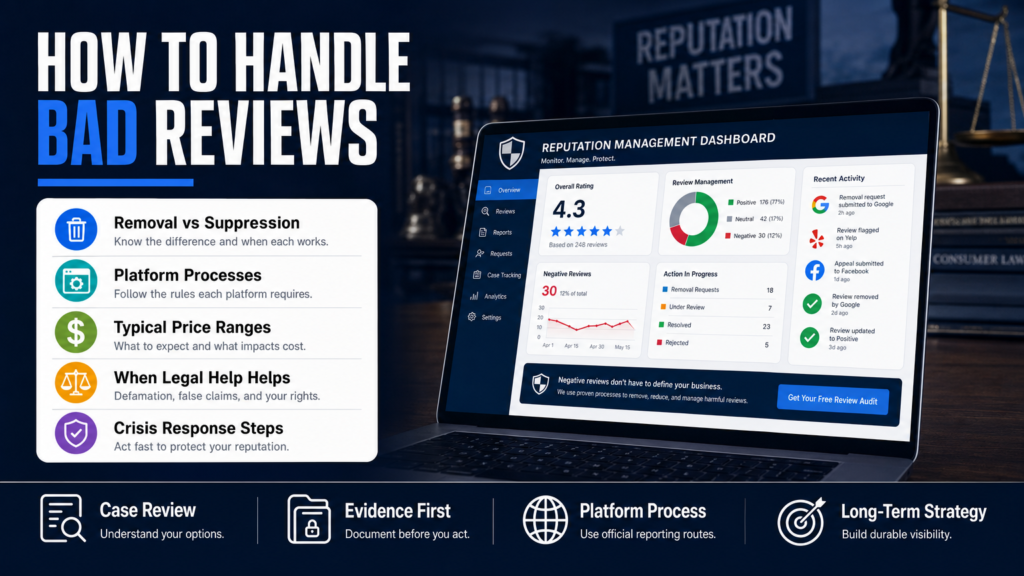
You just found a damaging one-star review from a person you don’t recognize — and it’s the top result for your name or your business. Which company is the best for removing negative reviews? You need options that are realistic, legal, and fast enough to stop revenue or licensing risk.
This article walks through what reputable removal services do, when removal is likely (and when it isn’t), how much removal commonly costs, and how to choose a provider if you decide to hire an outside firm. It answers the direct questions readers search for — including “How do you get negative reviews removed?” and “How much does it cost?” — with platform-specific steps and timelines you can expect.
We’ll also show a hypothetical end-to-end example, list common mistakes to avoid, and give practical next steps you can use immediately. If you need direct help, consider an assessment from a specialist, but this guide will let you make a better hiring decision.
Table of Contents
- How do you get negative reviews removed?
- Can companies really remove bad reviews?
- How much does it cost to get a negative Google review removed?
- What companies offer services to remove bad Google reviews?
- When removal isn’t possible: suppression and repair options
- Choosing a company: what to look for
- DIY vs hiring an agency: when to do each
- Immediate steps for a viral review or crisis
- DIY vs Agency: Quick Comparison
- Hypothetical Example: Doctor with Anonymous Defamatory Review
- Common Mistakes People Make When Trying to Remove Reviews
- Best Practices For Handling Negative Reviews
- Expert Tips
- Conclusion
- Why Businesses Choose Your Reputation Agency
- Frequently Asked Questions
How do you get negative reviews removed?
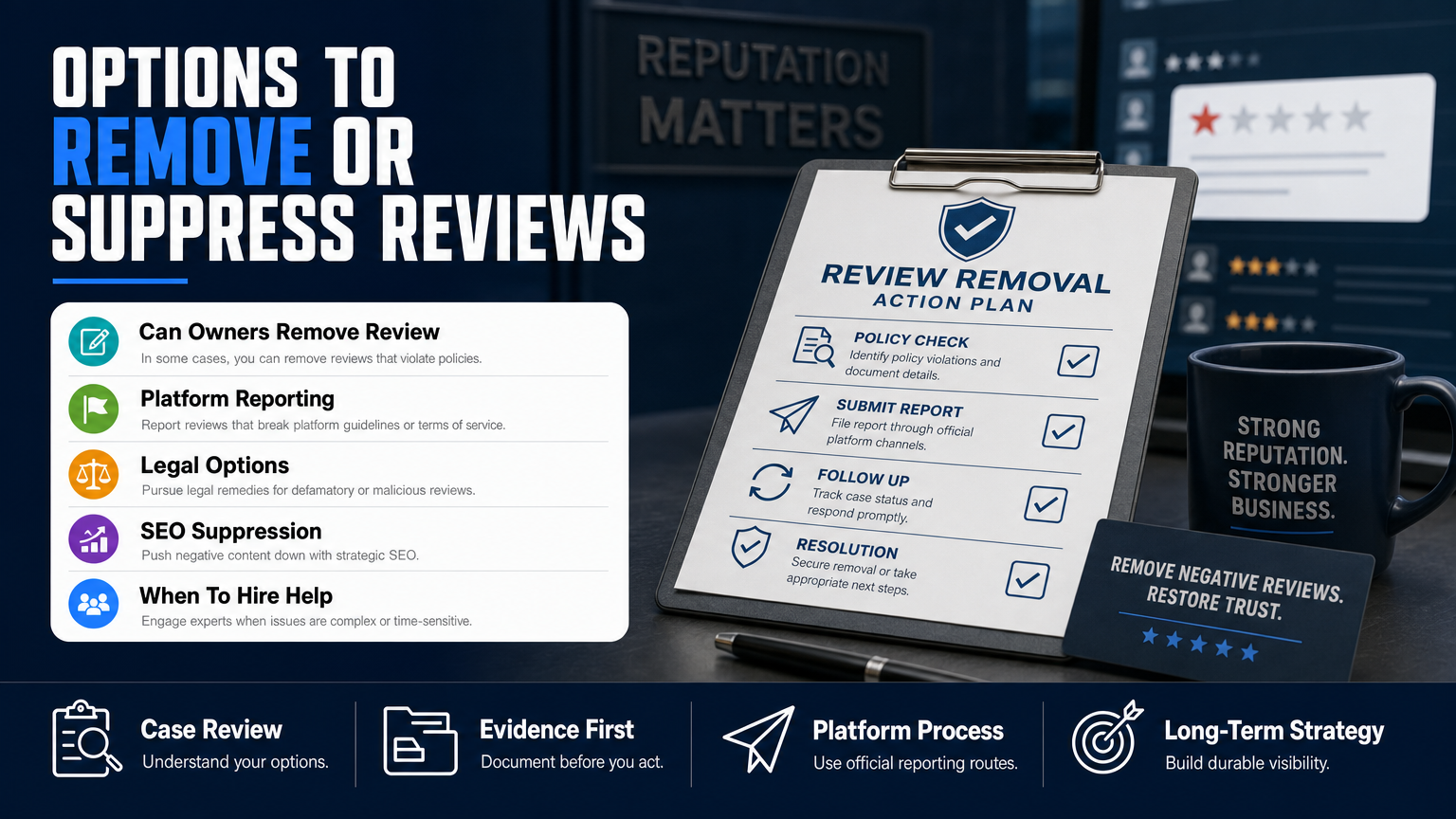
Removal is a process, not a single button. The primary routes are: (1) report the review through the platform’s abuse or policy process, (2) ask the reviewer to edit or delete the review (if contactable), (3) request removal from the hosting publisher (for third‑party blogs or news), or (4) pursue legal options when the content is defamatory or illegal. Which route is appropriate depends on the platform, the content, and the evidence.
If you want speed and professional handling, an agency can assemble the evidence, file the necessary reports and escalate where appropriate. For urgent situations there are vendors who offer accelerated workflows — see our service page Remove Negative Reviews Fast – Guaranteed in 30 Days for an example of an accelerated process and what it entails. Note: timelines are estimates, not guarantees.
- Step 1: Preserve evidence (screenshots, link, reviewer profile).
- Step 2: Map the review type to applicable policy (defamation, impersonation, privacy, spam).
- Step 3: File a platform report and track the case number. Use an escalation path if the first decision is unfavorable.
- Step 4: If the platform denies removal and the claim is false, consult with counsel about legal options and coordinate any takedown letters.
- Identify whether the review alleges facts (potential defamation), is opinion, or violates platform policy (hate, harassment, illegal content).
- Collect supporting evidence: screenshots, timestamped links, booking records (if relevant), and internal logs showing no record of the transaction if the reviewer claims something false.
- Use official platform reporting tools before publicly responding; responses and escalation paths differ between Google, Yelp, TripAdvisor, and industry sites.
- If the reviewer is reachable, request correction politely and document the request — some platforms weigh a reviewer’s voluntary removal more favorably.
Platform reporting: what to expect
Each platform has a unique reporting workflow and varying thresholds for removal. Google and Yelp let businesses flag reviews; Google also accepts legal removal requests for defamation and privacy content. Platforms typically review reports manually and may require documentary proof.
Keep in mind: platform decisions are controlled by the platform. A firm can prepare and submit reports on your behalf, but it cannot force a platform to remove content.
- Google: flag via Google Business Profile and submit legal claims for defamation/privacy where applicable.
- Yelp: flag the review and use business owner responses to provide context while the report is pending.
- Industry sites (healthcare, legal, travel): many have complaint forms and licensing-based escalation paths.
Can companies really remove bad reviews?
Short answer: companies can often get reviews removed when the content violates platform policies, involves impersonation, contains personal data, or is demonstrably false and defamatory — but removal always depends on the evidence, the publisher/platform, and the legal context.
A reputable company will evaluate whether the review qualifies for removal or review, pursue the legal, technical, platform-based, and reputational options available, and recommend suppression or correction when removal isn’t available.
- Step 1: Have the provider run an intake and evidence checklist.
- Step 2: Let the provider attempt platform reporting and publisher outreach.
- Step 3: Review the provider’s recommended escalation (legal letter, DMCA, court filing) and cost estimate before proceeding.
- What a vendor can do: prepare evidence, submit policy reports and legal takedown requests, negotiate with publishers, and implement suppression/SEO when removal fails.
- What a vendor can’t do: guarantee removal, force a platform to delete content, or promise permanent suppression of a search result.
When legal options are realistic
A legal route can be effective when a review contains provably false statements of fact (defamation), personal data publication, or explicit threats. Whether to proceed requires counsel because litigation has cost, time, and public‑record consequences.
Your Reputation Agency coordinates with qualified counsel when a legal option is appropriate; a lawyer can determine whether a claim may be available and recommend next steps.
- Defamation requires false statements presented as fact and identifiable harm.
- Privacy-based takedowns (exposed SSNs, medical records) fit different legal tools like privacy statutes or platform policies.
- When a legal route is unlikely, mitigation and search‑result suppression are viable alternatives.
How much does it cost to get a negative Google review removed?
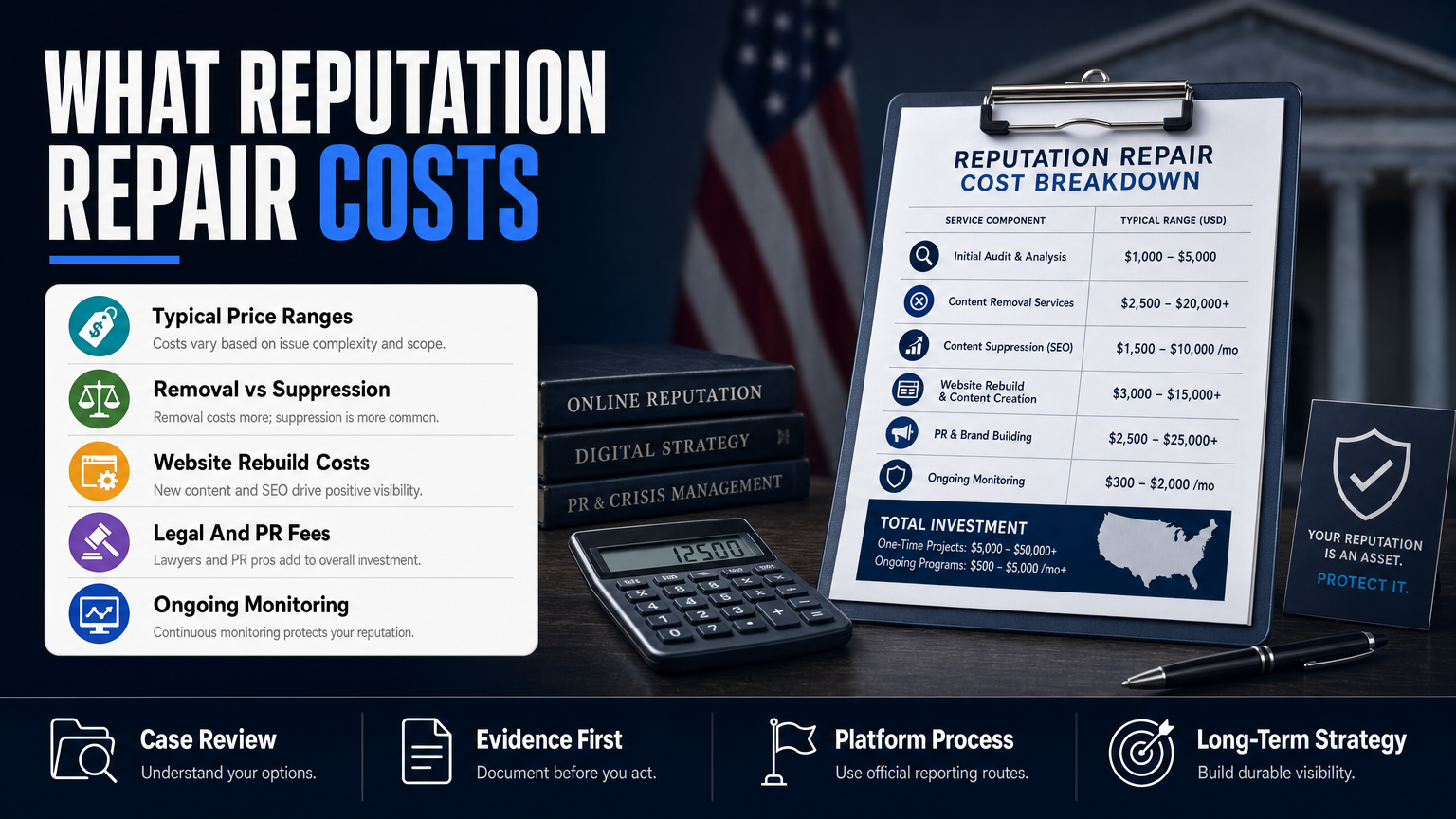
Costs vary with complexity. A single straightforward platform report typically costs little to handle internally; hiring a professional service raises fees based on evidence collection, escalation, and legal coordination. Typical ranges are: basic reporting ($0–$300), specialist agency work ($300–$2,500 per review for complex platform escalations and evidence collection), and legal escalation ($1,500–$10,000+ depending on counsel and jurisdiction). These are ranges, not guarantees.
If you want a cost-benefit view that includes downstream revenue risk, consult analyses such as What a One‑Star Google Review Actually Costs You — that page helps quantify potential losses to help decide whether to pursue removal or mitigation.
- Step 1: Get a written intake and scope from any vendor before work begins.
- Step 2: Ask for estimated ranges and explanation of what each fee covers (evidence, filing, follow-up).
- Step 3: Reserve budget for suppression (SEO, content creation) if removal fails; suppression campaigns carry separate costs.
- Low complexity: content that clearly violates platform policy (spam, explicit threats) — often quick and low-cost.
- Medium complexity: factual disputes requiring documentation and follow-ups — moderate fees and time.
- High complexity: defamatory allegations, anonymous reviewers, third‑party publishers, or court filings — significant legal and agency costs.
No upfront guarantees and payment models
Some providers advertise contingency or ‘no-win, no-fee’ models. Scrutinize these offers carefully: contingency arrangements may limit effort scope or require you to accept less control over communications. Always get the scope, milestones, and cancellation terms in writing.
A professional agency will explain that timing depends on the platform, publisher responsiveness, and legal complexity, and provide an estimated timeline only after assessment.
- Ask for transparent reporting and itemized fees.
- Insist on written descriptions of deliverables, escalation thresholds, and termination rights.
What companies offer services to remove bad Google reviews?
There are three types of providers: (1) platform specialists who focus on Google Business Profile and review flagging, (2) reputation agencies that combine removal with suppression and PR, and (3) law firms that pursue legal takedowns or subpoenas. Which company is the best for removing negative reviews depends on your needs — speed, legal complexity, or ongoing monitoring.
If you’re specifically looking for a legal and platform-focused approach to Google reviews, see our overview of lawful removal options at Remove Negative Google Reviews – Legally & Effectively. That page explains the typical legal thresholds and platform steps for Google removals.
- Step 1: Match your case to the provider type (simple platform flagging vs. legal escalation).
- Step 2: Ask candidates for written process outlines and references for similar cases (don’t accept invented testimonials).
- Step 3: Confirm they will work with your counsel if legal action becomes necessary.
- Small boutiques: lower cost, may be faster on routine flagging.
- Mid-size reputation agencies: combine platform work with SEO and PR, suitable for sensitive public‑facing professionals.
- Law firms: best for complex defamation or privacy claims requiring formal legal process.
How providers differ on scope
Some vendors promise only to file flags and wait; others proactively build documentation, contact the reviewer, and implement SEO suppression. Make sure the proposal spells out whether the vendor will create new positive content, file legal notices, or just submit platform reports.
- Clarify who owns login credentials, who communicates with reviewers, and how confidentiality is handled.
- Confirm whether the vendor uses any reputation tactics that could be considered deceptive (avoid any vendor suggesting fake reviews or impersonation).
When removal isn’t possible: suppression and repair options
Removal is not always available — public records, truthful complaints, and some opinion pieces may remain online. When that happens, a combined strategy of mitigation, correction, and search-result suppression is the practical alternative.
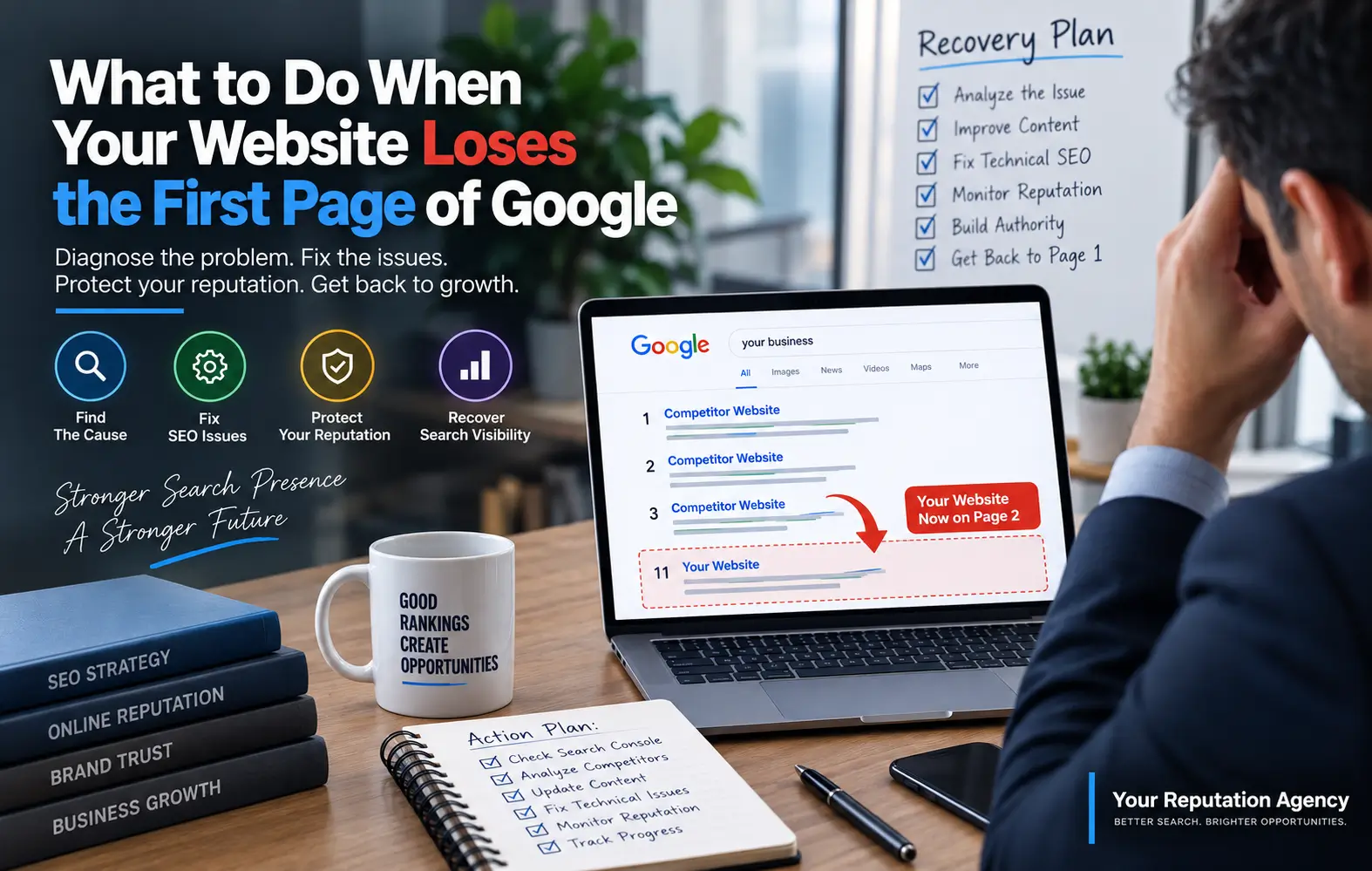
Suppression means improving the visibility of accurate, authoritative content so that the negative item is less prominent in search results. That often involves SEO, content publishing, directory updates, and PR or corrections requests to publishers.
- Step 1: Audit first-page search results for your name or business.
- Step 2: Identify easy wins (profiles you control) and third-party items you can influence.
- Step 3: Execute an SEO-focused suppression plan while continuing legal/policy efforts where applicable.
- Create or optimize authoritative assets: official website pages, professional profiles (LinkedIn, Healthgrades, Avvo), and press content.
- Publish corrective content (statements, FAQs) where appropriate, and optimize them for the same keywords that surface the negative item.
- Use structured data, schema, and consistent NAP (name/address/phone) to strengthen positive pages in search.
When to add PR or factual corrections
If a third-party article repeats an incorrect claim and the publisher is reachable, request a correction. A press or PR effort can sometimes produce a corrected article or add context, but publishers are not obligated to change content.
Public relations and transparent messaging are especially important when the review or article threatens licensure, clients, or public safety.
- Prepare a factual timeline and supporting documents before contacting a publisher.
- Offer a concise correction or clarification rather than an adversarial demand; publishers respond better to documented facts.
Choosing a company: what to look for
Not all providers are equal. The right one will explain processes, give a realistic view of removal likelihood, and coordinate with counsel when needed. Look for clear documentation, no-claim language about guaranteed outcomes, and an intake checklist that asks for evidence up front.
A reputable firm should also offer monitoring and a plan for long-term reputation repair, not just one-off flags.
- Step 1: Request a written intake form and evidence checklist.
- Step 2: Ask for sample reporting formats and typical timelines (presented as estimates).
- Step 3: Confirm data security and confidentiality provisions in the service agreement.
- Transparent scope of work and itemized fees.
- Written escalation pathways and communication cadence.
- Experience with platforms and industries relevant to you (medical boards, legal directories, hospitality sites).
- Willingness to coordinate with your attorney and provide documentation suitable for legal review.
Red flags to avoid
Avoid vendors that promise guaranteed removals, suggest buying fake positiverating content, or pressure you to transfer platform credentials without clear reasons. Also be wary of firms that refuse to put deliverables in writing.
Ask for references and confirm that the provider does not present itself as a law firm unless it actually is.
- Guarantees of removal or top search rankings.
- Requests to produce fake reviews or use deceptive tactics.
- Vague scopes, unclear fees, or refusing to sign a simple service agreement.
DIY vs hiring an agency: when to do each
Many businesses can handle clear-cut policy violations internally, but complex cases benefit from agency support. Decide based on time, platform complexity, and the stakes involved (licensure, large revenue loss, or high-profile exposure).
Below is a quick comparison to help weigh the decision; if your case has legal exposure, involve counsel early.
- Step 1: Triage the incident (low-, medium-, high-risk).
- Step 2: Choose DIY for low-risk items you can document and file yourself; choose agency if you lack time, or the item affects licensing, major revenue, or public perception.
- Step 3: If hiring, require a written plan and regular reporting.
- DIY: suitable for quick policy flags and when you have time to follow up.
- Agency: better for multi-platform, cross‑publisher, or high-risk incidents requiring coordinated PR/SEO/legal work.
Cost vs speed tradeoffs
DIY often costs less but takes more of your time and may miss escalation levers. Agencies cost more but can move faster and leverage relationships, workflows and coordinated SEO. Neither option guarantees removal; weigh speed and documentation needs.
- DIY saves fees but may delay resolution if you’re unfamiliar with platform flows.
- Agencies provide sustained follow-up and monitoring that many busy professionals can’t maintain internally.
Immediate steps for a viral review or crisis
When a review goes viral or is amplified on social media, act quickly to control damage: preserve evidence, draft an external statement, and prioritize communication to affected stakeholders. Rapid response minimizes further spread and preserves legal options.
Coordinate platform reporting, PR messaging, and a suppression plan simultaneously. For persistent or escalating public incidents, involve counsel promptly.
- Step 1: Take screenshots and save URLs with timestamps.
- Step 2: File platform reports and begin immediate suppression actions (push positive content to search).
- Step 3: Draft a short, factual public message; consult counsel about public statements.
- Preserve everything: screenshots, URLs, timestamps, and analytics of traffic spikes.
- Do not publicly argue with the reviewer; factual, calm responses are preferable.
- Notify internal stakeholders (practice manager, compliance officer) and prepare a concise public statement if appropriate.
When to escalate to paid crisis response
Paid crisis response makes sense when the incident threatens licensing, major client loss, or attracts media attention. A coordinated team (reputation, PR, legal) can reduce visibility and craft messaging while pursuing removal or correction.
Rapid service providers will often combine platform reports, targeted SEO, and media outreach to limit exposure; they provide an intake and action plan quickly, but again, cannot promise specific removal outcomes.
- Activate crisis monitoring and alerting for mentions.
- Prioritize controlled channels (your website, official social accounts) for accurate information.
DIY vs Agency: Quick Comparison
Decide based on time, cost tolerance, and risk.
| DIY | Agency |
|---|---|
| Cost | Higher fees; covers evidence, escalation, SEO |
| Speed | Slower if you’re busy; limited escalation |
| Legal support | Coordinates with counsel; may recommend legal action |
| Platform expertise | Processes and templates for multiple platforms |
| Control | Hands-off for you; vendor manages tasks |
| Long-term repair | Often included (SEO, PR, monitoring) |
Hypothetical Example: Doctor with Anonymous Defamatory Review
Scenario (hypothetical): Dr. A finds a one-star review on Google alleging negligent care and the review is shared on a local Facebook group. The reviewer is anonymous and provides no verifiable appointment details.
Process used (illustrative only): the firm performs an evidence intake, flags the review to Google, reaches out to the reviewer publicly with a brief professional reply, attempts to contact the reviewer if any contact details exist, asks the Facebook group moderator to remove the reposted content (if it violates group rules), and begins a suppression campaign targeting the doctor’s name in search.
- Step 1: Intake and evidence collection (screenshots, internal logs).
- Step 2: Platform reporting and follow-up by the agency (flag to Google, request Facebook moderator action).
- Step 3: Publish authoritative content (updated team bio, FAQ) and optimize those pages to push the negative item lower in search.
- Step 4: If Google denies removal and the statement is provably false, coordinate with counsel on a demand letter or other legal options.
- Preserve screenshots of the Google review and Facebook posts with timestamps.
- Search internal records for any matching patient encounter and document none found.
- File a Google legal/privacy claim if the review includes identifying health details or private information.
Common Mistakes People Make When Trying to Remove Reviews
Below are frequent errors that worsen outcomes or waste budget.
Publicly attacking the reviewer
Responding angrily or revealing personal information about the reviewer can escalate the situation and provide more fodder for distribution. Always respond calmly, state facts, and offer to take the conversation offline. Public hostility rarely leads to removal.
Assuming every negative review is removable
Not all negative content violates policies or is legally actionable. Treat truthful negative feedback and opinion differently from defamatory or policy‑violating content. Misclassifying a post wastes time and can delay correct mitigation steps.
Paying for fast ‘guaranteed’ removal offers
Be skeptical of any firm that guarantees removal or permanent suppression. Guarantees may mask low follow-up, hidden fees, or unethical tactics. Request a written scope and avoid vendors that insist on absolute promises.
Using fake reviews or deceptive tactics
Creating fake positive reviews or asking employees to impersonate customers is unethical and violates platform terms. These tactics can lead to further penalties and damage credibility if discovered.
Failing to document everything
Weak evidence makes platform and legal escalations difficult. Preserve originals, collect internal records, and keep a running log of communications with platforms and publishers.
Best Practices For Handling Negative Reviews
Implement these durable practices to increase your chance of successful remediation and to protect your reputation going forward.
Document everything early
At the first sign of a damaging review, capture screenshots, URLs, and any internal records that refute or contextualize the claim. Documentation is the basis for platform flags and legal review.
Follow the platform’s official process
Start with the platform’s abuse or flagging flow. Platforms expect their forms to be used first; third-party outreach without filing a report often delays action.
Combine technical, legal, and reputational approaches
A single tactic seldom solves complex incidents. Combine platform reports, SEO suppression, PR corrections, and legal review when needed for a multi-pronged strategy.
Keep public responses factual and professional
When you respond publicly, be concise, acknowledge concern, and offer to take the matter offline. This demonstrates professionalism to future readers and reduces escalation risks.
Monitor continuously
After a takedown or suppression effort, set up monitoring for new mentions and follow-up. Reputation is ongoing; a one-time fix is rarely sufficient.
Expert Tips
- Preserve evidence immediately—screenshots with timestamps are the baseline for any escalation.
- Ask for a written intake and a costed action plan before hiring any vendor.
- Treat truthful negative reviews and false statements differently—only the latter may justify legal steps.
- Coordinate PR and legal counsel before issuing public statements that could become public record.
- Use your controlled properties (website, LinkedIn) as primary assets in suppression campaigns.
- Avoid vendors that promise guaranteed removal or ask you to post fake reviews.
- If a review contains private data (SSNs, medical records), prioritize privacy/legal channels.
- Request monthly monitoring and reporting after any remediation work.
Conclusion
Choosing the best company for removing negative reviews depends on the platform, the nature of the content, and the stakes for your practice or business. No firm can guarantee removal; reputable providers explain the options, document evidence, and run coordinated platform, SEO, and legal workflows when appropriate.
If the content cannot be removed, suppression and reputation repair are practical, measurable alternatives. Start with a documented intake, get a written plan from any vendor, and consult counsel for anything that looks defamatory or that might create record-level risk. When speed matters, prioritize firms that offer a clear escalation path and regular status reporting.
Why Businesses Choose Your Reputation Agency
Managing your reputation takes more than monitoring reviews or publishing the occasional blog post. It takes a strategy built around your situation, your industry, and what is actually showing up in search.
Your Reputation Agency works with businesses, executives, healthcare professionals, attorneys and growing brands. Our services include:
- Remove defamatory content and false posts (news, blogs, listings)
- Remove or challenge negative reviews (Google, Yelp, TripAdvisor, industry sites)
- Mugshot and arrest record removal
- Remove videos, images, and other multimedia that damage reputation
- Remove personal data from people‑search and data‑broker sites (opt‑outs)
- Search result suppression (SEO to bury negative links)
- Social media takedowns and impersonation removal
- Rapid online crisis management and incident response
- Ongoing monitoring and alerting of reputation signals
- Coordination with legal counsel and use of legal tactics when required
Frequently Asked Questions
1. How do you get negative reviews removed?
Start by documenting the review (screenshots and URLs), determine whether it violates platform policy or contains false statements, and file an official report with the platform. If the platform declines removal and the review is demonstrably false or illegal, consult counsel about legal options. Agencies can assist by compiling evidence, submitting reports, and coordinating escalation.
2. Can companies really remove bad reviews?
Companies can often secure removals when reviews violate platform policies, include privacy breaches, impersonation, or provably false factual claims. However, removal depends on the platform and the evidence; no ethical company can guarantee removal in all cases.
3. How much does it cost to get a negative Google review removed?
Costs vary: simple platform flagging is low-cost; agency work can range from a few hundred to several thousand dollars depending on complexity; legal escalation can add significantly more. These are ranges, not promises; get a written scope and cost estimate for your case.
4. What companies offer services to remove bad Google reviews?
Providers include platform specialists, reputation-management agencies, and law firms. Select based on whether you need quick flagging, coordinated SEO/PR, or legal action. For a legal and platform-focused overview, see Remove Negative Google Reviews – Legally & Effectively.
5. How long does it take to remove a review?
There is no universal timeline. Platform review decisions can take days to weeks; legal actions take months. An estimated timeline should be provided after assessment, but no provider can promise a fixed removal deadline.
6. Is it worth paying for removal services?
That depends on the stakes. If the review threatens licensure, major revenue, or public safety, investing in professional help and legal coordination is often justified. For low-risk items, you may handle removal internally. Assess expected cost against potential loss of business or reputation.
7. Can you sue to get a review removed?
Suing may be an option if the review contains false statements of fact that are demonstrably defamatory, but litigation has costs, timelines, and public-record consequences. A qualified attorney should evaluate the merits before pursuing legal action.
8. What if the reviewer is anonymous?
Anonymous reviewers complicate matters. You can still flag policy violations, request platform review, and preserve evidence, and counsel can pursue discovery or subpoenas in some cases. Simultaneously work on suppression and monitoring while exploring identification options with legal counsel.
9. What should I do while removal is pending?
Preserve evidence, post a calm factual public response as appropriate, optimize your authoritative pages to reduce the negative item’s visibility, and set up monitoring. If the case affects licensing or client safety, inform stakeholders and involve counsel early.
This content provides general information and does not constitute legal advice. The available options and likely outcomes depend on the facts, evidence, platform policies, applicable law, jurisdiction, and public-interest considerations.
Past examples do not guarantee future results. Removal, correction, deindexing, and search-position changes depend on third parties and circumstances outside Your Reputation Agency’s control.