Introduction
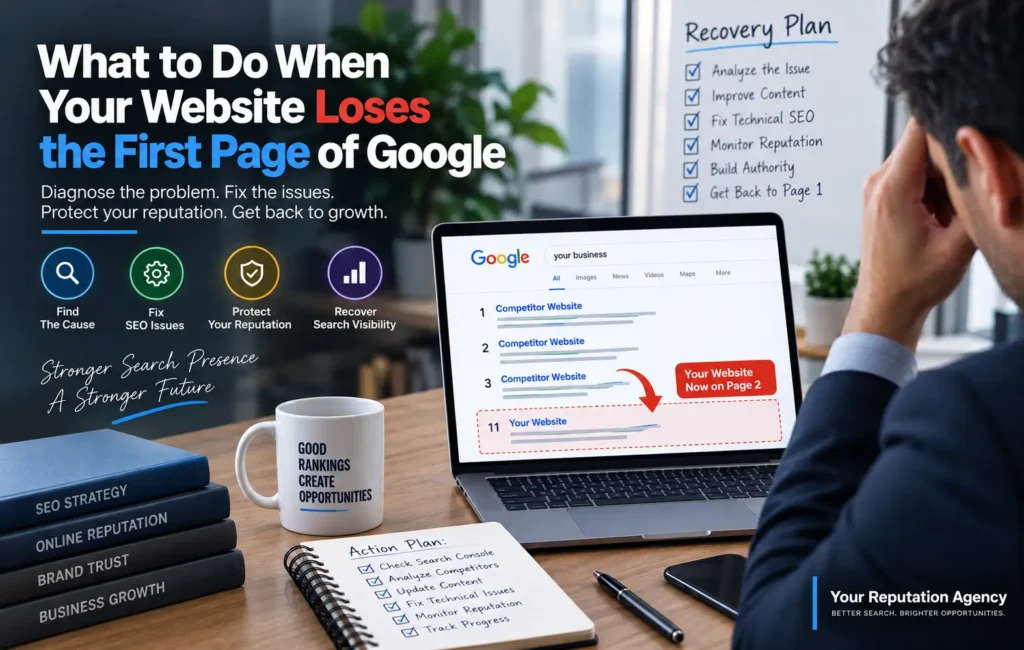
If you’re wondering what to do when your website loses the first page of Google, don’t panic and start changing everything at once. A sudden ranking decline can result from technical SEO problems, algorithm changes, outdated content, stronger competitors, changing search intent, or declining brand visibility.
For a business owner, CEO, lawyer, doctor, entrepreneur, or personal brand, losing page-one visibility can mean more than lower traffic. It can affect leads, sales, credibility, and the first impression prospects form when they search for your company or name.
The right response is systematic: identify what changed, determine why it changed, fix the underlying problem, and strengthen your overall search presence.
This guide explains exactly how to approach a Google ranking drop while also showing why SEO and online reputation management increasingly need to work together.
Table of Contents
- Why Losing Google’s First Page Matters
- What Causes a Website to Lose Rankings?
- What to Do When Your Website Loses the First Page of Google
- Step-by-Step Ranking Recovery Process
- How Reputation Can Affect Search Visibility
- Real Example
- Common Mistakes to Avoid
- Best Practices for Long-Term Visibility
- Expert Tips
- SEO vs. Reputation Management
- Conclusion
- FAQs
- Strong CTA
Why Losing Google’s First Page Matters
Google’s first page puts your business in front of people who are actively searching for information, products, or services.
When your website drops from position three to position fourteen, you may lose valuable clicks. More importantly, competitors may now receive the attention that previously went to your business.
For reputation-sensitive businesses, there is another concern.
Your website may no longer dominate the search results for your brand.
That means other pages can become more prominent, including:
- Review websites
- Social media profiles
- News articles
- Industry directories
- Forum discussions
- Old content
- Competitor pages
- Negative or inaccurate information
This is why a ranking decline should be viewed as both an SEO issue and a digital visibility issue.
Your website needs to rank. But your overall search results also need to communicate credibility.
What Causes a Website to Lose Google Rankings?
A ranking drop doesn’t automatically mean Google penalized your website.
There can be many explanations.
Algorithm Changes
Google regularly improves its search systems. An update may change how Google evaluates relevance, helpfulness, content quality, or other ranking signals.
Technical SEO Problems
Technical changes can make important pages harder for search engines to crawl or index.
Check for:
noindextags- Robots.txt restrictions
- Broken pages
- Server errors
- Incorrect canonical tags
- Redirect problems
- Sitemap issues
- Website migrations
- Security problems
Outdated Content
Your competitors may have published newer and more useful information while your page remained unchanged.
A page that ranked well two years ago isn’t guaranteed to remain competitive today.
Changing Search Intent
Searchers’ expectations can change.
A keyword that once produced long-form articles may now produce local businesses, comparison pages, videos, product pages, or other formats.
If your content no longer satisfies the intent, rankings can decline even if the content is technically optimized.
Stronger Competitors
Sometimes your website hasn’t become worse.
The websites above you simply became better.
Competitors may have improved:
- Content
- User experience
- Authority
- Internal linking
- Digital PR
- Brand recognition
- Local SEO
- Reviews
- Topical coverage
Reputation Problems
Your broader online presence matters too.
Negative reviews, inaccurate information, unfavorable articles, or unresolved reputation issues can influence how potential customers perceive your business after discovering you through search.
What to Do When Your Website Loses the First Page of Google
The best approach is to investigate before making major changes.
Here’s a practical recovery framework.
Step 1: Confirm the Ranking Drop
First, verify that the decline is real.
Use Google Search Console and your analytics platform to compare performance over time.
Review:
- Clicks
- Impressions
- Average position
- CTR
- Search queries
- Landing pages
- Devices
- Countries
- Search appearance
Don’t judge your entire SEO strategy based on one keyword or one day’s data.
A temporary fluctuation isn’t necessarily a problem.
Step 2: Find the Pages That Lost Visibility
Next, identify exactly which URLs declined.
You might discover that:
- One service page lost rankings.
- Several blog posts declined.
- Only mobile traffic dropped.
- Branded searches remain stable.
- Non-branded keywords declined significantly.
These patterns tell you where to investigate.
For example, if your homepage is stable but five commercial service pages lost visibility, the problem may be concentrated around content quality, competition, topical authority, or specific technical issues.
Step 3: Check Technical SEO
Before rewriting content, make sure Google can properly access and understand your pages.
Review:
- Indexing status
- Canonical URLs
- Robots.txt
- XML sitemap
- Internal links
- Redirects
- HTTPS
- Server responses
- Mobile experience
- Core technical issues
If a high-value page accidentally received a noindex directive, rewriting 2,000 words won’t solve the problem.
Technical health comes first.
Step 4: Compare Your Page With the Current Winners
Search the keyword manually.
Look carefully at the pages ranking above yours.
Don’t simply count words.
Instead, ask:
- What questions do these pages answer?
- Is their information more current?
- Do they provide original insights?
- Is their expertise clearer?
- Are their examples more useful?
- Does their structure make information easier to find?
- Do they better match search intent?
- Do they demonstrate stronger authority?
The goal isn’t to copy competitors.
The goal is to understand what Google appears to consider useful for that search and then create something genuinely better.
Step 5: Improve the Content
If your content is outdated or incomplete, improve it for the user—not just the algorithm.
Consider adding:
- Current information
- Original examples
- Expert insights
- Clear explanations
- Relevant statistics
- Helpful tables
- FAQs
- Practical steps
- Better internal links
- Stronger author or business information
Avoid forcing keywords into every paragraph.
A useful page should naturally cover the concepts and questions surrounding the topic.
Google’s people-first guidance emphasizes creating content primarily to help people rather than producing pages designed only to manipulate search rankings.
Step 6: Review Your Online Reputation
This is where SEO and reputation management overlap.
Search your:
- Company name
- CEO name
- Founder name
- Main services
- Brand + reviews
- Brand + complaints
- Brand + negative keywords
Then review what appears.
If negative or inaccurate information has become more prominent because your website lost visibility, you may have a broader reputation challenge.
A professional Reputation Monitoring strategy can help identify changes across search results, reviews, social platforms, news, and other important digital channels.
The objective isn’t to hide legitimate criticism.
Instead, reputation management should focus on accurate information, appropriate responses, policy-compliant removal opportunities, and building a stronger overall digital presence.
Step 7: Strengthen Your Local Search Presence
For businesses serving a specific location, organic SEO and local visibility should work together.
Your website should align with your:
- Business information
- Location signals
- Google Business Profile
- Reviews
- Local content
- Industry directories
- Brand mentions
This becomes especially important for:
- Lawyers
- Doctors
- Real estate professionals
- Contractors
- Agencies
- Consultants
- Local service businesses
Businesses looking to improve this broader foundation can explore Online Presence & Local SEO for Small Businesses.
A consistent local presence can make it easier for customers and search systems to understand who you are, what you offer, and where you operate.
Step 8: Strengthen Your Authority
If competitors consistently outrank you, look beyond on-page SEO.
Consider building authority through:
- Original research
- Industry publications
- Expert commentary
- Digital PR
- Relevant partnerships
- Valuable resources
- Natural backlinks
- Brand mentions
- Strong internal linking
Don’t chase hundreds of low-quality links.
A smaller number of relevant, credible references can be much more valuable than a large quantity of artificial links.
Step 9: Monitor Your Name and Brand
Your search visibility isn’t limited to your website.
For executives and personal brands, the search results for an individual’s name can be equally important.
If you are concerned about what appears when someone searches your name, resources such as How to Monitor Your Name on Google Automatically can help you understand the monitoring process.
Businesses should take a similar approach with their brand name.
The earlier you discover a new negative result or reputation issue, the more options you may have for responding strategically.
Step 10: Consider AI Search Visibility
Search behavior is expanding beyond traditional Google results.
People increasingly use AI-powered platforms to research:
- Businesses
- Executives
- Professionals
- Products
- Services
- Reviews
- Companies
This means your digital footprint should be clear and consistent across multiple sources.
Your website should contain useful, understandable information about your business, while your external presence should reinforce the same facts.
The goal isn’t to manipulate AI systems.
The goal is to establish a credible digital footprint that search engines and AI systems can understand.
Real Example: A Business Loses Its Page-One Ranking
Consider a hypothetical real estate agency that previously ranked in the top five for an important local keyword.
Over time, its position falls to page two.
The owner initially assumes Google made a mistake.
An investigation reveals several issues:
- The primary service page hasn’t been updated in years.
- Competitors have published better local resources.
- Several business directories contain inconsistent information.
- The company has received several recent negative reviews.
- The website has weak internal links between related services and guides.
- Competitors have earned stronger local mentions.
- The agency’s brand information is inconsistent across several platforms.
The solution isn’t simply “add more keywords.”
The recovery strategy should combine:
- Technical SEO
- Content improvement
- Internal linking
- Local SEO
- Reputation monitoring
- Review management
- Authority building
- Brand consistency
This example demonstrates why ranking recovery needs to consider the entire search landscape.
Common Mistakes to Avoid
Changing Everything at Once
Don’t rewrite every page immediately.
Identify the affected pages first.
Keyword Stuffing
Repeating the target keyword excessively can make content unnatural and less useful.
Buying Cheap Backlinks
Low-quality links can introduce additional risk instead of fixing the underlying problem.
Deleting Pages Too Quickly
A declining page may still have valuable backlinks, traffic, historical authority, or useful content.
Investigate before removing it.
Assuming Every Drop Is an Algorithm Penalty
A ranking decline can have many causes.
Technical problems, competitors, seasonality, content quality, and changing search demand should all be considered.
Ignoring Reviews
A business may recover organic visibility but still lose customers if searchers encounter a poor reputation.
Expecting Instant Recovery
SEO recovery isn’t always immediate.
Some changes may take weeks or months before their impact becomes clear.
Best Practices for Long-Term Search Visibility
A strong recovery strategy should eventually become a long-term visibility strategy.
Monitor important keywords
Focus on commercially valuable queries instead of obsessing over every small ranking movement.
Update important content
Review high-value pages regularly and improve information that has become outdated.
Build topical authority
Create useful resources around your primary services rather than publishing disconnected articles.
Improve internal linking
Connect related service pages, guides, and resources so users and search engines can navigate your website more effectively.
Monitor reputation
Don’t wait for a reputation crisis before checking what people see when they search your business.
Maintain brand consistency
Your website, social profiles, directories, review platforms, and third-party mentions should communicate accurate and consistent information.
Protect your digital assets
Businesses with executives or public-facing leadership should also consider executive-level reputation protection.
For example, CEO Reputation Management can address the unique search and reputation challenges surrounding company leaders.
Expert Tips for Recovering Search Visibility
1. Focus on Business-Critical Pages First
Don’t spend months optimizing pages that generate little business value.
Prioritize:
- Service pages
- Location pages
- High-converting landing pages
- Brand pages
- Important executive pages
2. Look at Search Results, Not Just Analytics
The SERPs can help you understand why.
Analytics tells you what happened.
Study what Google currently shows for your target queries.
3. Don’t Chase Every Algorithm Update
Focus on building genuinely useful, accurate, trustworthy content rather than making emergency changes every time SEO news appears.
4. Protect Your Brand Search Results
Your website shouldn’t be the only positive asset associated with your brand.
A resilient digital presence includes credible third-party references, reviews, professional profiles, social channels, and authoritative content.
Businesses seeking a broader strategy can explore Reputation Management Services rather than treating individual search problems in isolation.
5. Prepare for Reputation Crises Before They Happen
A negative news story, viral complaint, legal dispute, executive controversy, or sudden review surge can quickly change the search landscape.
A proactive Crisis Reputation Management strategy can help organizations prepare for these situations rather than reacting after the damage has already spread.
SEO vs. Reputation Management
| Situation | SEO | Reputation Management |
|---|---|---|
| Technical indexing problem | High priority | Low priority |
| Outdated content | High priority | Medium priority |
| Competitor outranking you | High priority | Medium priority |
| Negative reviews | Medium priority | High priority |
| Negative news coverage | Medium priority | High priority |
| Executive reputation issue | Medium priority | High priority |
| Brand-name search problem | Medium priority | High priority |
| Local visibility decline | High priority | High priority |
| Search-result crisis | High priority | High priority |
| AI brand visibility | High priority | High priority |
For many companies, these aren’t separate problems.
A business needs to be visible enough to be found and credible enough to be chosen.
Reputation Management Should Be Part of Your Recovery Strategy
A Google ranking drop can expose weaknesses that were previously hidden.
When your website dominated page one, users may have encountered your preferred brand assets first.
After a decline, they may see other sources.
That’s why Online Reputation Protection Services can complement an SEO recovery strategy.
A comprehensive reputation strategy can involve:
- Monitoring search results
- Tracking reviews
- Evaluating negative content
- Strengthening positive brand assets
- Improving online profiles
- Developing authoritative content
- Protecting executive visibility
- Responding to legitimate criticism
- Identifying appropriate removal opportunities
The objective isn’t to manipulate search engines.
It’s to create a more accurate, trustworthy, and resilient online presence.
Building a Stronger Reputation Around Your Leadership Team
For many companies, the reputation of the CEO and senior executives is closely connected to the brand.
A company can have excellent services, yet a search for its founder may reveal outdated, inaccurate, or damaging information.
That’s why businesses with highly visible leadership may benefit from Executive Reputation Management.
Similarly, professionals who have built their business around their expertise can benefit from a more specialized Expert Reputation Management approach.
These strategies help connect personal credibility with broader business visibility.
Don’t Ignore Personal Brand Search Results
Not every reputation problem belongs to a corporation.
Doctors, lawyers, consultants, entrepreneurs, investors, real estate professionals, and other public-facing professionals often depend heavily on their personal names.
If search results for your name influence whether someone contacts you, your personal search presence deserves attention.
Personal Reputation Management can be particularly relevant when your professional identity and personal name are closely connected.
Reputation Recovery Requires a Broader View
Some reputation problems are limited to one review.
Others involve multiple search results, news stories, social discussions, or outdated content.
In those situations, a structured Reputation Management strategy can help evaluate the entire search landscape rather than focusing on one URL.
Businesses that need strategic guidance can also work with Reputation Management Consultants to understand which issues deserve immediate attention and which can be handled through long-term visibility building.
For larger or more complex situations, a dedicated Reputation Management Firm can coordinate multiple areas of reputation strategy.
Social Media Also Matters
Google isn’t the only place customers research a company.
They may check LinkedIn, Facebook, Instagram, YouTube, industry communities, and other platforms before making a decision.
Your social profiles should therefore support the same professional identity communicated through your website.
A coordinated Social Media Reputation Management strategy can help businesses monitor and improve how their brand is represented across social channels.
What About Wikipedia and High-Authority Results?
For established businesses, executives, and public figures, Wikipedia-related search results can sometimes become part of a broader reputation strategy.
However, Wikipedia has strict editorial standards and isn’t simply a promotional platform.
Any Wikipedia work should prioritize compliance, reliable sourcing, neutrality, and legitimate notability.
For organizations where this is relevant, Wikipedia Consulting & Reputation Management can provide a more appropriate starting point.
Helpful Resources for Monitoring Your Search Presence
Ranking recovery works better when monitoring continues after the initial fixes.
You can also explore:
- How Often Should You Monitor Your Online Reputation?
- How to Monitor Your Online Reputation: A Complete Guide
- Best Tools for Monitoring Online Reputation – Expert Guide
- Reputation Disasters: What Businesses Can Learn
- Online Reputation Management for Small Businesses
These resources can help businesses move from reactive reputation repair toward proactive monitoring and protection.
Conclusion
If you’re asking what to do when your website loses the first page of Google, the answer starts with diagnosis.
Don’t immediately rewrite everything or assume you’ve received a penalty.
Instead, identify the affected pages, review Search Console data, check technical SEO, analyze competitors, evaluate search intent, improve outdated content, strengthen authority, and monitor your broader online reputation.
For businesses and professionals, Google rankings are only one part of digital visibility.
Your reviews, brand mentions, executive presence, local search signals, social profiles, third-party coverage, and overall reputation can influence what prospects see after searching for you.
The strongest long-term approach combines SEO, reputation monitoring, content quality, authority, and brand protection.
Your goal shouldn’t simply be to recover yesterday’s ranking.
It should be to build a stronger digital presence that deserves to remain visible tomorrow.
Lost Your First-Page Google Visibility?
A Google ranking drop can quickly become a business problem when fewer people find your website—or when other search results begin shaping the story about your brand.
Your Reputation Agency helps businesses, CEOs, entrepreneurs, professionals, and personal brands understand and improve their online search presence.
Our team can help you assess:
- Google search visibility
- Negative search results
- Online reviews
- Brand mentions
- Executive reputation
- Local visibility
- Search-result risks
- Content and authority gaps
- Reputation crisis exposure
Don’t wait until a ranking decline becomes a reputation crisis.
Get a professional assessment of your online presence and discover where your biggest reputation and visibility risks are.
Contact Your Reputation Agency
You can also review what clients say about the agency on Trustpilot.
Frequently Asked Questions
1. What to Do When Your Website Loses the First Page of Google?
First, verify the decline using Google Search Console. Then identify the affected pages and queries, check technical SEO and indexing, compare competing pages, evaluate search intent, update weak content, and investigate changes in your broader online reputation.
2. Why did my website suddenly lose its Google ranking?
A sudden decline can result from algorithm changes, technical problems, indexing issues, content quality, stronger competitors, changing search demand, or website changes. You should investigate the data before deciding what caused the decline.
3. Can updating old content help recover Google rankings?
Yes. If content has become outdated, incomplete, or less useful than competing pages, a meaningful update can improve its usefulness. However, updating content isn’t a guaranteed ranking solution, so the underlying cause should be investigated first.
4. Should I change my website immediately after losing page-one rankings?
Not necessarily. Making many changes at once can make it difficult to determine what caused the problem or what actually helped. Diagnose the decline first, then prioritize changes based on evidence.
5. Can negative reviews hurt my business after losing Google rankings?
Negative reviews can significantly influence customer trust and conversion decisions. Even if reviews aren’t directly responsible for an organic ranking decline, they can become more visible when your website loses prominent positions.
6. How long does it take to recover a lost Google ranking?
There is no universal timeline. Technical corrections may show effects relatively quickly, while content, authority, competition, and broader search-system changes can take substantially longer to evaluate.
7. Should I buy backlinks after my website drops from page one?
No. Avoid artificial or manipulative link-building schemes. Focus on earning relevant links and mentions through useful content, digital PR, partnerships, expertise, and resources that people genuinely want to reference.
8. Can reputation management help after losing Google rankings?
Yes. Reputation management can be especially useful when a ranking decline makes negative reviews, news, outdated information, or other reputation-sensitive content more visible. It should complement—not replace—SEO improvements.
9. How can I protect my brand from future Google ranking drops?
Use ongoing SEO monitoring, regularly update important content, maintain technical health, monitor competitors, strengthen brand authority, track reputation, and develop credible digital assets that can support your brand across search and AI-powered discovery.
10. Should CEOs monitor their own Google search results?
Yes. Executives and public-facing professionals can benefit from regularly monitoring searches for their names because reputation issues involving leadership can affect both personal credibility and the wider company brand.