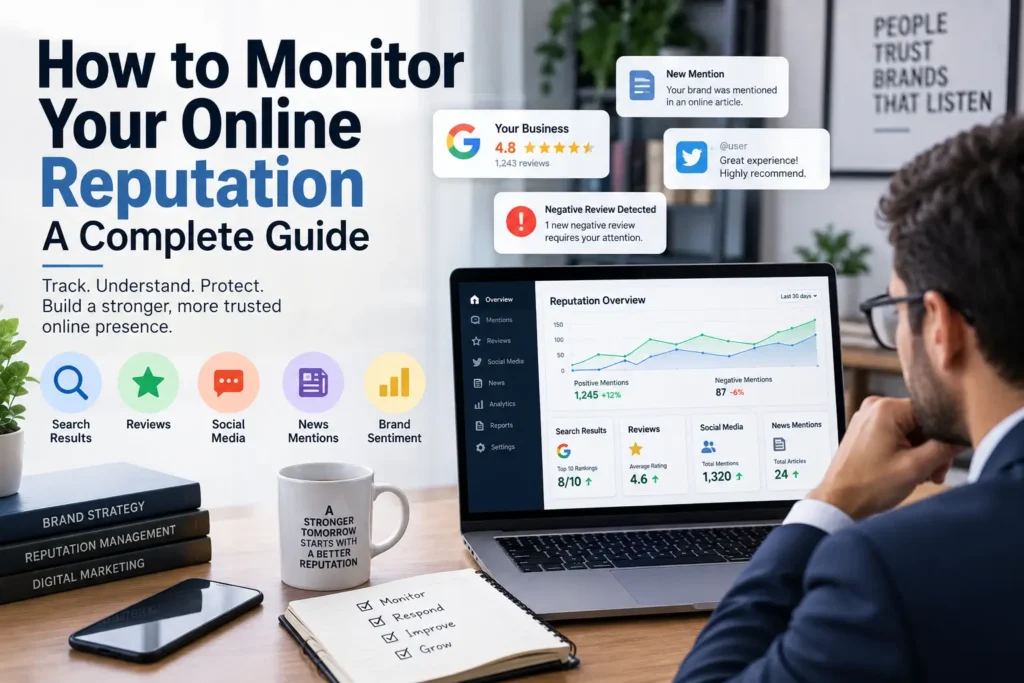
Your online reputation can influence whether a customer calls your business, a patient books an appointment, an investor takes you seriously, or a potential client chooses a competitor. That is why knowing How to Monitor Your Online Reputation is no longer optional for business owners, CEOs, professionals, and personal brands.
Your reputation exists across search engines, review platforms, social networks, news websites, business directories, forums, and increasingly, AI-powered search experiences. A problem that starts with one review or social post can become much more visible if nobody notices it early.
The good news is that reputation monitoring does not have to mean watching the internet manually all day. With the right combination of alerts, search checks, platform monitoring, and professional analysis, you can identify reputation risks before they become major problems.
Table of Contents
- Why Online Reputation Monitoring Matters
- How to Monitor Your Online Reputation Step by Step
- What You Should Monitor
- Reputation Monitoring Tools and Platforms
- How Often Should You Monitor Your Reputation?
- Real-World Reputation Monitoring Example
- Common Reputation Monitoring Mistakes
- Best Practices for Long-Term Reputation Protection
- When to Hire a Reputation Management Professional
- Final Takeaway and Next Steps
- Frequently Asked Questions
Why Online Reputation Monitoring Matters
People rarely see your reputation in just one place. A potential customer might find your website through Google, check your reviews, look at your social media, and then search your name again before making a decision.
That means a strong reputation requires visibility across multiple digital touchpoints.
Effective monitoring helps you identify:
- New negative reviews
- Brand mentions
- Negative news coverage
- Defamatory claims
- Social media complaints
- Competitor-related issues
- Changes in branded search results
- Fake or misleading information
- Customer sentiment trends
Monitoring also gives you an opportunity to respond while an issue is still manageable.
Google’s guidance emphasizes helpful, reliable, people-first content and clear expertise as important considerations for creating trustworthy search experiences.
How to Monitor Your Online Reputation Step by Step
A reliable monitoring system should be structured rather than reactive. Instead of searching your name randomly, create a repeatable process that covers the places where your reputation matters most.
Step 1: Search Your Brand and Name
Start with the searches your customers, clients, patients, investors, or partners are most likely to perform.
Search for:
- Your company name
- Your personal name
- CEO or executive names
- Brand name + reviews
- Brand name + complaints
- Brand name + scam
- Brand name + lawsuit
- Brand name + news
- Brand name + location
Review at least the first page of results and pay attention to recurring negative themes.
Step 2: Monitor Review Platforms
Reviews are one of the most visible reputation signals for local and service-based businesses.
Monitor platforms relevant to your industry, including Google Business Profile, Yelp, industry-specific directories, and other major review websites.
Do not focus only on your average rating. Look at the language customers use, recurring complaints, response patterns, and whether suspicious reviews appear.
Step 3: Track Brand Mentions
Your company can be mentioned online without receiving a direct notification.
A journalist may mention your business in an article. A customer may discuss your service on a forum. An industry publication may reference one of your executives.
Brand-mention monitoring helps you discover these conversations before they become difficult to manage.
Step 4: Monitor Social Media
Social platforms can turn small complaints into highly visible conversations.
Your monitoring should cover your official accounts as well as relevant mentions of your company or leadership team.
For organizations with an active social presence, dedicated Social Media Reputation Management can help create a more structured approach to monitoring and responding to online conversations.
Step 5: Check Search Results Regularly
Search results should be treated as part of your reputation dashboard.
Search your important branded queries and record:
- Which pages appear
- Which pages are positive or negative
- Whether new results have appeared
- Whether important profiles are visible
- Whether outdated information is still ranking
- Whether negative content has moved higher
This creates a baseline that makes future changes easier to identify.
What Should You Monitor?
Not every online mention requires the same level of attention. The best monitoring systems prioritize information based on potential business impact.
| Reputation Area | What to Watch | Potential Risk |
|---|---|---|
| Google Search | Negative or inaccurate results | High |
| Reviews | Complaints and suspicious reviews | High |
| News | Negative coverage | High |
| Social Media | Complaints and viral posts | Medium–High |
| Forums | Discussions and accusations | Medium |
| Business Listings | Incorrect information | Medium |
| Executive Profiles | Leadership-related mentions | High |
| AI Search | How your brand is represented | Emerging |
This broader approach matters because reputation is not simply a review-management problem. It is the combined perception created by multiple digital sources.
Reputation Monitoring Tools and Platforms
There are many ways to build a monitoring system, ranging from simple manual checks to specialized software.
Search Engine Monitoring
Regular branded searches can reveal changes that automated tools may miss. Create a list of important searches and review them consistently.
Review Monitoring
Use platform notifications wherever available. For businesses receiving frequent reviews, centralized monitoring can save significant time.
Social Listening
Social listening platforms can identify conversations around specific names, brands, products, or topics.
Search Performance Data
Search performance tools provide another layer of insight. Microsoft’s Bing Webmaster Tools, for example, provides data on impressions, clicks, average position, keywords, pages, and other search-performance metrics.
You can explore Microsoft Bing Webmaster Tools for official search-performance and website monitoring resources.
For a more comprehensive tool comparison, see our guide to Best Tools for Monitoring Online Reputation – Expert Guide.
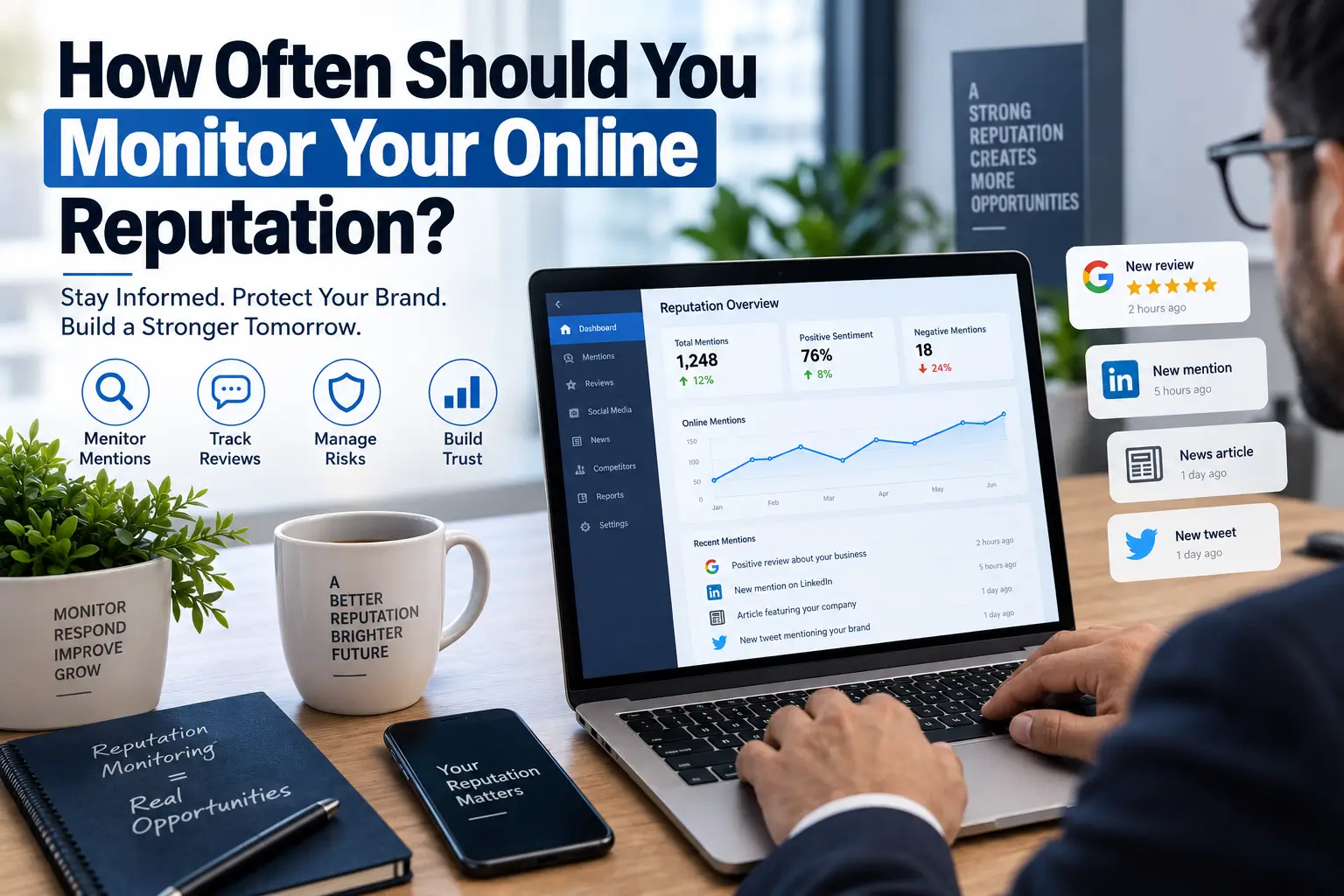
How Often Should You Monitor Your Reputation?
The right monitoring frequency depends on your visibility and risk level.
Daily Monitoring
Daily checks are appropriate for:
- High-profile executives
- Public figures
- Large brands
- Businesses experiencing a crisis
- Companies receiving large numbers of reviews
Weekly Monitoring
Weekly checks may be sufficient for smaller businesses with relatively stable online visibility.
Monthly Reputation Audits
A monthly review provides a broader picture. Look for changes in search results, sentiment, new mentions, review trends, and emerging risks.
The key is consistency. A monitoring system that happens once every six months cannot provide the same protection as one that identifies issues early.
Real Example: How a Small Reputation Issue Can Grow
Imagine a real estate professional receives an unfair one-star review after a disagreement with a prospective client.
Initially, the review may have limited visibility. However, if the business has only a small number of reviews, the negative experience can have a disproportionate effect on the overall profile.
Now imagine another website publishes a post repeating the customer’s claims without verifying them. A social media user shares that post, and additional pages begin referencing the story.
The issue has now moved beyond a single review.
A structured monitoring process could have identified the original complaint, allowed the business to respond professionally, and helped determine whether the subsequent content required further action.
This illustrates why How to Monitor Your Online Reputation is ultimately about early detection—not simply reacting after damage has already occurred.
Common Reputation Monitoring Mistakes
Even businesses that understand the importance of reputation monitoring can make avoidable mistakes.
Only Monitoring Google
Google is important, but it is not the entire internet. Important conversations may happen on social media, review platforms, forums, news websites, and industry directories.
Checking Only When There Is a Problem
Reactive monitoring creates blind spots. By the time you discover an issue, it may already have gained visibility.
Responding Emotionally
A frustrated response can attract more attention to a complaint. Reputation monitoring should create time for thoughtful decision-making rather than encourage impulsive reactions.
Ignoring Positive Signals
Monitoring is not only about finding negative information. Positive reviews, favorable mentions, media coverage, and successful content should also be tracked.
Treating Every Negative Mention as a Crisis
Not every criticism requires removal or a public response. Good reputation management distinguishes between legitimate feedback, opinion, inaccurate information, and potentially harmful content.
Best Practices for Long-Term Reputation Protection
A strong monitoring program should be connected to a broader reputation strategy.
1. Establish a Reputation Baseline
Document your current search results, reviews, social presence, media mentions, and important profiles.
2. Create a Response Framework
Decide in advance which issues require immediate attention and which can be handled through normal customer service.
3. Protect Executive Visibility
For CEOs and founders, personal and corporate reputations often overlap. Maintaining accurate professional profiles and authoritative content can help create a stronger digital footprint.
If leadership reputation is a priority, explore CEO Reputation Management.
4. Build Positive Digital Assets
A healthy reputation is easier to protect when accurate, useful, authoritative information already exists online.
This can include:
- Expert articles
- Company profiles
- Executive biographies
- Industry publications
- Professional interviews
- Educational resources
- Authentic customer reviews
5. Review Your Strategy Regularly
Search behavior, platforms, competitors, and AI-powered experiences change. Your monitoring strategy should evolve with them.
Google’s current guidance for AI features emphasizes the same foundational principles used in traditional search: technically accessible pages, helpful content, and people-first quality.
Reputation Monitoring vs. Reputation Management
Monitoring and management are related but not identical.
Reputation monitoring tells you what is being said and where it is appearing.
Reputation management determines what to do about it.
For example, monitoring might identify a negative article ranking for your company name. Reputation management then evaluates whether the article can be corrected or removed, whether a response is appropriate, or whether broader search-visibility strategies should be considered.
For businesses that need a more comprehensive approach, our Reputation Management Services combine monitoring with strategic reputation protection.
You can also learn more about How Reputation Management Works before deciding which approach fits your situation.
When Should You Hire a Reputation Management Professional?
DIY monitoring can work for a small business with limited online visibility. However, professional support becomes more valuable when the reputation issue is complex, high-profile, or potentially damaging.
Consider professional assistance when:
- Negative content ranks prominently
- Your business is receiving suspicious reviews
- False information is spreading
- Your executive reputation is affected
- Negative media coverage appears
- A reputation crisis is developing
- You lack the time to monitor multiple platforms
- Search results no longer accurately represent your business
A professional Reputation Management Agency can evaluate the broader digital landscape instead of focusing on one isolated result.
For organizations that prefer strategic advisory support, Reputation Management Consultants can help develop a customized monitoring and response framework.
Personal Reputation Requires a Different Approach
Business reputation and personal reputation can overlap, but they are not always managed in the same way.
Entrepreneurs, doctors, lawyers, real estate professionals, and other public-facing individuals may have search results connected directly to their names.
In these situations, monitoring should cover:
- Name searches
- Professional profiles
- News mentions
- Reviews
- Social media
- Industry publications
- Public-facing business information
Our Personal Reputation Management service focuses specifically on protecting and strengthening an individual’s digital presence.
Influencers and creators may also face unique challenges because their reputation is closely connected to audience sentiment and social visibility. Our guide to Online Reputation Management for Influencers covers those considerations in greater detail.
Build a Reputation Monitoring System That Works
Knowing How to Monitor Your Online Reputation is valuable, but consistency is what makes the process effective.
Start by identifying the names, brands, executives, products, and keywords that matter most. Then monitor search results, reviews, social conversations, news mentions, and important digital profiles on a schedule appropriate to your risk level.
Most importantly, don’t wait for a reputation crisis before creating your system.
A proactive approach gives you better visibility, more time to evaluate problems, and a stronger foundation for protecting customer trust.
For organizations that need ongoing support, a specialized Reputation Monitoring strategy can provide a more structured way to identify emerging risks and track changes over time.
Client Reviews & Trust
Choosing an online reputation management partner is an important decision. Before getting started, prospective clients can explore feedback from people who have experienced Your Reputation Agency firsthand.
We encourage you to review our Trustpilot feedback to learn more about client experiences, service quality, communication, and our approach to reputation management. Independent reviews can provide valuable context when evaluating a professional reputation management partner.
Common Questions About Online Reputation Monitoring
What is online reputation monitoring?
Online reputation monitoring is the process of tracking search results, reviews, news articles, social media mentions, forums, and other online information that can influence how people perceive an individual or organization.
How often should I monitor my online reputation?
The ideal frequency depends on your visibility and risk. High-profile businesses and executives may benefit from daily monitoring, while smaller businesses may use weekly checks combined with a monthly reputation review.
How can I monitor my online reputation for free?
You can begin with manual Google searches, platform notifications, Google Business Profile monitoring, social media alerts, and basic search-performance tools. These methods provide a useful foundation before investing in specialized software.
What should I do if I find a negative review?
First, determine whether the review appears genuine and whether it violates the platform’s policies. If it is legitimate feedback, respond professionally and address the underlying concern. If you believe it violates platform rules, investigate the appropriate reporting process.
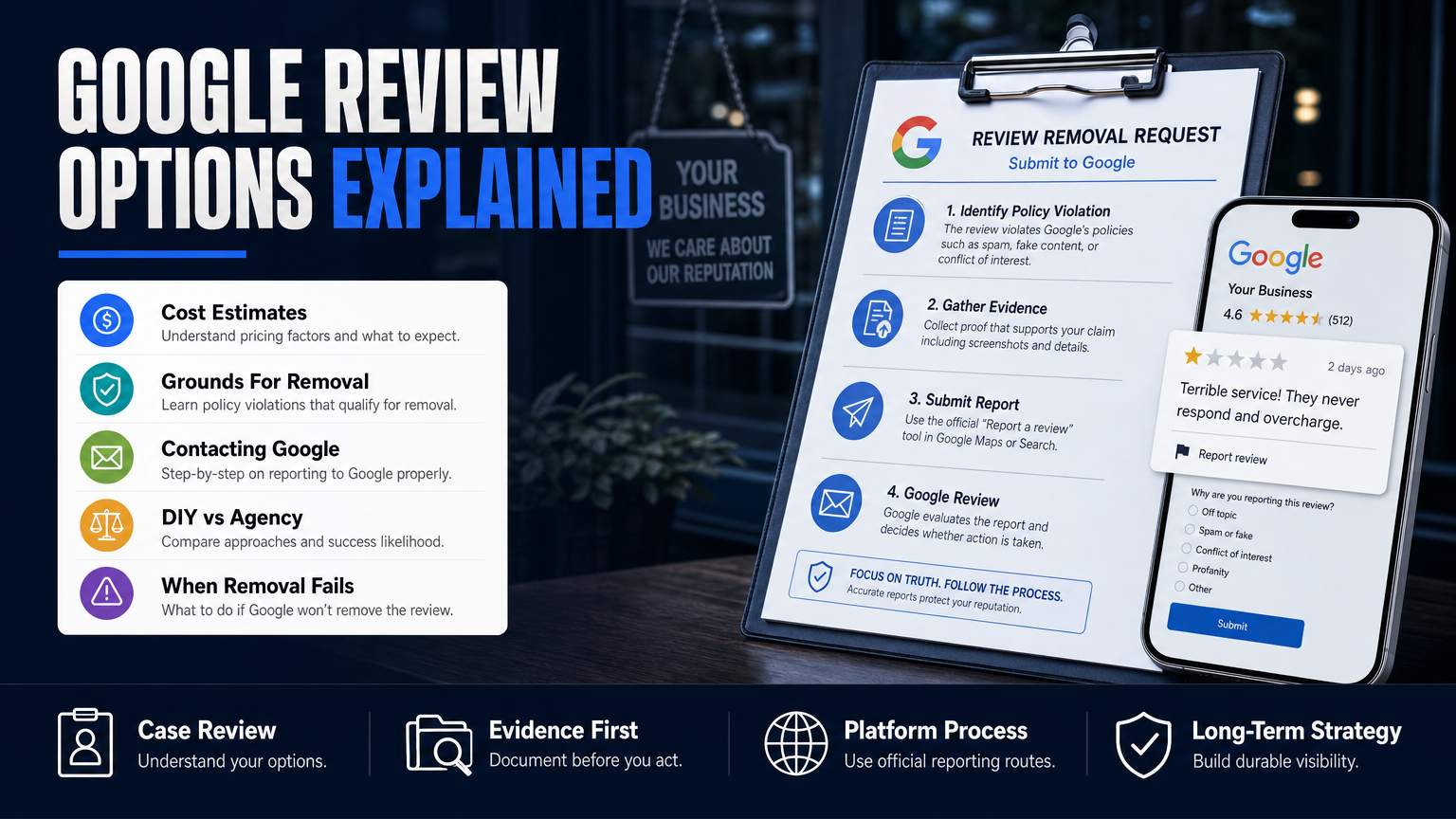
For businesses dealing specifically with problematic reviews, you can learn more about Remove Google Reviews and the circumstances in which review-related action may be appropriate.
Can reputation monitoring remove negative content?
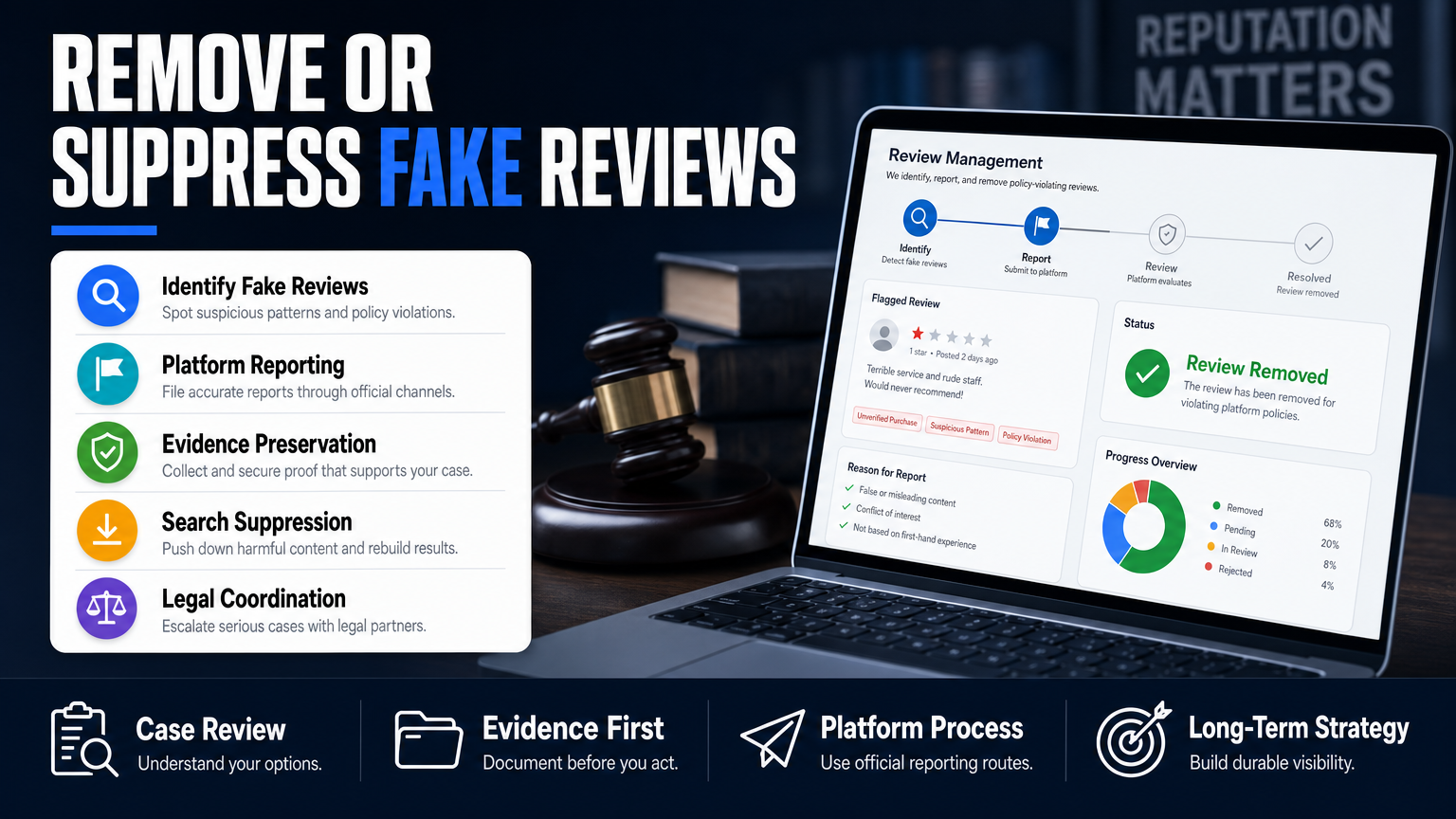
Monitoring itself does not remove content. It identifies potential problems. Depending on the circumstances, a separate reputation management strategy may involve publisher outreach, correction requests, platform reporting, content improvement, or search visibility strategies.
Is social media monitoring part of reputation management?
Yes. Social media can significantly influence public perception, particularly for executives, personal brands, and consumer-facing businesses. Monitoring relevant mentions and conversations can help identify issues before they become more widespread.
Why is reputation monitoring important for CEOs?
A CEO’s name can become closely associated with the company’s brand. Monitoring executive search results, news coverage, professional profiles, and social mentions can help identify risks that may affect both personal credibility and corporate reputation.
How can a reputation management firm help?
A professional Reputation Management Firm can monitor relevant digital channels, assess potential risks, prioritize issues, and coordinate a broader reputation strategy. The right approach depends on the client’s industry, goals, search environment, and the nature of the issue.
Strong CTA: Protect Your Reputation Before a Problem Escalates
Your reputation deserves more than occasional Google searches.
If you’re a business owner, CEO, doctor, lawyer, entrepreneur, real estate professional, or personal brand, your online presence can directly influence how people evaluate you. A single negative result may not define your reputation, but ignoring reputation risks can give them more room to grow.
Your Reputation Agency provides strategic online reputation management for individuals and organizations that need a more proactive approach. From monitoring and executive reputation protection to search visibility and reputation recovery, our team can help you understand what’s appearing online and determine what should happen next.
If you are ready to take control of your digital reputation, contact Your Reputation Agency for a confidential consultation and discuss a strategy built around your specific situation.
Conclusion
Learning How to Monitor Your Online Reputation is ultimately about staying informed before a small issue becomes a major reputation problem.
The most effective approach combines regular search checks, review monitoring, social listening, brand-mention tracking, and periodic reputation audits. For high-risk individuals and organizations, professional monitoring can add another layer of analysis and strategic support.
Most importantly, reputation monitoring should be proactive. Don’t wait until a negative article, review, or social post starts affecting your customers. Build a system now, track what matters, respond thoughtfully, and continuously strengthen the digital presence you want people to see.