Introduction
Your reputation is no longer controlled only by what people say about you in person. Today, customers, investors, employees, journalists, and business partners can form an opinion about a person or company after a single Google search.
That is why understanding how reputation management works matters for business owners, CEOs, doctors, lawyers, entrepreneurs, personal brands, and other professionals whose success depends on trust.
Online reputation management, or ORM, is the process of monitoring, improving, and protecting how a person or organization appears across search engines, review platforms, social media, news websites, and other digital channels.
Importantly, reputation management is not simply about deleting negative content. A professional strategy looks at the entire digital presence, identifies risks, strengthens credible information, and creates a healthier online footprint over time.
What Is Online Reputation Management?
Online reputation management is a structured process for influencing, protecting, and improving how an individual, company, or brand is represented online.
It can involve several activities, including:
- Monitoring brand and personal mentions
- Reviewing search engine results
- Managing online reviews
- Addressing harmful or inaccurate content
- Creating authoritative content
- Improving branded search visibility
- Protecting executive and personal brands
- Responding to reputation crises
- Monitoring emerging risks
Reputation management is therefore broader than SEO. SEO can help improve search visibility, while ORM considers the quality, accuracy, sentiment, authority, and context of the information people encounter.
Google explains that its systems consider factors such as relevance, usability, expertise, and other signals when determining which information appears in Search.
How Reputation Management Works
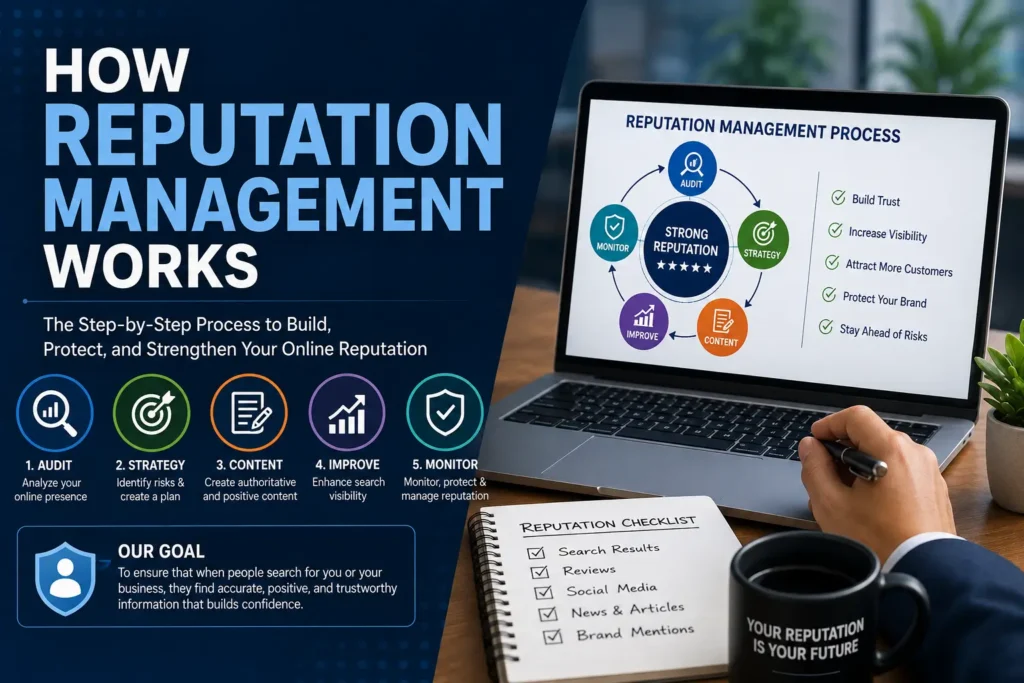
The easiest way to understand how reputation management works is to think of it as a continuous cycle:
Audit → Analyze → Strategize → Improve → Monitor → Protect
A professional campaign normally starts by understanding what currently appears online. The next stage identifies the biggest reputation risks and opportunities.
From there, specialists develop a customized plan that may involve content creation, SEO, review management, search suppression, publisher outreach, digital PR, or crisis response.
The process doesn’t end when search results improve. Ongoing monitoring helps identify new risks before they become larger problems.
Step 1: Conduct a Comprehensive Reputation Audit
Every effective ORM campaign begins with research.
A reputation audit examines what appears when people search for the company, executive, professional, product, or brand.
This may include:
- Google search results
- Bing search results
- News coverage
- Reviews
- Social media profiles
- Business directories
- Forums
- Blogs
- Images and videos
- Third-party profiles
The objective is to establish a clear baseline.
For example, a company might discover that its website ranks first for its brand name, but an outdated review website appears immediately below it. Another business might discover that its CEO’s LinkedIn profile is weak while several old articles dominate branded searches.
Without this initial analysis, it is difficult to determine which actions deserve priority.
Step 2: Identify Reputation Risks
Once the online footprint has been mapped, the next step is separating normal online activity from genuine reputation risks.
Not every negative result requires intervention.
A legitimate critical review may simply provide an opportunity for a professional response. In contrast, inaccurate allegations, misleading articles, fake reviews, impersonation, or coordinated attacks may require a more strategic response.
Reputation risks can generally be grouped into:
| Risk | Potential Response |
|---|---|
| Negative reviews | Review management and customer response |
| False information | Investigation and appropriate removal request |
| Negative search results | SEO and search suppression |
| Harmful news coverage | Strategic response and reputation recovery |
| Weak executive presence | Executive reputation management |
| Social media crisis | Crisis communication strategy |
| Lack of positive content | Authority and content development |
This classification prevents businesses from using the wrong strategy for the wrong problem.
Step 3: Build a Customized Reputation Strategy
After the audit, the reputation team creates a roadmap.
A strong strategy should answer several questions:
- What is currently damaging the reputation?
- Which search results matter most?
- Which content can potentially be corrected or removed?
- Which content needs to be addressed through suppression?
- What positive information is missing?
- Which audiences need to be influenced?
- How will progress be measured?
The answer will differ depending on the client.
For example, a doctor may need stronger professional profiles and educational content, while a CEO may need executive thought leadership, media positioning, and stronger branded search results.
Step 4: Improve Search Visibility
Search engines are one of the most important parts of modern reputation management.
When someone searches for your name or company, you want the results to provide an accurate and trustworthy picture of who you are.
This can involve optimizing:
- Company websites
- Executive biographies
- Professional profiles
- Service pages
- Articles
- Press coverage
- Social profiles
- Business listings
- Industry profiles
Google states that crawling involves discovering new or updated pages, while indexing involves processing and storing pages so they can potentially appear in Search.
That means reputation work requires patience. Publishing a new page does not guarantee immediate rankings.
Step 5: Manage Reviews and Public Feedback
Reviews can strongly influence how prospective customers perceive a business.
Reputation management therefore includes monitoring review platforms and responding appropriately to genuine customer feedback.
A good review strategy focuses on:
- Monitoring new reviews
- Responding professionally
- Identifying recurring customer concerns
- Encouraging authentic feedback
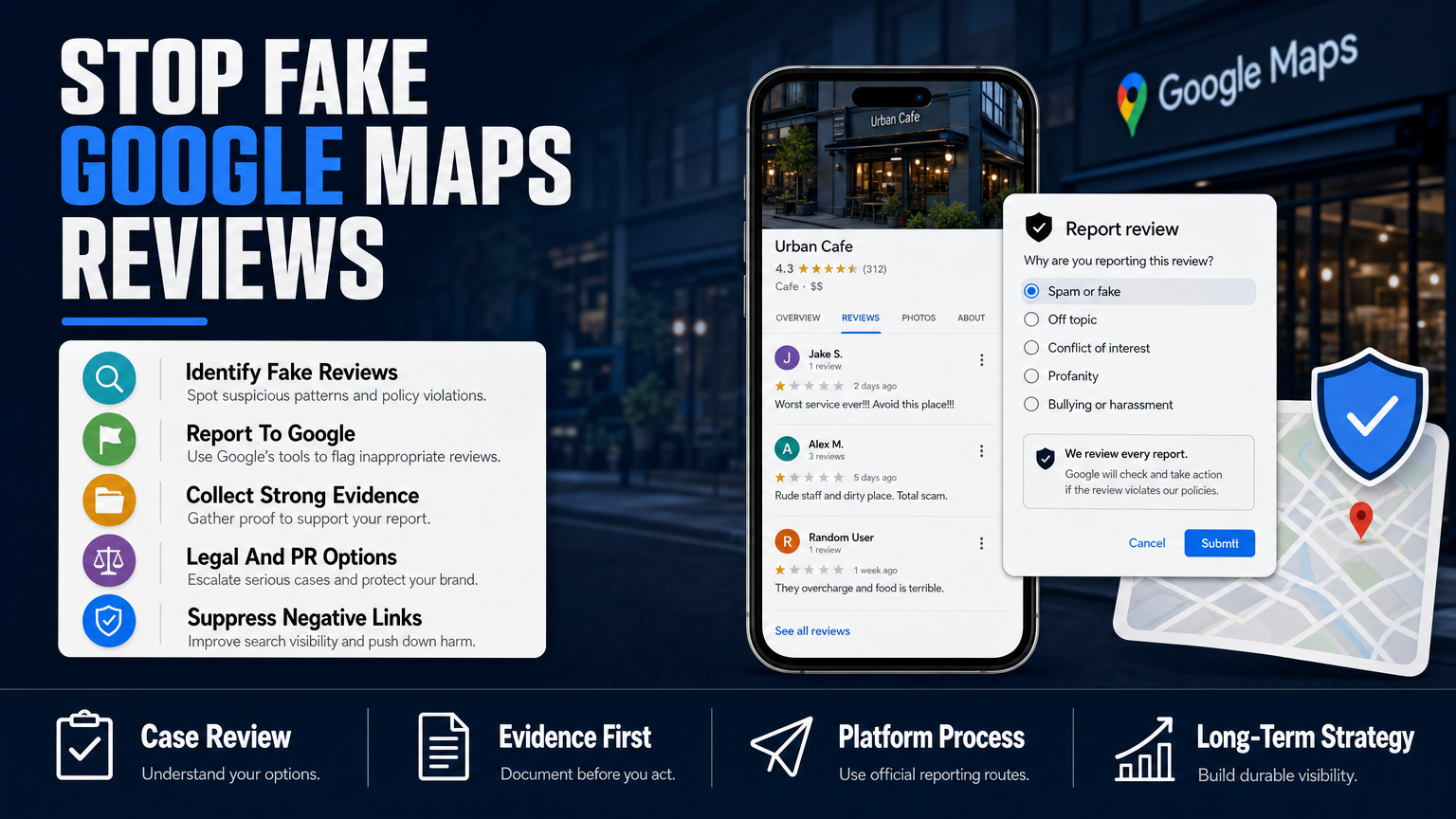
- Reporting reviews that violate platform policies
- Improving the underlying customer experience
The goal should never be to manufacture positive reviews. Instead, businesses should create genuine experiences that naturally encourage satisfied customers to share their feedback.
For businesses facing specific Google review problems, a specialized service may be appropriate: Remove Google Reviews
Step 6: Create Authoritative Content
One of the most important parts of reputation management is building a stronger digital footprint.
This means creating useful, accurate, relevant content that demonstrates expertise and provides search engines and users with better information about the person or organization.
Examples include:
- Expert articles
- Company insights
- Executive profiles
- Industry commentary
- Educational guides
- Case studies
- Service pages
- Professional biographies
- Press and media content
The purpose is not to publish hundreds of low-quality pages.
Instead, the objective is to develop a smaller collection of useful, authoritative, relevant assets that genuinely represent the brand.
This approach aligns with Google’s emphasis on helpful, reliable, people-first content.
Step 7: Monitor and Protect the Reputation
Reputation management does not end once the immediate issue improves.
Online conversations continue to change. New reviews can appear, articles can be published, social media discussions can gain attention, and search results can change over time.
Ongoing monitoring can identify:
- New brand mentions
- Negative reviews
- New search results
- Media coverage
- Competitor activity
- Social discussions
- Emerging reputation threats
This allows businesses to respond earlier instead of waiting until a problem becomes highly visible.
Content Removal vs. Search Suppression
A common misunderstanding about how reputation management works is that every negative result should be deleted.
That isn’t realistic.
There are two fundamentally different approaches.
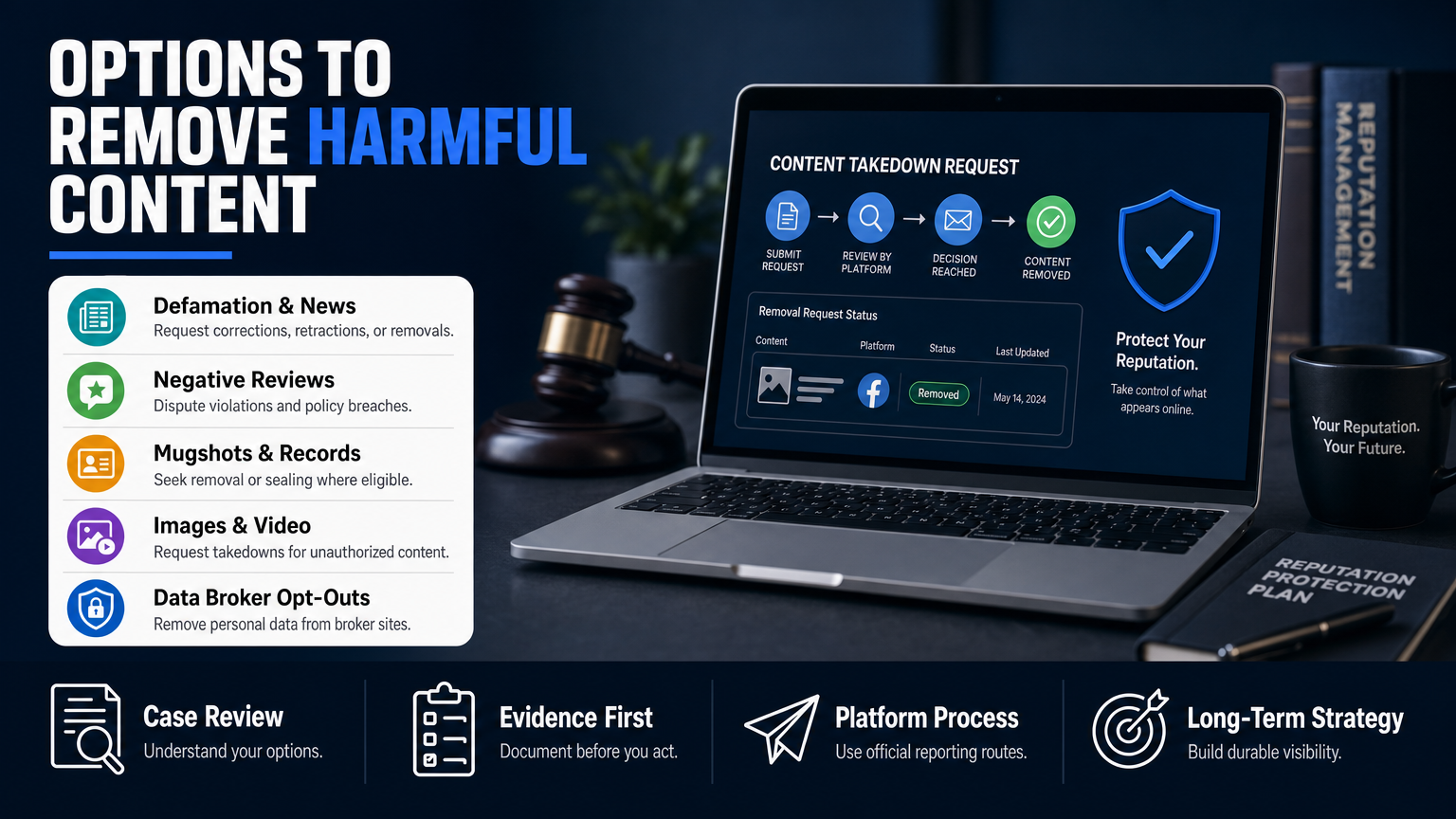
Content Removal
Content removal attempts to address the original source.
Depending on the situation, this could involve:
- Contacting a website owner
- Requesting a correction
- Reporting policy violations
- Requesting removal under applicable policies
- Seeking appropriate legal advice
However, removal depends on the publisher, platform, circumstances, and applicable rules.
Search Suppression
Suppression takes a different approach.
Instead of trying to delete a page, the strategy focuses on strengthening relevant, accurate, and authoritative content so harmful or outdated results become less prominent.
You can learn more about the difference in our guide:
Search Suppression vs. Content Removal | Key Differences
And our detailed guide explains:
What Is Search Result Suppression? | Complete Guide
Neither strategy is appropriate for every situation. A professional assessment should determine which approach makes sense.
How Reputation Management Works for Different Professionals
The fundamentals remain similar, but the strategy changes according to the client’s industry and reputation risks.
Business Owners
Business owners may focus on reviews, local search visibility, brand mentions, customer trust, and negative content.
CEOs and Executives
Executives often need stronger professional profiles, thought leadership, media positioning, and protection of their personal search results.
For additional guidance, see our CEO Reputation Management Guide:
CEO Reputation Management Guide
Doctors and Healthcare Professionals
Healthcare reputation management requires particular attention to professional credibility, patient feedback, accurate credentials, and ethical communication.
Online Reputation Management for Healthcare
Lawyers
Lawyers often need to protect professional credibility while maintaining accurate biographies, reviews, publications, and legal-industry profiles.
Personal Brands and Influencers
Personal brands can be especially vulnerable because the individual and the brand are closely connected. Search results, social media, reviews, and media coverage can all influence commercial opportunities.
Online Reputation Management for Influencers
Real Estate Professionals
For real estate professionals, reviews, local search visibility, professional profiles, and public trust can directly influence lead generation.
A Realistic Reputation Management Example
Consider a fictional business owner named Michael who operates a growing real estate company.
A Google search for Michael’s name reveals:
- His company website
- An outdated negative article
- His LinkedIn profile
- Several property-related pages
- A few customer reviews
The problem isn’t necessarily that every result is negative. The issue is that the outdated article receives disproportionate visibility.
A reputation management campaign could begin by auditing the article, determining whether a legitimate correction or removal route exists, strengthening Michael’s professional profiles, creating useful industry content, improving his company’s authority, and monitoring search results.
Over time, the objective is to create a more complete and accurate digital picture of Michael and his business.
This example illustrates an important principle: reputation management is about improving the overall digital narrative, not simply chasing one URL.
Common Reputation Management Mistakes
Many businesses make their reputation problems worse by reacting without a strategy.
1. Responding Emotionally
Public arguments can attract additional attention to an issue.
2. Trying to Remove Everything Negative
Not every criticism violates a policy or qualifies for removal.
3. Using Low-Quality SEO Tactics
Mass-produced pages, spammy backlinks, or manipulative tactics can create additional problems.
4. Ignoring Reviews
Ignoring legitimate customer concerns can make a business appear unresponsive.
5. Waiting Until a Crisis
Proactive monitoring is generally easier than repairing years of accumulated reputation damage.
6. Expecting Instant Results
Search engines need time to crawl, index, and evaluate content. Google specifically notes that crawling and indexing can take time and that requesting a crawl does not guarantee immediate inclusion or rankings.
Best Practices for Long-Term Reputation Protection
A sustainable reputation strategy should become part of normal business operations.
Consider these practices:
- Monitor branded search results regularly
- Keep company information accurate
- Maintain professional social profiles
- Publish genuinely useful content
- Respond to legitimate reviews professionally
- Track media mentions
- Maintain consistent brand messaging
- Strengthen executive profiles
- Address reputation risks early
- Review your digital footprint periodically
The objective is to build an online presence that accurately represents your expertise and creates confidence among customers and stakeholders.
Expert Tips for Building a Stronger Digital Reputation
Focus on Accuracy
Your online information should be consistent across websites, profiles, directories, and social channels.
Demonstrate Real Expertise
Publish content based on genuine experience, knowledge, and professional expertise rather than generic material.
Build Multiple Trusted Assets
Your website should not be the only place where authoritative information about your brand exists.
Think Beyond Google
Modern reputation management should consider search engines, review platforms, social media, news websites, and AI-powered discovery experiences.
Microsoft’s search ecosystem similarly relies on indexed information and search technologies to help users discover relevant content, making a consistent and accessible digital presence valuable beyond Google alone.
Measure the Right Things
Don’t judge a campaign only by rankings.
Also evaluate:
- Branded search visibility
- Sentiment
- Review trends
- Positive content visibility
- Referral traffic
- Qualified leads
- Search impressions
- Reputation risks
Reputation Management and AI Search
The way people discover information is changing.
Users increasingly ask AI systems questions about companies, executives, professionals, and brands. This makes it more important than ever to maintain accurate, consistent, authoritative information across the web.
AI reputation management focuses on strengthening the digital signals that help AI-powered systems understand who you are, what your organization does, and which sources provide credible information about you.
That includes:
- Consistent business information
- Strong entity signals
- Authoritative content
- Expert profiles
- Structured information
- Reputable third-party references
- Accurate brand descriptions
For businesses preparing for this changing search environment, our dedicated AI Reputation Management service provides a more specialized approach: AI Reputation Management
Navigating a Reputation Crisis
Some reputation issues require immediate action.
A crisis might involve a viral accusation, negative media coverage, widespread complaints, a controversial incident, or rapidly spreading misinformation.
During a crisis, businesses should prioritize:
- Understanding exactly what happened
- Verifying available information
- Avoiding emotional public responses
- Establishing clear communication
- Monitoring the conversation
- Correcting inaccurate information where appropriate
- Protecting customers and stakeholders
- Developing a longer-term recovery strategy
For a deeper look at crisis response, read: Navigating PR Crises: Effective Online Reputation Management Strategies
When Should You Hire a Reputation Management Agency?
You don’t necessarily need professional ORM for every negative comment.
However, professional help becomes particularly valuable when:
- Negative content ranks highly for your name
- A reputation crisis is spreading
- False information is affecting your business
- Negative reviews are becoming a recurring problem
- An executive’s reputation is affecting business opportunities
- Media coverage is creating long-term damage
- You don’t have the expertise or resources to manage the issue internally
A professional agency can bring together SEO, content strategy, monitoring, review management, search suppression, and crisis planning into one coordinated strategy.
If you need a broader overview of professional ORM solutions, explore: Reputation Management Services
Frequently Asked Questions
What is reputation management?
Reputation management is the ongoing process of monitoring, improving, and protecting how an individual, company, or brand is represented online.
How reputation management works in simple terms?
It starts with auditing your digital presence, identifying risks, creating a strategy, improving authoritative content and search visibility, managing reviews, and continuously monitoring the results.
Can reputation management remove negative content?
Sometimes. Removal depends on the content, publisher, platform policies, and circumstances. When removal isn’t possible, search suppression and reputation improvement strategies may be considered.
How long does reputation management take?
The timeline varies considerably. Simple issues may require less work, while complex reputation recovery can require months of consistent strategy, content development, monitoring, and optimization.
Is reputation management the same as SEO?
No. SEO primarily focuses on search visibility, while reputation management considers search results alongside reviews, media, social platforms, public perception, and digital credibility.
Does reputation management work for CEOs?
Yes. Executive reputation management can help CEOs and founders strengthen professional visibility, protect credibility, develop thought leadership, and address reputation risks.
Can reputation management help doctors and lawyers?
Yes. Professionals in trust-sensitive industries can use reputation management to strengthen accurate professional information, manage reviews, improve search visibility, and protect credibility.
How often should an online reputation be monitored?
Monitoring frequency depends on the individual’s or company’s visibility and risk level. High-profile brands and executives may benefit from more frequent monitoring than smaller businesses.
Can AI affect online reputation?
Yes. AI-powered search and answer systems may use information from publicly available sources. Maintaining accurate, authoritative, and consistent information across the web can help establish a stronger digital presence.
What should I do if I have a reputation crisis?
First, avoid reacting emotionally. Document what is happening, verify the facts, monitor the spread of information, and develop a structured response. For significant crises, professional reputation and PR guidance can be valuable.
Conclusion
Understanding how reputation management works is important because your digital reputation can influence trust long before someone speaks with you directly.
Effective ORM isn’t about manipulating search engines or pretending that criticism doesn’t exist. It is about creating an accurate, trustworthy, and authoritative digital presence while addressing legitimate reputation risks through appropriate strategies.
The process starts with an audit, moves through strategy and implementation, and continues with monitoring and protection. Depending on the situation, that may involve content development, SEO, review management, search suppression, executive reputation management, crisis response, or AI-focused reputation strategies.
Most importantly, reputation protection should be proactive. Waiting until a negative result becomes a crisis can make recovery more difficult.
Read our client reviews on Trustpilot and Google Business Profile to learn why organizations trust Your Reputation Agency for professional online reputation management.
Protect Your Reputation Before It Becomes a Business Problem
Your reputation represents years of work, expertise, relationships, and customer trust. It deserves a strategy that is just as thoughtful as the business you built.
Your Reputation Agency helps business owners, CEOs, entrepreneurs, doctors, lawyers, personal brands, real estate professionals, and organizations assess and strengthen their online presence through customized reputation management strategies.
Whether you’re dealing with a specific reputation problem or want to build stronger digital protection before one occurs, our team can assess your situation and recommend the most appropriate next steps.
Ready to take control of your online reputation?
Contact Us for a confidential consultation and discuss a strategy built around your reputation, goals, and long-term business interests.