Your online reputation has become one of your most valuable business assets. Whether you’re a CEO, business owner, doctor, lawyer, entrepreneur, or personal brand, people research you online before making decisions. A single search result, customer review, or news article can influence trust long before someone contacts your business.
That is why understanding the Best Reputation Management Strategies is no longer optional—it’s essential. Modern reputation management goes far beyond responding to negative reviews. It involves building authority, improving search visibility, monitoring brand mentions, and creating a trustworthy digital presence across search engines, AI platforms, review websites, and social media.
In this comprehensive guide, you’ll learn proven reputation management strategies used by successful organizations, discover common mistakes to avoid, and understand how proactive reputation management helps protect long-term business growth.
Table of Contents
- Why Reputation Management Matters More Than Ever
- What Is Reputation Management?
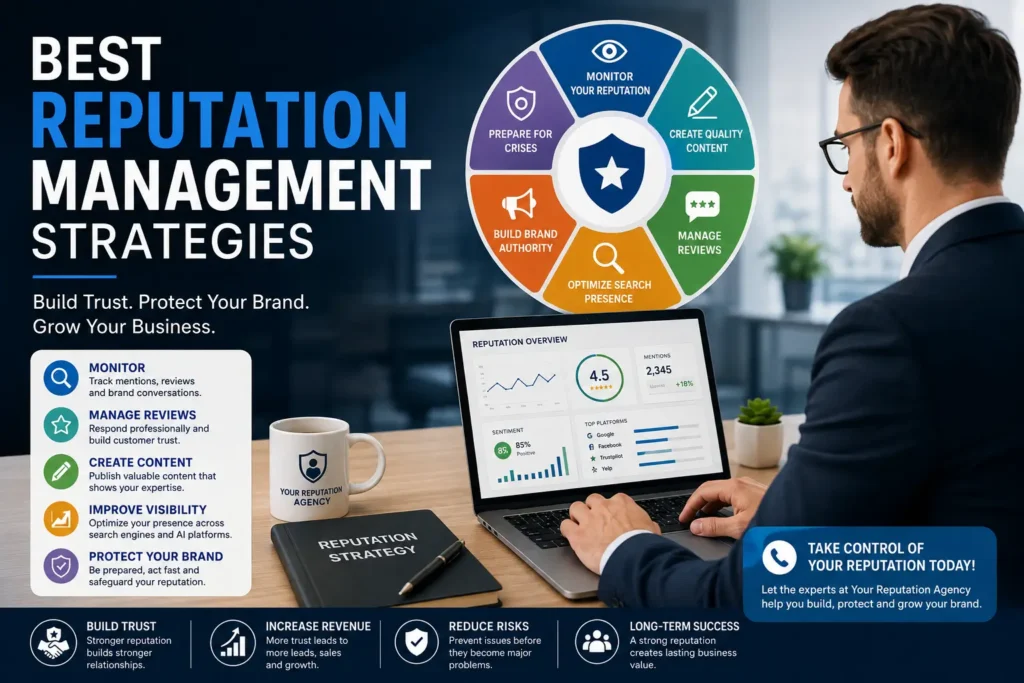
- Best Reputation Management Strategies for Businesses
- Build a Strong Digital Foundation
- Monitor Your Online Reputation
- Create High-Quality Content Consistently
- Manage Customer Reviews Professionally
- Optimize Your Search Presence
- Prepare for Reputation Crises
- Real-World Example
- Common Reputation Management Mistakes
- Best Practices for Long-Term Success
- Expert Reputation Management Tips
- Conclusion
- Frequently Asked Questions
Why Reputation Management Matters More Than Ever
The internet has changed how people make decisions.
Before purchasing a product, hiring a lawyer, booking a doctor, or partnering with a company, people almost always search online first. They read reviews, explore search results, check news articles, browse social media, and increasingly rely on AI-powered search experiences such as ChatGPT, Google AI Overviews, Gemini, and Bing Copilot.
A positive digital reputation builds confidence before a conversation even begins.
On the other hand, outdated information, inaccurate content, negative reviews, or poor search visibility can create doubt—even if your business delivers exceptional service.
Businesses that actively invest in reputation management are often better positioned to:
- Build customer trust
- Increase qualified leads
- Improve conversion rates
- Strengthen brand authority
- Reduce reputational risks
- Support long-term SEO performance
Reputation management isn’t simply about handling problems—it’s about creating a digital presence that accurately reflects your expertise and credibility.
What Is Reputation Management?
Online Reputation Management (ORM) is the ongoing process of monitoring, improving, protecting, and influencing how individuals and businesses are perceived online.
An effective reputation strategy combines multiple disciplines, including:
- Search Engine Optimization (SEO)
- Content Marketing
- Digital Public Relations
- Review Management
- Brand Monitoring
- Crisis Communication
- Search Result Optimization
- Social Media Management
- AI Search Optimization
Rather than focusing on one platform, successful reputation management creates consistency across your entire digital ecosystem.
This holistic approach improves trust with customers while also helping search engines better understand your brand’s authority.
If you’re interested in seeing how modern AI platforms are changing online reputation, explore our guide on AI Reputation Management
Best Reputation Management Strategies for Long-Term Success
No single tactic can protect your online reputation.
Instead, successful businesses combine several proven strategies that reinforce one another over time.
Below are the most effective reputation management strategies used by leading brands and professionals.
1. Build a Strong Digital Foundation
Everything begins with your own digital assets.
Your website should become the most trusted source of information about your business.
That means maintaining:
- A fast, secure website
- Professional service pages
- Helpful educational content
- Accurate contact information
- Clear brand messaging
- Updated leadership profiles
- Trust signals such as testimonials and certifications
When your owned properties are strong, search engines are more likely to prioritize accurate information about your business.
2. Monitor Your Online Reputation Consistently
You cannot manage what you don’t monitor.
Many businesses discover reputation issues only after customers mention them—or worse, after revenue begins to decline.
Effective monitoring includes tracking:
- Google Search results
- Customer reviews
- Brand mentions
- News articles
- Social media discussions
- Business directories
- AI-generated search responses
Early detection allows businesses to respond before small issues become larger reputation problems.
3. Create Helpful, High-Quality Content
One of the most effective reputation management strategies is consistently publishing valuable content that demonstrates expertise.
Helpful content benefits both users and search engines by answering real questions while establishing topical authority.
Examples include:
- Educational blog posts
- Industry guides
- Case studies
- FAQs
- Executive insights
- White papers
- Client success stories
- Video content
Businesses that regularly publish authoritative content often experience stronger search visibility and increased customer trust.
For examples of successful client outcomes, you can naturally reference See Our Case Studies.
4. Manage Online Reviews Proactively
Online reviews are often the first impression potential customers have of your business. Whether someone is searching for a law firm, medical practice, real estate agency, or software company, reviews heavily influence purchasing decisions.
Instead of focusing only on negative reviews, build a system that consistently encourages satisfied customers to leave honest feedback.
Effective review management includes:
- Responding to both positive and negative reviews
- Thanking customers for their feedback
- Addressing concerns professionally
- Never purchasing fake reviews
- Monitoring review platforms regularly
- Learning from customer feedback
A transparent response to criticism often builds more trust than having only perfect ratings.
If your business is dealing with policy-violating or fraudulent reviews, our Remove Google Reviews service explains the available options:
5. Optimize Your Search Presence
When people search your business or personal name, what they find matters.
One of the Best Reputation Management Strategies is ensuring your most trustworthy and relevant content appears prominently in branded search results.
Search optimization includes:
- Optimizing your website
- Building authoritative backlinks
- Publishing expert articles
- Maintaining accurate business listings
- Improving entity recognition
- Optimizing executive profiles
- Creating branded knowledge assets
Search visibility isn’t just about ranking higher—it’s about ensuring the right information appears first.
6. Prepare Before a Reputation Crisis Happens
Many organizations wait until a crisis occurs before thinking about reputation management.
The most successful businesses prepare in advance.
Every organization should have:
- A crisis communication plan
- Designated spokespersons
- Brand monitoring tools
- Media response procedures
- Internal communication guidelines
- Review response workflows
- Escalation processes
Preparation reduces confusion and enables faster, more professional responses when unexpected situations arise.
Businesses that already have reputation strategies in place recover much faster from online challenges.
7. Invest in Executive Reputation Management
For many organizations, the reputation of leadership directly influences the reputation of the company itself.
Investors, journalists, employees, and prospective clients frequently research CEOs and executives before making important decisions.
Executive reputation management focuses on:
- Leadership visibility
- Thought leadership
- Professional biographies
- Media positioning
- Search optimization
- Personal branding
- Reputation monitoring
A strong executive presence often strengthens overall corporate credibility.
To learn more, explore our comprehensive CEO Reputation Management resource.
8. Strengthen Your Reputation Across AI Search Platforms
Search is changing rapidly.
People no longer rely exclusively on Google. Increasingly, they ask questions through ChatGPT, Google AI Overviews, Gemini, Microsoft Copilot, and Perplexity.
These platforms rely on trusted sources, authoritative websites, and consistent brand information.
To improve visibility across AI-powered search experiences:
- Publish original expert content
- Maintain consistent business information
- Earn citations from authoritative sources
- Build topical authority
- Improve website structure
- Use clear headings and FAQs
- Keep content updated regularly
Businesses that prepare for AI-powered search today will have a significant competitive advantage tomorrow.
Step-by-Step Reputation Management Plan
If you’re just getting started, follow this practical roadmap.
Step 1
Audit your online reputation.
Search your business name, executive names, products, and services to understand what customers currently see.
Step 2
Identify your biggest reputation risks.
Prioritize issues based on visibility, credibility, and potential business impact.
Step 3
Improve your owned digital assets.
Update your website, optimize service pages, strengthen executive profiles, and ensure consistent branding across every platform.
Step 4
Develop a long-term content strategy.
Publish educational blogs, FAQs, case studies, guides, and industry insights that demonstrate expertise while supporting SEO.
Step 5
Monitor your reputation continuously.
Track reviews, search results, media mentions, AI-generated summaries, and social conversations to identify emerging issues early.
Why Consistency Always Wins
Many businesses look for quick fixes.
In reality, reputation management works much like building trust in real life—it happens gradually through consistent actions.
Small improvements made every week create significant long-term results.
Businesses that continuously publish helpful content, respond professionally to customers, improve search visibility, and strengthen brand authority typically outperform competitors who only react during crises.
Reputation management is not a campaign.
It is an ongoing business strategy.
A Real-World Example
Imagine a regional law firm receives several negative reviews after a highly publicized legal dispute. Although the firm’s service quality remains excellent, potential clients begin finding those reviews before anything else.
Instead of reacting defensively, the firm implements a comprehensive reputation strategy. They publish educational legal guides, optimize attorney profiles, encourage satisfied clients to leave honest reviews, strengthen local SEO, and share thought leadership articles.
Within several months, positive, authoritative content begins appearing more prominently in search results. Prospective clients now see valuable resources, verified client feedback, and professional credentials before isolated negative mentions.
This approach doesn’t erase criticism—it provides a more accurate and balanced representation of the firm’s expertise and reputation.
Common Reputation Management Mistakes
Even businesses with excellent products or services can damage their reputation by making avoidable mistakes. Understanding these common pitfalls can help you build a stronger and more resilient online presence.
Ignoring Negative Reviews
Some businesses choose not to respond to negative reviews, hoping they’ll disappear over time. Unfortunately, silence can be interpreted as indifference.
A professional, respectful response shows potential customers that you value feedback and are committed to resolving concerns.
Reacting Emotionally
Reputation issues can be stressful, but emotional responses often make the situation worse.
Avoid arguing publicly, blaming customers, or responding aggressively on social media. Instead, communicate calmly, acknowledge concerns when appropriate, and move conversations offline whenever possible.
Using Black-Hat Reputation Tactics
Shortcuts such as fake reviews, spam backlinks, fake news campaigns, or misleading content may provide temporary gains but can severely damage long-term credibility.
Google continues to prioritize authentic, helpful, and trustworthy content. Ethical reputation management is always the safest and most sustainable approach.
Neglecting Your Website
Many organizations spend time managing social media but forget that their website is their most important digital asset.
Keep your website updated with:
- Helpful service pages
- Educational blog content
- Leadership profiles
- Customer testimonials
- Accurate business information
- Clear contact details
A well-maintained website strengthens both trust and search visibility.
Waiting Until a Crisis Happens
One of the biggest mistakes is treating reputation management as an emergency service rather than an ongoing business strategy.
Organizations that continuously monitor and strengthen their reputation recover much faster when unexpected challenges arise.
Best Practices for Long-Term Reputation Success
The Best Reputation Management Strategies are built on consistency rather than quick fixes.
Successful organizations follow these best practices:
- Monitor your brand regularly.
- Publish valuable content consistently.
- Respond professionally to customer feedback.
- Keep business information accurate across all platforms.
- Build relationships with reputable media outlets.
- Optimize executive and leadership profiles.
- Update your website frequently.
- Encourage authentic customer reviews.
- Track branded search performance.
- Review your reputation strategy quarterly.
These habits create a positive digital footprint that supports long-term business growth.
Expert Tips from Reputation Management Professionals
Over the years, we’ve seen one consistent pattern: businesses that invest in their reputation before problems occur are almost always in a stronger position than those reacting after a crisis.
Here are a few expert recommendations:
Focus on Trust Before Rankings
Search rankings matter, but trust matters more. Build content that genuinely helps your audience, and search visibility often follows naturally.
Think Beyond Google
Your audience may also discover your business through AI assistants, review websites, social media, podcasts, and news platforms. Maintain a consistent brand presence everywhere.
Build Topical Authority
Publishing multiple articles around related topics helps search engines understand your expertise. This also improves visibility in AI-powered search experiences.
Measure Reputation Performance
Track metrics such as:
- Branded search impressions
- Review ratings
- Customer sentiment
- Referral traffic
- Media mentions
- Search visibility
- Conversion rates
These insights help refine your reputation strategy over time.
Reputation Management: Reactive vs. Proactive
| Reactive Reputation Management | Proactive Reputation Management |
|---|---|
| Responds after a reputation issue occurs | Builds trust before issues arise |
| Focuses on damage control | Focuses on prevention and authority |
| Higher recovery costs | Lower long-term costs |
| Can take longer to rebuild trust | Maintains consistent customer confidence |
| Often stressful and urgent | Strategic and planned |
| Limited control over public perception | Greater influence over online visibility |
The most successful organizations combine both approaches—preparing proactively while remaining ready to respond when challenges arise.
Conclusion
Your reputation influences every stage of the customer journey—from the first Google search to the final purchasing decision. As search engines and AI-powered platforms continue to evolve, maintaining a trustworthy digital presence has become one of the smartest investments a business can make.
The Best Reputation Management Strategies focus on long-term credibility rather than short-term fixes. By consistently publishing helpful content, managing customer feedback professionally, optimizing your search presence, monitoring your brand, and preparing for potential crises, you can build a reputation that supports sustainable growth.
Remember, reputation management isn’t about creating a perfect image. It’s about ensuring that accurate, trustworthy, and valuable information represents your business wherever people search.
Protect Your Reputation with Your Reputation Agency
Your reputation is one of your most valuable business assets. Whether you’re building a personal brand, growing a company, or protecting an executive profile, having the right strategy can make all the difference.
At Your Reputation Agency, we help businesses, executives, entrepreneurs, healthcare professionals, law firms, and organizations strengthen their digital reputation through ethical, data-driven online reputation management solutions.
Our services include:
- Online Reputation Management
- AI Reputation Management
- Executive Reputation Management
- Search Result Suppression
- Review Management
- Brand Monitoring
- Crisis Reputation Management
- Digital Authority Building
Every strategy is tailored to your unique goals, industry, and reputation challenges.
If you’re ready to strengthen your online presence and protect your long-term credibility, Contact Us to schedule a confidential consultation.
Frequently Asked Questions
1. What are the best reputation management strategies?
The best reputation management strategies include monitoring your online presence, publishing high-quality content, managing reviews, optimizing search visibility, and preparing for reputation challenges before they occur.
2. Why is reputation management important?
A strong online reputation builds customer trust, improves brand credibility, supports SEO, and increases the likelihood of attracting qualified leads and long-term business opportunities.
3. How often should I monitor my online reputation?
Businesses should monitor their online reputation regularly. Weekly reviews of search results, customer feedback, media mentions, and social conversations help identify issues early.
4. Can SEO improve my online reputation?
Yes. Search Engine Optimization helps increase the visibility of accurate, authoritative content while strengthening your overall digital presence.
5. How does AI affect reputation management?
AI-powered search platforms rely on trusted, well-structured information. Businesses with strong digital authority and consistent content are more likely to be referenced accurately.
6. Should small businesses invest in reputation management?
Absolutely. Small businesses often rely heavily on customer trust and local visibility, making reputation management an essential part of sustainable growth.
7. How can I prepare for a reputation crisis?
Develop a crisis communication plan, monitor your brand regularly, respond professionally to customer concerns, and maintain strong digital assets before problems arise.
8. When should I hire a reputation management agency?
Consider working with a professional agency when negative search results, online reviews, misinformation, or reputation challenges begin affecting your credibility, customer trust, or business performance.