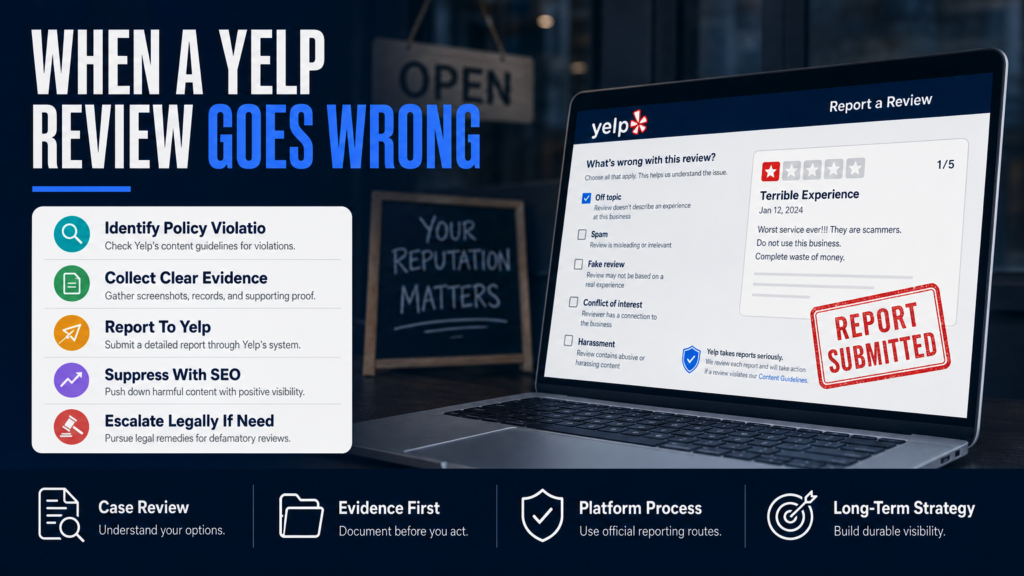
You found a review on Yelp that you believe is false, fabricated, or written by someone with no real interaction with your business. It sits on your public profile, costs you customers, and you want it gone. This article walks through realistic, platform-specific steps to evaluate whether you can remove false Yelp review and what to try first.
I’ll show you how Yelp’s reporting process works, how to document the evidence platforms need, when to escalate to legal avenues, and how to limit damage when deletion isn’t possible. Expect concrete checklists and timelines that reflect what Yelp and search engines actually do — not vague promises.
If you need a case assessment, link your situation to the likely options: removal through Yelp’s policy process, negotiation with the reviewer, legal notice, or reputational suppression. Each path requires different evidence and a different timeframe; this guide explains those differences so you can choose the right next step.
Table of Contents
- Is It Illegal To Delete Negative Reviews?
- Can You Pay To Remove Negative Reviews?
- How Do I Ask Google To Remove A False Review?
- Does Google Remove False Reviews?
- Step-by-Step: How To Remove A False Yelp Review
- When Removal Isn’t Available: Suppression, Correction, And Mitigation
- When To Consider Legal Options
- How To Prevent False Reviews And Prepare For Rapid Response
- DIY vs Agency: Which Path For A False Yelp Review?
- Hypothetical Example: The Phantom Review
- Common Mistakes People Make When Trying To Remove Reviews
- Best Practices For Handling Suspected Fake Yelp Reviews
- Expert Tips
- Conclusion
- Why Businesses Choose Your Reputation Agency
- Frequently Asked Questions
Is It Illegal To Delete Negative Reviews?
Short answer: deleting a review is not automatically illegal, but context matters. A reviewer can delete a review they posted; a business cannot lawfully delete someone else’s review from Yelp. Deletion becomes illegal when it is part of coercion, extortion, or a paid-for cover-up that violates state laws or federal statutes.
If a business owner or contractor pays or pressures a reviewer to remove a truthful review, or threatens action to coerce removal, that behavior can create legal exposure. On the other hand, a reviewer who falsifies identity or posts defamatory statements may be subject to legal action — not because deletion is automatically legal, but because the underlying conduct may be illegal.
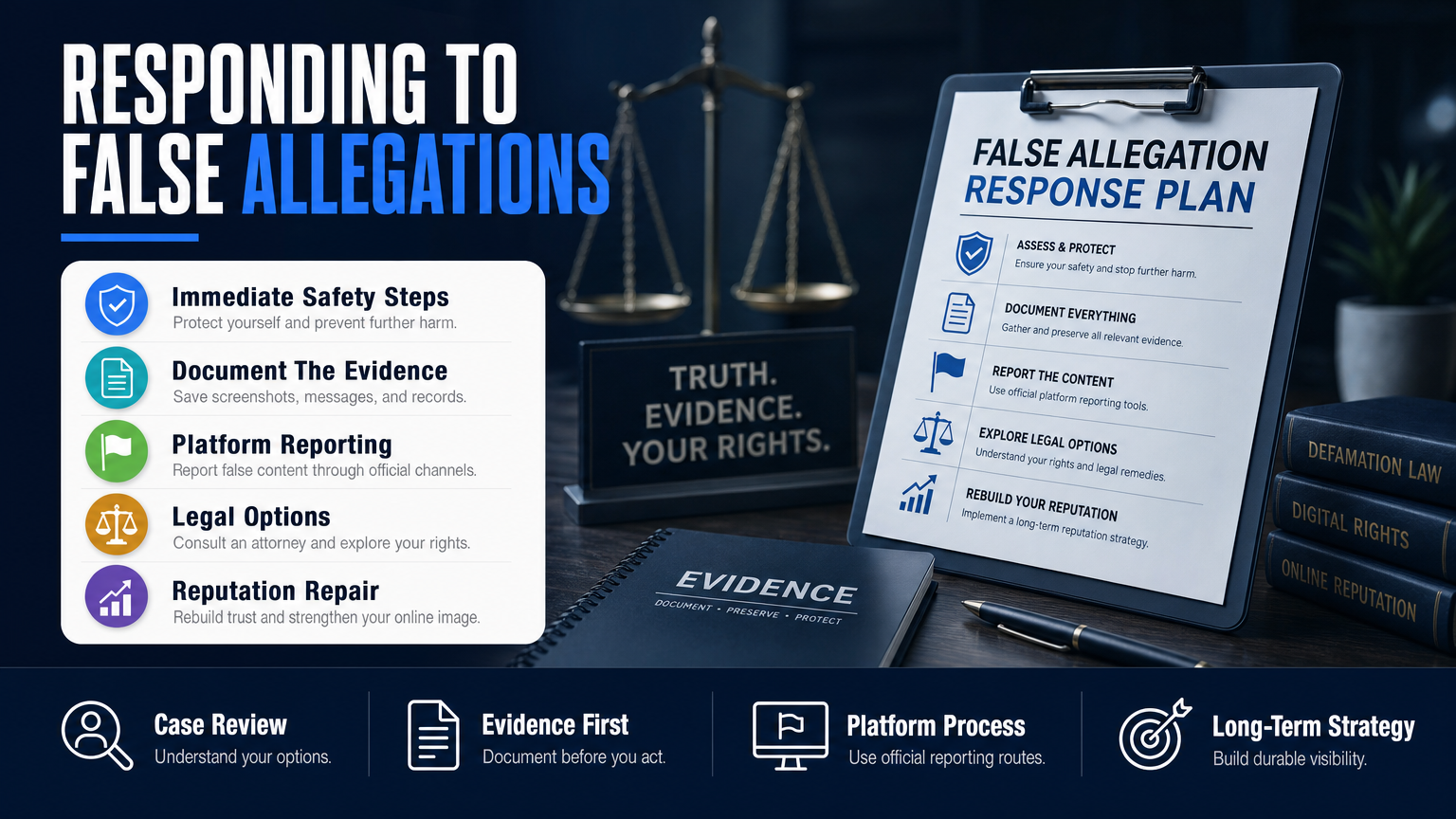
- Document the review and any communications before you try to remove or alter it.
- Assess whether the post is opinion, a factual allegation, harassment, impersonation, or a privacy violation.
- Preserve evidence (screenshots, timestamps, transaction records) in case legal or platform escalation is needed.
- Reviewers can always remove their own reviews; businesses cannot.
- Attempting to buy removals or threatening reviewers may trigger legal liability.
- False statements presented as fact can be actionable; opinions are usually protected speech.
When Deletion Crosses The Legal Line
Illicit behavior includes attempts to bribe reviewers, fabricate reviewer identities, or orchestrate deceptive removals. Those tactics can be illegal and will likely violate platform terms of service.
If you suspect criminal behavior (extortion, threats, harassment), involve counsel or local law enforcement as appropriate; they can advise on whether a civil or criminal path exists.
- Do not pay third parties who promise guaranteed removals — it’s risky and often against platform rules.
- Keep any messages or offers from the reviewer (they sometimes ask for payment to delete). Those messages may be useful evidence.
Can You Pay To Remove Negative Reviews?
Paying someone to remove a review is generally problematic. Yelp’s policy prohibits manipulating reviews, and paying for deletions risks breaching platform rules and consumer-protection laws. That said, there are legitimate paid services that help you pursue removal channels, document claims, or build suppression strategies — but they may not guarantee removal.
If you are concerned about revenue impact from a single review, read our analysis in When One Yelp Review Threatens Your Business’s Bottom Line to understand the commercial risks and thresholds that often justify professional help.
- Confirm the vendor’s scope: platform reporting, evidence gathering, legal referrals, or SEO suppression.
- Ask for a written agreement describing what the vendor will and won’t do (no guarantees).
- Insist on transparency about fees and what happens if removal is not possible.
- Directly paying a reviewer to remove content can be deceptive or illegal in some contexts.
- Paid reputation services may charge for time and expertise; they do not have special access to Yelp.
- Some vendors advertise pay-after-removal models — treat claims skeptically and ask for clear processes and written terms.
What A Responsible Paid Service Will Do
A reputable consultant or agency will evaluate whether the review may qualify for removal under Yelp’s policies, collect supporting evidence, file properly documented requests, and advise on mitigation or suppression strategies.
They should also coordinate with legal counsel when the matter involves defamation, impersonation, or privacy violations — but they must not present themselves as a law firm unless they are one.
- Policy evaluation and written recommendation
- Documented platform reports and escalation attempts
- Coordination with lawyers for subpoenas or cease-and-desist letters
How Do I Ask Google To Remove A False Review?
If a false review appears on Google (Maps or Business Profile), the process differs from Yelp. To request removal, you must flag the review through your Google Business Profile or use Google’s legal removal tools for content that breaks law or Google policy.
Here are the practical steps to request removal from Google and how they compare to Yelp processes.
- Sign in to Google Business Profile and find the review.
- Click the three-dot menu next to the review and select ‘Flag as inappropriate’ and choose the most applicable reason.
- If the flag does not result in removal, use Google’s legal help forms for defamation, doxxing, or impersonation.
- Escalate to paid support (if on a paid G Suite account) or engage counsel to pursue subpoenas if the reviewer’s identity is necessary for legal action.
- Flag the review inside Google Business Profile (Report review > select a policy reason).
- If the review contains illegal content or impersonation, use Google’s legal removal forms.
- Collect supporting documentation (transaction records, identity proof, screenshots) before filing.
What Evidence Helps a Google Request
Google responds faster to verifiable, objective evidence: receipts showing no service occurred, communications proving the reviewer wasn’t a customer, or signs of impersonation.
Keep a dated audit trail of your submissions and responses — it helps later escalations.
- Receipts or invoice numbers showing no transaction
- Booking records or appointment logs
- Correspondence with the reviewer showing fabrication or impersonation
Does Google Remove False Reviews?
Google does remove reviews that violate its policies, but removal is not automatic. The platform weighs whether the review violates specific rules: spam, illegal content, hate speech, impersonation, or conflicts of interest. False factual claims alone, framed as opinion, are harder to remove without strong corroborating evidence.
Timing and outcomes vary: some removals happen within days; others require repeated escalation or legal requests, and some never get removed. Removal depends on Google’s assessment, available evidence, and whether the content clearly breaches policy.
- Flag via the Business Profile first.
- If flagged but not removed, use the legal removal form if the content fits the legal criteria.
- Consider subpoena or court order as a last resort to identify the reviewer if legal action is appropriate.
- Google removes reviews for spam, impersonation, or clear policy violations.
- Purely negative-but-true consumer feedback is rarely removed.
- If the review is defamatory, a legal route may be necessary.
Practical Expectations
Do not assume removal will happen because the review is inaccurate. Prepare a backup plan: reply professionally on the platform and work to suppress the review’s visibility through SEO and positive content.
Document each attempt so you have a timeline should you later pursue legal action or need to show a pattern of bad-faith reviews.
- Keep a log of flags and responses
- Preserve screenshots with timestamps
- Prepare a public response that is factual and calm
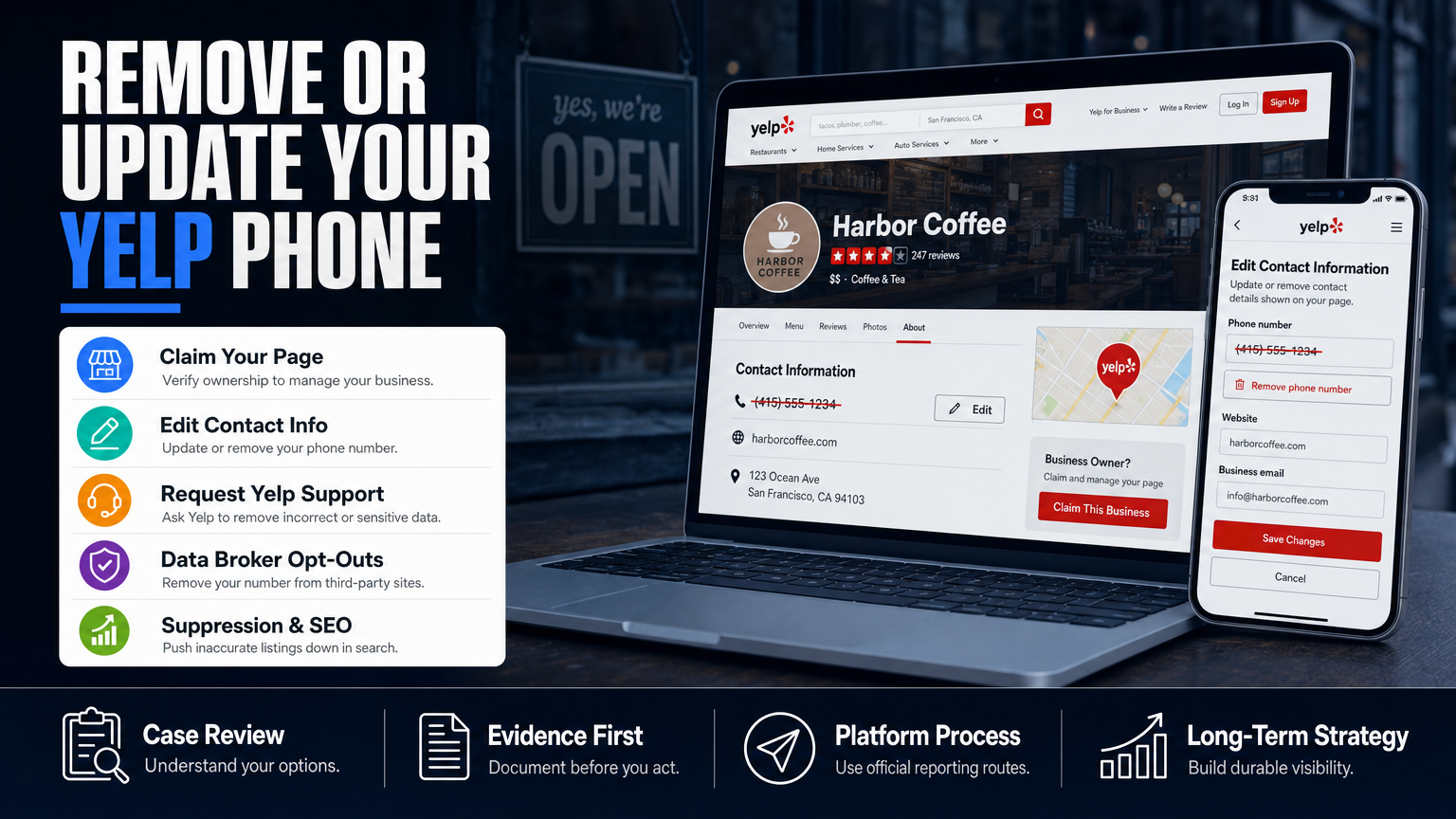
Step-by-Step: How To Remove A False Yelp Review
Yelp’s process differs from Google’s. Yelp evaluates reviews for compliance with its content guidelines (e.g., conflicts of interest, hate speech, or impersonation). Yelp also uses automated filters that sometimes hide suspicious reviews; however, visibility decisions are controlled by Yelp.
Follow this step-by-step checklist to pursue removal or suppression through Yelp’s official channels.
- 1) Screenshot the review and note the URL, reviewer name, date, and any identifiers.
- 2) Search your records for proof the reviewer never transacted or engaged with your business.
- 3) Use Yelp’s ‘Report Review’ function and select the precise policy reason (e.g., ‘irrelevant to consumers’ or ‘conflict of interest’).
- 4) If reporting inside the platform fails, use Yelp’s business support channels to submit a more detailed request with attached evidence.
- 5) If the review impersonates your business or an employee, provide ID and documentation to Yelp’s legal/escrow process as requested.
- 6) If all platform routes fail, evaluate legal options and consider suppression and corrective content.
- Identify the review’s policy violation (e.g., fabricated account, false identity, conflict of interest).
- Gather supporting evidence: transaction records, IP anomalies, or correspondence.
- File a formal content removal request to Yelp with clear supporting documentation.
How To Message A Reviewer (When Appropriate)
Sometimes a direct, non-confrontational private message can resolve a misunderstanding — but only when you can confirm the message comes through Yelp and you follow Yelp’s guidelines. Never offer money or bribes.
Keep messages factual, brief, and focused on resolving the issue: apologize if appropriate, request more details privately, and offer a channel to make it right.
- Use Yelp’s messaging only for clarification and resolution.
- Do not promise refunds in exchange for deletion.
- If a reviewer demands payment for deletion, treat that as potential extortion and preserve the messages.
When Removal Isn’t Available: Suppression, Correction, And Mitigation
Sometimes a false Yelp review cannot be removed because it doesn’t clearly violate policy or because the platform declines the request. In those cases, your options are mitigation and suppression: improve the overall narrative around your business so the single review loses prominence.
Suppression and mitigation are valid strategies and often the most realistic path when a platform won’t remove content. For context on how marketplace reviews can sink a company and when suppression is the right move, see When One Marketplace Review Can Sink Your Business.
- Audit your first-page search results to identify assets that can be optimized.
- Create or boost high-authority pages (press releases, contributor articles, updated service pages).
- Implement a review-generation campaign focused on verified customers to shift average ratings.
- Publish authoritative, SEO-optimized content that outranks or buries the negative review.
- Increase positive, verified reviews to dilute the impact of a single negative one.
- Respond publicly to the review with a calm, factual correction — this helps searchers evaluate both sides.
When Suppression Is The Most Practical Option
Suppression is appropriate when a platform refuses to remove content that is inaccurate but not policy-violating, or when the reviewer cannot be identified. A suppression strategy should be measurable and used alongside ongoing monitoring.
We develop SEO reputation strategies intended to improve the visibility of relevant and credible information; results vary by the strength of competing content and platform behavior.
- Use targeted blog content to address the issue factually (not defamatory).
- Promote positive customer stories on high-authority sites.
- Monitor search results weekly and adapt the content plan.
When To Consider Legal Options
Legal action can be appropriate when a review includes provably false factual allegations that harm your business, or when the reviewer is impersonating your company or committing fraud. The decision to pursue legal remedies should be made with counsel because defamation law is complex and varies by state.
A qualified attorney can determine whether a claim may exist and whether discovery or a subpoena is necessary to identify an anonymous reviewer. Remember: the content may warrant legal review, but courts do not automatically order removals.
- Document the false statements and the harm they caused (lost contracts, clients, bookings).
- Consult an attorney experienced in internet defamation for jurisdiction-specific advice.
- If advised, pursue a subpoena or demand letter; coordinate with the platform’s legal contact.
- Defamation requires a false statement of fact and demonstrable harm; opinions are usually protected.
- Subpoenas can compel platforms to reveal identifying info, but platforms evaluate legal requests and require proper process.
- Cost-benefit matters: litigation can be expensive and slow; weigh it against reputational and financial impact.
What To Expect From Legal Routes
Courts may order disclosure of a reviewer’s identity in appropriate cases, but they do not always order removal of the content. Even with a favorable court order, platform compliance timelines vary and platforms may push back.
Legal steps should be coordinated with a disclosure of evidence timeline and an assessment of whether the public interest favors disclosure.
- Prepare to show actual damages where required by state law.
- Be ready for counterclaims or protective speech defenses.
- Expect months of process rather than a quick fix.
How To Prevent False Reviews And Prepare For Rapid Response
Prevention matters. Implement routines to reduce the chance of false reviews and to detect them fast: automated alerts, transaction logging, and clear customer channels for complaints will reduce escalation to public posting.
A fast, documented response can reduce harm: policy-based monitoring, templated public replies, and a process for moving verified disputes off-platform often defuse problems before they take root.
- Create an escalation playbook with roles: who replies publicly, who handles private outreach, and who documents evidence.
- Run quarterly audits of review sites specific to your industry.
- Build a habit of soliciting reviews from satisfied customers to maintain a balanced rating profile.
- Set up review monitoring alerts for Yelp, Google, and industry-specific sites.
- Require staff to log customer interactions with verifiable identifiers (dates, invoice numbers).
- Train staff to respond calmly and to offer a private escalation path for unresolved complaints.
How Monitoring Helps Contain Issues
Reputation monitoring lets you react within hours instead of days. Early contact often resolves misunderstandings before negative posts gain traction.
If the matter escalates, logs from your monitoring tool serve as evidence of prompt, professional handling.
- Set daily or weekly alerts for new mentions.
- Use monitoring to detect coordinated attacks early (review-bombing patterns).
- Integrate monitoring with your legal and PR contacts for quick escalation.
DIY vs Agency: Which Path For A False Yelp Review?
A direct comparison of typical responsibilities, costs, and outcomes when you handle a removal vs hiring an agency.
| DIY | Agency |
|---|---|
| Cost | Upfront low cost; time investment |
| Expertise | Platform experience, legal contacts |
| Speed | Variable; depends on your availability |
| Evidence Collection | Handled by the agency with templates |
| Escalation | Agency coordinates legal and PR escalation |
| Guarantees | None — agency provides process, not guaranteed removal |
Hypothetical Example: The Phantom Review
A small dental practice receives a two-star Yelp review alleging a botched procedure by a non-existent practitioner. The office has no record of the patient. The review mentions a common staff name and a fabricated date.
Here’s an anonymized, step-by-step illustration of how the practice could proceed, from evidence gathering to mitigation when removal was not granted.
- 1) Collect evidence showing no matching appointment or patient record.
- 2) Report the review to Yelp via ‘Report Review’ and attach a brief evidence summary.
- 3) Message the reviewer politely asking for clarifying details while preserving all responses.
- 4) If Yelp declines removal, publish a factual, calm public response describing your investigation and offering a private contact to resolve the matter.
- 5) Simultaneously, create an SEO push: update your service pages, publish a Q&A about patient safety, and solicit verified patient testimonials to dilute the negative review’s prominence.
- 6) If the reviewer demands money or impersonates staff, consult counsel about a cease-and-desist or subpoena to identify the account owner.
- Screenshot review and save the review URL and reviewer profile.
- Search appointment logs for the date and practitioner named in the review.
- Check video/door logs, receipts, and staff schedules to verify presence or absence of the reviewer.
Common Mistakes People Make When Trying To Remove Reviews
Below are frequent missteps that make situations worse or eliminate later legal options.
1. Responding Emotionally, Not Factually
An angry or defensive public reply escalates the perception problem and creates sharable content that can be used against you. Keep responses short, professional, and corrective.
- Stick to verifiable facts and an invitation to discuss offline.
- Avoid accusations or threats in public replies.
2. Offering Payment For Deletion
Paying a reviewer or even suggesting compensation risks violating platform terms and possibly state laws. If a reviewer asks for money, preserve the messages and consult counsel.
- Never engage in quid-pro-quo for deletions.
- Report requests for payment to the platform as potential extortion.
3. Failing To Preserve Evidence
Deleting logs, ignoring screenshots, or not saving messages eliminates the proof you’ll need for platform escalations or legal steps. Always preserve everything in a time-stamped archive.
- Take timestamped screenshots and export logs.
- Keep copies of your reports and any platform responses.
4. Assuming Removal Is Quick Or Guaranteed
Platforms weigh multiple factors; policy removals can take time or be denied. Expect a process and prepare mitigation strategies rather than banking on fast removal.
- Plan suppression or response strategies in parallel with removal attempts.
- Set realistic internal timelines and goals.
5. Not Reviewing Platform Policies Before Reporting
If you can’t point to the exact policy violation in your report, platforms are less likely to act. Tailor your request to Yelp’s published content guidelines and provide concise evidence that matches those rules.
- Quote the relevant Yelp policy when you file a report.
- Attach documents that directly contradict the review’s factual claims.
Best Practices For Handling Suspected Fake Yelp Reviews
Adopting consistent habits reduces the chance that false reviews derail your business and improves the odds of successful resolution when they occur.
Document Everything Immediately
Create a secure repository for screenshots, URLs, and transaction records. Time matters — capture evidence before the reviewer edits or removes their post.
- Use immutable storage (email to yourself, cloud archive) for timestamps.
- Export platform messages and keep copies of your reports.
Use Platform Processes First
Start with Yelp’s official reporting flow and include targeted, policy-based reasons for removal. Platforms prefer structured reports over vague complaints.
- Select the most specific policy reason available.
- Attach clear, concise evidence rather than long narratives.
Respond Publicly, But Offer Private Resolution
A brief, factual public reply demonstrates professionalism. Invite the reviewer to continue offline and provide a customer-service path for resolution — this is useful for onlookers and for later litigation if needed.
- A model reply: acknowledge, state facts, and offer a private contact.
- Do not demand deletion in the public reply.
Have A Suppression Plan Ready
If removal fails, deploy a content and SEO plan to reduce the review’s prominence. That includes adding authoritative content, soliciting new reviews, and promoting positive third-party mentions.
- Prioritize content that can rank for your business name or the specific search queries people use.
- Track changes weekly and adapt the content mix.
Coordinate With Legal Counsel When Needed
If the review includes false factual claims that cause measurable harm, consult a lawyer. They’ll advise on whether a subpoena or other legal option makes sense given jurisdictional rules and costs.
- Balance legal costs against projected business impact.
- Legal steps should be a last resort after platform and mitigation efforts.
Expert Tips
- Always keep a date-stamped log of every action you take — platforms respect clear timelines.
- Avoid confrontational language in public replies; a calm correction looks better to new customers.
- If a reviewer asks for money to delete a post, preserve their messages and report the exchange to the platform.
- Ask satisfied customers to leave reviews regularly so that one negative post does not dominate your rating.
- Use precise policy language in your reports — quoting Yelp’s guideline increases the chance of action.
- Consider asking an editor at a local news site to run a neutral piece about your practice if the review made false public accusations.
- Set up alerts for brand mentions so you catch fake reviews within hours, not days.
- When you hire a vendor, require transparency about methods and written disclaimers that no guaranteed removals are promised.
Conclusion
A false Yelp review is a solvable problem in many—but not all—cases. The right approach begins with disciplined evidence collection, a policy-directed report to Yelp, and a realistic fallback plan (suppression and correction) if the platform declines removal.
Professional help is appropriate when the review causes measurable damage or when the reviewer engages in extortion or impersonation; expect an agency to provide process, documentation, and coordination with lawyers rather than promises of guaranteed deletion. Your immediate priorities should be to secure evidence, respond calmly in public, and start mitigation actions to protect revenue and hiring prospects.
Why Businesses Choose Your Reputation Agency
Managing your reputation takes more than monitoring reviews or publishing the occasional blog post. It takes a strategy built around your situation, your industry, and what is actually showing up in search.
Your Reputation Agency works with businesses, executives, healthcare professionals, attorneys and growing brands. Our services include:
- Remove or suppress negative search results and news articles from Google
- Review removal and remediation (Google, Yelp, Facebook, Trustpilot, industry sites)
- Data broker and people-search opt-outs to remove personal information
- Mugshot and arrest-record removal or suppression
- Takedowns of defamatory, false, or malicious posts (social, blogs, forums)
- Online crisis management and rapid-response reputation repair
- Impersonation and fake account removal on social platforms
- Reputation monitoring, alerts, and ongoing surveillance
- First-page SEO and suppression strategies to bury negative content
- Digital security audits and privacy hardening to prevent future exposure
Frequently Asked Questions
1. Is it illegal to delete negative reviews?
Deleting a review you personally posted is not illegal. However, if a business owner pays, coerces, or fabricates removals, that conduct can create legal exposure and violate platform policies. If you suspect extortion or threats, preserve the messages and consult counsel.
2. Can you pay to remove negative reviews?
Directly paying reviewers to remove their posts is risky, may violate platform rules, and can be illegal in some situations. There are legitimate paid services that document claims and file platform or legal escalations, but no reputable provider can guarantee removal or special access to Yelp.
3. How do I ask Google to remove a false review?
Flag the review in your Google Business Profile (three-dot menu > ‘Flag as inappropriate’) and choose the correct policy reason. If the content is illegal or impersonates someone, use Google’s legal removal forms. Collect receipts, booking logs, and correspondence to support your request.
4. Does Google remove false reviews?
Google removes reviews that clearly violate its policies (spam, impersonation, hate speech), but it does not remove content simply because it’s negative or inaccurate without corroborating evidence. Removal depends on the policy, evidence provided, and Google’s assessment.
5. How long does a Yelp review removal request take?
There’s no guaranteed timeline. Some policy-based removals occur in days; other escalations or legal requests may take weeks or months. Timing depends on the clarity of the violation, the evidence you provide, and platform workload.
6. What should I do if Yelp refuses to remove a fake review?
If Yelp declines removal, document the denial, publish a calm public response, pursue suppression through SEO and positive reviews, and consult counsel if the review includes defamatory factual claims or impersonation.
7. Can I subpoena Yelp to reveal the identity of an anonymous reviewer?
Courts can compel platforms to disclose identifying information in certain circumstances, but the process requires legal counsel and varies by jurisdiction. Platforms review subpoenas and may resist or require a court order before providing user data.
8. Will responding to the review make it worse?
A poorly worded or emotional response can worsen perception. A short, factual reply that acknowledges concern and invites private resolution typically helps. Avoid insults, accusations, or offers of payment for deletion.
9. When is it worth hiring a reputation agency?
Consider professional help when a review is causing measurable financial or hiring harm, when multiple coordinated attacks occur, or when you need documentation and coordinated escalation (platform, legal, and SEO). A reputable agency provides process, evidence collection, and mitigation strategies — not guarantees of removal.
This content provides general information and does not constitute legal advice. The available options and likely outcomes depend on the facts, evidence, platform policies, applicable law, jurisdiction, and public-interest considerations.
Past examples do not guarantee future results. Removal, correction, deindexing, and search-position changes depend on third parties and circumstances outside Your Reputation Agency’s control.