You typed the question What are the top agencies in Mumbai? because you need an agency that can handle a specific business problem — lead generation, branding, high-stakes reputation work, or performance marketing tied to revenue.
This article delivers a practical map: how agencies in Mumbai differ by specialty, what ‘top’ actually means depending on your goal, realistic price ranges, and a step-by-step evaluation process you can use the same day.
I’ll also answer common quick questions people ask while choosing an agency (what agencies do, how fees work, and how to judge performance), and show what to do when content removal or suppression isn’t available.
Read the sections that match your need (reputation-sensitive professionals should focus on the sections about compliance and crisis response) and use the comparison table and checklist before you sign any SOW.
Table of Contents
- What Does a Marketing Agency Actually Do?
- How Do You Judge The Best Agency In The World — And Does That Apply To Mumbai?
- How To Pick A Performance Marketing Agency In Bangalore — Lessons For Mumbai Buyers
- How Much Do Digital Marketing Companies Charge?
- Top Agency Types In Mumbai And Which One You Need
- What To Do When Removal Is Not Available
- Evaluating Agencies: Checklist And Contract Points
- Where Reputation And SEO Intersect — A Quick Strategy
- How Agencies Handle Former-Employee Issues And Internal Reviews
- DIY vs Hiring an Agency — Quick Comparison
- Hypothetical Scenario: A Doctor Facing An Online Complaint
- Common Mistakes Organizations Make Choosing Agencies
- Best Practices When Hiring an Agency in Mumbai
- Expert Tips
- Conclusion
- Why Businesses Choose Your Reputation Agency
- Frequently Asked Questions
What Does a Marketing Agency Actually Do?
Marketing agencies are service providers that package specialized skills — strategy, creative, media buying, SEO, social content, analytics — into outcomes for clients. The exact role depends on the agency’s specialization: creative agencies make brand work and campaigns; performance agencies optimize ads and conversion funnels; PR firms handle news and media relations; SEO shops influence search visibility.
For reputation-sensitive work (mugshots, defamatory posts, high-profile negative press), agencies often combine technical removal attempts, SEO suppression, and PR/legal coordination rather than offering a single silver-bullet service.
At a practical level an agency will: audit your current footprint, recommend a prioritized plan, run platform-specific requests and campaigns, and report outcomes. We evaluate whether the content may qualify for removal or review, and we pursue the legal, technical, platform-based, and reputational options available.
- Ask for a specific scope: what pages/queries will be targeted and how success will be measured.
- Confirm escalation paths: platform reporting, publisher outreach, and legal referral processes.
- Clarify confidentiality and data handling in the contract.
- Audit: inventory of problematic links, reviews, social posts, and data-broker listings
- Tactical work: takedown requests, DMCA/defamation escalations, opt-outs, and SEO content creation
- Monitoring: alerts for new mentions and ongoing surveillance
- Reporting: performance metrics and recommended next steps
When platforms won’t remove content
Platforms and publishers control what they remove. If removal is unavailable, agencies typically shift to mitigation: correct the record, amplify authoritative content, suppress by outranking, and pursue legal options when appropriate.
For more on why deleted posts often persist in search and screenshots, see The Screenshot Effect: Why Deleted Posts Never Disappear.
- Mitigation through SEO suppression and authoritative content
- Publisher corrections or retractions where factual errors exist
- Legal review for defamation or privacy violations
How Do You Judge The Best Agency In The World — And Does That Apply To Mumbai?
‘Best’ is a contextual judgement. Globally acclaimed agencies are recognized for creativity, case-study innovation, or scale; they do not guarantee results for your local market or industry. For a Mumbai-based brief, the best agency is the one with a proven process for your objective, relevant industry experience, and measurable KPIs.
Use documented, verifiable criteria: client roster consistency, measurable outcomes (CPL, revenue uplift, search visibility improvements), third-party awards with explanation, and independent client references — not slick claims alone.
- Request a short-list of comparable projects and a people-first team list.
- Ask each agency for a 30/60/90-day plan and how they measure success.
- Pilot small paid work if possible before signing long-term retainers.
- Match specialization to need: brand, performance, influencer, or crisis management
- Verify outcomes: ask for benchmarks and permission to contact references
- Check operational fit: time zone, language, cultural alignment, and team availability
How reputation work differs from award-winning creative
Creative agencies may win awards but lack the legal, privacy, and platform-specific experience needed for reputation remediation. Conversely, reputation firms may not produce viral creative campaigns. If you need both, plan a multi-agency or integrated engagement with clearly defined handoffs.
- Reputation work needs publisher outreach and legal coordination
- Creative campaigns need performance tracking and scale
- Integrated projects require a shared reporting dashboard
How To Pick A Performance Marketing Agency In Bangalore — Lessons For Mumbai Buyers
Bangalore has a dense market for performance agencies; the factors that define a good performance partner there also apply in Mumbai: attribution clarity, conversion optimization, and an iterative testing culture.
When evaluating agencies in Mumbai against a Bangalore benchmark, focus on their analytics stack, sample tests they ran, how they own the conversion funnel (landing page to sale), and transparency on media spend vs management fees.
- Map your conversion funnel and ask the agency to identify three immediate tests.
- Agree on measurement (revenue per click, CAC, LTV) before starting.
- Set a 90-day trial KPI and review cadence.
- Request a sample experiment and the resulting data (A/B test example)
- Confirm attribution models: last-click, multi-touch, or data-driven
- Ask how they control ad fraud, bot traffic, and publisher transparency
What to expect from agency reports
Reports should connect spend to business outcomes. Weekly snapshots are fine for tactical adjustments; monthly reports should include strategic recommendations, channel ROI, and planned experiments.
- KPIs tied to commercial outcomes
- Actionable insights with owners and deadlines
- Transparency on creative and media performance
How Much Do Digital Marketing Companies Charge?
Fees vary by specialization, scope, and agency size. Below are typical ranges you’ll see in Mumbai; these are industry examples, not promises. Always ask for a written SOW that breaks down deliverables.
Keep in mind timing depends on the work complexity, platform response times, and legal involvement if applicable.
- Ask for an itemized quotation showing media vs management fees.
- Clarify exit terms and deliverable ownership (creative assets, accounts).
- Request milestones and acceptance criteria tied to payment.
- Freelancer / Consultant: $300–$2,000 per month (single-discipline)
- Small boutique agency: $1,500–$8,000 per month
- Mid-size agency: $5,000–$25,000 per month
- Large agency/retainer: $20,000+ per month (full-service or enterprise)
- Project fees: one-off campaigns or site builds usually $2,000–$100,000 depending on scale
Special pricing for reputation-sensitive work
Reputation remediation often includes hourly work for outreach, legal coordination, and technical SEO. Agencies may charge a hybrid: setup fee + hourly + monthly monitoring. Legal fees are separate and depend on counsel.
We coordinate with qualified legal professionals when a matter requires legal analysis; legal costs are additional and depend on jurisdiction and complexity.
- Typical reputation project: $3,000–$15,000 setup plus monthly monitoring
- Data broker opt-outs often billed per-record or as a package
- Mugshot/record suppression often requires multi-month efforts
Top Agency Types In Mumbai And Which One You Need
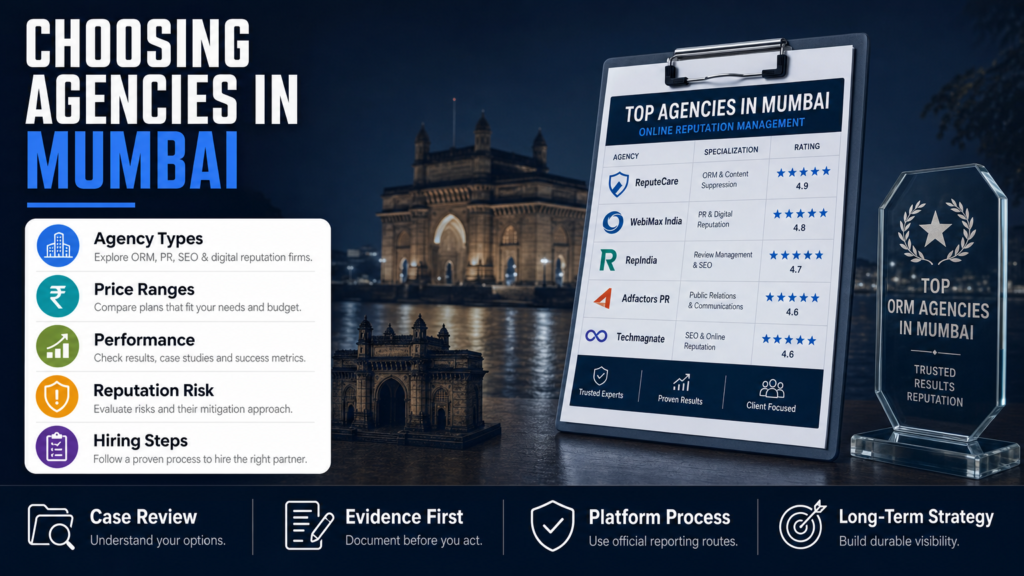
Mumbai’s agency ecosystem includes full-service networks, creative shops, performance specialists, influencer platforms, PR firms, and boutique reputation firms. Choose by outcome, not brand name.
Below are quick profiles and when to hire each type.
- Match your primary goal to the agency type.
- If you have mixed needs, create a phased plan: immediate crisis response first, then SEO and content building.
- Insist on an accountable project lead and a named escalation contact.
- Creative Agencies — Best for brand repositioning and high-production campaigns.
- Performance Agencies — Best for measurable short-term revenue and CPL optimization.
- SEO/Content Agencies — Best for long-term organic visibility and suppression strategies.
- PR Firms — Best for handling media inquiries, press corrections, and interview coordination.
- Reputation Firms — Best for takedowns, data-broker opt-outs, monitoring, and crisis response.
A short list of Mumbai names by specialty (examples, not endorsements)
Performance: agencies that emphasize growth marketing and measurable funnels; Creative: agencies with strong production capabilities; PR: firms known for media placements and crisis counsel. Verify each agency’s recent work and references before engaging.
- Check client lists, but verify case studies with named contacts.
- Look for vertical experience (healthcare, legal, professional services) for regulated sectors.
- Confirm multi-channel capability if you need both digital and earned media.
What To Do When Removal Is Not Available
Sometimes platforms and publishers refuse removal requests: the post complies with platform policy, is a lawful public record, or the publisher declines retraction. When that happens, successful remediation switches from removal to mitigation and correction.
Mitigation is a tactical mix of SEO, authoritative narrative, publisher outreach, and legal review where applicable.
- Create a prioritized content plan to push negative items off page one (bio pages, press, optimized articles).
- Use targeted outreach to publishers who rank for the search term and request corrections when factual errors exist.
- Implement monitoring and alerts so you can respond to new items rapidly.
- Correct the record: publish accurate, authoritative content that addresses the issue
- Search suppression: create and promote content intended to outrank harmful results
- Publisher escalations: request corrections or clarifications where factual errors exist
- Legal review: determine whether a defamation claim or privacy-based remedy may apply
How search suppression typically works
We develop SEO reputation strategies intended to improve the visibility of relevant and credible information. That includes creating and optimizing content on high-authority domains, leveraging social profiles that rank well, and promoting those assets with measured campaigns. Search results may change because algorithms, competitors, publishers, and user behavior are outside our control.
- Build or refresh LinkedIn, corporate, and authoritative author pages
- Publish corrective articles on owned domains and industry sites
- Amplify content via PR and social distribution
Evaluating Agencies: Checklist And Contract Points
Before you sign, use this shortlist to compare proposals. Insist that deliverables are specific and measurable, and that escalation pathways for urgent matters are defined.
Also verify data protection and confidentiality controls — but remember that no vendor can promise absolute privacy.
- Run an interview with the proposed team and contact at least one reference.
- Ask how they coordinate with legal counsel when a case may warrant legal action.
- Include a 30–90 day review clause to reassess and cancel if expectations are not met.
- Defined scope and deliverables with SOW milestones
- Measurement plan with agreed KPIs and reporting cadence
- Named project lead and escalation contact
- Clear fee structure: retainer vs project vs performance fees
- Confidentiality clause with operational limits spelled out
When to involve legal and PR together
Complex reputation crises often need simultaneous legal and PR responses: legal for cease-and-desist or court actions, PR for public-facing messaging. Agencies should coordinate with qualified attorneys; they should not imply they can provide legal representation.
- Legal advice should come from a licensed attorney in the relevant jurisdiction
- PR messages should be reviewed for legal risk before public release
- Your agency should provide referrals to experienced counsel
Where Reputation And SEO Intersect — A Quick Strategy
If your priority is search visibility, remember: the first page of Google often functions as your public homepage. Treat it as the place to manage trust.
A combined SEO + content + PR strategy is the standard approach when takedown is unlikely.
- Map the first page results and target the 3–5 weakest items for suppression.
- Produce and optimize 6–12 pieces of high-authority content targeted at priority queries.
- Coordinate earned media placements and backlink outreach to strengthen those pages.
- Identify the exact search queries that matter (name + employer, name + allegation, business name + complaint).
- Produce high-quality, authoritative content that answers the queries directly.
- Promote that content so it gains links and social signals.
Practical reading
For more on why the first page matters and how it behaves as a public-facing profile, see The First Page of Google Is Your Real Homepage.
How Agencies Handle Former-Employee Issues And Internal Reviews
Former employees can create search results or review content that shapes public perception. Agencies assess whether the material is opinion, factual allegation, or harassment, and pursue appropriate channels: publisher outreach, review-mediation programs, or mitigation.
When a former employee’s content becomes your biggest search result, coordinated reputation and HR responses matter.
- Gather evidence and timeline for any factually incorrect claims.
- Use platform moderation and review-appeal processes, and document every step.
- If appropriate, consult counsel about potential legal remedies.
- Differentiate between opinion (protected speech) and false factual claims (which may warrant correction or legal review).
- Use documented outreach when requesting review removal or correction.
- Plan a narrative: an honest corporate response may reduce escalation.
A related resource
If your problem resembles an employee-driven search issue, see When a Former Employee Becomes a Brand’s Biggest Search Result for strategies to manage the search narrative.
DIY vs Hiring an Agency — Quick Comparison
A short decision table to help you decide whether to attempt remediation yourself or hire a specialized Mumbai agency.
| DIY (You) | Agency |
|---|---|
| Lower direct cost initially | Higher upfront fees but scale and expertise |
| Requires learning platform policies | Experienced with platform processes and publisher outreach |
| Limited legal coordination | Can coordinate with counsel and PR partners |
| Slower response for technical SEO | Faster implementation of suppression/production |
| Good for small, simple fixes | Better for complex crises and multi-channel campaigns |
| No ongoing monitoring unless you set it up | Includes monitoring and alerting options |
Hypothetical Scenario: A Doctor Facing An Online Complaint
A Mumbai-based specialist finds a negative blog post and multiple low-quality directory listings appearing high in searches for their name. The doctor’s phone calls drop and new patient bookings stall. Removal is unlikely because the blog claims are framed as opinion and the directories are public business listings.
How an agency would typically proceed in this anonymized example: an initial audit, targeted outreach, content creation, and monitoring — not a promise of removal.
- Week 1–2: Audit, outreach, and emergency messaging (if media attention exists).
- Month 1–3: Content production, SEO work, and initial promotion.
- Month 3–6: Evaluate SERP movement; continue promotion and publisher follow-ups as needed.
- Step 1: Audit and prioritize offending URLs; map the exact search queries affecting bookings
- Step 2: Publisher outreach requesting corrections for factual errors, and submitting review disputes where policy violations exist
- Step 3: Build authoritative assets — optimized bio, hospital profile, and bylined medical articles on respected platforms
- Step 4: Run a short paid search and social campaign to drive clicks to the new authoritative content
- Step 5: Monitor, report, and iterate; consult legal counsel if defamation thresholds are met
Common Mistakes Organizations Make Choosing Agencies
Below are frequent errors we see from professionals and business owners when selecting agencies, with short explanations and how to avoid them.
Mistake 1 — Choosing Based Only on Size or Awards
Large network agencies have scale but may lack niche experience. Awards show creative skill but not relevance to your industry. Instead, prioritize demonstrable experience with similar problems and ask for references you can verify.
Mistake 2 — Not Checking Measurement Methods
Agencies sometimes report vanity metrics. Ask for the attribution model, conversion definitions, and raw data samples. Make sure KPIs tie to business outcomes you care about.
Mistake 3 — Signing Long Retainers Without Exit Clauses
Long contracts without performance reviews trap clients. Include review periods, termination for cause, and acceptable-performance metrics in the SOW.
Mistake 4 — Treating Reputation Work Like Ordinary Marketing
Reputation remediation often requires legal and publisher escalation; treating it as a standard campaign can delay action and increase damage. Ensure the agency coordinates cross-discipline responses.
Mistake 5 — Expecting Guaranteed Removal
No reputable agency will guarantee content removal or specific search results. Clear expectations upfront prevent disappointments later.
Best Practices When Hiring an Agency in Mumbai
These are durable practices that will reduce risk and increase the chance of a successful engagement.
Get a Baseline Audit
Start with a documented audit of search results, review sites, social channels, and data brokers. An audit identifies the high-impact targets and provides a measurable baseline.
- Include screenshots and timestamps for all problematic mentions
- Record the queries that trigger the worst results
Define Clear KPIs And Reporting
Tie agency fees to clear, agreed-upon deliverables and cadence. Avoid vague promises; ask how they will report progress and what success looks like.
- Set monthly checkpoints and a 90-day performance review
- Require access to the actual dashboards or data exports
Insist On Ethical, Platform-Compliant Tactics
Do not allow deceptive tactics. Agencies should use official reporting processes and reputable SEO/link-building practices. Avoid anything that could be construed as manipulation or false representation.
- No fake reviews, no false identities, no impersonation
- Transparency about tactics and platform escalations
Coordinate PR And Legal Early
Bringing PR and legal advisors into the plan early prevents contradictory actions and speeds publisher escalations when needed.
- Legal counsel should advise on public statements and next steps
- PR should prepare messaging templates for different outcomes
Plan For Ongoing Monitoring
Reputation management is rarely a one-off. Budget for monitoring and quick-response capacity so new issues are addressed before they escalate.
- Set up alerts for name and brand variants
- Schedule quarterly reassessments
Expert Tips
- Prioritize the search queries that cost you revenue or opportunities — not every negative mention is equal.
- Ask agencies for the exact team members who will work on your file and a short bio for each.
- Insist on an entry-level pilot project to test responsiveness and quality before committing to large retainers.
- Document every outreach to publishers; good documentation helps legal options later.
- Use reputable review-mediation channels on platforms like Google My Business and Trustpilot before escalating.
- If the issue involves public records, ask for a legal assessment early — public records have different removal prospects.
- Keep your public-facing statements factual and concise; speculative statements can escalate.
- Retain copies of all evidence and screenshots with timestamps; platforms sometimes remove content and you’ll need records.
Conclusion
Choosing among Mumbai’s agencies requires matching specialty to the problem, demanding transparent measurement, and planning for both near-term crisis response and longer-term reputation rebuilding. ‘Top’ agencies look different depending on whether your priority is creative branding, performance marketing, or reputation remediation.
If removal is possible we evaluate whether the content may qualify for removal or review and pursue the available legal, platform-based, and reputational options. When removal is unavailable, a disciplined mitigation and SEO strategy, coordinated with PR and legal where needed, is the practical path forward. Use the checklist and ask the specific questions in this article before you sign any contract.
Why Businesses Choose Your Reputation Agency
Managing your reputation takes more than monitoring reviews or publishing the occasional blog post. It takes a strategy built around your situation, your industry, and what is actually showing up in search.
Your Reputation Agency works with businesses, executives, healthcare professionals, attorneys and growing brands. Our services include:
- Remove or suppress negative search results and news articles from Google
- Review removal and remediation (Google, Yelp, Facebook, Trustpilot, industry sites)
- Data broker and people-search opt-outs to remove personal information
- Mugshot and arrest-record removal or suppression
- Takedowns of defamatory, false, or malicious posts (social, blogs, forums)
- Online crisis management and rapid-response reputation repair
- Impersonation and fake account removal on social platforms
- Reputation monitoring, alerts, and ongoing surveillance
- First-page SEO and suppression strategies to bury negative content
- Digital security audits and privacy hardening to prevent future exposure
Frequently Asked Questions
1. What does a marketing agency do?
A marketing agency provides services such as strategy, creative production, media buying, SEO, social management, and analytics to achieve client goals. The specific deliverables depend on the agency’s specialty and the client’s needs.
2. What’s the best agency in the world?
There is no single ‘best’ agency universally — the best choice depends on your objective, industry, budget, and operating model. Evaluate agencies by measurable outcomes, relevant experience, and references rather than awards alone.
3. Which performance marketing agency is the best in Bangalore?
The best performance partner is the one with demonstrable testing discipline, clear attribution methods, and experience in your vertical. The same selection criteria apply to Mumbai agencies — ask for sample experiments and measurable KPIs.
4. How much do digital marketing companies charge?
Fees vary widely: freelancers might charge $300–$2,000/month, boutiques $1,500–$8,000/month, mid-sized agencies $5,000–$25,000/month, and large agencies $20,000+/month, with project-based fees for specific campaigns. Reputation work often includes setup fees plus monthly monitoring and separate legal costs.
5. Can agencies guarantee removal of negative content?
No reputable agency will guarantee removal. We evaluate whether the content may qualify for removal or review and pursue available options. Platform decisions and publisher cooperation remain outside the agency’s control.
6. What should I ask during the initial agency interview?
Ask for the team working on your account, a 30/60/90-day plan, KPIs tied to business outcomes, examples of comparable work, and references you can contact. Verify reporting cadence and escalation procedures for urgent issues.
7. When should I involve legal counsel?
Involve legal counsel early when content includes potentially defamatory factual claims, privacy violations, or when publisher refusals suggest a legal remedy may be appropriate. Agencies should coordinate with qualified lawyers and can provide referrals.
8. Is SEO suppression a reliable substitute for removal?
SEO suppression can reduce visibility of harmful results but is not guaranteed or permanent. We develop SEO reputation strategies intended to improve relevant information visibility, but search outcomes vary with algorithm changes, competitors, and publisher behavior.
9. How quickly will I see results?
Timing depends on platform responses, publisher cooperation, legal complexity, and the authority of the content you’re trying to displace. Some changes may appear within weeks; other matters can take months. An estimated timeline can be provided after assessment.
This content provides general information and does not constitute legal advice. The available options and likely outcomes depend on the facts, evidence, platform policies, applicable law, jurisdiction, and public-interest considerations.
Past examples do not guarantee future results. Removal, correction, deindexing, and search-position changes depend on third parties and circumstances outside Your Reputation Agency’s control.