You searched your name and found something that could cost you a job, a client, or your peace of mind. This article explains practical, actionable ways to remove google results for your name and what to do when outright removal isn’t available.
We walk through the reporting paths on Google and major platforms, free opt-outs like data-broker requests, basic SEO suppression techniques, and when to consider legal review or professional help. The primary keyword appears here because this is what you’re trying to fix: remove google results for your name.
If you need quick next steps: document the URLs and screenshots, prioritize content that is defamatory, private, or impersonation, and follow the platform reporting flows we lay out below.
This is not a guarantee of deletion. Removal depends on publisher cooperation, platform policies, evidence, and sometimes jurisdiction. Where removal isn’t possible, we list mitigation options that can reduce visibility.
Table of Contents
- How can I remove Google Search results that show my name?
- How can I remove my name from Google Search results for free?
- How do I hide my name from appearing when someone Googles me?
- Can I tell who has googled my name?
- What to do when removal of Google results isn’t available
- Platform-specific takedown checklist (reviews, social posts, and news)
- Monitoring and follow-up: keep control after the initial push
- DIY vs Hiring an Agency
- Hypothetical: ‘Dr. M.’ and a Negative Article
- Common Mistakes People Make When Trying To Remove Their Name
- Best Practices For Managing Name Search Results
- Expert Tips
- Conclusion
- Why Businesses Choose Your Reputation Agency
- Frequently Asked Questions
How can I remove Google Search results that show my name?
Begin by classifying the content. Is it a factual public record (court docket), a private data leak (SSN, phone), a fraudulent impersonation, a false allegation, or a negative review? Each category follows different reporting paths and legal options.
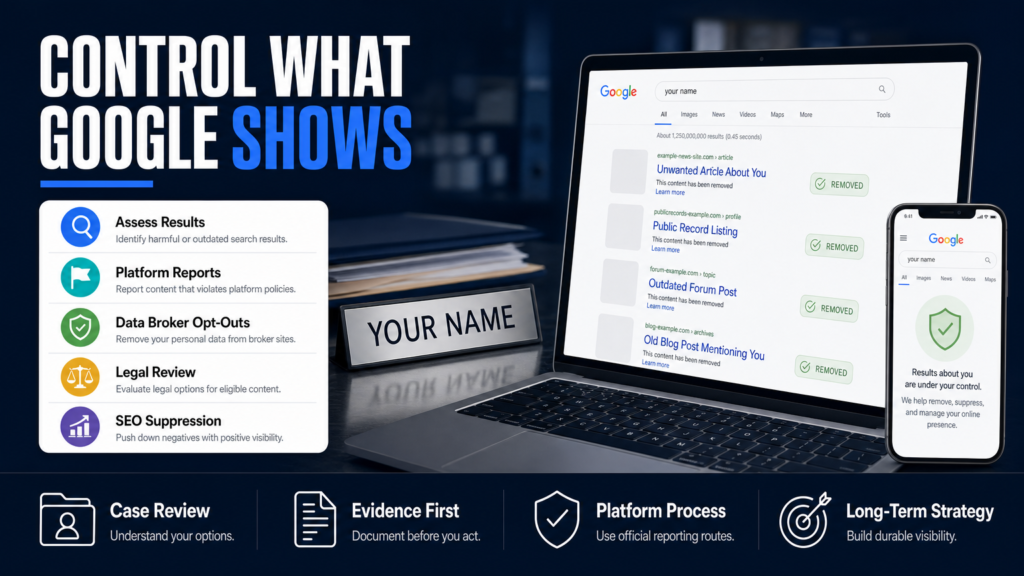
Google provides a mix of automated tools and manual review channels. You can request removal for certain privacy violations, doxxing, and content that violates Google’s policies. We evaluate whether the content may qualify for removal or review and pursue the legal, technical, platform-based, and reputational options available.
- Step 1: Save evidence. Take timestamped screenshots and archive the URLs (Wayback, archive.today) without altering content.
- Step 2: Use the appropriate Google form (private info, legal removal, or remove outdated content).
- Step 3: Send a take-down or correction request to the hosting site or webmaster. If a review or listing is on a platform, follow that platform’s dispute flow.
- Step 4: Track responses and escalate to legal review if the publisher refuses and the content appears false or defamatory.
- Private data or doxxing (SSN, bank account, images) — use Google’s Remove Outdated Content and personal info forms.
- Impersonation or fake accounts — report directly to the platform that hosts the page first (Twitter/X, Facebook, Instagram, LinkedIn).
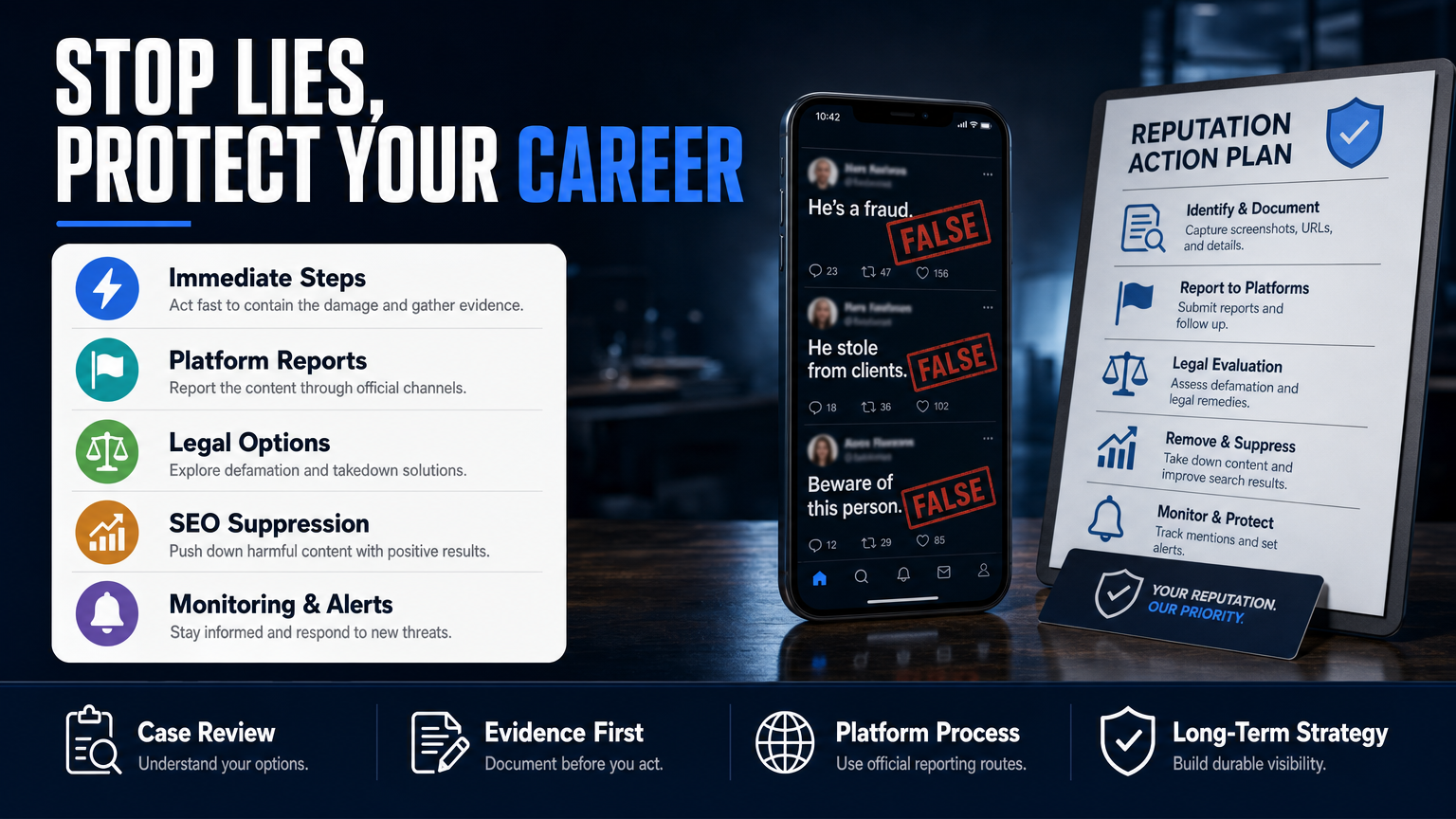
- Defamatory or false allegations — pursue publisher takedown requests and consider legal review.
- Reviews — use platform-specific review-removal processes (Google Maps, Yelp, Trustpilot).
Google-specific reporting forms
Google has different forms depending on the problem: ‘Remove Outdated Content,’ ‘Request removal for personal information,’ and ‘Legal removal requests.’ Each asks for different proof — e.g., a government ID only where required for identity verification.
If the content is on a third-party site, removing it at the publisher is usually required before Google stops showing the page in search results. Google’s index reflects what publishers choose to keep available online.
- Use ‘Remove Outdated Content’ when a page has been changed or deleted but still appears in results.
- Use ‘Personal Info Removal’ for exposed SSNs, bank numbers, images shared without consent, or doxxing.
- Use ‘Legal removal’ forms if a court order or copyright claim applies.
When to get immediate professional help
If the result is causing imminent, serious harm — employers withdrawing offers, extortion, or doxxing with threats — you may need rapid-response support. Your Reputation Agency handles crisis response, but an attorney may also be required for some legal options.
Read the case study context in When One Google Result Can Cost You Your Career to understand typical consequences and remediation paths.
- Prioritize threats and doxxing reports.
- Coordinate with counsel for preservation letters or emergency court orders when life, safety, or criminal conduct is involved.
How can I remove my name from Google Search results for free?
There are several no-cost steps you can take immediately. Free options include platform reporting, data-broker opt-outs, and using Google’s own removal tools.
Free does not mean guaranteed. We pursue the official, platform-based options first because they are the accepted, documented paths.
- Step 1: Identify the exact URLs showing your name.
- Step 2: Attempt a publisher takedown: contact the site owner, provide a concise request, and state why the content violates privacy or is false.
- Step 3: File platform reports (e.g., Google, Facebook, Twitter/X, Yelp).
- Step 4: Submit data-broker opt-outs (many allow online forms).
- Step 5: Monitor search results and archive updates.
- Use Google’s ‘Remove Outdated Content’ and ‘Private Information’ forms.
- Contact the site owner or webmaster and request removal or correction.
- Submit opt-out requests to major data brokers (Spokeo, Whitepages, Instant Checkmate).
- Dispute false reviews on Google Maps, Yelp, and other review sites via their help centers.
Data-broker opt-outs (free but time-consuming)
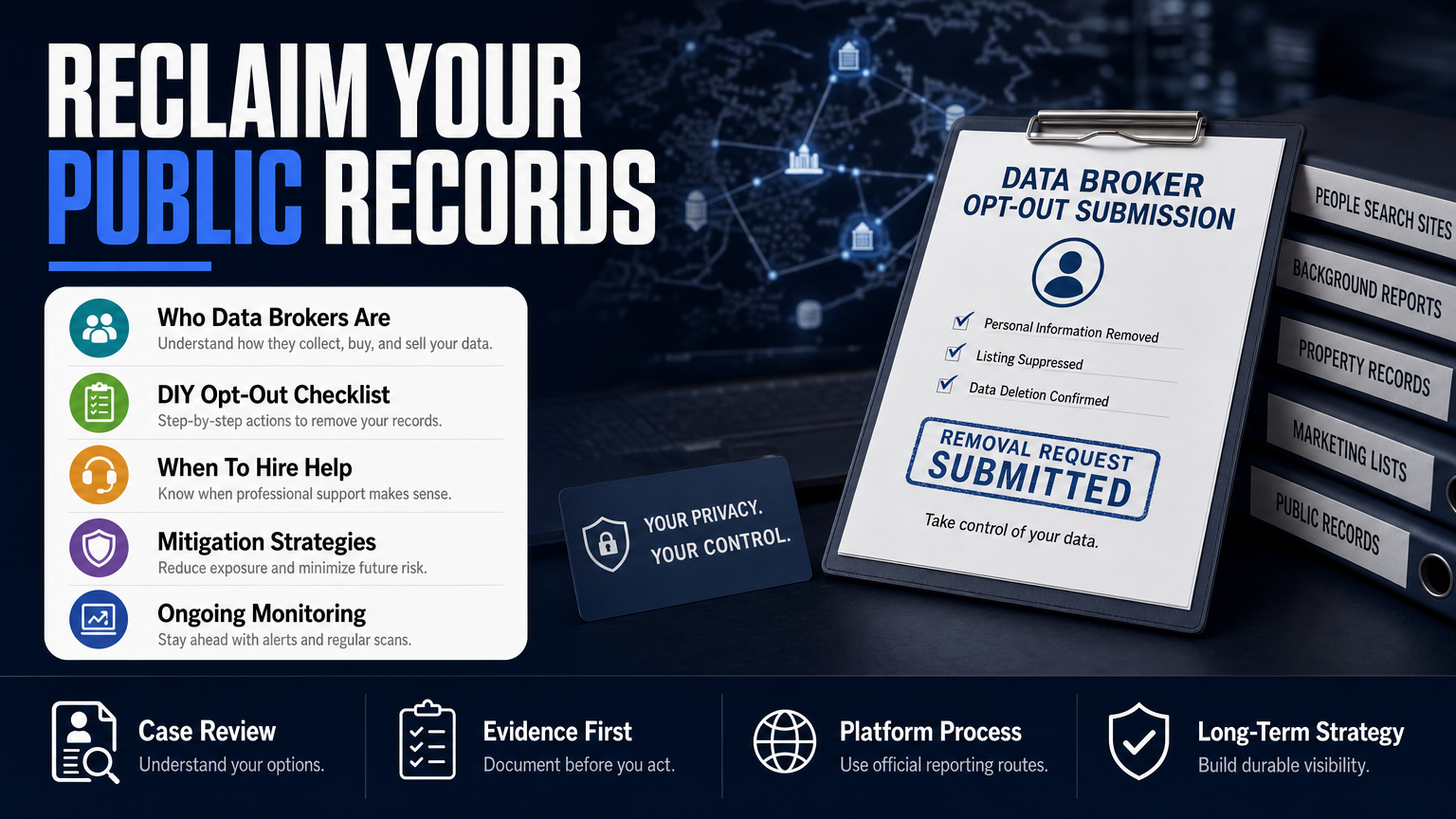
Major people-search sites allow voluntary opt-outs. They differ in process: some require email links, others require forms or ID checks. This can reduce the appearance of your contact details in search results over time.
Make a prioritized list (Whitepages, Intelius, Spokeo, BeenVerified), then batch the requests. Expect follow-ups and re-requests; many services periodically re-index public records.
- Create a dedicated email to handle opt-out confirmations.
- Use sample templates but customize to each site’s form fields.
- Keep records of submitted opt-outs and confirmation emails.
Free review disputes
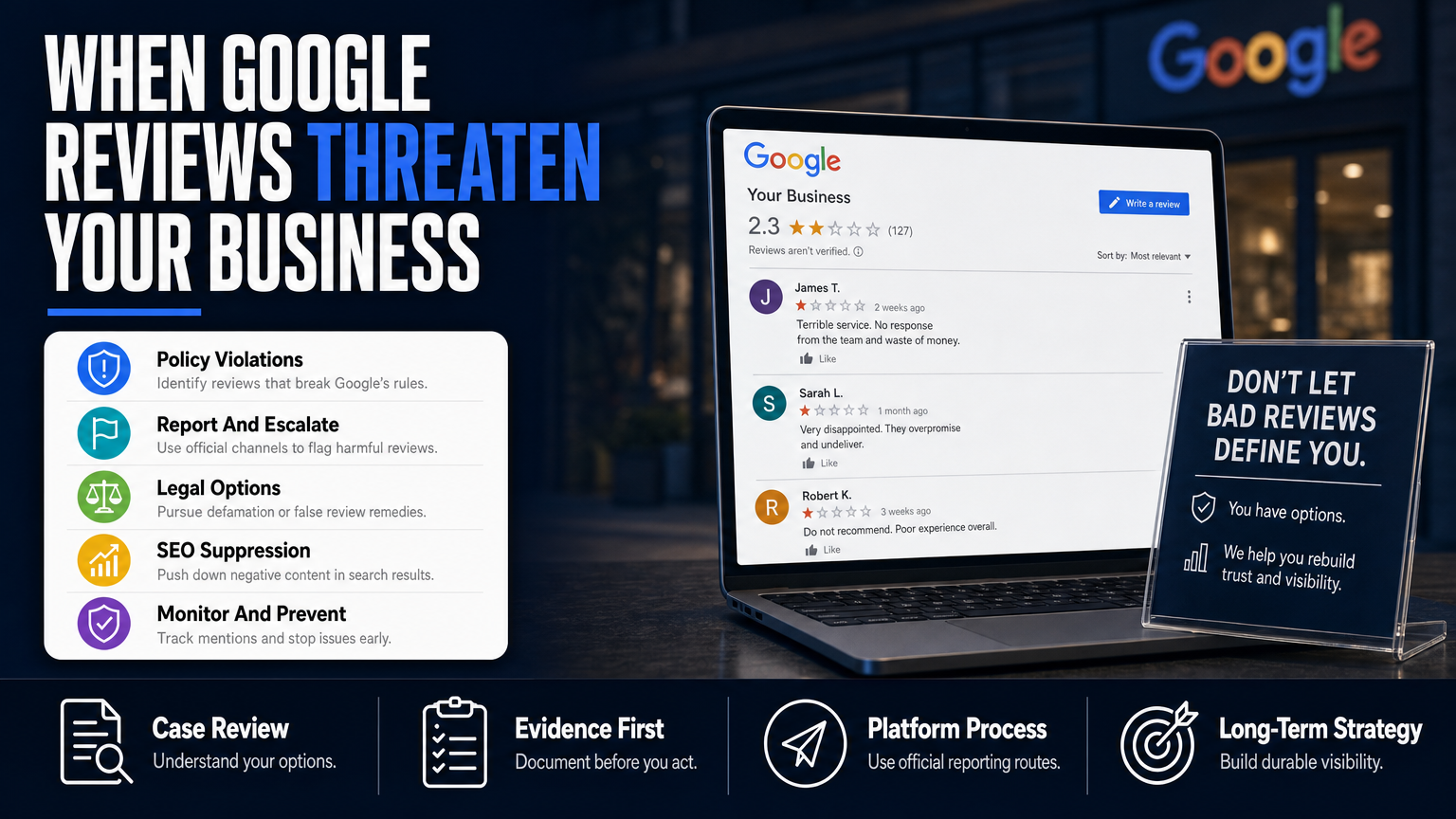
If the harmful content is a review, follow the review site’s dispute flow. Google Maps, Yelp, and Facebook each have documented processes for reporting policy violations. You can sometimes get a review removed if it violates platform policy (hate speech, evidence of being fake, doxxing) but not merely because it is negative or unfair.
For guidance on why a single result matters and how it affects hiring and client decisions, see When One Google Result Can Cost You Clients and Jobs.
- Document why the review violates policy (screenshots, dates).
- Submit the dispute with supporting evidence through the platform’s help center.
- If the dispute fails, consider publishing a reply explaining your side professionally.
How do I hide my name from appearing when someone Googles me?
Hiding your name has two meanings: removing specific results and reducing the likelihood that a name search surfaces harmful content. When outright removal isn’t available, suppression through authoritative alternative content is the primary strategy.
We develop SEO reputation strategies intended to improve the visibility of relevant and credible information rather than promising a fixed ranking or permanence.
- Step 1: Audit the first three pages of Google for your name and list URLs you want to suppress.
- Step 2: Claim and optimize authoritative profiles: LinkedIn, About.me, Google Business Profile (if applicable).
- Step 3: Publish controlled content—short bios, a professional website, press mentions—and promote those URLs via social channels.
- Step 4: Build links to your positive pages from other trustworthy sites to increase their search authority.
- Create and optimize authoritative profiles (LinkedIn, personal website, professional directories).
- Publish new content that answers searches people use about you (blog posts, press releases, podcasts).
- Use consistent naming and schema so search engines associate positive content with your name.
Content priorities for suppression
Search engines prefer fresh, authoritative pages. A well-structured personal website and active LinkedIn profile often rank quickly for name searches. For businesses, Google Business Profile and industry citations are high priority.
We develop SEO tactics intended to improve visibility of credible sources, but search results may change because algorithms, competitors, publishers, and user behavior are outside our control.
- High priority: LinkedIn, personal domain (yourname.com), university or employer profiles.
- Medium priority: industry directories, interviews, local press mentions.
- Lower priority: social posts unless they are regularly engaged with and linked to.
Can I tell who has googled my name?
Short answer: No—Google does not provide a feature that tells you who searched for a specific name or term. Search behavior is anonymized and aggregated to protect user privacy.
You can infer interest from other signals like referral traffic to your website, LinkedIn profile views, or notifications from specific platforms (e.g., LinkedIn shows who viewed your profile under certain subscription levels).
- Step 1: If you own a site, connect it to Google Search Console to see queries and pages that receive clicks.
- Step 2: Use site analytics (e.g., Google Analytics) to monitor traffic spikes and referral sources.
- Step 3: For social platforms, check built-in viewer notifications and consider upgrading accounts where appropriate.
- Google Search Console shows search queries that lead to a site you own, not who searched for your name on Google broadly.
- LinkedIn and other platforms may show profile viewers depending on privacy settings.
- Referral traffic and analytics can reveal when people click links to content about you, which can indicate interest.
What to do about repeated monitoring
If you are concerned that someone is persistently searching you (stalking, harassment), document the behavior and reach out to law enforcement or an attorney. Technical measures—privacy settings, removing public contact info—reduce casual discovery but do not stop determined actors.
Your Reputation Agency handles confidentiality and security controls for reputation cases, but forensic or legal action requires coordination with qualified professionals.
- Limit public contact information on profiles.
- Enable two-factor authentication and strengthen account security.
- Preserve evidence if you suspect harassment.
What to do when removal of Google results isn’t available
Not all content can be removed. Truthful public records, news reporting in the public interest, and some court dockets are typically not removable by Google absent specific law or a court order. When removal is unavailable, we recommend mitigation, correction, and visibility management.
When removal is unavailable, we may recommend mitigation, correction, or reduced visibility through targeted SEO, content creation, and outreach.
- Step 1: Prepare a factual, sober response or clarification on your owned channels (site, LinkedIn).
- Step 2: Build distribution—get local press, guest posts, or directory listings that link to your positive pages.
- Step 3: Monitor search visibility and refresh content as needed to maintain momentum.
- Publish corrective or contextual content that addresses legitimate concerns (e.g., an explanation, press statement, or published response).
- Use suppression: build or optimize pages you control that rank above the negative result.
- Consider formal legal options only after consulting an attorney if the content is false or defamatory.
When to seek corrections instead of removal
If a news story contains inaccuracies, contact the reporter and the publication with specific, sourced corrections. Many outlets will publish corrections or editor’s notes. Corrections can improve the public record and sometimes reduce the prominence of incorrect statements in search snippets.
Be aware that contacting a publisher can sometimes prompt re-reporting; aim for clarity and documentation rather than demands.
- Send a concise correction with links to primary sources.
- Request an editor’s note or correction rather than an outright takedown for public-interest reporting.
- Coordinate with legal counsel if the publisher refuses and the statement is demonstrably false.
When suppression becomes the primary strategy
Suppression is an ongoing process: it requires building and maintaining authoritative pages and link signals. Results vary according to the strength of the negative content and the authority of competing sources.
We develop SEO reputation strategies intended to improve the visibility of relevant and credible information and recommend an evaluation to estimate realistic timelines.
- Create and optimize evergreen content that reflects your professional identity.
- Earn links and mentions from reputable sites to boost the authority of your positive pages.
- Monitor and refresh suppression content quarterly.
Platform-specific takedown checklist (reviews, social posts, and news)
Different platforms have different policies and evidence requirements. Below are short checklists for common problem types. Use the platform’s reporting tools first; if that fails, escalate to the site owner or consider legal review.
For detailed steps on deleting a name from Google specifically, see How to Delete Your Name from Google Search Results.
- Step 1: Prepare documentation — screenshots, URLs, time stamps, and a short description of the violation.
- Step 2: File the platform report and retain the confirmation number.
- Step 3: If the platform declines, send a formal removal request to the publisher with a clear legal basis if available.
- Step 4: Escalate to legal counsel when the content is demonstrably false and causes material harm.
- Google Search/Maps: Report policy violations, request removal of personal info, use Remove Outdated Content form.
- Yelp/Facebook/Trustpilot: Follow the review dispute flow and provide evidence of policy violation or fraud.
- Social networks (X, Instagram, TikTok): Report impersonation and doxxing via platform forms; request removal of content that violates terms.
- News publishers: Send correction requests with sources and ask for amendments if factual errors exist.
Handling mugshots and arrest records
Some mugshot sites exploit public records. A combination of publisher requests, data-broker opt-outs, and suppression is usually necessary. Legal remedies may be available in certain jurisdictions where laws restrict the commercial use of mugshots.
Mugshot removal is an area where a focused, documented approach tends to produce the best results.
- Identify the original source of the arrest record.
- Pursue publisher takedowns if images were posted without consent.
- Use suppression tactics to push mugshot pages off the first page of search results.
Monitoring and follow-up: keep control after the initial push
Removal or suppression is not a one-time task. Use ongoing reputation monitoring to catch re-uploads, mirrored pages, and site migrations that bring old content back into search results.
Your Reputation Agency provides monitoring, but you can set up initial alerts yourself.
- Step 1: Create Google Alerts and subscribe to mentions of your name with quotes.
- Step 2: Add key URLs to a monitoring tool or spreadsheet with review dates.
- Step 3: If content reappears, repeat the reporting workflow immediately and document the recurrence.
- Set Google Alerts for exact-name queries and problem URLs.
- Use a SERP tracker to watch the first page results for your name.
- Schedule monthly checks of major people-search sites and review sites.
When to document and escalate
If content is repeatedly re-posted by the same publisher or network of sites, preserve evidence and speak with counsel about potential cease-and-desist letters or other legal steps.
Preserving evidence early improves options later if legal remedies become necessary.
- Archive pages using multiple archiving services.
- Keep a clear timeline of publication and takedown attempts.
- Coordinate with counsel for escalation if necessary.
DIY vs Hiring an Agency
Quick comparison of what you can expect from a self-directed approach versus professional help.
| DIY (You) | Agency |
|---|---|
| Cost | Paid service fees |
| Time commitment | Delegated |
| Technical SEO skills | Included |
| Legal coordination | Arranges counsel and referrals |
| Platform relationships | Experienced escalation pathways |
| Monitoring and follow-up | Ongoing surveillance offered |
Hypothetical: ‘Dr. M.’ and a Negative Article
Situation: Dr. M., a physician with a local practice, finds a decade-old blog alleging malpractice that she disputes. The blog appears on page one of Google for her name and is affecting new patient calls.
Approach: Dr. M. documents the article, requests corrections from the author, files a Google personal-info report for sensitive content, submits data-broker opt-outs to reduce exposure of contact details, and launches a suppression campaign with a new professional page and multiple directory listings.
- Step 1: Prioritize the harm — lost patients were the immediate issue.
- Step 2: Attempt publisher correction; when that failed, add authoritative pages above the negative article.
- Step 3: Continue monitoring; the report and suppression began to reduce the article’s visibility within a variable timeframe, though no removal was guaranteed.
- Saved screenshots and archived the original article.
- Sent a factual correction request to the blog author with sources.
- Filed Google’s reporting form for personal info where applicable.
- Published a comprehensive professional bio on a new domain and optimized LinkedIn.
Common Mistakes People Make When Trying To Remove Their Name
Below are frequent errors and how to avoid them. Each mistake slows the process or makes outcomes worse.
Mistake 1: Assuming every negative result is removable
Not all content qualifies for removal. Truthful public records and responsible news reporting will usually remain online. Treat those differently — by correcting or contextualizing rather than demanding removal.
- Action: Audit results and classify them before you act.
Mistake 2: Using fake identities or deceptive tactics
Attempting to game platforms or post fake content to bury negatives can violate terms and cause new problems. Avoid fake accounts, fake reviews, or deceptive SEO tricks.
- Action: Use legitimate profiles and transparent corrections.
Mistake 3: Not preserving evidence
Platforms and publishers can change pages. If you may need legal or escalation routes later, preserve clear, timestamped evidence up front.
Action: Archive pages, take screenshots, and record response emails.
- Action: Use archive.today, the Wayback Machine, and local timestamped screenshots.
Mistake 4: Overlooking data brokers
Even if you remove a page, people-search sites can keep republishing contact information. Ignoring data brokers leaves discoverability intact.
Action: Submit opt-outs to major brokers and monitor them quarterly.
- Action: Track opt-out confirmations and re-check annually.
Mistake 5: Failing to follow up
A single report or email is often insufficient. Platforms and publishers receive many requests — polite follow-up and escalation are usually necessary.
Action: Keep a log of submissions and next-date reminders for escalation.
- Action: Use a spreadsheet to track status, confirmation IDs, and deadlines.
Best Practices For Managing Name Search Results
Durable practices reduce future exposure and increase the chance that search results reflect accurate, professional information.
Practice 1: Start with a thorough audit
List the exact URLs, their content type (news, forum, review), and why each is problematic. Prioritize by impact: hiring, revenue, or safety.
Action: Use that list to build your takedown and suppression plan.
- Identify first-page threats and second-page backups.
Practice 2: Keep communications factual and documented
When contacting publishers or platforms, provide clear, documented reasons for removal or correction. Avoid inflammatory language; focus on evidence and specific policy violations.
Action: Provide links to primary sources when requesting corrections.
- Attach PDFs or links to public records where appropriate.
Practice 3: Build authoritative, consistent profiles
Claim and optimize LinkedIn, a personal domain, and professional directories. Use consistent name formats (first + last) and a professional photo.
Action: Use schema on your website so search engines understand the content type (author, job title).
- Maintain a content calendar to publish fresh, authoritative updates.
Practice 4: Monitor proactively
Set up alerts and a simple monitoring schedule. Fast detection of reuploads or mirrored pages reduces the time harmful content remains discoverable.
Action: Check Google Alerts weekly and review SERP changes monthly.
- Use a third-party monitoring service for higher-risk profiles.
Practice 5: Coordinate with counsel when needed
If content is demonstrably false, defamatory, or causing measurable harm, consult an attorney for legal options. We coordinate with qualified legal professionals when a matter requires legal analysis.
Action: Preserve all evidence to support any legal review.
- Ask counsel about letters of preservation, cease-and-desist, or potential claims.
Expert Tips
- Document everything before you ask for removal — screenshots, archives, and timestamps matter.
- Start with the publisher: removing the source removes the index entry faster than reporting to search engines alone.
- Use exact-match quoted searches to find mirrored or scraped copies of harmful content.
- For reviews, respond publicly and professionally even if the platform doesn’t remove them — your response is visible to future searchers.
- Batch data-broker opt-outs using a dedicated email address to keep confirmations organized.
- If safety is a concern, prioritize law enforcement and legal counsel before public actions.
- Maintain a single authoritative personal website — it’s the best long-term asset for suppression.
- Expect maintenance: suppression requires periodic updates and fresh authoritative signals.
Conclusion
Removing google results for your name is a mix of platform reporting, publisher outreach, legal evaluation, and sustained SEO work. No single action guarantees deletion; success depends on the content type, publisher cooperation, and policy rules.
Begin by auditing and preserving evidence, use the platform-specific flows we describe, and pursue suppression when removal isn’t an option. If the situation risks your livelihood or safety, coordinate with counsel and consider professional reputation support to manage the technical and escalation work efficiently.
Why Businesses Choose Your Reputation Agency
Managing your reputation takes more than monitoring reviews or publishing the occasional blog post. It takes a strategy built around your situation, your industry, and what is actually showing up in search.
Your Reputation Agency works with businesses, executives, healthcare professionals, attorneys and growing brands. Our services include:
- Remove or suppress negative search results and news articles from Google
- Review removal and remediation (Google, Yelp, Facebook, Trustpilot, industry sites)
- Data broker and people-search opt-outs to remove personal information
- Mugshot and arrest-record removal or suppression
- Takedowns of defamatory, false, or malicious posts (social, blogs, forums)
- Online crisis management and rapid-response reputation repair
- Impersonation and fake account removal on social platforms
- Reputation monitoring, alerts, and ongoing surveillance
- First-page SEO and suppression strategies to bury negative content
- Digital security audits and privacy hardening to prevent future exposure
Frequently Asked Questions
1. How do I remove Google Search results of my name?
Classify the content first (privacy, impersonation, false allegation, or public record). Use Google’s reporting forms for personal info or outdated content, request takedowns from publishers, and follow platform dispute processes. Removal depends on the content, publisher, platform policies, evidence, and jurisdiction.
2. How can I remove my name from Google Search results for free?
Free options include filing Google’s removal forms, contacting site owners, disputing reviews on platforms, and submitting opt-outs to data brokers. These methods are cost-free but time-consuming and not guaranteed to succeed.
3. How can I hide my name from appearing when Googled?
When removal isn’t available, focus on suppression: build authoritative content you control (personal site, LinkedIn), optimize it for name searches, and earn reputable links so positive pages outrank negatives. This is an SEO-driven strategy and outcomes vary.
4. Can I tell who has googled my name?
No—Google does not reveal who searched for a name. You can monitor referral traffic and site analytics if you own relevant pages, and platforms like LinkedIn may show profile views under certain settings, but you cannot see who performed a general Google search.
5. Will deleting a social account remove search results?
Deleting an account can lead to de-indexing over time, but cached copies or mirrors may remain. Use Google’s ‘Remove Outdated Content’ tool after deletion and monitor results; removal timing is variable and not guaranteed.
6. How long does it take to remove a search result?
There is no universal timeline. Timing depends on the platform, publisher responsiveness, the strength of your evidence, and whether legal processes are required. An estimated timeline can be provided after an individual assessment but cannot be guaranteed.
7. What if a news article about me is false?
Contact the publication with specific factual corrections and supporting sources. Many reputable outlets will publish corrections or editor’s notes. If the outlet refuses and the statement is demonstrably false and harmful, consult an attorney to evaluate legal options.
8. Are data-broker opt-outs effective?
Opt-outs reduce the visibility of contact data on people-search sites, which can lower discovery via Google over time. They are free but repetitive — many sites periodically re-index data, so ongoing monitoring and repeat opt-outs are necessary.
9. Should I hire an agency or attempt this myself?
DIY works for low-complexity cases and when you have time to follow up. Hire an agency when you need coordinated SEO suppression, ongoing monitoring, platform escalation experience, or rapid crisis response. Compare the trade-offs in time, skill, and cost before deciding.
This content provides general information and does not constitute legal advice. The available options and likely outcomes depend on the facts, evidence, platform policies, applicable law, jurisdiction, and public-interest considerations.
Past examples do not guarantee future results. Removal, correction, deindexing, and search-position changes depend on third parties and circumstances outside Your Reputation Agency’s control.