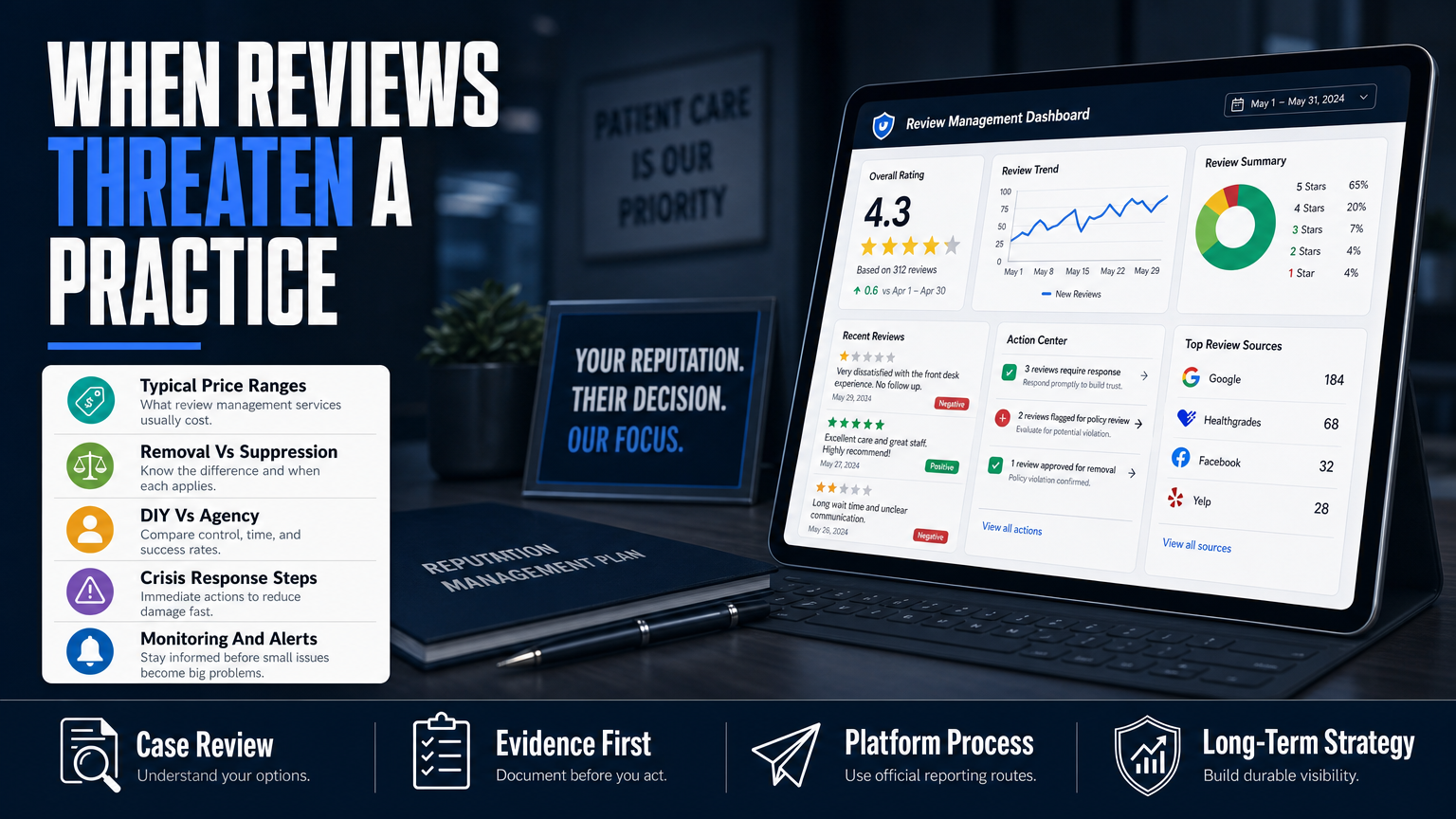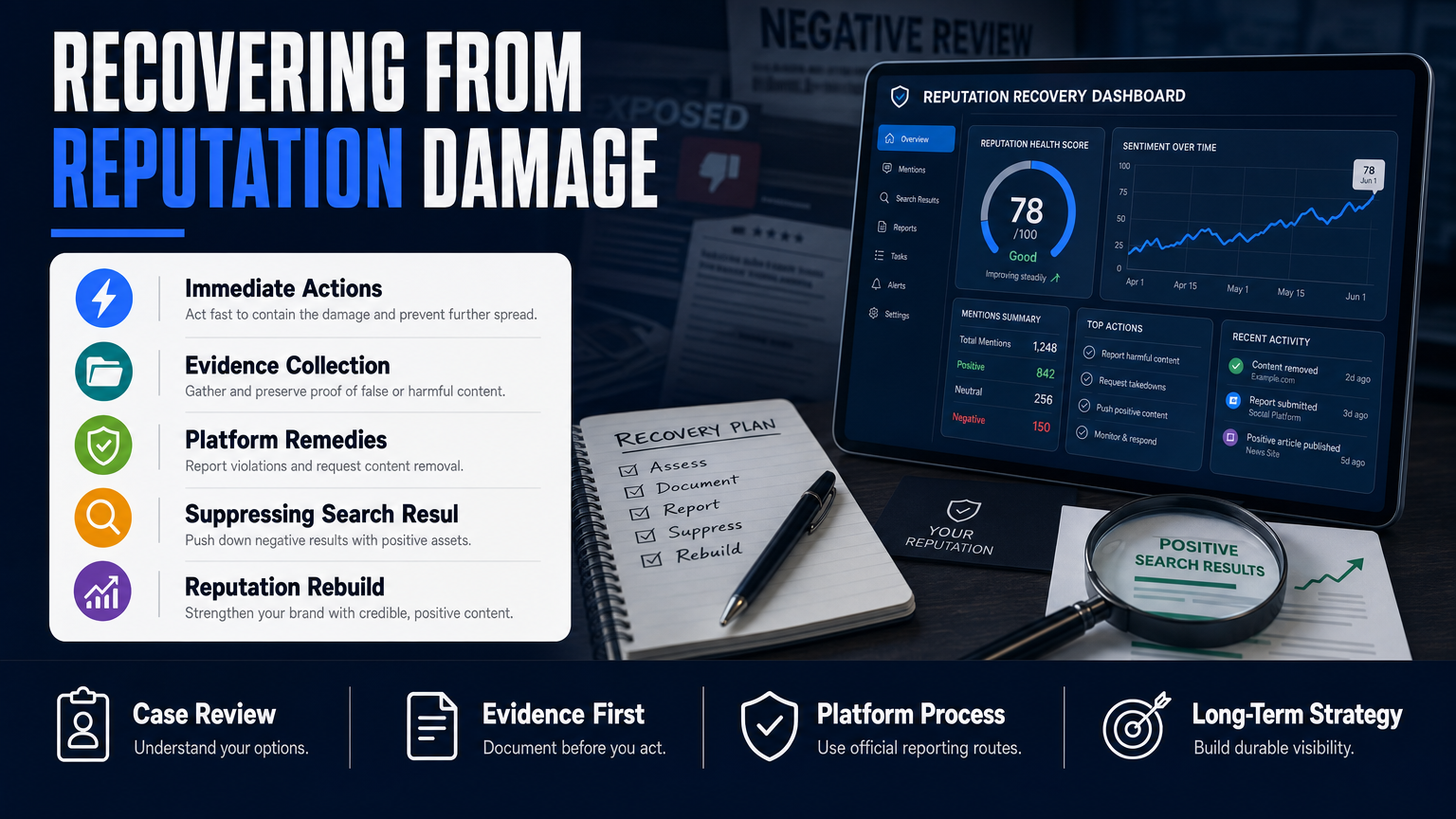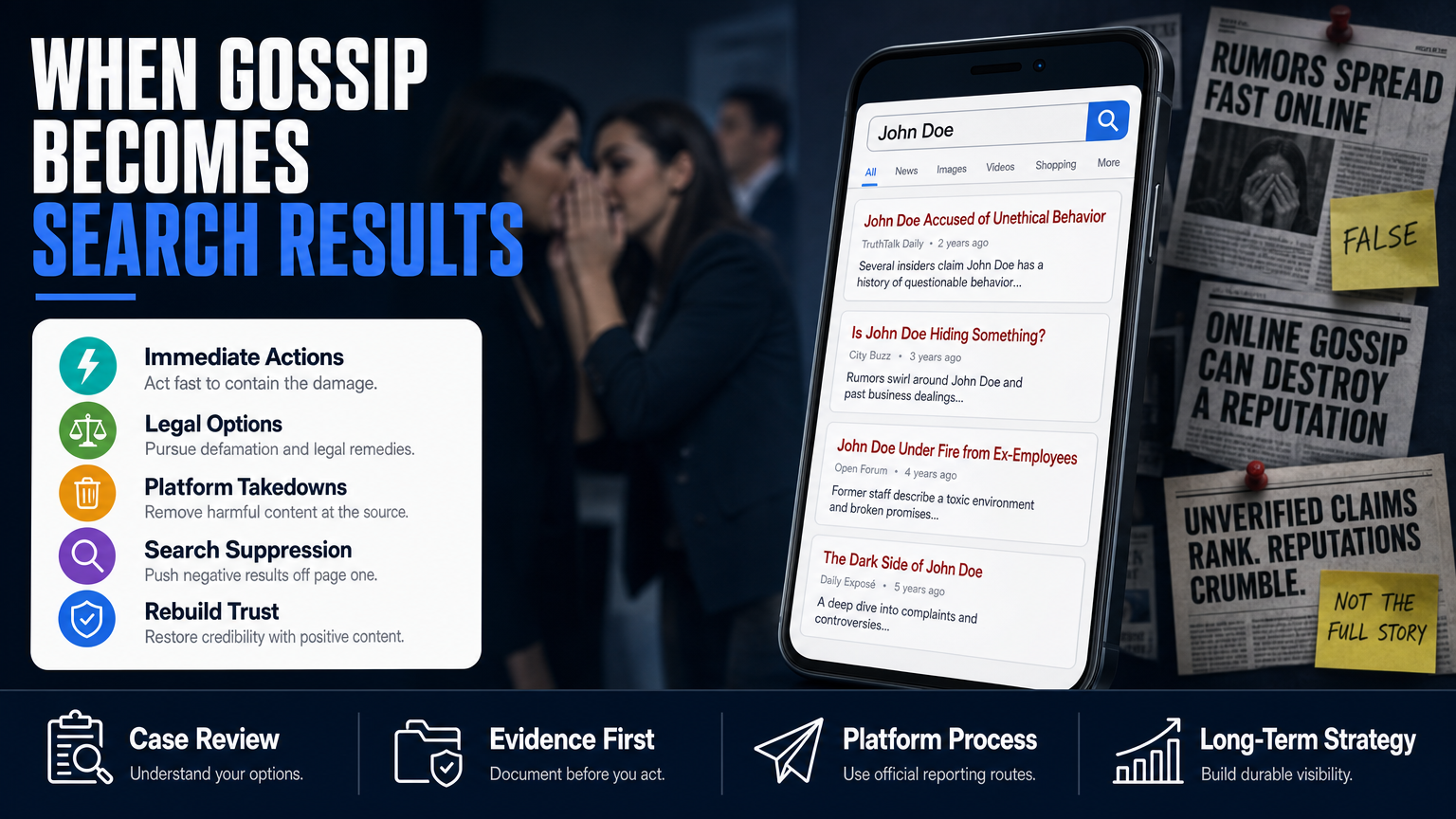
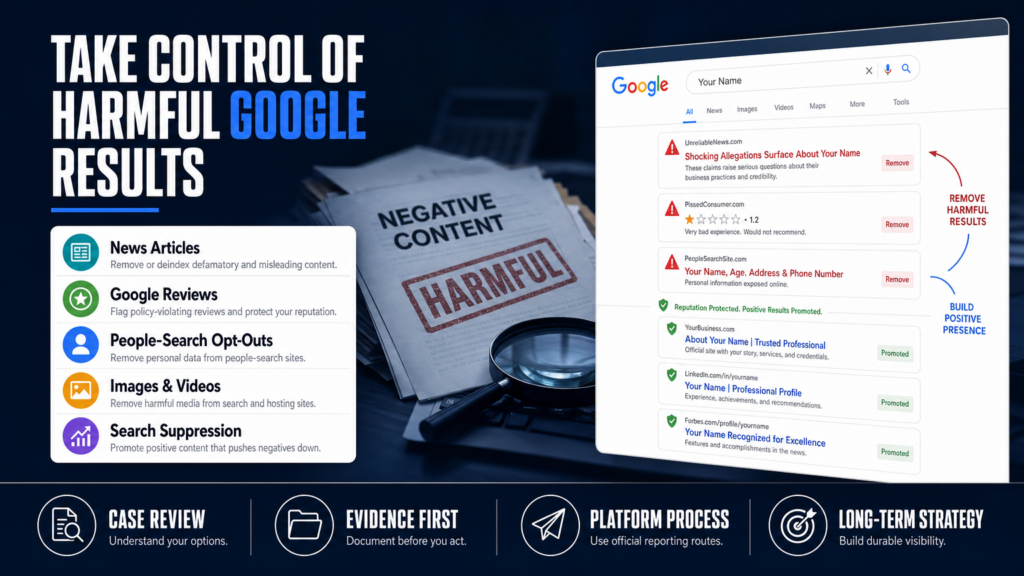
You found a negative item on page one of Google that costs you clients, calls, or job opportunities — and you need options, not platitudes. This article walks you through how we evaluate and act when someone asks us to remove negative google results.
We explain, in concrete steps, when a link may qualify for takedown or platform review, how to challenge or request removals for reviews and news, and when suppression or correction is the only realistic path.
You’ll get platform-specific next actions (Google, Yelp, TripAdvisor, people-search sites), a decision checklist for escalation to counsel, and a plain-English playbook for handling viral incidents and ongoing monitoring.
Table of Contents
- Can Negative News Be Removed From Google Search Results?
- Can A Negative Google Review Be Removed?
- How To Remove A Negative Review (Google, Yelp, TripAdvisor, Industry Sites)
- How To Remove Negative Content Across The Web (images, mugshots, people-search opt-outs)
- If Removal Isn’t Possible: Suppression, Correction, and Containment
- Rapid Response: What To Do When Negative Content Goes Viral
- Monitoring, Documentation, and When To Involve Counsel
- Removal vs Suppression: Which Strategy Fits Your Case?
- Hypothetical Example: The Doctor, The Blog Post, and the Search Result
- Common Mistakes People Make When Trying To Remove Negative Google Results
- Best Practices For Handling Negative Google Results
- Expert Tips
- Conclusion
- Why Businesses Choose Your Reputation Agency
- Frequently Asked Questions
Can Negative News Be Removed From Google Search Results?
Short answer: sometimes. Whether you can remove negative news from Google depends on where the story is published, what the story alleges, and platform or publisher policies. Google itself does not remove a URL simply because it is embarrassing or critical.
We evaluate whether the content may qualify for removal or review under publisher takedown policies, Google’s limited removal channels (privacy-sensitive info, doxxing, copyrighted content), or through a legal claim such as defamation if the facts are provably false.
- 1) Document the URL and capture screenshots with timestamps.
- 2) Confirm whether the publisher is a news site, blog, or user-generated platform.
- 3) Check Google’s removal tools for privacy, doxxing, or legal requests (not all cases qualify).
- 4) Contact the publisher with a clear correction or takedown request — keep records.
- 5) If the publisher refuses and the content appears false, consult an attorney about next steps.
- If a reputable news site published true reporting, removal is unlikely without a legal ruling.
- If the item contains doxxing, financial data, or involuntary explicit images, platforms and Google have clearer removal pathways.
- If the article repeats demonstrably false facts about you, a legal route (defamation) may be available — this requires counsel and evidence.
Step-by-step: Filing a Google removal request for privacy or doxxing
Use Google’s legal removal forms when the URL contains personal data like bank account numbers, explicit images published without consent, or financial account numbers. Follow Google’s form carefully and supply proof.
Timing and outcome depend on Google’s review and the strength of your evidence. Platform decisions remain under the platform’s control.
- Collect screenshots and the exact URL.
- Prepare documentation proving the privacy violation (ID redacted copies, police reports for doxxing, etc.).
- Submit via Google’s appropriate removal form and track the case number.
Can A Negative Google Review Be Removed?
Yes — in certain situations. Reviews that violate platform policies (hate, harassment, fake accounts, extortion) or that are demonstrably unrelated to the transaction can be reported and may be removed after review.
Not every negative review can or should be removed. Honest customer criticism, even if unfair, is typically allowed under site policies because it conveys opinion.
- 1) Determine if the review violates policy (libel, personal data, threats, sexual content).
- 2) Use the review platform’s reporting process (Google Business Profile → Flag as inappropriate).
- 3) Provide evidence: proof of fake reviewer, duplicate reviews, or policy violation.
- 4) If platforms decline, respond publicly with a calm, factual reply where appropriate.
- Google removes reviews that violate its content policies or that are posted by bots or competitors.
- You can request removal, but platform decisions are not guaranteed.
- When removal fails, documented responses and suppression strategies are practical alternatives.
How we triage review removal requests
We classify reviews by risk (licensure impact, revenue impact, regulatory risk), available evidence of falsity, and platform where it appears. High-risk items are escalated to formal takedown requests and, when appropriate, partnered legal review.
- Evidence of a fake account (no activity, mismatched location).
- Review that reveals private health or financial data.
- Coordinated review-bombing patterns.
How To Remove A Negative Review (Google, Yelp, TripAdvisor, Industry Sites)
Removal processes differ by platform. Below are practical steps for the major sites professionals and businesses face.
If you need a high‑risk item reviewed, collect evidence before filing — platform teams process clearer cases faster.
- Google Reviews: Flag the review in Google Business Profile, attach evidence via the web form, and track the support case.
- Yelp: Use Yelp’s business owner tools to report reviews, and if the reviewer is fake, collect profile screenshots and timing to support the claim.
- TripAdvisor: Report via the management center with booking evidence if the reviewer didn’t stay or is making false claims.
- Industry sites: Follow the site’s formal dispute process and consider contacting site moderators or site owners directly.
- Keep replies concise and factual; never post confidential information or make admissions in a public reply.
- Use each platform’s reporting flow; escalate with documented proof if initial reports are denied.
Google-specific steps (practical)
Sign into your Business Profile, find the review, click the three dots, and select “Flag as inappropriate.” If the review remains, open a support case in Google Business Profile Help and attach evidence (booking records, photos proving the reviewer wasn’t a customer).
- Flag the review immediately to create a record.
- Escalate to Google support if it appears to be fake or violates policy.
- Document all correspondence and timestamps.
When to use a dispute letter to the platform
A formal dispute letter is useful when you have documentary evidence that the review is fake or contains private information. Address the letter to the platform’s appointed contact, include specific URLs, and attach redacted proof.
- Include exact URLs and screenshots.
- Cite the platform policy you believe was violated.
- Keep a copy of every submission.
How To Remove Negative Content Across The Web (images, mugshots, people-search opt-outs)
Different content types require different approaches: images and videos often use copyright or privacy claims; mugshots and arrest records sometimes have publisher opt-out paths; people-search sites can be handled with opt-out forms.
We pursue the legal, technical, platform-based, and reputational options available. Removal depends on the content, publisher, platform policies, evidence, jurisdiction, and circumstances.
- 1) Identify host and hosting jurisdiction.
- 2) Check for copyright, privacy, or explicit-image removal channels.
- 3) Use people-search opt-out forms and track submissions.
- 4) If content is on a publisher’s site, send a targeted takedown or correction request.
- Images/Videos: consider DMCA takedown if you own the copyright, or platform privacy removal forms for non-consensual explicit images.
- Mugshots: many mugshot sites offer paid or free opt-out processes per site; some are outdated and require publisher outreach.
- People-search/data broker sites: use the site’s opt-out process, and consider automated monitoring because profiles can reappear.
People-search opt-outs: the practical reality
Each people-search site (Intelius, Spokeo, Whitepages, BeenVerified, etc.) has a different opt-out flow. Success rates vary. We prepare a repeatable documentation package and calendar to re-check listings because profiles can reappear.
- One-by-one opt-outs are manual and time-consuming.
- Some sites will remove only if you provide ID — handle copies securely.
- Opt-outs reduce exposure but rarely erase every copy from the web.
Resources and deeper reading
If you’re trying to understand how one damaging search result affects clients or hiring, see our longform analysis When One Search Result Can Cost Your Career and Clients for practical examples and priority criteria.
If Removal Isn’t Possible: Suppression, Correction, and Containment
When takedown is unavailable, suppression and corrective content are the primary tools. We develop SEO reputation strategies intended to improve the visibility of relevant, credible information so the harmful item moves lower in search results.
Suppression is not guaranteed and depends on the strength of the negative content and the authority of competing sources; expect variable timelines and results.
- 1) Prioritize owned assets (website About pages, LinkedIn, published bios) for optimization.
- 2) Publish new, reputable content tied to your name or brand.
- 3) Use targeted link-building to strengthen those pages.
- 4) Monitor rankings and adjust focus monthly.
- Create authoritative content (press releases, expert profiles, guest articles) to occupy page one.
- Use site-level SEO on owned properties (your domain, LinkedIn, professional directories).
- Correct factual errors publicly where possible and push the corrected version into the indexes.
DIY vs Agency: Which path to choose?
DIY suppression is possible for small-scale issues if you have time and SEO savvy. For high-risk items that threaten licensure or revenue, coordinated technical, PR, and legal action is often faster and safer.
- DIY: lower cost, steeper learning curve, slower on complex cases.
- Agency: project management, platform experience, legal coordination — not a guarantee of results.
Further reading on private-info removal
If your primary concern is private information in search results, our primer When One Google Result Can Cost You Clients and Jobs explains opt-outs, legal options, and realistic expectations.
Rapid Response: What To Do When Negative Content Goes Viral
A viral post requires a different playbook: speed, control of messaging, and immediate containment. Rapid online crisis management and incident response focus on stopping further spread and protecting high-value pages.
We handle social takedowns, impersonation removal, coordination with legal counsel, targeted outreach to publishers, and PR messaging to restore balance while evidence and legal options are assessed.
- 1) Immediate technical lock-down (accounts, passwords, two-factor auth).
- 2) Triage the most visible items and file high-priority removal reports.
- 3) Prepare an approved, short public statement for key channels.
- 4) Start suppression work for critical search results.
- Quarantine communications: change passwords, lock down accounts, identify the leak vector.
- Document everything: collect URLs, screenshots, and timestamps for potential takedowns or legal action.
- Engage PR and legal if the incident threatens licensure, regulatory scrutiny, or physical safety.
When to call counsel and PR
If the incident involves alleged criminality, regulatory exposure, or a claim that could trigger litigation, consult qualified counsel. For reputational incidents that affect revenue, coordinate with experienced PR to craft corrective messaging.
- Legal: for potential defamation, doxxing, or coordinated harassment.
- PR: for messaging to clients, employees, and the public.
Monitoring, Documentation, and When To Involve Counsel
Ongoing monitoring is essential. A single removed item can reappear or be mirrored. Use automated alerts, weekly audits, and an evidence log for every takedown request and platform interaction.
The content may warrant legal review. A qualified attorney can determine whether a legal claim may be available; we coordinate with qualified legal professionals when a matter requires legal analysis.
- 1) Create a searchable evidence folder with screenshots and URLs.
- 2) Schedule regular checks of page-one results for your primary keywords.
- 3) Review every platform’s response and escalate patterns to legal if necessary.
- Set up Google Alerts and third-party monitoring for your name, business, and common misspellings.
- Keep a secure, date-stamped archive of every harmful item and your outreach history.
- Involve counsel if the content is demonstrably false, threatens licensure, or involves serious privacy invasions.
Automated monitoring tools vs manual checks
Automated tools catch new mentions quickly but can miss context; manual audits identify nuance and platform-specific details. Combine both for reliable protection.
- Use alerts for speed and manual reviews weekly for accuracy.
- Adjust alerts to include variations of your name and brand.
A final resource
For stepwise removal options and an expert checklist focused on search results, see our deeper guide Remove Negative Content from Google | Expert Guide.
Removal vs Suppression: Which Strategy Fits Your Case?
A side‑by‑side look at when to pursue removal and when to plan suppression and repair.
| Removal (Takedown) | Suppression (SEO + PR) |
|---|---|
| Best for clear policy violations or privacy breaches | Best for true but damaging content or stubborn news items |
| Requires platform acceptance or legal victory | Requires consistent content and link-building effort |
| Can be faster if accepted (hours–weeks) | Usually slower; measurable changes often take months |
| May involve direct publisher negotiation or counsel | Primarily technical, editorial and PR work |
| Outcome depends on evidence and platform policies | Outcome depends on content quality, authority, and competition |
| Risk: partial removal (mirrors, caches remain) | Risk: suppression may be incomplete or temporary |
Hypothetical Example: The Doctor, The Blog Post, and the Search Result
Situation: A local clinic finds a blog post alleging malpractice on page one of Google for the doctor’s name. The piece repeats a complaint but includes factual errors and private medical details.
Response process (anonymized, illustrative):
- 1) Day 0–3: Secure evidence, lock down accounts, flag content to Google and the host.
- 2) Day 3–14: Submit formal takedown and correction requests; document responses.
- 3) Week 2–8: Begin suppression work—publish corrected content, strengthen profiles, and pursue high-quality backlinks.
- 4) Month 2–6: Monitor for movement in search results; if the publisher refuses correction and counsel advises, consider legal options.
- 5) Ongoing: Keep the monitoring cadence and update stakeholders.
- Triage: classify the item as high-risk (licensure and patient trust), capture screenshots, and identify publisher contact info.
- Removal attempts: file a privacy removal with Google for medical details and send a formal takedown/correction request to the blog’s host and author.
- Legal review: counsel assesses whether the factual errors meet the threshold for a defamation claim; preparatory evidence gathered.
- Containment: optimize owned pages (clinic site, provider profile), publish an updated professional statement, and place authoritative bios on directories.
Common Mistakes People Make When Trying To Remove Negative Google Results
Avoid these frequent errors — they waste time and can make the situation worse.
1. Chasing Every Negative Item
Mistake: Treating all negative mentions as equally urgent. Reality: Some items cause no material harm. Prioritize by impact (clients, revenue, licensure).
- Result: Wastes resources on low-risk items.
- Fix: Use a risk matrix to rank items before action.
2. Ignoring Platform Policy Details
Mistake: Filing removal requests without referencing relevant policy sections or evidence. Platforms deny unclear requests.
Fix: Cite exact policy language and attach clear evidence (screenshots, transaction records).
3. Posting Emotional Public Replies
Mistake: Responding publicly with anger or admissions. This can amplify the content and create new evidence against you.
Fix: Keep public replies short, professional, and offer offline escalation (contact information or a request to discuss).
4. Assuming All Negative Content Is Removable
Mistake: Believing that negativity, age, or embarrassment alone qualify for removal. Platforms protect lawful opinion and true reporting.
Fix: Plan for suppression and correction when removal is unlikely.
5. Using Deceptive Tactics
Mistake: Paying for fake positive reviews, creating phony accounts, or using fake legal threats. These tactics are unethical and can backfire legally and publicly.
Fix: Use legitimate SEO, PR, and legal channels only.
Best Practices For Handling Negative Google Results
Adopt these durable steps to manage risk and improve outcomes.
Document Everything Immediately
Best practice: Capture screenshots with timestamps, record URLs, and log all outreach. This creates an auditable trail for platforms or counsel.
- Use a secure folder and keep raw originals.
- Export any platform messages or reviewer profiles.
Prioritize By Real Harm
Best practice: Triage items by business/clinical impact. Focus first on items that affect revenue, licensure, or safety.
- High priority: items that appear first on page-one and reference harm or illegal activity.
- Medium: widespread negative reviews that affect conversion.
- Low: single, old complaints on obscure pages.
Use Formal, Evidence-Based Takedown Requests
Best practice: When filing a removal request, be specific and attach proof. Cite the relevant platform policy and explain exactly why the content violates it.
- Address requests to the publisher and the platform.
- Keep copies of every submission and response.
Coordinate Legal And PR When Necessary
Best practice: For high-stakes incidents, coordinate counsel and PR so that legal steps don’t unintentionally inflame public perception and vice versa.
- Align public messaging and legal filings.
- Restrict who speaks publicly and use approved statements.
Invest In Ongoing Monitoring And SEO
Best practice: Suppression is an ongoing effort; treat search visibility as an asset that requires regular maintenance.
- Schedule quarterly SEO audits.
- Refresh and publish authoritative, timely content tied to your brand.
Expert Tips
- If the content contains your SSN, financial account numbers, or explicit images, prioritize platform privacy/legal removal channels.
- Capture evidence before contacting anyone — screenshots with visible timestamps are often decisive.
- Never admit liability in a public reply; offer to take the conversation offline instead.
- For review disputes, booking records or transaction IDs speed up platform reviews when they verify a reviewer’s claim.
- Use structured data on your site (schema) to help search engines show trusted bios and reduce the visibility of third-party items.
- Set up a recurring audit calendar — many opt-outs lapse or sites republish content.
- When a publisher is uncooperative, a professional correction request that cites factual errors and offers evidence can persuade some independent blogs.
- Coordinate with counsel early if content accuses you of criminal conduct or could affect licensure.
Conclusion
Removing negative Google results is rarely a single action. It’s a process: evaluate, document, pursue formal channels where available, and use suppression when removal isn’t realistic. Each case depends on content type, publisher, and evidence.
If your matter is high-stakes (licensure risk, major revenue impact, or personal safety concerns), bring legal and PR professionals into the process early and keep your documentation organized. For lower-risk issues, a disciplined suppression and monitoring plan often restores balance on page one.
Why Businesses Choose Your Reputation Agency
Managing your reputation takes more than monitoring reviews or publishing the occasional blog post. It takes a strategy built around your situation, your industry, and what is actually showing up in search.
Your Reputation Agency works with businesses, executives, healthcare professionals, attorneys and growing brands. Our services include:
- Remove defamatory content and false posts (news, blogs, listings)
- Remove or challenge negative reviews (Google, Yelp, TripAdvisor, industry sites)
- Mugshot and arrest record removal
- Remove videos, images, and other multimedia that damage reputation
- Remove personal data from people‑search and data‑broker sites (opt‑outs)
- Search result suppression (SEO to bury negative links)
- Social media takedowns and impersonation removal
- Rapid online crisis management and incident response
- Ongoing monitoring and alerting of reputation signals
- Coordination with legal counsel and use of legal tactics when required
Frequently Asked Questions
1. How can I remove negative news from Google search results?
Removal depends on the publisher and the content. Google removes URLs only in narrow circumstances (privacy breaches, explicit images, doxxing) or when a legal order requires it. For news that contains false statements, you may need to pursue a correction with the publisher or consult counsel about defamation options. We evaluate whether the content may qualify for removal or review and pursue the available platform, publisher, and legal avenues.
2. Can I get a negative Google review removed?
Possibly. Google removes reviews that violate its policies (hate speech, threats, fake accounts, personal data). If a review is policy-violative, flag it and provide evidence. If it’s a genuine negative opinion, it will likely remain; in that case, respond professionally and pursue suppression strategies to reduce its visibility.
3. How do I remove a negative review?
Start by documenting the review and checking platform policy. Use the platform’s reporting tools (for example, flagging a Google review in your Business Profile), attach evidence if available, and escalate to platform support. If the platform refuses removal, publish a calm public response and consider SEO and content strategies to lower the review’s search prominence.
4. How to remove negative content?
There are four general paths: 1) Use platform removal channels for policy or privacy violations; 2) Ask the publisher for correction or takedown; 3) Pursue legal action where facts are provably false and counsel advises; 4) If removal isn’t feasible, deploy suppression, correction, and PR to reduce visibility. We pursue the legal, technical, platform-based, and reputational options available.
5. How long does removal or suppression take?
Timing varies widely. A platform removal for a clear policy violation can be resolved in days to weeks; legal routes take months. Suppression via SEO and content creation typically takes several months to show meaningful movement. Timing depends on platform responsiveness, publisher cooperation, legal complexity, and competitive search factors.
6. Can I sue to force Google to remove a result?
You can seek legal remedies in some circumstances, but litigation is fact-dependent and not guaranteed to succeed. A qualified attorney can assess whether defamation, privacy, or other claims may be viable. Note that Google rarely removes URLs solely based on a lawsuit unless a court orders removal or the content violates specific laws.
7. Will Google remove true but negative information?
Generally no. Google does not remove truthful, lawfully published content simply because it is negative or embarrassing. If the content contains protected personal data or non-consensual explicit images, removal routes exist. Otherwise, suppression and corrective content are the pragmatic options.
8. What should I do first when I see a damaging search result?
Document the item with screenshots and the exact URL, assess the risk (revenue, licensure, safety), and determine the appropriate channel — platform report, publisher request, or legal review. Start the evidence log and set up monitoring for reappearances.
9. Is paying for an agency worth it?
An agency can streamline the process, handle the manual opt‑outs and platform escalation, coordinate PR and legal, and run suppression campaigns. For low-risk matters you may DIY, but for high-stakes incidents that threaten clients or professional standing, coordinated professional help often saves time and reduces errors. Agencies do not have special access to platforms and cannot guarantee removal.
This content provides general information and does not constitute legal advice. The available options and likely outcomes depend on the facts, evidence, platform policies, applicable law, jurisdiction, and public-interest considerations.
Past examples do not guarantee future results. Removal, correction, deindexing, and search-position changes depend on third parties and circumstances outside Your Reputation Agency’s control.