Someone has accused you of something you didn’t do. Whether it’s a private dispute, a social post, a review, or a formal complaint, the first question is: what can I do if someone makes false allegations against me? This article shows practical actions you can take right now and over the following weeks.
You’ll get a clear decision path: how to secure safety, collect evidence, use platform reporting and legal options, and begin reputation repair. Where removal or legal action may be available, we explain the conditions and risks; where they aren’t, we explain realistic mitigation and suppression strategies.
The guidance below is practical and jurisdiction-aware—some options depend on the platform or whether the allegation concerns criminal conduct, workplace behavior, or a private dispute. We show what matters most to platforms, lawyers, employers, and search engines so you can set priorities and move quickly.
Table of Contents
- Can You Be Accused Without Proof—and What That Means
- How To Build A Strong Defense Against False Accusations
- What To Do If You’re Accused Of Lying
- Can You Sue For Defamation?
- If The False Allegation Appears Online
- If False Allegations Affect Your Job Or Business
- When Removal Is Not Available: Damage Control And Suppression
- Coordinating Legal, Technical, And PR Responses
- Removal vs Suppression: Which Track Suits Your Situation
- Hypothetical Example: A Viral Post Accuses A Consultant Of Misconduct
- Common Mistakes People Make When Responding
- Best Practices To Protect Your Reputation After A False Allegation
- Expert Tips
- Conclusion
- Why Businesses Choose Your Reputation Agency
- Frequently Asked Questions
Can You Be Accused Without Proof—and What That Means
Yes. People can and do make accusations without independent proof. An allegation is not the same as a proven fact; platforms, employers, and the public may still react even when proof is absent.
Understanding the distinction between an allegation, a demonstrable false statement, and a protected opinion matters because it determines your options—platform takedowns, legal claims, employer investigations, or public clarification all follow different rules.
- Record the accusation exactly: copy text, save screenshots with timestamps and URLs.
- Preserve related communications (emails, DMs, voicemail) securely.
- Note witnesses, dates, and any contemporaneous evidence that refutes the claim.
- Accusation vs. Proof: An allegation can be made with zero corroborating evidence.
- Platform Response: Most social platforms and news sites require policy violations (harassment, doxxing, impersonation) for removal rather than a statement being ‘false.’
- Employer Response: HR often acts on complaints before legal resolution; prepare to document and respond.
- Legal Thresholds: Defamation requires false factual statements and damages in many jurisdictions; the bar varies with your role (public figure vs private individual).
How platforms treat unproven claims
Platforms adjudicate under their community rules, which focus on harassment, threats, impersonation, and privacy breaches. A claim that is simply false but not abusive or privacy-violating may remain.
- Twitter/X, Facebook, Instagram: removal if post violates harassment or privacy policies.
- Google Search/News: will not remove true-or-false content absent legal requirement or privacy policy violations.
- Yelp/Glassdoor: may remove reviews that violate review policies or are proven fake, but not merely critical.
How To Build A Strong Defense Against False Accusations
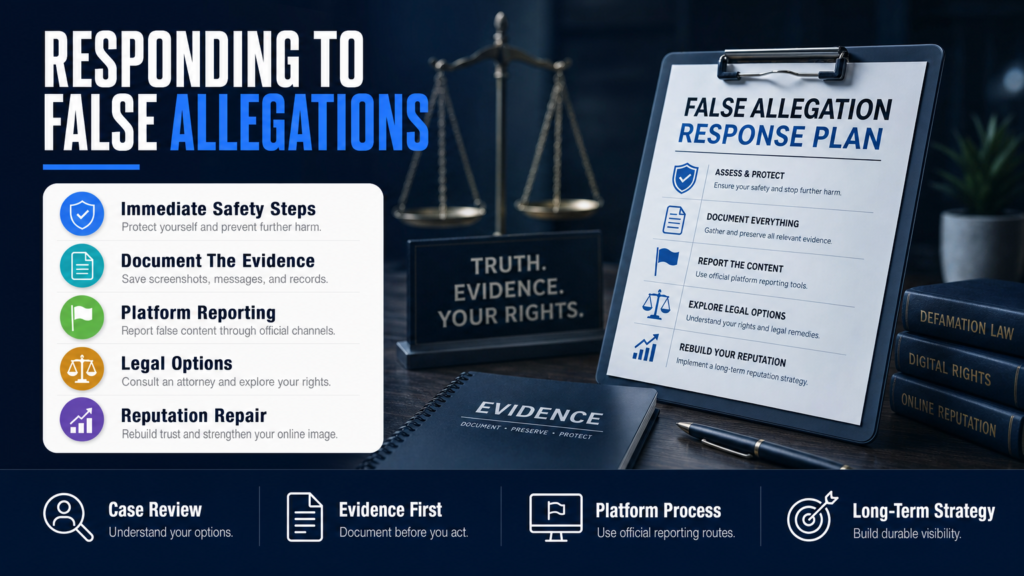
‘Winning’ against false accusations requires evidence, a clear narrative, and multiple parallel actions: documentation, platform reports, legal evaluation, and reputation work. There is no single universal playbook—choices depend on facts and goals (removal, retraction, suppression, job retention).
- Step 1: Secure safety for you and any affected parties.
- Step 2: Create a digital evidence folder (PDFs, screenshots, exported messages) and back it up offline.
- Step 3: Draft a factual statement and timeline you could share with counsel or an employer.
- Step 4: Use platform reporting routes where policy breaches exist, and keep a record of those reports.
- Prioritize safety: if the allegation involves threats, violence, or stalking, contact law enforcement immediately.
- Document methodically—screenshots, saved pages, and logged timestamps are the single most important asset.
- Contact trusted counsel for allegations with legal exposure; for reputation-only matters consider professional reputation help to coordinate non‑legal responses.
Documenting evidence—what to save
Save the original post, any comment threads, the poster’s profile, and third-party shares. Capture the URL and the timestamp. For social posts, export using the platform’s download tool when available.
- Full-page screenshots (desktop and mobile layout)
- Archived copies via the Internet Archive or PDF prints
- Metadata if available (email headers, server logs if you have access)
What To Do If You’re Accused Of Lying
Being accused of lying—by a coworker, client, or on social media—requires a measured response. Immediate emotional reactions often escalate the situation; instead follow a short, practical checklist to preserve credibility and options.
- 1. Take a screenshot of the allegation and any public reaction.
- 2. Draft a concise factual rebuttal (no ad-hominem), keep it to the facts and cite evidence.
- 3. Share the rebuttal through the least public effective channel first (employer, moderator, or the poster privately).
- 4. Escalate to a formal complaint or legal counsel if harms persist or reputational damage is material.
- Pause before replying publicly; a defensive or angry response can be used against you.
- Collect corroborating evidence: witnesses, timestamps, original documents, and prior communications.
- Decide the appropriate channel for response: private correction, HR process, platform counter-notice, or public statement.
Template for a measured reply
A short factual reply works better than a long defense. Example: ‘I dispute these claims. On [date] I did X; I have attached a copy of [document]. I’d be glad to provide more details to resolve this.’
- Avoid accusing the accuser of bad faith in public.
- Do not delete your evidence or primary records.
Can You Sue For Defamation?
Possibly—but whether you should and whether you can win depends on the content, whether the statement is presented as fact (not opinion), demonstrable falsity, damages, and jurisdictional rules. A lawyer can evaluate whether the required elements exist in your case.
- Step A: Get a legal evaluation—only an attorney can identify whether a defamation claim is viable.
- Step B: Consider sending a demand letter as a preliminary step, with counsel advising wording and risks.
- Step C: If litigation begins, preserve evidence and expect discovery—this can reveal private communications and extend public attention.
- Elements commonly assessed: false statement of fact, publication to a third party, fault (negligence or malice), and measurable harm.
- Public figures face a higher bar (actual malice in the US).
- Small defamatory statements without provable damages may not be worth litigation costs.
When litigation is more-or-less likely to help
Litigation can produce retractions, court orders, and monetary damages, but it also magnifies attention and is costly. Legal options make sense when the statement is clearly false, provable, and causing quantifiable harm (lost contracts, terminated employment).
- Stronger case when there is documentary evidence disproving the allegation.
- Consider alternative legal tools: cease-and-desist letters, anti-SLAPP motions, or court-ordered discovery.
If The False Allegation Appears Online
Online allegations require both platform and search-engine strategies. We evaluate whether the content may qualify for removal or review and pursue the legal, technical, and reputational options available.
Start with the platform: each network has a different process and thresholds for removal. When the platform won’t act, consider mitigation and suppression to limit reach.
- 1. Identify whether the content violates terms (harassment, doxxing, impersonation, non-consensual images).
- 2. Use platform reporting tools and follow up with appeals if initially denied.
- 3. If the content is on a site that refuses removal, evaluate suppression strategies (SEO, authoritative content placement).
- Report using the platform’s abuse, defamation, privacy, or impersonation forms.
- Contact the site host or the publisher directly for mistaken or false reporting on news sites.
- Preserve evidence and track every report and response from platforms.
When you need professional help online
If the content is widely shared or on high-authority domains (news outlets, major blogs), professional reputation help can coordinate legal outreach, media corrections, and first-page SEO strategies to reduce visibility over time. If the allegation is trending, act quickly to document reach and shares.
- For pervasive viral lies, see our deeper guidance on social platform crises in When a Viral Lie on Social Media Threatens Your Career.
- We develop SEO reputation strategies intended to improve the visibility of relevant and credible information.
If False Allegations Affect Your Job Or Business
Workplace accusations and review campaigns can end contracts and block career opportunities. Your response will likely involve HR, legal counsel, and targeted reputation work focused on stakeholders (clients, licensing boards, hiring managers).
- 1. Prepare a concise incident timeline and evidence package for HR or leadership.
- 2. Escalate to legal counsel if the allegation risks regulatory or licensing consequences.
- 3. Use managed reputation tactics (positive testimonials, updated web pages, and search-optimized content) to maintain client trust.
- Notify your employer or HR with a clear factual timeline and supporting documents.
- If reviews or rumors are harming your business, gather evidence and report policy violations to the platform.
- Prepare a communications plan for clients and partners that is factual, limited, and approved by counsel where appropriate.
When to involve external reputational support
When the allegation causes lost revenue, canceled contracts, or search results that harm customer trust, third-party reputation teams can coordinate messaging, review remediation, and employer-facing materials. For commercial and job impacts see When an Online Rumor Threatens Your Job or Business.
- Provide the reputation team with verified evidence and authorization to coordinate on your behalf.
- Expect to combine platform appeals, PR outreach, and SEO work.
When Removal Is Not Available: Damage Control And Suppression
Not all content can be removed. Search engines may decline to delist, publishers may refuse corrections, and platforms may rule the content permitted. In those situations, mitigation and suppression are the most realistic routes.
Suppression means improving the visibility of credible, positive, or corrective content so the harmful allegation is less prominent in searches and discovery. We develop SEO reputation strategies intended to improve the visibility of relevant and credible information.
- 1. Audit first-page search results for your name or business and identify replaceable items.
- 2. Produce and promote new content that addresses the issue factually (statements, timelines, FAQs).
- 3. Build links and authority to those positive pages so they outrank the harmful content over time.
- Create authoritative content: press releases, professional profiles, and third-party validations.
- Use targeted SEO: optimized blog posts, LinkedIn content, and other high-authority pages.
- Correct the record where possible: formal responses to editors, letters-to-the-editor, or corrections requests.
Why screenshots and archives keep the allegations alive
Even if a post is removed, screenshots, shares, and cached copies can keep it alive—the so-called screenshot effect. Plan mitigation assuming removed content may still circulate in copies or on other sites.
- Use monitor alerts to track reposts and caches.
- If permanence of a screenshot or repost is harming you, see legal avenues and correction requests in The Screenshot Effect: How One Post Can Ruin a Career.
Coordinating Legal, Technical, And PR Responses
A coordinated response typically works best: legal evaluation, platform takedowns where applicable, technical evidence preservation, and public or stakeholder messaging when appropriate. No single action is usually decisive—parallel tracks increase your chance of limiting harm.
We evaluate whether the content may qualify for removal or review and pursue the legal, technical, platform-based, and reputational options available.
- 1. Triage: assess safety, legal risk, platform jurisdiction, and reputation impact.
- 2. Preserve: collect and back up all evidence immediately.
- 3. Execute: file platform reports, send legal communications if advised, and publish corrective/authoritative content.
- 4. Monitor: set alerts, continue evidence collection, and adapt strategy based on responses.
- Legal: defamation claims, cease-and-desist letters, and discovery tools.
- Technical: forensic preservation, DMCA for copyrighted material, and privacy takedowns for doxxing.
- PR: targeted stakeholder communications, press corrections, and SEO content to restore context.
Working with counsel and reputation professionals
A qualified attorney can determine whether a legal claim may be available and coordinate with reputation professionals. We coordinate with qualified legal professionals when a matter requires legal analysis.
- Define clear goals with counsel—retraction, monetary damages, or mitigation—and understand trade-offs.
- Expect confidentiality limits; put specific confidentiality obligations into a service agreement.
Removal vs Suppression: Which Track Suits Your Situation
Two common approaches when faced with false allegations: attempt removal or pursue suppression. Compare typical traits below.
| Removal | Suppression |
|---|---|
| Goal: eliminate the content | Goal: reduce content visibility |
| Depends on platform policy or court order | Depends on SEO and content authority |
| Often faster if successful but less predictable | Slower, measurable over weeks/months |
| Requires evidence of policy breach or legal ground | Requires ongoing content production and link building |
| Can lead to re-publication elsewhere | Reduces discovery risk in searches and hiring checks |
| May involve lawyers and takedown notices | Often handled by reputation/SEO teams |
Hypothetical Example: A Viral Post Accuses A Consultant Of Misconduct
Scenario: A mid-career consultant receives a viral Twitter thread alleging professional misconduct. The thread contains a few factual errors, no identifying court records, and one private message that was misquoted. The consultant is losing client calls and receives concerned emails from a partner firm.
Process: The consultant preserves screenshots and collects supporting documents (emails and contracts) that contradict the thread. They report the tweet for harassment/false context to the platform and request removal, but the platform declines because the post doesn’t violate terms. They then engage counsel to send a demand letter to the poster and their hosting provider, and hire a reputation specialist to initiate suppression.
- 1. Immediate: preserve evidence and notify close stakeholders.
- 2. Short-term: file platform reports and request corrections from the poster.
- 3. Parallel: publish authoritative content (detailed timeline on the consultant’s site, LinkedIn statement) and boost with SEO.
- 4. Ongoing: monitor for reposts, respond to serious inquiries with a consistent factual statement, and evaluate litigation only if damages are quantifiable and likely recoverable.
- Evidence collected: original contracts, email thread timestamps, client testimonials.
- Platform action: report filed, appeal documented, platform declined initial removal.
- Legal action: demand letter sent; litigation considered but deferred due to cost/visibility concerns.
Common Mistakes People Make When Responding
Avoid common reactions that worsen exposure or erase your defenses. Below are frequent errors and how to avoid them.
Mistake: Responding Emotionally In Public
An angry or defensive post often inflames the situation and becomes part of the public record. It can be used against you in employer investigations or litigation.
- Instead: pause, craft a short factual statement, and consult counsel or a reputation professional before posting.
Mistake: Failing To Preserve Evidence
Deleting messages or failing to archive pages removes your ability to prove falsity or to use platform appeal paths that require proof.
- Instead: take screenshots, export messages, and back files up offline immediately.
Mistake: Chasing Every Copy Online
Trying to remove every repost manually wastes time and often fuels spread. Prioritize high-authority sites and channels that drive search visibility.
- Instead: focus on takedowns for policy violations and suppression for search results.
Mistake: Assuming Litigation Solves Visibility
Even successful lawsuits can amplify attention (the Streisand effect). Litigation should be chosen for evidence-backed goals, not as a reflex.
- Instead: weigh the pros and cons with counsel, including costs and publicity risk.
Mistake: Using Retaliatory or Deceptive Tactics
Attempting to hack, fabricate counterclaims, or use fake accounts to bury content is illegal and will make your situation worse.
- Instead: use legitimate reporting, legal, and reputation channels.
Best Practices To Protect Your Reputation After A False Allegation
Adopt durable habits that reduce future exposure and make responses faster and more credible.
Preserve Evidence Immediately
Always create a forensic habit: capture screenshots, archive pages, and export messages as soon as an allegation appears.
- Use tools like browser full-page screenshots, PDF print, and third-party archival services.
Limit Public Replies; Use Controlled Channels
Replying in public rarely helps. Begin with private correction, HR, or a direct message to the poster when safe and appropriate.
- Keep any public statement short, factual, and non-inflammatory.
Engage Counsel For Serious Risks
When allegations could lead to regulatory, licensing, or criminal consequences, a lawyer should be consulted immediately.
- A lawyer can advise on defamation viability, evidence preservation, and litigation risks.
Monitor Continuously
Set alerts for your name, business, and the allegation’s key phrases. Early detection limits spread.
- Use Google Alerts, platform monitoring tools, and paid reputation services when necessary.
Plan For Long-Term Reputation Repair
If removal is impossible, plan a 3–12 month suppression strategy combining authoritative content, media outreach, and SEO to restore context.
- Track metrics: search result positions, referral traffic, and sentiment among key stakeholders.
Expert Tips
- Do not delete the original post without saving it—removal can make it harder to prove falsity later.
- Label and timestamp every piece of evidence; courts and platforms prefer chronological, organized submissions.
- If the allegation involves criminal conduct, inform law enforcement but consult counsel before providing statements.
- Use platform escalation routes (appeals, legal removals, privacy forms) in parallel, not sequentially.
- When hiring reputation help, insist on a written scope and confidentiality terms that define expectations.
- Keep communications with employers and regulators factual and documented to reduce misunderstandings.
- Avoid public denial-by-attack; a calm, evidence-backed correction will maintain credibility better.
- If a post is about a private individual, highlight the privacy violation when reporting—platforms treat doxxing seriously.
Conclusion
Facing false allegations is disorienting, but a deliberate, evidence-first approach reduces harm. Immediate steps—preserve evidence, assess safety, and choose the right channel for response—set the foundation for legal or reputational remedies.
You may be able to get content reviewed, request retractions, or pursue legal remedies, but every option depends on platform rules, the nature of the statement, and jurisdictional law. When removal is not available, suppression and reputation restoration are practical, measurable alternatives that protect hiring prospects and client trust. If you need coordinated support, a combined legal and reputation approach is usually the fastest way to restore context and limit damage.
Why Businesses Choose Your Reputation Agency
Managing your reputation takes more than monitoring reviews or publishing the occasional blog post. It takes a strategy built around your situation, your industry, and what is actually showing up in search.
Your Reputation Agency works with businesses, executives, healthcare professionals, attorneys and growing brands. Our services include:
- Remove or suppress negative search results and news articles from Google
- Review removal and remediation (Google, Yelp, Facebook, Trustpilot, industry sites)
- Data broker and people-search opt-outs to remove personal information
- Mugshot and arrest-record removal or suppression
- Takedowns of defamatory, false, or malicious posts (social, blogs, forums)
- Online crisis management and rapid-response reputation repair
- Impersonation and fake account removal on social platforms
- Reputation monitoring, alerts, and ongoing surveillance
- First-page SEO and suppression strategies to bury negative content
- Digital security audits and privacy hardening to prevent future exposure
Frequently Asked Questions
1. Can you be accused of something without proof?
Yes. Someone can make an accusation without evidence. An allegation is not proof. Platforms and employers may still respond to accusations, but legal remedies like defamation claims require falsity and other elements which vary by jurisdiction.
2. How to win against false accusations?
Winning typically means establishing a record of facts and evidence, using platform reporting where policies are violated, and pursuing legal options when advisable. A coordinated approach—preserve evidence, seek counsel, and deploy reputation management—gives the best chance to correct the record or mitigate damage.
3. What to do when someone accuses you of lying but you didn’t?
Do not respond emotionally in public. Preserve all evidence, prepare a concise factual rebuttal, and share it through appropriate channels (employer HR, direct message, or legal counsel). Escalate only if harm continues or you have grounds for formal action.
4. Can I sue for defamation if someone is lying about me?
Possibly. A defamation claim usually requires a false factual statement, publication to a third party, and demonstrable harm. Consult an attorney to evaluate the strength of a claim and the practical costs and benefits in your jurisdiction.
5. Can you press charges against someone for making false accusations?
In criminal law, knowingly filing a false police report or making certain false statements to authorities can be a crime in many jurisdictions. Civilly, you may pursue defamation or related claims. Speak with a lawyer and, if appropriate, local law enforcement to explore criminal avenues.
6. What can I do if someone makes false allegations against me online?
Report the content using the platform’s abuse, privacy, or defamation forms and preserve evidence. If removal isn’t available, pursue suppression via authoritative content and SEO, and consider legal review for takedowns or corrections. For guidance on booming online lies, see When a Viral Lie on Social Media Threatens Your Career.
7. What can I do if someone makes false allegations against me at work?
Document everything and provide a clear timeline and evidence to HR or leadership. Request a formal investigation if appropriate, get legal advice for employment and licensing risks, and prepare communications for clients or partners if needed. Our article on workplace rumors is a relevant resource: When an Online Rumor Threatens Your Job or Business.
8. Can you press charges for false accusations to CPS or similar agencies?
Making knowingly false reports to child protection services or similar agencies can be a criminal offense in many places. If you believe such a false report has been made, consult counsel immediately and consider notifying the agency that the report is false while preserving evidence to defend yourself.
9. How long does it take to remove or suppress false content?
Timing varies widely. Platform decisions depend on their policies and review queues; legal actions and search-engine behavior vary by jurisdiction and case complexity. Some cases may show changes in weeks, others take months; an estimated timeline is best provided after assessment of the specific case.
This content provides general information and does not constitute legal advice. The available options and likely outcomes depend on the facts, evidence, platform policies, applicable law, jurisdiction, and public-interest considerations.
Past examples do not guarantee future results. Removal, correction, deindexing, and search-position changes depend on third parties and circumstances outside Your Reputation Agency’s control.