You just discovered a claim being told about you—maybe a coworker repeating a false talk, a short voicemail, or a social post accusing you of something untrue—and it’s already costing you interviews, customers, or peace of mind. You need clear options for how to legally stop someone from slandering you? and a practical sequence of actions that protect evidence and limit harm.
This article delivers a step‑by‑step framework: immediate containment, gathering legally useful evidence, platform and statutory remedies, when a lawyer should get involved, and what to do if removal isn’t possible. We explain what qualifies as slander, what proof courts require, realistic timelines, and low-risk tactics you can use now.
We focus on U.S. outcomes for professionals and small businesses: what platforms will remove, how police and civil courts treat false spoken allegations, and how reputational suppression and correction work when takedown isn’t available. Where results depend on law or platforms we say so plainly and avoid promises of guaranteed removal or specific legal outcomes.
Table of Contents
- What can I do legally if someone is spreading lies about me?
- What legally qualifies as slander?
- How do you get someone to stop slandering you?
- What proof is needed to sue for slander?
- When removal is not available: mitigation and suppression
- Emergency steps when slander creates immediate harm
- Working with lawyers and platforms: what to expect
- Removal vs Suppression: Which Path Fits Your Case?
- Hypothetical: The Doxxed Doctor and the Clinic Offerings
- Common Mistakes People Make When Responding to Slander
- Best Practices For Legally Stopping Slander And Limiting Harm
- Expert Tips
- Conclusion
- Why Businesses Choose Your Reputation Agency
- Frequently Asked Questions
What can I do legally if someone is spreading lies about me?
If someone is telling lies about you, legal and platform-based options exist but depend on the medium (spoken words, social posts, voicemail, workplace gossip), the content, and the damage. First priorities are containment and evidence preservation; legal remedies follow after you know the facts.
Immediate steps can include documenting the statements, requesting platform takedown under harassment or defamation policies, and asking the publisher to correct or remove the content. We evaluate whether the content may qualify for removal or review and pursue the legal, technical, platform-based, and reputational options available.
- Step 1 — Secure evidence: save multiple copies (local and cloud), note URLs, and archive pages with screenshots and, if possible, a public web archive.
- Step 2 — Limit immediate spread: politely request the speaker to stop; where relevant, make a short factual statement to affected parties.
- Step 3 — Use platform reporting tools for harassment, impersonation, or defamation claims.
- Step 4 — Consult an attorney for a legal assessment if damage to income, clients, or safety is evident.
- Preserve evidence: screenshots, timestamps, audio/video files, and witness contact details.
- Use platform reporting (Facebook, Twitter/X, YouTube, Yelp) when the post violates policies.
- Send a carefully worded cease‑and‑desist letter (see next sections) as an escalation.
- Talk to a qualified attorney if the statements are potentially defamatory and causing quantifiable harm.
Documenting speech and witnesses
For spoken words (meetings, voicemails, phone calls) you cannot rely on memory. Recordings, contemporaneous notes with times and attendees, and independent witnesses make the difference between a disputed claim and provable defamation.
If a third party repeated the lie online (e.g., a TikTok or podcast), capture the original post and any reshared copies; note who shared it and when.
- Save audio files in lossless formats when possible; timestamp everything.
- Ask witnesses to email a short statement summarizing what they heard with date/time.
- Preserve message threads and direct messages (export where a platform allows).
What legally qualifies as slander?
Slander is spoken defamation—false statements communicated orally (including over the phone or in meetings) that harm reputation. In the U.S. legal context, courts usually treat slander and libel under the defamation umbrella, but the proof and remedy vary with medium and jurisdiction.
To qualify as slander (a defamatory oral statement) the statement generally must be false, factual (not a mere opinion), published (spoken to a third party), and cause reputational harm or measurable loss. Statements made as privileged communications (e.g., some courtroom testimony or certain employer references) may be protected.
- Confirm the statement is presented as fact, not opinion.
- Identify who heard or received the statement.
- Collect proof the statement is false (documents, dated records, witnesses).
- Document harm—lost clients, canceled interviews, termination, or measurable financial impact.
- False factual assertion—not an opinion or hyperbole.
- Communicated to someone other than you (publication element).
- Shows fault: negligence or malice depending on plaintiff’s status (private vs public figure).
- Caused actual or presumed damages (economic loss or provable harm).
Private person vs. public figure
If you’re a private individual, most states require proof of negligence for false statements. If you’re a public figure (high-profile professional, public official, or someone who injected themselves into a public controversy), you may need to show actual malice—knowledge of falsity or reckless disregard for truth.
This higher standard makes slander claims tougher for public figures. A qualified attorney can evaluate which standard applies to your situation.
- Private person: lower fault standard, easier to prove negligence.
- Public figure: higher ‘actual malice’ standard, requires stronger evidence of intent.
How do you get someone to stop slandering you?
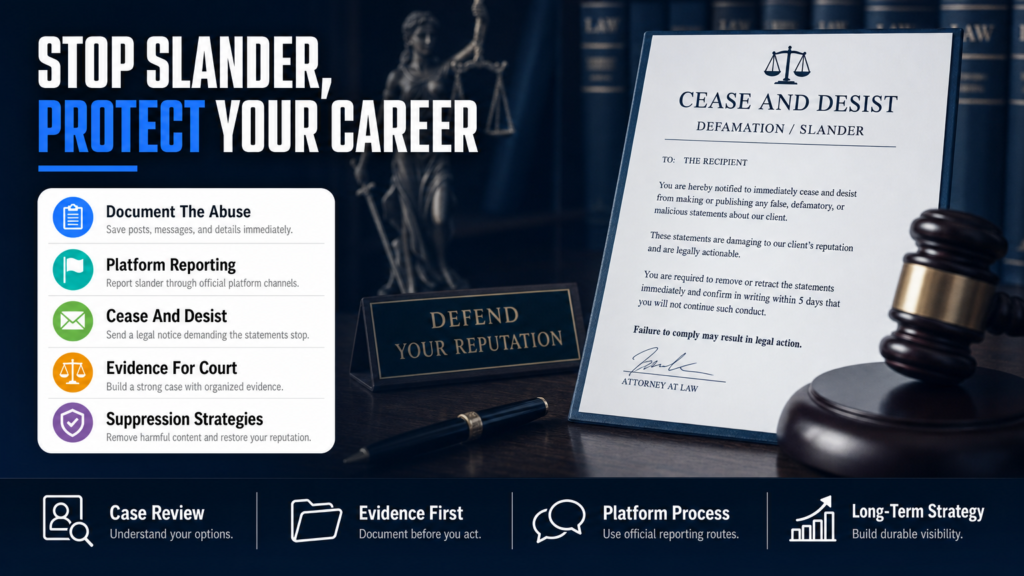
Stopping slander usually combines direct requests, platform enforcement, reputational countermeasures, and legal pressure. The fastest non‑litigious route is a measured combination: document, request retraction, use the platform’s reporting pathway, and escalate with a cease‑and‑desist letter if needed.
When a post or broadcast threatens your professional life you may also need coordinated public correction or targeted SEO steps. For an example of how a single post can ripple across search and hiring decisions, see The Screenshot Effect: How One Post Can Ruin a Career.
- Step 1 — Calm outreach: send a short, factual request (via email/text) asking the person to stop and delete any posts.
- Step 2 — Platform reporting: follow each platform’s defamation/harassment flow and submit evidence.
- Step 3 — Escalate with a cease‑and‑desist if outreach fails; keep copies of every correspondence.
- Step 4 — If public harm continues, consult counsel about civil remedies and document all losses.
- Ask the speaker to stop and to correct the record in the same forum (prefer written confirmation).
- File platform complaints citing policy violations (harassment, impersonation, false statements).
- Use a cease‑and‑desist letter to create a formal record and to demand retraction or correction.
- Consider reputation suppression (SEO, authoritative positive content) if removal is denied or impossible.
Using a cease‑and‑desist properly
A cease‑and‑desist letter is a legal escalation, not an automatic takedown tool. It can succeed when the speaker or publisher prefers to avoid litigation. Drafting matters: letters that threaten frivolous suits or demand removal of truthful statements can backfire.
We recommend a lawyer draft or review formal letters. If you use a template, keep the tone factual—state the false statements, cite evidence, and request retraction or removal within a reasonable timeframe.
- Include exact quotes, dates, and locations of the statements.
- State the harm and the specific corrective action you want.
- Avoid inflammatory language or threats of harassment—be professional.
Platform enforcement: where to start
Different platforms have different processes and thresholds. YouTube and Facebook have reporting flows for harassment and defamation; LinkedIn and employer platforms may take impersonation or false professional claims more seriously.
If a post is viral, use the platform’s escalation tools (appeal, business report, or press office contact) and keep records of each submission.
- Report violating content via in‑platform tools first.
- If necessary, use a platform’s appeals or business escalation path.
- Preserve proof of reporting and the platform’s responses.
What proof is needed to sue for slander?
To bring a successful slander claim you must gather evidence proving falsity, publication, fault, and damages. The exact proof depends on whether you’re a private person or public figure and on state law. Courts expect clear, contemporaneous documentation.
No single item guarantees success; a consistent evidentiary record improves your position. For legal routes and how courts treat online accusations, see Legal Options for Removing False Online Accusations.
- Step 1 — Collect and authenticate original content (metadata, URL, archived copies).
- Step 2 — Obtain witness statements or affidavits from those who heard the slander.
- Step 3 — Gather contemporaneous business records showing measurable losses.
- Step 4 — Talk to a lawyer about subpoenas or discovery to compel additional evidence if needed.
- Direct evidence of the false statement (recordings, posts, transcripts).
- Evidence the statement was communicated to third parties (screenshots, witness declarations).
- Proof the statement is false (contracts, medical records, timelines, objective documents).
- Documentation of harm (lost clients, terminated contracts, canceled bookings, expert economic reports).
- Any evidence of malicious intent if you’re a public figure (deliberate lies, reckless reporting).
How courts treat audio and witness testimony
Audio recordings and sworn witness statements are strong, but admissibility depends on lawful recording practices and authentication. Some states require two‑party consent for recordings; check local law before relying on or creating recordings.
A lawyer can help determine which evidence will be admissible and how to preserve chain of custody.
- Check state recording statutes before making or using recordings.
- Use notarized witness statements when possible.
- Keep a clear chain of custody for files and exports.
When removal is not available: mitigation and suppression
Removal is sometimes impossible: truthful statements, third‑party outlets refusing to retract, or opinion pieces protected by the First Amendment. When takedown is unavailable, the practical path is mitigation—correction, reputation management, and pushing negative results lower in search through positive, authoritative content.
We develop SEO reputation strategies intended to improve the visibility of relevant and credible information. Search results may change because algorithms, competitors, publishers, and user behavior are outside our control.
- Step 1 — Ask for correction or right‑of‑reply from the publisher.
- Step 2 — Publish and promote factual, authoritative content (bios, articles, speaking engagements).
- Step 3 — Use structured data and YouTube/LinkedIn signals to rank positive items.
- Step 4 — Set ongoing monitoring and fast‑response processes for future incidents.
- Request corrections or a right‑of‑reply from the publisher if they refuse removal.
- Publish authoritative counterstatements: press releases, LinkedIn posts, professional profiles, and guest articles on reputable sites.
- Use targeted SEO: build content around your name plus professional keywords to displace negative results.
- Monitor and alert: continuous surveillance catches recurrences and new shares.
When and how to use reputation suppression
Suppression replaces the result set, rather than removing content. It’s implemented through focused content creation and link building to authoritative properties—LinkedIn, government directories, professional associations, and reputable press placements.
Search-engine and platform behavior varies; an estimated timeline can be provided after an individual assessment, and some cases may begin to show changes within a general estimated range, but no universal timeframe applies.
- Priority: authoritative, unique content that answers common queries.
- Use diversified platforms to avoid single-point failures.
- Monitor SERPs and adapt content strategy regularly.
Emergency steps when slander creates immediate harm
If a false spoken allegation creates imminent safety risks, job termination, or fraud threats, act fast: notify your employer or clients with facts, secure legal counsel, and consider contacting law enforcement if threats, stalking, or extortion are involved.
For professional licensing or employer threats, give your licensing body or HR a concise factual packet. Keep communications factual—avoid emotional public recriminations that can complicate later legal steps.
- Step 1 — Immediate safety check: threats and doxxing may be crimes—call police if you are in danger.
- Step 2 — Notify stakeholders (employer, major clients) with a short factual memo and evidence.
- Step 3 — Engage counsel for rapid civil or criminal escalation if the conduct meets statutory thresholds.
- If you face threats or harassment, call local law enforcement—criminal harassment and extortion are separate from defamation.
- Brief your employer or key clients with documented facts to prevent premature actions.
- Preserve all communications and set up a secure, separate channel for urgent notifications.
Distinguishing defamation from criminal conduct
Slander and libel are civil claims; the police usually do not intervene just because someone lied. But if the speech includes threats, stalking, or coordinated harassment, those can be criminal matters. A legal review can identify whether both civil and criminal actions are options.
- False allegations alone are usually civil; threats and extortion are criminal.
- Document each incident and share it with counsel to determine best pathways.
Working with lawyers and platforms: what to expect
A lawyer can evaluate whether a defamation claim is likely to succeed and draft demand letters, pursue discovery, or file suit. Legal options depend on the evidence, applicable law, jurisdiction, and public-interest considerations. The content may warrant legal review but consult counsel before making public accusations.
Platforms review reports under their own community standards and terms of service. We use the official reporting and review processes made available by platforms and coordinate with counsel when matters require legal analysis.
- Step 1 — Get a legal assessment to determine if your claim meets the defamation elements in your state.
- Step 2 — Use counsel to draft letters and prepare subpoenas if you need identifying information from anonymous posters.
- Step 3 — Coordinate legal steps with platform reports to avoid conflicting strategies.
- Initial legal consult: case assessment, strength of evidence, and likely damages.
- Possible remedies: cease‑and‑desist, retraction demands, civil suit for damages, injunctive relief in narrow cases.
- Platform options: formal report, appeals, and business escalations; platform decisions remain under the platform’s control.
When to pursue subpoenas or discovery
If an anonymous poster is the source, a lawyer can seek a subpoena to the platform or ISP for identifying information. Platforms resist these requests without a court order, and the success depends on jurisdiction and platform policy.
Subpoenas and discovery are powerful but time‑consuming and may lead to counterclaims; they should be used when the expected benefit outweighs cost and time.
- Subpoenas require court procedure and legal counsel.
- Platforms may require a court order and have their own thresholds for compliance.
- We coordinate with qualified legal professionals when a matter requires legal analysis.
Coordination with PR and reputation services
Legal action and public communications must be coordinated. A lawyer may advise quiet letters while reputation teams prepare corrected messaging and SEO assets. Keep legal counsel in the loop to avoid statements that could harm litigation or create new defenses for the speaker.
If you need a deeper look at how a viral allegation can threaten your career, read When a Viral Post Threatens Your Professional Life.
- Align public statements with legal strategy.
- Avoid reactive social posts that could be used against you in court.
- Use controlled, factual messaging for stakeholders.
Removal vs Suppression: Which Path Fits Your Case?
Use this quick comparison to decide whether to pursue a takedown or focus on suppression and correction.
| Removal | Suppression / Mitigation |
|---|---|
| Goal | Bury or overshadow negative content |
| Typical route | Build authoritative positive content and links |
| When available | When publisher/platform agrees or law requires it |
| Timeframe | Can be fast if publisher complies; otherwise uncertain |
| Cost drivers | Content creation, PR placements, SEO work |
| Legal burden | Lower — focuses on visibility, not court proof |
Hypothetical: The Doxxed Doctor and the Clinic Offerings
Scenario: A mid‑level physician (anonymous for this example) learns that a local forum post falsely accuses them of malpractice. The post spread via private Facebook groups and a single blog. The physician lost one referral and received hostile calls. Removal seems unlikely because the blog refuses to retract and claims opinion.
Process used: the physician preserved screenshots, exported the Facebook thread, collected an affidavit from a witness who heard the allegation, and documented a lost contract. They reported the Facebook posts for harassment and then engaged an attorney for a cease‑and‑desist and to assess civil options.
- Step 1 — Evidence preservation: multiple exports and notarized witness statements.
- Step 2 — Platform reports and press corrections where possible.
- Step 3 — Reputation suppression: publish authoritative biographies, medical board profile updates, and a patient‑facing statement on the clinic website.
- Step 4 — Monitoring and readiness to escalate if slander continued or more clients were lost.
- Evidence gathered: screenshots, archived blog page, witness affidavit, timeline of lost referrals.
- Platform actions: reported Facebook groups and requested removal; Facebook removed some reposts under harassment policy.
- Legal actions: lawyer sent a measured cease‑and‑desist; no immediate lawsuit was filed due to cost-risk analysis.
Common Mistakes People Make When Responding to Slander
Reacting emotionally or without a plan can make a defamation problem worse. Below are frequent errors and how to avoid them.
Mistake 1: Publicly attacking the speaker
Posting a heated rebuttal on social media often amplifies the false claim and creates additional content that can be indexed and shared. It can also be used against you later in litigation.
Instead: take a calm, documented approach and consult counsel before public rebuttals.
Mistake 2: Failing to preserve evidence
Waiting to save screenshots or relying on memory alone weakens any future legal claim. Platforms remove content, and once it’s gone you must rely on third‑party archives or witness testimony.
Instead: immediately archive, screenshot, and export conversations, and gather witness contact details.
Mistake 3: Demanding takedown of truthful content
Trying to remove honest criticism or truthful public records wastes time and can create a Streisand effect. Courts and platforms protect opinions and truthful reporting.
Instead: focus on corrections, context, and suppression strategies when content is truthful but unfairly damaging.
Mistake 4: Using threats or illegal tactics
Hiring people to hack, doxx, or harass the speaker is illegal and will escalate your legal exposure. False takedown threats or fabricated evidence are also dangerous.
Instead: pursue lawful remedies and coordinate with counsel.
Mistake 5: Waiting too long to involve counsel
Delaying legal advice can let evidence disappear, witnesses forget details, or reputational harm widen. Early counsel can advise on quick subpoenas, preservation letters, and safe public messaging.
Instead: get a short legal consult early to shape evidence collection and communications.
Best Practices For Legally Stopping Slander And Limiting Harm
Use these durable practices as a checklist; they balance legal protection, platform strategy, and reputation work.
Practice 1: Preserve and timestamp everything
Start with multiple copies of screenshots, recordings, and exports. Use reputable archiving services and store files in multiple locations. If possible, notarize critical evidence or obtain a sworn witness statement.
- Archive web pages and save original media files.
- Collect witness emails that state when they heard the statement.
Practice 2: Use measured communication
When contacting the speaker, platform, employer, or clients, use calm, factual statements. Avoid threats or emotional public posts. A short factual email is often the most effective first step.
- Request retraction or correction in the same forum where the statement appeared.
- Keep correspondence professional and saved in your evidence file.
Practice 3: Leverage platform policy before litigation
Most platforms have harassment, impersonation, and defamation pathways. Use those tools first while documenting all interactions; platform decisions can support a later legal claim.
We use the official reporting and review processes made available by platforms.
- Follow platform reporting precisely and keep copies of confirmations.
- Escalate using appeals or business/escalation contacts if available.
Practice 4: Combine legal and reputational responses
Parallel actions often work best: legal letters to create consequences, plus SEO and PR to correct public perception. Coordinate counsel with reputation teams to avoid conflicting strategies.
- Align public statements with legal counsel.
- Publish authoritative content to reduce negative visibility.
Practice 5: Monitor continuously
Set up real‑time alerts for your name, company, and key phrases. Quick detection limits spread and gives you more options.
We recommend reputation monitoring services for professionals at risk of recurrent attacks.
- Use Google Alerts, platform mentions, and paid monitoring tools for critical coverage.
- Review alerts daily in an active incident; shift to weekly once the issue stabilizes.
Expert Tips
- Start preserving evidence in the first 24 hours—digital content can be removed or changed quickly.
- Avoid public emotional responses; they amplify the claim and produce more searchable content.
- Get a short legal consult early—many attorneys offer limited-scope engagement to evaluate viability.
- Use notarized witness statements to strengthen claims when recordings are unavailable.
- If a platform won’t remove content, ask for a correction or right-of-reply from the publisher.
- Track measurable harm (lost clients, canceled contracts) before you file a civil claim.
- Consider factual, third‑party validations (professional board pages, published works) to push negative results lower in search.
- Coordinate PR and legal moves so public messaging doesn’t undermine litigation strategy.
Conclusion
When false spoken claims or viral accusations threaten your job or business, the right response is legal plus practical: stop the spread, preserve proof, use platform rules, and escalate with counsel when the evidence and harm justify it. There is no universal quick fix; outcomes depend on the content, the forum, the evidence, and applicable law.
If removal is unavailable, build a robust mitigation plan—authoritative content, corrections, and continuous monitoring—to protect your career and income. We evaluate whether the content may qualify for removal or review and pursue the legal, technical, platform-based, and reputational options available, coordinating with qualified attorneys as needed.
Why Businesses Choose Your Reputation Agency
Managing your reputation takes more than monitoring reviews or publishing the occasional blog post. It takes a strategy built around your situation, your industry, and what is actually showing up in search.
Your Reputation Agency works with businesses, executives, healthcare professionals, attorneys and growing brands. Our services include:
- Remove or suppress negative search results and news articles from Google
- Review removal and remediation (Google, Yelp, Facebook, Trustpilot, industry sites)
- Data broker and people-search opt-outs to remove personal information
- Mugshot and arrest-record removal or suppression
- Takedowns of defamatory, false, or malicious posts (social, blogs, forums)
- Online crisis management and rapid-response reputation repair
- Impersonation and fake account removal on social platforms
- Reputation monitoring, alerts, and ongoing surveillance
- First-page SEO and suppression strategies to bury negative content
- Digital security audits and privacy hardening to prevent future exposure
Frequently Asked Questions
1. What can I do legally if someone is spreading lies about me?
Start by preserving evidence and documenting who heard the statements. Use platform reporting tools for posts that violate terms, send a measured cease‑and‑desist if appropriate, and consult an attorney if the statements cause measurable harm. Each case depends on the medium, jurisdiction, and facts.
2. What legally qualifies as slander?
Slander refers to false, factual spoken statements communicated to third parties that harm reputation. To qualify as slander you typically need falsity, publication, fault (negligence or malice), and damages. Opinions and non‑factual hyperbole are usually not slander.
3. How do you get someone to stop slandering you?
Contain the spread by documenting evidence, requesting deletion or correction, reporting to platforms, and escalating with a cease‑and‑desist letter or legal counsel when necessary. Combining these steps with reputation mitigation (corrections and suppression) often stops further damage.
4. What proof is needed to sue for slander?
Courts expect proof of the false statement, publication to a third party, evidence it’s false, fault (negligence or actual malice), and damages. Useful items include recordings, screenshots, witness affidavits, and business records showing lost income.
5. Can I press criminal charges for false accusations?
Most false accusations are civil matters (defamation). Criminal charges are appropriate in limited situations—threats, extortion, stalking, or specific state offenses. Contact law enforcement if you face direct threats or criminal conduct, and consult counsel for civil options.
6. Should I send a cease‑and‑desist letter myself?
You can send a short factual request, but a lawyer’s letter often carries more weight and reduces risk of procedural mistakes. Avoid threatening language or demands to remove truthful content. If cost is a concern, consider a limited-scope attorney consult to draft the letter.
7. How long does a slander claim take to resolve?
Timelines vary widely. Platform actions can be days to weeks; civil litigation can take months or years. Timing depends on jurisdiction, evidence, legal complexity, and platform behavior. An estimated timeline can be provided after a case assessment.
8. What if the publisher refuses to remove the false statement?
If removal is refused, ask for correction or a right‑of‑reply, build authoritative countercontent to suppress the result, and consult counsel about subpoenas or civil action if the damages justify it. We pursue the legal, technical, platform-based, and reputational options available.
9. Can reputation management fix damage caused by slander?
Reputation management can help mitigate harm by publishing authoritative content, correcting context, and improving search results over time. We develop SEO reputation strategies intended to improve visibility of credible information; results vary according to content strength and platform behavior.
This content provides general information and does not constitute legal advice. The available options and likely outcomes depend on the facts, evidence, platform policies, applicable law, jurisdiction, and public-interest considerations.
Past examples do not guarantee future results. Removal, correction, deindexing, and search-position changes depend on third parties and circumstances outside Your Reputation Agency’s control.