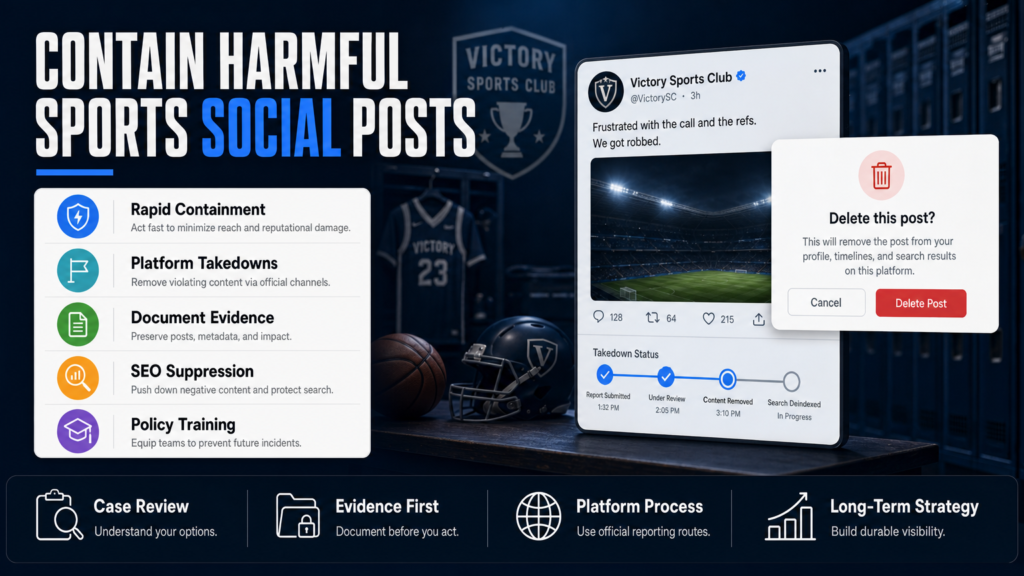
You just saw a damaging post on a team feed or an athlete’s account and you need to know what will actually help. This is the moment organizations and athletes most often lose control — panic decisions, partial deletions, or public reactions that make the post spread.
This article walks through evaluating and pursuing deleting social media posts from sport organization and athlete accounts: what platforms will consider for removal, how to document and preserve evidence, the options when removal isn’t available, and the coordinated steps teams should take to limit damage.
We focus on practical, platform-specific tactics (Twitter/X, Facebook/Instagram, TikTok, YouTube, Reddit), legal and PR coordination, and durable remediation like SEO suppression and policy work. Where outcomes depend on platform rules, jurisdiction, or evidence, we call that out plainly.
Read this to get an immediate containment checklist, step-by-step takedown paths, a clear comparison of DIY vs agency help, and the exact documentation most platforms and lawyers will need.
Table of Contents
- How social posts create pressure and reputational risk for athletes and teams
- What athletes and orgs commonly do wrong when a post goes viral
- Platform takedowns: what you can expect from each major platform
- When posts are false or defamatory: documentation and legal coordination
- When removal isn’t available: suppression, correction, and long-term strategies
- Training and policy: how to prevent posts from becoming crises
- Practical checklist: who to call and what to do in the first 48 hours
- DIY vs Agency Support: Which route fits your situation?
- Hypothetical scenario: High school star’s account reposts an offensive meme
- Common mistakes organizations make and how to avoid them
- Best practices for handling and preventing social media crises
- Expert Tips
- Conclusion
- Why Businesses Choose Your Reputation Agency
- Frequently Asked Questions
How social posts create pressure and reputational risk for athletes and teams
Athletes and sports organizations occupy a public stage: posts reach fans, recruiters, sponsors, and journalists quickly. A single image, DM screenshot, or out-of-context clip can be amplified beyond the original audience.
Not every harmful post is the same: mistakes, insult-laden replies, privacy breaches, impersonation, and false allegations each require different responses. Distinguish whether the content is a privacy violation, harassment, impersonation, false claim, or a legitimate opinion or critique before you decide on a takedown strategy.
Timing matters: early containment reduces resharing and screenshots. That said, platforms and publishers evaluate takedown requests on their own schedules and according to policy, so containment steps should run in parallel with official removal requests.
- Stop further sharing from team channels (pause scheduled posts).
- Archive the post with timestamped screenshots, URL captures, and video downloads where possible.
- Assign a single point of contact to coordinate takedowns, communications, and legal review.
- High-profile accounts often amplify secondary harm — teammates, rivals, or fans will reshare.
- Screenshots, downloads, and reposts mean deletion on the original account rarely erases all traces.
- Sponsors and compliance officers will demand documented steps; keep a clear chain-of-action.
What athletes and orgs commonly do wrong when a post goes viral
Teams and athletes often react emotionally: public apologies typed without counsel, deleting only from one account while leaving linked accounts live, or demanding mass removal without documentation.
Each of these mistakes can magnify the issue: apologies that don’t acknowledge facts can be used out of context, partial deletions create confusion, and unsupported legal threats waste time.
- Pause public responses until a single authorized spokesperson and counsel review the facts.
- Capture every public instance of the post with date/time and URL.
- Identify whether the content breaches platform policy, contains defamation, or violates privacy.
- Reacting publicly before facts are verified
- Not preserving evidence or metadata
- Relying solely on platform reporting without escalation
- Engaging in retaliatory or deceptive tactics
Step-by-step immediate containment
1) Pause all scheduled social posts and set account posting to administrators only.
2) Download or screenshot the offending content and the full thread or comment chain; record the account handle and the post URL.
3) Notify in-house counsel or your reputation contact and prepare an internal holding statement that does not admit fault.
Platform takedowns: what you can expect from each major platform
Each platform has distinct policies, evidence needs, and escalation paths. You should open reporting requests on the relevant platform(s) immediately, while also collecting bedrock evidence a reviewer will want.
For Facebook and Instagram, use the official reporting flow and consider documentation for copyrighted content, privacy violations, or harassment. For tactical guidance on these platforms see Content Removal from Facebook and Instagram – Smart Guide.
For Twitter/X, TikTok, YouTube, Reddit and other platforms, follow the platform reporting tools and be prepared to escalate to the platform’s appeals or business support paths if the post affects a verified account or ongoing competition.
- 1) File platform reports with links, screenshots, and a concise, factual explanation.
- 2) Use business/brand support channels if available (Twitter/X Verified contacts, Facebook Business Support).
- 3) Preserve the original content and any subsequent reposts; do not rely on the platform’s action as your only evidence.
- Facebook/Instagram: privacy, harassment, impersonation, and intellectual property claims are common grounds.
- Twitter/X: impersonation and policy-violating media may be removed; evidence of coordinated harassment helps.
- TikTok: community guideline violations and impersonation are considered; copyright claims require registration details.
- YouTube: copyright and defamation paths differ; removal can be slower for newsworthy public-interest content.
- Reddit: subreddit moderators control much content; reports to admins are needed for cross-subreddit issues.
Escalation for verified accounts and organizations
If the post targets a verified athlete or a team account, use platform business support and provide verification (e.g., official roster page, government ID for the athlete if requested in secure channels). Platforms sometimes offer expedited review for verified harm, but this varies and is never guaranteed.
- Prepare verification documents before escalation (roster links, official site pages).
- Do not post private documents publicly; use secure upload methods provided by the platform.
When posts are false or defamatory: documentation and legal coordination
False allegations present a different set of options from insults or offensive language. A platform may remove false statements only if they violate policy or if you can show clear evidence; in many cases, legal options may be required.
Start with careful documentation: contemporaneous screenshots with timestamps, witness statements, links to original posts, and records of who shared the content. This evidentiary folder is what platforms and counsel will request.
For guidance on procedures to request removal of demonstrably false claims on Facebook or Instagram, see How to Remove False Posts from Facebook or Instagram.
- 1) Preserve evidence and note timestamps, URLs, and accounts that reshared the content.
- 2) Seek a legal assessment to determine whether a cease-and-desist, DMCA (if applicable), or court order is appropriate.
- 3) Coordinate public messaging with counsel to avoid admissions or statements that could complicate legal options.
- False factual claims may support platform flags if they violate community rules or involve fabricated evidence.
- Defamation claims require a legal analysis; evidence and jurisdiction matter.
- Platforms rarely adjudicate complex factual disputes without clear policy breaches or legal process.
How lawyers and platform processes interact
A lawyer can send targeted legal demands to publishers and platforms. Platforms themselves respond to valid court orders and certain legal process, but they will not act simply on the basis of complaints without satisfying their policy or legal thresholds.
Your Reputation Agency coordinates with qualified attorneys when matters require legal analysis, but we do not provide legal representation.
When removal isn’t available: suppression, correction, and long-term strategies
Removal is not always possible. Platforms may decline requests, publishers may refuse, or the content may be lawful and public. When that happens, suppression and correction become the immediate tools.
Suppression means pushing down negative results with authoritative, relevant content. This approach relies on SEO, owned channels, and earned media to displace harmful items on search engine first pages. We develop SEO reputation strategies intended to improve the visibility of relevant and credible information, but results vary and are not guaranteed.
The ‘screenshot problem’ means deleted posts often remain visible elsewhere. For why deletion alone rarely solves the issue, see The Screenshot Effect: Why Deleted Posts Still Hurt.
- 1) Audit first-page search results for the athlete or organization and rank which items must be addressed first.
- 2) Publish and promote authoritative pages (official roster pages, verified LinkedIn, press releases) to outrank negatives.
- 3) Use link-building, social posting, and content syndication to increase the visibility of positive or corrective content.
- Create and optimize authoritative content (team statement pages, verified profiles, structured bios).
- Request corrections or context from the original publisher when accuracy issues exist.
- Use takedown-by-reputation routes (contact site owners, abuse desks, webhost complaints) when policy fits.
When to pursue corrections or retractions
If a publisher has repeated demonstrably false information, request a correction with clear, referenced evidence. Many local outlets and smaller blogs will issue corrections when presented with documentation; major publishers are less predictable.
Corrections and retractions can help search visibility because they alter the underlying source rather than relying solely on suppression tactics.
Training and policy: how to prevent posts from becoming crises
Prevention reduces the frequency and severity of incidents. Invest in a clear social media policy, role-based access controls, and mandatory training for athletes, coaches, and staff.
A good policy covers who can post on behalf of the organization, approval workflows for sponsored content, use of personal accounts during games, and steps for preserving evidence when incidents occur.
Include incident drills — role-play common scenarios (leaked DMs, impersonation, offensive posts) and rehearse the containment checklist so teams can act calmly.
- 1) Draft a short, clear social media policy tailored to your organization’s competitive and regulatory environment.
- 2) Run semi-annual training that includes platform-specific examples and escalation paths.
- 3) Establish an incident response folder with ready-to-use evidence-capture templates and internal contacts.
- Designate official account handlers and reduce the number of people with posting permissions.
- Require social-media training before players join first teams or travel internationally.
- Use two-factor authentication and periodic access audits to reduce the risk of account compromise.
Account security basics
Enable two-factor authentication on all official accounts, remove unused admin access, and require password managers for shared credentials. Compromised accounts are a leading cause of high-profile incidents.
Practical checklist: who to call and what to do in the first 48 hours
First 48 hours matters for containment and evidence. Use this checklist to structure immediate action and assign responsibilities.
Assign a single incident lead who coordinates takedowns, legal review, communications, and sponsor notifications. Keep conversations on secure channels and record decisions.
- Hour 0–2: Contain (pause posts, capture evidence, assign lead).
- Hour 2–24: Report (file platform takedowns, notify legal/team counsel, inform sponsors).
- Day 2–7: Escalate and plan (pursue publisher contact, plan SEO suppression, coordinate PR).
- Pause scheduled content and restrict posting rights.
- Capture screenshots, post URLs, and account handles.
- File platform reports and gather escalation contact info.
- Notify sponsors and compliance teams with a factual status update.
- Prepare a holding statement and await counsel’s review before public comment.
Who to include in the response team
Include the social media manager, legal counsel (internal or external), media relations lead, a technical contact for account security, and one executive sponsor to approve statements.
DIY vs Agency Support: Which route fits your situation?
A quick comparison to decide whether to handle the issue in-house or bring in outside reputation help.
| DIY | Agency Support |
|---|---|
| Cost: lower immediate spend | Higher upfront cost; scalable support |
| Speed: depends on internal capacity | Faster triage and 24/7 escalation paths |
| Expertise: limited to staff knowledge | Specialized platform, legal, and SEO experience |
| Escalation: reliant on public reporting tools | Adds formal escalation, publisher outreach, and documentation support |
| Long-term: requires in-house SEO and PR work | Offers sustained suppression campaigns and monitoring |
| Confidentiality: internal control but limited resources | Contractual confidentiality and controlled workflows |
Hypothetical scenario: High school star’s account reposts an offensive meme
Situation: A high school athlete’s personal account reposts an offensive meme that quickly appears on local team pages and a community Facebook group, prompting sponsor concern and local media coverage.
Approach: The organization follows the containment checklist — pauses team posts, captures evidence, notifies the athlete’s parents and legal counsel, and files platform reports. They do not rush a public apology until facts are reviewed.
Outcome (hypothetical process): Platform review removed one infringing repost under harassment policy within several days, a local blog removed its copy after a documented correction request, and the team launched a corrective communications post and mandatory training. SEO suppression work reduced the prominence of the incident in search results over months.
- 1) Contain and document (0–24 hours): secure accounts, capture evidence.
- 2) Report and escalate (24–72 hours): file platform reports, contact publishers.
- 3) Coordinate communications and remediation (1–4 weeks): prepare statements, begin SEO suppression and training.
- Immediate: Capture screenshots and thread history; restrict team account access.
- Short term: File platform reports and request publisher correction with evidence.
- Medium term: Publish team statement and targeted content to push harmful items down.
Common mistakes organizations make and how to avoid them
These mistakes recur because organizations focus on optics rather than process. Correcting process prevents repeat incidents.
1. Deleting only the original post
Problem: Deleting the original post can create a false sense of resolution while screenshots and reposts continue to circulate.
Fix: Preserve evidence first, then request removal and pursue suppression; treat deletion as one piece of a larger response.
2. Speaking publicly before verifying facts
Problem: Hastily worded apologies or denials often contain inaccuracies that opponents amplify.
Fix: Use a short holding statement and convene legal and communications leads before any substantive public comment.
3. Failing to secure accounts
Problem: Compromised accounts and reused passwords make a single incident into a prolonged breach.
Fix: Enforce two-factor authentication, regular access reviews, and limit admin numbers.
4. Overreliance on platform reporting
Problem: Platforms may decline removal for lawful content; relying only on reports delays other remedies.
Fix: Parallelize efforts — pursue publisher contact, legal analysis, and SEO suppression while reporting.
5. Retaliatory or deceptive responses
Problem: Attempts to manipulate platform systems, impersonate others, or coordinate fake takedowns expose the organization to penalties.
Fix: Use transparent, documented approaches and escalate through official and legal channels when necessary.
Best practices for handling and preventing social media crises
Implementing durable processes reduces both the chance of incidents and their long-term impact.
Rapid assessment and containment
Assign a single incident lead, capture evidence immediately, and pause scheduled posts. Early containment reduces downstream amplification and helps legal and platform reviewers evaluate the matter with complete records.
- Use timestamped screenshots and record URLs and account handles.
- Keep a log of every action taken and by whom.
Document everything for platforms and counsel
Preserve original content, any reposts, and witness statements. This evidence is essential for platform appeals and legal assessment.
- Save HTML-source or use a web-archive service for important pages.
- Store evidence in a secure folder with restricted access.
Use official platform and publisher channels first
Begin with the platform’s reporting tools; supplement with publisher outreach and business support. For Facebook and Instagram, consult specific removal guidance as part of your process: Content Removal from Facebook and Instagram – Smart Guide.
Plan for long-term remediation when removal isn’t an option
Develop an SEO suppression plan, correct inaccuracies with publishers, and create authoritative content that addresses the issue directly and transparently when appropriate.
- Prioritize first-page targets for suppression.
- Use trusted third-party outlets for corrective coverage when feasible.
Train, restrict access, and test your response
Require recurring training, limit who can post on behalf of the organization, and run incident-response drills so the team can execute calmly under pressure.
- Quarterly access audits
- Semi-annual incident simulations
Expert Tips
- Always capture the full thread or comment context; isolated screenshots lose critical context.
- Use an incident log with times and names — platforms and lawyers expect documented chains of action.
- If a post involves private data, prioritize privacy flags and webhost complaints alongside platform reports.
- Limit public statements to a holding line until counsel reviews the facts.
- Remove internal admin rights from compromised devices and rotate passwords immediately.
- When a publisher refuses correction, a documented correction request strengthens later legal options.
- Consider a short, factual Q&A page on your official site to address recurring misinformation and provide a definitive source.
- Monitor search results daily for the first two weeks after an incident; early suppression moves are most effective.
Conclusion
A damaging social post does not end a season or career by default, but mishandled responses can make the impact far worse. Focus first on calm containment, accurate documentation, and prioritized escalation — then choose a remediation path (removal requests, publisher correction, or suppression) appropriate to the situation.
If removal is available, pursue it through platform rules and legal channels when necessary; when it isn’t available, invest in authoritative correction and SEO-driven suppression. Preparedness — a tested policy, locked accounts, and a pre-defined incident team — is the single most effective way to reduce future incidents.
Why Businesses Choose Your Reputation Agency
Managing your reputation takes more than monitoring reviews or publishing the occasional blog post. It takes a strategy built around your situation, your industry, and what is actually showing up in search.
Your Reputation Agency works with businesses, executives, healthcare professionals, attorneys and growing brands. Our services include:
- Remove or suppress negative search results and news articles from Google
- Review removal and remediation (Google, Yelp, Facebook, Trustpilot, industry sites)
- Data broker and people-search opt-outs to remove personal information
- Mugshot and arrest-record removal or suppression
- Takedowns of defamatory, false, or malicious posts (social, blogs, forums)
- Online crisis management and rapid-response reputation repair
- Impersonation and fake account removal on social platforms
- Reputation monitoring, alerts, and ongoing surveillance
- First-page SEO and suppression strategies to bury negative content
- Digital security audits and privacy hardening to prevent future exposure
Frequently Asked Questions
1. Can I force a platform to delete a post about my athlete or team?
Platforms act according to their policies and legal process. We evaluate whether the content may qualify for removal or review and pursue the platform options available, but platform decisions remain under the platform’s control.
2. What counts as enough evidence to get a false post removed?
Evidence that helps a platform or publisher includes timestamped screenshots, the original post URL, proof the content is fabricated (documents, records), and clear identification of the poster. A qualified attorney can determine whether a legal claim may be available in complex cases.
3. If I delete the post from the original account, will it stop spreading?
Deleting the original can help but does not eliminate copies or screenshots. The ‘Screenshot Effect’ means deleted posts often remain; suppression and publisher outreach are usually required to reduce visibility.
4. Should the athlete apologize publicly right away?
Not usually. Rapid apologies without fact-checking can worsen the situation or create legal complications. Use a brief holding statement and consult communications and legal leads before substantive public comments.
5. How long does suppression or SEO remediation take?
Timing depends on the strength of the negative content, the authority of competing sources, and search-engine behavior. Some changes may appear in weeks; durable improvement often requires months of coordinated content and link-building, and no universal timeframe applies.
6. When should we involve a lawyer?
Involve legal counsel when you face alleged defamation, privacy breaches, impersonation, or when a publisher refuses correction and the matter risks legal or regulatory exposure. The content may warrant legal review, but legal outcomes depend on jurisdiction, evidence, and other factors.
7. Is it better to handle this internally or hire an agency?
If you have experienced staff, verified escalation contacts, and time to manage evidence and outreach, DIY can be effective. Agencies provide faster triage, documented escalation paths, specialized platform expertise, and sustained suppression campaigns — choose based on urgency and internal capacity.
8. What if the post is on a forum or subreddit moderated by volunteers?
Contact moderators first with evidence and policy citations; if moderators do not act and the post violates platform policy, escalate to platform admins. In parallel, document the post and pursue suppression since volunteer moderation is variable.
9. Can we require athletes to delete personal accounts’ posts?
Organizations can have policies requiring certain conduct and may include disciplinary processes for violations. However, enforcement must respect contractual and employment considerations and should be coordinated with HR and legal counsel.
This content provides general information and does not constitute legal advice. The available options and likely outcomes depend on the facts, evidence, platform policies, applicable law, jurisdiction, and public-interest considerations.
Past examples do not guarantee future results. Removal, correction, deindexing, and search-position changes depend on third parties and circumstances outside Your Reputation Agency’s control.