In today’s digital world, your reputation is often your first impression. Before someone contacts your business, schedules a consultation, or makes a purchase, they usually search your name or company online. What they find can significantly influence their decision.
Understanding why reputation management is important has become essential for business owners, executives, entrepreneurs, doctors, lawyers, and personal brands. Your online reputation directly affects trust, credibility, customer acquisition, and even long-term revenue.
A single negative review, misleading article, or outdated search result can shape public perception for years. On the other hand, a well-managed online presence builds confidence and positions your business as a trusted authority.
This guide explains why reputation management matters, how it protects your digital presence, and the practical steps you can take to build lasting trust in today’s search-driven world.
Table of Contents
- What Is Reputation Management?
- Why Reputation Management Is Important
- How Online Reputation Affects Business Growth
- The Cost of Ignoring Your Reputation
- Who Needs Reputation Management?
- Step-by-Step Guide to Building a Strong Reputation
- Real Business Example
- Common Reputation Management Mistakes
- Best Practices for Long-Term Success
- Expert Tips from Reputation Professionals
- Frequently Asked Questions
- Final Thoughts
What Is Reputation Management?
Reputation management is the process of monitoring, protecting, improving, and maintaining how people perceive you or your business online. It involves managing search results, customer reviews, media mentions, social media conversations, and other digital content that influences public opinion.
Modern reputation management goes far beyond responding to negative reviews. It combines search engine optimization (SEO), content marketing, digital public relations, review management, brand monitoring, and strategic communication to create a trustworthy online presence.
For businesses, the goal is simple: ensure that when someone searches your brand, they find accurate, credible, and positive information that reflects your expertise and values.
Why Reputation Management Is Important in Today’s Digital World
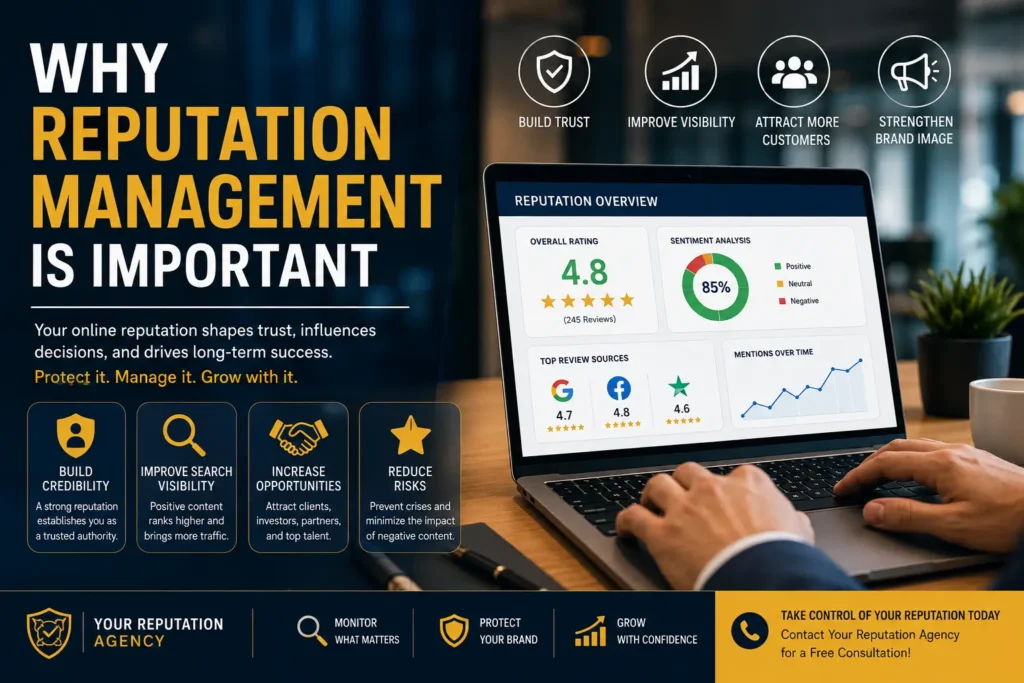
Every online interaction contributes to your reputation. Whether it’s a Google review, a news article, a LinkedIn profile, or an AI-generated summary, people form opinions before they ever contact you.
This is exactly why reputation management is important.
A strong online reputation helps you:
- Build customer trust before the first conversation
- Increase conversion rates and qualified leads
- Improve visibility in Google Search and AI-powered search experiences
- Strengthen your professional credibility
- Reduce the impact of negative content
- Attract investors, partners, and top talent
- Support long-term business growth
Businesses with a positive digital presence are more likely to earn trust because people naturally choose brands they feel confident about.
How Search Engines and AI Have Changed Reputation Management
Search behavior has evolved dramatically over the last few years.
Today, people don’t rely only on traditional Google search results. They also use AI-powered platforms such as ChatGPT, Gemini, Microsoft Copilot, and Perplexity to research businesses before making decisions.
These systems often summarize information from trusted online sources rather than displaying only a list of links.
That means your reputation now depends on:
- Your website
- News mentions
- Business directories
- Customer reviews
- Professional profiles
- Industry publications
- Educational content
- Brand consistency across the web
Building trustworthy digital assets has become more important than ever because AI systems increasingly rely on authoritative information when generating responses.
Reputation Is More Than Reviews
Many businesses think reputation management only means responding to Google reviews.
In reality, your online reputation includes everything people discover when researching your brand.
This includes:
- Google Search results
- Google Business Profile
- Customer reviews
- News articles
- Social media profiles
- Videos
- Industry directories
- Blog content
- Press mentions
- AI-generated search summaries
Every piece of information contributes to how customers perceive your expertise and reliability.
For this reason, successful reputation management requires a comprehensive strategy rather than focusing on a single platform.
How a Strong Reputation Drives Business Growth
Your reputation influences nearly every stage of the customer journey. Before someone requests a quote, schedules a consultation, or signs a contract, they usually spend time researching your business online.
A positive reputation reduces uncertainty and increases confidence. Customers are naturally more likely to choose companies that demonstrate expertise, transparency, and consistent customer satisfaction.
Businesses with a strong online reputation often experience:
- Higher conversion rates
- Better customer retention
- More referrals
- Increased organic traffic
- Stronger brand loyalty
- Greater pricing power
- Improved investor confidence
Reputation isn’t simply about avoiding criticism—it’s about creating a competitive advantage.
The Hidden Cost of a Poor Online Reputation
Many businesses underestimate how expensive a damaged reputation can become.
Negative search results, unresolved customer complaints, misleading articles, or fake reviews can discourage potential customers before your sales team even has a chance to speak with them.
A poor reputation may lead to:
- Lost sales opportunities
- Lower search visibility
- Reduced customer trust
- Higher advertising costs
- Difficulty recruiting talented employees
- Increased customer acquisition costs
- Negative media attention
- Declining brand authority
In many cases, repairing a damaged reputation requires significantly more time and investment than protecting it proactively.
Who Needs Reputation Management?
Reputation management is no longer reserved for celebrities or multinational corporations. Anyone whose success depends on trust can benefit from managing their online reputation.
It is especially valuable for:
Business Owners
Business owners rely on trust to attract customers, secure partnerships, and build long-term growth. A positive reputation strengthens every stage of the buying process.
CEOs & Executives
Leadership reputation directly impacts investor confidence, employee trust, media perception, and corporate credibility.
Our dedicated CEO Reputation Management service helps executives protect their professional image while building long-term authority.
Doctors & Healthcare Professionals
Patients increasingly research physicians online before scheduling appointments. Reviews, search results, and educational content all influence healthcare decisions.
Lawyers & Law Firms
Legal services are built on credibility. A strong online reputation helps law firms establish trust before potential clients make contact.
Entrepreneurs & Startups
Startups often compete against established brands. Building a trusted digital reputation helps reduce uncertainty for customers, investors, and partners.
Personal Brands
Consultants, coaches, authors, speakers, influencers, and creators all benefit from maintaining a professional online presence that accurately reflects their expertise.
Step-by-Step Guide to Building a Strong Online Reputation
Strong reputations don’t happen by accident. They are built through consistent effort and strategic planning.
Step 1: Audit Your Online Presence
Search your name, company, and key executives on Google.
Review:
- Search results
- Google Business Profile
- Reviews
- News articles
- Social media profiles
- Business directories
Identify both strengths and potential risks.
Step 2: Monitor Brand Mentions
Reputation changes every day.
Monitor:
- Customer reviews
- Social mentions
- News coverage
- Industry discussions
- Search engine visibility
Early detection allows you to respond before small issues become major reputation problems.
Step 3: Create Helpful Content
One of the best ways to build authority is by consistently publishing useful, educational content.
Examples include:
- Blog articles
- Case studies
- Industry guides
- FAQs
- Videos
- Whitepapers
Helpful content demonstrates expertise while improving search visibility.
Step 4: Encourage Genuine Customer Reviews
Satisfied customers are often willing to leave reviews—they simply need to be asked.
Positive, authentic reviews help strengthen credibility across Google, Trustpilot, and other trusted platforms.
If you’re dealing with unfair or policy-violating reviews, our guide on Remove Negative Google Reviews – Legally & Effectively explains your options.
Step 5: Respond Professionally
Not every review will be positive.
Respond respectfully, acknowledge concerns, and demonstrate a willingness to help.
Professional responses often build more trust than having only perfect ratings.
Step 6: Strengthen Your Search Presence
Improve the visibility of accurate, positive information by optimizing:
- Your website
- Service pages
- Executive profiles
- Business listings
- Press coverage
- Educational resources
Businesses with stronger digital authority generally recover faster from reputation challenges.
Proactive vs. Reactive Reputation Management
| Proactive Reputation Management | Reactive Reputation Management |
|---|---|
| Builds trust before problems occur | Responds after damage has happened |
| Strengthens brand authority | Focuses on damage control |
| Improves long-term search visibility | Often requires emergency strategies |
| Encourages positive customer engagement | Addresses complaints after they appear |
| Supports sustainable business growth | Can be more costly and time-consuming |
| Reduces future reputation risks | Often begins after trust has already declined |
The most successful organizations invest in reputation management before a crisis occurs.
Learn from Real Reputation Challenges
Many businesses wait until negative search results begin affecting sales before taking action.
However, organizations that invest in proactive reputation management typically recover faster and maintain stronger customer trust.
If you’re interested in seeing how reputation recovery works in practice, read our article: What Is an Example of Online Reputation Management?
Real-World Example: Reputation Management in Action
Imagine a regional law firm that suddenly receives several one-star Google reviews from individuals who were never clients. At the same time, an outdated news article begins appearing near the top of branded search results.
Potential clients searching for the firm now see negative information before visiting the website. As inquiries decline, the firm realizes its online reputation is affecting business growth.
Instead of reacting emotionally, the firm adopts a structured reputation management strategy.
The process includes:
- Auditing its online presence
- Reporting fake or policy-violating reviews
- Publishing helpful legal resources
- Optimizing attorney profiles
- Improving local SEO
- Encouraging genuine client feedback
- Monitoring search results continuously
Over the following months, positive content becomes more visible, authentic reviews increase, and prospective clients regain confidence in the firm.
This example demonstrates that successful reputation management is rarely about a single action—it is about consistently building trust over time.
Common Reputation Management Mistakes
Many reputation issues become worse because businesses respond incorrectly.
Avoid these common mistakes.
Ignoring Negative Feedback
Ignoring reviews or customer complaints rarely makes them disappear. Prompt, professional responses demonstrate accountability and customer care.
Responding Emotionally
Public arguments with customers or critics often attract additional attention and may damage credibility further.
Always remain calm, respectful, and solution-oriented.
Buying Fake Reviews
Purchasing reviews or attempting to manipulate ratings violates the policies of many review platforms and can permanently damage customer trust.
Authenticity always wins in the long run.
Waiting Until a Crisis Happens
Many organizations only think about reputation management after negative content starts affecting sales.
Building trust before problems occur is significantly more effective than trying to repair major damage later.
Publishing Low-Quality Content
Creating large amounts of thin or repetitive content simply to improve rankings rarely produces sustainable results.
Instead, focus on publishing helpful, experience-driven content that genuinely answers customer questions.
Best Practices for Long-Term Reputation Management
The strongest online reputations are built through consistency rather than shortcuts.
Follow these best practices.
Publish Helpful Content Regularly
Educational blog posts, guides, FAQs, videos, and case studies establish expertise while supporting search visibility.
Google’s Helpful Content system rewards content created primarily for people rather than search engines.
Monitor Your Brand Consistently
Track:
- Google reviews
- Search results
- News mentions
- Social media conversations
- Industry directories
Early awareness allows faster responses to emerging issues.
Encourage Authentic Customer Reviews
Satisfied customers often become your strongest advocates.
Invite genuine feedback through ethical review requests while respecting each platform’s policies.
Keep Business Information Updated
Ensure your website, Google Business Profile, social media accounts, and business directories all display consistent information.
Accurate details strengthen trust and improve local search performance.
Invest in Professional Reputation Management
For executives, healthcare professionals, law firms, and growing businesses, working with experienced reputation specialists often produces more sustainable results than attempting to manage complex issues internally.
Our Reputation Management Services are designed to help organizations protect credibility, strengthen search visibility, and build long-term digital trust.
Expert Tips from Reputation Management Professionals
After working with businesses across multiple industries, several best practices consistently produce better outcomes.
- Monitor your reputation before problems appear.
- Build authoritative content instead of reacting only to negative mentions.
- Respond professionally to every legitimate customer concern.
- Keep executive and company profiles updated.
- Develop a long-term SEO and reputation strategy.
- Focus on trust, not just rankings.
- Measure reputation using customer sentiment as well as search visibility.
- Treat reputation management as an ongoing business investment.
Organizations that consistently follow these principles generally recover faster from setbacks and maintain stronger customer relationships.
Why Google and Industry Experts Emphasize Trust
Google has repeatedly stated that creating helpful, reliable, people-first content is one of the best ways to build long-term visibility.
Read Google’s official documentation: click here
Likewise, Search Engine Journal regularly emphasizes that brand authority, trust, and user experience play an increasingly important role in modern SEO.
These resources reinforce an important principle:
The businesses that consistently provide value and build trust are more likely to earn long-term visibility.
Conclusion
Understanding why reputation management is important is no longer optional—it’s essential for businesses operating in today’s digital environment.
Your online reputation influences customer trust, search visibility, purchasing decisions, professional opportunities, and long-term business success. Every review, article, social media mention, and search result contributes to how people perceive your brand.
The good news is that reputation can be managed proactively. By monitoring your online presence, publishing helpful content, responding professionally to feedback, and investing in long-term digital credibility, you can build a reputation that supports sustainable growth rather than reacting only when problems arise.
Businesses that treat reputation as a strategic asset consistently outperform those that ignore it.
Protect Your Reputation Before It Becomes a Crisis
Your reputation is one of your most valuable business assets—and protecting it requires more than simply responding to negative reviews.
At Your Reputation Agency, we help business owners, executives, professionals, and organizations strengthen their online reputation through ethical, long-term strategies designed to build trust and improve digital visibility.
Whether you need reputation monitoring, executive reputation management, search suppression, review management, or a complete online reputation strategy, our team is ready to help.
If you’d like to discuss your situation confidentially, Contact Us today and let our specialists create a customized reputation management plan tailored to your goals.
Read our client reviews on Trustpilot and Google Business Profile to learn why organizations trust Your Reputation Agency for professional online reputation management.
Frequently Asked Questions
1. Why is reputation management important for businesses?
Reputation management is important because it influences how customers, investors, and partners perceive your business. A positive online reputation builds trust, improves search visibility, increases conversions, and supports long-term business growth.
2. How does online reputation affect customer decisions?
Most customers research a business online before making a purchase. Reviews, search results, news articles, and social media profiles all influence whether someone chooses your company or a competitor.
3. Can a few negative reviews really hurt my business?
Yes. While occasional negative reviews are normal, multiple unresolved complaints or misleading information can reduce customer confidence and impact sales. Responding professionally and maintaining a strong overall reputation helps minimize their effect.
4. Who should invest in reputation management?
Reputation management benefits:
- Business owners
- CEOs
- Entrepreneurs
- Doctors
- Lawyers
- Real estate professionals
- Financial advisors
- Public figures
- Personal brands
- Growing companies
Anyone whose success depends on trust can benefit from proactive reputation management.
5. How long does reputation management take?
The timeline depends on the complexity of the situation. Some improvements can be seen within a few weeks, while building a strong and sustainable online reputation often takes several months of consistent effort.
6. Is reputation management only about removing negative content?
No. Modern reputation management focuses on building a stronger digital presence through helpful content, SEO, review management, brand monitoring, search visibility, and customer engagement. Content removal is only one part of a comprehensive strategy.
7. Does reputation management help with SEO?
Yes. A strong online reputation supports SEO by increasing trust signals, improving branded search results, strengthening authority, and helping positive content rank higher in search engines.
8. What is the difference between reputation management and crisis management?
Reputation management is an ongoing strategy to build and maintain trust over time. Crisis management focuses on responding to unexpected events that may damage a company’s public image.
9. Why should I hire a professional reputation management agency?
Experienced professionals understand search engines, digital PR, SEO, review platforms, and online brand protection. They create customized strategies that deliver sustainable improvements while following ethical best practices.
10. How can Your Reputation Agency help?
Your Reputation Agency provides customized online reputation management solutions for businesses, executives, and professionals. Our services include reputation monitoring, crisis reputation management, review management, search suppression, executive branding, and long-term reputation protection designed to strengthen trust and improve digital visibility.