Your online reputation influences nearly every important business decision today. Before contacting a company, hiring a professional, or making a purchase, most people search online to evaluate credibility. Search results, Google reviews, news articles, social media profiles, and AI-generated answers all contribute to the first impression someone forms about your brand.
If you’ve ever wondered what is an example of online reputation management, you’re not alone. Many business owners understand the importance of reputation but aren’t sure what reputation management actually involves.
In this guide, you’ll learn how search engine reputation management works, see real-world examples, discover proven strategies, and understand why proactive reputation management has become an essential part of modern business growth.
Table of Contents
- What Is Search Engine Reputation Management?
- Why Online Reputation Matters More Than Ever
- What Is an Example of Online Reputation Management?
- How Search Engine Reputation Management Works
- Step-by-Step Reputation Management Process
- Real Business Example
- Common Reputation Management Mistakes
- Best Practices for Long-Term Success
- Expert Tips
- Frequently Asked Questions
- Conclusion
What Is Search Engine Reputation Management?
Search Engine Reputation Management (SERM) is the process of influencing how individuals or businesses appear in search engine results. The objective is to ensure that accurate, trustworthy, and valuable information becomes more visible while reducing the impact of outdated, misleading, or harmful content through ethical reputation management strategies.
Unlike traditional SEO, which focuses primarily on ranking keywords, SERM focuses on protecting and strengthening branded search results. This includes managing Google search results, online reviews, news articles, social media profiles, business listings, and other digital assets that shape public perception.
Effective search engine reputation management combines multiple disciplines, including SEO, content marketing, digital PR, review management, brand monitoring, and reputation strategy.
For a deeper understanding of how this process works, explore our guide on What Is Search Engine Reputation Management?
Why Online Reputation Matters More Than Ever
The way people research businesses has changed dramatically over the last decade. Customers no longer rely solely on recommendations—they verify information through search engines before making decisions.
Today, your online reputation can influence:
- Customer trust
- Sales and conversions
- Investor confidence
- Hiring decisions
- Business partnerships
- Media perception
- Search engine visibility
- AI-generated recommendations
A single negative article or poor review rarely defines a brand on its own. However, when multiple negative results dominate the first page of Google, they can significantly reduce credibility and discourage potential customers.
This is why businesses increasingly invest in proactive reputation management rather than waiting until a crisis occurs.
How Search Engines Shape Public Perception
Search engines don’t create your reputation—they organize and present the information already available online.
When someone searches for your name or business, they may see:
- Your official website
- Google Business Profile
- Customer reviews
- News articles
- Social media accounts
- Industry directories
- Third-party review websites
- AI-generated summaries
Collectively, these results form your digital reputation.
A strong online presence isn’t about hiding negative information. It’s about ensuring that accurate, trustworthy, and high-quality content represents your business effectively.
Google’s Helpful Content guidelines also emphasize creating content that genuinely helps users rather than content designed solely for search rankings. This makes authenticity, expertise, and trust more important than ever.
Why Search Engine Reputation Management Is Different from Traditional SEO
Although SEO and reputation management often work together, they have different objectives.
| Traditional SEO | Search Engine Reputation Management |
|---|---|
| Focuses on ranking service or product keywords | Focuses on branded search results |
| Drives organic traffic | Builds trust and credibility |
| Improves keyword rankings | Improves brand perception |
| Optimizes website visibility | Optimizes the entire digital footprint |
| Generates leads | Protects long-term reputation |
Businesses that combine both strategies often achieve stronger long-term growth because they improve both visibility and credibility.
Reputation Is Now Part of AI Search
Modern AI platforms such as Google AI Overviews, ChatGPT, Gemini, and Bing Copilot increasingly rely on trusted online sources when generating answers.
That means your reputation extends beyond traditional Google rankings. Your website, reviews, news coverage, and digital authority all contribute to how AI systems understand and reference your brand.
Organizations that consistently publish authoritative content, maintain positive customer experiences, and strengthen their online presence are better positioned for both traditional search engines and AI-powered search experiences.
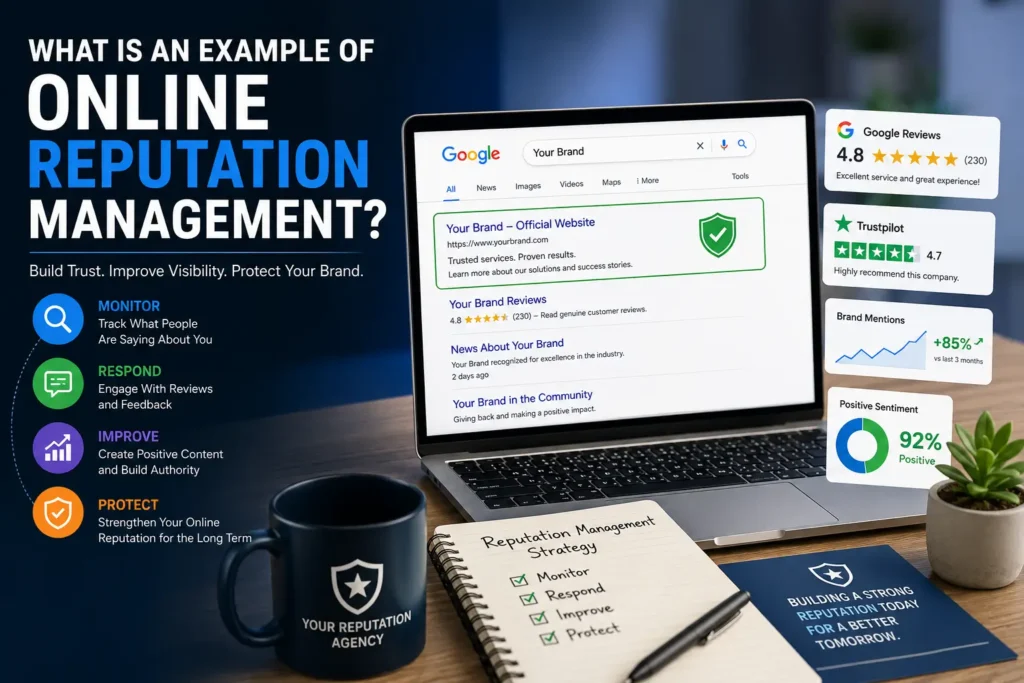
What Is an Example of Online Reputation Management?
Many people associate online reputation management with removing negative reviews or responding to complaints. While those actions are important, they represent only a small part of a much broader strategy.
A practical answer to what is an example of online reputation management is this:
A business notices that outdated news articles and several negative reviews appear on the first page of Google. Instead of focusing on one issue, the company improves its website, earns authentic customer reviews, publishes expert content, optimizes its Google Business Profile, strengthens social media profiles, and creates valuable resources that gradually improve how the brand appears in search results.
This approach doesn’t rely on shortcuts. Instead, it builds a stronger, more trustworthy digital presence that benefits both users and search engines.
Common Examples of Online Reputation Management
Reputation management strategies vary depending on the situation. Below are some of the most common examples businesses and professionals use to protect and strengthen their online image.
Managing Customer Reviews
Reviews strongly influence purchasing decisions. Responding professionally to both positive and negative reviews demonstrates transparency and shows potential customers that your business values feedback.
Good review management includes:
- Responding promptly
- Remaining professional
- Addressing concerns respectfully
- Encouraging genuine customer reviews
- Learning from customer feedback
Improving Search Results
Sometimes the biggest challenge isn’t negative reviews—it’s what appears on Google when someone searches for your name or business.
Organizations often improve branded search results by:
- Publishing educational content
- Optimizing company profiles
- Creating helpful resources
- Building authoritative backlinks
- Improving website SEO
Over time, these efforts strengthen positive search visibility.
Building a Strong Personal Brand
Executives, attorneys, doctors, entrepreneurs, and public figures often invest in personal branding as part of reputation management.
This may include:
- Professional biography pages
- Industry interviews
- Guest articles
- Conference speaking
- Thought leadership content
- LinkedIn optimization
If your personal reputation is an important part of your professional success, our Personal Reputation Management service explains how customized strategies help individuals strengthen their digital credibility.
Managing a Reputation Crisis
Unexpected situations can affect even the most respected organizations.
Examples include:
- Viral social media incidents
- Negative news coverage
- Customer complaints
- Employee misconduct
- Data breaches
- Executive controversies
Having a structured response plan helps businesses respond quickly while protecting long-term trust.
Our Crisis Reputation Management service explains how organizations can respond strategically during sensitive situations.
How Search Engine Reputation Management Works
Effective reputation management follows a structured process rather than isolated tactics.
Each stage builds stronger digital authority while reducing reputational risk.
Step 1 — Reputation Audit
The first step is understanding your current online reputation.
A professional audit typically reviews:
- Google search results
- Customer reviews
- News coverage
- Social media profiles
- Brand mentions
- Directory listings
- Website authority
- Competitor visibility
This provides a clear picture of both strengths and potential risks.
Step 2 — Identify Reputation Challenges
After gathering data, reputation specialists determine what requires attention.
Common issues include:
- Negative reviews
- Outdated articles
- Low-quality search results
- Weak branded visibility
- Inconsistent business information
- Limited online authority
Understanding the root cause helps prioritize the most effective solutions.
Step 3 — Develop a Reputation Strategy
Every reputation challenge is unique.
Rather than applying identical tactics to every business, experienced agencies create customized strategies based on industry, audience, search competition, and long-term goals.
A comprehensive strategy may include:
- SEO improvements
- Content marketing
- Review management
- Digital PR
- Search suppression
- Brand monitoring
- Executive branding
Step 4 — Strengthen Positive Digital Assets
One of the most effective reputation management strategies is creating more high-quality content that accurately represents your business.
Examples include:
- Educational blog articles
- Service pages
- Case studies
- Client success stories
- Industry resources
- FAQ pages
- Company news
- Video content
Helpful content builds trust while supporting stronger search visibility.
Step 5 — Monitor and Improve
Reputation management doesn’t end after publishing new content.
Ongoing monitoring helps businesses:
- Track search results
- Monitor reviews
- Detect brand mentions
- Identify reputation risks
- Measure visibility improvements
- Protect long-term credibility
Continuous optimization keeps your digital reputation strong as search engines and customer expectations evolve.
A Real Business Example
Imagine a regional law firm receives several negative reviews following a service issue. At the same time, outdated directory listings and limited online content make it difficult for potential clients to find accurate information.
Instead of focusing solely on the reviews, the firm launches a comprehensive reputation strategy.
The process includes:
- Updating the company website
- Optimizing attorney profile pages
- Publishing legal education articles
- Improving Google Business Profile information
- Responding professionally to customer feedback
- Encouraging satisfied clients to leave honest reviews
- Strengthening local SEO
- Monitoring branded search results
Within several months, the firm’s online presence becomes significantly stronger. Potential clients now discover authoritative content, updated business information, and authentic customer feedback before encountering isolated negative mentions.
This demonstrates how successful online reputation management focuses on strengthening the overall digital ecosystem rather than reacting to a single issue.
Why Professional Reputation Management Delivers Better Results
Many businesses attempt to manage their online reputation only after a serious problem appears.
Professional reputation management takes a more proactive approach by combining SEO, digital PR, content strategy, review management, and brand monitoring into one coordinated plan.
Rather than simply reacting to reputation issues, organizations build long-term authority that benefits both search engines and AI-powered search platforms.
If you’re evaluating whether professional help is right for your business, our guide on How Much Does Online Reputation Management Cost? explains the factors that influence pricing and long-term value.
Common Mistakes That Hurt Online Reputation
Even well-established businesses can unintentionally damage their online reputation. Many organizations react only after a problem becomes public, making recovery more difficult.
Avoid these common mistakes:
Ignoring Negative Reviews
Customers don’t expect perfection—they expect accountability.
Failing to acknowledge legitimate concerns can create the impression that a business doesn’t value customer feedback. A professional, respectful response often strengthens trust, even when criticism exists.
Responding Emotionally
Reputation issues can be frustrating, but emotional responses rarely help.
Public arguments, defensive comments, or personal attacks often receive more attention than the original complaint. Remaining calm and professional protects your credibility.
Trying to Remove Everything
Not every negative mention should be removed.
In many situations, ethical reputation management focuses on strengthening positive, authoritative content rather than pursuing unrealistic removal requests.
A balanced online presence appears more authentic than attempting to eliminate every critical opinion.
Neglecting SEO
Search engines determine what most people see first.
Businesses that ignore SEO often allow outdated pages, inaccurate information, or third-party websites to dominate branded search results.
Strong SEO supports strong reputation management.
Waiting Until a Crisis Happens
One of the biggest mistakes is assuming reputation management is only necessary after bad publicity.
The strongest reputations are built before problems occur through consistent monitoring, quality content, and customer engagement.
Best Practices for Long-Term Reputation Management
Successful reputation management isn’t about quick fixes—it’s about building lasting trust.
Here are several proven best practices.
Monitor Your Brand Regularly
Know what people are saying about your business.
Regular monitoring helps identify:
- New reviews
- Brand mentions
- Search result changes
- News coverage
- Social media conversations
Early awareness allows faster responses.
Publish Helpful Content Consistently
Helpful content establishes expertise while improving search visibility.
Consider publishing:
- Educational blog posts
- Industry insights
- Case studies
- Customer success stories
- Frequently asked questions
- Video resources
Consistent publishing strengthens both SEO and reputation.
Keep Business Information Updated
Ensure your:
- Website
- Google Business Profile
- Social profiles
- Business directories
- Contact information
remain accurate and consistent.
Inconsistent information reduces customer confidence and can negatively affect local search visibility.
Encourage Authentic Customer Reviews
Positive reviews build credibility naturally.
Rather than purchasing reviews or using unethical tactics, encourage satisfied customers to share honest experiences.
Authentic feedback supports both reputation management and local SEO.
Build Authority Across Multiple Platforms
Don’t rely solely on your website.
Strengthen your presence across:
- Industry directories
- Google Business Profile
- Trusted publications
- Professional associations
- Relevant media coverage
A diversified digital footprint creates stronger online authority.
Expert Tips from Reputation Professionals
Experienced reputation specialists understand that sustainable success comes from consistency rather than shortcuts.
Here are several expert recommendations.
Think Long-Term
Reputation management is an ongoing investment—not a one-time campaign.
Organizations that consistently improve their online presence are better protected during future challenges.
Focus on Customer Experience
The strongest reputation strategy begins offline.
Exceptional products, services, and customer support naturally generate positive reviews and recommendations.
Measure Progress
Track important metrics such as:
- Brand search visibility
- Review ratings
- Organic traffic
- Customer sentiment
- Search result improvements
- Brand mentions
Data-driven decisions produce better long-term outcomes.
Invest in Professional Guidance
Complex reputation issues often involve SEO, public relations, legal considerations, and digital marketing.
Working with experienced professionals helps businesses avoid costly mistakes while accelerating long-term growth.
Comparison Table
| Traditional SEO | Search Engine Reputation Management |
|---|---|
| Focuses on keyword rankings | Focuses on brand perception |
| Drives website traffic | Builds customer trust |
| Optimizes webpages | Optimizes the entire online presence |
| Measures keyword performance | Measures reputation health |
| Generates leads | Protects long-term credibility |
| Improves search visibility | Improves search visibility and public confidence |
Although both strategies complement each other, reputation management places greater emphasis on trust, credibility, and branded search results.
Why Small Businesses Should Invest in Reputation Management
Many small business owners believe reputation management is only necessary for large corporations or public figures.
The reality is quite different.
Local businesses often depend heavily on online reviews, Google Business Profiles, and customer recommendations. Even a few negative search results can influence purchasing decisions.
A proactive reputation strategy helps small businesses:
- Build customer trust
- Improve local search visibility
- Increase qualified leads
- Strengthen brand credibility
- Compete with larger companies
- Protect long-term growth
If you’re a growing business, our guide on Online Reputation Management for Small Businesses explains practical strategies for building and protecting your digital reputation.
The Future of Online Reputation Management
Online reputation management has evolved far beyond responding to reviews or publishing occasional blog posts. Today, your digital reputation is evaluated by search engines, AI assistants, customers, investors, journalists, and business partners simultaneously.
Platforms such as Google AI Overviews, ChatGPT, Gemini, Microsoft Copilot, and Bing AI increasingly rely on trusted online sources to answer questions. This means your website, reviews, media coverage, and digital authority all influence how your brand is represented across both traditional and AI-powered search.
Businesses that invest in reputation today are preparing for the future of search.
How AI Is Changing Reputation Management
Artificial intelligence is transforming how people discover businesses.
Instead of scrolling through multiple search results, users now receive AI-generated summaries based on trusted online information.
These summaries often consider:
- Company websites
- Customer reviews
- News publications
- Industry citations
- Expert content
- Business profiles
- Authoritative mentions
If your digital presence is incomplete or inconsistent, AI systems may have limited or outdated information available.
A strong reputation strategy helps ensure that accurate, trustworthy information becomes easier for both people and AI systems to understand.
Why Google’s E-E-A-T Matters More Than Ever
Google continues to emphasize Experience, Expertise, Authoritativeness, and Trustworthiness (E-E-A-T) when evaluating content quality.
Businesses with strong E-E-A-T typically demonstrate:
Experience
Sharing real knowledge gained through practical work rather than theoretical information.
Expertise
Publishing accurate, well-researched content that genuinely helps users solve problems.
Authoritativeness
Being recognized through quality backlinks, media mentions, customer reviews, and industry references.
Trustworthiness
Providing transparent information, secure websites, accurate contact details, and authentic customer experiences.
Reputation management naturally supports all four pillars by strengthening the credibility of your entire online presence.
Reputation Management Is an Investment, Not an Expense
Some organizations hesitate to invest in reputation management because they only consider the immediate cost.
However, the long-term value is often much greater.
A strong online reputation can help businesses:
- Generate more qualified leads
- Improve conversion rates
- Build customer confidence
- Increase referral opportunities
- Strengthen executive credibility
- Attract investors and partners
- Support long-term SEO performance
- Protect business value during challenging situations
In contrast, repairing a damaged reputation after a crisis often requires significantly more time, effort, and resources.
Proactive reputation management is almost always the smarter investment.
Why Businesses Choose Your Reputation Agency
At Your Reputation Agency, we understand that every reputation challenge is unique.
Rather than offering generic solutions, we develop customized strategies based on your industry, goals, audience, and existing digital presence.
Our reputation management services include:
- Online Reputation Management
- Personal Reputation Management
- Crisis Reputation Management
- Executive Reputation Management
- Search Engine Reputation Management
- Review Management
- Search Result Suppression
- Digital Brand Protection
- Reputation Monitoring
- SEO Reputation Strategy
Whether you’re protecting a personal brand, rebuilding business credibility, or strengthening your online authority, our team provides ethical, data-driven solutions designed for long-term success.
Read our client reviews on Trustpilot and Google Business Profile to learn why organizations trust Your Reputation Agency for professional online reputation management.
Ready to Strengthen Your Online Reputation?
Your reputation influences every stage of the customer journey—from the first Google search to the final purchasing decision.
If you want to improve your digital presence, protect your brand from future risks, or recover from negative online content, now is the right time to act.
At Your Reputation Agency, we combine reputation management, SEO, content strategy, review management, and digital authority building to help businesses and professionals establish lasting credibility.
Whether you’re a business owner, CEO, attorney, physician, entrepreneur, or public figure, we’ll develop a customized strategy tailored to your unique goals.
If you’d like to discuss your situation confidentially, Contact Us today:
Together, we can build a stronger, more trusted online reputation that supports your long-term growth.
Conclusion
Understanding what is an example of online reputation management is the first step toward protecting one of your most valuable business assets—your reputation.
Online reputation management is far more than responding to negative reviews. It involves creating a trustworthy digital presence through helpful content, ethical SEO, review management, search engine reputation management, and proactive brand monitoring.
Organizations that consistently invest in their reputation build stronger customer trust, improve search visibility, and position themselves for success across Google Search, AI Overviews, ChatGPT, Gemini, Bing AI, and future search technologies.
The best time to manage your reputation isn’t after a crisis—it’s before one happens.
If you’re ready to strengthen your online presence with a customized, long-term strategy, Your Reputation Agency is here to help.