When someone searches your name or business on Google, the results they see create an immediate first impression. Those search results can influence purchasing decisions, hiring opportunities, partnerships, investments, and overall trust.
That’s why understanding what is search engine reputation management has become increasingly important for business owners, executives, healthcare professionals, attorneys, and anyone with a public online presence.
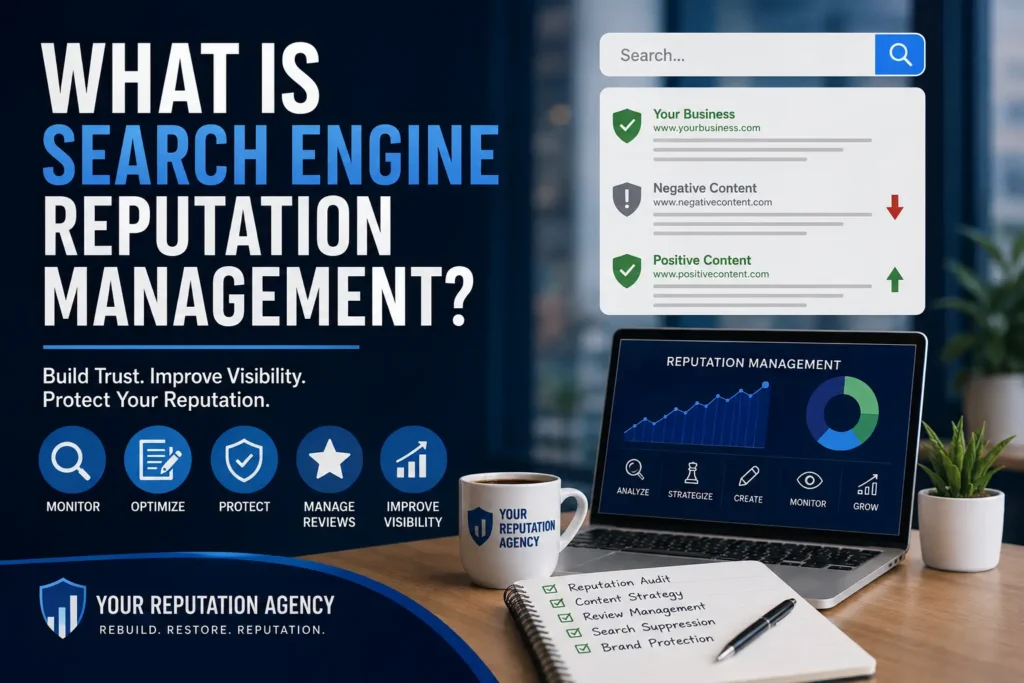
Search Engine Reputation Management (SERM) is the strategic process of improving and protecting how a person or organization appears in search engine results. Rather than focusing only on SEO rankings, SERM combines search optimization, online reputation management, review management, authoritative content creation, and reputation monitoring to build a trustworthy digital presence.
Whether you’re recovering from negative publicity or proactively protecting your brand, SERM helps ensure that people find accurate, credible, and positive information when they search for you online.
Table of Contents
- What Is Search Engine Reputation Management?
- Why Search Engine Reputation Management Matters
- How Search Engine Reputation Management Works
- Key Components of an Effective SERM Strategy
- Step-by-Step Reputation Management Process
- Real Business Example
- Common Reputation Management Mistakes
- Best Practices for Long-Term Success
- Expert Tips from ORM Specialists
- Frequently Asked Questions
- Final Thoughts
Why Search Engine Reputation Management Matters
Your online reputation is no longer controlled solely by your website. Customers, investors, employers, journalists, and even AI-powered search platforms evaluate your credibility using information from multiple online sources.
These may include:
- Google Search results
- News articles
- Online reviews
- Social media profiles
- Business directories
- Videos
- Blog posts
- AI-generated search summaries
If negative or outdated information dominates search results, it can reduce trust before someone even contacts your business.
A strong search engine reputation helps:
- Build customer confidence
- Increase conversion rates
- Strengthen brand authority
- Support executive credibility
- Improve investor confidence
- Protect long-term business growth
- Enhance visibility across Google and AI search platforms
Today, reputation isn’t just about public relations—it’s a critical business asset.
How Does Search Engine Reputation Management Work?
Search Engine Reputation Management is a long-term strategy designed to influence how your brand appears when people search online.
Instead of relying on a single tactic, successful SERM combines multiple disciplines, including SEO, content marketing, digital PR, review management, and online reputation monitoring.
A typical strategy includes:
Reputation Audit
The first step is understanding your current online reputation.
This includes analyzing:
- Google search results
- Brand mentions
- Customer reviews
- News coverage
- Search visibility
- Social media presence
- Competitor reputation
The audit identifies reputation risks and opportunities for improvement.
Search Result Optimization
Authoritative, high-quality content helps search engines better understand your expertise and credibility.
Optimization may include:
- Service pages
- Educational blog content
- Company profiles
- Executive biographies
- Knowledge panels
- Business citations
These assets work together to strengthen positive branded search results.
Reputation Monitoring
Monitoring allows businesses to identify potential issues before they become major reputation problems.
Regular monitoring tracks:
- New reviews
- Brand mentions
- News articles
- Search ranking changes
- Customer sentiment
- Emerging reputation risks
Businesses looking for continuous protection often invest in professional Reputation Monitoring services to detect issues early and respond strategically.
Review Management
Online reviews directly influence customer trust and local search performance.
Effective review management includes:
- Responding professionally
- Encouraging authentic customer feedback
- Addressing customer concerns
- Monitoring review platforms
- Improving overall customer experience
Rather than chasing perfect ratings, successful businesses focus on building genuine credibility over time.
Content Authority
One of the strongest reputation management strategies is consistently publishing valuable, trustworthy content.
Helpful content allows search engines—and increasingly AI platforms—to recognize your business as an authoritative source within your industry.
This includes:
- Educational blogs
- Industry resources
- Case studies
- FAQs
- Service pages
- Thought leadership articles
High-quality content not only improves search visibility but also builds confidence among potential customers.
Personal Brand Protection
For executives, doctors, lawyers, entrepreneurs, and public figures, personal reputation often becomes just as valuable as business reputation.
Developing a professional digital presence through optimized profiles, authoritative content, and strategic visibility helps strengthen trust across search engines.
If you’re focused on protecting your professional identity, our Personal Reputation Management solutions are designed specifically for high-visibility individuals.
Step-by-Step Search Engine Reputation Management Process
Building a strong online reputation doesn’t happen overnight. Successful Search Engine Reputation Management (SERM) follows a structured process that combines SEO, reputation management, digital marketing, and continuous monitoring.
Here’s how experienced ORM professionals approach it.
Step 1: Audit Your Current Online Reputation
Before making improvements, you need to understand how your brand currently appears in search results.
A comprehensive reputation audit typically includes:
- Branded Google searches
- Search result analysis
- Online reviews
- News mentions
- Social media profiles
- Business directory listings
- Competitor comparisons
This audit reveals what potential customers see first and helps prioritize the most critical reputation issues.
Step 2: Identify Reputation Risks
Not every negative search result requires immediate action.
Instead, identify which content has the greatest impact on your credibility.
Examples include:
- Negative news articles
- False or misleading information
- Fake reviews
- Outdated content
- Low-quality directory listings
- Negative forum discussions
- Inactive social profiles
Understanding these risks allows you to focus resources where they’ll have the greatest impact.
Step 3: Build Authoritative Digital Assets
One of the most effective SERM strategies is creating high-quality assets that deserve to rank.
These include:
- Optimized service pages
- Educational blog articles
- Executive biographies
- Company profile pages
- Press features
- Resource guides
- Case studies
- FAQ pages
Search engines reward helpful, trustworthy content that demonstrates expertise and experience.
The stronger your digital assets become, the easier it is to build long-term search visibility.
Step 4: Optimize Branded Search Results
When someone searches your company or personal name, the first page of Google should communicate trust and authority.
Optimization often includes:
- Improving title tags and meta descriptions
- Updating business information
- Strengthening internal linking
- Publishing new branded content
- Optimizing social media profiles
- Improving structured data
- Enhancing local SEO signals
The goal is to ensure accurate and valuable information appears prominently across search results.
Step 5: Manage Online Reviews
Customer reviews significantly influence purchasing decisions.
Rather than focusing only on star ratings, businesses should prioritize authentic customer experiences and thoughtful responses.
Best practices include:
- Responding professionally to both positive and negative reviews
- Encouraging satisfied customers to leave honest feedback
- Monitoring review platforms regularly
- Addressing customer concerns promptly
- Reporting reviews that violate platform guidelines
If your business is struggling with policy-violating reviews, our guide on Remove Negative Google Reviews – Legally & Effectively explains the appropriate options.
Step 6: Strengthen Personal and Executive Visibility
For many organizations, the leadership team represents the brand.
Executives who maintain a strong professional presence often improve overall company credibility.
This may include:
- Executive profile optimization
- Thought leadership content
- Industry interviews
- Speaking engagements
- Professional biographies
- Knowledge panel improvements
Healthcare professionals, attorneys, consultants, and entrepreneurs often benefit significantly from executive visibility strategies.
For medical professionals, our Doctor Reputation Management resource explains industry-specific reputation strategies.
Step 7: Monitor and Improve Continuously
Search results evolve constantly.
New reviews appear.
News stories are published.
AI search platforms update their answers.
Competitors publish new content.
Because of this, Search Engine Reputation Management should never be treated as a one-time project.
Continuous monitoring helps organizations identify problems early while maintaining strong search visibility over time.
Search Engine Reputation Management vs Traditional SEO
Although closely related, SERM and SEO have different objectives.
| Traditional SEO | Search Engine Reputation Management |
|---|---|
| Improves keyword rankings | Improves branded search perception |
| Focuses on website traffic | Focuses on trust and credibility |
| Targets search visibility | Targets reputation across search results |
| Optimizes web pages | Optimizes your entire digital footprint |
| Measures rankings | Measures sentiment, authority, and trust |
The strongest digital strategies combine both SEO and Search Engine Reputation Management to create sustainable business growth.
Real Example: Why Search Reputation Matters
Imagine two law firms offering similar legal services.
Both have attractive websites and comparable pricing.
However, when prospective clients search the firms online, the results are very different.
Law Firm A shows:
- Recent positive client reviews
- Educational legal articles
- Executive attorney profiles
- Professional media mentions
- Active social media
Law Firm B shows:
- Old unresolved complaints
- Outdated directory listings
- Minimal online presence
- Little educational content
Even before making contact, most people naturally trust Law Firm A because its search results demonstrate expertise, transparency, and credibility.
This example illustrates why Search Engine Reputation Management directly influences business growth, even before a sales conversation begins.
Common Search Engine Reputation Management Mistakes
Many organizations unintentionally weaken their online reputation by making avoidable mistakes.
Common examples include:
- Ignoring negative reviews
- Publishing inconsistent business information
- Using duplicate or thin content
- Neglecting executive profiles
- Waiting until a crisis occurs
- Failing to monitor branded searches
- Buying fake reviews
- Relying on short-term SEO tactics
A proactive strategy consistently outperforms reactive reputation management.
Best Practices for Search Engine Reputation Management
Building a positive search reputation isn’t about reacting to problems—it’s about creating a strong digital foundation that earns trust over time. Organizations that consistently invest in their online presence are far better positioned to withstand negative publicity, algorithm updates, or changing customer expectations.
Here are the best practices followed by successful brands.
Publish Helpful, High-Quality Content
Google increasingly rewards content that demonstrates real expertise and answers users’ questions.
Focus on creating:
- In-depth blog posts
- Industry guides
- Service pages
- Case studies
- FAQs
- Resource centers
Every piece of content should solve a problem, provide value, and reflect your expertise.
Keep Your Business Information Consistent
Your business details should remain consistent across:
- Google Business Profile
- Company website
- Social media
- Online directories
- Industry listings
Consistent information improves both search visibility and customer trust.
Encourage Authentic Customer Reviews
Positive reviews are one of the strongest trust signals online.
Instead of requesting only five-star reviews, encourage satisfied customers to leave honest feedback about their experience.
Authentic reviews improve credibility while supporting local SEO performance.
Monitor Your Brand Regularly
Reputation issues often start small.
Regular monitoring allows businesses to identify:
- New reviews
- Brand mentions
- News coverage
- Search ranking changes
- Social conversations
Early detection often prevents larger reputation problems.
Build Executive Authority
People trust people.
Executives who publish insights, participate in interviews, and maintain professional profiles often strengthen the reputation of the entire organization.
Thought leadership has become an important component of modern Search Engine Reputation Management.
Expert Tips from Online Reputation Specialists
Based on years of ORM experience, several principles consistently deliver better long-term results.
Think Long-Term
Reputation management is an investment rather than a quick fix.
Businesses that consistently publish quality content and monitor their online presence usually experience stronger long-term growth.
Don’t Focus Only on Google
Today’s customers research businesses across multiple platforms.
Your reputation includes:
- Bing
- AI Overviews
- ChatGPT
- Gemini
- Perplexity
- YouTube
- Review platforms
- Industry directories
A comprehensive strategy improves visibility across the entire digital ecosystem.
Prioritize Transparency
Customers value authenticity.
Respond professionally to reviews.
Correct mistakes when appropriate.
Communicate honestly.
Transparency strengthens credibility far more than attempting to appear perfect.
Invest Before a Crisis Happens
Many companies seek reputation management only after negative publicity appears.
The most successful organizations build strong reputations long before problems arise, making them far more resilient when challenges occur.
The Future of Search Engine Reputation Management
Search behavior continues to evolve.
AI-powered search experiences now summarize information from multiple trusted sources rather than simply displaying links.
This means businesses must focus on becoming authoritative, reliable sources that consistently publish accurate, helpful content.
Future Search Engine Reputation Management will increasingly emphasize:
- Entity SEO
- E-E-A-T signals
- Brand authority
- Helpful content
- Structured data
- AI visibility
- Digital trust
- Consistent online identity
Organizations that invest in these areas today will be better positioned as search technology continues to evolve.
Why Your Reputation Agency?
At Your Reputation Agency, we understand that your reputation is one of your most valuable business assets.
Our team develops customized reputation strategies designed to help individuals, executives, professionals, and businesses build long-term digital trust.
Our services include:
- Search Engine Reputation Management
- Personal Reputation Management
- Reputation Monitoring
- Executive Reputation Management
- Review Management
- Search Result Suppression
- Digital Brand Protection
- Crisis Reputation Management
Every strategy is tailored to your goals, industry, and current online presence.
If you’d like to discuss your reputation challenges or proactively strengthen your online visibility, Contact Us for a confidential consultation.
Read our client reviews on Trustpilot and Google Business Profile to learn why organizations trust Your Reputation Agency for professional online reputation management.
Conclusion
Understanding what is search engine reputation management is no longer optional for businesses operating in today’s digital landscape.
Every Google search, online review, news article, and AI-generated summary contributes to how customers perceive your brand.
Search Engine Reputation Management combines SEO, online reputation management, content strategy, review management, and continuous monitoring to ensure your online presence accurately reflects your expertise and credibility.
Rather than waiting for a reputation crisis, proactive organizations invest in long-term strategies that build trust, strengthen authority, and improve visibility across Google, Bing, AI Overviews, ChatGPT, Gemini, and other emerging search platforms.
A strong online reputation isn’t built overnight—but with the right strategy, it becomes one of your greatest competitive advantages.
Frequently Asked Questions
1. What is Search Engine Reputation Management?
Search Engine Reputation Management (SERM) is the process of improving how individuals and businesses appear in search engine results through SEO, reputation management, content creation, review management, and monitoring.
2. Why is Search Engine Reputation Management important?
It helps build trust, improve credibility, strengthen branded search results, and influence how customers, investors, employers, and partners perceive your business online.
3. Is Search Engine Reputation Management different from SEO?
Yes. Traditional SEO focuses primarily on increasing website rankings and organic traffic, while SERM focuses on improving your overall online reputation and branded search perception across multiple digital platforms.
4. How long does Search Engine Reputation Management take?
The timeline varies depending on the complexity of your online reputation. Many businesses begin seeing improvements within a few months, while long-term reputation building is an ongoing process.
5. Can negative search results always be removed?
Not always. Some content cannot be removed, but its visibility can often be reduced through ethical reputation management strategies such as search suppression and authority building.
6. Who needs Search Engine Reputation Management?
Business owners, CEOs, entrepreneurs, healthcare professionals, attorneys, public figures, consultants, agencies, and any organization that depends on public trust can benefit from SERM.
7. What is the difference between reputation monitoring and reputation management?
Reputation monitoring identifies new mentions, reviews, and reputation risks, while reputation management develops strategies to improve and protect your overall online presence.
8. How can Your Reputation Agency help?
Your Reputation Agency provides customized Search Engine Reputation Management solutions, including reputation monitoring, personal reputation management, review management, search suppression, executive reputation management, and long-term digital brand protection.