Clinic one-star review recovery
Clinic one-star review recovery should protect patient privacy while showing future readers that concerns are taken seriously. The practice must investigate the service issue without confirming that the reviewer is a patient.
Seven recovery steps
- Preserve the review, profile, date, rating, and internal records.
- Verify the interaction without exposing protected information.
- Investigate the complaint and identify corrective action.
- Reply briefly with a secure private contact path.
- Report fake engagement, threats, or clear policy violations.
- Improve recurring issues in scheduling, billing, or communication.
- Track ratings with appointments, referrals, and complaint themes.
A professional response can build trust even when the review remains. Never disclose treatment details or confirm patient status in public.
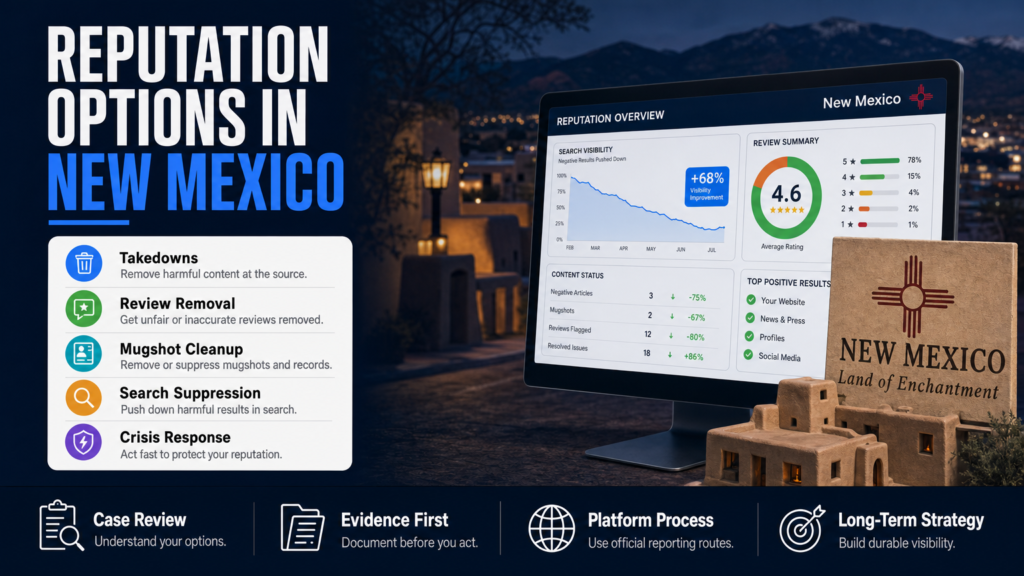
If a negative review, an old mugshot, or an unfavorable article is driving potential clients away in New Mexico, you’re not alone — and you have options. This article explains how an online reputation management company New Mexico-based professionals use when they need legal, technical and SEO-led fixes.
You’ll get clear steps to evaluate whether content can be removed, what suppression (SEO) looks like if removal isn’t available, how to choose a reliable provider, and what to do the first 72 hours after a viral incident. We use concrete timeframes and platform-specific routes where possible, and we say plainly when an outcome depends on law, platform policy, or publisher cooperation.
This guide is written for physicians, small-business owners, lawyers, and executives in New Mexico who need fast, practical next steps rather than vague promises.
Read the sections you need first — there are dedicated bits on reviews, takedowns, when removal isn’t possible, and a sample end-to-end scenario you can model for your situation.
Table of Contents
- What Is The Best Online Reputation Management Company For New Mexico Professionals?
- What Does Online Reputation Management Do?
- Who Is The Best Social Media Management Company When You Need Reputation Help?
- Can You Give Examples Of Online Reputation Management?
- Removal Versus Suppression: Which Should You Try First?
- What To Do When Removal Is Not Available
- Choosing A Local New Mexico Agency Versus A National Firm
- How Much Does Reputation Work Cost And How Long Does It Take?
- Monitoring, Recovery, and Rebuilding Trust After an Incident
- Removal vs Suppression: Quick Comparison
- Hypothetical: A Santa Fe Clinic’s Viral Review And Recovery
- Common Mistakes That Make Reputation Problems Worse
- Durable Best Practices For New Mexico Professionals
- Expert Tips
- Conclusion
- Why Businesses Choose Your Reputation Agency
- Frequently Asked Questions
What Is The Best Online Reputation Management Company For New Mexico Professionals?
There’s no single company that is objectively ‘the best’ for every case. The right firm depends on what you need: legal coordination for defamation, technical SEO for suppression, rapid crisis support for viral incidents, or continuous monitoring for sensitive occupations.
When you search for an online reputation management company New Mexico, prioritize firms that can demonstrate specific experience with your risk profile (medical license risks, regulatory boards, local press), that explain the mix of takedown and SEO tactics they will use, and that clearly differentiate what they can do versus what platforms or publishers control.
- List the concrete outcomes you need (remove article, suppress first page, remove reviews).
- Request case examples or anonymized processes for similar industries.
- Ask for a projected workflow, not a timeline guarantee.
- Check references and written confidentiality terms.
- Look for experience with your industry (medical, legal, hospitality).
- Ask whether they coordinate with local counsel for legal takedowns.
- Get a written scope that separates removal evaluation from SEO suppression.
- Avoid firms that promise guaranteed removals or top search rankings.
How to compare proposals
Compare proposals on three axes: tactics (legal, technical, PR), evidence required (court filings, DMCA, proof of identity), and reporting cadence.
A reliable proposal will list likely outcomes, blockers, and decision points rather than fixed promises.
- Tactics listed and who does them (client, agency, attorney).
- Dependencies (publisher cooperation, platform review times).
- Monthly reporting frequency and KPIs (visibility change, takedown attempts).
What Does Online Reputation Management Do?
Online reputation management (ORM) is a bundle of technical, legal, and communications tactics intended to evaluate, remove where possible, and reduce the visibility of harmful online content. A typical program includes content evaluation, takedown requests, SEO suppression, review challenges, and monitoring.
We evaluate whether the content may qualify for removal or review. If removal is not available, we pursue mitigation strategies such as publishing authoritative content and technical SEO to push harmful links off the first page of search results.
- Initial audit and risk classification of each negative item.
- Prioritize items by impact (licensure risk, revenue impact, hiring).
- Deploy parallel strategies—legal where necessary, technical otherwise.
- Report results and adapt strategy monthly based on movement and new content.
- Takedowns: DMCA, platform policy reports, direct publisher requests.
- Legal escalation: coordinate with counsel when content may be defamatory or violates privacy.
- Review challenges: submit evidentiary disputes to Google, Yelp, TripAdvisor, and industry sites.
- Search suppression: create and optimize authoritative pages to outrank negative links.
- Monitoring: continuous alerts for new mentions, impersonation, or data-broker leaks.
How removal evaluations work
Removal depends on the content, publisher, platform policies, evidence, and jurisdiction. We assess whether a post is false, defamatory, a doxxing/privacy violation, or a platform policy breach.
For each item we record the evidence required, the likely routes (publisher takedown, platform report, DMCA), and the feasibility of success.
- Defamation requires false statement plus harm — a legal review may be needed.
- DMCA takedowns require proof of copyright ownership.
- Privacy and doxxing removals rely on demonstrating personal data exposure.
Who Is The Best Social Media Management Company When You Need Reputation Help?
For reputation incidents tied to social platforms, the ‘best’ social media management company is the one that combines rapid moderation, platform escalation experience, and public messaging capability. That often means firms that handle both takedowns/impersonation removal and messaging for audiences.
Social media companies focused only on growth or content calendars are not a fit for crisis work: you need teams experienced with platform appeals on X, Facebook, Instagram, YouTube, and TikTok, plus a crisis PR skillset.
- Identify which platforms contain the harmful content.
- Request case examples of appeals on the same platforms.
- Confirm 24–72 hour response windows for initial mitigation.
- Agree on a content and messaging calendar for published rebuttals or clarifications.
- Look for proven experience with platform appeal workflows and impersonation removal.
- Ask whether they coordinate legal escalation for doxxing or threats.
- Ensure they provide both short-term moderation and long-term mend/rebuild messaging.
Platforms that commonly need crisis handling
X (formerly Twitter), Facebook, Instagram and TikTok are where viral attacks and impersonation frequently surface. YouTube appeals require copyright and defamation evidence when making takedown requests.
Platform decisions remain under the platform’s control; agencies should explain appeals processes rather than promise outcomes.
- X: impersonation, doxxing, harassment appeals.
- Facebook/Instagram: community-standards and identity verification paths.
- YouTube: copyright claims, privacy complaints, and community guidelines.
Can You Give Examples Of Online Reputation Management?
Yes. Examples range from removing a doxxing post, to challenging fake reviews, to building eight search results that push a negative article off page one. Below are common examples and the typical mix of tactics used.
These are illustrative scenarios — outcomes depend on the publisher, evidence, and platform rules.
- Identify the content and platform.
- Collect evidence and document harm or falsehood.
- Select parallel paths: platform appeal, publisher outreach, legal review, and SEO mitigation.
- Monitor for re-posts or secondary distribution.
- Fake review on Google: Evidence collection, reviewer tracing, review challenge via Google Business Profile, and if needed, SEO suppression.
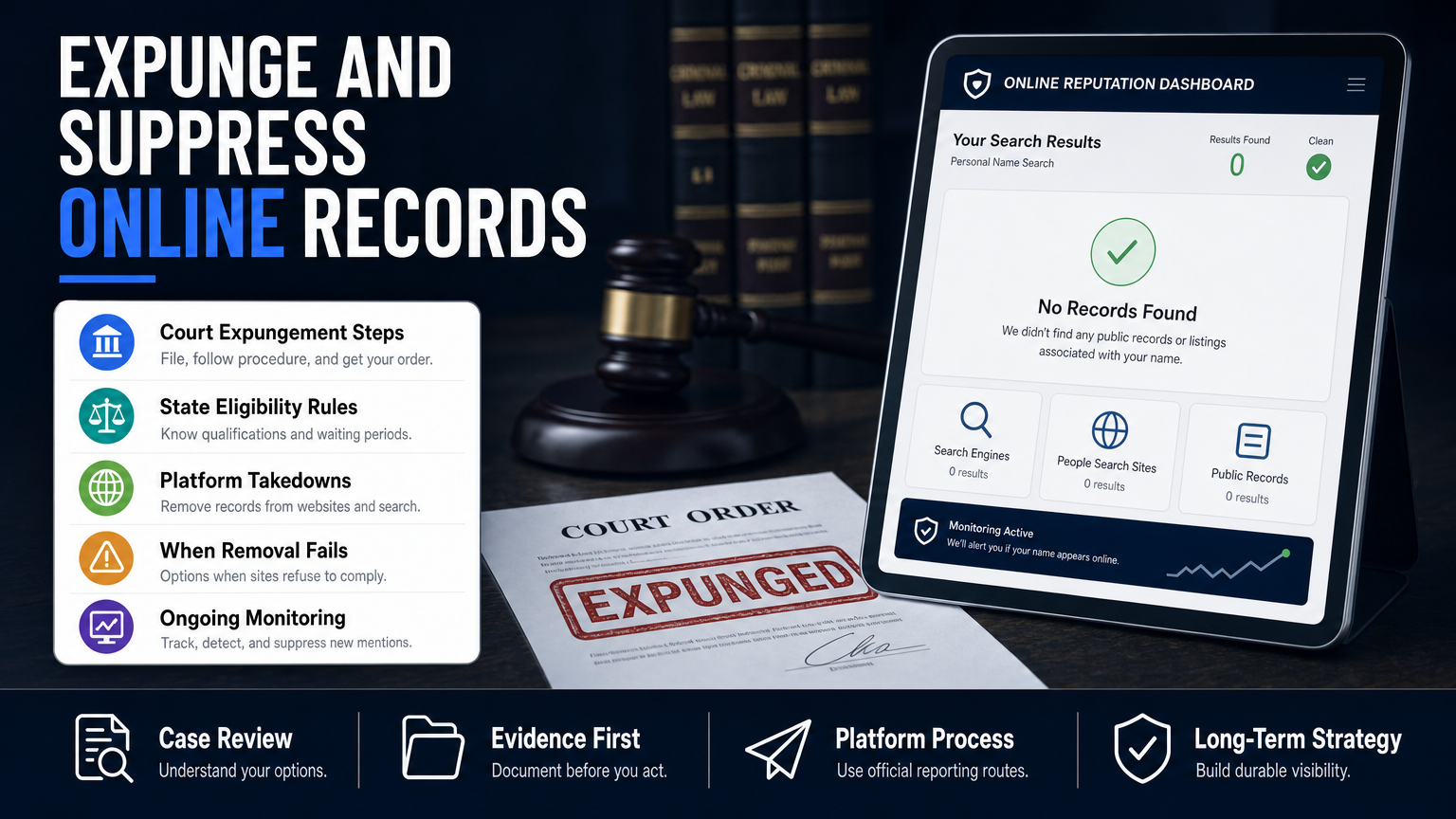
- Mugshot listing: Publisher opt-out requests, legal demand letters to aggregator sites, and data-broker opt-outs.
- Viral video: Platform policy appeals on YouTube/TikTok for violations, plus PR messaging and search suppression.
Where to find more detail on review crises
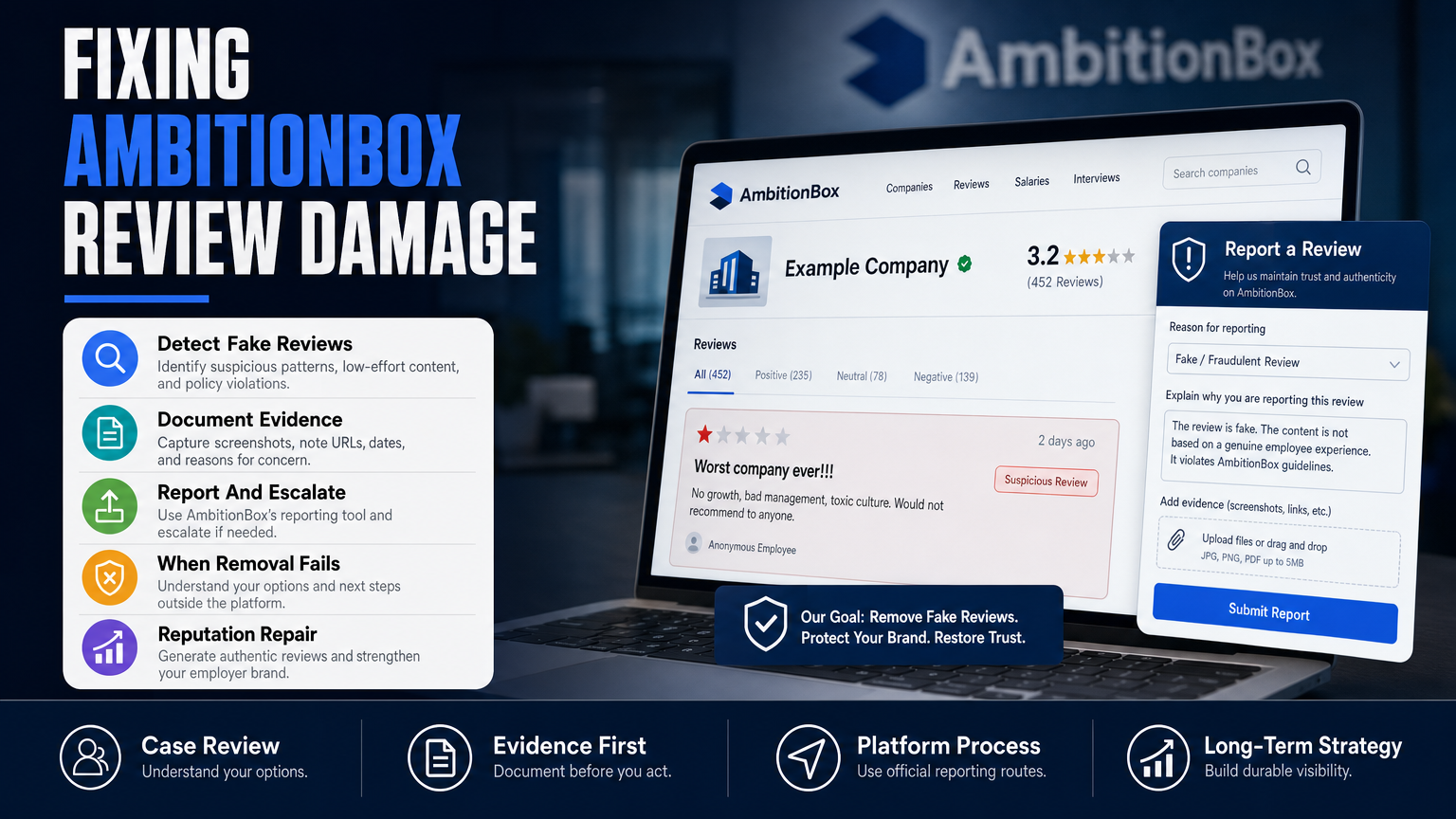
If your primary issue is customer reviews, read this detailed breakdown of review-driven crises and how they escalate and get handled.
That piece explains when to pursue removal versus correction and how public replies affect search visibility.
- For a focused discussion on review crises, see When Google Reviews Become a Brand’s Biggest Crisis.
Removal Versus Suppression: Which Should You Try First?
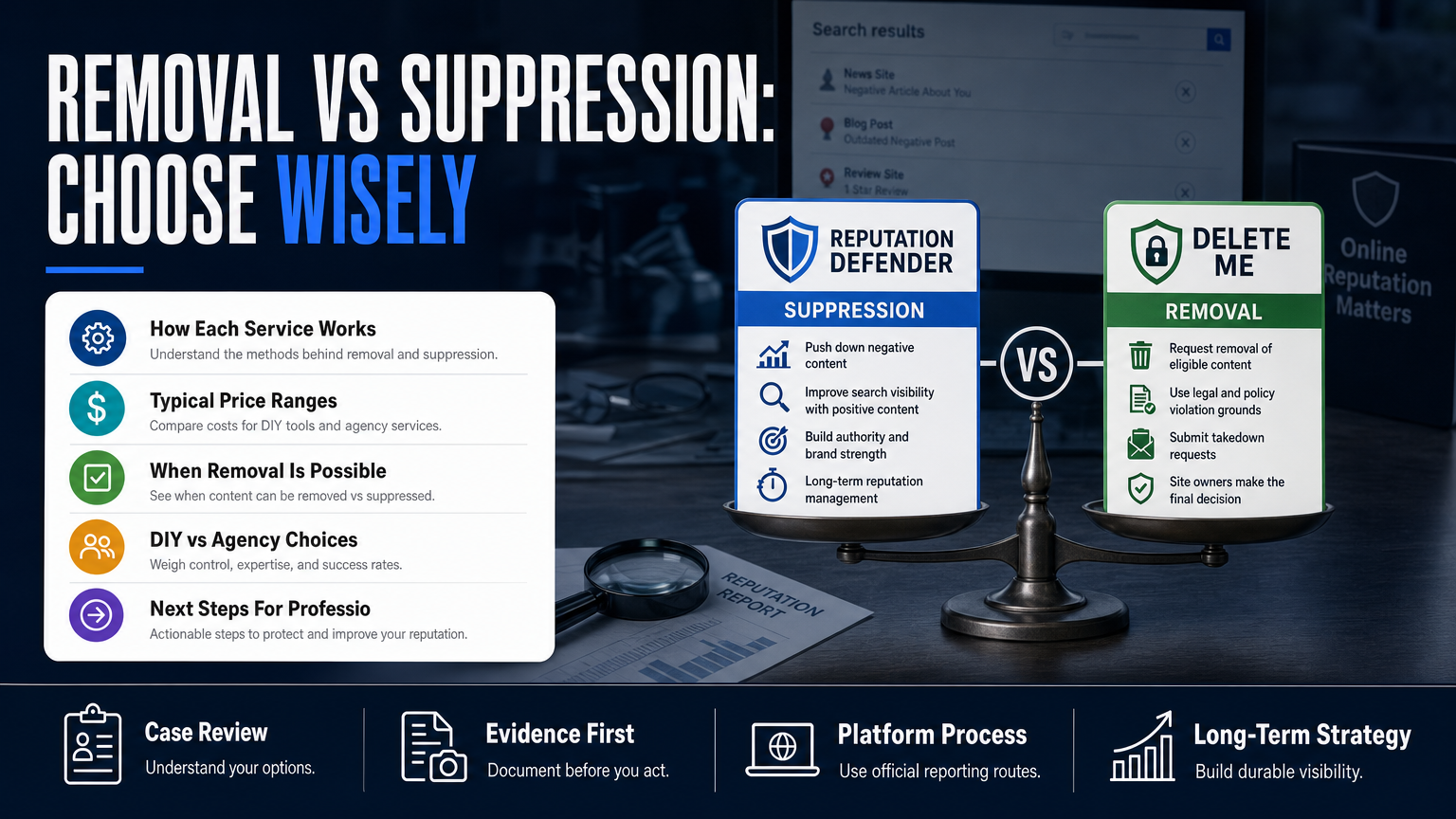
Removal is preferred when content clearly violates platform policy, is demonstrably false and defamatory, or exposes private data. Suppression (SEO) is the fallback when removal routes are unavailable or unsuccessful.
We evaluate both simultaneously in most cases: pursue takedown while starting a suppression campaign because platform reviews and publisher negotiations take time.
- Audit the negative URLs and classify each as possibly removable or suppression-only.
- Initiate takedown requests and legal reviews where appropriate.
- Begin SEO content creation targeted at the specific search queries driving traffic.
- Monitor and adjust monthly.
- Removal depends on policy, evidence, and publisher cooperation.
- Suppression uses SEO to create credible, authoritative content that outranks negatives.
- Both approaches require documentation and an iterative plan.
Compare common approaches
Below is a quick comparison to help you decide which to prioritize. In many cases, coordinated use of both produces the best practical outcome.
What To Do When Removal Is Not Available
Removal is not always possible — truthful reporting, public records, and opinion pieces are often not removable. When that’s the case, focus on mitigation: correction, context, and visibility management.
Mitigation includes publishing authoritative rebuttals, securing positive third-party articles, optimizing business profiles, and targeted paid search to control the narrative in searches for your name or business.
- Create an owner-controlled hub page addressing the issue and linking to corrective documentation.
- Build 6–12 supporting pages (news, bios, thought-leadership) optimized for the target query.
- Run a measured paid-search campaign for high-risk queries while SEO work takes hold.
- Maintain monitoring to catch re-emergent items and respond quickly.
- Publish a clear factual statement or FAQ on your official website addressing the issue.
- Use press releases and earned media to create high-authority pages.
- Optimize Google Business Profile, LinkedIn, and industry profiles to own the first-page slots.
- Consider targeted paid search ads for critical high-intent queries as a temporary visibility control.
When to involve PR and legal
If the negative content is causing immediate revenue or licensure risk, coordinate PR to shape public message and involve counsel to explore legal options.
We coordinate with qualified legal professionals when a matter requires legal analysis, and we handle matters confidentially under a service agreement.
- PR helps reframe and rebuild trust with clients and regulators.
- Legal counsel can determine whether a defamation or other legal claim may be available.
Choosing A Local New Mexico Agency Versus A National Firm
Local New Mexico firms often bring state-specific knowledge (local press relationships, familiarity with state regulatory boards) while national firms offer scale and broader technical resources. Choose based on the complexity of your situation.
A local firm may help with quick publisher outreach and understanding the local press climate; a national firm may be stronger on large-scale SEO suppression and access to in-house developers.
- Assess where the harm originates (local news outlet vs. national site).
- Ask candidates for a hybrid plan if your case mixes local and national risk.
- Confirm who will handle publisher outreach, and whether legal coordination is included.
- Local: strong regional press contacts and familiarity with state regulators.
- National: broader technical SEO teams, content networks, and monitoring infrastructure.
- Many effective solutions combine local counsel/PR with national SEO resources.
Local considerations for New Mexico professions
If your reputational risk could affect licensure or local client retention, prioritize teams that understand local boards and the New Mexico media market.
If a publisher is a New Mexico outlet, a local approach to outreach and negotiation can sometimes move faster.
- Identify local outlets that repeatedly show up in searches for your name.
- Ask any prospective firm about experience with New Mexico regulatory or licensing issues.
How Much Does Reputation Work Cost And How Long Does It Take?
Costs range widely depending on the tactics used: simple review disputes may be low-cost, while legal takedowns and multi-month SEO suppression campaigns are higher. Expect a realistic estimate only after an individual assessment.
Timing depends on the platform, publisher cooperation, legal complexity, and search-engine behavior. Some cases may begin to show visible movement in weeks; others require several months of coordinated work.
- Request an audit to get a scoped estimate.
- Insist on deliverables rather than vague hourly promises.
- Budget for both initial remediation and 6–12 months of monitoring/SEO.
- Small scope (single review or listing): lower-cost fixed-fee options exist.
- Medium scope (multiple listings, a negative article): a combination of outreach and SEO, typically multi-month.
- Large scope (viral incident, multiple publishers): peak activity in the first 30–90 days, with ongoing monitoring after.
What influences price most
The number of negative properties, whether legal action is needed, the authority of the sites involved, and how fast you need action are the main cost drivers.
We provide an estimated timeline after assessment, but timing depends on the platform, publisher, evidence, legal complexity, and search-engine behavior.
- Publisher resistance increases time and cost.
- High-authority publishers (national outlets) require more investment in suppression.
- Legal coordination increases fees but may be necessary for certain removals.
Monitoring, Recovery, and Rebuilding Trust After an Incident
Reputation work doesn’t end with a takedown or an SEO push. Continuous monitoring, incident response plans, and sustained messaging are required to recover trust.
We recommend an ongoing monitoring program for high-risk professionals to alert you to new mentions, review spikes, or impersonation attempts.
- Implement automated alerts for search, social, and review sites.
- Schedule quarterly reputation audits and SEO refreshes.
- Use PR and authoritative content to rebuild trust with clients and regulators.
- Set monitoring alerts for mentions of your name, business, and common misspellings.
- Have a 24–72 hour incident-response protocol for new viral mentions.
- Rebuild trust with third-party endorsements, updated bios, and client communications.
Optimizing your first-page assets
Your first-page results are your de facto storefront online. See how to treat that page as a communications asset and prioritize content you control.
For a deeper dive into controlling first-page results, read The First Page of Google Is Your Real Homepage.
- Control your Google Business Profile and LinkedIn to take high-visibility slots.
- Use consistent NAP (name, address, phone) data for local businesses.
- Consider authoritative guest pieces on local outlets to secure high-authority results.
Removal vs Suppression: Quick Comparison
Use this to decide where to focus first. Many cases require both.
| Removal | Suppression (SEO) |
|---|---|
| Goal | Goal |
| Eliminate the item from the web or platform | Push the item down in search results |
| Depends on platform/publisher cooperation | Depends on content production and SEO signals |
| Faster if platform/publisher agrees | Often takes weeks to months |
| May require legal evidence or DMCA | Requires content assets and technical SEO |
| Not possible for truthful public records | Works even when removal is not allowed |
Hypothetical: A Santa Fe Clinic’s Viral Review And Recovery
Situation: A small clinic in Santa Fe receives a viral one-star thread on a local forum alleging long wait times and poor care, amplified by reposts and Google reviews. The clinic’s Google search for its name shows the forum post and two negative review pages on the first page.
Actions taken: The clinic’s representative documents the forum thread, screenshots timestamps, and tracks republished instances. The reputation team performs a quick triage to separate items that may be removable (doctored photos, false factual claims) from items that are opinion-based and suppression-only.
Tactical mix: Simultaneous platform appeals (forum moderation request and Google review disputes) while publishing a detailed owner-statement and patient FAQ on the clinic’s site. The team then launches targeted SEO: an optimized clinic biography, press release about new scheduling processes, and two guest posts on local health blogs. Paid search ads run for high-intent queries during the first month.
- Day 1–3: Triage and immediate moderation requests; secure evidence and notify staff.
- Week 1–4: Publish owner statement, begin SEO content, launch paid search for name queries.
- Month 1–3: Monitor movement; continue outreach to forum publishers and request removals where false claims were documented.
- Month 3+: Maintain monitoring and publish periodic positive content and patient testimonials to sustain search visibility gains.
- Evidence: timestamps, booking logs (where permissible), and screenshots.
- Removal attempts: forum moderation and review dispute forms with screenshots.
- Suppression: 8 owner-controlled pages created and optimized for clinic-name queries.
Common Mistakes That Make Reputation Problems Worse
Below are frequent errors we see that slow recovery or make issues escalate.
1. Reacting Emotionally on Public Threads
Posting angry replies on review sites or social posts amplifies the issue and creates more indexed content. Keep replies factual, brief, and professional or respond offline where possible.
- Avoid heated exchanges; they become part of the public record.
- Draft responses with a neutral colleague or counsel before posting.
2. Chasing Every Negative Mention Equally
Trying to remove every single mention wastes budget. Prioritize items by impact: those visible on page one, items affecting licensure or revenue, and republished content.
- Rank items by traffic, authority, and potential harm.
- Focus legal resources on the highest-impact properties.
3. Hiring Agencies That Promise Guarantees
Any firm promising guaranteed removal or fixed search positions is overpromising. Platform decisions, publisher cooperation, and search algorithms are outside an agency’s direct control.
- Insist on process-based proposals instead of guaranteed outcomes.
- Request clear reporting metrics tied to actions, not promises.
4. Failing To Preserve Evidence Early
Not taking early screenshots, timestamps, and backups can destroy the ability to pursue legal or policy-based takedowns later.
Collect and store raw evidence immediately if you expect legal or platform escalation.
- Capture screenshots, page-source, and cached URLs as soon as the incident is noticed.
- Record any direct threats or doxxing content for law enforcement.
5. Using Retaliatory Tactics
Attempting to post false positive reviews, fake takedown claims, or deceptive content can backfire and violate platform policies, exposing you to penalties.
Use honest, documented corrections and reputation-building tactics instead.
- Never fabricate reviews or content.
- Follow platform policies and transparent PR practices.
Durable Best Practices For New Mexico Professionals
Adopt these durable practices whether you work with an agency or manage issues in-house.
1. Maintain An Evidence-First Record
Keep organized records of bookings, communications, and any documents relevant to disputes. This speeds legal review and increases the chance of successful platform appeals.
- Use date-stamped exports and secure cloud storage.
- Log communications with publishers and platforms.
2. Control Owner-Managed Assets
Prioritize assets you control: your website, Google Business Profile, LinkedIn, industry profiles, and content. These are the most reliable tools for suppression and messaging.
- Optimize titles and meta descriptions for name queries.
- Use About pages and FAQs to present facts and corrective context.
3. Have An Incident Response Playbook
Create a 72-hour plan for viral incidents: who approves messaging, who captures evidence, and who contacts counsel and PR.
Fast, coordinated action reduces mistakes and public noise.
- Define approval chains and contact lists.
- Practice the playbook with tabletop exercises annually.
4. Combine PR, Legal, And Technical Work
Effective reputational recovery blends legal evaluation, platform reporting, and public messaging. Teams that coordinate these functions move faster and make fewer tactical errors.
We coordinate with qualified legal professionals when a matter requires legal analysis.
- Build a multidisciplinary team before a crisis hits.
- Agree on thresholds for when legal counsel is engaged.
5. Invest In Ongoing Monitoring
Prevention matters. Ongoing monitoring identifies small problems before they become crises.
Automated alerts reduce reaction time for takedowns, impersonation, or data leaks.
- Set alerts for name, business, and common misspellings.
- Monitor review sites, social platforms, and niche industry forums.
Expert Tips
- Preserve evidence immediately — screenshots and cached URLs can be decisive.
- Never promise clients or staff a guaranteed outcome; promise a thorough process instead.
- Use paid search tactically to cover name searches while SEO suppression matures.
- For review disputes, collect transaction records or communications before filing appeals.
- When dealing with local publishers in New Mexico, polite direct outreach often yields faster responses than formal legal letters.
- Limit public replies to three short factual sentences and offer offline contact.
- Set monthly check-ins for the first three months after an incident; then move to quarterly monitoring.
- If a breach or doxxing occurred, contact digital security specialists immediately and preserve system logs.
Conclusion
A practical reputation plan for New Mexico professionals blends removal attempts where feasible, a robust suppression strategy when removal isn’t available, coordinated PR and legal counsel when necessary, and steady monitoring to prevent recurrence. No single approach works for every case — good providers will scope, document, and prioritize actions based on measurable impact.
If you’re facing an urgent issue, focus first on evidence preservation, immediate moderation requests, and owning the high-visibility assets you control. From there, develop a time-boxed plan with clear deliverables and reporting so you can see what moves and why.
Why Businesses Choose Your Reputation Agency
Managing your reputation takes more than monitoring reviews or publishing the occasional blog post. It takes a strategy built around your situation, your industry, and what is actually showing up in search.
Your Reputation Agency works with businesses, executives, healthcare professionals, attorneys and growing brands. Our services include:
- Remove defamatory content and false posts (news, blogs, listings)
- Remove or challenge negative reviews (Google, Yelp, TripAdvisor, industry sites)
- Mugshot and arrest record removal
- Remove videos, images, and other multimedia that damage reputation
- Remove personal data from people‑search and data‑broker sites (opt‑outs)
- Search result suppression (SEO to bury negative links)
- Social media takedowns and impersonation removal
- Rapid online crisis management and incident response
- Ongoing monitoring and alerting of reputation signals
- Coordination with legal counsel and use of legal tactics when required
Frequently Asked Questions
1. What is the best online reputation management company?
There’s no single best company for every situation. The best fit depends on your needs (legal takedown vs. long-term SEO suppression), industry experience, and whether the vendor coordinates with counsel and local press. Look for documented processes, industry experience, and transparency about what they can and cannot control.
2. What does online reputation management do?
Online reputation management evaluates harmful content, pursues removal options where available, and uses SEO and communications to reduce the visibility of negative items. Typical services include platform appeals, publisher outreach, review challenges, search suppression, monitoring, and PR coordination.
3. Who is the best social media management company?
The best social media management company for reputation work is one that combines platform escalation experience with crisis PR. Growth-focused social agencies are not always suitable for crisis handling; prioritize teams that handle impersonation removal, rapid moderation, and public messaging.
4. Can you give me some examples of online reputation management?
Examples include removing doxxing posts through platform policy enforcement, challenging fake reviews on Google/Yelp, taking down copyrighted videos on YouTube via DMCA, and building authoritative content to push negative links off page one of search results.
5. How long does it take to fix a damaged search result?
Timing varies. Some platform removals can occur in days if the publisher complies; SEO suppression typically takes weeks to months. Timing depends on platform review speeds, publisher cooperation, legal complexity, and search-engine behavior — an estimated timeline can be provided after an individual assessment.
6. Can you guarantee removal of content?
No reputable firm can guarantee removal. Platform decisions, publisher cooperation, and legal outcomes are outside an agency’s control. We evaluate whether the content may qualify for removal or review and pursue the available options.
7. What should I do first if I discover a negative article about me?
Preserve evidence with dated screenshots and cached copies, limit public responses to brief factual statements, and begin a documented takedown and suppression assessment. If the item risks licensure or legal exposure, contact counsel and your reputation team immediately.
8. Is it better to hire a local New Mexico agency or a national firm?
Local agencies often understand state media and regulators, which helps for region-specific issues; national firms usually have larger SEO and technical resources. Many effective solutions combine local counsel/PR with national SEO teams depending on the case complexity.
9. How do I respond to a fake review on Google?
Collect evidence (transaction records, communications), reply professionally and offer offline resolution, then submit a dispute through Google Business Profile with supporting documentation. If the review violates platform policy (hate speech, harassment, impersonation), use the platform’s reporting tools and evidence-based appeals. For more on review crises, see When Google Reviews Become a Brand’s Biggest Crisis.
This content provides general information and does not constitute legal advice. The available options and likely outcomes depend on the facts, evidence, platform policies, applicable law, jurisdiction, and public-interest considerations.
Past examples do not guarantee future results. Removal, correction, deindexing, and search-position changes depend on third parties and circumstances outside Your Reputation Agency’s control.