You just found a complaint, arrest record, or bad review that shows up first when someone searches your name. That first page feels like your homepage—and you need options fast. This article compares Reputation Defender vs Delete Me so you can decide which service model fits your situation.
Reputation defender vs delete me is a search many professionals ask when the problem is either defamatory content, unwanted people-search listings, or a review attack. Below we explain what each provider class typically does, what they cannot promise, and how to choose a path that matches the problem, evidence, and desired outcome.
This guide gives concrete cost ranges, step-by-step assessment checklists, a two-column comparison of removal vs suppression, and a full hypothetical example showing a plausible timeline and choices. It also explains what to do when removal is not available and which technical and legal tools are appropriate.
If you represent a practice, a small business, or are a high-income professional, use the steps and checklist here to prepare before you contact any vendor or lawyer.
Table of Contents
- Is Reputation Defender Legitimate?
- How Should You Judge Which Reputation Company Is Best?
- How Much Does a Service Like Reputation Defender Cost?
- What Are The Different Types Of Reputation You Need To Manage?
- Removal vs Suppression: When Each Strategy Fits
- When Removal Is Not Available — Practical Next Steps
- DIY vs Hiring An Agency — How To Choose
- How To Assess An Offer And The Immediate Actions You Can Take
- Removal vs Suppression — Quick Comparison
- Hypothetical Example: A Surgeon, A Negative Article, And The Response
- Common Mistakes That Make Reputation Problems Worse
- Best Practices For Professionals Facing Reputation Threats
- Expert Tips
- Conclusion
- Why Businesses Choose Your Reputation Agency
- Frequently Asked Questions
Is Reputation Defender Legitimate?
Short answer: Reputation Defender is a legitimate commercial reputation-management company that offers removal, suppression and monitoring services. Like other firms in this market, it operates under commercial terms and platform-based processes — not as a law firm. Whether it is the right fit depends on your goals, budget and the nature of the content.
Legitimacy means the company uses official reporting channels, data-broker opt-outs, SEO suppression tactics, and — where appropriate — coordinates with attorneys. It does not mean guaranteed removal or special platform access. Removal depends on the content, publisher, platform policy, evidence, and jurisdiction.
If you want an immediate sanity check about whether a viral complaint could end a career, see our short primer on escape routes and practical next steps at Can One Viral Complaint End a Professional Career.
- Confirm company registration, business address, and written service agreement.
- Ask for a scope-of-work: exactly what platforms and content they will target.
- Request an assessment that explains likely options (removal, suppression, legal).
- Legitimate firms: use platform reporting, legal escalation when justified, and SEO to suppress.
- They may offer monitoring, opt-outs from people-search sites, and takedown requests for impersonation.
- No legitimate provider can promise removal or a fixed timeframe.
What ‘legitimate’ should mean in practice
A responsible provider will give a written plan, discuss alternative outcomes if removal is denied, and identify when legal review is advisable. They should not ask you to misrepresent facts to platforms.
- Clear scope and fees in writing
- Use of official platform channels
- No promises of guarantees
How Should You Judge Which Reputation Company Is Best?
People often ask, “What is the best online reputation management company?” The correct answer depends on the problem type. There is no universal best — there are better fits.
Match the vendor’s demonstrated strengths to the type of harm: removal-heavy legal issues require firms with legal coordination; suppression and SEO require strong content production and technical SEO skills; data-broker opt-outs suit firms with automation for dozens of directories.
A practical way to compare vendors is to score them on three dimensions: technical SEO capability, takedown/legal escalation experience, and industry-specific knowledge (healthcare, legal, finance).
- List your top three content problems (e.g., Google review, arrest record site, people-search listing).
- Ask each vendor for prior process descriptions — not outcomes — that match each problem.
- Check independent reviews and request references for similar problem types.
- For review attacks: choose vendors with review-response and platform escalation experience.
- For people-search/data-broker exposure: choose opt-out automation and ongoing monitoring.
- For viral defamation or impersonation: choose firms that coordinate with qualified attorneys.
Red flags and useful questions to ask
Red flags include guarantees of removal, demands to fabricate accounts or fake positive content, or pressure to sign long-term contracts without an initial assessment.
Ask: Which platforms do you have experience with? How do you escalate legal matters? What evidence will you need from me?
- Avoid guarantees of removal
- Require a written investigative plan
- Insist on documented escalation paths
How Much Does a Service Like Reputation Defender Cost?
Cost questions are common: “How much does it cost to use Reputation Defender?” Pricing varies by case complexity, the number of items to address, and whether legal services are needed.
Typical market ranges for commercial reputation services are below. These are not quotes and timing/results are not guaranteed; they are general market signals to help planning.
- Get an itemized assessment before signing — the firm should list what they will attempt and what they will not.
- Ask whether the price covers legal referrals or whether counsel is billed separately.
- Confirm whether ongoing monitoring or subscription fees apply after initial work.
- Simple opt-out or people-search removal: $500–$2,000 one-time or $25–$100/month subscription for monitoring.
- Moderate cases (multiple reviews, some suppression): $2,000–$8,000, often delivered over 3–6 months.
- Complex cases (defamation, legal escalation, persistent viral content, or extensive SEO): $8,000–$50,000+ with ongoing retainers possible.
How vendors structure fees
Vendors typically use one-off project fees, monthly retainers for ongoing monitoring and suppression campaigns, or hybrid models. Legal retainers or court costs are separate when litigation is required.
- Project fees for defined removals or opt-outs
- Retainers for ongoing surveillance and content production
- Separate billing for attorney work
What Are The Different Types Of Reputation You Need To Manage?
Understanding the ‘types of reputation’ helps you choose the right tool. Four practical categories matter for search-visibility work.
Different types demand different remedies and expectations.
- Map problems to categories: e.g., a defamatory blog post is personal search + content reputation; a Yelp attack is review reputation.
- Target the correct channel: search engines (SEO), platforms (Yelp/Google), publishers (news sites), or brokers (Intelius, Spokeo).
- Decide if legal review is needed — defamation, impersonation, and doxxing often require counsel.
- Personal search reputation: how your name appears in Google, Bing, etc.
- Business/brand reputation: what shows for your company name, location, and products.
- Review reputation: star ratings and written reviews on Google, Yelp, Industry sites (Zocdoc, Avvo, Healthgrades).
- Privacy/exposure issues: data-broker listings, doxxing materials, mugshot sites.
Why channel matters
A people-search listing is handled differently than a negative news article. Data-brokers have opt-outs; publishers may require legal demands or corrections; platforms have review and appeal processes.
Your desired outcome also matters: full removal is sometimes available for privacy violations but often not for truthful public records or journalistic content.
- Opt-outs work best for data brokers
- Platform reports for impersonation or fake accounts
- Publisher correction or legal demand for defamation
Removal vs Suppression: When Each Strategy Fits
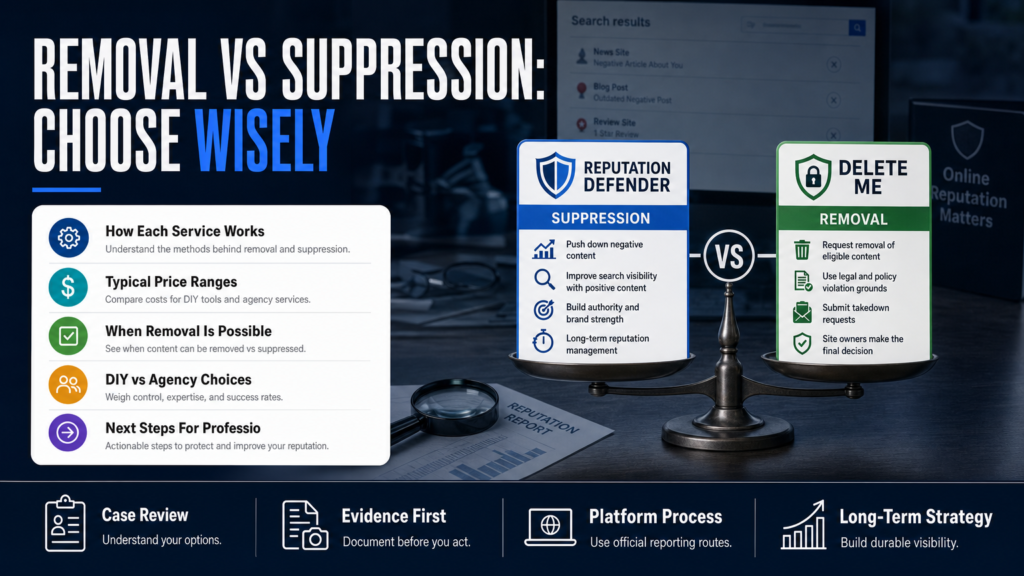
One core distinction is removal (making content disappear or be taken down) versus suppression (pushing it down in search results). Both are valid, and your case dictates the choice.
Below is a concise two-column comparison to help decide whether to pursue removal, suppression, or a combined approach.
- Assess whether the content violates platform policy or law — if yes, pursue removal options.
- If removal is unlikely, plan an SEO suppression campaign plus content controls (LinkedIn, company site, press).
- Combine approaches: attempt removal while preparing suppression content and monitoring results.
- Removal is the priority for clear platform-policy violations, impersonation, doxxing, or content protected by law.
- Suppression is realistic for truthful but harmful content, persistent public records, or stubborn publisher refusals.
Tactical checklist for hybrid cases
When a publisher refuses correction, begin suppression with high-quality, authority content and consider paid amplification to speed visibility changes.
Keep an eye on citation trails — some negative items are syndicated to dozens of sites and each must be managed.
- File platform reports where policy fits
- Start content production for suppression
- Use targeted PR for authoritative counter-content
When Removal Is Not Available — Practical Next Steps
Removal is sometimes impossible: truthful public records, some news reporting, and defensible opinions often remain online. If removal is not available, mitigation and narrative control are your tools.
Mitigation means correction, context, and visibility work: publish authoritative content, correct factual errors where possible, and use monitoring to detect spread.
- Get a search-results audit: identify which pages must be outranked.
- Produce and optimize 3–7 authoritative pages that reflect the correct narrative.
- Monitor search movement; adjust content strategy after 30–90 days based on results.
- Write a factual, neutral statement on your site addressing the issue if accurate and advisable.
- Use SEO to create trusted pages (LinkedIn, professional directories, press releases) that outrank negatives.
- Contain spread: ask aggregators to de-index duplicated content when policy applies.
A note on legal options
The content may warrant legal review. A qualified attorney can determine whether a legal claim may be available. We coordinate with qualified legal professionals when a matter requires legal analysis.
- Legal action is evidence-dependent and jurisdiction-specific
- Court orders can lead to takedowns but are not guaranteed
- Litigation often lengthens the timeline and increases cost
DIY vs Hiring An Agency — How To Choose
Many professionals weigh doing it themselves versus hiring a specialist. Small, simple opt-outs or a few review responses can be DIY. Complex, multi-channel issues typically benefit from an agency.
If you are unsure whether to proceed alone, read our breakdown of when to escalate and practical first steps. If a single viral complaint threatens licensure or employment, start with emergency containment and consider professional help — see Can ReputationDefender Fix a Viral Complaint and Save Your Career?.
- For DIY: follow platform reporting steps, document everything, and set a 30–60 day review.
- For agency: require a written plan and a short pilot phase before committing to long-term retainers.
- Always preserve evidence and maintain a calm, factual tone in public responses.
- DIY: good for single people-search opt-outs, one-off review responses, and basic SEO pages.
- Agency: preferred for coordinated review-bomb defenses, complex suppression campaigns, or ongoing monitoring.
- Hybrid: some agencies offer advisory packages where you execute simple opt-outs under guidance.
What to expect from a professional engagement
A reputable agency will perform an audit, classify items by removal likelihood, recommend a mix of takedown and suppression, and provide monitoring for a defined period. They should clarify when they will coordinate with legal counsel.
- Audit and priority matrix
- Takedown and suppression plan
- Monitoring and reporting cadence
How To Assess An Offer And The Immediate Actions You Can Take
Before signing, insist on an itemized plan, a statement of what is not possible, and a documented escalation path. If you need immediate steps, here’s a short triage checklist.
For guidance on managing single review crises in a practice setting, see When One Review Threatens Your Practice: What To Do Next.
- Step 1: Document — capture screenshots and URLs and note dates.
- Step 2: Report — flag impersonation or policy violations to platforms.
- Step 3: Contain — change passwords, secure accounts, and turn on 2FA.
- Step 4: Plan — decide DIY vs agency and request a written scope.
- Immediate triage: preserve screenshots, collect timestamps, document who saw the content and where.
- Do not engage in threats or doxxing; keep public replies factual and brief.
- Start a search-audit and set alerts for new mentions using a monitoring tool.
What a good scope-of-work includes
It should list each target (URL/platform), the action the firm will attempt (report, opt-out, legal demand, SEO), estimated milestones (ranges only), and monitoring frequency.
- Target list of URLs
- Planned actions per item
- Monitoring and reporting schedule
Removal vs Suppression — Quick Comparison
Use this table to decide immediately whether to prioritize removal attempts or an SEO suppression campaign.
| Removal | Suppression |
|---|---|
| Goal | Goal |
| Make the content disappear or be blocked | Push content below page one with positive material |
| Best for policy violations, impersonation, doxxing | Best for truthful articles, court records, syndicated complaints |
| Relies on platform/publisher action or legal orders | Relies on SEO, content creation, and authority signals |
| Often faster if policy is clear but not guaranteed | Takes weeks to months; visible progress depends on competition |
| May require legal costs | Usually requires content production budget and SEO expertise |
Hypothetical Example: A Surgeon, A Negative Article, And The Response
Situation: An anonymized example — a late-night online article alleges negligence in a single case. The article is factually disputed by the surgeon and shared widely on social platforms. The surgeon is not named in any legal judgment, and the hospital issues a limited statement.
Assessment: The content is journalistic in style and published on a regional news site (publisher-controlled), syndicated to multiple aggregate sites, and appears as the top result for the surgeon’s name.
Actions taken: The surgeon’s team followed a mixed strategy: immediate containment, publisher outreach, potential legal review, and a suppression campaign.
- Day 0–3: Triage — preserve evidence, request removal of any policy-violating social posts, set alerts.
- Week 1–3: Outreach — send a correction request to the publisher (and an attorney assessment if needed). Begin SEO content publishing.
- Month 1–3: Monitor and adjust — track rankings, amplify authoritative content, negotiate with aggregators for de-indexing where appropriate.
- Immediate containment: document screenshots, request removal of social shares that violated platform rules, secure accounts.
- Publisher outreach: request factual correction with documented evidence; insurer and hospital counsel looped in.
- Suppression: create authoritative profiles (hospital bio, LinkedIn), publish a clear professional response on the surgeon’s site, and place an expert commentary with a local health outlet to outrank.
Common Mistakes That Make Reputation Problems Worse
These are repeated errors we see. Avoid them.
Mistake 1 — Reacting Emotionally In Public
Posting angrily on social platforms or threatening the reviewer escalates the visibility and can be used against you. Always have a calm, factual response or no response until you consult counsel or a reputation advisor.
- Emotional replies inflate attention
- Platform moderators may ignore abusive responses
Mistake 2 — Paying For Fake Positive Reviews
Buying fake reviews or using friends to pad ratings violates platform policies and can result in penalties. It damages credibility and may expose you to fines or platform sanctions.
- Violates Google and Yelp policies
- Undermines long-term trust
Mistake 3 — Assuming Old Content Is Harmless
Old content can resurface and stay in search results indefinitely. Do a full audit — syndicated copies and caches mean old posts may be ranking for years.
- Check caches, copies and syndications
- Treat dated posts as active threats if they rank
Mistake 4 — Hiring A Vendor Without A Written Plan
Signing a vague contract can lock you into fees with little transparency. Require a scope-of-work and milestones before payment.
- Insist on targets, actions, and reporting
- Clarify when legal counsel is separate
Mistake 5 — Ignoring Monitoring After An Incident
Reputation incidents can flare up again. Stopping monitoring too early leaves you blind to new syndications or copycat posts.
- Maintain alerts for at least 6–12 months after an incident
- Adjust strategy as search and social signals change
Best Practices For Professionals Facing Reputation Threats
A pragmatic checklist for durable recovery.
Practice 1 — Start With Accurate Documentation
Collect screenshots, URLs, timestamps, and witness accounts. A clear audit reduces wasted effort and accelerates legal or platform actions.
- Preserve evidence in multiple formats
- Record who saw the content and when
Practice 2 — Prioritize Safety And Containment
Secure accounts (change passwords, enable 2FA), remove exposed personal data if possible, and limit the content’s reach on social platforms through platform reports when policy applies.
- Lockdown vulnerable accounts
- Report impersonation and doxxing immediately
Practice 3 — Use Neutral, Corrective Public Responses
If you must respond publicly, keep replies factual and concise. Avoid admissions or statements that create new legal exposure.
- Stick to verifiable facts
- Keep responses short and professional
Practice 4 — Build Authority Content For Suppression
Create and optimize pages that establish your professional identity: an up-to-date website bio, LinkedIn, professional directories, and media placements. High-authority content is the primary tool for suppression.
- Publish 3–7 authoritative pages
- Use consistent name and credentials across profiles
Practice 5 — Maintain Ongoing Monitoring
Set up alerts and periodic audits. Early detection reduces spread and cost. Monitoring also documents recurrence if legal action becomes necessary.
- Use Google Alerts, platform alerts, and a monitoring dashboard
- Review search results monthly for at least six months
Expert Tips
- Preserve evidence immediately — screenshots with timestamps are the cornerstone of any action.
- If content alleges illegal activity or malpractice, consult qualified legal counsel before posting a public defense.
- Do not pay for fake reviews; invest instead in a verified review-generation plan for satisfied clients.
- When publishing suppression content, use your real, consistent identity and domain authority for credibility.
- Treat data-broker removal as ongoing — many sites reappear and require repeat opt-outs.
- Short, factual responses on review sites often reduce escalation — avoid long narratives in public replies.
- Ask any vendor for a pilot or single-item engagement to evaluate competence before larger commitments.
- Keep a contact list of platform escalation channels and a basic timeline of actions taken.
Conclusion
Choosing between Reputation Defender vs Delete Me — or any removal vs opt-out provider — is a matter of fit, not virtue. Start by classifying the problem: is it a platform policy violation, a syndicated news article, a people-search listing, or a coordinated review attack? Each requires a different mix of legal, technical, and editorial responses.
Be skeptical of promises and demand an evidence-based, written plan. When removal is not available, suppression and narrative work are effective and measurable alternatives. If you’re facing an immediate career risk, prioritize containment, documentation, and expert assessment before escalating.
The right first step is an honest audit and a short-term, reversible plan that preserves options. That approach keeps you in control while you decide whether to pursue removal, suppression, or both.
Why Businesses Choose Your Reputation Agency
Managing your reputation takes more than monitoring reviews or publishing the occasional blog post. It takes a strategy built around your situation, your industry, and what is actually showing up in search.
Your Reputation Agency works with businesses, executives, healthcare professionals, attorneys and growing brands. Our services include:
- Remove or suppress negative Google search results and news articles
- Take down or mitigate negative reviews (Google, Yelp, Trustpilot, industry sites)
- Remove defamatory content, false posts and impersonation accounts
- Remove personal data from people-search and data-broker sites (opt-outs)
- Mugshot and arrest-record removal or suppression
- YouTube and negative video removal / demotion
- Rapid crisis response for viral incidents and online smear campaigns
- Social media impersonation and fake account removal
- Reputation monitoring, alerts and ongoing surveillance
- Search engine reputation repair (SEO to bury negative results)
Frequently Asked Questions
1. Is Reputation Defender legitimate?
Yes — Reputation Defender is a commercial reputation-management company that operates within platform processes and legal channels. Legitimacy means it uses official reporting, opt-outs, SEO and sometimes legal coordination. It cannot guarantee removal or special access to platforms.
2. What is the best online reputation management company?
There is no single ‘best’ company for every case. The right company depends on the problem type: data-broker opt-outs, review attacks, or defamatory articles all require different skills. Evaluate firms on SEO capability, takedown experience, and industry knowledge.
3. How much does it cost to use Reputation Defender?
Costs vary. Simple opt-outs may run $500–$2,000. Moderate suppression and review work commonly falls in $2,000–$8,000. Complex defamation and legal escalation can exceed $8,000. These are market ranges, not guarantees; exact pricing depends on the case.
4. What are the different types of reputation?
Practically, reputation falls into personal search reputation, business/brand reputation, review reputation, and privacy/exposure issues (data-brokers, doxxing, mugshots). Each category uses specific tools and workflows.
5. Can I remove a truthful news article about me?
Truthful news is usually not removable on the basis of being negative. Options include requesting corrections for factual errors, filing legal claims only when defamation elements exist, or pursuing suppression with authoritative content and SEO.
6. How long does suppression take?
Suppression timelines vary by content authority and competition. You may see movement within weeks for low-authority results, but expect months for entrenched, high-authority pages. Timing depends on many factors and cannot be guaranteed.
7. When should I involve an attorney?
Consult an attorney if the content alleges criminality, threatens your license, contains false factual allegations that defame you, or involves doxxing and threats. An attorney can assess legal claims and draft formal demands when appropriate.
8. Are people-search opt-outs permanent?
Opt-outs reduce visibility but are not always permanent: data brokers may repopulate listings or new aggregators may appear. Effective management combines opt-outs with monitoring and periodic repeat requests.
9. What should I do first if a review attack begins?
Triage: document the reviews, flag any policy-violating posts to the platform, respond briefly and professionally to genuine concerns, and consider temporary suppression or monitoring while you decide whether to hire a specialist.
This content provides general information and does not constitute legal advice. The available options and likely outcomes depend on the facts, evidence, platform policies, applicable law, jurisdiction, and public-interest considerations.
Past examples do not guarantee future results. Removal, correction, deindexing, and search-position changes depend on third parties and circumstances outside Your Reputation Agency’s control.