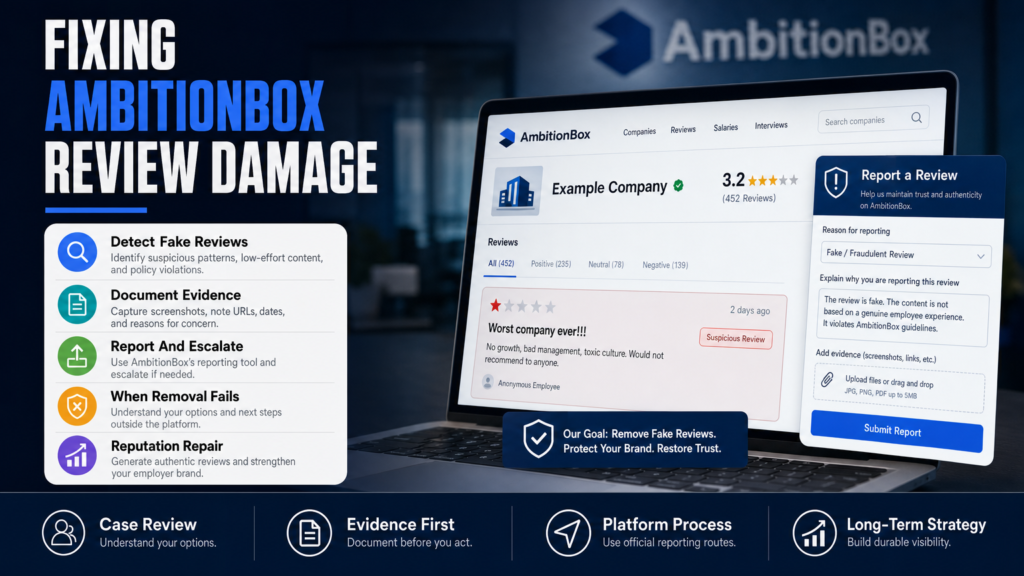
You found hostile or clearly falsified employee reviews on AmbitionBox and they’re appearing in search results for your company. This guide shows exactly what to do next and how we evaluate whether content may qualify for removal or suppression — including how to remove fake reviews from ambitionbox in practical terms.
You’ll get step-by-step actions you can take now: how to spot fake AmbitionBox reviews, how to assemble the evidence reviewers and platforms require, how to use AmbitionBox’s reporting channels and what to do if the platform won’t remove the content. The article also covers cross-platform escalation (Google and other employer-review sites), cost considerations, and mitigation strategies when removal isn’t available.
If you manage a small or medium business, a professional practice, or you’re an HR lead dealing with reputational risk, this article gives a pragmatic workflow you can start today and the realistic expectations you should set with stakeholders.
Table of Contents
- Are Fake Reviews Allowed On AmbitionBox?
- How To Identify Fake AmbitionBox Reviews
- How To Report And Escalate Fake Reviews On AmbitionBox
- How To Fight Fake Reviews Across Platforms (Including Google)
- How Much Does It Cost To Remove Or Manage Negative Reviews?
- What To Do When Removal Isn’t Available
- Do Platforms (Like Google) Penalize Fake Reviews?
- Long-term Monitoring, SEO And Reputation Repair
- DIY vs Agency: Which Approach Suits Your AmbitionBox Problem?
- Hypothetical Scenario: From Detection To Mitigation
- Common Mistakes Companies Make When Dealing With Fake AmbitionBox Reviews
- Best Practices For Handling Fake AmbitionBox Reviews
- Expert Tips
- Conclusion
- Why Businesses Choose Your Reputation Agency
- Frequently Asked Questions
Are Fake Reviews Allowed On AmbitionBox?
AmbitionBox, like most employer-review platforms, has policies against fake, defamatory, or impersonation reviews. However, enforcement depends on the evidence you provide and platform capacity. Saying a review is “fake” is not the same as proving it under their policy.
You should evaluate each problematic review against several criteria: whether the author can be verified as an employee, whether the review contains fabricated facts presented as events, whether it’s an impersonation, or whether it violates the site’s content rules (harassment, privacy violations, explicit threats).
- Collect the review link and a screenshot for records (include timestamp and URL).
- Compare the review text to your internal records (employment dates, communications) for verifiable discrepancies.
- Preserve any related public posts or profiles that indicate the review’s author is fake or coordinating reviews.
- AmbitionBox policies prohibit content that is fraudulent, impersonates an employee, or violates privacy.
- AmbitionBox will review complaints but may decline removal if the content is framed as opinion or lack sufficient evidence.
- The platform’s decisions are under its control; we help prepare evidence but cannot force a removal.
How To Identify Fake AmbitionBox Reviews
Spotting fake reviews is partly pattern-recognition and partly evidence gathering. Fake reviews often share common signals; document them before filing a complaint.
Don’t assume a hostile ex-employee equals a fake review — hostile reviews can be genuine but still actionable if they contain fabrications or personal data exposures.
- Run reverse image searches on profile pictures.
- Check the reviewer’s LinkedIn, Facebook, or other public pages for employment history inconsistencies.
- Save metadata: reviewer handle, profile URL, review URL, and capture the surrounding page (HTML or PDF).
- Repeated phrasing, identical sentences, or copy-paste text across multiple reviews.
- Profiles with no history on AmbitionBox, generic names, or stock photos that reverse-search to unrelated identities.
- Reviews posted within a very short window (review-bombing) or from accounts that have only ever reviewed your business.
- Claims of facts you can disprove with verifiable records (employment dates, job title, pay).
Tools That Help
Use simple open-source checks before escalating: reverse image search (Google Images, TinEye), Wayback Machine snapshots, and spreadsheets to track timestamps and duplicates.
If multiple reviews show the same IP patterns or coordination, that’s evidence for platform escalation or legal review — preserve logs and export data where possible.
- Google/TinEye for images
- Wayback Machine for page history
- Spreadsheet or ticketing system to log evidence
How To Report And Escalate Fake Reviews On AmbitionBox
AmbitionBox provides reporting tools for reviews that violate its terms. A structured, documented report increases the chance reviewers will act. Below are practical steps and templates to use when you report.
If AmbitionBox’s standard reporting does not resolve the issue, escalation options include contacting parent company support, requesting takedown via a designated agent, or preparing for legal takedown requests if the content meets the threshold for defamation or privacy violations.
- Step 1 — Document: Save the review URL, review ID (if visible), and an HTML or PDF snapshot.
- Step 2 — Compare and Prepare Evidence: Gather employment records, IP logs (if available), and other corroborating material.
- Step 3 — Use AmbitionBox’s Report Function: Submit the report with a cover letter and attachments via their help or contact page.
- Step 4 — Follow Up: If you receive no response within the platform’s stated SLA, escalate to the platform’s parent company support channel with the same packet.
- Step 5 — Consider Legal Review: If the content is defamatory, harassing, or exposes private data, consult a qualified attorney to assess further options.
- Prepare a concise cover letter that lists each review, why it violates policy, and the evidence you attach.
- Attach verifiable evidence: employment records (where permissible), screenshots, and records of impersonation or coordination.
- Keep a professional tone; do not publish threats or solicit public retaliation — platforms react faster to calm, factual submissions.
Sample Reporting Checklist
Use this checklist before submitting: review link, screenshot, why it violates terms, identity-discrepancy evidence, timeline of events, and your contact information for follow-up.
- Review link and screenshot
- Clear statement of policy violation
- Supporting evidence files
- Contact information
How To Fight Fake Reviews Across Platforms (Including Google)
AmbitionBox reviews can appear in broader search results and may be mirrored elsewhere. Fighting fake reviews means working platform-by-platform and using the official reporting channels each requires.
For Google-specific issues — like a review showing up in search snippets — you should combine platform reporting with search-engine reputation strategies. For a detailed breakdown of map-based review attacks and recovery, see The Anatomy of a Google Maps Review Attack and Recovery.
- Identify every platform and duplicate where the review appears.
- Submit tailored reports to each platform with the same evidence packet.
- Begin a mitigation plan (see mitigation section) concurrently — don’t wait for platform action.
- Report the same evidence to each platform where the content appears; do not assume one takedown will remove every instance.
- For search visibility, prepare to pursue suppression strategies (SEO, positive content, press) where removal isn’t granted.
- Document each submission and response to create an evidence trail for further escalation or legal steps.
When To Loop In Legal Counsel
If a review includes demonstrably false facts presented as law (e.g., claims of criminal conduct that didn’t occur), or it publishes private data, a lawyer can advise on a legal takedown or cease-and-desist. Legal routes may be necessary but are not guaranteed.
Coordinate with counsel to ensure evidence is preserved and to draft appropriate notices; do not treat legal action as an automatic fix for every negative or false comment.
- Legal review recommended for defamation, doxxing, or impersonation
- Preserve evidence before sending legal notices
- Legal outcomes depend on jurisdiction and proof
How Much Does It Cost To Remove Or Manage Negative Reviews?
There is no fixed fee that guarantees removal. Costs vary by approach: DIY reporting is free but time-consuming; engaging a reputation firm or attorney adds fees; legal takedowns add attorney costs and court expenses in some cases.
We assess the situation first and provide an estimate tailored to the work required. For perspective on downstream business impact and replacement cost, review What One Fake Review Actually Costs Your Practice.
- Estimate impact and scope: number of reviews, duplicates, and platforms involved.
- Decide whether to pursue only platform reporting, add SEO suppression, or engage legal counsel.
- Request detailed, itemized quotes from vendors or counsel to compare expected deliverables.
- DIY reporting: nominal monetary cost, moderate time investment.
- Reputation agencies: typically monthly retainers or project fees depending on scope (monitoring, content creation, outreach).
- Legal action: variable—initial attorney consults, cease-and-desist letters, possible litigation costs.
- SEO and suppression campaigns: project fees for content creation and link-building, often multi-month engagements.
Budgeting Ranges (Typical, Not Guaranteed)
Indicative ranges reflect typical market activity but are not promises: a focused reporting & follow-up effort might be under $1,000 in staff time or contractor fees; multi-platform suppression plus monitoring commonly runs several thousand dollars over months; legal takedowns can exceed that depending on complexity.
- Small in-house push: $0–$1,000 (mostly staff time)
- Agency-managed remediation + monitoring: $1,500–$8,000+ over months
- Legal engagement for takedown or litigation: variable, often $3,000+
What To Do When Removal Isn’t Available
Sometimes AmbitionBox or other platforms decline to remove content because it does not breach their guidelines or because it’s framed as opinion. When removal is not available, the sensible path is mitigation: correct, contextualize, and suppress.
Mitigation combines factual responses, search-engine reputation repair, positive content publishing, and detection measures. One helpful primer on quantifying reputational impact is What a One-Star Review Really Costs Your Practice.
- Step 1 — Audit search results for your company and identify which pages rank for key queries.
- Step 2 — Create new, high-quality content and optimize it for the same queries (company About, careers, press releases).
- Step 3 — Promote that content (social, PR, backlinks) to increase authority and likelihood of ranking above the negative page.
- Step 4 — Implement monitoring to catch future fake reviews quickly.
- Respond where appropriate: factual clarifications rather than emotional rebuttals (only when platform allows responses).
- Publish authoritative content: employee testimonials, case studies, press coverage, and a clear careers page to outrank negative results.
- Use targeted SEO and content promotion to push negative pages lower in search results.
- Set up monitoring and alerts to detect new instances early and address them quickly.
When Public Response Helps — And When It Hurts
A measured public response can correct factual inaccuracies and show readers you take concerns seriously. Avoid defensive, accusatory, or legally threatening language in public replies; such responses can escalate visibility and harm search signals.
If replying is not allowed on AmbitionBox or the response would draw more attention to a false allegation, focus on behind-the-scenes mitigation instead.
- Factual, concise corrections work best
- Avoid emotional or retaliatory language
- Prefer private outreach when possible
Do Platforms (Like Google) Penalize Fake Reviews?
Platforms such as Google and AmbitionBox have policies against fake reviews and do take action when violations are proven. That said, enforcement is inconsistent and depends on the evidence and platform priorities.
Google does act on coordinated review manipulation and fake accounts when identified, but it does not ‘punish’ all accounts automatically; decisions are made case-by-case and are governed by the platform’s content policies.
- Document coordination or duplicate behavior across accounts.
- Report to each platform with clear evidence.
- If platforms decline action, preserve records and consider legal options if appropriate.
- Platforms can remove or suppress reviews that breach their terms.
- Automated detection flags many abuses, but human review is often required for removals.
- Proof of coordination, impersonation, or fabricated facts strengthens the case for action.
Long-term Monitoring, SEO And Reputation Repair
The safest way to reduce the impact of fake AmbitionBox reviews is an ongoing program of monitoring, proactive content, and reputation-building. This is a multi-channel effort: careers pages, press, LinkedIn, Glassdoor, and SEO all matter.
Start with consistent monitoring and a rapid-response playbook so you can evaluate and act the moment an attack begins.
- Implement daily or weekly alerts for brand mentions and review activity.
- Create and promote at least two high-authority pages that address employer reputation and careers.
- Review and update the playbook quarterly and after any incident to close gaps.
- Set alerts for brand + company name, AmbitionBox pages, and common misspellings.
- Maintain a content calendar for positive, authoritative pages to outrank negatives.
- Use structured data and canonical tags on your properties to increase search relevance.
Monitoring Tools To Consider
Combine free alerts (Google Alerts) with paid monitoring platforms for more comprehensive coverage. Retain records of every incident and response; they matter in later escalations.
A professional agency can reduce the administrative burden and coordinate cross-platform actions efficiently.
- Google Alerts
- Platform-native alerts (AmbitionBox, Glassdoor)
- Commercial reputation monitoring tools
DIY vs Agency: Which Approach Suits Your AmbitionBox Problem?
A quick side-by-side to help choose a path for dealing with fake AmbitionBox reviews.
| DIY (In-House) | Agency (Specialist Support) |
|---|---|
| Cost (direct) | Monthly or project fees |
| Time to act | Frees internal time |
| Expertise | Platform and legal coordination |
| Access to escalation paths | Established escalation workflows |
| SEO/suppression abilities | Integrated SEO and content campaigns |
| Legal coordination | Can coordinate with counsel |
| Reporting and documentation | Professional evidence packaging |
Hypothetical Scenario: From Detection To Mitigation
A mid-size consulting firm notices three new AmbitionBox reviews posted in 48 hours accusing the company of ‘phantom layoffs’ and naming non-existent managers. The reviews have nearly identical wording. The company follows this workflow:
This example is hypothetical and anonymized to illustrate the process; outcomes depend on evidence, platform response, and legal context.
- If AmbitionBox declines removal, the firm escalates to the platform owner and consults counsel about defamatory statements. Meanwhile, the firm launches an SEO push to promote positive pages and sets up weekly monitoring.
- Step 1: Detection — HR saves URLs and takes full-page screenshots, logs timestamps, and copies reviewer profiles.
- Step 2: Verification — HR checks personnel records and confirms no layoffs occurred and the named managers never worked at the company.
- Step 3: Evidence package — The company compiles screenshots, employment rosters, and a cover letter explaining why the reviews violate AmbitionBox policy.
- Step 4: Reporting — The firm files reports through AmbitionBox’s help center and emails the platform’s support channel with the same package.
- Step 5: Parallel mitigation — The firm publishes a press statement about hiring growth, updates its careers page, and promotes employee testimonials to outrank the negative pages.
Common Mistakes Companies Make When Dealing With Fake AmbitionBox Reviews
These errors slow resolution and can make negative content more visible. Avoid them.
Mistake 1 — Reacting Emotionally in Public
Publishing angry or accusatory replies can attract attention and worsen search signals. Stick to calm, factual responses when a public reply is appropriate.
Mistake 2 — Failing To Preserve Evidence
If you don’t capture screenshots, URLs, and timestamps immediately, you may lose the ability to prove impersonation or coordination later.
Mistake 3 — Reporting Without Supporting Evidence
Platforms are more likely to act when you supply clear documentary proof. A weak report often results in denial.
Mistake 4 — Assuming Removal Is Guaranteed
Believing that a single report guarantees removal leads to disappointment. Be prepared with a mitigation plan if the platform declines action.
Mistake 5 — Ignoring Cross-Platform Copies
Removing one instance on AmbitionBox may leave copies or screenshots circulating elsewhere. Search thoroughly and report duplicates where they appear.
Best Practices For Handling Fake AmbitionBox Reviews
Adopt a repeatable process that combines evidence, platform reporting, mitigation, and monitoring.
Practice 1 — Document Everything
Save page snapshots, URLs, and reviewer profile details. Use a ticketing system or spreadsheet to track every report and response.
Practice 2 — Use Clear, Factual Reporting
When you report, state exactly which policy is violated, attach evidence, and be concise. Avoid long narratives that obscure the core violation.
Practice 3 — Prepare A Mitigation Playbook
Have templates for responses, a list of authoritative pages to promote, and an escalation list (platform contacts, legal counsel) ready before a crisis hits.
Practice 4 — Monitor Proactively
Set up alerts and regular checks of employer-review sites and search results. Early detection reduces impact and often simplifies resolution.
Practice 5 — Coordinate With Counsel When Needed
For defamation, impersonation, or doxxing cases, coordinate with a qualified attorney. Legal options are fact-dependent and not always appropriate.
Expert Tips
- Preserve evidence immediately — screenshots and URLs are worth far more than later recollection.
- When reporting, attach a one-page evidence summary to make it easy for human reviewers to act.
- If multiple reviews post in a short window, treat it as coordinated activity and escalate sooner.
- Avoid public threats or legal bluster in platform messages — be factual and concise.
- Promote official company pages (About, Careers) to outrank negative review pages.
- Use structured data on your careers and press pages to improve search visibility.
- Log every contact with platforms and counsel; a record speeds later escalation.
- Consider a short paid PR push for authoritative coverage if the negative content is trending.
Conclusion
Dealing with fake AmbitionBox reviews is a process, not an event. The most effective responses combine solid evidence, targeted reporting, and backup mitigation when removal isn’t granted. Expect platform decisions to vary and plan accordingly.
If you can document impersonation, coordination, or falsified facts, submit a concise evidence package and escalate. If platforms decline removal, shift quickly to reputation repair: publish authoritative content, promote it, and implement monitoring so future attacks are detected and handled faster.
Why Businesses Choose Your Reputation Agency
Managing your reputation takes more than monitoring reviews or publishing the occasional blog post. It takes a strategy built around your situation, your industry, and what is actually showing up in search.
Your Reputation Agency works with businesses, executives, healthcare professionals, attorneys and growing brands. Our services include:
- Remove or suppress negative Google search results and news articles
- Take down or mitigate negative reviews (Google, Yelp, Trustpilot, industry sites)
- Remove defamatory content, false posts and impersonation accounts
- Remove personal data from people-search and data-broker sites (opt-outs)
- Mugshot and arrest-record removal or suppression
- YouTube and negative video removal / demotion
- Rapid crisis response for viral incidents and online smear campaigns
- Social media impersonation and fake account removal
- Reputation monitoring, alerts and ongoing surveillance
- Search engine reputation repair (SEO to bury negative results)
Frequently Asked Questions
1. Are fake reviews allowed?
No platform formally allows fake reviews; AmbitionBox and other sites prohibit fraudulent or impersonation reviews. Enforcement, however, depends on the platform’s assessment of your evidence and their policies. Provide clear documentation when you report a suspected fake.
2. How to fight fake Google reviews?
Treat each platform on its own terms: report the review via Google’s official reporting flow, collect evidence, and include it in your submission. Combine reporting with a search-engine mitigation strategy — see The Anatomy of a Google Maps Review Attack and Recovery for an in-depth look at map-based attacks and recovery.
3. How much does it cost to remove negative Google reviews?
There’s no fixed price that guarantees removal. DIY reporting is free but time-consuming; agency remediation and SEO suppression typically cost from a few thousand dollars depending on scope; legal action varies widely. Costs depend on the number of platforms, complexity, and whether legal counsel is required.
4. Does Google punish fake reviews?
Google can remove or demote fake or coordinated reviews when violations are proven. The platform evaluates reports case-by-case, and automated systems plus human review influence outcomes. Google’s actions are not guaranteed and depend on the evidence and policy context.
5. How long does it take to remove a fake AmbitionBox review?
There is no universal timeline. Platform response times vary with workload, the strength of your evidence, and whether human review is required. Expect variable timelines and have a mitigation plan ready if removal takes time or is denied.
6. Can a lawyer force AmbitionBox to remove a review?
A lawyer may be able to demand removal where content is defamatory, harassing, or violates privacy laws, but legal options depend on jurisdiction, the facts, and the cost-benefit of litigation. Legal action should be considered with counsel and is not an automatic solution.
7. Should I reply publicly to a fake AmbitionBox review?
Only reply publicly if you can correct factual inaccuracies succinctly and professionally. Avoid inflammatory or accusatory language. If the platform doesn’t permit replies or if a reply would draw more attention, prioritize mitigation and private escalation.
8. What if the reviewer is a former employee?
A former employee can still post legitimate opinions. Distinguish between critical but truthful accounts and fabricated claims. If the review contains demonstrably false facts or personal data, document the discrepancies and submit them with your report.
9. Can suppression (SEO) replace removal?
Suppression is an accepted, often necessary complement to removal when removal is not possible. SEO and content promotion aim to reduce visibility of negative pages but do not erase them. Results vary with the strength of competing content and search algorithms.
Past examples do not guarantee future results. Removal, correction, deindexing, and search-position changes depend on third parties and circumstances outside Your Reputation Agency’s control.