What a one-star Google review really costs
The one-star Google review cost can include lost map clicks, calls, bookings, referrals, and employee confidence. The impact depends on review prominence, business type, rating history, and whether the complaint appears credible.
Seven business risks
- Lower conversion from branded and local searches.
- Lost calls, bookings, and quote requests.
- Higher advertising costs when prospects hesitate.
- More staff time spent handling objections.
- Reduced partner and referral confidence.
- Recruiting friction for customer-facing roles.
- Long-term visibility if the review is widely discussed.
Verify the reviewer, investigate the issue, respond professionally, and report only clear policy violations. Track ratings alongside calls and conversions so the response is based on evidence.
You just found a damaging article or a surge of 1-star reviews appearing in searches for your name or practice, and your first question is practical: how much will this cost to fix? This article breaks down typical online reputation management Toronto cost scenarios so you can budget and act fast.
We use ‘online reputation management toronto cost’ here because pricing often depends on local factors—market rates, platform mix (Google, Yelp, TripAdvisor, YouTube), and whether content sits on Toronto-based publishers or international sites. Below you’ll find realistic price ranges, what drives those prices, and a step-by-step checklist to get an accurate agency estimate.
You’ll also get clear instructions for the three outcomes you’ll likely face — content likely removable, content possibly removable with legal or platform escalation, and content that cannot be removed but can be suppressed or mitigated — plus what to do when removal isn’t available.
Table of Contents
- What does online reputation management cost in Toronto?
- How much does SEO typically cost in Toronto?
- How much does an ORM typically cost?
- How much does NetReputation cost?
- What to do when removal is not available
- DIY vs hiring an agency: what to consider
- How to get an accurate estimate and what agencies need
- Cost-saving strategies and red flags
- Reductions and guarantees you should avoid
- Removal vs Suppression: Which Approach Costs More?
- Hypothetical: Toronto Clinic With Viral Complaint — End‑to‑End
- Common Mistakes That Drive Up Costs or Failures
- Best Practices for Cost-Effective Reputation Recovery
- Expert Tips
- Conclusion
- Why Businesses Choose Your Reputation Agency
- Frequently Asked Questions
What does online reputation management cost in Toronto?
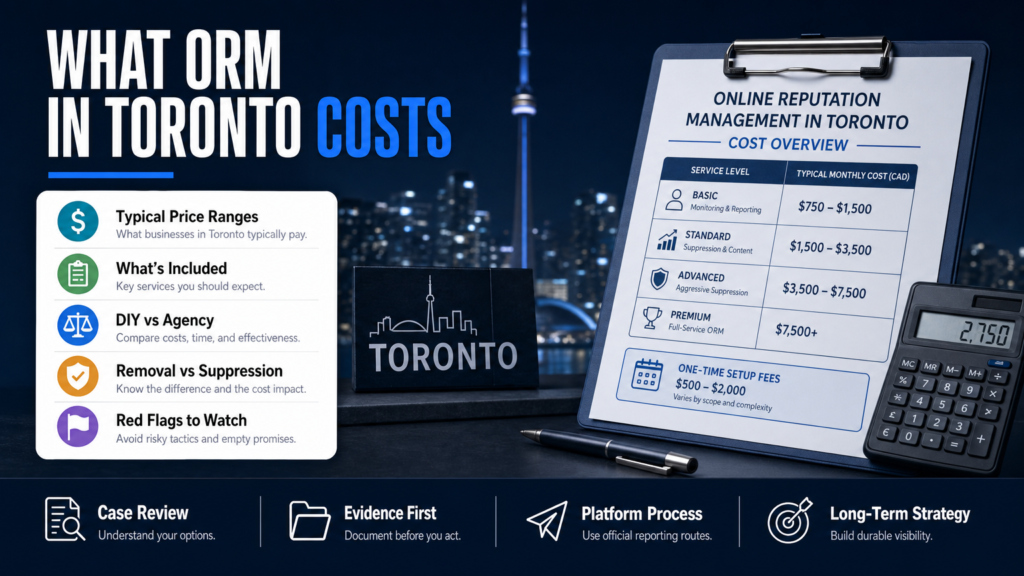
There’s no single price because reputation work is defined by the problem, not by a fixed product. Still, common Toronto scenarios cluster into predictable ranges.
For recurring ORM work focusing on review management, monitoring, response templates, and search-engine suppression, expect retainers rather than one-off fees. Below are typical ranges and what they usually cover.
- Start with an audit: a vetted agency should provide a free or paid audit that identifies the specific links, platforms, and publishers involved.
- Get written options: removal attempts, suppression plan, monitoring, and estimated timelines (always phrased as estimates).
- Compare fees and deliverables, not promises: watch for language that guarantees removal or rankings.
- Basic monitoring and review-response program: CAD 800–1,800/month — automated alerts, templated responses, monthly reporting.
- Mid-tier ORM (local businesses, professionals): CAD 1,800–5,000/month — review strategy, removal attempts, targeted SEO suppression, content creation.
- Comprehensive crisis / legal + PR + SEO programs: CAD 5,000–20,000+/month — urgent takedowns, legal coordination, sustained SEO, paid amplification and PR.
- One-off removal or takedown projects: CAD 1,000–30,000 depending on publisher, legal complexity, and whether court filings are necessary.
What drives price in Toronto specifically
Local factors: Toronto’s media market is dense; local publishers and community forums can have high visibility, which often requires PR or paid amplification to outrank.
Jurisdictional complexity: if the content is hosted outside Canada, removal may require cross-border legal work, which raises cost.
Competition: the more competitors push positive content, the more sustained SEO work is needed to keep negative items buried.
- Publisher cooperation: legacy news sites are less likely to remove content and more likely to require corrections or legal steps.
- Type of content: mugshots, doxxing or privacy violations typically require more urgent and technical intervention.
- Evidence and legal basis: defamatory or false statements that are provable will usually justify a legal escalation, which adds cost.
How much does SEO typically cost in Toronto?
SEO pricing overlaps with ORM because suppression is often achieved by publishing and promoting neutral or positive content. In Toronto, SEO agency pricing mirrors larger markets but with local nuances.
If your problem is primarily search visibility (buried or negative pages), budgeting for consistent SEO work is important; short bursts rarely stick.
- Confirm target keywords and the first page URLs an agency will compete for.
- Require a content calendar: blog topics, social assets, and backlink strategy tied to suppression targets.
- Ask for sample reporting that ties activities to visibility changes for specific URLs (not vague traffic stats).
- Local SEO packages (Google Business Profile, citations): CAD 500–2,000/month.
- Ongoing organic SEO (content, link building, technical fixes): CAD 1,500–7,500/month depending on competition.
- Project or campaign-based suppression (content creation + promotion): CAD 3,000–20,000 one-time, plus ongoing maintenance.
When SEO alone isn’t enough
SEO helps visibility but does not remove content. If the content violates platform policy or is demonstrably false, platform reporting and legal options should run in parallel with SEO.
Expect SEO suppression to take weeks to many months; some results may appear in 6–12 weeks for low-competition queries, but durable suppression often needs 6–18 months of sustained work.
- Use SEO for durable, credible content that a court of public opinion would trust (profiles, bylines, reputable directories).
- Avoid quick-fix spammy links — these can cause short-lived lifts and long-term penalties.
How much does an ORM typically cost?
‘ORM’ (online reputation management) pricing depends on service mix: monitoring, review remediation, platform takedowns, SEO suppression, and legal coordination. A typical agency will offer packages or bespoke quotes.
Be prepared to pay more when the case requires legal escalation, international takedowns, or sustained PR and content campaigns.
- Ask for an itemized proposal showing exactly what the retainer covers and what triggers extra fees.
- Request examples of similar engagements (process detail, not names or guaranteed outcomes).
- Insist on clear reporting cadence and measurable KPIs (number of links addressed, visibility changes for named URLs).
- Subscription models: recurring monthly retainers covering monitoring, basic removals, review response and suppression activities.
- Project models: one-off removals, crisis response, or targeted suppression campaigns priced case-by-case.
- Hybrid: a smaller retainer plus per-incident fees for takedowns and legal coordination.
Typical deliverables at different tiers
Entry tier: monitoring, templated review replies, basic people-search opt-outs, and monthly reporting.
Mid tier: targeted publisher outreach, formal platform reports, SEO content creation, and a set number of removal attempts per month.
High tier: 24/7 crisis response, PR coordination, legal intake and coordination with retained counsel, and paid media or content amplification.
- Make sure ‘removal attempts’ are defined: how many publishers, how many hours of outreach, and what channels are used.
- If legal coordination is part of the package, confirm whether legal fees are included or billed separately.
How much does NetReputation cost?
NetReputation is a well-known vendor in the ORM market. Like other providers, they price by scope: the platform, content type, volume of links, and the need for legal escalation.
Because vendors update their pricing and often provide bespoke quotes, the most reliable course is to request a case-specific estimate. Publicly reported starting points for larger, established vendors are often in the low thousands of dollars for initial work, but exact fees vary.
- Provide a short audit (list of URLs, screenshots, dates) when you request a quote to get an actionable estimate.
- Ask how many removal attempts are included, whether legal referrals are covered, and what ongoing maintenance costs apply.
- NetReputation and similar companies generally provide custom quotes after an audit.
- Expect higher fees for cases involving international publishers, court filings, or complex privacy violations.
How to compare vendor proposals
Compare the scope of work, not just price. A cheaper firm may only provide templated reporting and minimal outreach; a higher fee may cover legal coordination and bespoke SEO.
Request references or process documentation showing how they handle publisher pushback and escalation paths.
- Confirm billing cadence and termination terms.
- Check whether the vendor outsources removals or does them in-house.
What to do when removal is not available
Removal is often the preferred outcome, but it isn’t always possible—platform policy, truthful public records, or stubborn publishers can block takedowns. When removal isn’t available, mitigation and suppression become the primary tools.
Below are practical, proven steps to reduce the impact of content you cannot remove.
- 1) Audit the first two pages of search results for relevant queries.
- 2) Prioritize 3–7 URLs you want to push down and create a content calendar targeting them.
- 3) Combine on-page SEO (new pages), off-page SEO (high-quality links), and social signals (press, video) to outrank the negative items.
- 4) Monitor and adapt: suppression campaigns often require months of consistent activity and maintenance.
- Create authoritative, keyword-targeted content (professional bio pages, press releases, thought leadership, and FAQs) to outrank negative links.
- Optimize existing good assets (LinkedIn, institutional profiles, local directory listings) with the target name and keywords.
- Use structured data and schema where appropriate to help search engines surface the right snippets.
- Pursue correction or right-to-reply on publisher sites where the content is inaccurate or incomplete.
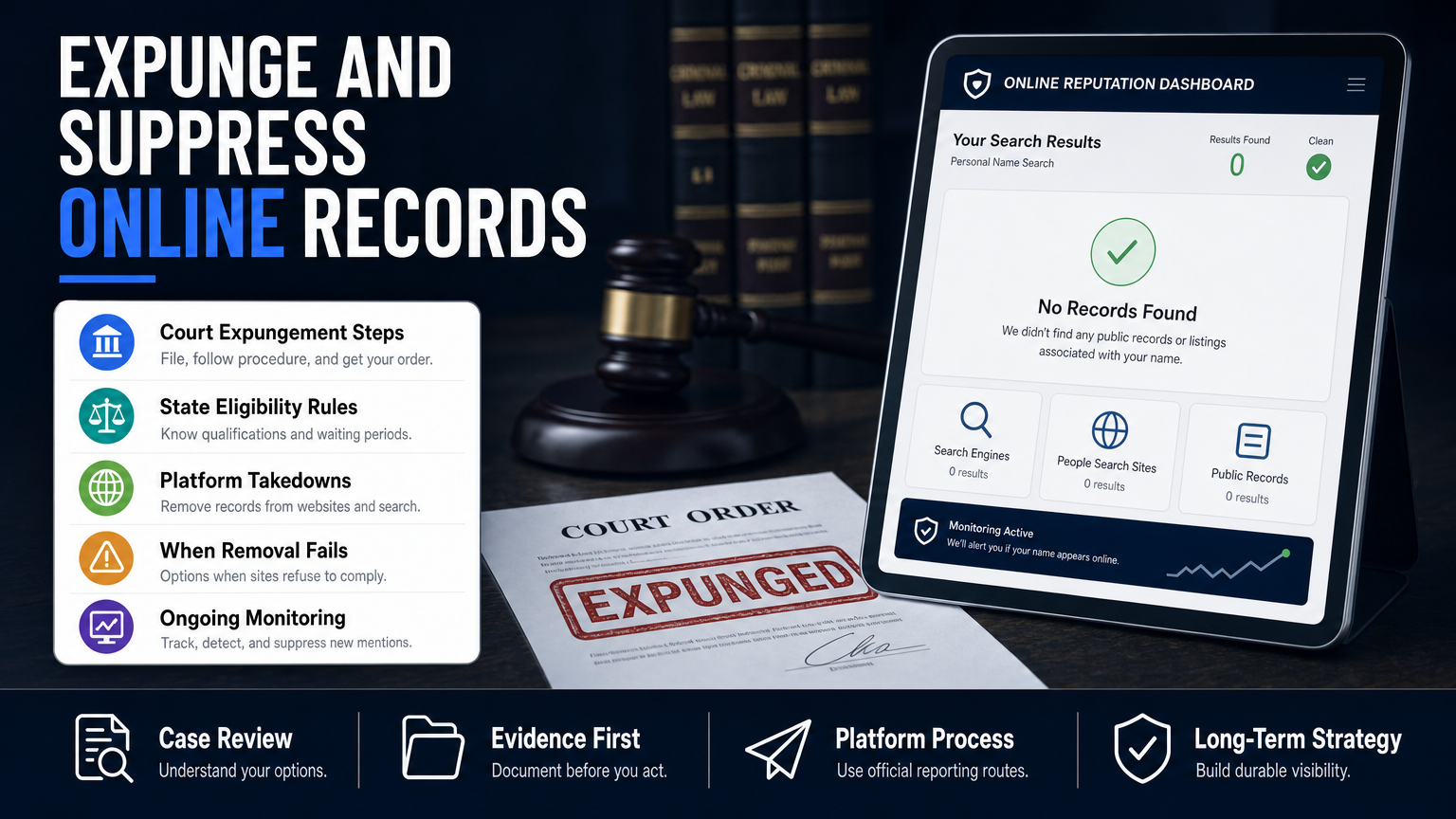
When public records block removal
If the content is a truthful public record (court filings, government registries), removal is unlikely. Focus on contextualization, response, and SEO to ensure searchers see the full picture.
You may also pursue sealing orders or record amendments through qualified counsel if appropriate under local law.
- Coordinate with legal counsel on privacy law or record-sealing options.
- Publish clear statements and supporting documents on your owned channels to provide context.
DIY vs hiring an agency: what to consider
Some professionals start with DIY steps to save cost. Others prefer an experienced agency because time, evidence handling, and specialized platform relationships matter in a crisis.
If you’re considering doing this yourself, be honest about available time, familiarity with platform policies, and whether you can produce regular, SEO-optimized content.
- 1) Run a clean audit and document every URL with screenshots and timestamps.
- 2) Prioritize quick wins (take down privacy violations, correct factual errors) before launching SEO suppression.
- 3) If the case involves potential defamation or large-scale doxxing, consult a qualified attorney before escalating publicly.
- Good DIY tasks: basic monitoring (Google Alerts), people-search opt-outs, templated review responses, and creating or optimizing your LinkedIn and professional profiles.
- Tasks that usually need an agency: complex takedown negotiations, coordinated SEO suppression campaigns, legal coordination, and 24/7 crisis response.
When to hire an agency right away
Hire an agency when the issue risks licensure, significant revenue loss, or when you lack time to manage a sustained campaign. An agency can coordinate legal counsel, PR, SEO and platform takedown attempts simultaneously.
If you hire, compare proposals carefully and ask to see the proposed activities mapped to the exact URLs you need addressed.
- Check for clear reporting, escalation procedures, and defined deliverables.
- Avoid vendors who guarantee removals or rankings.
How to get an accurate estimate and what agencies need
A reliable quote starts with evidence. Agencies will request a short intake with specific URLs, screenshots, dates, and a description of why the content is harmful or false.
Expect a process: audit → options (removal vs suppression) → proposal → kickoff. Timelines and costs will be estimates, not promises.
- 1) Send the intake documentation to an agency and ask for a written audit (many agencies do this for free or a modest fee).
- 2) Request two options: a limited-scope intervention (cheaper) and a full crisis plan (more expensive).
- 3) Compare both scope and reporting: cheaper is only better if it solves the specific problem.
- Prepare: list of affected URLs, copies/screenshots, customer interactions (if reviews), and any prior legal correspondence.
- Ask for itemized tasks: how many outreach attempts, SEO deliverables, content pieces, and monitoring hours.
- Request estimated ranges for likely outcomes and timeframes framed as conditional and dependent on platform/publisher response.
A useful next step right now
If you want to understand how search results behave for your name, read The First Page of Google Is Your Real Homepage for a framework on why the first page matters and what agencies do to change it.
That piece explains how durable content is created and measured — useful when you evaluate SEO-based suppression proposals.
- Linking your audit to specific first-page targets makes proposals easier to compare.
- Ask agencies to map each recommended activity to particular URLs rather than vague promises.
Cost-saving strategies and red flags
You can reduce spend without sacrificing outcomes if you pick the right tactics and watch for common vendor red flags.
Also learn why Google Reviews often cause outsized damage and what dedicated review-management programs cost and achieve.
- 1) Negotiate an initial 3-month engagement with clear KPIs.
- 2) Ask for month-by-month deliverables and exit terms.
- 3) Require a documented escalation path for any legal or PR steps.
- Cost-savers: prioritize the highest-impact URLs, do in-house content where feasible, and use a limited retainer for attack-phase work.
- Red flags: vendors who promise specific removals or guaranteed search positions, lack of an itemized scope, or billing models that lock you in with long automatic renewals.
A resource about reviews and crises
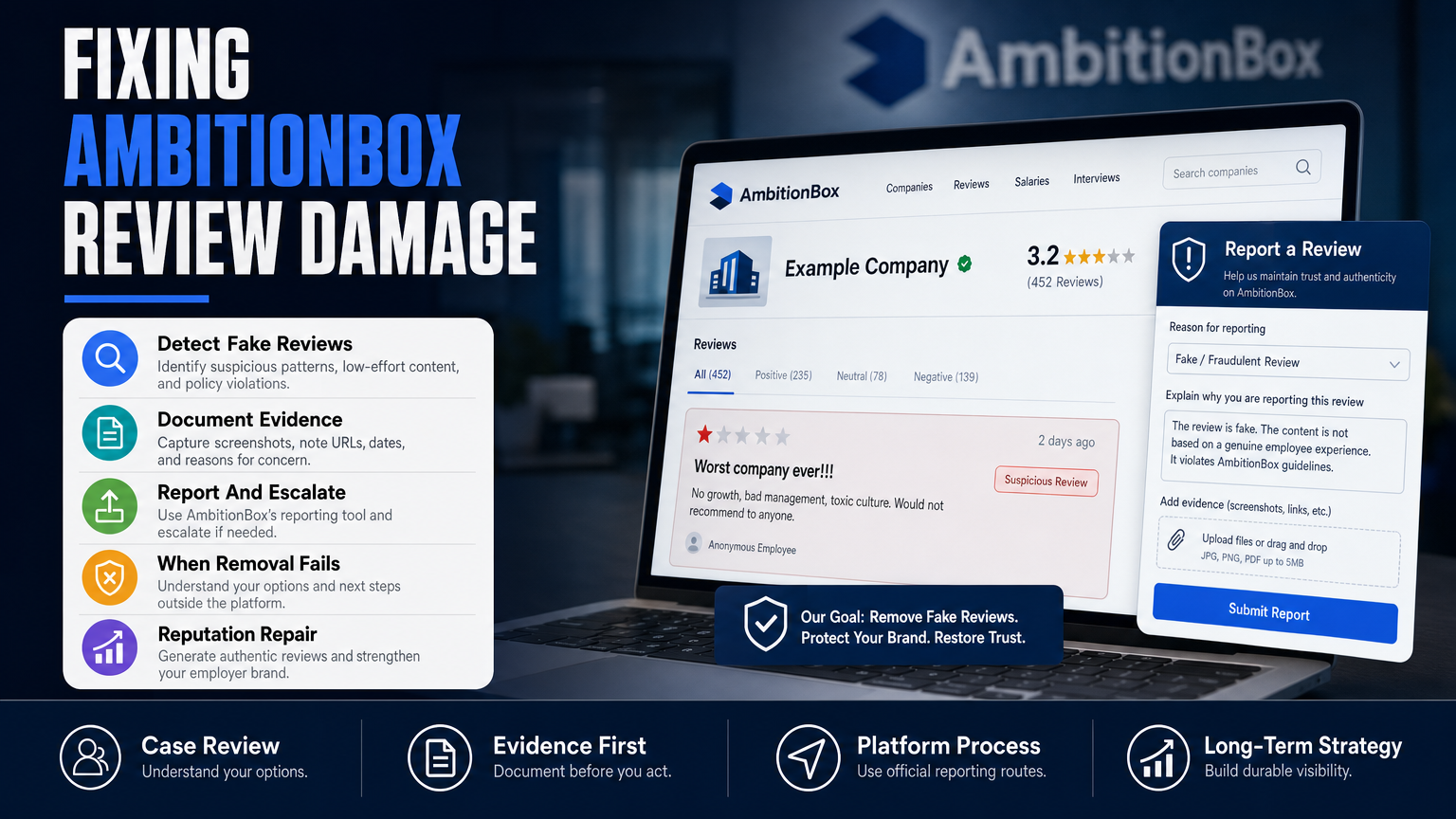
If Google Reviews are central to your issue, read When Google Reviews Become a Brand’s Biggest Crisis to understand response strategies, review dispute workflows, and when escalation may be needed.
Review removal is platform-dependent; sometimes correction, customer outreach, or publishing context works better than removal attempts.
- Documentation matters: keep screenshots and ticket numbers for review disputes.
- Avoid any offer that suggests buying positive reviews — that’s deceptive and can violate platform rules.
Reductions and guarantees you should avoid
Be wary of vendors that offer guaranteed removals, fixed timelines, or claims to have ‘special access’ to platform teams. These claims are either false or legally risky.
Instead, expect transparent process language: the agency will ‘evaluate whether the content may qualify for removal or review’ and will ‘pursue the legal, technical, platform-based, and reputational options available.’
- If you see unrealistic guarantees, ask the agency to reframe deliverables into defined actions (number of outreach attempts, number of authored pieces, monitoring hours).
- Get a written escalation path and estimate ranges, and include termination rights if the vendor misrepresents capabilities.
- Do not sign contracts that promise outcomes or permanent suppression.
- Ask for confidentiality terms in the contract — but recognize that confidentiality has limits and is not absolute.
Another useful primer
For more detail on how search-first strategies are implemented across markets, read The First Page of Google Is Your Real Homepage. That article clarifies why durable content and citation building are core parts of suppression campaigns.
Use that framework when evaluating content-production proposals in your quote.
- Ensure proposed content aligns with your professional voice and compliance obligations (e.g., medical professionals must follow licensing board rules).
- Avoid fabricated or deceptive content — publish factual, verifiable materials.
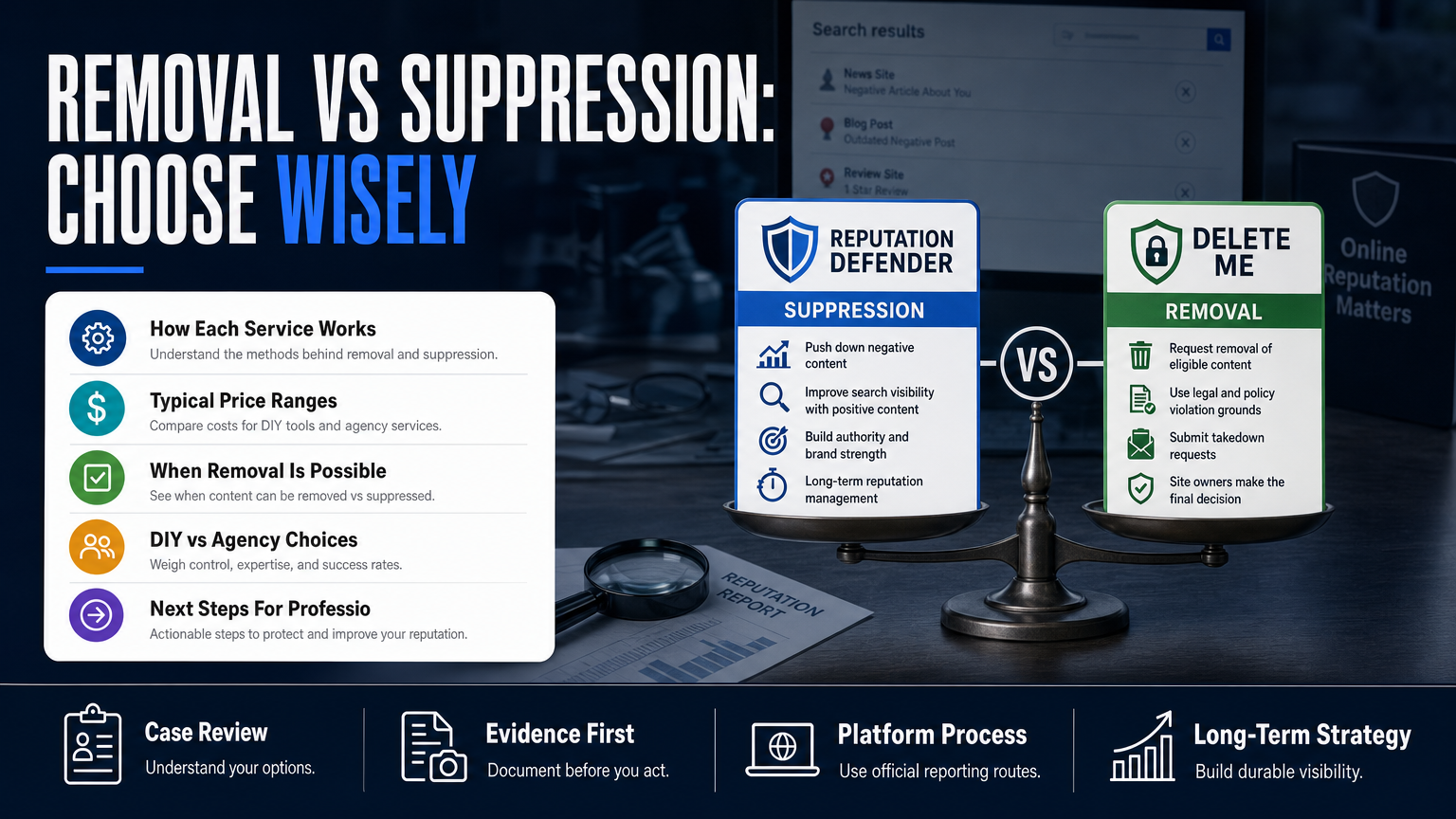
Removal vs Suppression: Which Approach Costs More?
A quick side-by-side to help you choose the right initial strategy.
| Removal (Takedown) | Suppression (SEO + Content) |
|---|---|
| Goal | Goal |
| Eliminate specific content from a platform | Push negative items below first page of search |
| Often faster if publisher cooperates | Requires continuous effort and time |
| May require legal review and formal notices | Requires content creation, link building, and technical SEO |
| Costs can spike with legal filings | Costs are steady (retainer or project-based) over months |
| Outcome depends on publisher/platform policy | Outcome depends on content quality, authority, and competition |
Hypothetical: Toronto Clinic With Viral Complaint — End‑to‑End
Scenario: A mid-size dental clinic in Toronto had a patient complaint amplified by a local blog and several coordinated 1-star reviews. The clinic’s name and physicians appeared on the first page for their brand search.
This anonymized scenario shows a common pathway from audit to stabilization.
- 1) Triage and containment (0–72 hours): set up monitoring, flag staff to avoid public replies that admit liability, and gather documentation.
- 2) Outreach (days 3–14): request corrections or right-of-reply from the blog, file review disputes where policy violations exist, and contact the Reddit poster offering to resolve the billing issue offline.
- 3) Legal intake (if needed): counsel reviewed the blog content; no clear defamation, so legal filing was not recommended.
- 4) Suppression campaign (weeks 2–12+): publish authoritative pages (physician bios, patient policies), create press-style clarifications, and build high-quality backlinks to these positive pages.
- 5) Monitoring and maintenance (months 3–12): continued review response, monthly reporting, and periodic fresh content to maintain first-page positions.
- Initial audit identified: 1 local blog post (high authority), 6 1-star reviews on Google and Yelp, and one Reddit thread with a screenshot of a billing dispute.
- Primary constraints: the local blog refused removal, the reviews violated no platform policy strictly, and the Reddit thread was within user rights.
Common Mistakes That Drive Up Costs or Failures
Avoid these frequent missteps. They waste budget and slow recovery.
Mistake 1 — Chasing every negative URL
Trying to remove or suppress every single negative mention is costly and often unnecessary. Focus on first-page results and the handful of URLs that actually affect searchers.
- Audit impact before action: prioritize by traffic and visibility.
- Use triage: immediate risks (do xx), medium (do yy), low (monitor).
Mistake 2 — Believing guarantees
Vendors promising removals or guaranteed rankings are selling certainty they cannot deliver. Platform policies, algorithms and third-party publishers are outside any agency’s control.
- Insist on process-based deliverables (outreach attempts, content count, reporting).
- Avoid long automatic auto-renewing contracts with penalties.
Mistake 3 — Public argument with reviewers
Getting into public fights with reviewers or on social platforms escalates visibility and can be legally risky. Document interactions and take disputes offline when possible.
- Use neutral, professional replies; document evidence for platform disputes.
- Escalate to legal only when counsel advises and evidence supports it.
Mistake 4 — Ignoring documentation
Failing to screenshot and preserve URLs, dates and communications makes legal or platform escalation much harder and more expensive later.
- Capture evidence immediately and store it securely.
- Record ticket numbers and responses from platforms or publishers.
Mistake 5 — Buying fake reviews or deceptive content
Paid fake reviews or deceptive content may offer a temporary lift but risks platform penalties and ethical concerns — and can damage trust if discovered.
- Invest in legitimate reputation-building: client outreach, consistent service quality and authentic testimonials.
- Follow platform guidelines for soliciting reviews.
Best Practices for Cost-Effective Reputation Recovery
These durable practices reduce long-term cost and improve the chance of a sustainable outcome.
Practice 1 — Start with a focused audit
A focused audit reveals which URLs matter. Ask the agency to map each recommended action to specific links and expected impact.
An audit is almost always worth the modest fee because it prevents wasted work.
- Ask for impact ranking: immediate, medium, low.
- Include search terms, screenshots and traffic context.
Practice 2 — Use reputable content to suppress
Create authoritative content on platforms with weight: institutional pages, major industry sites, and bylined articles on reputable outlets.
High-quality content costs more up front but is more durable than low-quality, high-volume link schemes.
- Prioritize evergreen pages with clear ownership and contact information.
- Use schema and optimization for targeted queries.
Practice 3 — Document everything
Documentation helps platform disputes and any legal reviews. Keep records of reviewer identity when possible, screenshots, ticket numbers, and correspondence.
- Store evidence off-site (secure cloud or encrypted storage).
- Log every outreach attempt and result.
Practice 4 — Coordinate legal and PR when necessary
If the case includes false allegations, privacy violations, or major financial risk, coordinate counsel and a PR professional. Coordination increases cost but reduces risk of missteps.
Ensure any legal communications are reviewed by counsel before publishing public responses.
- Use counsel for defamation, privacy law, or complex international takedowns.
- PR teams should align messaging with legal advice.
Practice 5 — Maintain monitoring after the campaign
Suppression is rarely a one-time fix. Regular monitoring lets you catch reemerging issues early and avoid surprise spikes in visibility.
A modest monthly monitoring plan can be far cheaper than repeated full-scale interventions.
- Set alerts for new mentions, reviews and social spikes.
- Schedule quarterly audits to reassess first-page visibility.
Expert Tips
- Always get a written, itemized scope before signing — deliverables matter more than price.
- Prioritize first-page URLs; the rest can often be monitored rather than attacked.
- Collect screenshots immediately; ephemeral social posts vanish and platform tickets expire.
- If reviews are the issue, document attempted remedies with customers before disputing publicly.
- Insist any timeline is framed as an estimate and depends on platform and publisher response.
- Budget for three phases: triage (immediate), remediate (weeks), and maintenance (months).
- Avoid vendors that recommend buying fake reviews — it risks penalties and reputational harm.
- Consider a 3-month test engagement to validate an agency’s process before committing long-term.
Conclusion
Budgeting for online reputation management in Toronto requires a clear assessment of the problem, a prioritized plan, and realistic expectations about outcomes and timelines. Prices vary widely because they are driven by the platforms involved, publisher cooperation, legal complexity, and the need for sustained SEO work.
Get an evidence-based audit, compare itemized proposals, and choose a vendor that explains processes clearly without promising guaranteed removals or rankings. When removal isn’t possible, a coordinated suppression and monitoring strategy can protect search visibility and your professional reputation over the long term.
Why Businesses Choose Your Reputation Agency
Managing your reputation takes more than monitoring reviews or publishing the occasional blog post. It takes a strategy built around your situation, your industry, and what is actually showing up in search.
Your Reputation Agency works with businesses, executives, healthcare professionals, attorneys and growing brands. Our services include:
- Remove defamatory content and false posts (news, blogs, listings)
- Remove or challenge negative reviews (Google, Yelp, TripAdvisor, industry sites)
- Mugshot and arrest record removal
- Remove videos, images, and other multimedia that damage reputation
- Remove personal data from people‑search and data‑broker sites (opt‑outs)
- Search result suppression (SEO to bury negative links)
- Social media takedowns and impersonation removal
- Rapid online crisis management and incident response
- Ongoing monitoring and alerting of reputation signals
- Coordination with legal counsel and use of legal tactics when required
Frequently Asked Questions
1. How much does online reputation management cost?
Costs vary by scope. In Toronto, monthly retainers for ORM commonly run from CAD 800 to CAD 20,000+ depending on services. One-off projects or legal takedowns can range from a few hundred to many thousands. A precise quote requires an audit of the specific URLs, platforms, and legal issues involved.
2. How much does SEO typically cost in Toronto?
Typical ongoing SEO in Toronto ranges from CAD 1,500–7,500/month for competitive local organic work. Local SEO packages for Google Business Profile and citations can be CAD 500–2,000/month. Project-based suppression campaigns can cost several thousand upfront plus ongoing maintenance.
3. How much does an ORM typically cost?
ORM costs reflect the mix of monitoring, takedown attempts, review management, SEO suppression, and legal coordination. Small-scale work can start around CAD 800–1,800/month; more comprehensive programs commonly fall between CAD 1,800–5,000/month; full crisis programs can exceed CAD 5,000/month.
4. How much does NetReputation cost?
NetReputation and similar vendors provide custom quotes after an audit. Publicly reported starting points for established vendors are often in the low thousands for initial work, but exact pricing varies with case complexity. Request a written estimate for your specific URLs and needs.
5. What if removal is impossible — what are my options?
When removal isn’t available, focus on mitigation: produce authoritative content to outrank the negative items, correct factual errors where possible, pursue publisher corrections or right-of-reply, and maintain vigilant monitoring. Legal options may exist in some jurisdictions, but removal is never guaranteed.
6. Can I handle this myself to save money?
You can do basic monitoring, profile optimization, people-search opt-outs, and templated review responses yourself. However, complex takedowns, coordinated suppression, legal escalation, and 24/7 crisis response typically require experienced agencies or counsel. Be realistic about time and expertise before choosing DIY.
7. How long will it take to see results?
Timelines vary: a successful platform takedown can sometimes happen in days or weeks if policies are violated, but SEO suppression and reputation rebuilding commonly take months. Any timeline offered should be an estimate that depends on publisher cooperation, platform policies, and search-engine behavior.
8. What should I provide to get an accurate quote?
Provide a short audit: a list of affected URLs, screenshots with timestamps, the queries you care about, any prior platform ticket numbers or legal correspondence, and a description of business impact. That lets agencies produce an itemized proposal tied to the actual problem.
9. Are removals guaranteed if I pay an agency?
No reputable agency can guarantee removal. Platform decisions and publisher choices are outside the agency’s control. Agencies will evaluate whether the content may qualify for removal or review and pursue the legal, technical, platform-based, and reputational options available.
This content provides general information and does not constitute legal advice. The available options and likely outcomes depend on the facts, evidence, platform policies, applicable law, jurisdiction, and public-interest considerations.
Past examples do not guarantee future results. Removal, correction, deindexing, and search-position changes depend on third parties and circumstances outside Your Reputation Agency’s control.