You’re a clinician, practice manager, or healthcare leader who just found a damaging article, mugshot page, or a stream of negative reviews visible to prospective patients. That content is costing calls, referrals, and peace of mind — and you need clear next steps.
This guide to online reputation management for healthcare explains what actually works: which platforms permit takedowns, when legal action is reasonable, how to reduce visibility through SEO, and how to run a durable review and crisis program.
You’ll get concrete actions, platform-specific processes, realistic timeframes (with caveats), and a decision framework for whether to handle this in-house or hire an agency. We explain what removal may qualify for, when suppression is the right plan, and how to protect patient privacy going forward.
Table of Contents
- Why reputation management matters for healthcare providers
- How do platforms handle removal requests for healthcare content?
- Can negative reviews be removed from Google, Yelp, and specialty sites?
- What to do when removal is NOT available
- Responding to gossip groups, social media, and impersonation
- Search-engine suppression and SEO tactics for healthcare reputations
- Monitoring, crisis response, and legal-tactical coordination
- DIY vs. hiring an agency — deciding factors
- Removal vs Suppression (SEO): Quick Comparison
- Hypothetical example: Dr. A — article + negative reviews
- Common mistakes healthcare organizations make
- Durable best practices for healthcare reputation management
- Expert Tips
- Conclusion
- Why Businesses Choose Your Reputation Agency
- Frequently Asked Questions
Why reputation management matters for healthcare providers
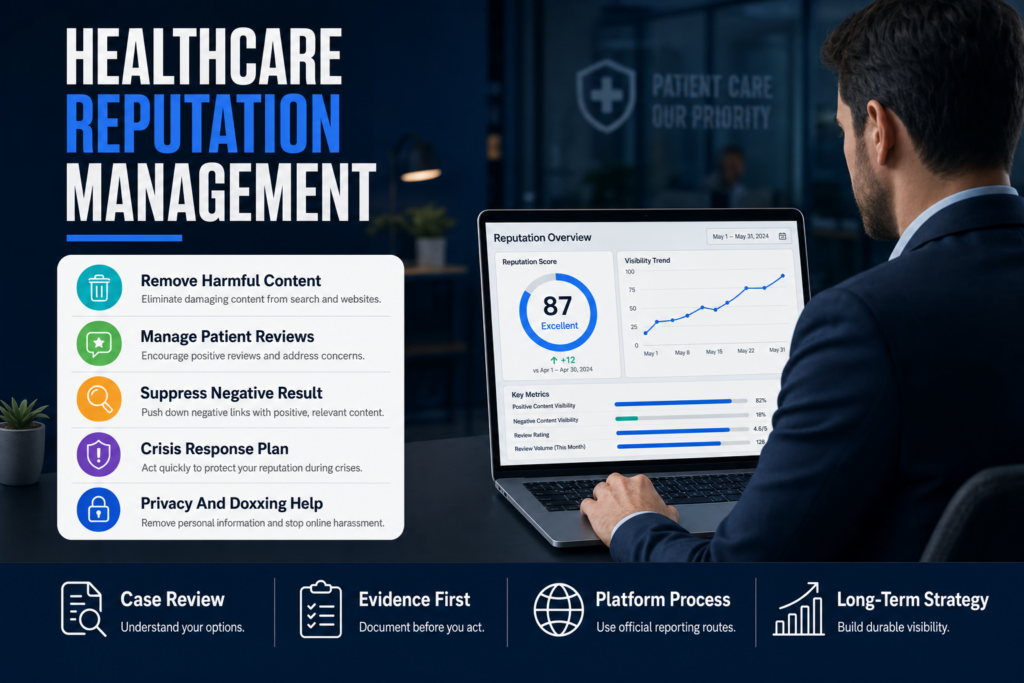
Patients often search Google, Healthgrades, Vitals, and reviews before booking. Negative or misleading content on those sites can reduce new-patient volume, affect referral relationships, and lead to regulatory or malpractice-scrutiny risks. Managing your online presence is therefore a business and clinical-quality priority.
This is about more than star ratings: a single accusation, mugshot site, or privacy breach can dominate search results for a practitioner’s name. For a deeper dive on the competitive effects and patient behavior, read Healthcare Reputation: Why Patients Are Choosing Your Competitors on Google.
Reputation work in healthcare must also consider HIPAA and state privacy laws: patient-discussion forums and social posts can create privacy and professional-risk vectors that require both technical and legal attention.
- Clinical impact: lost new patients, strained referrals
- Operational impact: scheduling and revenue disruption
- Regulatory risk: complaints, state board scrutiny, privacy breaches
How do platforms handle removal requests for healthcare content?
Removal options depend on the content category: defamation, impersonation, privacy (personal data), platform policy violations, or legal takedowns. Each platform — Google, Yelp, Facebook, YouTube, Healthgrades, RateMDs, etc. — has different rules and processes.
We evaluate whether the content may qualify for removal or review, then pursue the legal, technical, platform-based, and reputational options available. Platform decisions remain under the platform’s control.
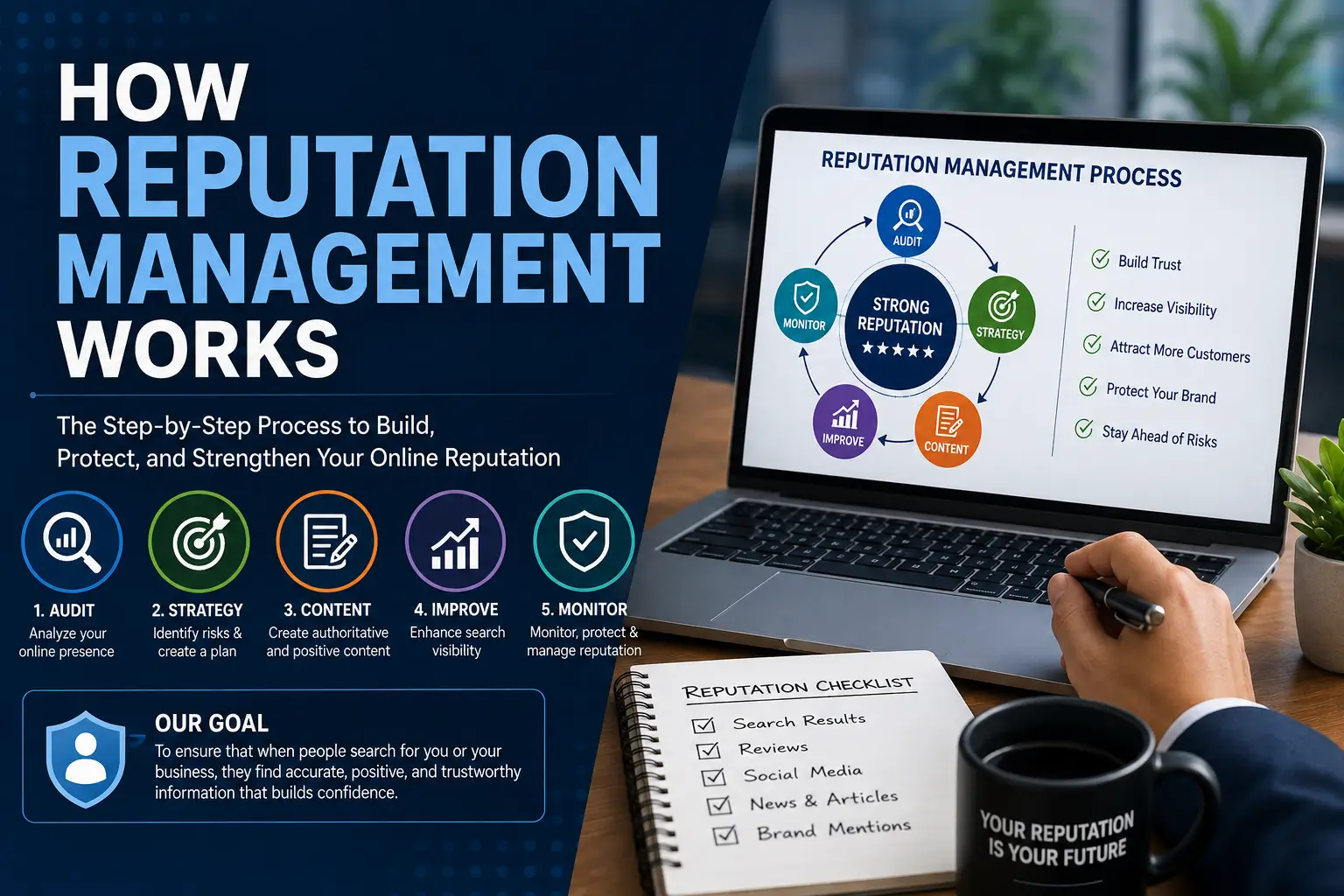
- 1) Audit: catalog every offending URL, platform, and the claim type (defamation, privacy, opinion).
- 2) Evidence: save screenshots, archive pages (Wayback), and collect original identifiers (dates, user handles).
- 3) Submit platform reports with targeted evidence and follow up through escalation channels (business support, legal forms).
- 4) If platform options fail, consider publisher contact or legal demand letters after attorney consultation.
- Google: remove content from Google Search only when it violates policies or after a publisher removes it. Use Google’s Remove Outdated Content tool for changed pages and legal-removal forms for personal data.
- Yelp/Facebook/Trustpilot: use official review-reporting flows; provide evidence for policy violations (harassment, fraud, or conflict of interest).
- Health-specific sites (Healthgrades, Vitals, RateMDs, RealSelf): each site has a different dispute process—expect manual review and varied outcomes.
Example platform processes and timeframes
Google flagging / legal forms: platform responses range from days to weeks; search-index changes may take additional days to weeks once a page is removed.
Yelp review disputes: an initial review often occurs in 3–10 business days; escalations may take longer.
Mugshot and data-broker opt-outs: some sites process opt-outs in 7–90 days, others charge fees or refuse; removal depends on site policy and jurisdiction.
Can negative reviews be removed from Google, Yelp, and specialty sites?
Removing a negative review requires demonstrating a policy violation (fake review, conflict of interest, hate speech, privacy breach, extortion) or convincing the reviewer to remove it. Honest negative reviews about clinical experience are typically opinion-based and not removable under platform policies.
Describe the issue factually when disputing reviews. For details on why proactive reputation programs matter for businesses and professionals, see Why Online Reputation Management Is Important for Businesses and Professionals.
- 1) Triage reviews by severity: false factual claims, HIPAA violations, extortion, or libel get priority.
- 2) Attempt reviewer outreach: politely ask for specifics or an opportunity to resolve; request removal when appropriate.
- 3) Submit documented disputes to platform support (attach evidence, dates, and location).
- 4) If the review is defamatory and evidence supports legal action, consult an attorney about next steps.
- Google Business Profile: flag a review for policy violations or use “Edit Profile” -> “Support” for escalations.
- Yelp: use the ‘Report Review’ link and contact business support if a review violates guidelines.
- Specialty review sites: use each site’s dispute form; document medical record references carefully to avoid HIPAA disclosure in your response.
What to do when removal is NOT available
Sometimes removal isn’t possible: truthful negative feedback, public-record arrest pages, or publishers who refuse requests. When that happens, suppression and mitigation become the primary strategy.
We develop SEO reputation strategies intended to improve the visibility of relevant and credible information. Search results may change because algorithms, competitors, publishers, and user behavior are outside our control.
- 1) Content map: identify which positive pages to build or optimize (bios, hospital profiles, faculty pages).
- 2) Publication calendar: schedule 3–6 high-quality assets (articles, interviews, patient education pages) and link them to clinic and provider profiles.
- 3) Review pipeline: implement a compliant review-generation program to gather current, authentic reviews (see best practices).
- 4) Monitor: track ranking changes and adjust content priorities every 30–90 days.
- Create authoritative, positive content (clinic pages, clinician bios, patient-education resources) and optimize them for the practitioner’s name and clinic + location keywords.
- Claim and optimize profiles: Google Business Profile, Healthgrades, Vitals, WebMD, LinkedIn, Facebook, YouTube, RealSelf — authoritative profiles rank well and push negative items down.
- Use targeted content (guest posts, local news, press releases) and structured data (schema) to earn search visibility for positive pages.
When SEO suppression is most effective
Suppression works best when the negative item ranks but is hosted on a low-authority site or is thin-content. High-authority publisher pages or legal records are harder to suppress and require longer, sustained efforts.
Estimated visible improvements can appear in weeks to months; no timeframe is guaranteed. An estimated timeline can be provided after an individual assessment.
Responding to gossip groups, social media, and impersonation
Private Facebook groups, Reddit threads, and WhatsApp/Telegram channels can spread allegations and patient gossip that harm reputations. A combination of platform reporting, takedown requests for impersonation, and measured public response is required.
For advice on navigating surgeon-focused gossip communities, consult Protecting Your Medical Reputation: Navigating Online Gossip Groups.
- 1) Contain: identify the thread and archive evidence (screenshots, permalinks).
- 2) Report: use platform abuse/impersonation forms and escalate to platform business support if possible.
- 3) Correct the record: publish an explanatory statement on owned channels if appropriate and legally safe.
- 4) Pursue legal or law-enforcement options only after attorney review when posts include doxxing, threats, or extortion.
- Impersonation: use Facebook/Instagram and Twitter/X impersonation forms; provide a government ID if required by the platform.
- Private groups: collect evidence (screenshots with timestamps, member names), report posts violating platform rules, and consider a factual public statement if the issue has become public.
- Reddit and forums: use site report flows and contact moderators; Reddit’s API and mod system can result in removals if rules are broken.
Search-engine suppression and SEO tactics for healthcare reputations
Search-engine suppression is a tactical, long-term effort to populate top-10 search results with positive, authoritative pages so negative items move below the fold. We develop SEO reputation strategies intended to improve the visibility of relevant and credible information.
Tactics must be ethical and platform-compliant: build legitimate profiles, publish helpful content, earn local and professional backlinks, and optimize for name + specialty + location queries.
- 1) Baseline audit: capture current SERP for your name and clinic keywords; identify which pages to target.
- 2) Build/optimize: claim profiles, improve bios, publish 4–8 authoritative pages, and add schema.
- 3) Promote: distribute content to relevant local and medical channels for natural links.
- 4) Measure: track ranking changes every 30 days and refine priorities.
- Priority assets: hospital profile pages, university/medical-school bios, specialty society pages, Google Business Profile, LinkedIn, and patient-education pages.
- Technical SEO: add structured data (schema.org/MedicalOrganization, Physician), improve page speed, and ensure mobile usability.
- Link strategy: secure genuine mentions from news outlets, local hospitals, and specialty blogs rather than low-quality link schemes.
Monitoring, crisis response, and legal-tactical coordination
A fast, organized response reduces damage. Monitoring detects new threats; a crisis protocol sets roles and messaging. When a matter warrants legal attention, coordinate with counsel for evidence preservation and takedown or demand letters.
We handle matters confidentially and apply privacy and security controls, and we coordinate with qualified legal professionals when a matter requires legal analysis.
- 1) Set up monitoring: add alerts for clinician names, practice names, and common misspellings.
- 2) Create a 24–48 hour triage process for viral incidents: immediate containment, public statement if needed, technical takedown requests, and legal review.
- 3) After-action: document what happened, adjust policies (privacy, intake), and implement technical fixes.
- Monitoring tools: Google Alerts (free), Talkwalker Alerts (free), Mention, Brand24, and platform native alerts for Google Business Profile and Yelp.
- Crisis runbook elements: decision owner, pre-approved factual statements, escalation thresholds (e.g., viral post, doxxing, or extortion), and legal contact information.
- Evidence preservation: capture permalinks, full-page screenshots, and export user-generated content with timestamps.
DIY vs. hiring an agency — deciding factors
Some clinics can handle low-severity issues in-house (single unfair review, minor misinfo). Complex cases (defamation across multiple publishers, mugshot sites, doxxing, or viral social attacks) typically require coordinated technical, SEO, legal, and PR efforts.
Below is a concise comparison to help you decide.
- Consider in-house if you have time, basic SEO skills, and access to legal counsel for serious threats.
- Consider an agency when you need cross-platform escalation, sustained SEO suppression, publisher outreach, and crisis PR.
Removal vs Suppression (SEO): Quick Comparison
Use this to choose a primary approach when dealing with harmful healthcare content.
| Removal | Suppression (SEO) |
|---|---|
| Goal | Push negative content down |
| Best for | Best for low-authority publishers and policy violations |
| Speed | May be fast if publisher/platform complies |
| Predictability | More predictable long-term with sustained effort |
| Cost | Variable — legal costs possible |
| Control | More control over new positive content |
| Limitations | Depends on publisher/platform policies and jurisdiction |
Hypothetical example: Dr. A — article + negative reviews
Situation: Dr. A (a pseudonymous general surgeon) discovered a third-party blog alleging poor outcomes and several negative Google and Healthgrades reviews after a local incident. The blog included some inaccurate factual claims and an unverifiable patient narrative.
Approach: This scenario used a combined process — platform dispute for reviews, publisher outreach for the blog, legal-tactical assessment for potential defamation, and an SEO suppression campaign to build authoritative pages.
- 1) Immediate containment (0–72 hours): set up alerts, preserve evidence, notify practice leadership and legal counsel, and post a brief factual statement on the clinic site where appropriate.
- 2) Platform disputes (3–21 days): dispute reviews with Google and Healthgrades showing conflicts of interest or policy violations; escalate to business support if initial attempts fail.
- 3) Publisher outreach (7–30+ days): send a factual correction request to the blog’s editor with documented errors and request correction or retraction; follow up with a formal demand only after legal counsel review.
- 4) SEO suppression (1–6 months): publish optimized doctor bio pages, a patient-education series, and local news-friendly content; claim and optimize Google Business Profile and hospital profiles.
- 5) Ongoing monitoring (continuous): track SERP movement, respond to new reviews, and adjust the content calendar.
- Audit: cataloged 12 URLs (blog post, three Healthgrades entries, two Google reviews, social posts).
- Evidence: archived pages with Wayback, exported reviewer usernames, and gathered clinical scheduling logs to check factual claims where possible.
Common mistakes healthcare organizations make
Avoid these recurring errors — they waste time and can make situations worse.
Mistake 1 — Reacting publicly without facts
An emotional public reply to a patient allegation can escalate the issue and create additional discoverable material. Respond carefully: acknowledge a complaint, offer private contact, and avoid clinical details that could violate HIPAA.
Mistake 2 — Ignoring evidence preservation
Failing to archive offending pages, screenshots, or timestamps can prevent later legal or platform escalation. Always preserve the original content before it disappears.
Mistake 3 — Paying for fake reviews or fake suppression
Buying fake reviews or using deceptive SEO tactics violates platform terms and can produce penalties that worsen visibility and credibility. Use only ethical, documented approaches.
Mistake 4 — Assuming all negative content is removable
Believing that a truthful but damaging review or public record will automatically be deleted leads to wasted effort. When removal is unavailable, pursue mitigation and suppression instead.
Mistake 5 — Not coordinating with legal and compliance
Addressing claims that touch on potential defamation, HIPAA breaches, or criminal allegations without legal input risks additional liability. Coordinate early with counsel when legal issues surface.
Durable best practices for healthcare reputation management
The most resilient reputations are built before a crisis. These durable practices reduce the likelihood and impact of harmful content.
Audit and documentation
Start with a full digital audit: search results for each provider, review-site profiles, social channels, niche directories, and people-search sites. Document baseline presence and obtain screenshots and permalinks for any negative items.
- Include variations: ‘Dr. Jane Smith MD’, ‘Dr. Jane Smith surgery’, clinic name + city.
Review-response policy
Create a written policy for responding to negative reviews that protects patient privacy and de-escalates. Example: a short, factual reply offering a private contact method and an intent to investigate.
- Train front-line staff on the policy to ensure consistent responses.
Compliant review generation
Build a steady pipeline of authentic reviews through follow-up emails, SMS requests, and on-site signage. Avoid offering incentives and ensure your process complies with platform terms and state regulations.
- Automate requests via your EHR or practice-management system using neutral language and direct links to review platforms.
Data privacy and doxxing prevention
Remove or limit public exposure of direct contact data (personal phone, home address) from people-search sites and public directories. Apply strong account-security controls to prevent impersonation.
- Enable MFA on all staff social and business accounts, limit who can post on the clinic’s channels, and use enterprise admin controls where available.
Crisis plan and partnerships
Maintain an up-to-date crisis playbook with assigned roles, legal contacts, and PR messaging templates. Have a list of technical and SEO partners to call for suppression work if needed.
- Test the plan quarterly with tabletop exercises.
Expert Tips
- Do not post clinical details in a public reply to a complaint — offer private contact instead.
- Archive any harmful content immediately using full-page screenshots and Wayback or archive.today links.
- Claim every authoritative profile (hospital, medical school, specialty society) — they rank well.
- Prioritize evidence: screenshots and timestamps matter more than verbal descriptions when disputing content.
- Use structured data (schema) on provider bios to boost the visibility of correct information.
- Set Google Alerts and Talkwalker Alerts for clinician names to get early warnings.
- If a review references a visit, ask the reviewer to contact the office privately; don’t admit or deny clinical facts in public.
- Coordinate SEO, PR, and legal teams — siloed responses cause delays and mixed messaging.
Conclusion
Healthcare reputation management requires a practical mix of platform know-how, careful legal judgment, SEO tactics, and patient-centric communications. There is no universal shortcut: each case depends on the content type, publisher authority, and applicable laws.
Start with a deliberate audit, preserve evidence, use platform processes first, and pivot to suppression and PR when removal is not possible. Where legal risk or doxxing is present, coordinate with qualified counsel and follow a pre-defined crisis playbook to contain and remediate damage.
Why Businesses Choose Your Reputation Agency
Managing your reputation takes more than monitoring reviews or publishing the occasional blog post. It takes a strategy built around your situation, your industry, and what is actually showing up in search.
Your Reputation Agency works with businesses, executives, healthcare professionals, attorneys and growing brands. Our services include:
- Remove or challenge defamatory content and false posts across news sites, blogs and social platforms
- Remove negative reviews from Google, Yelp, Facebook, Trustpilot, Glassdoor and industry review sites (e.g., Healthgrades, RateMDs, RealSelf, Vitals, Angi)
- Mugshot and arrest-record removal and remediation
- Remove or takedown negative videos, YouTube content, TikTok clips and other harmful multimedia
- Remove or suppress negative search results and implement search-engine suppression strategies (SEO to bury bad results)
- Remove personal information and opt-out from people-search and data-broker sites (address, phone, phone number removal)
- Social media impersonation and fake account takedown (reporting and removal on Facebook, Instagram, Twitter/X, LinkedIn, TikTok)
- Reddit and community forum post/comment removal and visibility reduction
- Online crisis management and reputation PR to respond to viral incidents
- Monitoring and alerting for negative content, fake reviews and emerging reputation threats
Frequently Asked Questions
1. How do I start managing my healthcare online reputation?
Begin with a digital audit: search your name and your practice name, save screenshots and permalinks of negative items, claim all authoritative profiles (Google Business Profile, Healthgrades, Vitals, LinkedIn), and set up monitoring (Google Alerts, Talkwalker Alerts). Document findings and develop a prioritized action plan.
2. Can I get a negative review removed from Google or Healthgrades?
Removal is possible when a review violates platform policies (fake reviewer, harassment, extortion, conflicts of interest) or contains private data. Honest clinical complaints are usually not removable. We evaluate whether the content may qualify for removal or review and pursue platform, publisher, and legal options as appropriate.
3. What if the content is a mugshot or arrest record?
Many mugshot sites will remove content on request, but processes vary widely — some charge fees, others do not respond. Removal depends on site policy and jurisdiction. When removal is unavailable, suppression and corrective content are typical alternatives.
4. How long does reputation repair take?
Timing depends on the platform, publisher cooperation, legal complexity, and the authority of competing pages. Some platform actions can occur in days; SEO suppression and durable reputation changes often take weeks to months. No universal timeframe applies.
5. Do I need a lawyer to handle defamatory content?
Potential defamation may warrant legal review. A qualified attorney can determine whether a legal claim may be available and draft demand letters or file suits if appropriate. We coordinate with qualified legal professionals when a matter requires legal analysis.
6. Is ‘right to be forgotten’ available in the U.S.?
There is no general ‘right to be forgotten’ in the United States. Requests for removal are evaluated under platform policies, publisher discretion, or specific state laws in limited circumstances. Removal depends on the content, publisher, platform policies, evidence, and jurisdiction.
7. How do I respond to a patient complaint online without violating HIPAA?
Do not disclose any protected health information in your response. Use a short, empathetic reply that offers private contact (phone or secure message) to resolve the matter and note that you’ll investigate. Consult your compliance officer or counsel for sensitive cases.
8. What should I do if someone is impersonating a clinician profile?
Report impersonation using the platform’s official forms (Facebook/Instagram impersonation report, Twitter/X impersonation form), enable account verification where possible, and preserve evidence. You may need to provide identity documents to the platform; coordinate this carefully with counsel and follow internal privacy controls.
9. How much do reputation management services for healthcare cost?
Costs vary by scope: simple review-response and monitoring can be modest, while multi-channel removal, publisher outreach, legal coordination, and SEO suppression require higher monthly retainers or project fees. Obtain a scoped quote after a documented audit; avoid firms promising guaranteed removal or fixed timelines.
This content provides general information and does not constitute legal advice. The available options and likely outcomes depend on the facts, evidence, platform policies, applicable law, jurisdiction, and public-interest considerations.
Past examples do not guarantee future results. Removal, correction, deindexing, and search-position changes depend on third parties and circumstances outside Your Reputation Agency’s control.