Introduction
Your online reputation has never been more valuable than it is today. Before contacting a business, hiring a professional, or making a purchase, most people search online to learn more about the person or company they’re considering. What they find during those first few minutes often determines whether they move forward—or choose a competitor instead.
That’s why understanding why online reputation management is important has become essential for businesses, executives, healthcare professionals, attorneys, entrepreneurs, and anyone whose reputation influences trust and credibility.
A strong online reputation is no longer built solely through excellent products or services. It also depends on search engine results, customer reviews, media coverage, social media conversations, business profiles, and increasingly, AI-powered search experiences like Google AI Overviews, ChatGPT, Gemini, and Microsoft Copilot. These platforms analyze publicly available information to summarize businesses and professionals, making reputation management more important than ever.
Online reputation management (ORM) is the ongoing process of monitoring, improving, and protecting how your brand appears across search engines and digital platforms. Rather than waiting for a reputation crisis, proactive ORM helps businesses establish authority, build customer confidence, and maintain a positive digital presence over time.
Whether you’re growing a startup, managing a healthcare practice, leading a law firm, or building a personal brand, investing in your reputation can directly influence lead generation, customer retention, and long-term business success.
In this guide, you’ll discover why online reputation management matters, how it supports SEO and AI visibility, common mistakes businesses make, and the practical strategies that help protect your digital credibility for the future.
Table of Contents
- Why Online Reputation Management Is Important
- How Online Reputation Affects Customer Trust
- The Relationship Between ORM and SEO
- How AI Search Is Changing Online Reputation
- Benefits of Professional Reputation Management
- Step-by-Step Reputation Management Strategy
- Real Business Example
- Common ORM Mistakes
- Best Practices for Long-Term Reputation Protection
- Expert Tips from Reputation Specialists
- Frequently Asked Questions
- Final Thoughts
- Contact Your Reputation Agency
Why Online Reputation Management Is Important
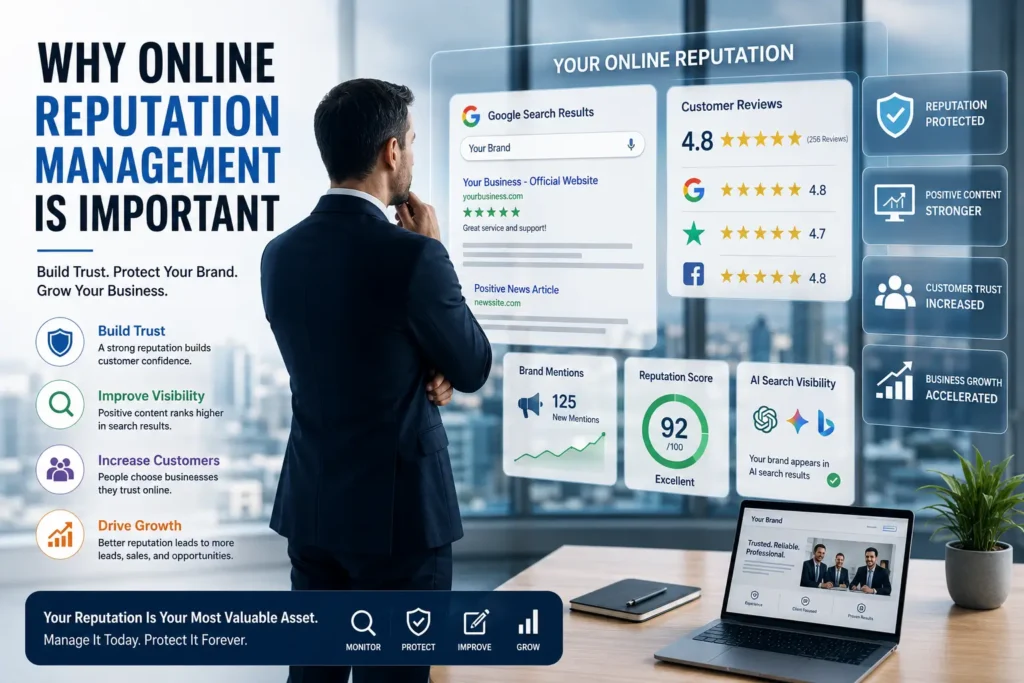
Every interaction a customer has with your brand contributes to your reputation. Today, those interactions happen primarily online. Whether someone discovers your business through Google Search, an AI-powered assistant, a review platform, or social media, the information they find shapes their perception before they ever contact you.
Understanding why online reputation management is important is no longer optional. It has become a core part of marketing, SEO, customer service, and brand growth. Businesses that actively manage their online reputation are more likely to earn trust, generate qualified leads, and maintain long-term credibility than those that ignore it.
Online reputation management isn’t simply about responding to negative reviews. It’s about creating a positive digital presence that accurately represents your expertise, values, and customer experience.
Trust Is Built Before the First Conversation
Modern consumers research businesses before making purchasing decisions. Whether they’re hiring an attorney, choosing a healthcare provider, selecting a real estate agent, or comparing service companies, they almost always search online first.
Within seconds, potential customers may evaluate:
- Google Search results
- Customer reviews
- News articles
- Business profiles
- Social media activity
- Company website
- AI-generated summaries
- Third-party mentions
If this information creates confidence, they’re more likely to contact your business. If it raises doubts, they may never become a customer.
Your online reputation has effectively become your digital first impression.
Why Online Reputation Management Matters for SEO
Search engines aim to deliver the most trustworthy and relevant information to users. Although Google has never confirmed that online reviews alone are a direct ranking factor, reputation signals contribute to the overall quality and authority of your digital presence.
Strong reputation management supports SEO by helping businesses:
- Publish authoritative content
- Increase branded searches
- Build topical authority
- Earn high-quality mentions
- Improve user engagement
- Strengthen local business visibility
- Generate authentic customer reviews
- Build long-term trust
As Google’s algorithms continue evolving, websites demonstrating Experience, Expertise, Authoritativeness, and Trustworthiness (E-E-A-T) are better positioned to compete in search results.
If you’d like to understand this relationship in greater depth, explore our guide on What Is Reputation Management in SEO?
AI Search Is Making Reputation More Important Than Ever
The way people search for information is changing rapidly.
Instead of browsing multiple websites, users increasingly ask AI assistants questions like:
- “Is this company trustworthy?”
- “Who offers the best reputation management services?”
- “Can I trust this business?”
- “What do customers say about this company?”
Platforms such as Google AI Overviews, ChatGPT, Gemini, and Microsoft Copilot analyze publicly available information from multiple trusted sources before generating responses.
This means your digital reputation is no longer judged only by Google rankings.
It is also influenced by:
- Authoritative website content
- Customer reviews
- Business profiles
- News coverage
- Industry mentions
- Structured website information
- Brand consistency
Businesses investing in reputation management today are preparing for the future of AI-powered search.
Why Reputation Matters for Different Professionals
Online reputation isn’t only important for large corporations.
Every profession that depends on trust benefits from proactive reputation management.
Business Owners
Customers want confidence before making purchasing decisions. A positive online reputation encourages more inquiries, stronger customer loyalty, and higher conversion rates.
CEOs and Executives
Leadership reputation directly affects investor confidence, partnerships, recruitment, and media perception. Executive reputation management helps protect professional credibility in both search results and AI-generated summaries.
Doctors and Healthcare Providers
Patients often compare healthcare providers online before booking appointments. Reviews, credentials, educational content, and search visibility all influence patient trust.
Lawyers
Legal clients typically research attorneys extensively before scheduling consultations. A professional online reputation reinforces expertise, reliability, and credibility.
Real Estate Professionals
Property buyers and sellers frequently evaluate online reviews, local authority, and personal branding before selecting an agent.
Entrepreneurs and Personal Brands
Founders increasingly become the public face of their businesses. Building a strong personal reputation strengthens both individual authority and company credibility.
Strong Reputation vs Weak Reputation
| Strong Online Reputation | Weak Online Reputation |
|---|---|
| Positive Google presence | Negative search results |
| Consistent brand messaging | Conflicting online information |
| Authentic customer reviews | Few or poor-quality reviews |
| High customer trust | Low buyer confidence |
| Strong AI visibility | Limited AI recognition |
| Better lead generation | Reduced conversion rates |
| Greater media credibility | Reputation uncertainty |
| Long-term business growth | Lost business opportunities |
The difference often isn’t the quality of the business itself.
It’s how that business is perceived online.
The Long-Term Business Benefits of ORM
Investing in reputation management creates benefits that extend well beyond improving search results.
Businesses with strong online reputations often experience:
- Higher customer confidence
- Better conversion rates
- Increased referral opportunities
- Stronger brand authority
- Improved customer retention
- Better recruiting outcomes
- Increased investor confidence
- Higher media credibility
- Greater resilience during crises
These advantages compound over time, making reputation management one of the most valuable long-term investments a business can make.
Reputation Management Is an Ongoing Strategy
Many organizations only think about reputation after something goes wrong.
However, the most successful brands take a proactive approach.
Rather than reacting to negative reviews or harmful content, they continuously monitor their online presence, publish helpful content, encourage authentic customer feedback, and strengthen their digital authority.
Businesses that invest consistently are often far better prepared when unexpected challenges arise.
Step-by-Step Online Reputation Management Strategy
Building a strong online reputation doesn’t happen by accident. It requires a structured, long-term strategy that combines SEO, content marketing, customer engagement, and ongoing monitoring. The following framework is used by successful businesses to strengthen their digital presence while reducing reputation risks.
Step 1: Audit Your Online Reputation
Before making improvements, you need a clear understanding of your current online presence.
Review:
- Google Search results for your brand name
- Google Business Profile
- Customer reviews
- News mentions
- Social media profiles
- Business directories
- Blog articles
- Images and videos
- AI-generated summaries
A comprehensive audit helps identify strengths, weaknesses, and opportunities for improvement.
Step 2: Monitor Brand Mentions
Reputation can change quickly.
Set up systems to monitor:
- Brand mentions
- Executive names
- Product names
- Customer feedback
- News coverage
- Social media discussions
Early detection allows businesses to address concerns before they become larger reputation issues.
Step 3: Create Helpful, Authoritative Content
One of the most effective reputation management strategies is publishing valuable content that demonstrates expertise.
Examples include:
- Educational blog posts
- Industry guides
- Case studies
- White papers
- Videos
- Frequently asked questions
- Customer success stories
Helpful content builds trust with both search engines and potential customers while supporting Google’s Helpful Content principles.
Step 4: Strengthen Your Search Presence
Search results often create the first impression of your business.
Improve your digital footprint by optimizing:
- Company website
- Executive profiles
- Google Business Profile
- LinkedIn pages
- Press mentions
- Business citations
- Industry directories
This creates more opportunities for positive, authoritative content to appear when people search for your brand.
Step 5: Encourage Authentic Customer Reviews
Customer reviews are one of the strongest trust signals available.
Rather than chasing perfect ratings, focus on collecting genuine feedback from satisfied customers.
Best practices include:
- Asking customers after successful projects
- Making review requests simple
- Responding professionally to every review
- Learning from constructive feedback
Authentic reviews build credibility while helping future customers make informed decisions.
Step 6: Respond Professionally to Negative Feedback
Negative reviews are not always harmful.
In fact, a thoughtful response often demonstrates professionalism and accountability.
When responding:
- Stay calm
- Acknowledge concerns
- Avoid arguments
- Offer solutions
- Continue conversations privately when appropriate
Professional responses often improve public perception more than deleting criticism.
Real Business Example
Imagine a growing law firm notices fewer consultation requests despite strong legal expertise.
After conducting an online reputation audit, the firm discovers:
- Outdated search results
- Very few Google reviews
- Limited educational content
- Weak executive visibility
- Inconsistent business information
Instead of focusing on quick fixes, the firm invests in a comprehensive reputation management strategy.
Over several months, they:
- Publish legal resources
- Improve attorney profiles
- Collect authentic client reviews
- Update business listings
- Strengthen local SEO
- Expand thought leadership content
As positive digital assets grow, branded search results improve, customer trust increases, and consultation requests steadily recover.
This illustrates how reputation management supports sustainable business growth rather than delivering temporary results.
Common Online Reputation Management Mistakes
Many businesses unintentionally damage their reputation by making avoidable mistakes.
The most common include:
Ignoring Customer Reviews
Failing to respond sends the message that customer feedback doesn’t matter.
Reacting Emotionally
Public arguments with customers often create greater reputational harm than the original complaint.
Waiting Until a Crisis
Reputation management is far more effective when implemented before problems occur.
Publishing Low-Quality Content
Producing content solely for search rankings rarely builds long-term authority.
Instead, prioritize content that genuinely helps your audience.
Inconsistent Branding
Different business information across websites creates confusion for both customers and search engines.
Consistency builds trust.
Expecting Instant Results
Strong online reputations develop over time.
Businesses seeking shortcuts often create larger problems later.
Best Practices for Long-Term Reputation Management
Organizations with strong reputations typically follow consistent best practices.
These include:
- Monitor your reputation regularly
- Publish helpful, original content
- Encourage authentic customer feedback
- Maintain accurate business information
- Optimize executive profiles
- Respond professionally to reviews
- Invest in SEO
- Update your website frequently
- Build authority within your industry
- Measure reputation performance over time
These habits create sustainable improvements that continue delivering value year after year.
Expert Tips from Reputation Specialists
Our experience working with businesses, executives, healthcare providers, legal professionals, and entrepreneurs has shown that the strongest reputations are built proactively—not reactively.
Here are several practical recommendations:
- Treat reputation management as an ongoing business investment.
- Focus on creating value rather than chasing search rankings.
- Invest in thought leadership that showcases your expertise.
- Build a recognizable brand voice across every platform.
- Regularly review your branded search results.
- Monitor emerging AI search experiences to understand how your brand is being represented.
- Encourage satisfied customers to share honest feedback.
- Review your online presence at least once every quarter.
Small, consistent improvements often produce far greater long-term results than dramatic short-term changes.
Protect Your Reputation Before Problems Arise
The best time to invest in your reputation is before you face a crisis.
Whether you’re managing a growing company, protecting an executive brand, or strengthening customer trust, a proactive strategy provides a significant competitive advantage.
Learn more about our professional Reputation Management solutions:
If your organization needs a broader long-term strategy, explore our specialized Reputation Protection Services designed to help businesses and professionals maintain trust across search engines, AI platforms, review websites, and digital media.
If you’d like personalized guidance, Contact Us to schedule a confidential consultation with one of our reputation specialists.
Online Reputation Management vs Traditional Marketing
Many businesses invest heavily in advertising but overlook one critical factor—trust. Traditional marketing helps people discover your brand, while online reputation management helps them decide whether they should trust it.
These two strategies work best when combined, but they serve very different purposes.
| Online Reputation Management | Traditional Marketing |
|---|---|
| Builds long-term trust | Creates brand awareness |
| Improves search perception | Promotes products or services |
| Strengthens digital credibility | Generates immediate attention |
| Manages reviews and online mentions | Focuses on campaigns and promotions |
| Supports SEO and AI visibility | Supports lead generation |
| Protects brand reputation | Drives traffic through advertising |
| Delivers sustainable authority | Delivers short-term exposure |
A successful business doesn’t choose one over the other. It integrates both to attract customers and earn their confidence.
Why AI Search Has Changed Reputation Management
Search behavior is evolving faster than ever.
Instead of typing simple keywords into Google, people increasingly ask AI-powered assistants complete questions such as:
- “Is this company trustworthy?”
- “Who has the best reputation management services?”
- “Can I trust this law firm?”
- “What do customers say about this business?”
Platforms like Google AI Overviews, ChatGPT, Gemini, and Microsoft Copilot generate answers by analyzing trusted information from across the web.
That means your online reputation is no longer measured only by search rankings. It is also influenced by:
- Brand consistency
- Customer reviews
- Website authority
- Expert content
- Media coverage
- Executive profiles
- Third-party mentions
- Structured website information
Businesses that invest in authoritative, helpful content today are better positioned for tomorrow’s AI-driven search experience.
Reputation Management Is Becoming a Competitive Advantage
Not long ago, online reputation management was viewed primarily as a crisis response service.
Today, it has become a strategic business investment.
Companies that actively manage their digital reputation often experience:
- Higher customer trust
- Better qualified leads
- Stronger search visibility
- Increased brand recognition
- Improved customer retention
- Greater investor confidence
- More partnership opportunities
Businesses that ignore reputation management risk allowing outdated, inaccurate, or incomplete information to shape public perception.
Future Trends in Online Reputation Management
The future of reputation management extends far beyond reviews.
Several trends are already changing how businesses build trust online.
AI-Powered Search Experiences
AI assistants are becoming a primary source of business information.
Brands with strong digital authority are more likely to be referenced accurately.
Greater Importance of E-E-A-T
Google continues emphasizing:
- Experience
- Expertise
- Authoritativeness
- Trustworthiness
Businesses demonstrating these qualities consistently are better positioned for long-term visibility.
Executive Branding
Customers increasingly want to know the people behind businesses.
Executives who invest in personal reputation management often strengthen the credibility of their organizations as well.
Helpful Content
Publishing genuinely useful content has become one of the strongest reputation-building strategies available.
Helpful content improves:
- Search rankings
- Customer trust
- AI visibility
- Industry authority
Authentic Reviews
Consumers increasingly recognize fake or manipulated reviews.
Authentic customer feedback remains one of the strongest trust signals available.
Measuring Reputation Management Success
Many businesses focus only on rankings.
However, successful reputation management measures a broader range of indicators.
Examples include:
- Improved branded search results
- Higher customer trust
- Increased review quality
- Better lead conversion
- Growth in positive brand mentions
- Higher website engagement
- Increased referral traffic
- Improved local visibility
- Stronger executive authority
These metrics provide a more complete picture of reputation growth than rankings alone.
Online Reputation Management Is an Investment, Not an Expense
Businesses often compare the cost of reputation management against the cost of advertising.
The better comparison is this:
“What does a damaged reputation cost?”
Negative publicity, poor reviews, declining customer confidence, and lost partnerships often have far greater financial consequences than investing in proactive reputation management.
Protecting your reputation protects your future revenue, customer relationships, and long-term business value. See what our clients are saying on Trustpilot and Google, then schedule a confidential consultation to learn how we can help protect and strengthen your online reputation.
Conclusion
If you’ve been asking why online reputation management is important, the answer is simple: your reputation influences nearly every business decision your audience makes.
Customers research businesses before making purchases. Employers evaluate professionals before hiring. Investors examine executives before forming partnerships. Search engines and AI platforms assess trust signals before presenting your brand to users.
A strong online reputation helps you earn credibility before the first conversation ever happens.
Rather than reacting to negative situations after they occur, proactive reputation management allows you to build trust, strengthen your digital authority, and position your business for sustainable growth.
Whether you’re a business owner, CEO, entrepreneur, doctor, lawyer, or agency leader, investing in your online reputation today is an investment in your long-term success.
Ready to Strengthen Your Online Reputation?
Your reputation is one of your most valuable business assets. Every search result, customer review, media mention, and AI-generated summary contributes to how people perceive your brand.
At Your Reputation Agency, we help businesses and professionals build, protect, and strengthen their online reputation through ethical, long-term strategies tailored to their unique goals.
Whether you need reputation monitoring, executive reputation management, search result improvement, review management, or comprehensive reputation protection, our experienced team is here to help.
Contact Your Reputation Agency today for a confidential consultation and discover how a proactive reputation strategy can support your business growth, improve customer trust, and protect your digital future.
Frequently Asked Questions
1. Why online reputation management is important for businesses?
Online reputation management is important because it influences customer trust, search visibility, purchasing decisions, and long-term business growth. A positive online reputation helps businesses attract more qualified leads while reducing the impact of negative reviews, misinformation, or unfavorable search results.
2. Can online reputation management improve SEO?
Yes. While reputation management is not a direct Google ranking factor, it supports SEO by strengthening brand authority, encouraging authentic customer reviews, improving branded search results, increasing user trust, and creating helpful content that aligns with Google’s E-E-A-T principles.
3. How long does online reputation management take?
The timeline depends on the complexity of your situation. Minor reputation improvements may be visible within a few weeks, while comprehensive reputation management strategies often require several months to build lasting authority and trust.
4. Who needs online reputation management?
Online reputation management benefits:
- Business owners
- CEOs and executives
- Doctors
- Lawyers
- Entrepreneurs
- Real estate professionals
- Personal brands
- Agencies
- Healthcare organizations
- Financial professionals
Anyone whose reputation influences professional success can benefit from proactive reputation management.
5. Can negative Google reviews be removed?
Some reviews may qualify for removal if they violate Google’s policies. However, many situations are better addressed through professional review management, thoughtful responses, and long-term reputation improvement strategies.
6. How does reputation management help during a crisis?
Professional reputation management helps organizations respond strategically by monitoring public perception, improving search visibility, publishing accurate information, and strengthening positive digital assets while reducing the impact of harmful online content.
7. Is reputation management only for large companies?
No. Small businesses, startups, local professionals, and personal brands often benefit just as much as large corporations. Building trust early can create a strong competitive advantage.
8. Does AI search make reputation management more important?
Yes. AI-powered platforms such as Google AI Overviews, ChatGPT, Gemini, and Microsoft Copilot increasingly summarize information from trusted online sources. A strong digital reputation helps ensure your business is represented more accurately across these platforms.
9. How often should I monitor my online reputation?
Businesses should review their online reputation regularly. Monthly monitoring is recommended, while organizations operating in highly competitive or public-facing industries may benefit from continuous reputation monitoring.
10. Why choose Your Reputation Agency?
Your Reputation Agency provides customized online reputation management solutions built around ethical SEO, reputation protection, executive branding, search suppression, review management, and long-term digital trust. Every strategy is tailored to the client’s goals and designed to support sustainable business growth.