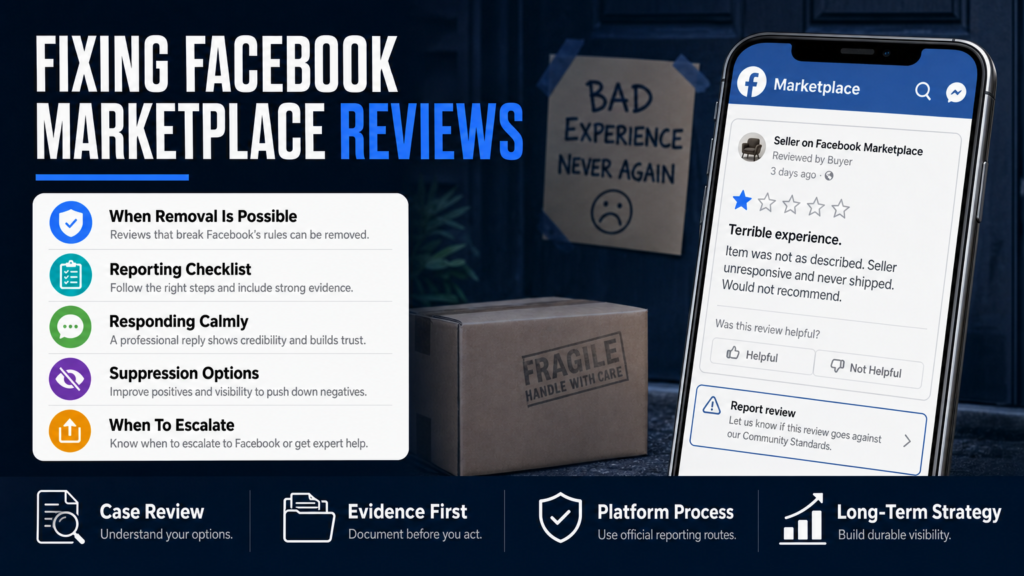
You found a one-star review on your Facebook Marketplace seller profile and it’s showing up when clients search your name. Can you get rid of a bad review on Facebook marketplace? The short answer: sometimes — but not always.
This article walks through the realistic options available for Facebook Marketplace reviews: when a review qualifies for platform takedown, how to report it, what to do if removal is unavailable, and how to reduce the damage through response, SEO, and escalation.
You’ll get step-by-step reporting instructions, an easy checklist to collect evidence, a comparison of removal vs suppression, and a hypothetical example that shows the timeline and likely outcomes. No guarantees are made; platform decisions and legal outcomes vary by case.
Table of Contents
- Can negative reviews be removed?
- What should I do if someone gave me a bad review on Facebook Marketplace?
- Can someone give you a bad review on Marketplace if you block them?
- How to respond to a negative review on Facebook Marketplace
- If removal isn’t available: suppression and mitigation options
- Practical takedown and reporting checklist for Marketplace reviews
- When to hire a reputation firm or legal counsel
- Takedown (Removal) vs Suppression (Mitigation)
- Hypothetical: Dr. S’s Marketplace Review
- Common Mistakes People Make With Marketplace Reviews
- Best Practices To Limit Harm From Marketplace Reviews
- Expert Tips
- Conclusion
- Why Businesses Choose Your Reputation Agency
- Frequently Asked Questions
Can negative reviews be removed?
Yes — negative reviews can sometimes be removed, but removal depends on Facebook’s content policies, the nature of the review, and the evidence you can provide. Facebook (Meta) only removes content that violates its Community Standards, Commerce Policies, or other specific rules.
We evaluate whether the content may qualify for removal or review and pursue the platform-based, technical, and legal options available. Platform decisions remain under Facebook’s control and outcomes vary by case.
- Document the review: screenshot, URL, timestamp, and any messages or transaction records.
- Compare wording to Facebook’s Commerce and Community policies to identify potential violations.
- Submit a platform report with the evidence, using Facebook’s official reporting flows (detailed in a later section).
- Policy violations that can support removal: hate speech, explicit threats, harassment, impersonation, doxxing (private info), and clear fake accounts.
- Reviews that are merely negative opinions or truthful accounts of a transaction rarely meet removal standards.
- If the review is defamation (false statements presented as fact), it may warrant legal review; a qualified attorney can determine whether a legal claim may be available.
What counts as a policy violation on Facebook?
Examples that may qualify: explicit threats, sexual content, hate speech, targeted harassment, doxxing (exposing private data such as SSNs), and content from an impersonating account.
Marketplace ratings that are inaccurate because no purchase took place or are left by a non-buyer can sometimes be flagged under Facebook’s review rules, but Facebook’s internal rules about who can leave ratings are inconsistent and subject to change.
- Impersonation: someone using a fake account to pose as a buyer.
- False identity: reviews left by hacked or reseller accounts.
- Private data or doxxing: content exposing sensitive personal information.
What should I do if someone gave me a bad review on Facebook Marketplace?
First, don’t panic. Collect evidence and follow a measured sequence: verify whether the reviewer actually transacted with you, check for policy violations, attempt an appropriate response, and report to Facebook if the content violates policy.
If the review is causing measurable harm — lost clients, license risk, or visible ranking damage — consider escalating to a reputation specialist or counsel for parallel suppression and legal assessment. For context on revenue impact and timing, see When One Facebook Review Can Cost Your Practice Real Revenue.
- Step 1 — Document: Take multiple screenshots (desktop and mobile) and save the Marketplace listing URL or seller profile.
- Step 2 — Verify: Check your messages and transaction records to confirm whether there was a legitimate buyer-seller relationship.
- Step 3 — Respond or Report: If the reviewer made false factual claims, prepare a calm factual public response and submit a report to Facebook if policy is violated.
- Immediate: Screenshot the review, copy the review text, record the date/time and link.
- Short term: Search for other references to the incident (messages, posts, photos) and preserve them.
- Next: Decide whether to respond publicly, report to Facebook, or both.
When to involve legal counsel or a reputation firm
If the review contains demonstrably false allegations that threaten licensure, employment, or business revenue, a qualified attorney can assess defamation options. A reputation firm can coordinate reporting, suppression SEO, and PR messaging while counsel evaluates legal claims.
Legal options depend on evidence, jurisdiction, and public-interest considerations. No outcome is guaranteed.
- Legal review if there are false allegations of criminal conduct.
- Reputation firm for parallel suppression and monitoring.
- Combine technical takedown attempts with measured public responses to limit damage.
Can someone give you a bad review on Marketplace if you block them?
Blocking somebody on Facebook does not retroactively remove ratings they already left. Whether they can leave new reviews after being blocked depends on whether the review system recognizes the relationship and whether the reviewer can still access the listing via another account.
Blocking can prevent direct messaging, but it doesn’t erase content left by the user. If the reviewer used a fake account, impersonation reporting is the relevant route.
- Step 1 — Check whether the review came from a confirmed buyer account or a suspicious/fake account.
- Step 2 — If suspicious, gather evidence of impersonation (profile inconsistencies, creation date, no mutual friends).
- Step 3 — Report as impersonation or fake account; blocking alone is not sufficient.
- Blocking prevents further direct contact but does not delete existing reviews.
- If the reviewer uses multiple accounts, blocking one account may not stop future reviews.
- If you believe the reviewer used an impersonating account, report the impersonation to Facebook for potential removal.
Why blocking feels like it should work — but often doesn’t
Users expect that removing access will erase their content. Facebook separates account-level controls (blocking) from content ownership. Blocking stops messaging and visibility between two accounts, but content posted publicly or in Marketplace can remain accessible.
If the reviewer later deletes their account, the review may disappear; but you cannot force deletion by blocking.
- Blocking = social access control, not content removal.
- Content removal requires platform reporting or account deletion by the reviewer.
How to respond to a negative review on Facebook Marketplace
Responding appropriately can limit damage and show prospective buyers you are professional. A public reply should be concise, factual, and invite offline resolution. Avoid emotional language or admitting fault you haven’t verified.
If the review includes false factual claims, respond with a factual, neutral correction and invite the reviewer to message you. If the review is abusive or violates policy, report it to Facebook while you respond.
- Step 1 — Draft a calm reply: Acknowledge the concern, state facts, and offer a way to resolve in private (e.g., “I’m sorry you had that experience. Please message me so we can fix this.”).
- Step 2 — Post the reply and monitor for escalation or a retraction.
- Step 3 — If the reviewer corrects or removes the review, capture screenshots for records.
- Keep replies short, professional, and focused on resolution.
- Never reveal private medical or legal details in a public reply.
- Offer to take the conversation offline (direct message, phone, or email) and follow up promptly.
Sample reply templates
Template for a disputed factual claim: “We don’t have a record of a completed sale for this item. Please DM your order details so we can investigate and make it right.”
Template for a service complaint: “I’m sorry the item didn’t meet expectations. Please message me and I’ll offer a return or refund as appropriate.”
- Avoid saying “You’re wrong” or accusing the reviewer publicly.
- Do not offer incentives for removal — that violates many platforms’ policies.
If removal isn’t available: suppression and mitigation options
When Facebook refuses to remove a review because it doesn’t violate policy, you can pursue mitigation: request a retraction, publish authoritative countercontent, and use search-engine suppression to reduce the review’s visibility.
We develop SEO reputation strategies intended to improve the visibility of relevant and credible information so that the negative review appears lower in search results. Results vary according to the strength of the negative content and the authority of competing sources.
- Step 1 — Attempt friendly outreach asking for correction or clarification.
- Step 2 — Create and optimize profiles and listings to push the negative item down in search results.
- Step 3 — Monitor results and use paid promotion of positive content if organic movement is slow.
- Ask the reviewer for correction or removal politely — document requests.
- Publish positive, keyword-optimized content (listings, profiles, articles) to outrank the negative item.
- Use review reclamation strategies (ask satisfied customers to leave legitimate reviews on relevant platforms).
When suppression and monitoring are the right path
Suppression is appropriate when a review is negative but not policy-violating (truthful complaint, opinion, or performance criticism). It’s also the fallback when the reviewer refuses to remove the content and legal options are weak or costly.
For large or public incidents that spread beyond Facebook (for example, cross-posted on forums), a combined SEO, PR, and monitoring plan is often needed. For a comparable cross-platform escalation approach, see When a Reddit Thread Quietly Sinks Your Google Ratings.
- Suppression is not a guarantee — search results are controlled by algorithms and competing publishers.
- Reputation programs are iterative: expect multiple months to see material changes.
Practical takedown and reporting checklist for Marketplace reviews
Follow these concrete steps to report a bad review on Facebook Marketplace and to prepare supporting evidence. Use the official reporting and review processes made available by platforms; platform decisions remain under their control.
Collecting clean evidence and following the exact reporting flow increases the chance that Facebook will escalate or remove content that violates policy.
- Step 1 — Screenshot the review, the seller profile, and any related messages. Save HTML if possible.
- Step 2 — Export any receipts, payment records, or shipping confirmations tied to the transaction.
- Step 3 — Use the Facebook UI: open the review, select Report, choose the reason (harassment, fake account, etc.), attach screenshots, and submit.
- Step 4 — If Facebook denies the report, escalate with an appeal and retain timeline records for possible legal review.
- Essential evidence: screenshots (desktop and mobile), URL, account name and profile link of reviewer, timestamps, and transaction records.
- Policy match: quote the exact text that violates Commerce/Community rules and explain why it breaches policy.
- Reporting path: use the Marketplace review or listing report tool, and use the ‘Report Profile’ / ‘Report Post’ flows for impersonation or harassment.
Reporting an impersonation or fake account
If you suspect the reviewer is impersonating someone or using a fake account, use Facebook’s impersonation reporting form and attach evidence showing the mismatch (e.g., differing profile photos, no mutual friends, sudden creation date).
Impersonation reports can take longer because Facebook may require verification, but they are the correct route when identity fraud is involved.
- Include links to the real profile if impersonation targets a known brand or individual.
- Retain all correspondence; if legal counsel is necessary later, these records matter.
When to hire a reputation firm or legal counsel
Bring in specialists when the review threatens licensure, ongoing revenue, or hiring, or when multiple reviews indicate a coordinated attack. A firm can coordinate reporting, suppression SEO, monitoring, and PR messaging while counsel reviews legal viability.
We handle matters confidentially and apply privacy and security controls. A qualified attorney can determine whether a legal claim may be available; we coordinate with attorneys when legal analysis is required.
- Step 1 — Prepare a case file: timeline, evidence, and impact statements (lost clients, canceled appointments).
- Step 2 — Ask the reputation firm for an estimated plan and timelines (not guarantees).
- Step 3 — Coordinate outreach: firm reports to platforms while counsel evaluates legal letters or court filings if appropriate.
- Hire counsel if the review contains demonstrable false allegations of criminal conduct or serious professional misconduct.
- Consider a reputation firm when the review is visible in search results and is driving measurable business harm.
- Specialists help manage multi-platform incidents and can provide documented workflows for escalation.
What to expect from an agency engagement
An agency will evaluate whether the content may qualify for removal or review, pursue the platform-based, legal, and SEO options available, and set monitoring. Timing depends on platform response, legal complexity, and search-engine behavior.
Be skeptical of anyone who promises guaranteed removal or specific ranking outcomes — results vary and no one has special access to platforms.
- Deliverables often include reporting attempts, suppression content, monitoring, and periodic status reports.
- Expect an estimated timeline only after the agency reviews the evidence.
Takedown (Removal) vs Suppression (Mitigation)
Quick two-column contrast to decide which approach fits your situation.
| Takedown (Removal) | Suppression (Mitigation) |
|---|---|
| Goal | Goal |
| Remove the offending content from the platform | Push the content lower in search and replace it with positive/neutral content |
| Evidence needed | Evidence needed |
| Clear policy violation or legal basis | No policy violation or limited legal leverage |
| Speed | Speed |
| Depends on platform review — can be fast or slow | Usually slower; SEO and content creation take weeks to months |
| Cost | Cost |
| Can be low for simple reports or high if legal action required | Typically predictable: SEO/content and promotion budgets |
| Control | Control |
| Platform has final say; legal courts have limited remedies | You control the new content and promotion strategy |
Hypothetical: Dr. S’s Marketplace Review
Situation: Dr. S, a solo practitioner, finds a negative five-sentence review on her Facebook Marketplace seller profile alleging unprofessional conduct after a supposed transaction. She has no record of the sale and the message thread shows no contact from the reviewer.
Process: Dr. S documents the review, searches for linked posts or messages, reports impersonation and false claims to Facebook, posts a calm public reply, and begins a suppression plan by publishing authoritative content and requesting new legitimate reviews on other profiles.
- Step 1 — Evidence: Dr. S took mobile and desktop screenshots, copied URLs, and pulled transaction records from her point-of-sale.
- Step 2 — Report: She used Facebook’s Report flow for impersonation and included the transaction evidence.
- Step 3 — Public reply: She posted a brief, professional reply inviting the reviewer to message and offering to investigate.
- Step 4 — Mitigation: While waiting for Facebook, she published optimized profiles (Google Business Profile, clinic page) and asked satisfied patients to leave reviews on vetted platforms.
- Step 5 — Follow-up: Facebook eventually removed the review after the impersonation appeal and the clinic monitored for new attacks.
- Collected screenshots of the review, the reviewer profile, and Marketplace listing.
- Exported transaction logs showing no sale to that user.
- Submitted an impersonation/fake-account report to Facebook and filed an appeal when initially denied.
Common Mistakes People Make With Marketplace Reviews
Avoid these common errors — they slow down resolution and can sometimes harm your position if the issue escalates.
Responding angrily or defensively
Emotional replies inflame the situation and create new visible content that prospective clients will see. A measured, factual reply invites resolution and looks better to future customers.
Assuming blocking deletes the content
Blocking a user stops direct contact but does not remove content they already posted. Content removal requires reporting or the account owner deleting the post.
Not documenting everything
Without clear screenshots, URLs, and timestamps, platform reports and legal claims are weaker. Capture multiple forms of evidence immediately.
Paying for fake positive reviews
Buying or soliciting fake reviews violates platform policies and can lead to penalties that harm long-term reputation. Focus on soliciting honest feedback from real customers instead.
Skipping suppression when removal isn’t possible
If you stop after an unsuccessful takedown, the negative item remains the top result. A combined suppression strategy is often necessary to restore search visibility.
Best Practices To Limit Harm From Marketplace Reviews
Follow these practical steps to preserve evidence, respond professionally, and reduce visibility if removal fails.
Document everything immediately
Screenshots, URLs, timestamps, and related messages should be saved as soon as you spot a harmful review. Back up evidence offline.
Use official reporting flows first
Report the review via Facebook’s reporting interface, choosing the correct violation category and attaching evidence. Platform reporting is the primary path for takedowns.
Respond publicly but briefly
A short public reply that acknowledges the concern and invites private communication demonstrates professionalism without creating a long public debate.
Start mitigation right away
Build or strengthen profiles and listings (Google Business Profile, your website, Yelp if relevant) and request legitimate reviews from satisfied customers to dilute the negative item.
Escalate when there’s measurable harm
If the review threatens licensure, revenue, or results from a coordinated attack, coordinate with counsel and a reputation specialist for parallel legal and mitigation paths.
Expert Tips
- Screenshot both mobile and desktop views — Facebook sometimes shows different content to different clients.
- Save the HTML or page source if possible; it preserves metadata that screenshots may not.
- If a review mentions a transaction, export any payment or shipping records tied to it before they’re deleted.
- Do not offer money or incentives for review removal — it violates platform rules and looks bad if exposed.
- Ask satisfied customers to leave reviews on higher-authority platforms to help suppression efforts.
- If a review is part of a coordinated attack, gather patterns (timing, identical language) — platforms treat coordinated abuse differently.
- Use short, factual public replies that invite offline resolution and don’t repeat the negative allegation.
- Keep a running impact log (missed bookings, lost clients) to support escalation to counsel or highlight damage to platforms.
Conclusion
A bad Facebook Marketplace review can often be managed, sometimes removed, and frequently mitigated through a combination of documentation, measured responses, official reporting, and suppression tactics. Which path makes sense depends on whether the review violates platform policy, whether the reviewer can be identified as an impersonator, and how much measurable harm the review is causing.
If platform reporting fails, a coordinated mitigation plan — publishing authoritative content, growing genuine positive reviews on other channels, and monitoring search results — is a realistic next step. If the review presents possible legal issues (false allegations of criminal conduct, threats to licensure), consult a qualified attorney and consider coordinated action with a reputation specialist.
Why Businesses Choose Your Reputation Agency
Managing your reputation takes more than monitoring reviews or publishing the occasional blog post. It takes a strategy built around your situation, your industry, and what is actually showing up in search.
Your Reputation Agency works with businesses, executives, healthcare professionals, attorneys and growing brands. Our services include:
- Remove defamatory content and false posts (news, blogs, listings)
- Remove or challenge negative reviews (Google, Yelp, TripAdvisor, industry sites)
- Mugshot and arrest record removal
- Remove videos, images, and other multimedia that damage reputation
- Remove personal data from people‑search and data‑broker sites (opt‑outs)
- Search result suppression (SEO to bury negative links)
- Social media takedowns and impersonation removal
- Rapid online crisis management and incident response
- Ongoing monitoring and alerting of reputation signals
- Coordination with legal counsel and use of legal tactics when required
Frequently Asked Questions
1. Can negative reviews be removed?
Yes, but only when they violate platform policies or where there is a legal basis for removal. Facebook removes content that breaches its Community Standards, Commerce Policies, or in cases of impersonation and doxxing. If a review is a truthful negative opinion, removal is unlikely and mitigation may be the better option.
2. What should I do if someone gave me a bad review on Facebook Marketplace?
Document the review (screenshots, URL, timestamps), verify whether the reviewer actually transacted with you, prepare a calm public reply inviting private resolution, and report the review to Facebook if it violates policy. If the review causes measurable harm, consider consulting counsel or a reputation firm; for a deeper look at revenue impact see When One Facebook Review Can Cost Your Practice Real Revenue.
3. Can someone give you a bad review on Marketplace if you block them?
Blocking a user stops direct contact but does not delete reviews they already posted. Blocking also may not stop someone who uses alternate or fake accounts. If you suspect impersonation, report the account to Facebook and collect evidence to support the claim.
4. How to respond to a negative review on Facebook Marketplace?
Respond briefly and professionally: acknowledge the concern, state verifiable facts, and invite private communication to resolve the issue. Avoid emotional language, public accusations, or offering incentives for removal — each can worsen the situation.
5. How long does it take for Facebook to remove a reported review?
Timing varies. Some simple reports are processed quickly; impersonation or complex harassment reports may take days or longer. Timing depends on the platform’s workload, the complexity of the claim, and the evidence provided. No universal timeframe applies.
6. What if Facebook denies my takedown request?
If Facebook denies a report, collect additional evidence, file an appeal if available, and consider mitigation strategies such as publishing positive content and asking satisfied customers for verified reviews. If the content appears defamatory, a legal review may be warranted.
7. Is it OK to ask customers to remove or change a review?
Yes — a polite, documented request to correct or remove a review is acceptable when done ethically. Do not offer money or incentives in exchange for removal; that can violate platform rules and risks further sanctions. Keep a record of your outreach.
8. When should I hire a reputation management firm?
Consider hiring a firm when the review is causing measurable business harm, threatens licensure, appears to be part of a coordinated campaign, or when cross-platform spread makes DIY mitigation ineffective. A firm can coordinate reporting, SEO suppression, monitoring, and PR while you focus on operations.
9. Will suppressing a review guarantee it never appears again?
No. Suppression strategies aim to reduce visibility by promoting authoritative content, but search engines and platform algorithms change and no permanent guarantee exists. We develop strategies intended to improve visibility of credible information; outcomes vary by case.
This content provides general information and does not constitute legal advice. The available options and likely outcomes depend on the facts, evidence, platform policies, applicable law, jurisdiction, and public-interest considerations.
Past examples do not guarantee future results. Removal, correction, deindexing, and search-position changes depend on third parties and circumstances outside Your Reputation Agency’s control.