Quick answer: how online reputation management works
Online reputation management works by auditing what people find, correcting inaccurate sources, removing eligible content, improving useful authoritative pages, managing reviews and profiles, earning credible mentions, and monitoring change.
Ethical ORM supports real trust and operational improvement rather than manufacturing praise or hiding legitimate criticism.
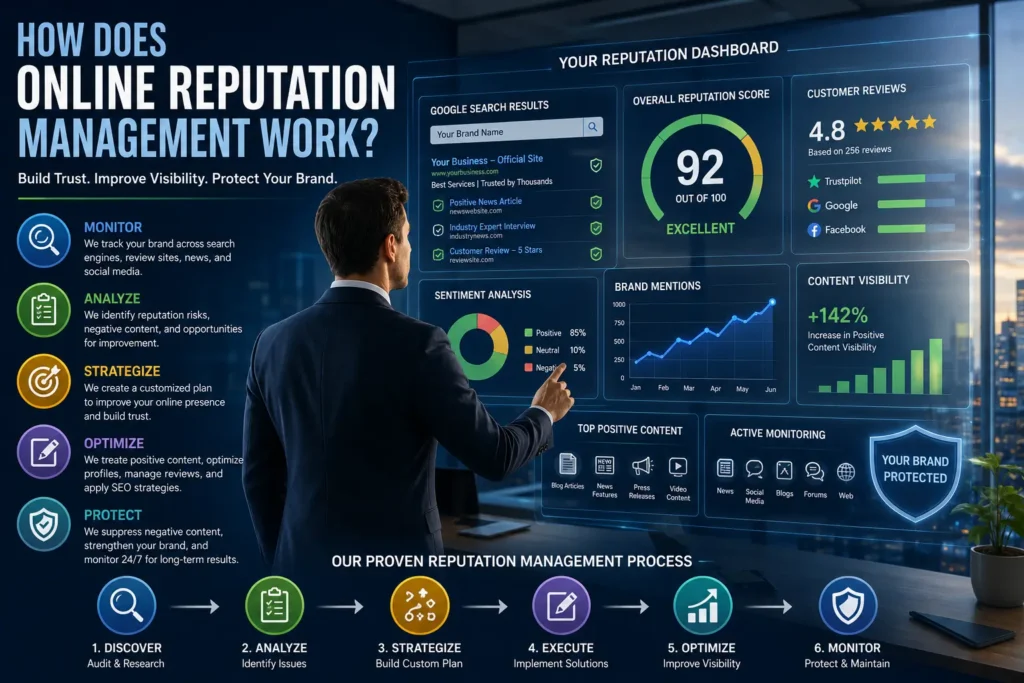
How Does Online Reputation Management Work?
Imagine a potential customer searching for your company on Google before making a purchase. Within seconds, they see your website, Google reviews, news articles, social media profiles, and third-party websites. That search result often becomes their first impression of your business.
So, how does online reputation management work in today’s digital world?
Online Reputation Management (ORM) is the process of monitoring, improving, and protecting how individuals and businesses appear across search engines, review platforms, social media, AI-powered search tools, and other online channels. Rather than simply responding to negative content, ORM focuses on building long-term trust by strengthening positive digital assets and maintaining an accurate online presence.
Whether you’re a CEO, doctor, attorney, entrepreneur, or business owner, investing in reputation management helps establish credibility, increase customer confidence, and support sustainable business growth.
Table of Contents
- What Is Online Reputation Management?
- How Does Online Reputation Management Work?
- Why Your Online Reputation Matters
- The Core Components of Online Reputation Management
- Step-by-Step ORM Process
- Real-World Example
- Common Reputation Management Mistakes
- Best Practices for Long-Term Success
- Expert Tips to Stay Ahead
- Comparison: DIY vs Professional ORM
- Frequently Asked Questions
- Conclusion & Next Steps
What Is Online Reputation Management?
Online Reputation Management (ORM) is the ongoing process of shaping how people perceive your brand online. It combines SEO, digital marketing, public relations, content strategy, review management, and brand monitoring to create a positive and trustworthy digital presence.
Every time someone searches your business name, they form an opinion based on the information they find. That information may include:
- Google Search results
- Google Business Profile
- Customer reviews
- News articles
- Blog posts
- Social media profiles
- Business directories
- Videos
- AI-generated search summaries
A strong reputation doesn’t happen by accident. It is built through consistent effort, valuable content, excellent customer experiences, and proactive reputation management.
If you’re looking for a comprehensive Online Reputation Management solution, our dedicated service explains how businesses protect and strengthen their digital presence over time:
How Does Online Reputation Management Work?
The answer is simpler than many people think.
Instead of trying to erase every negative mention, professional ORM focuses on improving the overall quality, visibility, and authority of your digital footprint.
A successful reputation management strategy typically includes several activities working together:
Monitoring Your Online Presence
The first step is understanding what people already see when they search for your name or business.
This includes monitoring:
- Search engine results
- Online reviews
- Social media mentions
- News coverage
- Blogs and forums
- Business listings
- AI-generated search results
Regular monitoring allows businesses to identify reputation risks before they become larger problems.
Improving Positive Search Results
Search engines prioritize relevant and authoritative content.
ORM specialists strengthen positive digital assets by optimizing:
- Company websites
- Service pages
- Executive biographies
- Press coverage
- Educational blog content
- Social media profiles
- Business directory listings
Over time, these improvements help increase the visibility of trustworthy information.
Managing Customer Reviews
Customer reviews play a significant role in purchasing decisions.
An effective ORM strategy encourages satisfied customers to leave genuine feedback while responding professionally to both positive and negative reviews.
This demonstrates transparency, improves customer trust, and supports long-term brand credibility.
Creating Helpful Content
High-quality content remains one of the strongest reputation-building tools.
Educational articles, industry insights, FAQs, case studies, and thought leadership content not only improve SEO but also establish expertise within your industry.
This approach aligns closely with Google’s Helpful Content principles and benefits both traditional search and AI-powered search experiences.
Why Your Online Reputation Matters More Than Ever
Today’s buyers rarely make decisions without researching a company first.
Before contacting a business, they often check:
- Google Search
- Google Business Profile
- Customer reviews
- Trustpilot
- News articles
- Company websites
- AI search assistants
If they encounter outdated, misleading, or negative information, they may choose a competitor instead.
A strong online reputation helps you:
- Build customer trust
- Increase conversion rates
- Improve search visibility
- Strengthen brand authority
- Support higher-value sales
- Attract better business opportunities
- Protect your business during unexpected reputation challenges
Your reputation has become one of your most valuable digital assets—and managing it proactively is no longer optional.
Step-by-Step: How Does Online Reputation Management Work?
A successful Online Reputation Management (ORM) strategy isn’t based on guesswork. It follows a structured process designed to strengthen your digital presence while reducing the impact of negative or outdated information. Every business has unique challenges, but the overall framework remains consistent.
Step 1: Conduct a Comprehensive Reputation Audit
Every successful ORM campaign begins with understanding your current online presence.
Before making improvements, reputation specialists evaluate how your business appears across search engines and digital platforms.
A professional reputation audit typically reviews:
- Google search results
- Google Business Profile
- Review platforms
- News articles
- Social media profiles
- Business directories
- Blog mentions
- Images and videos
- AI-generated search summaries
The goal is to identify both strengths and potential reputation risks.
Step 2: Identify Reputation Challenges
Once the audit is complete, the next step is determining what needs attention.
Common issues include:
- Negative reviews
- Outdated articles
- False or misleading information
- Poor search visibility
- Inconsistent business information
- Low review ratings
- Weak branded search results
- Limited online authority
Rather than treating every issue the same way, an effective strategy prioritizes the areas with the greatest impact on customer trust.
Step 3: Build a Customized Reputation Strategy
Every business has different objectives.
A local medical practice requires a different reputation strategy than a national law firm or technology company.
An effective ORM plan usually defines:
- Business goals
- Target audience
- Priority keywords
- Reputation risks
- Content opportunities
- SEO improvements
- Review management strategy
- Brand monitoring process
This personalized approach creates better long-term results than generic reputation tactics.
Creating Positive Digital Assets
One of the most effective ways to improve online reputation is by publishing valuable, trustworthy content.
Instead of focusing only on negative information, professional ORM strengthens the content you want people to find first.
Examples include:
- Educational blog articles
- Service pages
- Executive profiles
- Company news
- Press releases
- Customer success stories
- Case studies
- Industry insights
- FAQ pages
High-quality content not only builds trust with customers but also provides search engines with more authoritative information about your business.
Search Engine Optimization Plays a Major Role
SEO and Online Reputation Management work together.
When your website ranks well for branded searches, potential customers are more likely to find accurate information directly from your business.
Professional ORM includes optimizing:
- Website content
- Page titles
- Meta descriptions
- Internal linking
- Structured data
- Local SEO
- Branded search visibility
As these assets gain authority, they help strengthen your overall online reputation.
For businesses seeking comprehensive Reputation Management services, our team combines SEO, digital strategy, and reputation protection into one long-term solution.
Review Management Builds Customer Confidence
Online reviews are often the first thing potential customers notice.
A healthy review profile demonstrates transparency and credibility.
Effective review management involves:
- Encouraging genuine customer feedback
- Responding professionally to reviews
- Resolving customer concerns
- Monitoring new reviews regularly
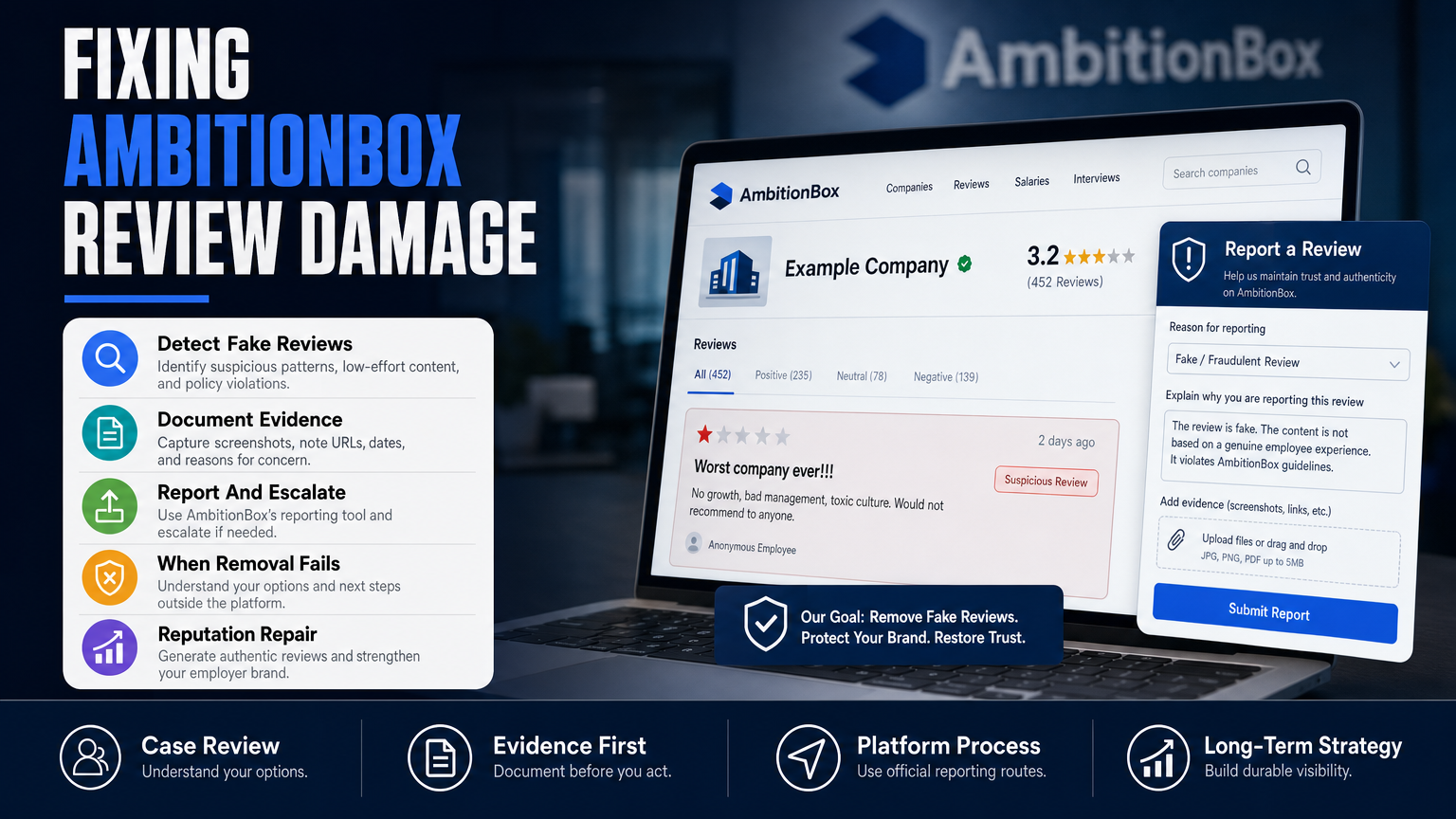
- Reporting policy-violating reviews when appropriate
Businesses that consistently engage with customer feedback often build stronger trust than those with no responses at all.
Remember, authenticity matters more than perfection. A mix of honest reviews and thoughtful responses appears more trustworthy than an unrealistically flawless profile.
Reputation Monitoring Never Stops
Your online reputation changes every day.
New reviews, social media conversations, news articles, and customer experiences continuously shape public perception.
Professional reputation monitoring helps businesses:
- Detect negative mentions early
- Identify fake reviews
- Monitor search rankings
- Track brand sentiment
- Discover PR opportunities
- Protect executive reputations
By identifying issues early, businesses can respond before small concerns become larger reputation challenges.
A Real-World Example
Imagine a regional law firm notices a decline in consultation requests.
After conducting a reputation audit, they discover:
- Several outdated directory listings
- A handful of unresolved negative reviews
- Limited positive content ranking on Google
- Executive profiles that hadn’t been updated in years
Instead of trying to remove every negative mention, the firm develops a long-term ORM strategy.
The campaign includes:
- Updating attorney biographies
- Publishing legal education articles
- Optimizing local SEO
- Improving Google Business Profile information
- Encouraging satisfied clients to leave honest reviews
- Monitoring branded search results
Over several months, prospective clients begin finding more accurate, authoritative information about the firm. Positive search visibility improves, customer confidence increases, and the firm’s digital reputation becomes significantly stronger.
This illustrates an important point: effective Online Reputation Management isn’t about hiding the truth—it’s about ensuring that trustworthy, relevant information is easier to find than outdated or incomplete content.
Reputation Management Is an Ongoing Investment
Many businesses assume ORM ends once search results improve.
In reality, maintaining a positive online reputation requires continuous effort.
Markets evolve, competitors publish new content, customer expectations change, and search algorithms continue to improve.
Organizations that consistently invest in their digital reputation are generally better positioned to:
- Build long-term trust
- Protect brand authority
- Improve customer retention
- Increase search visibility
- Reduce future reputation risks
A proactive strategy is almost always more effective—and less costly—than responding only after a reputation crisis occurs.
Common Mistakes That Hurt Your Online Reputation
Many businesses unintentionally damage their reputation by reacting instead of planning. A single poor decision can amplify a negative situation and make recovery more difficult.
Here are some of the most common ORM mistakes to avoid.
Ignoring Negative Reviews
Some business owners believe that if they ignore negative reviews, the problem will disappear.
In reality, unanswered reviews often signal to potential customers that the business doesn’t value feedback. Even if you can’t satisfy every customer, responding professionally demonstrates accountability and a willingness to improve.
Arguing with Customers Online
Public arguments rarely strengthen a brand.
Responding emotionally to criticism on Google, Facebook, LinkedIn, or review platforms can attract additional attention to the issue.
Instead:
- Stay professional.
- Acknowledge concerns.
- Offer to continue the conversation privately.
- Focus on resolving the problem.
Professional communication protects your reputation far better than winning an online argument.
Buying Fake Reviews
Purchasing reviews may seem like a shortcut, but it’s one of the quickest ways to lose customer trust.
Search engines and review platforms continue improving their ability to detect suspicious review patterns.
Fake reviews can result in:
- Review removal
- Account penalties
- Reduced customer confidence
- Long-term reputational damage
Authentic customer experiences always provide more sustainable results.
Waiting Until a Crisis Happens
Many organizations invest in reputation management only after a major problem appears.
Unfortunately, rebuilding trust is usually more expensive and time-consuming than protecting it proactively.
The strongest reputations are built before they are tested.
Best Practices for Long-Term Online Reputation Management
Building a strong reputation requires consistency rather than quick fixes.
The following best practices help create sustainable growth.
Publish Helpful, People-First Content
Google increasingly rewards content created for users rather than search engines.
Focus on publishing:
- Educational guides
- Industry insights
- Frequently asked questions
- Case studies
- Customer success stories
- Expert commentary
Helpful content strengthens both SEO and brand authority.
Keep Your Business Information Consistent
Ensure your business information remains accurate across every platform.
This includes:
- Company name
- Address
- Phone number
- Website
- Business hours
- Service descriptions
Consistency improves local SEO while reducing customer confusion.
Encourage Genuine Customer Reviews
Satisfied customers are often willing to leave reviews—they simply need to be asked.
A consistent review strategy creates:
- Increased trust
- Better local visibility
- Higher conversion rates
- Stronger brand credibility
Always encourage honest feedback rather than requesting only positive reviews.
Monitor Your Brand Regularly
Online conversations change quickly.
Monitor:
- Google Search
- Google Business Profile
- Review websites
- News mentions
- Social media
- AI search results
Early detection allows businesses to respond before small concerns become larger reputation challenges.
Expert Tips From Reputation Management Professionals
Experienced reputation specialists understand that successful ORM extends far beyond search rankings.
Here are several proven recommendations.
Think Long-Term
Online reputation is a long-term business asset.
Rather than focusing on today’s search results, invest in building lasting credibility through valuable content and consistent customer experiences.
Build Topical Authority
Search engines increasingly evaluate expertise.
Publishing content around your core services helps establish authority within your industry while supporting branded search visibility.
Instead of creating random articles, develop comprehensive resources that genuinely answer customer questions.
Strengthen Executive Visibility
Customers increasingly research company leadership before making purchasing decisions.
Well-optimized executive profiles, interviews, thought leadership articles, and speaking engagements strengthen both personal and corporate reputation.
This is particularly valuable for:
- CEOs
- Founders
- Attorneys
- Doctors
- Financial advisors
- Real estate professionals
Focus on Trust, Not Just Rankings
The goal isn’t simply reaching the top of Google.
The objective is ensuring that when people find your business, they immediately see trustworthy, accurate, and authoritative information.
Trust drives conversions.
DIY vs Professional Online Reputation Management
| DIY Reputation Management | Professional ORM |
|---|---|
| Limited monitoring | Comprehensive reputation monitoring |
| Basic review responses | Strategic review management |
| Occasional SEO | Full SEO and search optimization |
| Reactive approach | Proactive reputation strategy |
| Limited tools | Enterprise monitoring and reporting |
| Slower improvements | Structured long-term campaigns |
| General marketing knowledge | Specialized ORM expertise |
| Time-consuming | Managed by experienced professionals |
For businesses facing competitive markets or significant reputation challenges, professional guidance often delivers faster and more sustainable outcomes.
How AI Search Is Changing Online Reputation Management
Traditional Google rankings are no longer the only factor shaping public perception.
AI-powered search platforms—including ChatGPT, Google AI Overviews, Microsoft Copilot, Gemini, and Perplexity—summarize information from trusted online sources before users even click a website.
This means your reputation now depends on the overall quality and consistency of your digital footprint.
To perform well in AI-driven search experiences, businesses should focus on:
- Publishing authoritative, well-structured content
- Maintaining accurate business information
- Building trusted brand mentions
- Earning authentic customer reviews
- Demonstrating expertise through educational resources
- Keeping executive and company profiles up to date
Organizations that consistently produce credible, people-first content are more likely to be represented accurately across both traditional search engines and AI-powered search platforms.
Why Every Business Needs Online Reputation Management
Whether you run a small local business or a global company, your online reputation influences how people perceive your brand before they ever contact you. A single Google search can shape purchasing decisions, partnership opportunities, hiring outcomes, and even media attention.
Consumers today compare businesses online before making a decision. They read reviews, visit social media profiles, search for news coverage, and increasingly rely on AI-powered search assistants for recommendations.
A proactive Online Reputation Management (ORM) strategy helps businesses:
- Build customer trust
- Increase qualified leads
- Improve search visibility
- Strengthen brand authority
- Protect against misinformation
- Support long-term business growth
- Reduce the impact of future reputation risks
Rather than waiting for a reputation crisis, successful businesses invest in maintaining a strong digital presence year-round.
Industries That Benefit Most from ORM
Almost every industry benefits from reputation management, but for some professions, trust is essential.
Business Owners
Business owners rely on customer confidence to generate sales and long-term growth. A strong online reputation helps convert visitors into loyal customers while differentiating the business from competitors.
CEOs and Executives
Leadership reputation often influences investor confidence, strategic partnerships, and media perception.
Executive reputation management helps ensure that accurate, authoritative information appears prominently when stakeholders search for leadership teams.
Doctors and Healthcare Providers
Patients frequently research physicians before scheduling appointments.
Positive reviews, educational content, and optimized professional profiles help establish credibility while supporting patient trust.
Lawyers and Law Firms
Legal services are built on expertise and reputation.
Maintaining a professional digital presence helps prospective clients evaluate experience, credibility, and practice areas before making contact.
Entrepreneurs and Startups
Startups often have limited brand recognition.
ORM helps founders establish authority, increase online visibility, and build confidence with investors, customers, and business partners.
Real Estate Professionals
Property buyers and sellers frequently search agents online before making important financial decisions.
Positive reviews, market expertise, and a trustworthy digital presence can significantly influence client acquisition.
Personal Brands and Public Figures
Authors, speakers, consultants, influencers, athletes, and creators all benefit from consistent reputation management.
Managing online visibility ensures audiences find accurate information that reflects their expertise and achievements.
Reputation Management Is No Longer Optional
Search engines and AI-powered platforms are changing how people discover businesses.
Customers no longer rely solely on company websites. They compare information across multiple sources, including:
- Google Search
- Google Business Profile
- Trustpilot
- Industry directories
- News publications
- Social media
- AI search assistants
If these sources present incomplete, outdated, or inconsistent information, potential customers may lose confidence before reaching out.
This is why modern reputation management combines SEO, content strategy, digital PR, review management, and continuous monitoring into one long-term approach.
Conclusion
If you’ve been asking how does online reputation management work, the answer is both straightforward and strategic.
Online Reputation Management works by continuously monitoring, improving, and protecting how your business appears across search engines, review platforms, social media, news websites, and AI-powered search experiences. Rather than focusing on quick fixes, it creates a stronger digital foundation that builds trust, increases visibility, and supports long-term business success.
The most effective ORM strategies combine helpful content, search engine optimization, review management, brand monitoring, and consistent reputation building. Over time, these efforts improve not only how search engines view your business but also how customers, partners, and investors perceive your brand.
In today’s digital landscape, your online reputation is one of your most valuable business assets. Protecting it should be part of every organization’s long-term growth strategy.
Trusted by Clients on Trustpilot
Our commitment to transparency, professionalism, and measurable results is reflected in the feedback we receive from our clients. Your Reputation Agency currently holds a 4.2/5 TrustScore on Trustpilot based on customer reviews, with reviewers highlighting our personalized strategies, discreet service, and successful reputation management outcomes.
What clients appreciate most:
- ⭐ Tailored reputation management strategies
- ⭐ Professional and responsive communication
- ⭐ Effective improvement of Google search visibility
- ⭐ Ethical, long-term reputation protection
- ⭐ Positive results for both businesses and personal brands
Read verified client reviews on Trustpilot: Your Reputation Agency on Trustpilot
Ready to Strengthen Your Online Reputation?
Your online reputation directly impacts customer trust, search visibility, and business growth. Whether you’re dealing with negative search results, reputation challenges, or simply want to build a stronger digital presence, having the right strategy makes all the difference.
At Your Reputation Agency, we help businesses, executives, healthcare professionals, law firms, entrepreneurs, and personal brands protect and enhance their online reputation through ethical, data-driven strategies. Our services include reputation monitoring, search suppression, review management, executive reputation management, and long-term digital brand protection.
If you’re ready to take control of your online presence, our team is here to help.
Explore our services:
Whether you need proactive reputation building or support during a reputation challenge, Your Reputation Agency can develop a customized strategy tailored to your goals.
Schedule your confidential consultation today and start building a stronger, more trusted online presence.
Frequently Asked Questions
1. How does online reputation management work?
Online Reputation Management (ORM) works by monitoring, improving, and protecting how a business or individual appears online. It combines SEO, review management, content creation, search result optimization, digital PR, and reputation monitoring to build trust and increase positive online visibility over time.
2. Why is online reputation management important?
Your online reputation influences how customers, investors, employers, and business partners perceive your brand. A strong reputation builds credibility, improves search visibility, increases conversions, and helps protect your business from long-term reputational damage.
For a deeper understanding, read our guide: Why Is Reputation Management Important?
3. How long does online reputation management take?
The timeline depends on the complexity of the reputation challenge. Some businesses notice improvements within a few months, while more comprehensive campaigns may require six to twelve months or longer to build sustainable authority and trust.
4. Can online reputation management remove negative search results?
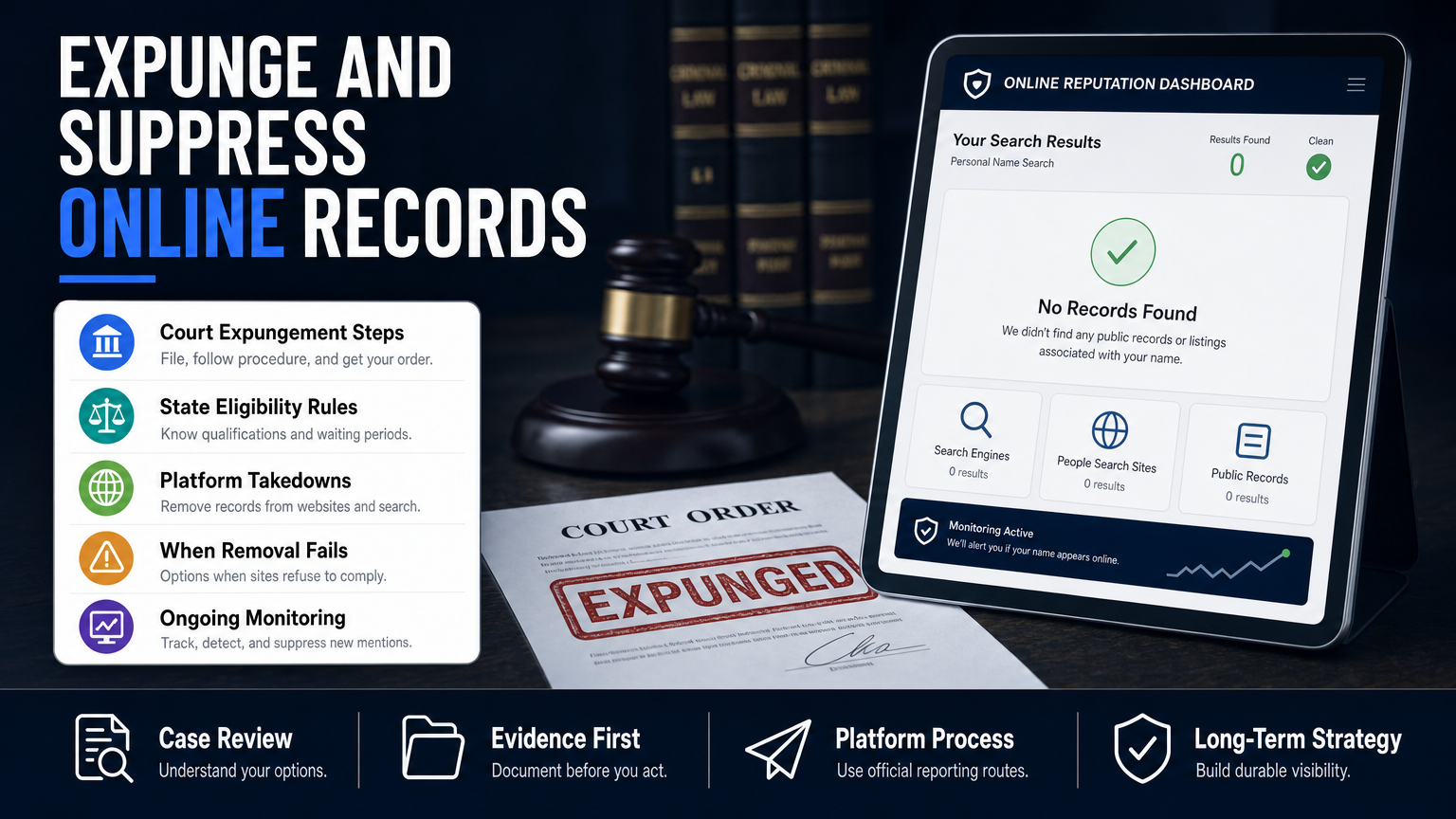
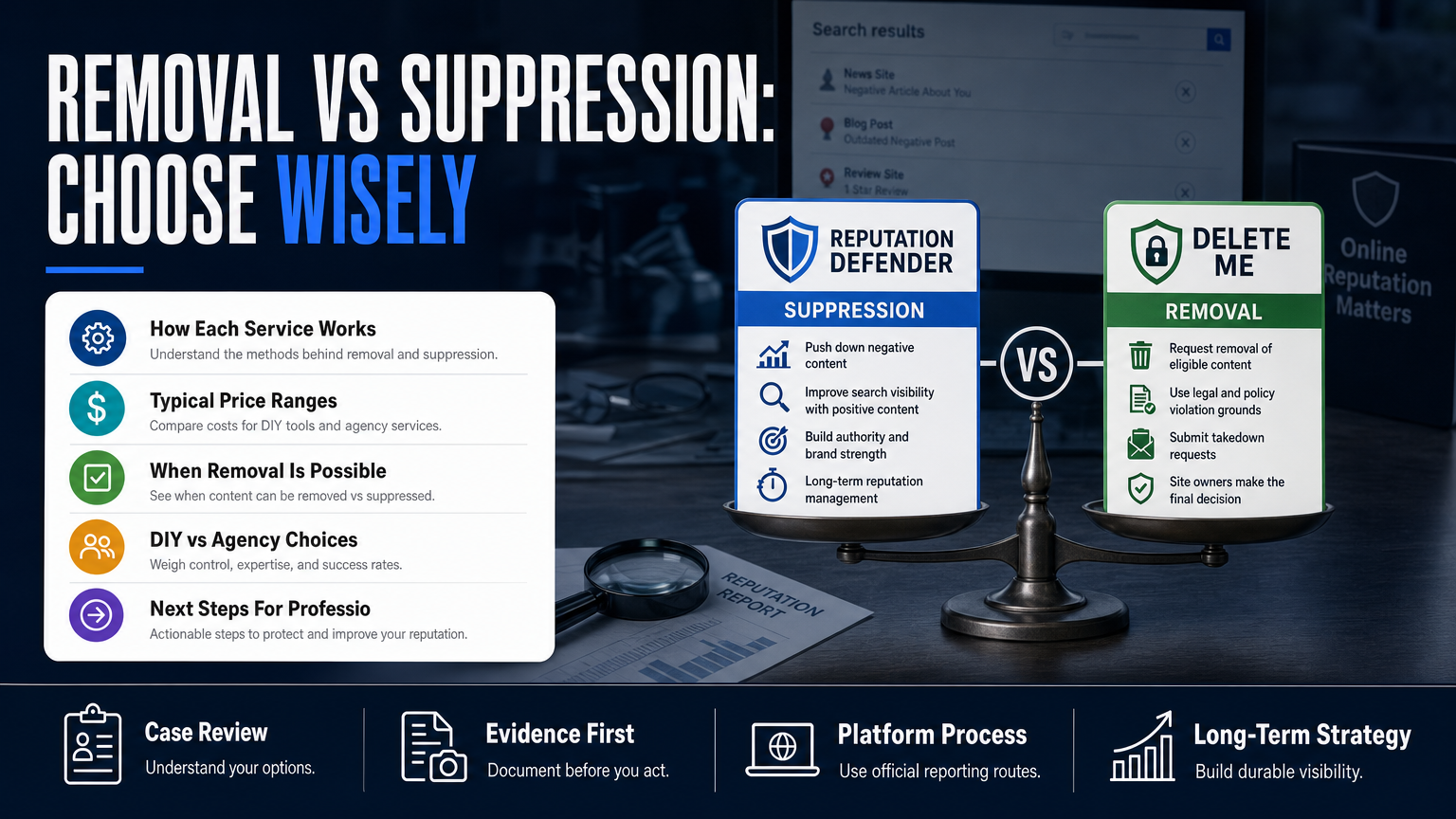
Not always. Some content may qualify for removal if it violates platform policies or legal requirements. In many situations, professional ORM focuses on ethical search suppression, SEO, and authoritative content creation to reduce the visibility of negative results.
5. Is ORM only for large companies?
No. Businesses of every size can benefit from reputation management. Small businesses, startups, local professionals, healthcare providers, law firms, real estate agencies, and entrepreneurs all rely on customer trust and online visibility.
6. What are the main components of Online Reputation Management?
A complete ORM strategy typically includes:
- Reputation monitoring
- Search Engine Optimization (SEO)
- Review management
- Content marketing
- Brand monitoring
- Search result suppression
- Digital PR
- Executive reputation management
- Local SEO
- Social media reputation management
7. How does AI affect online reputation?
AI-powered search platforms such as Google AI Overviews, ChatGPT, Microsoft Copilot, Gemini, and Perplexity increasingly summarize information from trusted online sources. Maintaining accurate, authoritative, and consistent content helps improve how your brand is represented across these AI-driven experiences.
8. Can reputation management help after online harassment or doxxing?
Yes. A professional ORM strategy can help reduce the impact of harmful content, strengthen positive search visibility, and support long-term reputation recovery. If you’re dealing with online abuse, our guide How to Handle Online Harassment and Doxxing: A 5-Step Shield provides practical advice.
9. Can reputation management help remove negative videos?
Negative videos can significantly affect public perception. Depending on the situation, professional strategies may include platform reporting, reputation monitoring, search suppression, and strengthening positive content. Learn more in our guide: Remove Negative Videos Fast – Restore Your Reputation
10. Why should I choose Your Reputation Agency?
Your Reputation Agency specializes in ethical, long-term Online Reputation Management strategies tailored to businesses, executives, professionals, and personal brands. We focus on sustainable reputation growth using SEO, content strategy, review management, reputation monitoring, and search optimization—without relying on risky shortcuts or unrealistic promises.