When a viral post becomes your business reputation
A viral post business reputation crisis can spread through screenshots, reaction videos, reviews, and news coverage before a company verifies what happened. Fast action matters, but an inaccurate first response can deepen the problem.
Seven response steps
- Preserve the original post, comments, shares, dates, and key claims.
- Verify facts and identify affected customers, employees, or communities.
- Assign one response owner and a rapid approval path.
- Correct material inaccuracies with evidence.
- Acknowledge genuine harm and explain corrective action.
- Report threats, impersonation, or privacy violations.
- Monitor search, reviews, social platforms, and follow-up coverage.
A credible response focuses on what happened, what changed, and when stakeholders will receive another update. Avoid attacking critics or posting repeated defensive statements.
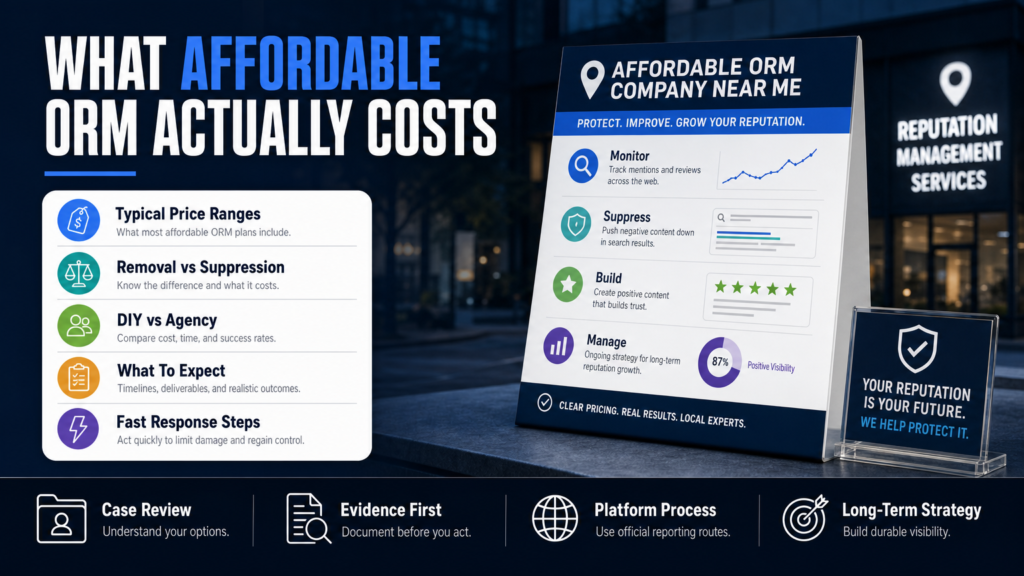
You just typed “affordable reputation management company near me” because a post, review, or photo is costing you clients, applicants, or sleep. That search is the right first move — but affordability and effectiveness don’t always go together. This article shows what an affordable option can realistically deliver and where low cost becomes false economy.
Below I break down typical price ranges, the difference between removal and suppression, and which platforms or problems escalate cost. You’ll get step-by-step actions you can take immediately, plus a checklist to evaluate local firms so you spend money where it matters.
This is written for US professionals and small businesses — doctors, lawyers, restaurateurs, contractors and executives — who need speed and certainty without hidden fees. Where outcomes depend on law, platform policy, or evidence, I’ll say so plainly and give the next practical move.
Table of Contents
- What Does Reputation Management Cost? Typical Ranges And Pricing Models
- How Much Does An ORM (Online Reputation Management) Typically Cost?
- What Are The Best Companies For Reputation Management (And How To Judge Them)
- How Much Does ReputationDefender Cost Per Month?
- What To Do When Removal Isn’t Available
- DIY Vs Agency: When To Pay For Help
- How To Pick An Affordable Reputation Management Company Near Me — A Step‑By‑Step Vetting Checklist
- Monitoring, Crisis Response, And Ongoing Costs You Should Budget For
- Removal vs Suppression (Which Fits Your Problem?)
- Hypothetical Scenario: Doctor, A Viral Complaint Post, And The 90‑Day Plan
- Common Mistakes People Make When Hiring An Affordable Reputation Firm
- Best Practices For Affordable, Effective Reputation Work
- Expert Tips
- Conclusion
- Why Businesses Choose Your Reputation Agency
- Frequently Asked Questions
What Does Reputation Management Cost? Typical Ranges And Pricing Models
Pricing for reputation work varies by problem type (reviews, defamatory posts, mugshots, doxxing), urgency, and the platforms involved. Below are common models and rough ranges — these are market observations, not guarantees.
If your priority was finding an “affordable reputation management company near me,” use these ranges to separate realistic offers from lowballers that cut corners.
- Identify the single worst search result and two next-worst results.
- Ask bidders to price both a removal attempt and an SEO suppression plan for those exact URLs/keywords.
- Require a written scope that lists deliverables, responsibilities for you (evidence, account access), and communication cadence.
- Hourly consulting: $150–$450/hr for senior operators. Useful for strategy, law coordination, or emergency response.
- Flat-fee takedowns/removals: $300–$5,000+ per item depending on complexity, publisher jurisdiction, and legal work required.
- Monthly suppression/SEO retainers: $500–$5,000+/mo depending on number of keywords, pages to suppress, and content creation needs.
- Review remediation packages: $300–$2,500+/mo for consult + reputation workflows; cost depends on volume and platform complexity.
- Crisis response (rapid incident teams): $2,000–$10,000+ as a short-term engagement, often higher for public figures or litigation-level issues.
How agencies justify price differences
Lower fees often mean template-driven suppression (generic blog posts, low-authority sites). Higher fees buy higher-authority content, legal coordination, and hands-on outreach to publishers.
Ask for examples of the specific tactics they’ll use for your URLs (guest posts, HARO, legal notices, data-broker opt-outs, DMCA, platform policy flags).
- Authority content vs disposable microsites
- Manual outreach vs automated filings
- In-house legal coordination vs referral to outside counsel
How Much Does An ORM (Online Reputation Management) Typically Cost?
ORM is a broad label that can include monitoring, reviews, suppression, removals, and PR. Typical ORM retainers reflect that breadth.
For a single professional (doctor, attorney) expect $750–$3,000/mo for a solid ORM retainer that includes monitoring, monthly SEO content, and limited takedown outreach. For small businesses with multiple locations or complex negatives, the range shifts upward.
- Clarify what monitoring covers (which keywords, which platforms, notification thresholds).
- Require a trial month or a short-term SLA that lets you evaluate communication and reporting.
- Ask for a cancellation policy and any minimum term before you sign.
- Starter ORM (solo pro, low-volume negatives): $500–$900/mo
- Standard ORM (SMB with active negatives): $1,200–$2,500/mo
- Enterprise/High-risk ORM (public figure, legal matters): $3,000–$10,000+/mo
What’s usually excluded from ORM retainers
One-off legal letters, court filings, paid media buys, and large-scale content creation usually cost extra. Confirm which removals, if any, are included.
Some agencies charge per-outreach attempt to publishers or per-platform dispute for high-volume review remediation.
- Court/attorney work billed separately
- Premium content production often add-on
- Third-party paid amplification usually extra
What Are The Best Companies For Reputation Management (And How To Judge Them)
There’s no single “best” for every problem. The right firm depends on the issue: reviews, mugshots, defamatory blog posts, or doxxing each favors different strengths (legal, SEO, PR, technical).
If reviews are your primary risk, prioritize agencies with demonstrable pathways for review mediation and review volume management; see our deeper look at review crises with When Google Reviews Become a Brand’s Biggest Crisis.
- Shortlist 3 firms and request a documented plan for your top 3 URLs or reviews.
- Compare scope, not just price: hours, expected deliverables, and reporting cadence.
- Confirm they will coordinate with your counsel when legal options are relevant.
- Look for platform-specific experience: Google, Yelp, Facebook, YouTube, and industry sites (Healthgrades, Avvo, TripAdvisor).
- Ask for anonymized examples of tactics (not results promises) and references from similar industries.
- Check procedural transparency: how they document outreach, evidence collection, and legal referrals.
Red flags in vendor proposals
Any vendor promising guaranteed removal, fixed timelines for platform decisions, or claiming insider access to Google or Yelp is a red flag.
Also watch for opaque pricing (no line-item for specific services) or pressure to sign long minimum terms before a pilot.
- Guarantees of removal or ranking promises
- No documented process for evidence and takedown attempts
- Requests for account passwords beyond what’s necessary
How Much Does ReputationDefender Cost Per Month?
ReputationDefender is one of several legacy providers often cited in comparison shopping. Public pricing is limited and varies by program; typical industry notes place comparable full-service providers in the $1,000–$3,000+/mo range depending on services.
Because platform behavior and case complexity vary, any specific monthly number should be treated as an estimate until you receive a written proposal tied to your URLs and objectives.
- Request a scope tied to your top 3 search terms or URLs and compare line-by-line with other vendors.
- Ask how they price one-off removals and whether legal referrals are extra.
- Smaller, brand-focused plans tend to be less expensive but offer limited takedown/legal coordination.
- High-touch programs with legal, PR, and SEO work push pricing toward the higher end of the range.
How to compare apples to apples
Require proposals to list exactly what is included monthly: monitoring frequency, number of keywords, outreach attempts, content pieces, and response time for crisis events.
Compare predicted labor hours for suppression work — cheaper vendors may simply publish low-authority content rather than invest in high-quality authority pages.
- Number of authority placements promised
- Monthly content production vs one-off posts
- Outreach attempts per publisher/request
What To Do When Removal Isn’t Available
Removal is often possible for policy violations or clear privacy breaches, but many times platforms or publishers refuse to remove truthful or newsworthy content. When removal isn’t available, mitigation and visibility control become the core strategy.
If you need to control first-page impressions rather than remove content, focus on high-quality, relevant pages that push negatives down. For strategy on shaping the first page, see The First Page of Google Is Your Real Homepage.
- Map the first SERP for the exact name and the damaging keyword phrase.
- Choose 3 owned/controlled pages to optimize and 3 third-party targets to pursue.
- Measure weekly and adjust content/targets if suppression stalls.
- Create and optimize owned assets: website pages, staff bios, company blog posts.
- Place authoritative third-party content: guest posts on niche sites, press releases to reputable outlets, and professional directory profiles.
- Use targeted SEO for the exact name + keywords tied to negative items.
Quick technical steps for better visibility control
Use schema markup on your bios and business pages (person, localBusiness) to give search engines clearer signals about relevance.
Canonicalize and optimize titles to capture branded queries (e.g., “Dr. Jane Smith, Cardiologist — Clinic Name”).
- Add structured data to professional bios
- Use keyword-accurate title tags and H1s
- Publish evergreen, authoritative content
DIY Vs Agency: When To Pay For Help
Budget-conscious teams can handle monitoring, basic opt-outs, and content publishing. But problems that need legal notices, publisher negotiations, or coordinated SEO suppression usually justify hiring an experienced agency.
If speed, risk to licensure, or revenue loss is involved, an agency’s process and platform experience can reduce further harm — at a cost.
- Do the low-cost triage yourself: screenshot evidence, collect URLs, send polite review response, attempt platform dispute.
- If platform dispute fails or content escalates, get a professional assessment and written plan.
- Ask an agency for a fixed-price pilot for the top 1–3 issues, then evaluate ROI.
- Good DIY cases: single bad review, data-broker opt-outs, basic monitoring.
- Hire an agency when: multiple sites, legal exposure, mugshots, impersonation, or complex negative PR exist.
- Use short pilots to test an agency’s responsiveness before committing long-term.
What to keep in-house
You should own the brand voice, legal decisions, and credentials. Agencies should execute under your direction and with access-limited accounts when required.
Never hand over unnecessary credentials; use publisher-specific flows and limited-access roles.
- Keep PR messaging approvals internal
- Retain legal decisions and approvals
- Limit account access to required scopes
How To Pick An Affordable Reputation Management Company Near Me — A Step‑By‑Step Vetting Checklist
Local presence can help for in-person sensitive matters, but remote-first agencies are often just as capable because most platforms are online. The checklist below helps you evaluate affordability and competence.
If a negative result originates from a former employee or ex-staffer, that changes tactics; our guidance on staff-driven negatives clarifies how to handle those scenarios: When a Former Employee Becomes a Brand’s Biggest Search Result.
- Step 1 — Prepare a packet: list of damaging URLs, keywords, impacted business metrics, and any legal counsel contact.
- Step 2 — Request 3 written proposals that include line-item pricing and a pilot option.
- Step 3 — Check references from clients in your industry and ask about communication and escalation.
- Step 4 — Start with a 60–90 day pilot focused on the worst 1–3 items, then decide on a longer retainer.
- Ask for a sample scope tied to your top 3 URLs, not a generic sales deck.
- Confirm the proposed vendor’s process for evidence preservation and chain-of-custody for legal disputes.
- Require monthly reporting that includes URLs targeted, outreach logs, and traffic changes for the targeted queries.
Questions to ask during the first call
How will you prioritize items? What happens if a publisher refuses to cooperate? Who will handle legal referrals?
What reporting frequency and metrics will you provide? What are typical timeframes (with the caveats that platforms and publishers control outcomes)?
- Who is my day-to-day contact?
- What access do you need from me?
- How do you bill for additional work?
Monitoring, Crisis Response, And Ongoing Costs You Should Budget For
Reputation work rarely ends. Monitoring and quick response reduce long-term costs. Budget separately for emergency crisis retainers if you are in a high-risk role.
Ongoing costs should include monitoring, periodic content refresh, and an emergency response bucket for rapid takedown attempts or PR support.
- Set up 24/7 alerts for your name, brand, and key phrases.
- Create an internal escalation plan with contact details and decision-makers.
- Reserve a flexible budget for unexpected takedown attempts or paid PR distribution.
- Monitoring tools and alerts: $20–$300/mo depending on sophistication.
- Emergency response retainer: $2,000–$10,000+ held for rapid engagement.
- Quarterly SEO/content refresh: $500–$2,000/quarter for ongoing suppression maintenance.
How to run a low-cost monitoring setup
Combine Google Alerts, a paid basic monitoring tool, and manual weekly SERP checks for your top 5 queries. That mix covers most early-warning signals affordably.
Document every incident in a shared spreadsheet with screenshots and timestamps.
- Google Alerts for brand+location keywords
- A paid monitor for review sites and social mentions
- Weekly SERP snapshot and archive screenshots
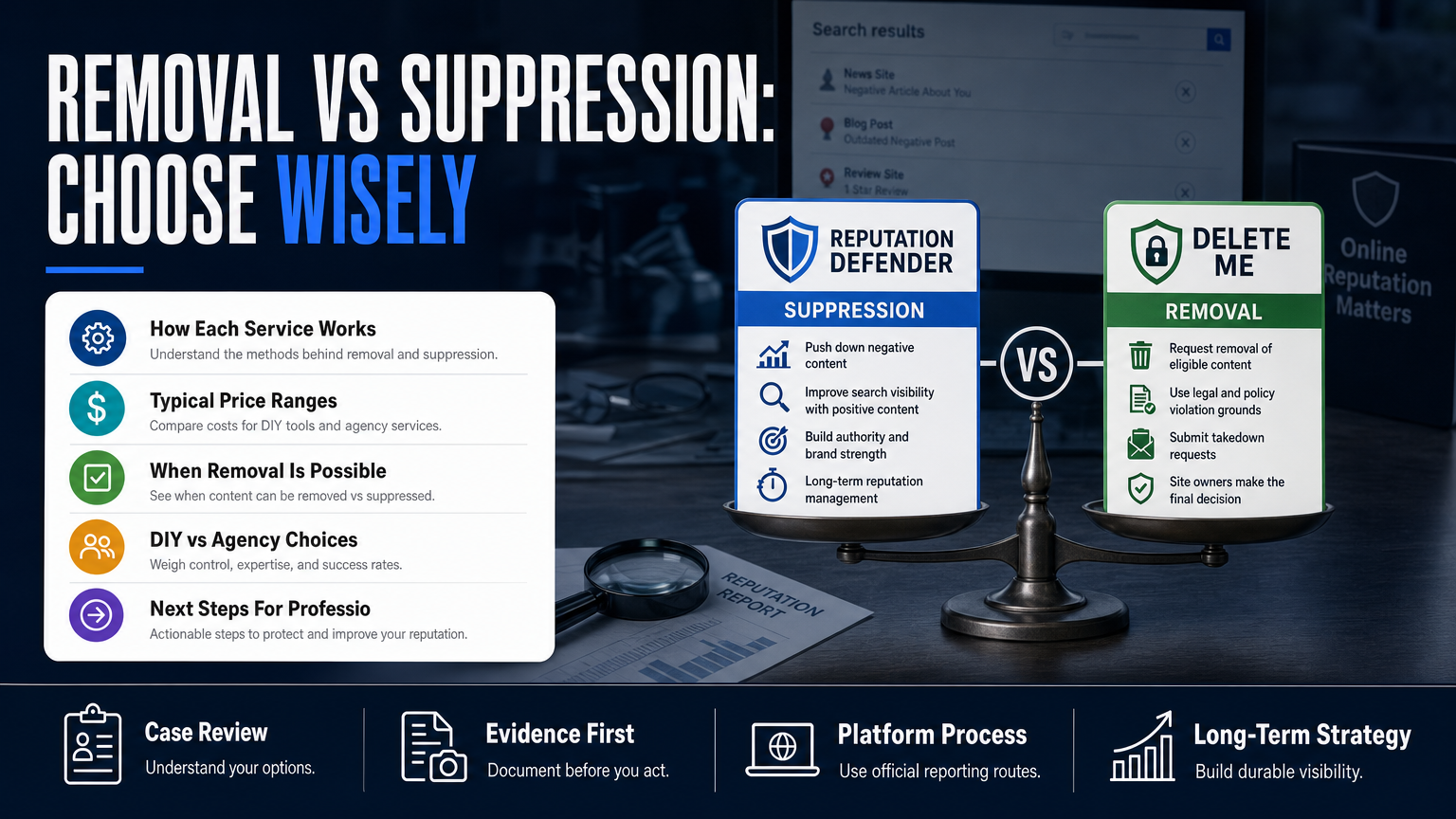
Removal vs Suppression (Which Fits Your Problem?)
A short comparison to decide whether to pursue removal or to deploy suppression (SEO and content).
| Removal | Suppression (SEO) |
|---|---|
| Goal | Push content down in search results |
| Best for | When platform policy/privacy/defamation applies |
| Control | Publisher or platform controls decision |
| Timeline | Potentially fast but unpredictable |
| Cost drivers | Legal fees, publisher negotiations |
| Longevity | If successful, content removed; often permanent |
| When to pick | Clear policy breach, private data, illegal content |
Hypothetical Scenario: Doctor, A Viral Complaint Post, And The 90‑Day Plan
Situation: Anonymized MD — a community cardiologist — wakes to a blog post alleging poor care (unverified) plus a surge of angry Google reviews after a single bad outcome. The post ranks #2 for the doctor’s name and the word “malpractice.”
90‑day response (high level): the priority is evidence preservation, immediate mitigation of business impact, and parallel removal attempts where appropriate.
- Step 1 — Evidence collection: screenshots, archive.org captures, and a timeline of events.
- Step 2 — Platform disputes: apply policy-based challenges for reviews and privacy requests where applicable.
- Step 3 — Publisher outreach: professional, documented requests for correction or removal with supporting evidence.
- Step 4 — SEO suppression: publish high-authority, keyword-focused content to occupy first-page slots.
- Step 5 — Monitoring and PR: watch search results daily and prepare public messaging if queries to licensing boards escalate.
- Day 0–7: Triage and containment — capture screenshots, ask for patient records legal review, publish a holding statement on owned channels.
- Day 7–30: Submit platform disputes for reviews; request review removals where policy violations exist; pursue publisher outreach to the blog that published the complaint.
- Day 30–90: Launch SEO suppression — 3 optimized bio pages, 2 guest posts on authoritative medical sites, and targeted social profiles to push the blog post off page one.
Common Mistakes People Make When Hiring An Affordable Reputation Firm
Avoid these frequent errors — each one costs time or amplifies the problem.
Mistake: Choosing The Cheapest Quote Without A Scope
Lowest price often reflects limited tactics (low-authority content, automated filings) rather than thorough remediation. Always demand a written scope tied to specific URLs.
- Ask for a line-item scope
- Compare hours, not just price
Mistake: Confusing Removal Promises With Reality
Platforms and publishers control removals. Any vendor that guarantees removal or a date is making an unreliable promise.
- Look for process descriptions instead of guarantees
- Expect conditional outcomes
Mistake: Giving Full Account Access When Not Needed
Some vendors request passwords unnecessarily. Use platform roles and limited-access arrangements to keep control and limit risk.
- Use delegated roles or moderated access
- Retain ownership of key accounts
Mistake: Not Planning For Ongoing Maintenance
Too many clients stop after a one-off push. Search results are dynamic; without maintenance, negatives can resurface or competitors can outrank your new content.
- Budget for quarterly refreshes
- Keep monitoring active
Mistake: Reacting Publicly Without Strategy
An emotional public response can create more traction for a negative story. Coordinate messaging with your remediation plan and legal counsel when appropriate.
- Have pre-approved response templates
- Coordinate PR and legal before public statements
Best Practices For Affordable, Effective Reputation Work
Adopt these durable habits to maximize results and keep costs under control.
Preserve Evidence Immediately
Take dated screenshots, archive pages, and collect witness statements. Evidence preservation supports both platform challenges and any possible legal review.
- Use archive.org and timestamped screenshots
- Keep a centralized incident file
Prioritize One Thing At A Time
Focus on the worst search result first (the item generating most harm) — getting small wins is both cost-effective and reduces urgency.
- Rank negatives by business impact
- Sequence removal attempts then suppression
Insist On Transparent Reporting
Require weekly or biweekly status updates that show outreach logs, responses, and measurable SERP movement for targeted queries.
- Outreach logs with timestamps
- Before/after SERP snapshots
Coordinate Legal, PR, And SEO
A coordinated approach reduces contradictions: PR statements should reflect legal constraints, and SEO should support corrective narratives.
We coordinate with counsel when required and advise clients to involve counsel early if there are threats to licensure, lawsuits, or criminal allegations.
- Align statements across channels
- Use legal input for policy-sensitive requests
Plan For Long-Term Monitoring
Treat reputation work as ongoing risk management. Regular audits and an emergency budget reduce scramble costs when incidents occur.
- Quarterly audits of branded SERPs
- Emergency retainer or rapid-response budget
Expert Tips
- Ask for a pilot tied to 1–3 URLs before signing a six-month retainer.
- Preserve evidence right away — screenshots and archived copies are essential.
- Prioritize high-authority content placement over many low-quality posts for suppression.
- Keep control of legal decisions and messaging; vendors execute under your direction.
- Use delegated account roles rather than full passwords when possible.
- Request outreach logs and timestamps for every publisher contact.
- Budget a small emergency fund for rapid publisher or PR interventions.
- Measure success by visibility and business indicators, not absolute promises of removal.
Conclusion
Finding an affordable reputation management company near me is less about the lowest hourly rate and more about predictable process, clear deliverables, and the right mix of legal, technical, and editorial tactics. Use the price ranges and vetting checklist here to separate vendors who do surface-level work from those who can handle complicated removals or suppression.
If removal isn’t available, a focused suppression plan combined with authoritative owned content can materially improve what prospects see on page one. Start with evidence preservation, demand written scopes, and use a short pilot to test an agency’s responsiveness before committing to a long-term contract.
Why Businesses Choose Your Reputation Agency
Managing your reputation takes more than monitoring reviews or publishing the occasional blog post. It takes a strategy built around your situation, your industry, and what is actually showing up in search.
Your Reputation Agency works with businesses, executives, healthcare professionals, attorneys and growing brands. Our services include:
- Remove defamatory content and false posts (news, blogs, listings)
- Remove or challenge negative reviews (Google, Yelp, TripAdvisor, industry sites)
- Mugshot and arrest record removal
- Remove videos, images, and other multimedia that damage reputation
- Remove personal data from people‑search and data‑broker sites (opt‑outs)
- Search result suppression (SEO to bury negative links)
- Social media takedowns and impersonation removal
- Rapid online crisis management and incident response
- Ongoing monitoring and alerting of reputation signals
- Coordination with legal counsel and use of legal tactics when required
Frequently Asked Questions
1. How much do reputation management services typically cost?
Costs vary widely: simple monitoring and opt-outs can be a few hundred dollars, while multi-platform removal and high-authority suppression can cost thousands. Expect hourly consulting at $150–$450/hr, takedown efforts from several hundred to several thousand per item, and monthly retainers from $500–$5,000+ depending on scope.
2. How much does an ORM typically cost?
ORM retainers for solo professionals usually range from $500–$3,000/month depending on the number of keywords and depth of services. High-risk public figures or businesses with multiple locations commonly pay more. Exact pricing should be based on a scoped proposal tied to your specific URLs and objectives.
3. What are the best companies for reputation management?
There’s no single best company for every need. Choose a firm with experience on the platforms causing you harm — Google, Yelp, Facebook, YouTube, or industry sites — and request a written plan for your exact issues. If reviews are the core problem, start with vendors who have documented review-remediation processes and read our analysis at When Google Reviews Become a Brand’s Biggest Crisis.
4. How much does ReputationDefender cost per month?
Publicly disclosed pricing varies and depends on the package. Comparable full-service providers generally fall in the $1,000–$3,000+/month range for comprehensive programs. Ask for a proposal tied to your URLs and objectives rather than relying on a headline price.
5. Can you guarantee removal of a negative article or review?
No reputable provider should guarantee removal. Platform and publisher decisions depend on policies, evidence, jurisdiction, and editorial judgment. A firm should explain possible routes (policy flags, legal notices, outreach) and the likelihood of success based on the facts.
6. What should I do if a former employee posts false claims about my company?
Preserve evidence, review platform policies for harassment/defamation, and pursue platform disputes where appropriate. Complex staff-driven cases often require coordination between legal counsel, PR, and reputation specialists; see our guidance on staff-related reputation issues at When a Former Employee Becomes a Brand’s Biggest Search Result.
7. How long does suppression take if removal fails?
Suppression timeframes vary. Some cases show measurable movement in weeks; others take months. Factors include the authority of competing sites, the strength of your new content, and algorithmic changes. Agencies can provide an estimated range after assessing the specific SERP and competition.
8. Can I do reputation work myself to save money?
Yes for monitoring, basic opt-outs, and initial responses to reviews. DIY is less practical for complex takedowns, legal coordination, or authority-based suppression. A hybrid approach (DIY monitoring + paid pilot for the toughest items) is often the most affordable and effective route.
9. Are there affordable local firms in California or Texas that handle this work?
Both local and remote firms serve California and Texas clients. Local firms can be helpful for in-person sensitive matters, but most platform work is online and can be managed remotely. Use the vetting checklist in this article to evaluate local vendors on scope, references, and documented processes.
This content provides general information and does not constitute legal advice. The available options and likely outcomes depend on the facts, evidence, platform policies, applicable law, jurisdiction, and public-interest considerations.
Past examples do not guarantee future results. Removal, correction, deindexing, and search-position changes depend on third parties and circumstances outside Your Reputation Agency’s control.