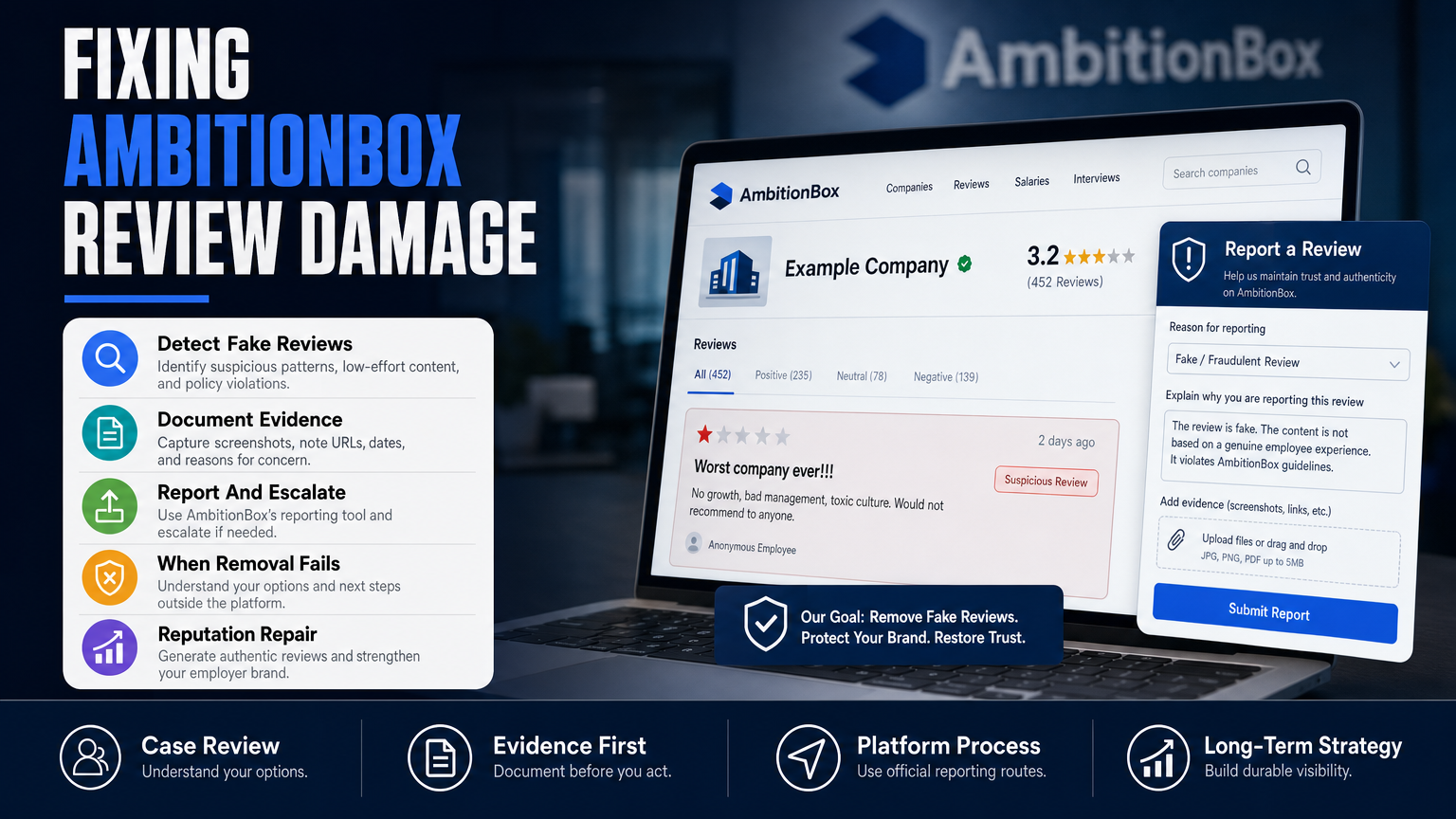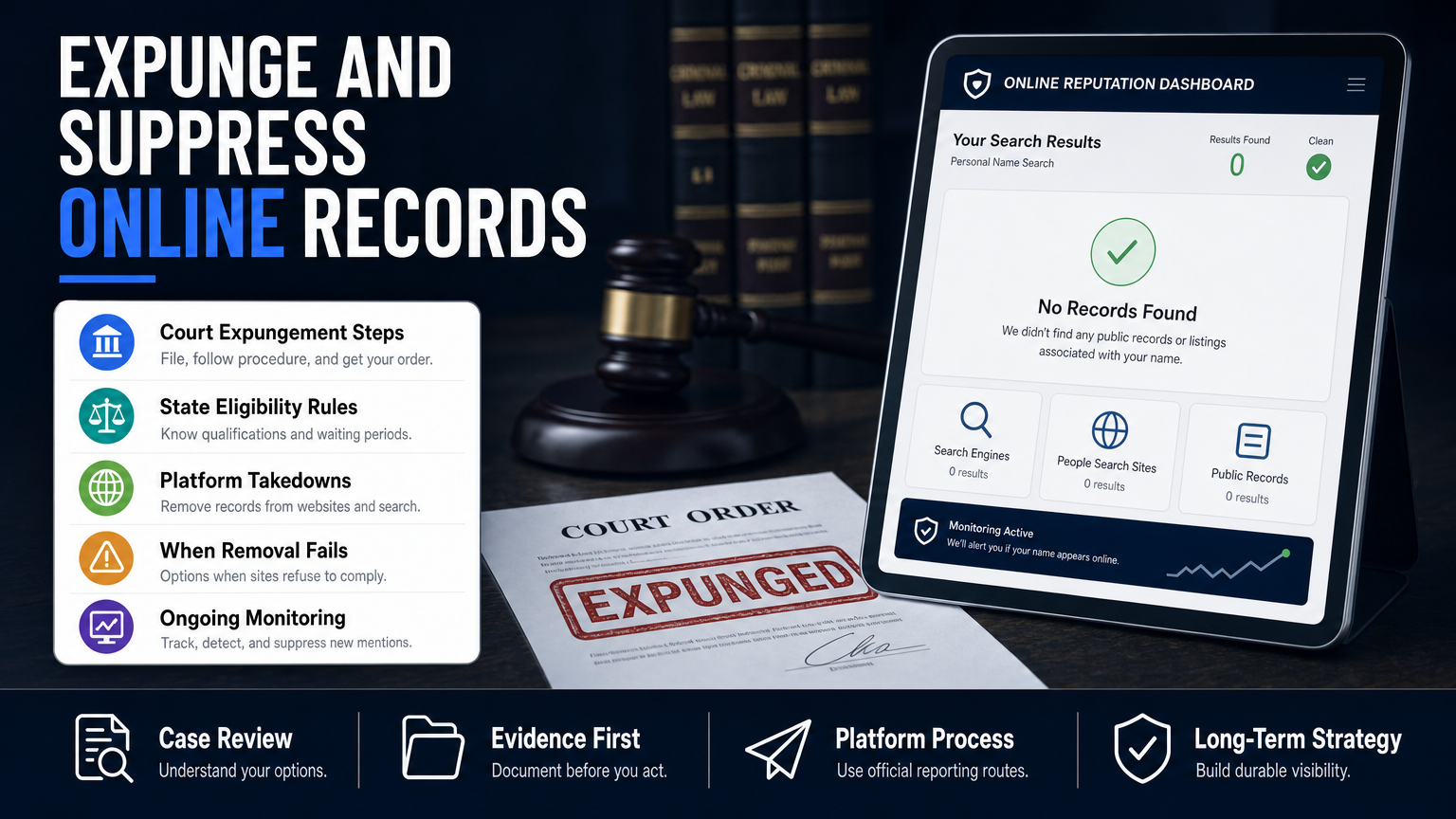
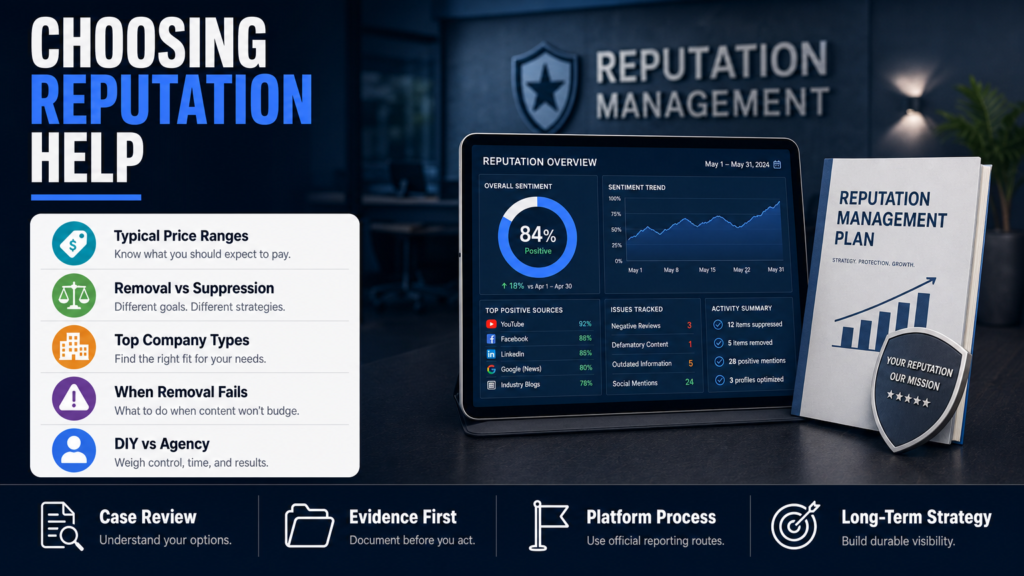
You found a bad Google review, a hostile blog post, or an arrest photograph that surfaces when people search your name. You need help fast — and you want to know which firms can actually handle crises like yours. This article compares the capabilities, typical approaches, and practical trade-offs among top online reputation management companies.
Below you’ll find a realistic look at how Top online reputation management companies operate, what tools and legal options they use, and how pricing usually breaks down for individuals versus businesses. I’ll show when removal is likely, when suppression is the right path, and what to do when platforms or publishers won’t cooperate.
Read this if you need to decide between building an in-house response, hiring a boutique specialist, or engaging a full-service firm. You’ll get a comparison table, a step-by-step hypothetical case, common mistakes to avoid, and concrete next steps you can use today.
Table of Contents
- What Do Top Online Reputation Management Companies Actually Offer?
- What Is The Best Online Reputation Management Tool?
- How Much Does Online Reputation Management Cost?
- comparison_table
- Real-World Example: A Hypothetical Doctor, A Viral Post, And A Recovery Plan
- Common Mistakes Firms And Clients Make
- Best Practices For Working With A Reputation Firm
- Expert Tips From Reputation Practitioners
- conclusion
- faq
- Removal vs Suppression — Which Approach Fits Your Case?
- Hypothetical Case Walkthrough: Private Clinic Reputation Recovery
- Common Mistakes to Avoid
- Best Practices to Follow
- Expert Tips
- Conclusion
- Why Businesses Choose Your Reputation Agency
- Frequently Asked Questions
What Do Top Online Reputation Management Companies Actually Offer?
Reputation firms blend legal, technical, SEO, and public-relations tactics. Typical services include evaluating whether content may qualify for removal or review, pursuing platform reporting and takedown requests, coordinating with attorneys for subpoenas or retraction demands, running SEO to push damaging pages lower in search, removing personal data from people-search sites, and managing review and social-media crises.
No reputable company promises guaranteed removal or permanent suppression. We evaluate whether the content may qualify for removal or review and pursue the legal, technical, platform-based, and reputational options available. Platform decisions and publisher cooperation remain under the platform’s or publisher’s control.
- 1) Triage: evidence collection and scope assessment.
- 2) Legal/Platform review: determine removal possibilities and escalation paths.
- 3) Technical/SEO plan: suppression targets and new content creation.
- 4) Execution: takedown requests, outreach, SEO, and monitoring.
- 5) Reporting: regular status updates and next-step recommendations.
- Takedowns: reporting policy violations on Facebook, TikTok, YouTube, Reddit, and forums.
- Review remediation: Google My Business, Yelp, Trustpilot, Healthgrades, RealSelf, Glassdoor.
- Search-engine suppression: SEO to promote accurate, credible content above harmful items.
- Privacy opt-outs: removing addresses, phone numbers, and data-broker listings where policies allow.
- Crisis PR and social response: drafting statements and managing media outreach.
How companies differ
Some agencies focus on automated tools and software for monitoring and review management; others provide manual takedown work, bespoke legal coordination, or crisis PR. Boutique firms often handle complex, evidence-intensive matters like alleged defamation or doxxing; platform-focused vendors sell subscription tools for review monitoring and workflows.
- Software-first: best for high-volume review monitoring and automated responses.
- Service-first: best for complex removals, legal coordination, and sensitive personal-data cases.
- Hybrid: combines tools for scale with human escalation for edge cases.
What Is The Best Online Reputation Management Tool?
There’s no single ‘‘best’’ tool for every use case. The ideal tool depends on whether you need monitoring, automated review workflows, sentiment analysis, or full content takedowns. For enterprises and agencies, multi-channel platforms (Reputation.com, BirdEye, and Podium) excel at review management and workflows. For single professionals or SMBs, lighter tools such as Brand24, Mention, or Google Alerts combined with manual escalation often suffice.
Evaluate tools on three practical axes: coverage (which sites and social platforms it watches), escalation (does it generate takedown-ready evidence and workflows?), and integration (can it connect to your CRM or help-desk?). If your priority is coordinated legal action or complex content removal, a software tool alone will usually be insufficient — you need a service that pursues the legal, technical, platform-based, and reputational options available.
- Define the problem (single review, doxxing, persistent negative article).
- Match tool capability to the problem (monitor, mediate, or remove).
- If removal is possible, ensure the tool or vendor produces evidentiary reports for escalation.
- Monitoring: Brand24, Mention, Meltwater — good for alerts and sentiment.
- Review management: Reputation.com, BirdEye, Podium — best for multi-location businesses.
- SEO suppression: custom SEO firms with ORM experience (often service-first).
- Takedown coordination: manual service firms, often paired with legal counsel.
When to pick software vs service
If the issue is mostly monitoring, reputation software provides the best return. If you need evidence collection, legal escalation, or complex takedown requests, choose a service-first agency or hybrid offering.
- Software only: recurring monitoring and review-response workflows.
- Service only: legal and manual removals, sensitive personal data, or reputation PR.
- Hybrid: use software for scale and human service for escalations.
How Much Does Online Reputation Management Cost?
Costs vary widely depending on services, urgency, and complexity. Expect a range from DIY/minor fixes costing under $500 to multi-month agency retainers and legal coordination running $5,000–$50,000+ for serious, evidence-heavy matters. We develop SEO reputation strategies intended to improve visibility, but timelines and costs depend on the strength of the negative content and the authority of competing sources.
Prices also differ by client type: a single professional seeking a few removals will face different fees than a multi-location business requiring continuous review management, litigation support, or crisis PR. For transparent planning, ask prospective firms for a written scope with estimated phases, deliverables, and a range of likely costs.
- Request an itemized scope: which platforms, what evidence is required, expected steps.
- Confirm what is included (monitoring, content creation, outreach) and what is extra (court filings, attorney fees).
- Ask for milestone reporting and estimated ranges rather than fixed promises.
- One-off takedown attempt: $300–$2,000 (simple platform reports and outreach).
- Targeted suppression (SEO + content): $1,500–$7,500 per month for 3–6 months.
- Legal escalation and evidence gathering: variable; attorney costs are separate and depend on jurisdiction.
- Full-service crisis retainer: $3,000–$15,000+ per month for ongoing monitoring and PR support.
Budgeting practicalities
If funds are limited, prioritize actions with the highest immediate impact: evidence preservation, urgent platform reports for policy violations (harassment, doxxing, impersonation), and mitigation of high-traffic search results. For longer-term reputation rebuilding, budget for sustained SEO and content generation.
For a realistic primer on strategic options and cost trade-offs, see Best Reputation Management Strategies.
- Short engagements can triage urgent risks; long engagements build authoritative, favorable content.
- Plan for legal costs separately if the case may require subpoenas or court motions.
What Are The Top 5 Digital Marketing Companies (and why that matters for ORM)?
When people ask ‘‘what are the top 5 digital marketing companies,’’ they usually look for firms that deliver scale, creative capabilities, and measurable SEO results. In ORM, the same capabilities matter: strong content creation, technical SEO, authoritative backlink acquisition, and analytics. Companies often cited for broad digital skill sets include global agencies with deep SEO and PR resources — but the exact top five depends on whether you value local presence, healthcare compliance expertise, or litigation coordination.
For reputation work, the best fit is less about brand-name lists and more about demonstrated ORM experience. A top-tier digital-marketing firm may excel at paid media and brand campaigns but lack experience with takedowns, review removal policies on healthcare sites (Healthgrades, Vitals), or evidence chains needed for legal escalation.
- Large global agencies: strong at enterprise SEO, brand PR, and large-scale content programs.
- Specialist ORM firms: experienced with removals, people-search opt-outs, and review-site policies.
- Local agencies: better for small multi-site businesses (restaurants, clinics) that need localized SEO.
Who Is The Best Social Media Management Company?
The ‘‘best’’ social media management company for crisis response depends on the goal. If you need fast content moderation and removal requests across platforms, choose a firm with platform-specific escalation expertise for Facebook, Instagram, Twitter/X, TikTok, and YouTube. If your need is ongoing brand-building to drown out negative search results, choose an agency experienced in content production, paid amplification, and SEO.
We coordinate with qualified legal professionals when a matter requires legal analysis; platform decisions remain under the platform’s control. Ask any prospective vendor for examples of platform-specific work: content takedown workflows, experience with YouTube copyright and defamation claims, or TikTok impersonation reporting processes.
- Crisis-first firms: fast-response teams and social moderation workflows.
- Content-first firms: produce shareable content to rebuild narrative and SEO signals.
- Hybrid teams: combine moderation, PR statements, and long-term content strategies.
When Removal Is Not Available: Suppression and Mitigation Strategies
Removal depends on the content, publisher, platform policies, evidence, and jurisdiction. When clearance for removal does not exist, top online reputation management companies rely on intentional mitigation: SEO suppression, authoritative content creation, correction or rebuttal pages, and legal or factual clarifications where appropriate.
For hands-on tactics to reduce the visibility of harmful content, see our practical workflow at How Do You Manage Online Reputation Management?. That resource explains how to combine monitoring, SEO, and content to change what searchers see first.
- Create authoritative owned content (site pages, professional profiles, guest articles).
- Build high-quality backlinks to favorable pages to improve ranking signals.
- Use schema, press releases, and social accounts to add canonical, up-to-date information.
- Pursue corrections or retractions with publishers when inaccuracies exist.
How To Choose The Right Company For Your Case
Choosing a firm is a procurement decision: check for relevant experience, documented processes, evidence handling, and how they coordinate with attorneys and platforms. Beware firms that promise guaranteed takedowns or fixed timelines. Ask for references in your industry (doctors, lawyers, executives) and ask how they would escalate a case like yours.
For a structured selection process and a checklist you can use in vendor interviews, read How to Pick the Best Online Reputation Management Agency. That guide helps you compare scope, communication cadence, legal coordination, and pricing models.
- Ask for a written scope with milestones and expected evidence requirements.
- Confirm who will handle platform reports and whether legal counsel is part of the retained team.
- Request sample reports and monitoring dashboards.
- Compare pricing models: hourly, per-incident, or retainer.
Monitoring, Retainers, and Long-Term Protection
Reputation is not fixed — new content can appear after a crisis seems resolved. Top companies offer monitoring and alerting to detect emerging threats: new reviews, social posts, or resurfacing articles. Monitoring plans vary from simple email alerts to 24/7 crisis retainer services.
A sensible approach ties monitoring to concrete thresholds: immediate escalation for doxxing, impersonation, and viral posts; daily or weekly alerts for new reviews and mentions. Confirm how access and confidentiality are handled; reputable firms limit case access and define confidentiality in the service agreement.
- Basic monitoring: alerts and weekly summaries.
- Advanced monitoring: sentiment analysis, influencer tracking, and automated workflows.
- Retainer: guaranteed response SLAs, crisis phone lines, and documented escalation.
Vendor Comparison: Removal vs. Suppression Approach
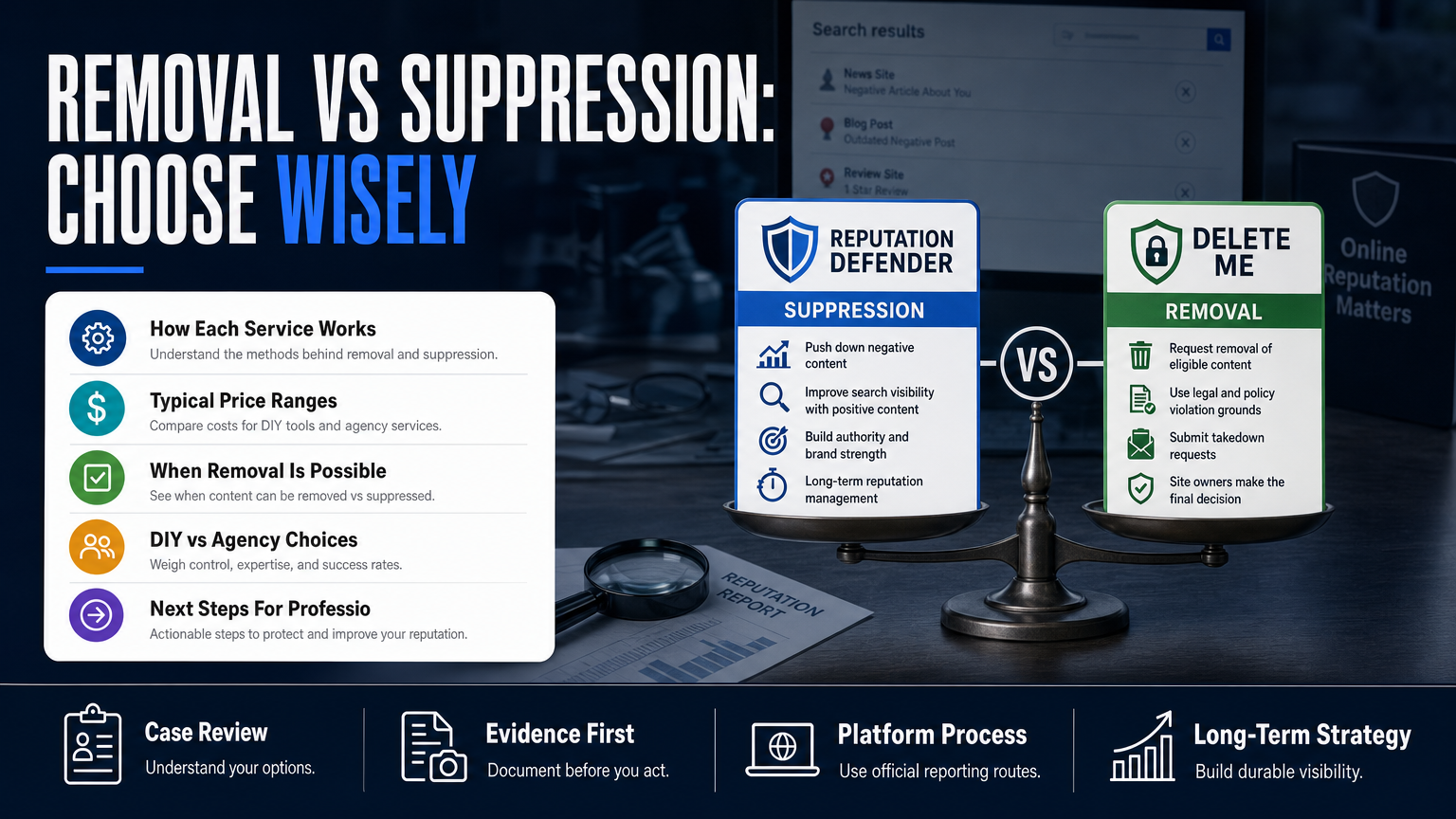
When interviewing vendors, understand whether they emphasize removal attempts, suppression via SEO, or a hybrid. The right choice depends on the content type, platform, and whether the publisher is cooperative.
- Removal-first vendors excel when platform policies clearly prohibit the content (harassment, doxxing, explicit privacy violations).
- Suppression-first vendors are practical when the content is lawful but damaging and published by noncooperative outlets.
- Hybrid vendors combine takedown attempts with immediate SEO uplift to reduce short-term exposure.
Legal Considerations And When To Involve Counsel
Some cases may warrant legal review: false factual allegations, extortion, defamation, or persistent impersonation. The content may warrant legal review and a qualified attorney can determine whether a legal claim may be available. Reputation firms often coordinate with outside counsel; they are not law firms themselves and do not provide legal representation.
Ask vendors how they document evidence, preserve metadata, and support subpoenas if a court filing becomes necessary. Legal steps are jurisdiction-dependent and costs vary; vendors should explain which tasks require counsel and which they handle operationally.
- Documentation: capture screenshots, URLs, timestamps, and social metadata.
- Chain of custody: request written confirmation of how evidence is stored.
- Coordination: clarify roles between agency and attorney before spending on legal escalation.
comparison_table
Real-World Example: A Hypothetical Doctor, A Viral Post, And A Recovery Plan
Scenario: An anonymous blog post alleges negligence about a medical procedure for a mid-size private practice physician. The post ranks on page one for the physician’s name and appears in paid snippets. The physician has five negative Google reviews from a disputed source.
This example shows a plausible, anonymized end-to-end workflow that a reputable firm might follow. It is not a promise of results but explains practical steps and timeframes you could expect to discuss with a vendor.
- Day 0–7: Triage and evidence preservation. Capture screenshots, URLs, and social metadata. Assess whether the blog violates platform or hosting policies.
- Week 1–4: Outreach. Send a documented correction request to the publisher and file platform reports where appropriate. Begin creating owned content (physician profile pages, clinic pages, patient-education content).
- Month 1–3: SEO suppression. Publish authoritative content, run a backlink campaign to those pages, and optimize schema. Encourage legitimate patient reviews to return balance (never fake or coerce reviews).
- Month 3–6: Monitoring and legal decision. If the publisher refuses correction and the evidence supports a legal claim, coordinate with counsel about next steps. Continue monitoring and maintain fresh authoritative content to protect search visibility.
- Initial triage and evidence collection.
- Platform reports where policy violations apply (harassment, doxxing).
- Publisher outreach requesting correction or retraction where factual errors are demonstrable.
- SEO suppression campaign to promote authoritative profiles and press corrections.
- Monitoring and follow-up, with legal escalation if publisher refuses correction and evidence supports a claim.
Common Mistakes Firms And Clients Make
Avoiding these common errors will improve your chance of an efficient, ethical outcome.
Mistake 1 — Doing Nothing Or Waiting Too Long
Delay lets negative content accumulate shares and backlinks, which makes suppression harder. Early evidence preservation is crucial because platforms and hosts may change or remove material over time for reasons unrelated to your case.
Mistake 2 — Public Confrontation Or Emotional Responses
Public arguments or threats amplify visibility and add new, searchable content. A measured, evidence-based approach avoids fueling the story and preserves legal options.
Mistake 3 — Paying For Fake Positive Reviews
Buying reviews or using fake accounts risks platform bans and legal trouble. It can also backfire if discovered, worsening trust and visibility.
Mistake 4 — Expecting Takedowns For Lawful But Damaging Content
Platforms typically protect lawful speech. Expecting removal simply because content is negative or embarrassing is unrealistic. Instead, plan for suppression and correction where appropriate.
Mistake 5 — Ignoring Ongoing Monitoring
Treat reputation as a continuous process. Without ongoing monitoring, new damaging posts or coordinated review attacks can appear unnoticed.
Best Practices For Working With A Reputation Firm
These durable practices improve outcomes and keep processes transparent.
Document Everything
Keep a secure, date-stamped file of screenshots, URLs, and communications. This supports both platform reports and any legal escalation. Ask the vendor how they preserve and share evidence.
Insist On A Clear Scope And Communication Plan
Request a written engagement plan with milestones, reporting cadence, escalation triggers, and estimated cost ranges. This lets you compare proposals apples-to-apples.
Prioritize Platform Policies For Rapid Wins
Harassment, doxxing, impersonation, and explicit privacy violations are often eligible for faster action via platform policy enforcement. Identify these first — they are typically the easiest to act on.
Combine Legal And Operational Paths When Needed
Some scenarios require both platform approaches and legal action. Coordinate counsel early to avoid missteps that could harm a legal case or limit discovery options.
Measure Outcomes Realistically
Use measurable KPIs: search ranking movement for targeted queries, removal status, sentiment changes, and review scores. Understand that search results are influenced by algorithmic and competitive factors outside any vendor’s full control.
Expert Tips From Reputation Practitioners
- Preserve evidence immediately — screenshots with timestamps are basic but essential.
- Separate emotional responses from your public reply; have a trusted advisor draft public statements.
- Don’t pay for fake reviews — reputable firms avoid deceptive tactics that risk penalties.
- If a review is false and violates platform policy, file a policy report with documented evidence.
- Prioritize removal options for doxxing, impersonation, and graphic content — platforms move fastest on safety issues.
- Ask vendors how they measure success beyond ‘removals’ — look for SEO and visibility metrics.
- Use canonical, authoritative content (profiles, About pages) to control the narrative.
- Contract for defined scopes and review exits; avoid open-ended retainers without deliverables.
conclusion
Top online reputation management companies vary by capability: software-focused vendors scale monitoring and review workflows, specialist firms handle legal and manual removals, and hybrid providers offer both. Your choice should match the problem: monitoring tools for alerts, boutique services for complex takedowns, and SEO-first teams for suppression.
No vendor can promise guaranteed removals or fixed timelines. A professional process — evidence collection, policy-first takedown attempts, coordinated SEO suppression, and legal coordination when warranted — is the reliable path. Start with a clear scope, insist on measurable milestones, and prioritize actions that preserve options.
faq
Removal vs Suppression — Which Approach Fits Your Case?
A quick comparison to help you decide whether to pursue removal, suppression, or both.
| Removal | Suppression |
|---|---|
| Goal | Goal |
| Eliminate content from a platform or publisher | Reduce visibility by outranking with positive/neutral content |
| Typical speed | Typical speed |
| Can be fast if platform policy applies; otherwise slow or impossible | Generally slower (weeks to months) but more reliable when removal fails |
| Best for | Best for |
| Policy violations, doxxing, harassment, impersonation | Lawful but damaging articles, old reviews, and legacy content |
| Permanence | Permanence |
| Depends on publisher/platform; not guaranteed | Requires ongoing content/SEO work to maintain |
| Cost drivers | Cost drivers |
| Legal involvement, publisher resistance, investigations | Content production, backlink building, paid amplification |
Hypothetical Case Walkthrough: Private Clinic Reputation Recovery
A private clinic discovers a syndication of an old arrest record on a mugshot site plus three negative Yelp reviews from anonymous accounts. The clinic needs to reduce immediate visibility for local search and remove personal data where possible.
This is an anonymized hypothetical example illustrating typical steps an agency might take; it does not guarantee outcomes.
- 1) Days 0–7: Evidence preservation and urgent reports for doxxing. Attempt people-search opt-outs where policies allow.
- 2) Weeks 1–4: Outreach to publishers for removal or correction; implement local SEO fixes to reclaim search snippets.
- 3) Months 1–6: Build authoritative local citations, solicit legitimate patient reviews ethically, and maintain monitoring alerts.
- Triage: identify which pages violate policy (privacy, doxxing) and preserve evidence.
- Immediate actions: file platform and hosting reports for doxxing and privacy violations.
- Mitigation: launch local SEO campaign, optimize Google Business Profile, and publish patient education content.
- Monitoring: set alerts for new mentions and watch review score trends.
Common Mistakes to Avoid
These are practical missteps we see frequently; correcting them improves outcomes and reduces wasted spend.
Relying Only On Promises Without Process
If a vendor won’t provide a written scope, milestone plan, or evidence-handling process, walk away. Promises without process are a red flag.
Mixing Legal And Public Messaging Poorly
Public messages can affect legal strategies. Coordinate counsel early to avoid undermining a potential claim or admission that limits options.
Treating Reputation Like A One-Time Fix
Reputation requires ongoing attention. Expect recurring monitoring and periodic content refreshes rather than a one-off project.
Using Generic SEO Tactics Without ORM Experience
Generic SEO agencies may not understand the nuance of review platforms, publisher outreach, or evidence preservation. Choose firms experienced in ORM specifics.
Failing To Vet Vendors’ Ethical Boundaries
Insist on ethical practices. Avoid firms that suggest deceptive tactics such as creating fake identities, fake reviews, or intimidation of critics.
Best Practices to Follow
Follow these durable practices when managing reputational risk or hiring a firm.
Start With Evidence Preservation
Immediately capture screenshots, URLs, and social metadata. This preserves options whether you pursue a platform report, publisher outreach, or legal action.
Use Platform Policies First
Identify policy violations (privacy, harassment, impersonation). Platform enforcement is often the fastest path for those categories.
Prioritize Owned Content
Invest in authoritative, search-optimized content you control: professional bios, clinic pages, reliable press, and scholarly or industry content.
Retain A Clear Communication Plan
Define who speaks publicly, who handles media inquiries, and who manages platform reports. This reduces contradictory statements that can amplify harm.
Maintain Ongoing Monitoring
Set alerts with escalation rules for urgent issues (doxxing, impersonation, viral posts). Regularly review the monitoring output with your vendor.
Expert Tips
- Preserve all evidence at first sight — screenshots with metadata are inexpensive insurance.
- If a platform policy clearly applies (doxxing, harassment), prioritize that removal path for speed.
- Ask vendors for a sample report and evidence package before signing a retainer.
- Keep public replies short and factual; never post legal threats publicly.
- Use authoritative third-party content (press, industry citations) to out-rank harmful pages.
- Budget separately for legal costs if the matter may require subpoenas or court filings.
- Measure success with visibility metrics, not just ‘removals’.
- Avoid black-hat tactics like buying fake reviews or creating fake personas.
Conclusion
Selecting among top online reputation management companies is a pragmatic choice about which capabilities you need: monitoring and automation, manual takedown and legal coordination, or SEO suppression and content creation. Match the vendor to the problem — urgent safety issues need platform-first action; misleading or lawful-but-damaging content typically needs an SEO and outreach approach.
Start with evidence preservation and a written scope. Insist on transparent reporting and realistic timelines: timing depends on the platform, publisher, evidence, and jurisdiction. If removal is unavailable, focus on measured mitigation and authoritative content to change what people see when they search your name.
Why Businesses Choose Your Reputation Agency
Managing your reputation takes more than monitoring reviews or publishing the occasional blog post. It takes a strategy built around your situation, your industry, and what is actually showing up in search.
Your Reputation Agency works with businesses, executives, healthcare professionals, attorneys and growing brands. Our services include:
- Remove or challenge defamatory content and false posts across news sites, blogs and social platforms
- Remove negative reviews from Google, Yelp, Facebook, Trustpilot, Glassdoor and industry review sites (e.g., Healthgrades, RateMDs, RealSelf, Vitals, Angi)
- Mugshot and arrest-record removal and remediation
- Remove or takedown negative videos, YouTube content, TikTok clips and other harmful multimedia
- Remove or suppress negative search results and implement search-engine suppression strategies (SEO to bury bad results)
- Remove personal information and opt-out from people-search and data-broker sites (address, phone, phone number removal)
- Social media impersonation and fake account takedown (reporting and removal on Facebook, Instagram, Twitter/X, LinkedIn, TikTok)
- Reddit and community forum post/comment removal and visibility reduction
- Online crisis management and reputation PR to respond to viral incidents
- Monitoring and alerting for negative content, fake reviews and emerging reputation threats
Frequently Asked Questions
1. What is the best online reputation management tool?
There is no single best tool for everyone. Choose based on your needs: Reputation.com, BirdEye, and Podium are strong for multi-location review management; Brand24 and Mention are good for monitoring. For removals or legal escalation, pair a tool with a service that can produce evidentiary reports and manual outreach.
2. How much does online reputation management cost?
Costs range widely: one-off tasks can be under $1,000; targeted suppression or ongoing SEO may run $1,500–$7,500 per month; complex cases with attorney involvement can cost $5,000–$50,000+. Ask vendors for itemized scopes and estimated ranges rather than fixed promises because timing and effort depend on evidence and platform behavior.
3. What are the top 5 digital marketing companies?
Lists vary by ranking criteria. In reputation work, prioritize firms with demonstrated ORM experience: content creation, technical SEO, backlink acquisition, and PR. Large global agencies excel at scale, while specialist ORM firms better handle takedowns and privacy opt-outs. Your choice should be based on relevant ORM case experience rather than brand recognition alone.
4. Who is the best social media management company?
The best provider depends on the problem: crisis-response firms handle moderation and rapid takedown workflows; content-driven agencies rebuild narrative and visibility. Ask for platform-specific examples (TikTok, YouTube copyright claims, Facebook impersonation) and how the firm escalates urgent safety issues.
5. Can a company guarantee removal of negative search results?
No reputable company can guarantee removal or permanent suppression. We evaluate whether the content may qualify for removal or review and pursue available options. Platform and publisher decisions are outside an agency’s control, and search rankings change for many external reasons.
6. What should I do first when I find damaging content?
Preserve evidence immediately (screenshots, URLs, timestamps), assess whether the content violates platform policies (doxxing, impersonation, harassment), and prioritize fast actions for safety issues. Then determine whether to pursue removal, suppression, or both, and get an estimate from a vendor with documented processes.
7. When should I involve an attorney?
Involve counsel when false factual allegations, extortion, or persistent impersonation may merit legal action. The content may warrant legal review; a qualified attorney can determine whether a claim is available. Reputation firms typically coordinate with outside counsel for subpoenas or court filings.
8. What if removal is not available?
When removal is unavailable, focus on mitigation: build authoritative owned content, run SEO suppression campaigns, request factual corrections, and maintain monitoring. For practical workflows on mitigation and monitoring, review How Do You Manage Online Reputation Management?.
9. How do I choose the right reputation agency?
Compare firms on relevant ORM experience, documented processes, evidence handling, and communication cadence. Request a written scope with milestones and sample reports. For a detailed vendor selection checklist, see How to Pick the Best Online Reputation Management Agency.
This content provides general information and does not constitute legal advice. The available options and likely outcomes depend on the facts, evidence, platform policies, applicable law, jurisdiction, and public-interest considerations.
Past examples do not guarantee future results. Removal, correction, deindexing, and search-position changes depend on third parties and circumstances outside Your Reputation Agency’s control.