Your online reputation can influence whether someone calls your business, hires you, books an appointment, invests in your company, or recommends your services. That is why understanding how do you manage online reputation management is important for business owners, CEOs, doctors, lawyers, entrepreneurs, and personal brands.
Online reputation management is not simply about removing negative content. It involves monitoring what people are saying, understanding how your brand appears in search results, responding appropriately to reviews and criticism, publishing credible information, and preparing for potential reputation crises.
The most effective approach is proactive, consistent, and evidence-driven. Instead of reacting to every negative comment, you create a structured system for protecting trust and strengthening your digital presence over time.
Quick Answer: How Do You Manage Online Reputation Management?
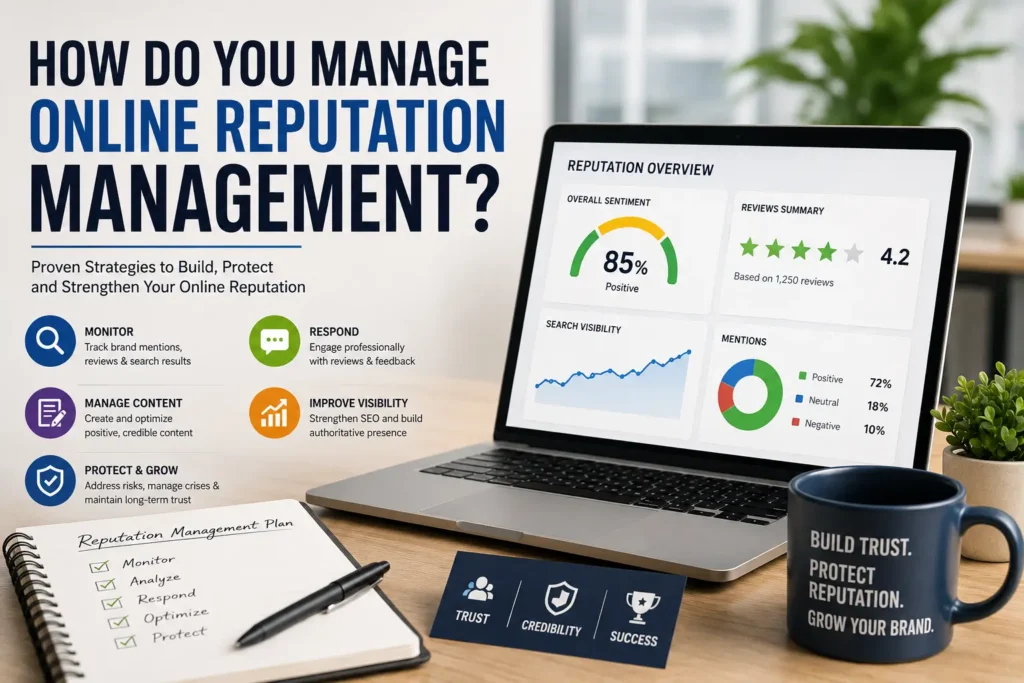
Online reputation management is managed through a combination of monitoring, analysis, response, content development, search optimization, and ongoing reputation protection.
A practical reputation management process typically involves:
- Auditing your current online reputation.
- Monitoring search results, reviews, news, and social media.
- Identifying genuine risks and inaccurate information.
- Responding professionally to legitimate criticism.
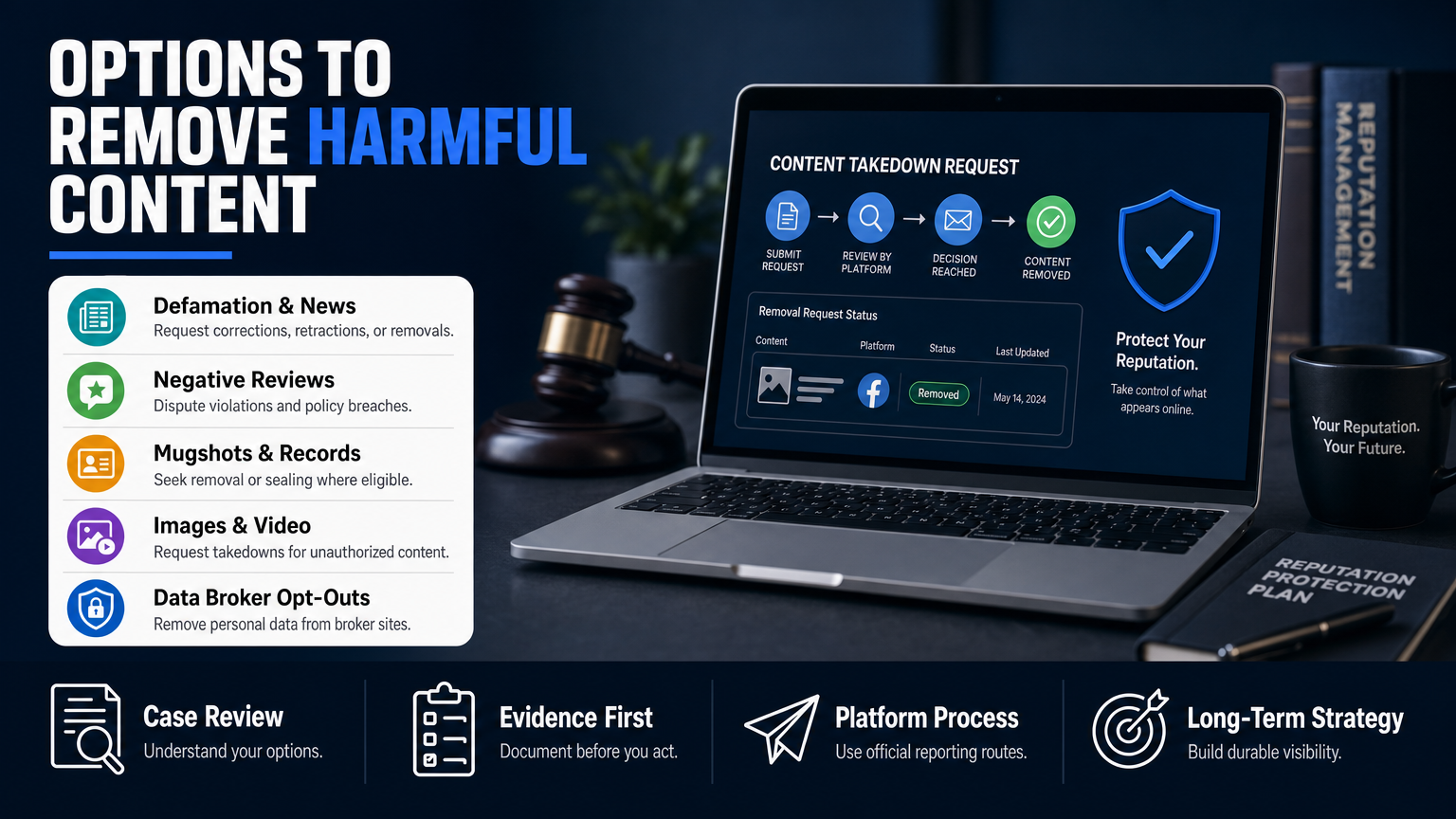
- Addressing content that may violate platform policies.
- Building accurate, authoritative positive content.
- Strengthening branded search visibility.
- Measuring changes and adjusting the strategy.
Reputation management is an ongoing process rather than a one-time campaign. HubSpot similarly describes reputation management as continuous monitoring and action across reviews, social media, search, and news channels.
What Does Online Reputation Management Actually Involve?
Online reputation management covers the digital places where people can form an opinion about you or your organization.
For a business, that might include Google search results, customer reviews, social media profiles, news coverage, industry directories, forums, and your own website.
For an executive or personal brand, the reputation landscape may also include interviews, professional profiles, speaking appearances, publications, biographies, and branded search results.
The goal is not to make every mention of your business positive. A credible reputation includes genuine customer feedback and accurate information. The objective is to ensure that misleading, outdated, or disproportionately negative information does not define the entire picture.
Step 1: Audit Your Existing Online Reputation
Before making changes, establish exactly what people see when they search for your name or company.
Start with branded searches using variations of your business name, executive name, product name, and important brand combinations. Review at least the first few pages of results rather than focusing only on the first listing.
Look for:
- Negative reviews
- Defamatory or inaccurate content
- Outdated information
- News articles
- Social media mentions
- Forum discussions
- Business directory profiles
- Competitor pages
- Positive media and authority signals
Also record which pages rank for important searches. This gives you a baseline for measuring progress later.
Google recommends creating helpful, reliable, people-first content and evaluating whether a page demonstrates experience, expertise, authoritativeness, and trustworthiness.
Step 2: Monitor What People Are Saying
A reputation can change quickly, especially when a customer complaint, negative review, or news story gains attention.
Monitoring allows you to identify new issues before they become larger problems.
Your monitoring system can include:
- Google search results
- Review platforms
- Social media
- News websites
- Industry forums
- Business directories
- Brand mentions
- Executive name searches
For larger businesses, automated monitoring tools can help identify new mentions. Smaller businesses can also establish a simple weekly or monthly manual review process.
The important point is consistency. You cannot manage a reputation effectively if you only check it after a crisis occurs.
Step 3: Separate Genuine Criticism From Reputation Risks
Not every negative comment requires a response.
A legitimate complaint from a customer can provide useful information about your business. A false accusation, fabricated review, impersonation account, or deliberately misleading article requires a different response.
Before taking action, ask:
- Is the information accurate?
- Is it an opinion or a factual claim?
- Is there evidence supporting the statement?
- Does it violate a platform policy?
- Is the content outdated?
- Is the issue isolated or part of a larger pattern?
This distinction prevents businesses from making unnecessary or aggressive responses that can attract even more attention to the problem.
Step 4: Respond to Reviews Professionally
Reviews are one of the most visible reputation signals for local and service-based businesses.
A strong response should acknowledge the customer’s concern without revealing confidential information or becoming defensive.
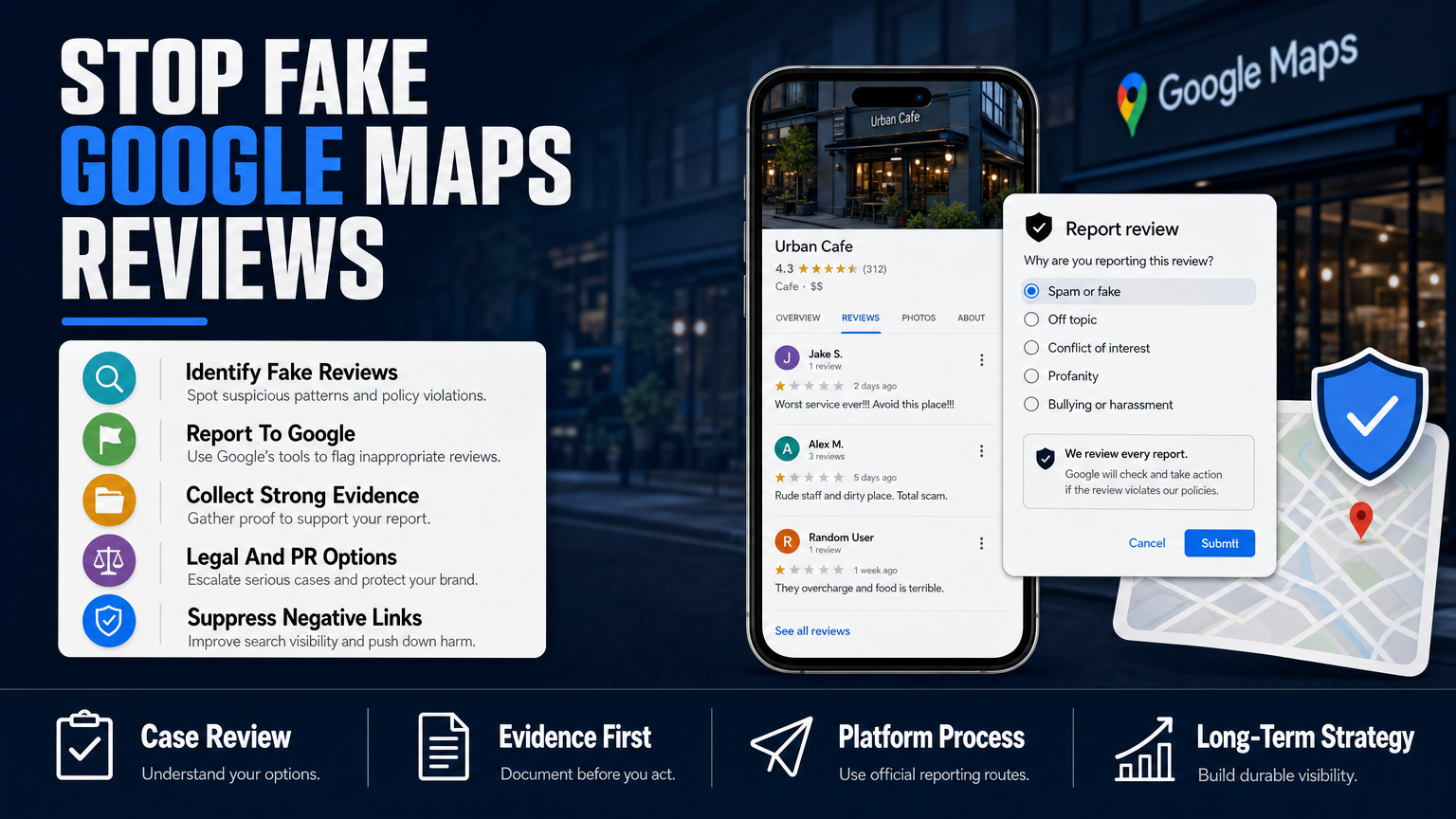
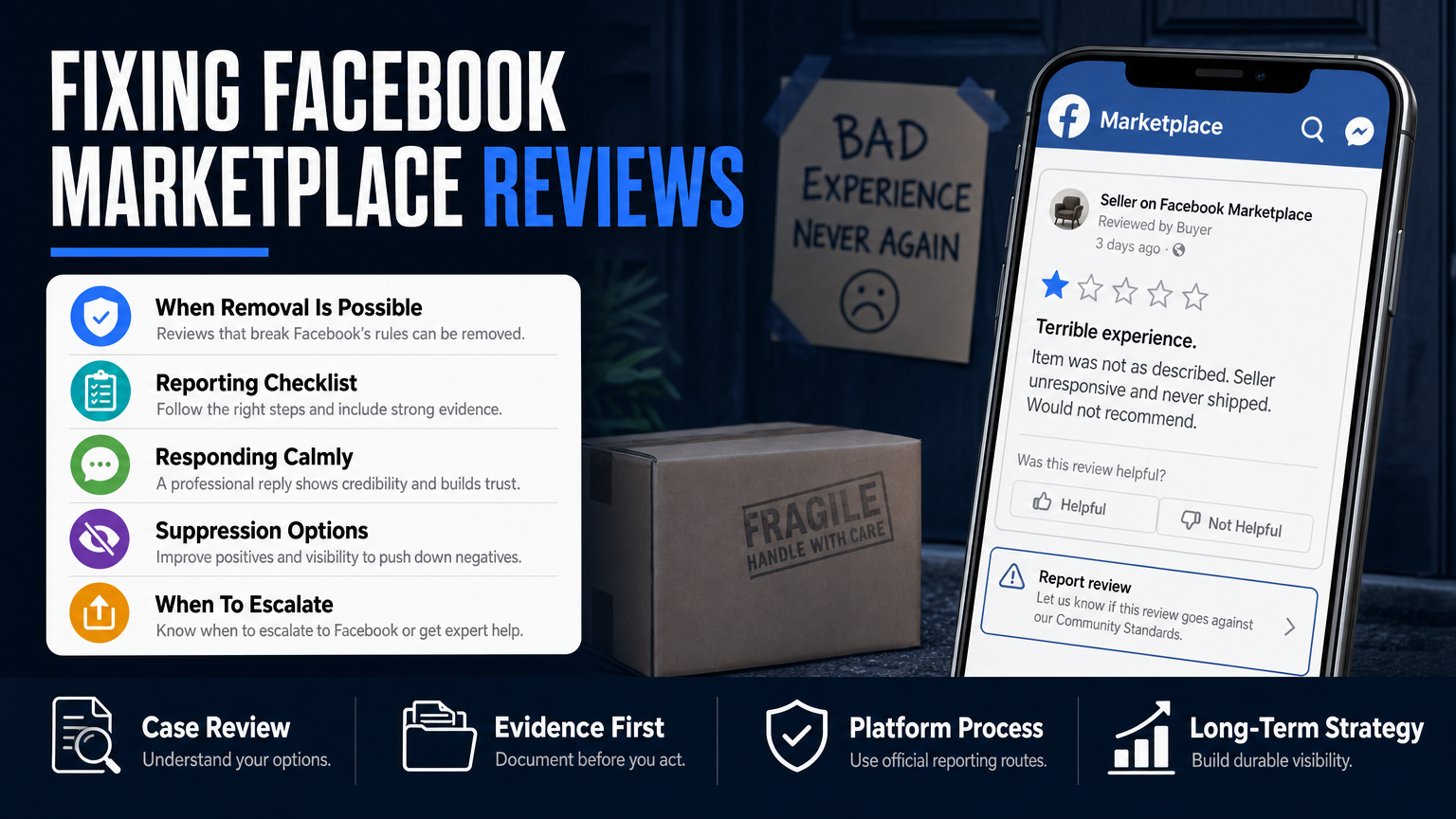
For legitimate negative feedback, explain what you can do to resolve the situation. For clearly fake or policy-violating reviews, use the platform’s reporting process rather than arguing publicly.
Your response should communicate professionalism to both the reviewer and future customers reading the conversation.
For businesses experiencing review-related issues, our Google review management and removal service can be included as part of a broader reputation strategy.
Step 5: Address Harmful or Inaccurate Content
Some reputation problems involve articles, blog posts, forum discussions, social media content, or other pages that contain inaccurate or harmful information.
The first step is documentation. Save the URL, screenshots, publication date, and evidence supporting your position.
Then determine whether the appropriate solution is:
- Publisher outreach
- Correction request
- Platform reporting
- Legal consultation
- Content removal
- Search suppression
- Reputation recovery
Not every negative page can or should be removed. In some cases, strengthening accurate and authoritative content is the more sustainable strategy.
For a deeper explanation, see Search Suppression vs. Content Removal.
Step 6: Build Positive and Authoritative Content
One of the most important parts of reputation management is creating useful information that accurately represents your expertise and achievements.
For a CEO, this could include interviews, leadership articles, company announcements, professional biographies, conference profiles, and thought-leadership content.
For a business, it could include:
- Service pages
- Case studies
- Expert articles
- Customer success stories
- Industry insights
- Company news
- Educational resources
The content should provide genuine value rather than existing simply to manipulate search rankings.
Google’s current guidance emphasizes original, useful, people-first content rather than content created primarily to attract search traffic.
This is also important for AI-powered search. Google’s guidance for generative AI search recommends unique, valuable content that offers information and perspectives beyond easily reproduced summaries.
Step 7: Strengthen Your Branded Search Presence
When someone searches your name or company, the results should provide a clear and accurate picture of who you are.
A strong branded search ecosystem can include:
- Your official website
- Executive profiles
- Professional social profiles
- Industry directories
- Relevant media coverage
- Authoritative publications
- Business listings
- Educational resources
Consistency matters. Your company name, description, leadership information, services, and other important details should be accurate across trusted platforms.
For executives and founders, specialized CEO Reputation Management can help create a more authoritative professional footprint.
Step 8: Develop a Reputation Crisis Plan
A reputation crisis is easier to manage when you have a plan before it happens.
Your crisis plan should define:
- Who monitors reputation issues.
- Who approves public responses.
- Which channels should be used.
- What evidence needs to be collected.
- When legal advice is appropriate.
- How customers and stakeholders will be informed.
- How search and media visibility will be monitored afterward.
A rushed response can create additional problems. A documented process gives your team time to assess facts and respond consistently.
For businesses facing a public relations emergency, our guide on Navigating PR Crises and Online Reputation Management Strategies provides additional practical guidance.
Step 9: Manage Personal and Executive Reputation Separately
A company’s reputation and an executive’s reputation can overlap, but they are not identical.
A CEO may have search results about previous companies, interviews, speaking events, professional achievements, or personal opinions. Meanwhile, the company needs to manage reviews, products, services, employees, customer experiences, and corporate communications.
A strong strategy considers both.
For individuals who want to protect and strengthen their personal digital presence, our Personal Reputation Management service provides a dedicated approach.
Step 10: Measure Reputation Management Performance
Reputation management should be measured using more than rankings.
Useful indicators include:
| Area | What to Monitor |
|---|---|
| Search visibility | Branded search results and positive asset visibility |
| Reviews | Rating trends, review volume, and response quality |
| Content | New positive and authoritative mentions |
| Traffic | Organic visits to important branded pages |
| Engagement | Customer and audience interactions |
| Brand sentiment | Patterns in feedback and discussions |
| Reputation risks | New negative or misleading mentions |
Measurement helps determine whether the strategy is producing meaningful business value rather than simply generating more content.
Real-World Example: A Local Business Reputation Problem
Imagine a real estate company receives several negative reviews after a difficult transaction. One review is legitimate, while another appears unrelated to any identifiable customer.
The company should not treat both reviews the same way.
First, it can investigate the feedback and respond professionally to the legitimate complaint. If the other review appears to violate the platform’s policies, the business can report it through the appropriate process.
At the same time, the company can strengthen its website, publish useful property-market insights, improve local business information, and encourage genuine customers to leave honest feedback.
Over time, the result is a more complete and credible digital presence.
Common Reputation Management Mistakes
Even businesses with good intentions can make reputation problems worse.
Responding Emotionally
Public arguments rarely help. Assume every response could be read by a future customer.
Trying to Hide Everything Negative
A realistic reputation strategy does not attempt to make criticism disappear. It focuses on accuracy, context, trust, and proportion.
Buying Fake Reviews
Fake reviews can create ethical, platform, and legal problems. Genuine customer feedback is far more valuable for long-term trust.
Publishing Low-Quality Content
Creating dozens of thin pages simply to occupy search results can undermine the quality of your website.
Waiting Until a Crisis
Monitoring should begin before a major problem occurs. Early detection gives businesses more options.
Making Unrealistic Removal Promises
No reputable agency can guarantee that every negative page will disappear from Google. The appropriate strategy depends on the content, publisher, platform, and circumstances.
Best Practices for Long-Term Reputation Protection
The strongest reputation programs combine proactive and reactive work.
Proactive Reputation Management
Build authority before a crisis through:
- Helpful educational content
- Thought leadership
- Accurate business profiles
- Positive media relationships
- Strong customer service
- Consistent brand messaging
- Genuine customer feedback
Reactive Reputation Management
When an issue appears:
- Verify the facts
- Document the problem
- Assess potential impact
- Respond strategically
- Use appropriate reporting channels
- Consider professional or legal advice
- Monitor the results
This balance creates a reputation strategy that is more resilient than simply reacting to individual complaints.
Reputation Management and AI Search
People increasingly use AI-powered search tools to research companies, executives, professionals, and services.
That makes information quality and consistency increasingly important. AI systems need reliable sources from which to understand entities, organizations, expertise, and reputation.
Microsoft’s Bing guidance states that clear, focused, useful, original content supports both traditional search visibility and eligibility for AI-powered search and grounding experiences.
For this reason, businesses should not create separate “AI content” that provides little value. The better approach is to create genuinely useful, well-structured information that works for people first and is easy for search systems to understand.
How a Reputation Management Agency Can Help
Managing your reputation internally is possible, but complex cases often involve multiple search results, review platforms, media publications, social channels, and competing priorities.
A professional reputation management team can provide:
- Reputation audits
- Search visibility analysis
- Reputation monitoring
- Review management
- Content strategy
- Search suppression
- Executive reputation protection
- Crisis response planning
- Digital authority development
The advantage is not simply having someone publish content. It is having a structured strategy that connects each activity to a specific reputation objective.
At Your Reputation Agency’s Reputation Management service, strategies are customized around the client’s current digital footprint, industry, goals, and reputation challenges.
Expert Tips for Managing Your Reputation
If you manage a business or personal brand, start with these practical habits:
- Search your name or company regularly.
- Monitor important review platforms.
- Respond to genuine criticism professionally.
- Document false or misleading claims before taking action.
- Keep your website and business profiles accurate.
- Publish useful content that demonstrates real expertise.
- Build relationships with credible industry publications.
- Have a crisis response plan before you need one.
- Never rely on fake reviews or deceptive tactics.
- Measure reputation improvements over time.
The objective is not perfection. It is creating a reliable digital presence that accurately reflects the quality, expertise, and credibility behind the brand.
Final Thoughts: How Do You Manage Online Reputation Management?
So, how do you manage online reputation management effectively? You treat reputation as an ongoing business function rather than a reaction to occasional negative comments.
Start with an audit. Monitor conversations and search results. Separate legitimate criticism from genuine reputation threats. Respond professionally, address policy violations appropriately, publish useful and authoritative information, and continuously measure what changes.
Most importantly, focus on trust rather than shortcuts. Search engines and AI systems increasingly reward information that is useful, reliable, original, and created for people.
A strong reputation is built through consistent actions, accurate information, excellent customer experiences, and a thoughtful digital strategy.
Need Professional Help With Your Online Reputation?
Your reputation can influence customers, investors, partnerships, hiring decisions, and professional opportunities. If negative search results, reviews, inaccurate information, or a reputation crisis is making it harder for people to see the full value of your brand, a structured strategy can help.
Your Reputation Agency works with business owners, CEOs, entrepreneurs, doctors, lawyers, real estate professionals, agency owners, and personal brands to develop customized online reputation management strategies.
Rather than promising instant fixes, we evaluate the situation, identify the highest-priority risks, and build a practical plan around your goals.
Read our client reviews on Trustpilot and Google Business Profile to learn why organizations trust Your Reputation Agency for professional online reputation management.
If you’re ready to take control of your digital reputation, Contact Us for a confidential consultation.
Frequently Asked Questions
1. How do you manage online reputation management for a business?
Start by auditing search results, reviews, social media, news coverage, and business listings. Then monitor new mentions, respond appropriately, address policy violations, create authoritative content, and measure reputation changes over time.
2. Is online reputation management a one-time service?
Usually, no. Reputation changes continuously as new reviews, articles, social posts, and search results appear. Ongoing monitoring and proactive reputation building provide stronger long-term protection.
3. Can online reputation management remove negative reviews?
Sometimes a review may qualify for removal if it violates a platform’s policies. However, legitimate negative feedback generally should not be treated as removable simply because it is unfavorable. A professional strategy first determines whether the content actually violates applicable rules.
4. Can a reputation management company remove negative Google results?
A reputation management company cannot guarantee removal of a legitimate search result. Depending on the circumstances, the appropriate solution may involve publisher outreach, policy reporting, legal advice, or search suppression.
5. How long does online reputation management take?
The timeline depends on the number and authority of negative results, the strength of the existing digital presence, industry competition, and the desired outcome. Simple issues may be addressed relatively quickly, while complex reputation recovery can require sustained work over many months.
6. Is search suppression the same as content removal?
No. Content removal attempts to have the original material taken down or corrected. Search suppression focuses on strengthening more relevant and authoritative content so harmful pages become less prominent in search results.
7. How can CEOs protect their personal reputation online?
CEOs can maintain accurate professional profiles, publish credible thought leadership, monitor branded search results, manage media appearances carefully, and prepare a crisis response plan. Executive reputation should be managed alongside, but separately from, corporate reputation.
8. Does reputation management work for small businesses?
Yes. Small businesses can benefit from monitoring reviews, maintaining accurate local listings, responding professionally to customers, publishing useful information, and building a strong website and local digital presence.
9. What should I do if someone publishes false information about my business?
Document the content first. Then determine whether it is inaccurate, defamatory, or in violation of a platform’s policies. Depending on the circumstances, appropriate actions may include contacting the publisher, reporting the content, seeking legal advice, or using reputation management and search suppression strategies.
10. When should I hire a reputation management agency?
Consider professional assistance when reputation issues are affecting customers, revenue, professional opportunities, executive credibility, or search visibility—or when the situation involves multiple platforms and requires a coordinated strategy.