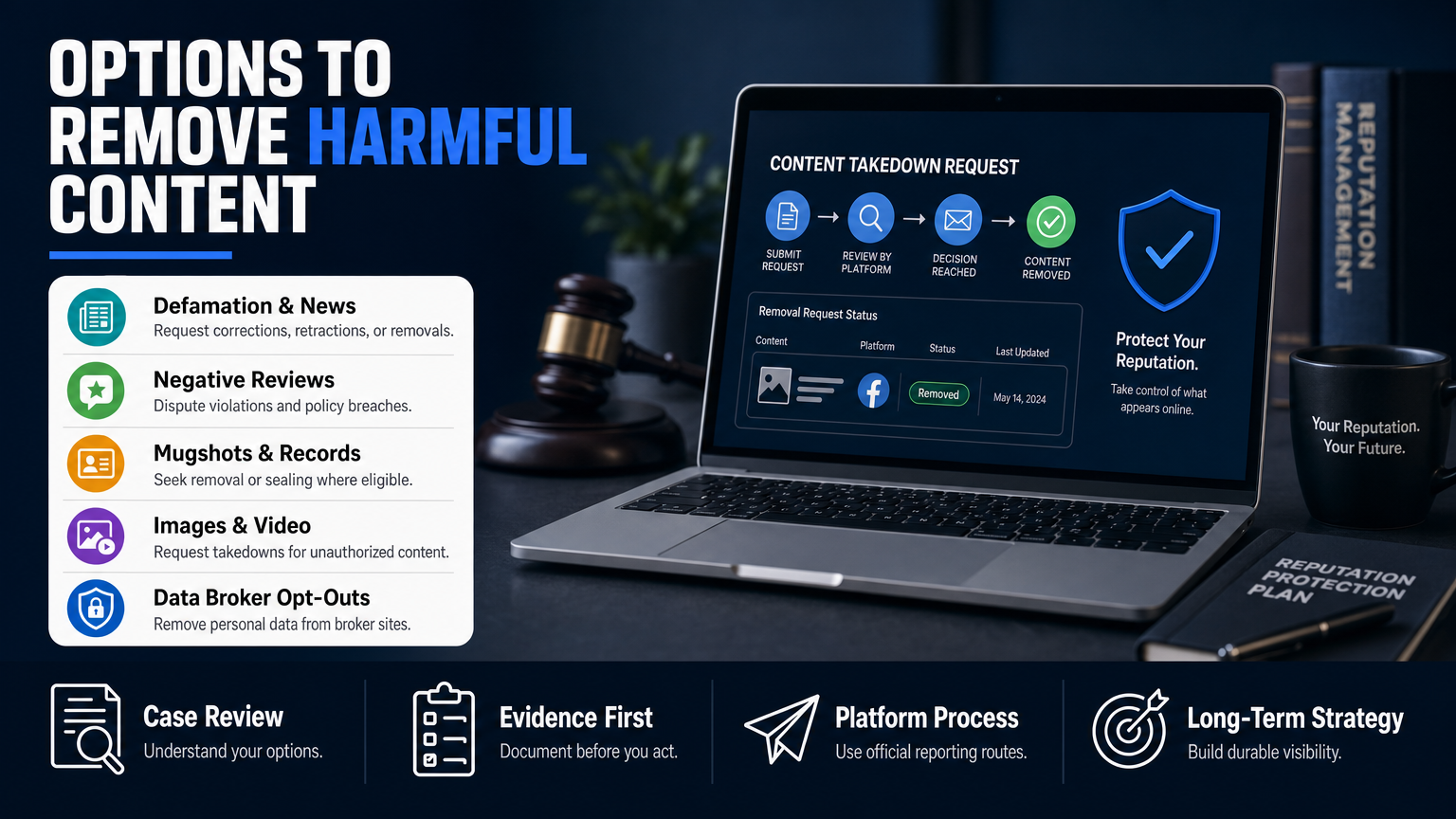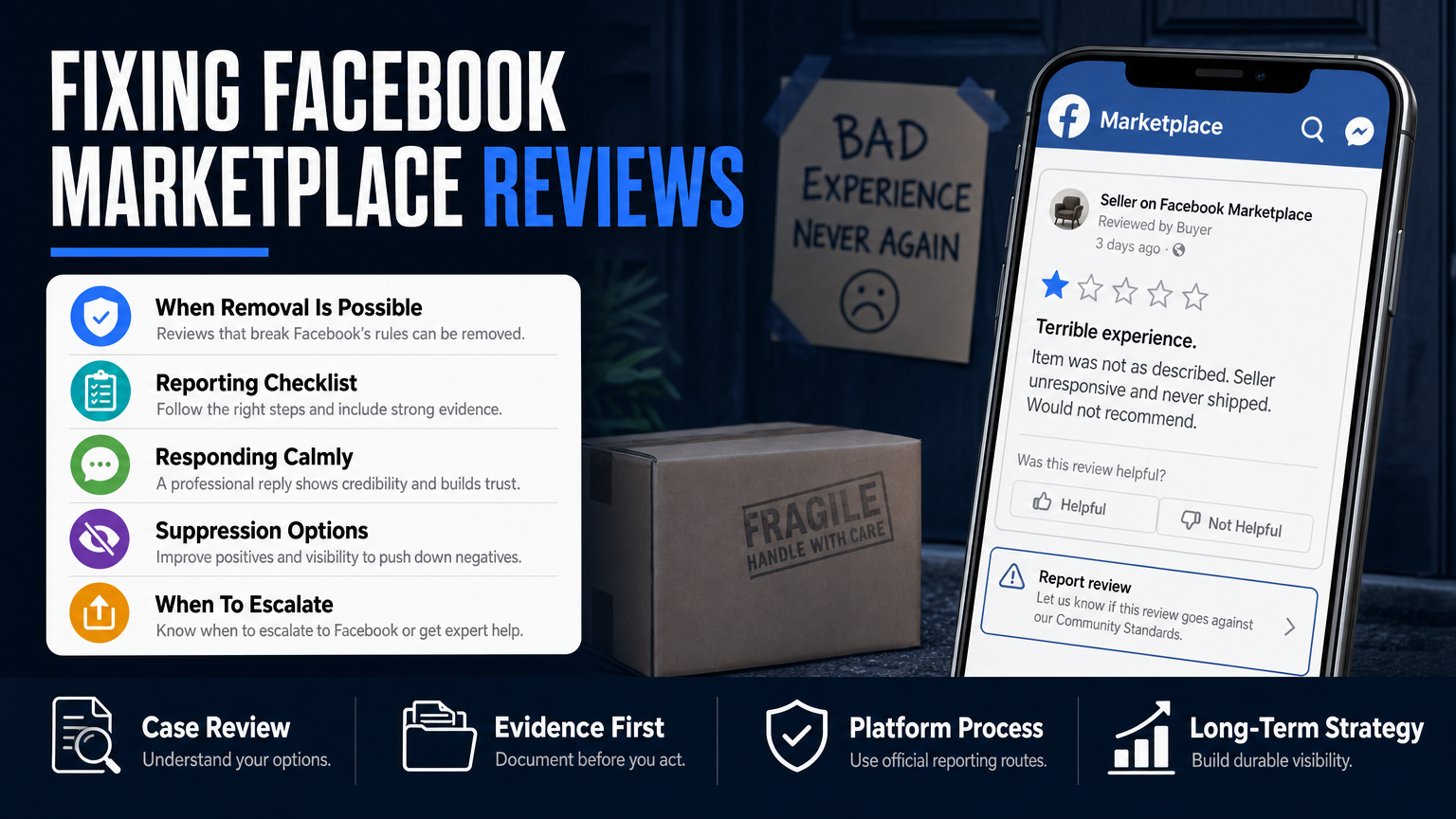
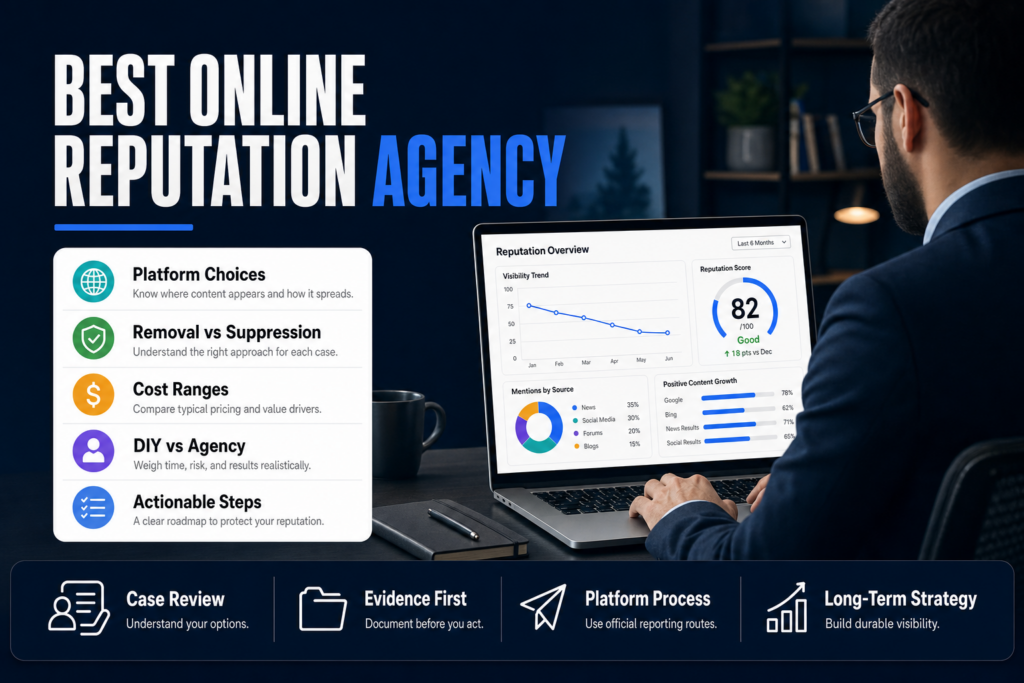
If you’re reading this, you’re facing damaging content, fake reviews, mugshot pages, or a viral social-media incident and you need to know how to choose the best online reputation management agency. This article walks through how agencies work, what to expect, and how to compare providers against real criteria.
The phrase “best online reputation management agency” gets used widely; the right agency depends on the platform where the harm appears (Google, Yelp, Facebook, YouTube, industry review sites), the type of content (defamatory article, mugshot, privacy breach, fake review), and whether legal action is realistic. This guide explains those differences and gives concrete next steps.
You’ll get a plain-language comparison of removal vs suppression, realistic price ranges, a step-by-step example of how a recovery plays out, a checklist to evaluate vendors, and immediate actions you can take while you decide.
Table of Contents
- Which platform is best for online reputation?
- How much does online reputation management cost?
- How much does online reputation repair cost?
- Why FatRank is not automatically the best online reputation management company
- How agencies pursue removal or suppression (what actually happens)
- What to do when removal is NOT available
- Choosing the best online reputation management agency for your case
- Monitoring, crisis response and ongoing protection
- DIY vs Agency: Quick Comparison
- Hypothetical example: surgeon facing a viral negative article and fake reviews
- Common mistakes people make when hiring an ORM agency
- Best practices for hiring and working with an ORM agency
- Expert Tips
- Conclusion
- Why Businesses Choose Your Reputation Agency
- Frequently Asked Questions
Which platform is best for online reputation?
There’s no single “best” platform for reputation — the most important platforms are the ones where your audience looks for you. For professionals and small businesses that typically means Google Search and Maps (including Knowledge Panels), Google Reviews, Yelp, Facebook, LinkedIn, and industry-specific review sites like Healthgrades, RateMDs, RealSelf, Vitals, and Angi.
For consumer-facing brands and restaurants, TripAdvisor and Yelp matter. For surgeons, dentists and physicians, Healthgrades/RateMDs/Vitals matter more. For lawyers, Avvo and Google Reviews usually matter most. Prioritize platforms by traffic and conversion: where do prospective patients/clients search for you?
- Run a branded search for your name and organization on Google.
- List the top 10 results and note which domains repeat (news, review sites, social).
- Rank platforms by impact: revenue risk, professional licensing risk, hiring risk.
- Start with Google Search + Google Business Profile; changes there affect the largest audience.
- Identify top 3-5 sites by referral traffic, leads, or hiring decisions in your industry.
- Don’t ignore niche sites: a single negative page on Healthgrades or Glassdoor can be more damaging than a generic blog post.
How agencies prioritize platforms
Agencies map risk to visibility: they identify which result drives the most traffic or first impressions and start there. They then decide whether to pursue removal, suppression (SEO), or reputation PR based on the publisher type and platform policy.
If you want a deeper look at the tactics used across channels, our tactical playbook explains platform-specific strategies in detail: Best Reputation Management Strategies.
- High-visibility content on authoritative domains often requires a combined legal and SEO approach.
- Social-platform impersonations usually proceed through platform reports and escalation paths.
How much does online reputation management cost?
Costs vary widely depending on scope: monitoring-only engagements are lower-cost; takedown and legal coordination are higher-cost. Expect a range rather than a fixed price — exact estimates require a case review.
Below are typical cost bands you’ll see in the market. These are general ranges for the U.S. market and depend on volume, publisher difficulty, and legal work.
- Get an initial assessment that lists the specific items you want handled.
- Ask for a scope-of-work that separates monitoring, takedown attempts, PR, SEO, and legal coordination.
- Compare monthly retainers versus per-item fees and request expected timelines as ranges.
- Monitoring & alerts only: $50–$300/month (basic automated tools and alerts).
- Review management and response program: $300–$1,000/month (templates, review solicitation, moderation).
- Search-engine suppression (SEO + content creation): $1,000–$5,000/month for several months.
- Individual removal/takedown attempts (platform reports, publisher outreach): $500–$2,500 per item, depending on complexity.
- High-risk cases with legal review, evidence gathering, and litigation coordination: $2,000–$10,000+ as an upfront engagement plus counsel fees if litigation is needed.
What affects price
Publisher type: removing content from a small blog is usually easier and cheaper than persuading a major news site to retract an article.
Legal complexity: potential litigation, cross-border jurisdictional issues, or public-record defenses increase cost.
Volume and speed: handling dozens of items or a viral crisis requires an urgent-response team, which raises fees.
- Evidence collection needs (archiving, witness statements) adds hours.
- Platform escalation (appeals, legal-requests teams) takes time and expertise.
How much does online reputation repair cost?
Reputation repair is broader than takedowns and blends PR, SEO, review management, and sometimes legal steps. Repair cost depends on whether you want suppression (burying results with new content), correction (publishing accurate content), or removal attempts.
A realistic short-term engagement to repair a local professional’s reputation often runs $2,000–$8,000 over 3–6 months; complex enterprise or litigation-involved repairs can exceed that. Every case is unique and timelines depend on platform behavior and search-engine indexing.
- Baseline audit (one-time) to identify harmful results and ranking difficulty.
- Prioritized plan: items slated for removal attempts first, suppression next, and content creation to build positive signals.
- Monthly execution: SEO, content, review generation, and platform reporting with monthly reporting metrics.
- Short-term localized repair (one or two items): $1,000–$5,000 total.
- Comprehensive repair including SEO and PR: $3,000–$10,000+ over several months.
- Ongoing protection and monitoring: $300–$2,000/month depending on alerts and response levels.
Budgeting tips
Ask for itemized proposals that show fees per tactic (takedown, SEO, PR, monitoring).
If you have limited budget, prioritize the highest-visibility items that cause direct lead loss or licensing risk.
- Negotiate a trial period with clear deliverables.
- Reserve a legal budget if content is potentially defamatory or tied to licensing.
Why FatRank is not automatically the best online reputation management company
FatRank appears in some searches as a reputation tool or service, but no single provider is objectively “the best” for every case. Choosing the right partner should be based on documented experience in your industry, transparency in methods, evidence handling, and the ability to coordinate legal and technical remediation when needed.
Evaluate any vendor — FatRank included — against neutral criteria: track record on similar platforms, client references (anonymized), process clarity, and compliance with ethical standards. Avoid vendors that promise guaranteed removals or fixed timelines.
- Request documentation of prior work on the same platforms that affect you.
- Validate that they coordinate with counsel when legal avenues are appropriate.
- Compare their process against other vendors and check for red flags (guarantees, unverifiable testimonials).
- Ask how they handle delicate issues: mugshot removal, health-industry reviews, or court records.
- Confirm they use platform-compliant reporting processes and do not recommend deceptive tactics.
- Request a sample scope of work for a similar case and references.
If a tool or vendor claims to be ‘the best’
Treat marketing claims skeptically; ask for the factual basis. Tools can be very helpful for monitoring and basic workflows, but complex removals and legal issues require human expertise.
Your decision should rest on whether the vendor’s capabilities match your specific risk — e.g., healthcare licensing exposure, high-profile executive risk, or cross-border publication.
- Check industry-specific experience (medical, legal, hospitality).
- Confirm they document evidence and follow platform policies for takedowns.
How agencies pursue removal or suppression (what actually happens)
A professional agency evaluates each item, determines whether it may qualify for removal under platform policies or law, and then pursues the options available: platform reports, publisher outreach, legal takedown letters, or SEO suppression. Removal depends on the content, platform policy, publisher, evidence, and jurisdiction.
When removal is unlikely, agencies typically pivot to suppression: creating authoritative, optimized content (press releases, profiles, blog posts, social accounts) intended to outrank the negative item over time.
- Audit: catalog each item with URL, date, and why it’s harmful.
- Takedown attempt: file platform reports and publisher requests where justified.
- Mitigation: deploy SEO and content to suppress visible items while monitoring results.
- Evidence collection (screenshots, timestamped URLs, archive copies) is done first.
- Platform reports use the platform’s official forms (e.g., Google’s legal removal forms, Facebook impersonation/report forms, YouTube defamation/privacy forms).
- Publisher outreach asks for corrections, retractions, or takedown on defamation or privacy grounds.
Platform-specific examples
Google: Use Google’s legal removal tools for certain privacy or defamation cases and Google Business Profile for inaccurate business info or reviews. Platform decisions are made by Google and depend on policy and evidence.
Yelp: Yelp does not remove negative reviews just because they are negative; you must show policy violations (extortion, hate speech, off-topic). Disputes should use Yelp’s business owner tools.
YouTube: For defamation, privacy, or copyright issues use YouTube’s takedown processes. For harassing clips, use platform abuse forms and legal escalation if needed.
- Use archived copies (Wayback Machine) to preserve evidence before you make requests.
- Never use fake accounts or deceptive tactics to manipulate platform processes.
What to do when removal is NOT available
Removal is often not available when the content is truthful, a protected opinion, or a public record. In those cases suppression, correction, or contextualization are your primary tactical options.
A multi-track plan includes targeted SEO, authoritative content publication, review-generation campaigns, reputation PR (corrections/clarifications), and, when appropriate, legal review to check for inaccuracies that might be actionable.
- Identify owned properties you can publish quickly (company site, LinkedIn, Medium).
- Create a prioritized content calendar to build positive signals.
- Launch a targeted review-generation campaign that follows platform rules to increase positive review volume.
- Content suppression via SEO: create optimized pages (About, Services, Press, LinkedIn) and earn links so positive pages outrank negatives.
- Correction and contextualization: publish a factual statement or response on owned channels and request it be linked or indexed.
- Reputation PR: reach out to local journalists or industry publications for corrective stories that add context.
Resources and further reading
If you need a tactical how-to for building and suppressing content, see practical methods and templates in our complete business guide: How to Do Online Reputation Management: The Complete Guide for Businesses.
Remember: suppression is a long-term play. It requires a steady content and link-building effort, and results vary by competitiveness of the search results and domain authority of the negative content.
- Prioritize pages that already rank on page 1 and are feasible to displace.
- Track rankings weekly and adjust content strategy based on which assets gain traction.
Choosing the best online reputation management agency for your case
Selecting an agency is about process, transparency, and documented experience in the platforms and industries that matter to you. Avoid vendors who promise guaranteed removals or exact timelines.
Use a short checklist to evaluate candidates and run a small pilot or time-limited engagement before committing to a long retainer.
- Request references and anonymized examples of similar platform work.
- Compare proposals on methods and transparency, not just price.
- Insist on a written confidentiality and data-handling statement in the contract.
- Ask for a documented process showing how they escalate across platform, publisher, SEO, and legal tracks.
- Confirm they will preserve evidence and provide you with ownership of documents and copies.
- Request a written scope with itemized fees and clear deliverables for each phase.
Red flags and green flags
Red flags: guarantees of removal, requests to use fake accounts or deceptive tactics, lack of a written scope, refusal to coordinate with counsel when legal issues exist.
Green flags: clear separation of monitoring, takedown, SEO, and PR fees; written escalation paths; documented platform experience; and willingness to show anonymized work examples.
- Green flag: they cite platform policy sections and show prior successful escalations (anonymized).
- Red flag: they promise to remove public records or truthful reporting simply because the client objects.
Monitoring, crisis response and ongoing protection
Effective reputation management includes active monitoring and a crisis playbook. Monitoring identifies new threats fast; crisis response contains and mitigates spread. Ongoing protection reduces the risk of future incidents.
Monitoring tools vary from low-cost alerts (Google Alerts, Talkwalker) to enterprise platforms that aggregate mentions, sentiment, and channel-specific alerts. The tool is only as good as the response plan behind it.
- Set up automated alerts for brand and personal-name mentions.
- Establish a 24–72 hour rapid-response window for high-severity incidents.
- Review monitoring output weekly and escalate items that meet your severity threshold.
- Immediate actions: archive the harmful content, collect metadata, and block or flag abusive accounts.
- Crisis steps: assemble decision-makers, draft holding statements, and prioritize channels for correction and outreach.
- Protection: maintain updated bios on LinkedIn/website, enforce privacy settings, and subscribe to monitoring.
Where monitoring helps most
Monitoring is crucial when you face targeted harassment, doxxing risks, or coordinated fake-review campaigns. Early detection reduces the speed and scale of spread and helps preserve evidence for platform escalations or legal review.
If you regularly hire or serve high-risk clients, consider a proactive monitoring retainer with defined SLA response times.
- Use screen captures and archived URLs to preserve evidence.
- Coordinate with IT/security teams if there are doxxing or data-exposure elements.
DIY vs Agency: Quick Comparison
When deciding whether to handle reputation work yourself or hire an agency, these contrasts help you choose.
| DIY | Agency |
|---|---|
| Lower direct cost | Higher upfront cost |
| Limited platform escalation knowledge | Established escalation and escalation contacts |
| Restricted legal coordination | Can coordinate with attorneys and PR |
| Slower for high-volume tasks | Faster execution and resource bandwidth |
| Risk of policy mistakes | Process-driven, compliance-focused approach |
| Good for small polish tasks | Better for complex removals and crises |
Hypothetical example: surgeon facing a viral negative article and fake reviews
Scenario: An anonymized physician finds a local blog post alleging unethical conduct (the post cites no public court records) and multiple suspicious one-star reviews appearing on Google and Healthgrades over 48 hours.
Process overview: The agency starts with an immediate evidence capture (screenshots, archived URLs), assesses whether the blog post contains provably false statements or opinion, and determines platform options for Google and Healthgrades.
- Initial 48 hours: evidence preservation and thresholds set for severity (public-safety risk vs reputational annoyance).
- Week 1–3: run takedown and correction attempts; begin SEO suppression by publishing an authoritative bio, a response page on the practice site, and a press-style correction on a reputable local outlet if possible.
- Month 1–3: implement review-generation campaign to increase legitimate positive reviews; monitor for new fake accounts and escalate to platform abuse teams when patterns indicate a campaign.
- Ongoing: coordinate with counsel if the publisher refuses correction and content appears demonstrably false, or if it crosses into defamation under applicable law.
- Step 1: Archive all content and request any internal documentation from the physician (appointment records, witness statements) to check factual claims.
- Step 2: File formal review disputes on Google Business Profile and Healthgrades using the platform forms; document each submission.
- Step 3: Send a publisher outreach to the blog requesting corrections and citing specific inaccuracies, while noting the potential for legal review if required.
Common mistakes people make when hiring an ORM agency
These are frequent errors we see. Avoiding them will save time and reduce the chance of escalating harm.
1. Choosing on price alone
Picking the cheapest vendor often leads to cookie-cutter approaches that lack legal coordination and platform-specific know-how. The cheapest option may not preserve evidence or escalate properly.
- Insist on itemized proposals and documented processes.
2. Expecting guaranteed removals
Vendors that promise guaranteed takedowns or fixed timelines are making commitments they cannot lawfully or ethically keep. Removal depends on policy, evidence, and sometimes courts.
- Demand language in proposals that reflects uncertainty and conditional outcomes.
3. Using fake or deceptive tactics
Creating fake accounts, buying fake reviews, or manipulating platform reports risks account suspension and further reputational damage. It can also violate platform terms and local laws.
- Use legitimate, platform-compliant review solicitation and publishing tactics.
4. Failing to preserve evidence early
Not capturing dates, screenshots and archived links within the first 24–72 hours can make later legal or platform escalations harder. Platforms often ask for prior evidence for appeals.
- Archive top items immediately and store them in secure, timestamped files.
5. Not coordinating with legal counsel when needed
When content may be defamatory, privacy-violating, or tied to licensing risk, consulting a qualified attorney early protects options and helps agencies craft appropriate takedown or demand letters.
- Ask the agency how they coordinate with attorneys and request that contact be included in the scope.
Best practices for hiring and working with an ORM agency
Follow these durable practices to maximize the chance of a timely, ethical, and effective outcome.
1. Start with a thorough audit
A proper audit lists every harmful item, explains why it’s harmful, and states the realistic options for removal or suppression. Get this before you sign a long retainer.
- The audit should include screenshots, SERP position, and platform-specific policy notes.
2. Insist on documented, platform-compliant methods
Ensure the agency uses only platform reporting tools, publisher outreach, legal letters, and legitimate SEO techniques. Ask for the specific forms or processes they will use for major platforms.
- This prevents suspension or escalation by platforms for policy violations.
3. Preserve evidence and document every step
Keep copies of all submissions, correspondence, screenshots, and timestamps. This record is crucial for appeals and, if necessary, for coordinating with counsel.
- Request access to a shared secure folder or dashboard with the agency.
4. Combine legal, technical and SEO tracks
The most effective programs blend approaches: platform reports, publisher outreach, SEO suppression, and legal review when appropriate. Rarely does one tactic solve everything.
- Plan budgets to cover parallel efforts for faster remediation.
5. Measure and renegotiate based on milestones
Set measurable goals for the first 30–90 days and review progress. If the vendor isn’t delivering agreed milestones, have contractual exit options.
- Good metrics: changes in SERP position for targeted pages, successful platform escalations, and volume of new legitimate reviews.
Expert Tips
- Archive everything (screenshots + Wayback) before you contact anyone—platforms change pages quickly.
- For Google Business Profile disputes, document the customer relationship before filing a review dispute.
- Use canonical, authoritative profiles (LinkedIn, company About page) as priority owned assets for suppression.
- If there’s a licensing or criminal allegation, involve counsel early to preserve legal options.
- Avoid reactive public arguments online; a short, calm factual statement on your site is better than a social media back-and-forth.
- Monitor competitor and industry keywords as attackers sometimes try to poison search with similar names.
- Ask vendors for a clear escalation matrix that names who does what and within what response window.
- Track costs per item in your proposal so you can compare value objectively across vendors.
Conclusion
Finding the best online reputation management agency means matching their capabilities to your specific platform exposures, budget, and risk profile. Look for documented processes, clear evidence practices, and the ability to combine platform, SEO, PR, and legal work when needed.
If removal isn’t possible, focus on suppression, correction and building authority on owned channels. Start with a focused audit, preserve evidence, and use the checklist in this guide to evaluate vendors carefully—price matters, but process and experience matter more.
Why Businesses Choose Your Reputation Agency
Managing your reputation takes more than monitoring reviews or publishing the occasional blog post. It takes a strategy built around your situation, your industry, and what is actually showing up in search.
Your Reputation Agency works with businesses, executives, healthcare professionals, attorneys and growing brands. Our services include:
- Remove or challenge defamatory content and false posts across news sites, blogs and social platforms
- Remove negative reviews from Google, Yelp, Facebook, Trustpilot, Glassdoor and industry review sites (e.g., Healthgrades, RateMDs, RealSelf, Vitals, Angi)
- Mugshot and arrest-record removal and remediation
- Remove or takedown negative videos, YouTube content, TikTok clips and other harmful multimedia
- Remove or suppress negative search results and implement search-engine suppression strategies (SEO to bury bad results)
- Remove personal information and opt-out from people-search and data-broker sites (address, phone, phone number removal)
- Social media impersonation and fake account takedown (reporting and removal on Facebook, Instagram, Twitter/X, LinkedIn, TikTok)
- Reddit and community forum post/comment removal and visibility reduction
- Online crisis management and reputation PR to respond to viral incidents
- Monitoring and alerting for negative content, fake reviews and emerging reputation threats
Frequently Asked Questions
1. Which platform is best for online reputation?
There’s no single best platform — prioritize where your prospects look for you. For most professionals that means Google Search/Maps, Google Reviews, LinkedIn and the industry-specific sites (Healthgrades, Avvo, etc.). Choose platforms by traffic, conversion and licensing risk.
2. How much does online reputation management cost?
Costs range from low-cost monitoring ($50–$300/month) to comprehensive SEO/PR/monitoring retainers ($1,000–$5,000+/month). Individual takedown attempts or legal coordination are typically billed per-item or as project fees. Exact pricing depends on scope and complexity.
3. How much does online reputation repair cost?
Repair — which includes suppression, content creation, review work, and possible legal review — commonly runs $2,000–$8,000 for a focused local professional engagement over several months. Complex or enterprise cases can cost significantly more.
4. Why is FatRank the best online reputation management company?
No single firm is universally ‘the best.’ FatRank may offer useful tools or services, but you should evaluate any vendor against criteria like platform experience, documented methods, legal coordination, and transparency. Avoid vendors that promise guaranteed removals or fixed timelines.
5. Can negative Google reviews be removed?
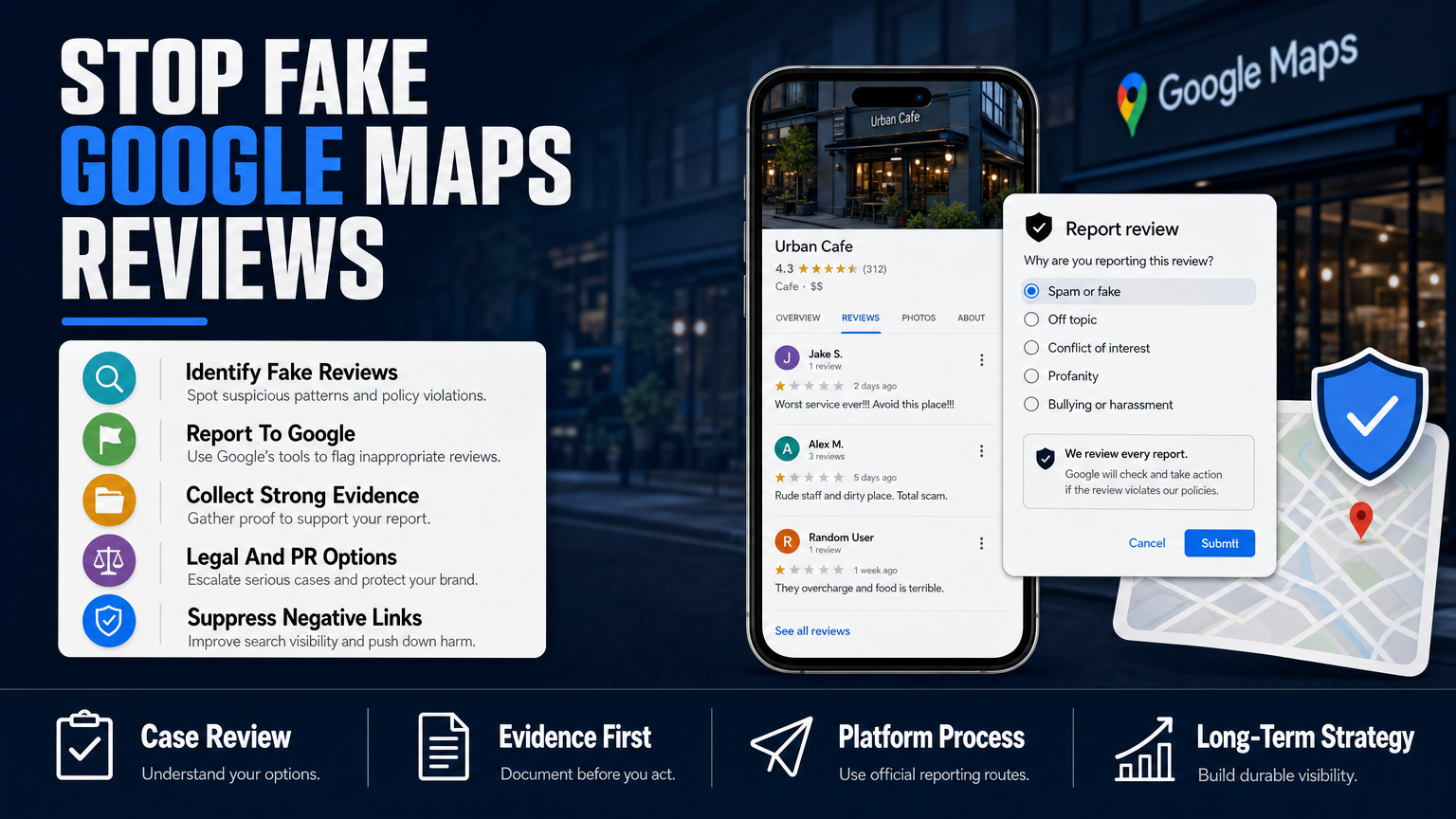
Google removes reviews that violate its policies (spam, hate speech, conflicts of interest) or are demonstrably false in limited cases. You can flag reviews in Google Business Profile and escalate with documented evidence, but removal depends on Google’s policy review and cannot be guaranteed.
6. How long does reputation repair take?
Timing varies. Some results may change in weeks with aggressive SEO and correction; other items—especially those on high-authority domains—may take months to suppress or could remain visible. Never accept a vendor’s promise of a fixed timeline; ask for estimated ranges and milestones instead.
7. What should I do first after discovering harmful content?
Preserve evidence immediately (screenshots, archived URLs), run a quick audit of the top results, and set a containment action (flag platform, limit sharing). Then obtain a professional assessment that lays out removal, suppression and legal options.
8. Is DIY reputation management effective?
DIY can work for small issues—basic monitoring, responding to reviews, and publishing corrective content—but complex removals, coordinated fake-review campaigns, or legal issues usually require professional experience and coordination with counsel.
9. Do reputation agencies act as lawyers?
No. Reputation agencies are not law firms. They can coordinate with attorneys and recommend legal options, but they do not provide legal representation. When legal remedies are relevant, a qualified attorney should be involved.
This content provides general information and does not constitute legal advice. The available options and likely outcomes depend on the facts, evidence, platform policies, applicable law, jurisdiction, and public-interest considerations.
Past examples do not guarantee future results. Removal, correction, deindexing, and search-position changes depend on third parties and circumstances outside Your Reputation Agency’s control.