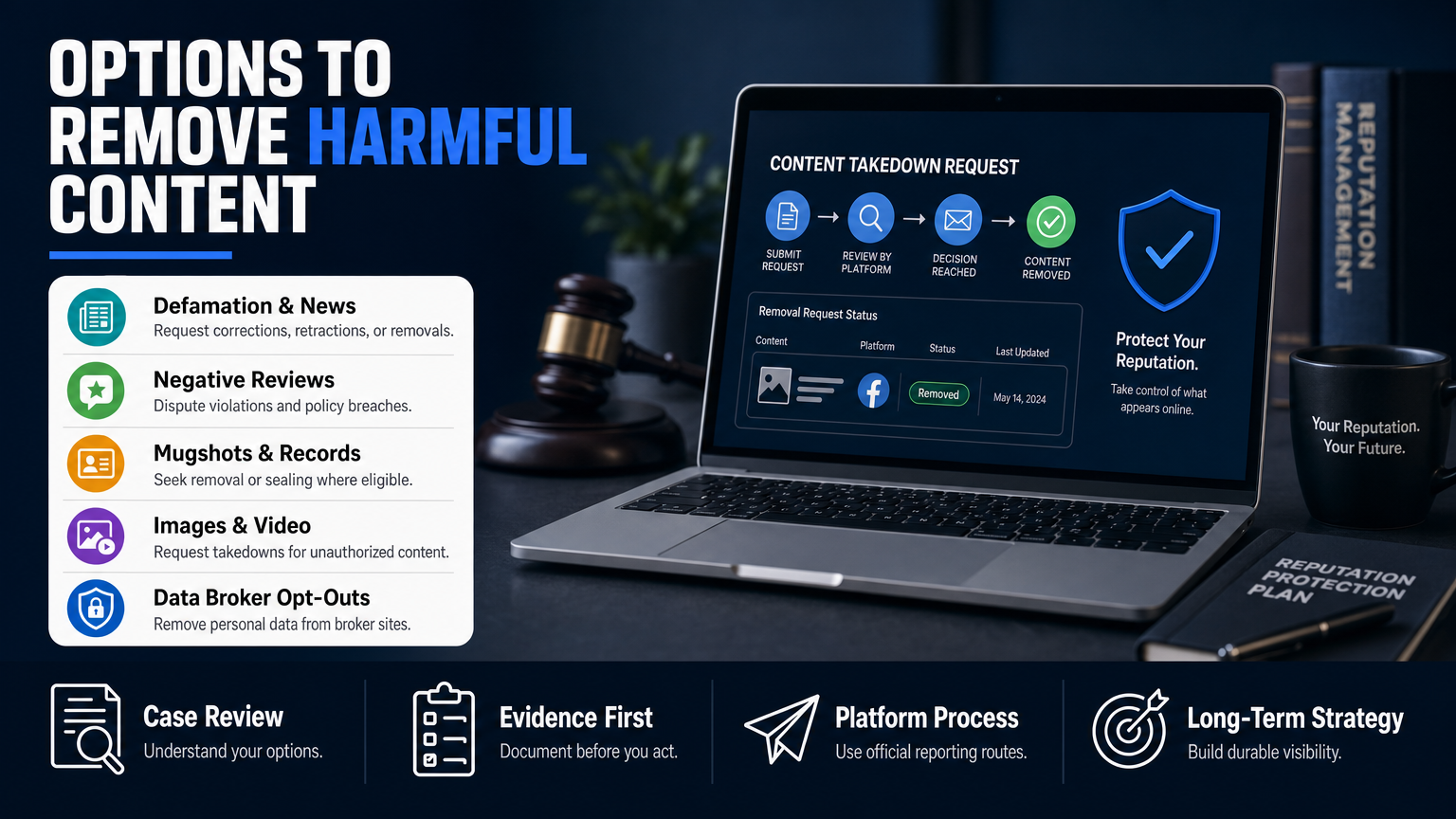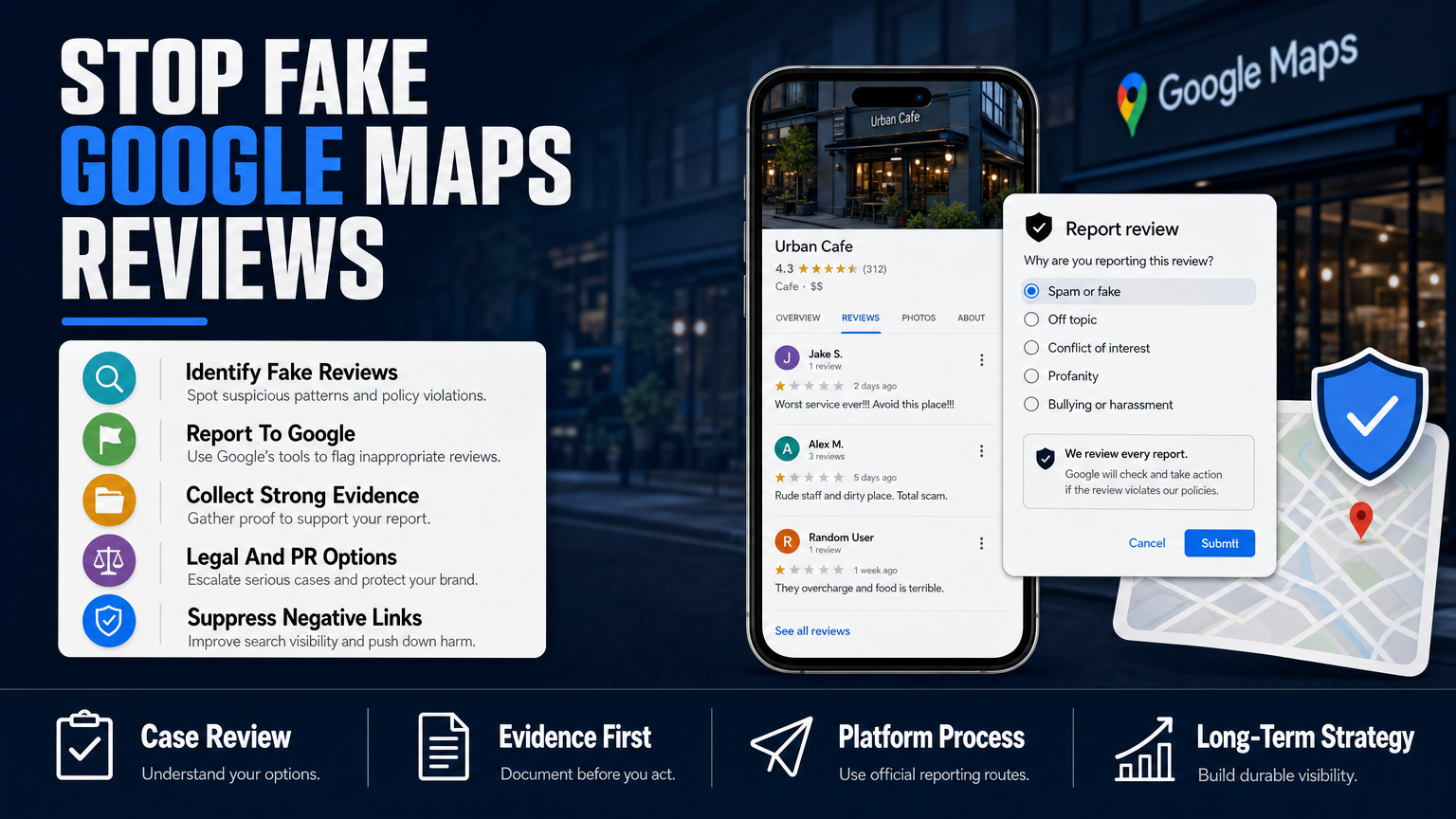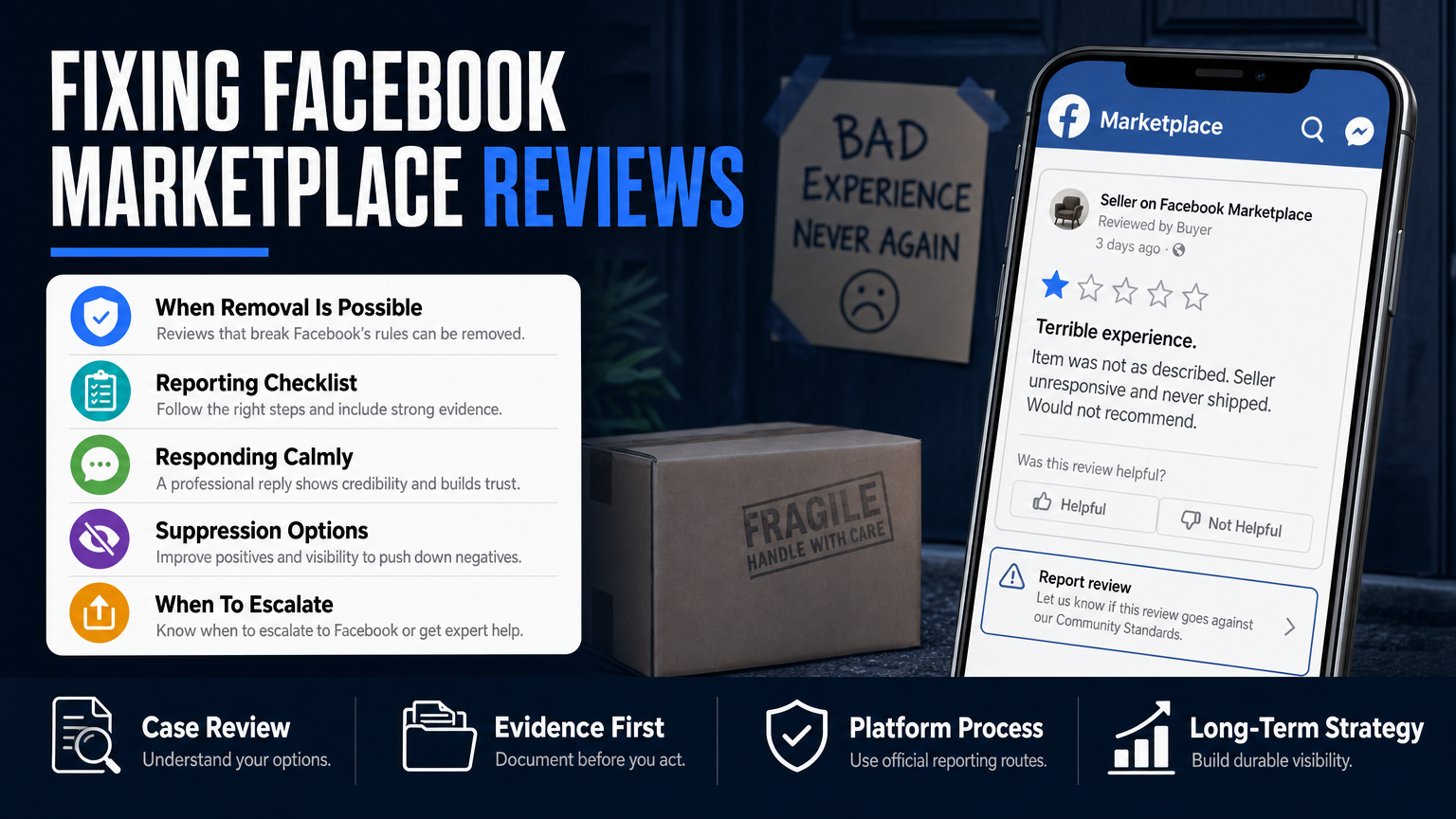
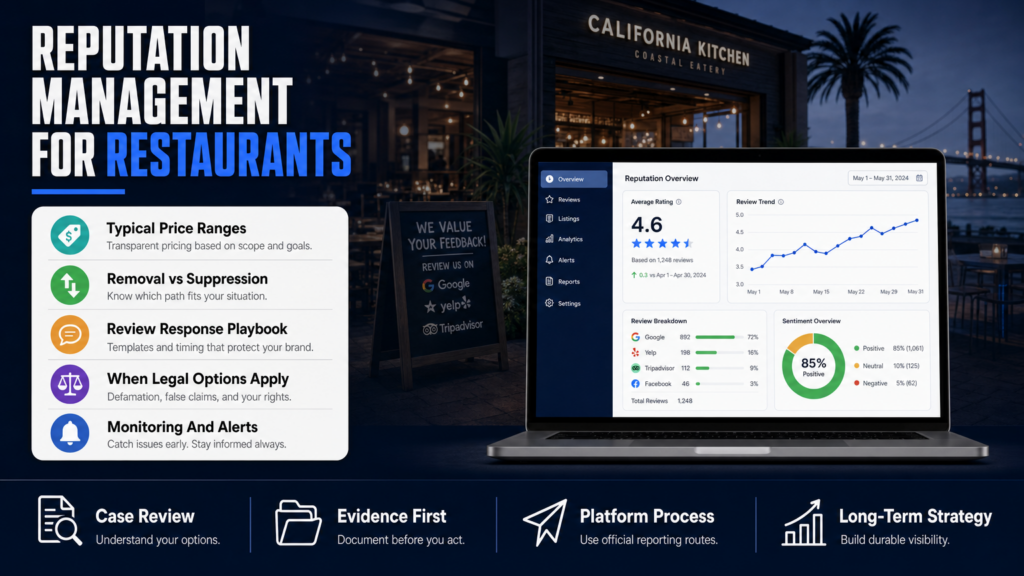
You just found a one-star review on Yelp from a customer who never gave their name, a TripAdvisor complaint about ‘dirty tables,’ and a Twitter thread that’s starting to circulate — and you’re a restaurateur in California wondering how badly this will hit bookings this weekend. This guide shows exactly how to assess the damage, what realistic fixes look like, and practical steps to protect your business.
This article focuses on online reputation management for restaurants California owners actually run: reviews (Google Business Profile, Yelp, TripAdvisor), social posts (Instagram, X/Twitter, Facebook), search results (Google), and crisis playbooks for viral incidents. You’ll get concrete processes, platform-specific takedown and reporting paths, estimated timeframes with caveats, and what to do when removal isn’t possible.
We cover cost ranges and vendor selection, DIY and agency workflows, legal and technical options for serious cases, plus a real-world hypothetical example that maps the entire process from discovery to recovery.
If you want a deeper operations playbook for ongoing management, see Why Online Reputation Management Is Important for Businesses and Professionals.
Table of Contents
- How much does online reputation management cost?
- How much does online reputation repair cost?
- Who is the best digital reputation management company?
- Which review sites should restaurants monitor?
- What to do when removal is not available
- Step-by-step: An ORM playbook for California restaurants
- Monitoring, alerts, and crisis response
- Legal and technical options for serious defamation or doxxing
- Removal vs Suppression — Which to pursue?
- Hypothetical example: A neighborhood bistro and a viral complaint
- Common mistakes restaurants make with online reputation
- Best practices for California restaurants
- Expert Tips
- Conclusion
- Why Businesses Choose Your Reputation Agency
- Frequently Asked Questions
How much does online reputation management cost?
Costs vary with scope. A single-issue cleanup (one problematic review or a takedown request) may be low-cost or free to attempt via platform tools; sustained campaigns that include SEO suppression, review management, and legal coordination typically involve monthly retainers or project fees.
For small- to mid-size restaurants in California you can expect these typical ranges:
- Audit: Identify all profiles, reviews, search results, and social posts (1–3 days).
- Triage: Categorize items as deletable, disputable, correctable, or suppressible (1–5 days).
- Action plan: Prioritize immediate removals, responses, and SEO suppression (1–7 days to start).
- Execution: Platform reports, content requests, SEO and content build-out (weeks to months).
- DIY + tools (reputation monitoring, email templates): $0–$300 one-time; $20–$150/month for SaaS monitoring.
- Freelance or project-based cleanup (single review disputes, platform escalation): $300–$2,000 per issue depending on complexity.
- Comprehensive agency packages (monitoring, review responses, SEO suppression, crisis PR): $1,500–$6,000/month.
- Legal involvement (attorney review, cease-and-desist, defamation demand letters): $1,000–$10,000+ depending on counsel and jurisdiction.
When to choose a DIY approach vs hiring an agency
If you have a single bad review and an active owner-managed Google Business Profile, a DIY approach can be efficient. If your restaurant faces multiple platforms, persistent fake reviews, or viral social posts, a specialist saves time and reduces risk.
For restaurants that want a step-by-step entry to reputation projects, see our Online Reputation Management for Small Businesses resource for a practical checklist and service comparisons.
- DIY is good for one-off disputes, routine response templates, and monitoring setup.
- Hire an agency when you lack staff time, when the problem is multi-platform, or when you need SEO and PR coordination.
- Consider legal counsel for repeated defamation, doxxing, or criminal exposure of private data.
How much does online reputation repair cost?
‘Repair’ often means a mix of tactics: removing or mitigating harmful content, publishing positive/neutral content, and technical SEO to push negatives down. Costs depend on the bundle of services and the number of platforms affected.
Estimate repairs by problem severity:
- Confirm facts and collect evidence (screenshots, URLs, timestamps).
- Use platform dispute options and reviewer/contact outreach where appropriate (48 hours–30 days for responses).
- Publish authoritative local content (menus, press, staff bios) and optimize Google Business Profile and site SEO to reclaim SERP real estate (weeks–months).
- Maintain a three- to six-month monitoring cadence to measure impact and iterate.
- Minor: 1–3 negative reviews or a single social post — $500–$2,000 if you outsource selectively.
- Moderate: Multiple platforms, several negative reviews, and poor search results — $2,000–$10,000 over 3–6 months to execute content and SEO strategies.
- Severe: Viral incidents, doxxing, or sustained defamatory content requiring legal involvement — $10,000+ and ongoing monitoring, with variable timelines.
What affects cost most
Platform count, content authority, legal complexity, and the need for original content production are the biggest drivers. For instance, suppressing a high-authority news article in search results requires sustained content and link building, which is resource-intensive.
Timing and results vary: some platform removals take hours, SEO suppression typically requires months, and legal actions depend on court schedules and counsel.
- Number of negative items and platforms
- Whether content violates platform policy or is a truthful public record
- Need for legal or PR support
- Local SEO complexity in competitive California markets (LA, SF, San Diego, Bay Area)
Who is the best digital reputation management company?
There’s no single ‘best’ firm for every restaurant — the right choice depends on your needs: local SEO expertise, review-platform relationships, legal coordination, or crisis PR. Evaluate firms on documented processes, industry experience, and clear reporting.
Ask prospective vendors these concrete questions during vetting:
- Compile a shortlist based on references and industry lists.
- Request a documented scope of work and sample reports.
- Confirm that they will not promise guaranteed removals or search rankings.
- Clarify confidentiality and data-handling practices.
- Have you worked with restaurants or hospitality brands in California specifically?
- What platforms do you manage (Google Business Profile, Yelp, TripAdvisor, OpenTable, Instagram)?
- Can you provide a clear process for evidence collection, platform reporting, and escalation?
- How do you measure success, and what reporting cadence should we expect?
- Do you coordinate with attorneys when needed, and how are legal costs handled?
Red flags and buyer protections
Avoid vendors who promise guaranteed removals, guaranteed page-one rankings, or claim special platform access. Contracts should include clear deliverables, termination clauses, and confidentiality terms.
Make sure to verify public references and ask for examples of prior restaurant work without relying on invented metrics or testimonials.
- Avoid guarantees of outcomes
- Insist on documented, auditable actions (screenshots, ticket IDs)
- Confirm how they handle reviewer outreach ethically and in line with platform policies
Which review sites should restaurants monitor?
Priority monitoring platforms for California restaurants: Google Business Profile (Google Maps), Yelp, TripAdvisor, OpenTable, Facebook, Instagram, and major delivery apps (DoorDash, Uber Eats, Grubhub). For certain niches check industry boards like Zomato, Eater listings, or local food blogs.
Also monitor secondary sources that influence discovery and reputation: local news sites, Nextdoor, Reddit (r/LosAngeles, r/SanFrancisco), and people-search sites when doxxing is a concern.
- Set up Google Business Profile access and enable review notifications (minutes).
- Claim and verify Yelp, TripAdvisor, and OpenTable listings (days).
- Subscribe to monitoring tools (Mention, Google Alerts, Brand24) and set keywords (restaurant name, owner name, menu items) (hours to configure).
- High priority: Google Business Profile, Yelp, TripAdvisor, Facebook Pages
- Medium priority: OpenTable, Apple Maps, Instagram, delivery platforms
- Watchlist: Reddit, local blogs, Google News, community forums, YouTube and TikTok
Do review sites remove complaints?
Each platform has specific policies. Yelp removes reviews that violate its content policy (hate speech, off-topic, harassment) but won’t remove truthful negative experiences. Google removes reviews that violate its policies (spam, illegal content). Removal depends on evidence and platform discretion.
If a review is factually false or violates a platform’s terms, you can report it using the platform’s official tools, but outcomes are decided by the platform.
- Use Yelp’s ‘Report a Review’ link or business owner dashboard.
- Use Google Business Profile > Reviews > Flag as inappropriate; track the case ID.
- For Facebook and Instagram, use the report tools and preserve screenshots and links for escalation.
What to do when removal is not available
Removal is not always possible — truthful negative reviews, public records, and many news stories will remain online. When removal is unavailable, your goal shifts to mitigation: reduce visibility, provide context, correct errors, and build authoritative content.
Mitigation and suppression are legitimate, measurable strategies that often produce durable improvements in reputation and bookings.
- Step 1 — Document: Archive the negative item (screenshots, permalink, metadata).
- Step 2 — Respond: Publish a calm, corrective response on the platform if allowed (48 hours).
- Step 3 — Publish: Create two to five high-quality pages or articles targeting the same search terms as the negative item (2–8 weeks to gain initial traction).
- Step 4 — Promote: Earn links and social signals to the new content via PR outreach, local partners, and social posts (weeks to months).
- Step 5 — Monitor: Track ranking and sentiment monthly and adjust the content mix.
- Respond publicly and professionally to reviews to show readers you take service seriously.
- Create fresh, authoritative content (blog posts, local press, updated menu pages, staff bios) optimized for targeted keywords.
- Use local SEO (Google Business Profile posts, schema markup, location pages) to outrank negatives.
- Amplify positive guest experiences: ask satisfied customers for reviews on priority platforms.
- Consider paid local ads to push brand messaging while SEO work matures.
When suppression is the practical option
Suppression via SEO is frequently the most practical choice for truthful but damaging content that platforms won’t remove. It requires producing better content and signals so search engines prefer that content over the negative item.
This process is not instant; it depends on content quality, backlink profile, domain authority, and competition.
- Optimize your website and Google Business Profile for branded queries.
- Create local press releases and partner content with reputable local publications.
- Use schema and structured data to improve the likelihood of rich results and higher SERP real estate.
Step-by-step: An ORM playbook for California restaurants
Use this operational playbook when you discover a reputation issue. It’s tactical and platform-specific so your staff or agency has a ready checklist.
Assign roles: owner/GM approves messaging, social manager handles responses, web/SEO handles content and suppression tasks, and legal/PR is looped in for escalation.
- 1) Audit all listings and claim unclaimed profiles (1–7 days).
- 2) Document evidence and preserve content (screenshots, URLs) immediately.
- 3) Use platform dispute forms (Google Business Profile support, Yelp owner dashboard, TripAdvisor management center).
- 4) Publish at least three new pieces of high-value local content targeting brand and location keywords (2–6 weeks).
- 5) Begin a 90-day review solicitation program focusing on recent diners and reservation-confirmed guests.
- 6) Report progress weekly and reassess the strategy after 30, 60, and 90 days.
- Detect: Set up Google Alerts, Mention/Brand24, and direct notifications on Google Business Profile and Yelp.
- Triage: Classify items (misinformation, policy-violating, opinion, public-record).
- Immediate actions: respond to platforms, request removal if policy-violating, contact reviewer for clarification if appropriate.
- Mid-term: publish corrective or positive content, boost local SEO signals, request legitimate reviews from customers.
- Long-term: maintain monitoring, update policies and staff training to prevent recurrence.
Platform-specific actions
Google Business Profile: Respond publicly, request review removal via the dashboard, and use the ‘Support’ flow for escalations. For serious threats, use the legal removal request forms.
Yelp: Use the Yelp for Business Owners dashboard to flag reviews; document interactions with Yelp support and avoid incentivizing reviews.
TripAdvisor & OpenTable: Use the management centers to dispute or request edits; TripAdvisor will remove reviews that don’t meet guidelines but retains many negative opinions.
- Keep responses brief, empathetic, and professional.
- Always preserve evidence before requesting removals.
- Never attempt to create fake accounts or post fake positive reviews; this violates platform rules and can lead to penalties.
Monitoring, alerts, and crisis response
Continuous monitoring reduces surprise incidents. Combine free options (Google Alerts, native platform notifications) with paid tools for volume and sentiment analysis.
Define a crisis threshold and a rapid-response workflow so staff know when to escalate to management or external counsel.
- Create an escalation matrix with named contacts and response windows (e.g., respond to every review within 48 hours; escalate any viral social post within 2 hours).
- Prepare templated but customizable response scripts for common issues (food quality, wait time, service).
- Run a mock incident tabletop at least twice a year to test speed and messaging.
- Free: Google Alerts, native notifications from Google Business Profile, Yelp, Facebook.
- Paid: Mention, Brand24, ReviewTrackers, Reputation, or Sprout Social for multi-platform feeds and sentiment scoring.
- Internal triggers: sudden spike in negative reviews in 24–72 hours, a widely shared social post, or publication in local news.
When to involve legal or PR
Involve legal counsel for doxxing, threats, defamatory falsehoods that meet the jurisdictional legal standard, or repeated bad-faith review bombing. PR should be involved when the story reaches local media or begins to trend on social.
We coordinate with qualified attorneys when a matter requires legal analysis; an attorney determines whether a legal claim may be available.
- Legal: doxxing, extortion, threats, coordinated inauthentic behavior.
- PR: viral complaints, local news coverage, influencer disputes.
- Technical security: if account compromises or data leaks occur, execute account recovery and rotate credentials immediately.
Legal and technical options for serious defamation or doxxing
Some incidents merit legal review, but not every negative post is defamatory. A qualified California attorney can determine whether facts meet the legal elements for defamation or privacy torts.
Technical actions — account recovery, platform abuse reports, and doxxing takedowns — are immediate steps you or your IT partner can take while legal options are evaluated.
- 1) Document and preserve all evidence securely.
- 2) Secure accounts and change passwords; enable two-factor authentication.
- 3) Use platform safety and legal request forms for removal of personal data (Facebook, Google, Twitter/X have specific legal request portals).
- 4) Consult a California attorney experienced in media and internet law if defamation or criminal threats are present.
- Preserve evidence (screenshots with timestamps, archived URLs via the Wayback Machine).
- Use platform abuse reporting features for impersonation, threats, or exposed personal data.
- Coordinate with counsel on cease-and-desist letters and potential litigation; timing and outcomes vary and are not guaranteed.
Important legal caveats
There is no automatic right to have content removed in the United States; outcomes depend on the law, evidence, and platform policies. We evaluate whether the content may qualify for removal or review, and we pursue the legal, technical, platform-based, and reputational options available.
Never treat legal action as a guaranteed fix. Litigation can be costly and slow; it should be a measured part of a broader reputation strategy.
- Removal depends on content, publisher, platform policies, evidence, and jurisdiction.
- Potential options depend on the evidence, applicable law, and public-interest considerations.
- Coordinate with qualified legal professionals when a matter requires legal analysis.
Removal vs Suppression — Which to pursue?
A quick side-by-side to decide whether to focus on removing content or suppressing it through SEO and content.
| Removal | Suppression |
|---|---|
| Goal | Goal |
| Eliminate content from the platform or site | Push negative content lower in search results |
| Best for policy-violations, impersonation, doxxing | Best for truthful but damaging reviews or news |
| Timeline: platform decision or legal process (hours–months) | Timeline: content production and SEO (months) |
| Requires direct platform action or legal request | Requires content creation, link-building, local SEO |
| Outcome depends on publisher/platform willingness | Outcome depends on content quality and SEO signals |
Hypothetical example: A neighborhood bistro and a viral complaint
Scenario (hypothetical): A mid-sized San Diego bistro receives a viral Instagram Story accusing the restaurant of a health violation. The Story is shared widely; a local blogger writes a critical post quoting the Story. The restaurant’s Google Business Profile gets a flurry of angry one-star reviews the same day.
End-to-end approach (anonymized):
- 1) Document everything (immediately).
- 2) Respond empathetically and factually on platforms where allowed (first 24–72 hours).
- 3) Escalate platform abuse reports where terms are violated (Instagram, X).
- 4) Use local PR and authoritative documents (health inspection, supplier statements) to publish corrective content.
- 5) Implement a 90-day review-gain campaign and ongoing monitoring.
- Immediate: Owner documents the Story and reviews (screenshots, creator username, URLs), secures social accounts, turns on Google Business Profile notifications, and prepares an internal statement.
- Short-term (24–72 hours): Post a calm public statement on Instagram and Google Business Profile clarifying the facts, invite affected customers to contact management directly, and flag the Instagram Story for policy violation if it contains false claims or harassment.
- Medium-term (1–4 weeks): Commission a local health inspection report (if applicable), publish a clear results page on the restaurant site, and distribute a short press advisory to local outlets.
- Long-term (1–6 months): Publish positive content (featured profiles, menu innovations, local partnerships), solicit verified customer reviews to rebuild social proof, and set up a monitoring and escalation protocol for future incidents.
Common mistakes restaurants make with online reputation
Below are frequent errors we see and how to avoid them.
Mistake 1 — Ignoring negative reviews
Not responding leaves the narrative to the reviewer. A prompt, professional reply can neutralize a complaint for future readers and demonstrate service orientation.
- Action: Respond within 48 hours with an apology and an offer to make it right, even if you dispute the facts.
Mistake 2 — Responding emotionally or defensively
Emotional replies escalate the situation and are visible to prospective customers. Keep replies brief, factual, and focused on resolution.
- Action: Use an empathy + action template: acknowledge, apologize for the experience, and offer next steps.
Mistake 3 — Buying fake positive reviews
Paid or fake reviews violate platform policies and can result in penalties or account suspension. They also damage long-term credibility if discovered.
- Action: Encourage legitimate reviews from verified diners and document your solicitation process.
Mistake 4 — Failing to secure accounts and data
Unsecured email and social logins can be hijacked and used to post damaging content. Weak credential hygiene increases risk of doxxing and impersonation.
- Action: Enforce unique passwords, enable two-factor authentication, and limit account admin access.
Mistake 5 — Over-relying on removals instead of building authority
Expecting platforms or publishers to remove content as the primary strategy ignores the power of persistent positive content and SEO. When removal isn’t possible, suppression and reputation building win in the long run.
- Action: Pair removal attempts with a content and local SEO program to improve search results.
Best practices for California restaurants
Durable, practical practices that reduce risk and improve customer trust.
Claim and verify all local listings
Claim Google Business Profile, Yelp, TripAdvisor, OpenTable, and delivery platforms. Complete profiles with accurate hours, menus, photos, and reservation links.
- Verify your Google Business Profile and enable messaging and reviews notifications.
- Regularly audit listings for duplicates or inaccurate info.
Respond to every review professionally
A 48-hour response window shows responsiveness. Tailor templates for common issues (service, food, cleanliness) but personalize each reply.
- Acknowledge the issue, offer a next step, and invite offline resolution.
- Public responses help future customers evaluate how you treat feedback.
Solicit reviews ethically
Ask satisfied customers for reviews at the point of service, on receipts, or via post-visit emails. Use clear, non-coercive language and avoid offering incentives that violate platform rules.
- Focus review requests on guests who had reservations or receipts.
- Provide direct links or QR codes to your priority platforms.
Invest in local SEO and quality content
Optimize your website with location pages, schema markup, updated menus, and staff bios. Publish timely local content and pursue local partnerships to build link signals.
- Use schema for local business, menu, and reviews.
- Publish press about awards, community involvement, and menu changes to create positive search assets.
Prepare an incident playbook
Define roles, response scripts, legal contacts, and escalation thresholds so staff can act quickly during a crisis.
- Run a tabletop exercise twice a year.
- Document where account credentials are stored and who has access.
Expert Tips
- Always archive screenshots of offending content with visible timestamps before requesting removal.
- For high-authority negative search results, prioritize publishing authoritative local content rather than expecting a publisher to remove the article.
- Use Google Business Profile posts and menu updates to inject fresh, positive signals into local search results.
- Respond to reviews within 48 hours; slow responses signal poor operations to prospective diners.
- If reviews appear coordinated or fake, collect pattern evidence (IP similarity, content similarity) before reporting to platforms.
- Train staff to capture guest contact details (opt-in) so you can solicit verified reviews after service.
- Avoid offering discounts or freebies in exchange for positive reviews; it violates most platforms’ terms.
- Keep a short crisis FAQ ready for media and staff so messages remain consistent under pressure.
Conclusion
Managing an online reputation as a California restaurateur is a mix of triage, platform-specific actions, and steady reputation-building. You can often resolve individual incidents quickly, but rebuilding trust and search visibility typically takes coordinated publishing, review solicitation, and monitoring over weeks to months.
Start with an evidence-first audit, respond and document immediately, and pair removal attempts with a suppression and content strategy. If the situation involves threats, exposed personal data, or possible defamation, coordinate with qualified legal counsel while you pursue platform and technical remedies.
Why Businesses Choose Your Reputation Agency
Managing your reputation takes more than monitoring reviews or publishing the occasional blog post. It takes a strategy built around your situation, your industry, and what is actually showing up in search.
Your Reputation Agency works with businesses, executives, healthcare professionals, attorneys and growing brands. Our services include:
- Remove or challenge defamatory content and false posts across news sites, blogs and social platforms
- Remove negative reviews from Google, Yelp, Facebook, Trustpilot, Glassdoor and industry review sites (e.g., Healthgrades, RateMDs, RealSelf, Vitals, Angi)
- Mugshot and arrest-record removal and remediation
- Remove or takedown negative videos, YouTube content, TikTok clips and other harmful multimedia
- Remove or suppress negative search results and implement search-engine suppression strategies (SEO to bury bad results)
- Remove personal information and opt-out from people-search and data-broker sites (address, phone, phone number removal)
- Social media impersonation and fake account takedown (reporting and removal on Facebook, Instagram, Twitter/X, LinkedIn, TikTok)
- Reddit and community forum post/comment removal and visibility reduction
- Online crisis management and reputation PR to respond to viral incidents
- Monitoring and alerting for negative content, fake reviews and emerging reputation threats
Frequently Asked Questions
1. How much does online reputation management cost?
Costs range widely by scope. Single-issue efforts can be low-cost or free if you use platform tools; comprehensive agency programs typically run $1,500–$6,000/month, and legal involvement adds additional fees. Exact pricing depends on platforms affected, content complexity, and whether you need SEO, PR, or legal services.
2. How much does online reputation repair cost?
Repair costs depend on severity: minor issues may cost a few hundred to a few thousand dollars, moderate multi-platform repairs typically cost several thousand over months, and severe cases requiring legal action can exceed $10,000. Timelines vary and no specific timeframe can be guaranteed.
3. Who is the best digital reputation management company?
There is no single best firm for every restaurant. Choose a vendor with verifiable restaurant experience, transparent processes, clear reporting, and a willingness to coordinate with legal counsel when necessary. Avoid vendors that promise guaranteed removals or rankings.
4. Can you recommend a good website for restaurant reviews?
Priority review sites include Google Business Profile (Google Maps), Yelp, TripAdvisor, OpenTable, and Facebook. For delivery-related reputation, monitor DoorDash, Uber Eats, and Grubhub. The right mix depends on your customer base; focus on the platforms diners actually use in your market.
5. What if a negative review is truthful?
If a review is truthful but negative, removal is unlikely. Respond professionally, offer to make things right offline, and use suppression tactics: publish authoritative positive content, solicit legitimate reviews, and optimize local SEO to reduce the negative item’s visibility.
6. How long does it take to see results from SEO suppression?
SEO suppression timelines vary: some improvements can appear in weeks, but meaningful, durable movement often takes 3–12 months depending on competition, content quality, and backlink signals. Results are not guaranteed and depend on search algorithms and third-party publishers.
7. When should I involve an attorney?
Consult an attorney when content appears defamatory, when personal data has been exposed (doxxing), when threats or extortion occur, or when coordinated fake-review campaigns persist. An attorney can assess legal viability; legal options depend on jurisdiction and evidence.
8. Can platforms guarantee removal of content?
No. Platform decisions remain under the platform’s control and follow their policies. We evaluate whether content may qualify for removal or review and pursue platform or legal options, but outcomes depend on the publisher, platform policies, evidence, and other factors.
9. What are the first steps if my restaurant faces a viral complaint?
Immediately document the content, secure accounts, publish a calm factual response where appropriate, flag any policy violations to the platform, and prepare a short public statement. Simultaneously begin a mitigation strategy: gather authoritative documents, contact local partners, and set up monitoring.
This content provides general information and does not constitute legal advice. The available options and likely outcomes depend on the facts, evidence, platform policies, applicable law, jurisdiction, and public-interest considerations.
Past examples do not guarantee future results. Removal, correction, deindexing, and search-position changes depend on third parties and circumstances outside Your Reputation Agency’s control.