You typed the question: How much does Reputation Defender cost per month? That matters if you’re a physician, lawyer, clinic owner, or small business deciding whether to pay for professional reputation help.
This article gives concrete ranges, explains what influences monthly fees, and lists realistic alternatives so you can compare value. We use platform-policy and market norms — not guarantees — to explain what each price usually buys.
Expect practical next steps: a checklist for vendor selection, what to ask in a demo, and the minimum budget ranges for suppression, takedowns, and crisis response.
Table of Contents
- How Reputation Defender pricing typically works
- Is ReputationDefender by Norton legit?
- What are good alternatives to ReputationDefender?
- What is the best reputation management software?
- How much do reputation management services typically cost?
- When removal is not available: suppression, correction, and PR
- How to decide whether ReputationDefender is right for you
- Removal vs Suppression — Quick Comparison
- Hypothetical scenario: a clinic owner with damaging aggregator mugshots
- Common mistakes businesses make when budgeting for reputation work
- Best practices when you’re preparing a budget and vendor shortlist
- Expert Tips
- Conclusion
- Why Businesses Choose Your Reputation Agency
- Frequently Asked Questions
How Reputation Defender pricing typically works
ReputationDefender (the consumer brand now owned by NortonLifeLock) sells a mix of monitoring, opt-outs from data brokers, review management, and reputation repair. Pricing depends on whether you buy a consumer-focused privacy product or a higher-touch reputation-management plan. Exact monthly fees vary by need, scope, and contract terms.
When people ask “How much does Reputation Defender cost per month?” you should expect a range rather than a single price: basic consumer privacy/monitoring packages are priced lower, while managed reputation services and crisis response are billed at higher monthly rates or retainers.
- Get a scope: identify the number and type of problematic items (reviews, articles, mugshots, data-broker listings, videos).
- Ask for deliverables: which removals, which SEO pages will be created, monitoring frequency, and crisis-response SLAs.
- Request a sample contract: check cancellation terms, confidentiality language, and whether hourly legal fees are separate.
- Compare total cost: monthly fee + project fees + estimated ad spend for promoted content, if applicable.
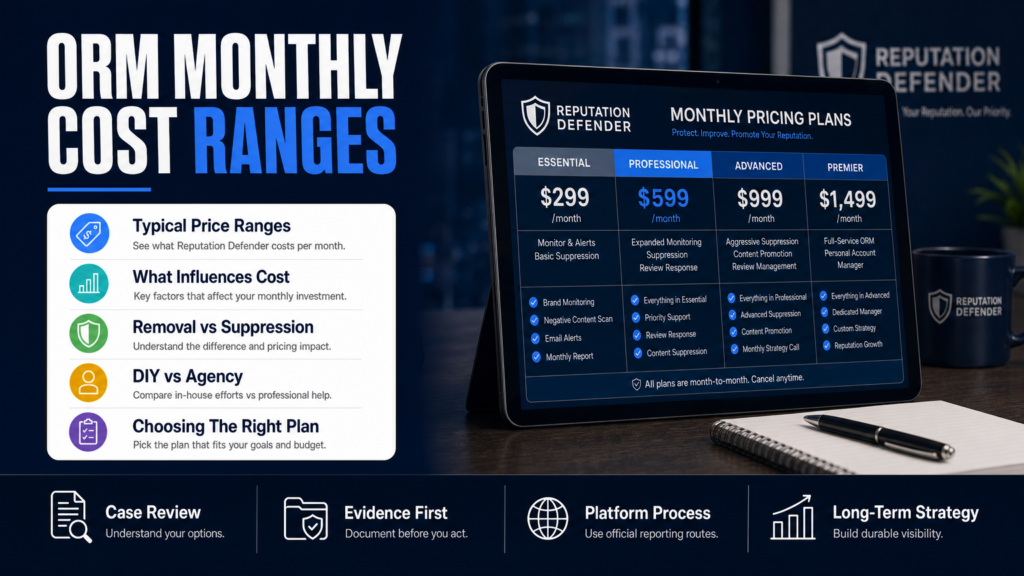
- Consumer privacy/monitoring: lower-cost subscription tiers (often under $30/month for single-user monitoring products, historically), focused on data-broker opt-outs and alerts.
- Basic reputation packages: low to mid-range monthly plans (commonly $100–$600/month) with review monitoring, dispute templates, and limited content removal attempts.
- Managed services and crisis response: high-touch packages (ranging from $1,000 to $10,000+ per month) that include active takedown work, SEO suppression, PR coordination, and legal referrals.
- One-off takedowns or legal coordination: may be quoted as project fees rather than monthly charges; expect a separate estimate for each complex removal or legal work.
What changes price most
The primary cost drivers are the number of unique negative items, whether content is on a major publisher (news or large blog), the need for custom legal work, the urgency of a response, and whether suppression requires new authoritative content creation.
Geography and licensure risk matter: licensed professionals facing threats to revenue or licensure typically need high-touch service and faster response windows, which increases cost.
- Publisher resistance (national news > local blog > social post) raises effort and cost.
- Legal complexity or subpoenas adds separate legal fees.
- Volume of negative reviews or listings increases ongoing management costs.
Is ReputationDefender by Norton legit?
Short answer: yes, ReputationDefender is a legitimate commercial service and the consumer brand operates under the NortonLifeLock umbrella. It offers credible monitoring and privacy tools for individuals and families.
Legitimacy, however, does not equal a magic cure. Like any legitimate vendor, their product set is useful for many consumers but limited by platform policy, publisher cooperation, and the law. We evaluate whether the content may qualify for removal or review and pursue the legal, technical, platform-based, and reputational options available.
- Ask for a product demo that maps features to your concrete problems (mugshots, reviews, news, doxxing).
- Request references or public case examples for similar professional clients.
- Clarify escalation: what happens if a publisher refuses your removal request?
- Reputable company: Backed by a large publicly known security company; provides consumer-facing privacy tools.
- Limited reach: Large publishers and truthful public records are often not removable through consumer opt-outs.
- Good for opt-outs and monitoring: Their strengths are data-broker opt-out workflows, identity monitoring, and templated dispute processes.
How Norton ownership affects use
Norton provides infrastructure and brand trust for consumer privacy products, which can be an advantage for basic monitoring. It does not mean special privileges with publishers or search engines.
If you require legal takedowns, reputation consulting, or aggressive SEO suppression, a stand-alone agency or specialized firm may offer different services and pricing models.
- Consumer focus: products tailored to individuals and families rather than high-risk professionals.
- For business-critical remediation, ask how the vendor coordinates with outside counsel and PR.
What are good alternatives to ReputationDefender?
Alternatives vary by target audience: consumer-focused privacy tools, software platforms, and managed agencies. Good alternatives for professionals include smaller specialized agencies and services that explicitly serve high-risk professionals and businesses.
If you want a deeper dive into pricing specifically for healthcare professionals and higher-touch remediation, compare budgets in our article on physician reputation costs: How Much Should You Pay To Fix A Doctor’s Online Reputation.
- Map the problem: decide if you need privacy opt-outs, takedowns, SEO suppression, or crisis PR.
- Match to supplier type: consumer tool for opt-outs, software for review management, agency for removals and SEO.
- Request scoped proposals from 2–3 providers and compare projected outcomes, not promises.
- DeleteMe — consumer-oriented data-broker opt-outs (subscription-based).
- NetReputation — agency approach focused on takedowns, suppression, and SEO for businesses and professionals.
- BirdEye or Podium — reputation software for review generation and management (platform-focused, less takedown work).
- Specialized ORM agencies (boutique firms) — tailored legal coordination and PR, higher monthly retainers.
- DIY + freelancer consultants — cheapest but requires time and vetting.
Picking the right alternative by need
If the problem is primarily data-broker listings and contact exposure, a consumer opt-out product may be sufficient. If the risk involves defamatory news, mugshots on large aggregator sites, or sustained review attacks, a managed reputation agency typically provides more options.
Compare not just price but credentials: experience with licensed professionals, legal coordination, and track records in SEO suppression.
- Privacy opt-outs: DeleteMe, ReputationDefender consumer plans.
- Review management at scale: BirdEye, Podium.
- Full-service remediation: boutique ORM agencies or specialist firms.
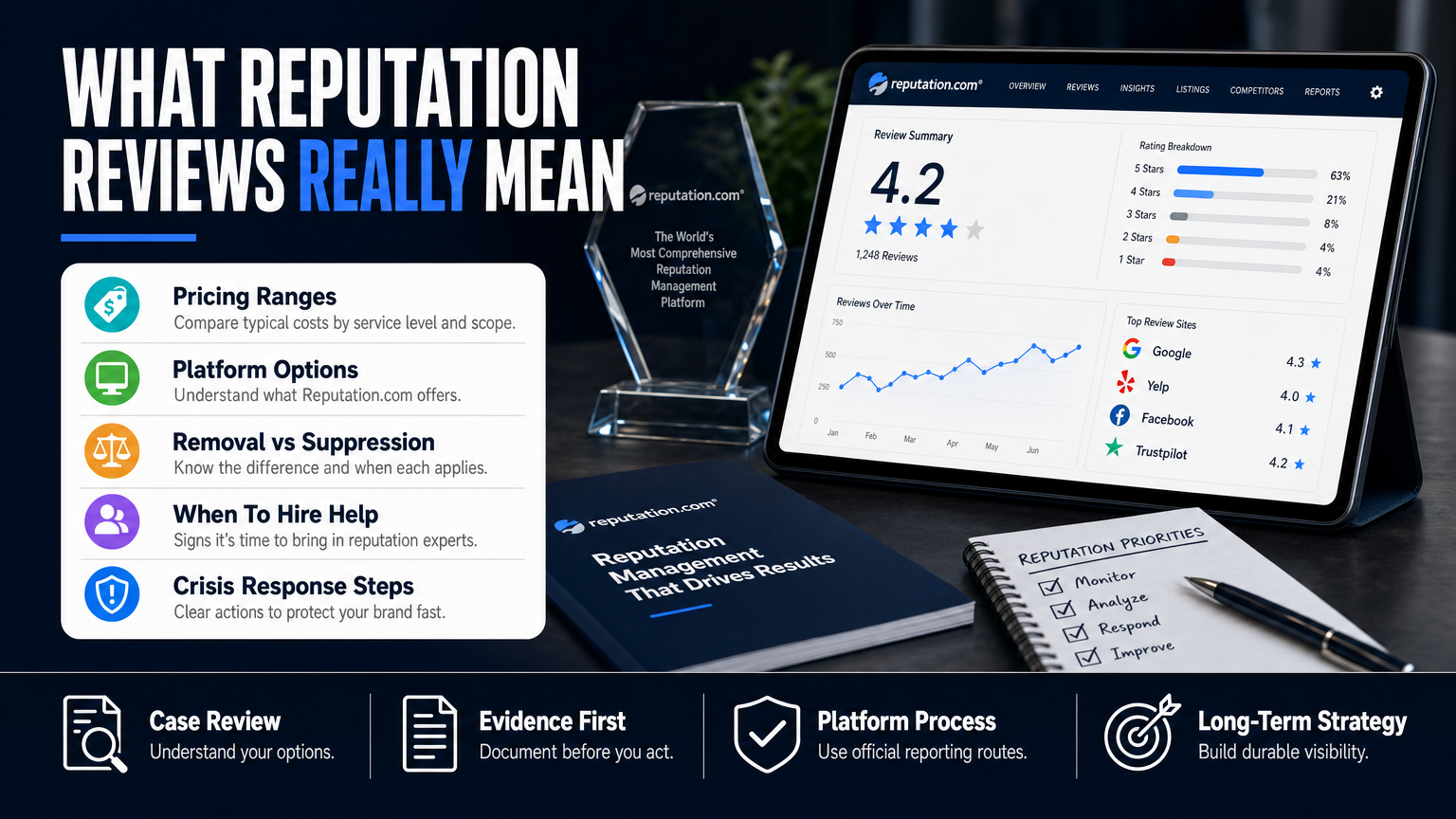
What is the best reputation management software?
There is no single ‘best’ product — the right software depends on your use case. Software-focused products excel at monitoring, review collection, and automated response tools but rarely can remove content from publishers or court records.
Evaluate software by features that matter for you: monitoring breadth, review-solicitation workflow, integration with practice-management systems, and reporting granularity.
- List your top 5 must-have features (e.g., Google/Yelp monitoring, HIPAA-safe workflows, multilingual support).
- Run vendor trials with real queries from your own name and key terms.
- Check data portability: can you export alerts and evidence for legal use?
- Key features to compare: multi-site monitoring, sentiment analysis, alerting frequency, and API integrations.
- Platforms do not replace removal: for takedowns or legal actions, you still need manual work or agency support.
- Price brackets: software subscriptions can range from $50 to $1,000+ per month depending on seats and features.
When software is the right choice
Software is the right solution if your main need is continuous monitoring, review collection and response workflows, or reporting for multiple locations. If you need removals or suppression of entrenched content, software is necessary but not sufficient.
- Large multi-location businesses benefit most from software.
- Solo professionals with isolated issues may prefer a one-off agency engagement.
How much do reputation management services typically cost?
Broad market ranges are helpful to budget. Below are typical market bands for US-focused services, with caveats: timing depends on platform, publisher, evidence, and legal complexity.
These are estimates based on common offerings; always request a written scope and avoid vendors that promise guaranteed removal or fixed timelines without assessment.
- Shortlist 3 vendors and ask for a sample monthly plan tied to the items you want addressed.
- Request transparent pricing for add-ons (legal referrals, court filings, expedited response).
- Negotiate trial periods or limited-scope pilots to evaluate vendor effectiveness.
- Low-touch monthly software/monitoring: $30–$300/month — monitoring, data-broker opt-outs, and basic templates.
- Mid-tier managed plans: $300–$2,000/month — active removal requests, review management, and basic SEO suppression.
- High-touch retainers/crisis response: $2,000–$10,000+/month — aggressive takedowns, PR coordination, legal referrals, and SEO campaigns.
- Project fees for complex removals: $500–$20,000+ depending on publisher scale, legal work, or litigation support.
How urgency affects price
Rapid-response crisis work (viral allegations, doxxing, or licensure threats) often incurs higher fees because it requires immediate staffing, PR coordination, and potential paid amplification of corrective content.
We coordinate with legal counsel and use legal tactics when required; legal fees are often billed separately or as an add-on to retainers.
- Same-day response and dedicated account teams increase cost.
- Emergency takedowns or DMCA/subpoena steps may require outside counsel expenses.
When removal is not available: suppression, correction, and PR
Many negative items cannot be removed: truthful public records, court documents, and many news stories are not eligible for takedown. When removal is unavailable, we may recommend mitigation, correction, or reduced visibility.
Mitigation typically combines SEO (to suppress negative links), content creation (positive articles and citations), and targeted PR to correct factual errors or provide your side of the story.
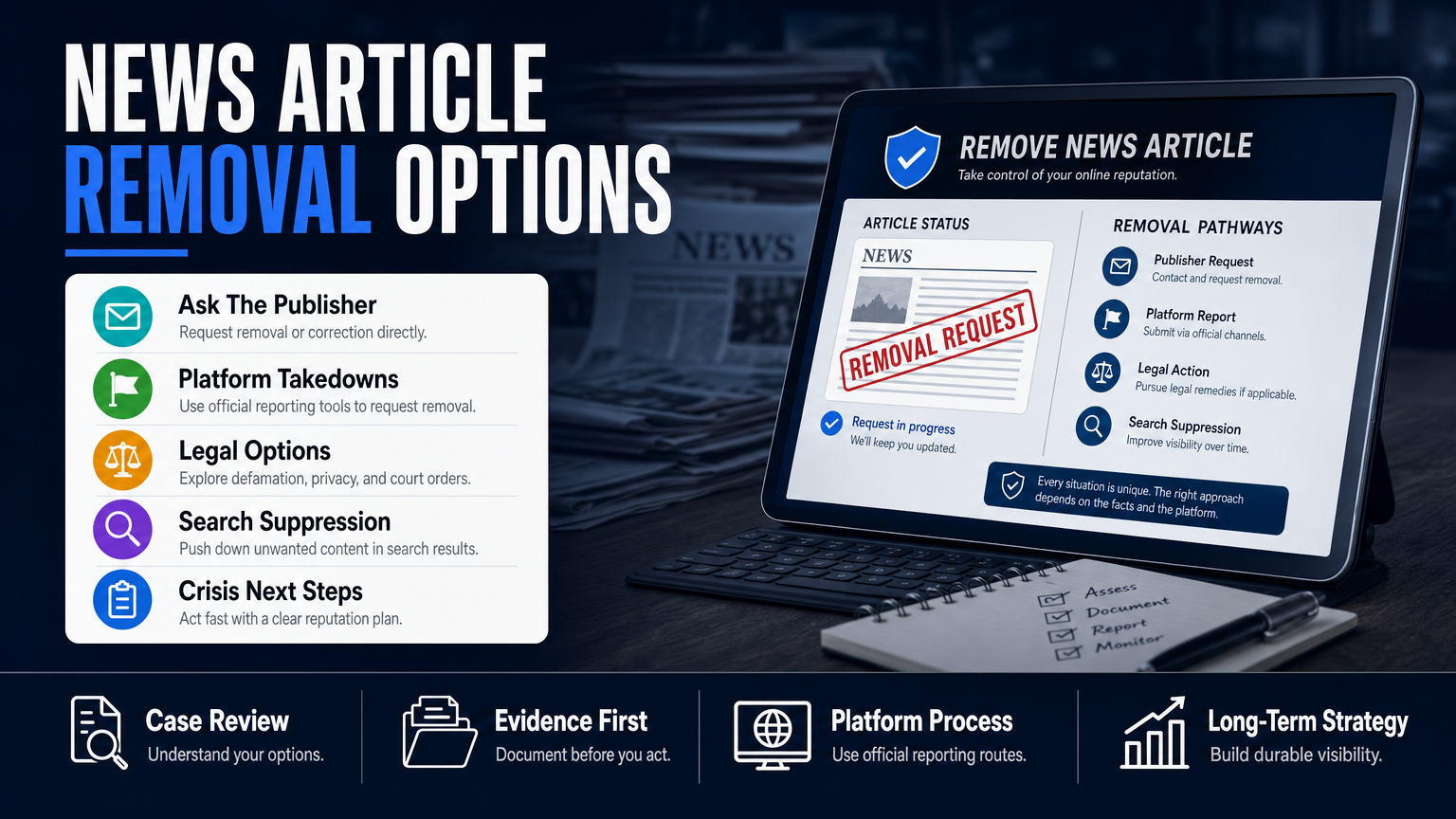
- Map the first page of search results and mark items removable vs not removable.
- Build a prioritized suppression plan: which pages to create, which directories to optimize, and which authors or outlets to contact.
- Deploy monitoring and reporting so you can see changes in rankings and sentiment over time.
- SEO suppression: create higher-authority pages that outrank negative results.
- Correction requests: contact publishers to request corrections or updates where facts are wrong.
- PR and messaging: proactively tell your side to restore trust and give context to prospective clients or patients.
When to bring in PR and legal coordination
If factual errors in a news story threaten licensure or revenue, coordinate PR and legal counsel. The law may permit correction requests or even litigation in some circumstances, but legal outcomes are never guaranteed.
A coordinated timeline and message reduce risk — and when appropriate, public-facing corrections can be more effective than suppression alone.
- Use legal review to evaluate defamation claims; decisions depend on evidence and jurisdiction.
- PR helps shape narrative and provide third-party validation (expert commentary, community endorsements).
Related reading on viral incidents
If you’re assessing corporate exposure from a post, our piece on how a post becomes the public face of a business explains the amplification risks and remediation steps: When a Viral Post Becomes Your Business’s Public Face.
How to decide whether ReputationDefender is right for you
Deciding comes down to matching scope to vendor capability and price. Do you need consumer privacy opt-outs, or do you need active takedowns, SEO suppression, and PR that protect revenue or licensure? Use a short checklist to decide.
If you’re worried a single complaint could damage your practice or career, get an assessment from a reputation firm that serves professionals — and ask for references. For context on extreme-risk situations, see our discussion of viral complaints and professional consequences at Can One Viral Complaint End a Professional Career.
- Create a prioritized list of items to address: rank by severity (licensure/revenue impact) and by likelihood of removal.
- Request a written scope and KPI framework from any vendor you shortlist.
- Pilot a limited engagement: try a 3-month scoped project to test effectiveness before committing to a long-term retainer.
- Checklist item: Is the content a public record or published by an authoritatively indexed news site? If yes, expect removal resistance.
- Checklist item: Does the content make false factual claims that can be disproved with documentation? If yes, legal routes may be viable.
- Checklist item: Do you need ongoing review management (multiple locations, frequent reviews)? Software or an agency retainer may be best.
Questions to ask on a sales call
Ask vendors about their process for publisher refusal, typical timelines for suppression efforts, how they coordinate with outside counsel, and what success metrics they use. Avoid vendors that promise guaranteed removal or fixed timelines without an individualized assessment.
- What exactly is included in the monthly fee?
- How do you escalate when a publisher refuses a removal?
- Can I see a sample report and contract terms?
Removal vs Suppression — Quick Comparison
A side-by-side look at takedown attempts versus SEO suppression for negative search results.
| Removal (Takedown) | Suppression (SEO / PR) |
|---|---|
| Goal | Goal |
| Make content unavailable | Push content down in search results |
| Requires publisher/platform action or legal remedy | Requires content creation and link building |
| Faster if publisher cooperates | Usually slower but more durable for public records |
| Not available for many truthful public records | Works even when removal is impossible |
| Costs vary widely; may include legal fees | Costs are predictable monthly SEO/PR spends |
Hypothetical scenario: a clinic owner with damaging aggregator mugshots
Situation: A small clinic owner finds multiple mugshot aggregator pages and an unverified complaint blog post ranking on the first page for their name. The pages are causing appointment cancellations, and the owner is concerned about licensure flags.
Process: The owner hires a managed reputation provider for a scoped 90-day engagement that includes data-broker opt-outs, direct takedown requests to the aggregator, SEO suppression (three high-authority posts + citations), and PR outreach to the complaint blog.
- Week 1: Audit and prioritization; legal review of potentially defamatory claims.
- Weeks 2–6: Submit platform and publisher removal requests; start content production for suppression.
- Weeks 6–12: Monitor results; ramp PR if publisher refuses correction. Adjust SEO if negative results persist.
- Month 3+: Move to ongoing monitoring contract if the owner wants continued protection.
- Step 1 — Triage: identify removable items vs public records and prioritize by impact.
- Step 2 — Evidence and documentation: collect proof that the mugshots are incorrect or that the blog post contains factual errors (if available).
- Step 3 — Multi-track approach: submit formal takedown requests and DMCA/terms-of-service complaints where applicable; launch SEO suppression for results that remain.
- Step 4 — Reporting: weekly rank tracking and escalation to outside counsel for any refusal.
Common mistakes businesses make when budgeting for reputation work
Below are frequent errors that add time, cost, or risk. Each mistake includes what to do instead.
Mistake 1 — Buying monitoring and expecting removals
Many buyers assume monitoring subscriptions include removals. They don’t. Monitor tools alert you; managed services pursue takedowns and suppression. Clarify deliverables before signing.
- Do this instead: Buy a pilot scope that explicitly lists removals and suppression tasks.
Mistake 2 — Choosing the cheapest vendor for crisis work
During a viral incident, speed and experience matter. Bargain suppliers may lack legal contacts or media relationships and can waste time.
- Do this instead: Prioritize firms with demonstrated experience for your industry and ask for escalation procedures.
Mistake 3 — Relying solely on removal requests
Removal requests often fail or take time. Relying only on them delays mitigation actions.
Do this instead: Run takedown and suppression in parallel so you aren’t left waiting for a single path to succeed.
Mistake 4 — Not documenting everything
Failing to keep evidence (screenshots, dates, correspondence) hinders legal options and platform appeals.
Do this instead: Maintain an evidence folder with exports, Google cache captures, and communication logs.
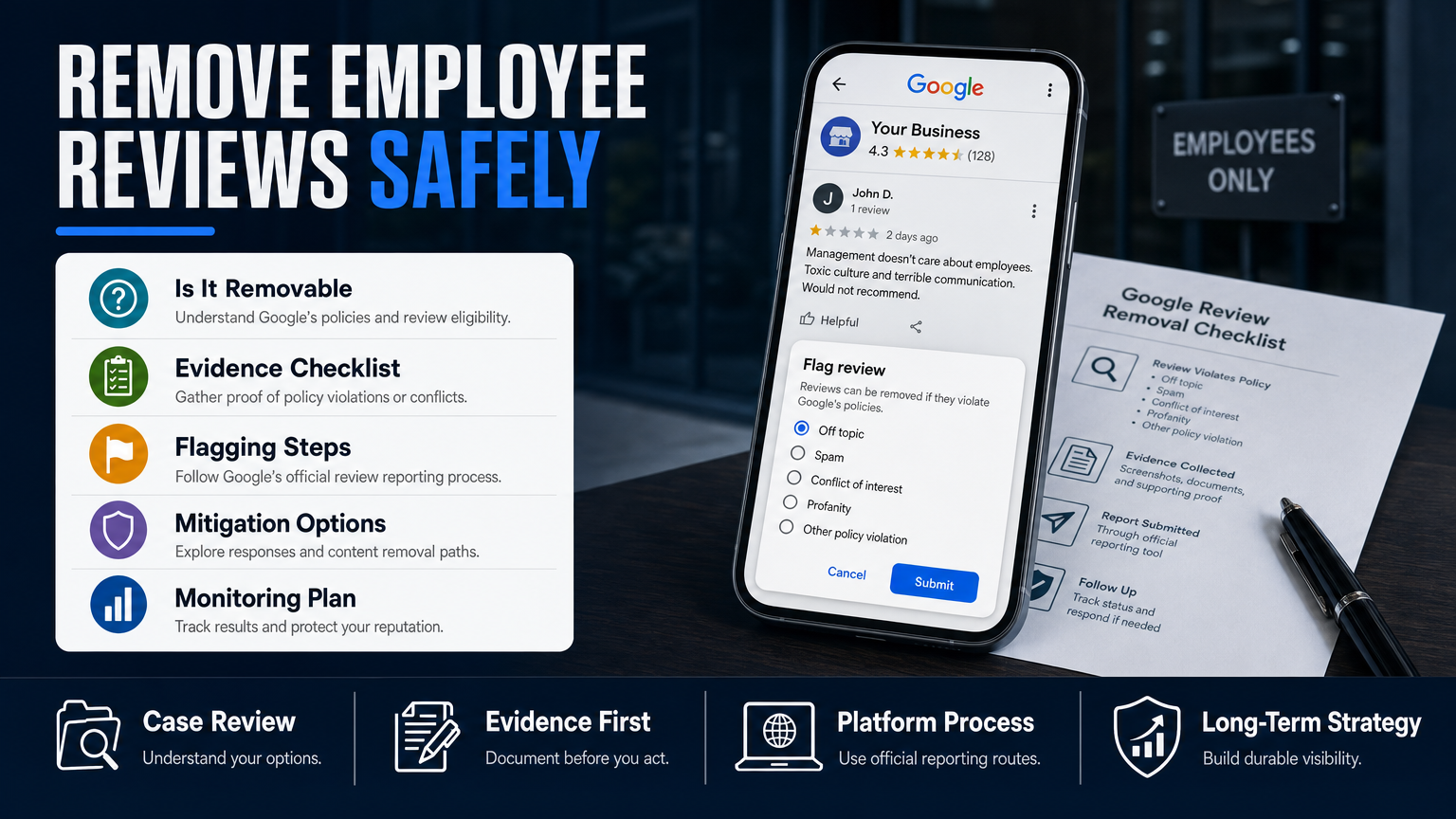
Mistake 5 — Confusing review disputes with libel removal
Negative reviews that express opinion are rarely removable. Treat false factual claims differently from opinion and follow platform guidelines.
Do this instead: Use review dispute workflows for violations of platform policy and legal review for demonstrably false factual claims.
Best practices when you’re preparing a budget and vendor shortlist
These durable steps reduce risk and make vendor comparisons meaningful.
Define clear objectives and KPIs
Decide what success looks like: item removal, first-page suppression, fewer complaints, or restored revenue. Put KPIs in writing.
- Examples: Remove X specific pages, push negative items below result #10, reduce cancellation calls by 50%.
Get an itemized scope and pricing
Ask vendors to itemize what’s included in the monthly fee and what’s billed separately. Watch for vague language about ‘white-glove’ service without deliverables.
- Request unit pricing for additional removals or expedited legal work.
Plan for layered tactics
Use multiple approaches: platform reporting, publisher outreach, SEO, PR, legal when appropriate, and monitoring. This reduces single-point failure risk.
- Track outcomes and reassign budget to the tactics that move results.
Retain evidence and maintain compliance
Document everything and ensure communications comply with privacy and professional rules (especially for healthcare and legal professions).
- Keep logs of requests, responses, and any corrections published by third parties.
Use pilots and time-boxed contracts
A 90-day pilot with defined deliverables reduces risk and provides data for longer-term budgeting.
- Include clear exit terms and reporting cadence in the pilot agreement.
Expert Tips
- Get an audit first — don’t buy open-ended monthly packages without an itemized first assessment.
- Budget for both immediate takedowns and 6–12 months of suppression work.
- Insist on evidence tracking (screenshots, timestamps, exports) to preserve legal options.
- If licensed, alert your professional-insurance counsel early; some policies cover PR or legal costs.
- Ask vendors for a playbook for publisher refusal and for samples of past escalation emails.
- Use SEO suppression concurrently with removal attempts; they reinforce each other.
- Avoid public defensive posts that repeat allegations; work privately with publishers and counsel.
- Negotiate trial periods or fixed-scope pilots to test vendor competence.
Conclusion
Answering “How much does Reputation Defender cost per month?” requires context. Consumer privacy subscriptions are relatively affordable, but managed reputation work for professionals and businesses can range from several hundred to several thousand dollars per month depending on urgency, scope, and the need for legal or PR support.
Budget against objectives, insist on itemized scopes, and run a short pilot before committing to a long-term retainer. If removal is unlikely, focus the budget on suppression, correction, and messaging — those tactics often protect revenue and licensure more reliably than waiting for a removal that may never arrive.
Why Businesses Choose Your Reputation Agency
Managing your reputation takes more than monitoring reviews or publishing the occasional blog post. It takes a strategy built around your situation, your industry, and what is actually showing up in search.
Your Reputation Agency works with businesses, executives, healthcare professionals, attorneys and growing brands. Our services include:
- Remove defamatory content and false posts (news, blogs, listings)
- Remove or challenge negative reviews (Google, Yelp, TripAdvisor, industry sites)
- Mugshot and arrest record removal
- Remove videos, images, and other multimedia that damage reputation
- Remove personal data from people‑search and data‑broker sites (opt‑outs)
- Search result suppression (SEO to bury negative links)
- Social media takedowns and impersonation removal
- Rapid online crisis management and incident response
- Ongoing monitoring and alerting of reputation signals
- Coordination with legal counsel and use of legal tactics when required
Frequently Asked Questions
1. Is Reputation Defender by Norton legit?
Yes — ReputationDefender operates as a legitimate consumer brand under NortonLifeLock. It offers monitoring and privacy services for individuals. Its consumer tools are useful for opt-outs and alerts, but large-publisher removals and legal outcomes depend on platform policy and law.
2. What are some good alternatives to Reputation Defender?
Alternatives include DeleteMe for data-broker opt-outs, software platforms like BirdEye or Podium for review management, and boutique ORM agencies (e.g., NetReputation) for takedowns and SEO suppression. Choose based on whether you need privacy opt-outs, review workflows, or high-touch remediation.
3. What is the best reputation management software?
There is no single best product; the right software depends on your needs. Prioritize monitoring breadth, review-management workflows, integrations, and reporting. Software helps with monitoring and response but rarely replaces manual takedowns and legal coordination.
4. How much do reputation management services typically cost?
Typical ranges: consumer monitoring $30–$300/month; mid-tier managed plans $300–$2,000/month; high-touch retainers $2,000–$10,000+/month. Project-based removals and legal work can be additional. Exact pricing depends on scope, urgency, and publisher complexity.
5. Can ReputationDefender remove mugshots or arrest records?
Potentially, but it depends. Aggregator mugshots and arrest records are often treated as public records or hosted by resistant publishers. We evaluate whether the content may qualify for removal or review and pursue available legal, platform, and reputational options; results vary by site and jurisdiction.
6. How long before I see results after hiring an ORM company?
Timing varies. Some removals occur quickly when a publisher cooperates, while suppression via SEO can take months. Timing depends on platform, publisher response, search-engine behavior, and whether legal steps are required. An estimated timeline can be provided after assessment.
7. Are there cheaper DIY options?
Yes. You can run manual opt-outs with data brokers, file platform reports for reviews and social posts, and start basic SEO yourself. DIY saves money but requires time, technical know-how, and legal judgment. For high-risk professionals, managed help often reduces overall risk and time-to-resolution.
8. Does any company guarantee removal or top search rankings?
No credible company can guarantee removal or fixed search rankings. Platform decisions and search algorithms are outside a vendor’s control. Reputable firms will describe strategies intended to improve visibility and pursue removals where justified, but they will not promise guaranteed outcomes.
This content provides general information and does not constitute legal advice. The available options and likely outcomes depend on the facts, evidence, platform policies, applicable law, jurisdiction, and public-interest considerations.
Past examples do not guarantee future results. Removal, correction, deindexing, and search-position changes depend on third parties and circumstances outside Your Reputation Agency’s control.