You found a news article — local or national — that is showing up when clients, licensing boards, or hiring managers search your name. You’re asking: Is there a way to get a news article removed from the internet? That question is the right place to start, and the answer depends on several things: who published it, what the article says, and whether it violates laws or platform policies.
This article explains the realistic paths to removal and review, when removal is unlikely, and what to do instead (suppression, correction, and reputation repair). It covers publisher requests, platform reporting, legal options, and practical steps to reduce visibility and reputational harm.
Read on for clear checklists you can use immediately, a comparison of removal vs suppression, and a hypothetical end-to-end example so you can see how the options fit together for a working professional or small business.
Table of Contents
- Can I Ask A Newspaper To Remove An Article?
- Can I Get Something Removed From The Internet?
- Can I Get An Article Removed From Google?
- How Long Do Newspaper Articles Stay Online?
- When Removal Isn’t Available: Suppression, Correction, And Repair
- How We Evaluate Removal Options (A Practical Checklist)
- What To Do Now: Immediate Steps You Can Take
- Removal vs Suppression: Which Path Fits Your Case?
- Hypothetical: A Local Arrest Story And The Recovery Path
- Common Mistakes Professionals Make When Trying To Remove Articles
- Best Practices For Handling Harmful News Coverage
- Expert Tips
- Conclusion
- Why Businesses Choose Your Reputation Agency
- Frequently Asked Questions
Can I Ask A Newspaper To Remove An Article?
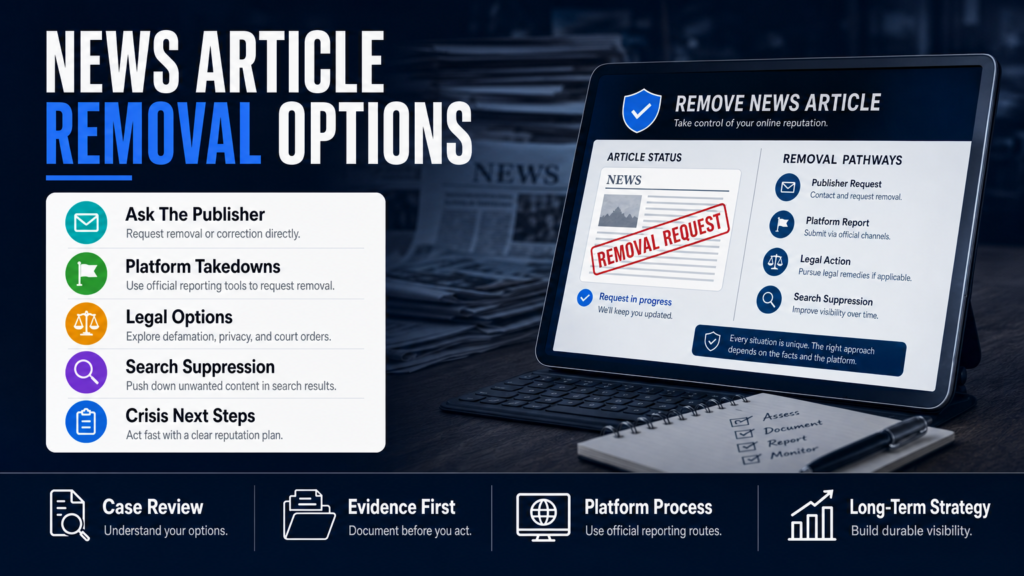
Yes — you can ask. Publishers control their own archives and the first and usually best place to start is the newsroom or the website’s corrections/reader services address. But asking is different from forcing removal: newspapers may decline for editorial reasons, law, or record-keeping obligations.
A polite, documented request has a better chance than an emotional demand. Describe the factual errors, provide evidence, and specify the remedy you want: correction, retraction, or removal. If the article contains demonstrable false statements, many reputable outlets will correct them; removal is rarer unless the piece breaches the publication’s own policies or applicable law.
- 1) Identify the article URL, author, publish date, and any factual errors.
- 2) Draft a short request: explain the error, attach proof, and propose correction or removal.
- 3) Send to the author and the editor; follow up once if no response.
- 4) If the paper declines and you believe the article is unlawful, consult a qualified attorney for options.
- Find the correct contact: the author, editor, or the corrections/reader-services email listed on the site.
- Supply concise evidence (court records, ID redactions, timeline discrepancies) and link to the original sources.
- Ask for a specific remedy and a deadline for response (e.g., 10–14 days).
What to include in your publisher request
Keep the message factual and focused. Include the exact URL, a sentence stating what is wrong, and a one-paragraph summary of supporting documentation. Don’t threaten litigation in the first email; offer to provide documents and clarify the facts.
- Exact URL and headline
- Clear statement of the incorrect claim
- Link or attachment with supporting documents
- Requested remedy (correction, headline change, removal)
When you should escalate to legal counsel
If the publisher refuses and the article contains potentially defamatory or privacy-violating material, a lawyer can evaluate whether a legal claim exists and what remedies are appropriate. A lawyer can also draft a more formal demand letter or explore injunctive relief if there is an urgent, irreparable harm — outcome and feasibility depend on jurisdiction and evidence.
- Statements presented as false factual claims that can be disproved
- Publication of private, intimate information or sensitive health data
- Publisher refuses corrections despite clear documentary proof
Can I Get Something Removed From The Internet?
Short answer: sometimes. Whether you can get content removed depends on the host (publisher site, social network, or aggregator), the content type (opinion, factual claim, private data), platform policies, and applicable law. We evaluate whether the content may qualify for removal or review and pursue the technical, platform-based, and legal options available.
For many publishers and platforms you can file takedown requests or opt-outs. For others, especially legacy news sites and independent blogs, removal is a negotiation with an editor or a legal question. For search engines and aggregators, you may request de-indexing or removal under certain policies.
- 1) Map where the article appears: original publisher, copies, aggregators, social shares, and search results.
- 2) Prioritize removal requests (original publisher and major platforms first).
- 3) Use platform reporting tools, publisher contacts, and opt-out forms as appropriate.
- 4) If removal is denied, plan suppression and correction measures.
- Publisher-owned article: removal is at the publisher’s discretion unless the content is illegal.
- Social networks: use the platform’s reporting tools for harassment, impersonation, or policy violations.
- Data brokers and people-search sites: many offer opt-outs and formal processes.
- Search engines: may remove certain personal data upon request under limited policies (e.g., URLs with doxxing or involuntary porn), but not generic news.
Platform vs publisher: different pathways
Platforms (Facebook, YouTube, Twitter/X) have internal reporting and community standards. Publishers are editorial entities. For the same story, you may need to ask both the publisher to change or take down the article and the platforms to remove reposted copies that violate platform rules.
- Use platform tools for policy violations (harassment, nudity, hate speech).
- Use publisher requests for factual corrections or retractions.
- For copies on content farms or aggregators, request removal citing DMCA (if copyright applies) or platform rules.
Can I Get An Article Removed From Google?
You cannot make Google remove an article from the web, because Google indexes publicly available pages it does not control. Google may remove specific URLs from its index in limited situations — for example, when content violates a law, contains personal data (in some regions), or when a site complies with a publisher’s removal. Otherwise Google’s primary recourse is to de-index a URL or remove cached copies.
If the article stays live on the publisher’s website, removal from Google’s index does not erase the original content but can reduce how frequently it appears in search results. Search result changes may happen because algorithms, publishers, and user behavior are outside our control.
- 1) Check whether the URL qualifies for a Google removal category at Google’s Legal Removal Requests page.
- 2) If the publisher removes or updates the article, request Google re-index (use Search Console or Google’s URL removal tool).
- 3) Consider suppression SEO if removal isn’t possible; build authoritative content to push the article down.
- Google’s removal tools handle limited categories (doxxing, non-consensual explicit imagery, personal data in EU/UK contexts with some rights, legal removals).
- For defamatory or false news, Google typically defers to the publisher unless a court order or specific policy violation exists.
- If a publisher removes the article, ask them to notify Google or request re-indexing of the updated page.
Practical use of Google’s tools
Google offers a URL removal tool for temporarily hiding cached or search results and a legal request form for certain personal data. Before filing, gather documentation, the exact URL, and a clear statement of the legal basis or policy violation.
If you’re a medical professional or a small-business owner facing an old article that harms licensure or revenue, a focused suppression and correction strategy is often more realistic. For a physician specifically, see When an Old Article Threatens a Doctor’s Practice for tailored steps.
- Temporary removals (cached content) are possible; permanent de-indexing requires compliance with policy or law.
- Google will not remove a lawful, factual news article merely because it’s embarrassing or inaccurate unless there is a legal basis.
How Long Do Newspaper Articles Stay Online?
Indefinitely, unless the publisher takes it down. Many online news sites keep archives for years or decades. Some outlets remove or archive paywalled stories, but copies, screenshots, and third-party archives (Wayback Machine, aggregators) often preserve content.
How long an article remains prominent in search depends on SEO dynamics: the publisher’s domain authority, how many other sites link to the piece, and competing content. Old articles can resurface during renewed interest or algorithmic changes.
- 1) Check live site, syndicated copies, and internet archives for where the article appears.
- 2) If removal occurs, identify cached and archived copies and request removal or update where possible.
- 3) Plan search suppression if the article is likely to remain online but you need to reduce visibility.
- Publisher archives: often permanent unless editorial decisions or legal orders require removal.
- Search visibility: may decline over time but can reappear with renewed attention.
- Backups and caches: Wayback Machine, Google cache, and syndicated copies can preserve content after removal.
Dealing with archives and caches
If a publisher removes an article, internet archives may still show the original content. You can request takedowns from third-party tools or use legal avenues if the archived content violates privacy or contains sensitive personal data, but these requests are considered case by case.
- Request removal from the Wayback Machine’s takedown process if the content meets their criteria.
- Ask Google to remove cached copies after the publisher deletes the original.
When Removal Isn’t Available: Suppression, Correction, And Repair
Often removal is not possible. When that happens we may recommend mitigation strategies: accurate corrections, reputational SEO to push harmful links down, public relations to reframe the narrative, and legal review if new information arises. We develop SEO reputation strategies intended to improve the visibility of relevant and credible information; search results may change because algorithms and third parties are outside our control.
Suppression (burying a link behind authoritative, positive content) is a common, lawful, and practical approach. It involves publishing new content, optimizing existing profiles (LinkedIn, official site, press releases), and creating high-authority pages that target your name or brand.
- 1) Audit the first page of search results for your name and identify controllable assets.
- 2) Create and optimize content (bio pages, guest articles, practitioner directories).
- 3) Publish factual, authoritative content and earn links to those pages.
- 4) Maintain continuous monitoring and update content as needed.
- Corrections and right-of-reply: ask publishers to publish clarifications or updates.
- SEO suppression: create authoritative pages (bio, awards, professional profiles) to outrank the negative link.
- PR and messaging: craft statements or interviews addressing the issue if appropriate.
- Monitoring: set alerts for new mentions and respond quickly to prevent escalation.
When to prioritize suppression over legal action
If the article is lawful, factually accurate, or tied to public interest, legal action is unlikely to succeed and can attract more attention. Suppression plus clear public-facing communication is often the faster path to reduced harm.
- Lawful reporting on public records or arrests
- Opinion pieces and commentary
- Old items where the effort and cost of litigation outweigh likely benefits
How We Evaluate Removal Options (A Practical Checklist)
A structured evaluation prevents wasted effort. We assess source, content type, potential legal claims, copies/aggregators, and the audience seeing the article. This lets you choose the most efficient route: publisher request, platform report, legal notice, or SEO suppression.
We coordinate with legal counsel when matters require legal analysis and use the official reporting processes made available by platforms. Platform decisions remain under the platform’s control.
- 1) Capture evidence: screenshots, URLs, and dates.
- 2) Map distribution: site, social shares, archives.
- 3) Draft publisher requests or platform reports with supporting evidence.
- 4) If applicable, refer the matter to counsel for legal evaluation.
- Identify the primary host and any duplicates.
- Classify the content: false factual claim, opinion, private data, harassment, or public-record reporting.
- Review platform and publisher policies for applicable takedown routes.
- Estimate impact: who is seeing the article and how it affects licensure, revenue, or hiring.
- Decide on a prioritized action plan (ask publisher, report to platform, pursue legal review, or suppress).
Documentation you should collect first
Screenshots, the exact URL, timestamps, court filings or official records that disprove false claims, and records of communication with the publisher are essential. This documentation helps editors evaluate corrections and lawyers assess legal claims.
- Full-page screenshots (include timestamp and URL bar if possible)
- Links to original records contradicting the article
- Any prior communications with publisher or author
What To Do Now: Immediate Steps You Can Take
If a news article is causing immediate damage, take these prioritized actions. Start with containment, factual documentation, and then pursue publisher and platform channels. If the situation threatens licensure, significant financial loss, or safety, consult counsel quickly.
If you need quick practical guidance on a local story that’s already affecting business and appointments, we lay out fast, tactical steps in When a Local News Story Threatens Your Practice — Fast Steps to Fix It.
- 1) Screenshot and archive the article everywhere it appears.
- 2) Send a concise, evidence-backed request to the publisher asking for correction or removal.
- 3) File platform reports for reposts that violate policies.
- 4) Begin a suppression plan: update your website, LinkedIn, and publish authoritative content to push the article down.
- Preserve evidence: take dated screenshots of the article, comments, and social shares.
- Identify who is seeing the article (patients, clients, partners) and prioritize communications to them.
- Contact the publisher calmly with documented corrections or a request for remedy.
- Report reposted copies on social platforms if they violate rules (harassment, doxxing, explicit content).
When to tell your professional networks
If clients, patients, or colleagues may encounter the article, prepare a factual short message or FAQ that clarifies the situation without escalating or repeating unverified accusations. Coordination with PR or legal counsel can help craft wording that preserves professional standing.
- Keep messages factual and non-confrontational
- Avoid repeating allegations verbatim
- Use controlled channels (email to clients, practice website notice) rather than open social posts unless advised
Removal vs Suppression: Which Path Fits Your Case?
A two-column comparison to help you decide whether to pursue removal or focus on suppression and repair.
| Removal | Suppression (SEO & PR) |
|---|---|
| Goal | Goal |
| Take article offline or force correction | Reduce visibility, promote positive content |
| Primary methods: publisher request, legal action, platform takedown | Primary methods: SEO, authoritative content, PR |
| Best when content is illegal, defamatory, or violates privacy | Best when content is lawful, accurate, or public-record |
| Potentially expensive and uncertain | More predictable, long-term investment |
| May create renewed attention (Streisand effect) | Works quietly over weeks to months |
| Outcome depends on publisher/platform/legal proof | Outcome depends on content volume and authority of new content |
Hypothetical: A Local Arrest Story And The Recovery Path
Scenario: An associate at a small clinic is named in a local news article about an arrest that later did not result in charges. The article remains live and is ranking for searches of the clinician’s name. The clinician is losing referrals and patient calls have dropped.
Process: The clinician documents the timeline showing that no charges were filed and collects court records. They send a clear request to the publisher asking for correction or a note that the case did not lead to conviction, attaching official records. The publisher declines immediate removal but agrees to add an editor’s note correcting the outcome. Copies on social networks are reported where they violate platform rules for harassment; aggregator copies are requested to be updated.
Parallel steps: the clinician publishes an updated biography on the clinic website, requests profile updates on practitioner directories, and commissions two authoritative guest articles explaining the clinician’s specialized care. Over weeks, these authoritative pages begin to outrank the old article for name searches.
- 1) Preserve screenshots and download court records.
- 2) Send a calm, evidence-backed correction request to the publisher.
- 3) Report reposts on social media if they violate platform policies.
- 4) Launch SEO suppression: update clinic site, LinkedIn, and publish new content.
- 5) Monitor search results and adapt content strategy every month.
- Document evidence before contacting publishers.
- Request specific remedies and provide court records.
- Combine publisher negotiation with suppression SEO and PR.
Common Mistakes Professionals Make When Trying To Remove Articles
Avoid these typical errors — they waste time and can make the problem worse.
Mistake: Demanding removal without evidence
Sending aggressive or vague demands often leads publishers to ignore requests. Provide clear evidence and a specific requested remedy; an editor is more likely to act on documentation than emotion.
- Solution: assemble court records, official documents, and a concise cover note.
Mistake: Publicly attacking the publisher
Calling out a newsroom on social media can escalate attention and reduce willingness to cooperate. Use private, professional channels first.
- Solution: pursue private correction requests before public escalation; involve counsel when appropriate.
Mistake: Assuming Google can silently erase it
Google indexes pages it does not control. Removing content from Google requires either a legal/policy basis or the source removal. Expect Google to defer to the publisher unless a specific policy applies.
- Solution: contact the publisher and plan suppression SEO while exploring any legitimate removal categories with Google.
Mistake: Starting litigation prematurely
Filing a lawsuit without clear evidence or counsel can be costly and generate more publicity. Litigation may be necessary in some cases, but it should follow careful legal review.
- Solution: consult a qualified attorney and weigh costs, risks, and alternatives.
Mistake: Ignoring ongoing monitoring
After a single fix, many professionals stop monitoring. New copies, social reshares, and archives can keep the issue alive.
Regular monitoring lets you react promptly and adapt suppression strategies.
- Solution: set up alerts and schedule monthly reputation audits.
Best Practices For Handling Harmful News Coverage
Adopt a disciplined process: document, request, escalate, and repair. Below are durable actions that apply across most cases.
Document everything first
Before sending requests or posting public statements, collect screenshots, timestamps, and any records that disprove inaccuracies. Good documentation strengthens publisher requests and legal evaluations.
- Screenshots with URL and date
- Official records (court filings, licensing outcomes)
- Repository of all communications with the publisher
Use calm, factual communication
Editors respond to calm, fact-based requests. Keep messages short, provide evidence, and state the remedy you seek.
- Avoid threats on first contact
- Offer to provide documents promptly
- Request a reasonable response timeframe
Prioritize controllable assets
Focus on assets you control (official website, LinkedIn, professional directories). Improve these pages and use them as anchors to push negative links down the results page.
- Optimize title tags and meta descriptions for name searches
- Publish recent achievements, case studies, or practice updates
- Claim and update directory listings (Healthgrades, Avvo, Yelp)
Coordinate legal and PR when appropriate
If the article is potentially unlawful or threatens licensure, coordinate counsel and PR so messaging is consistent and legally safe. A qualified attorney can determine whether a legal claim may be available.
- Legal counsel for potential defamation or privacy claims
- PR for messaging to clients and the public
- Integrated plan to avoid conflicting statements
Monitor and adapt
Reputation management is ongoing. Set alerts (Google Alerts, social listening), review search results monthly, and update your suppression strategy as needed.
- Automate alerts for name and brand mentions
- Monthly review of first two search result pages
- Adjust content and link-building based on results
Expert Tips
- Always capture dated screenshots before you do anything else.
- Ask for corrections before demanding removal — editors prefer fixes they can justify.
- If a publisher refuses, ask for an editor’s note or an update rather than full removal.
- Use authoritative, long-form content (legal bios, professional profiles) for suppression.
- Report reposts on social platforms quickly when they violate rules to prevent spread.
- Keep communications concise and evidence-focused; send attachments only when requested.
- Coordinate with legal counsel if the content is potentially defamatory or invasive of privacy.
- Treat suppression as an investment — it can take weeks to months to change search visibility.
Conclusion
There is no single, guaranteed method to get a news article removed from the internet. Removal depends on the publisher, platform policies, the nature of the content, and the evidence available. We evaluate whether the content may qualify for removal or review and pursue the legal, technical, platform-based, and reputational options available.
When removal is unlikely, focused suppression, factual corrections, and strategic communications often reduce the practical harm. If you need targeted guidance for a career-threatening article, see When a Single Article Threatens Your Career: What to Do Now. An estimated timeline and an appropriate plan can be provided after an individual assessment.
Why Businesses Choose Your Reputation Agency
Managing your reputation takes more than monitoring reviews or publishing the occasional blog post. It takes a strategy built around your situation, your industry, and what is actually showing up in search.
Your Reputation Agency works with businesses, executives, healthcare professionals, attorneys and growing brands. Our services include:
- Remove defamatory content and false posts (news, blogs, listings)
- Remove or challenge negative reviews (Google, Yelp, TripAdvisor, industry sites)
- Mugshot and arrest record removal
- Remove videos, images, and other multimedia that damage reputation
- Remove personal data from people‑search and data‑broker sites (opt‑outs)
- Search result suppression (SEO to bury negative links)
- Social media takedowns and impersonation removal
- Rapid online crisis management and incident response
- Ongoing monitoring and alerting of reputation signals
- Coordination with legal counsel and use of legal tactics when required
Frequently Asked Questions
1. Can you ask a newspaper to remove an article?
Yes — you can ask. Start with a calm, evidence-based request to the author or editor explaining the error and the remedy you want. Publishers may correct factual errors; outright removal is less common and typically depends on publisher policy or legal reasons.
2. Can I get something removed from the internet?
Sometimes. Removal depends on who hosts the content, whether it violates platform policies or law, and whether the publisher will cooperate. When removal is not available, mitigation options include search suppression, corrections, and PR.
3. Can I get an article removed from Google?
Google can de-index or remove certain URLs in limited circumstances (e.g., doxxing, non-consensual explicit imagery, or legal removals). For a typical news article, Google usually defers to the publisher unless there is a specific policy or legal reason to remove it.
4. How long do newspaper articles stay on the internet?
Potentially indefinitely. Publishers often keep archives for years. Even if a publisher removes an article, cached or archived copies (Wayback Machine, cached pages) may persist. Search visibility changes over time but is influenced by many external factors.
5. What should I do immediately if a harmful article appears?
Preserve evidence with screenshots, identify who is seeing the article, send an evidence-backed correction request to the publisher, report reposts on social platforms if they violate policies, and begin a suppression plan for controllable assets.
6. When should I involve an attorney?
Consult an attorney when the article contains demonstrably false factual claims, private or sensitive personal information, or when the situation threatens licensure or poses immediate financial harm. A lawyer can assess legal claims and advise on whether formal legal action is appropriate.
7. If the publisher refuses, is suppression effective?
Yes, suppression is a common strategy. Creating authoritative content and optimizing it for search can push the harmful article lower in results. Results vary by case and take time; search algorithms and third-party links are outside our control.
8. Will reporting reposts on social media remove the original article?
Reporting reposts may remove copies on social platforms if they violate policies, but it will not remove the original publisher’s article. Both publisher requests and platform reports are often necessary to reduce overall visibility.
9. How do I prevent the Streisand effect when seeking removal?
Avoid publicizing your takedown attempts on social media. Start with private, documented requests to the publisher and platform. If you must make a public statement, keep it factual and brief to avoid amplifying the issue.
This content provides general information and does not constitute legal advice. The available options and likely outcomes depend on the facts, evidence, platform policies, applicable law, jurisdiction, and public-interest considerations.
Past examples do not guarantee future results. Removal, correction, deindexing, and search-position changes depend on third parties and circumstances outside Your Reputation Agency’s control.