You’ve found one or more negative news articles showing up high in Google and other search results for your name or business. You’re asking how to remove negative news articles and what will actually move the needle before the next patient, client, or employer looks you up.
This article lays out the realistic options — takedown requests, platform reporting, legal review, SEO suppression, and PR — and explains when each path is likely to work. It includes step-by-step checks you can run right now and what to expect from timelines and outcomes.
We do not promise that any single action will remove a story. Instead, you’ll get a prioritized, evidence-based process your practice can follow immediately, plus sample language, and clear guidance about what to do when removal is not available.
Table of Contents
- How do I get rid of an unwanted news feed or news app item?
- How do I remove negative articles from Google Search?
- Is there a way to get a news article removed from the internet?
- How to get rid of a website or article that won’t go away
- The takedown toolkit: publisher outreach, legal, technical, and PR
- A realistic end-to-end example (anonymized scenario)
- Monitoring, costs, and what to expect next
- Takedown vs. Suppression — Which to Prioritize
- Hypothetical: Anonymized End‑to‑End Example
- Common Mistakes People Make When Trying To Remove News Articles
- Best Practices When Dealing With Negative News Coverage
- Expert Tips
- Conclusion
- Why Businesses Choose Your Reputation Agency
- Frequently Asked Questions
How do I get rid of an unwanted news feed or news app item?
An “unwanted news feed” can mean several things: a story that appears in Google News, a persistent result on the Google Search homepage or a news card in the Google App, or algorithmic recommendations on social platforms. The removal approach depends on which product is showing the story.
Start by identifying where the story appears and collect URLs and screenshots. Evidence speeds review and preserves the context you’ll need if you escalate.
- Step 1 — Catalog: Create a single document listing every URL, screenshots, and search terms that surface the story.
- Step 2 — Check policies: For each placement, read that platform’s content or news removal policy.
- Step 3 — Report to platforms: Use the platform’s official report form only after you have the documentation (links below show examples of reporting guidance).
- Screenshot the article, search result, and any social shares (desktop + mobile).
- Save the article URL, publisher domain, and the article’s publication date.
- Note where it appears: Google Search, Google News, Apple News, Facebook News Feed, Twitter/X timeline, or a platform app.
Reporting to Google News and Search
Google does not remove news articles simply because they are negative. Use Google’s removal tools only when the article violates Google’s policies (privacy violations, doxxing, revenge porn, or clear legal prohibitions). For other cases you may request de-indexing of specific URLs under narrow circumstances (privacy law, copyright), but these are exceptional.
If you believe the article violates policy, follow Google’s content removal forms and submit detailed evidence. See this guide for a focused walkthrough on removing a negative article from Google: Negative article: How to Remove it from Google.
How do I remove negative articles from Google Search?
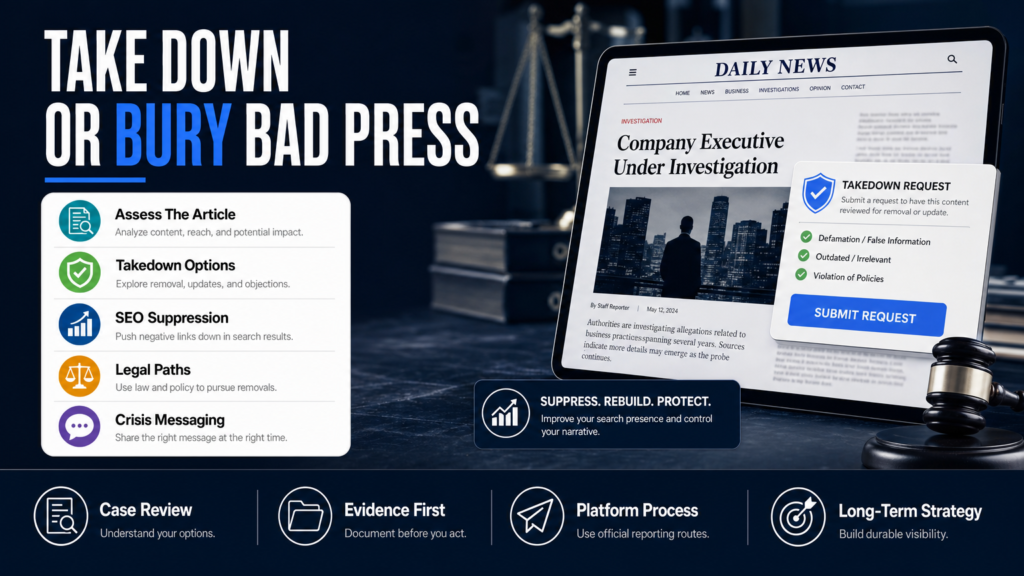
There are three realistic pathways to reducing or removing a news story from Google Search: platform takedown (publisher deletes it), a legal route (court order or DMCA), and search-engine suppression (SEO and content creation to push the result down). Which path you pursue depends on the article’s content, publisher cooperation, and whether it violates law or platform policy.
You cannot make Google ‘forget’ a truthful, lawfully published news report just because it is damaging. That’s an important practical legal limitation to understand before investing resources.
- Step 1 — Assess legal merit: Determine whether the article contains demonstrably false statements, private information, or copyright violations and consult counsel for legal options.
- Step 2 — Contact the publisher: Send a calm, documented request pointing to factual errors and ask for correction or retraction; include a time-limited offer to discuss.
- Step 3 — If publisher refuses, escalate: consider formal legal notice, DMCA (for images/text), or a strategic suppression campaign.
- Step 4 — Launch suppression: publish optimized pages (bios, press releases, LinkedIn posts, professional profiles) targeted at the same search terms; combine with backlinks and authoritative hosting.
- Publisher deletion: fastest if publisher cooperates; requires convincing the publisher or demonstrating legal grounds.
- Legal orders and DMCA: only for narrow legal claims (copyright, doxxing, privacy laws may apply in rare cases).
- SEO suppression: build credible, authoritative pages that outrank the negative result over time.
Tactics for a practical suppression campaign
Suppression is an SEO process aimed at replacing or outranking negative links with positive or neutral content. It can be launched while legal avenues are explored.
Quality and domain authority matter more than volume. Prioritize publishing on high-authority domains (professional associations, business directories, reputable guest articles).
- Optimize new content for the exact search phrases people use to find you.
- Claim and optimize professional profiles (LinkedIn, Healthgrades, Avvo, BBB).
- Use press releases and contributed articles on industry sites to create durable, authoritative pages.
When to use our takedown process
If you prefer a managed takedown workflow that combines publisher outreach, legal notices, and targeted SEO suppression, we offer a coordinated approach. Learn about our procedural steps here: Remove News Articles: Our Proven 3-Step Takedown Process.
Is there a way to get a news article removed from the internet?
Short answer: sometimes. Whether a news article can be removed depends on the publisher’s choice, the law, platform policy, and whether the article contains content that qualifies for removal (e.g., private data, copyright violations, or defamation that can be proven).
Removal is not automatic and rarely instantaneous. Expect a decision timeline that depends on the publisher, their legal counsel, and any court proceedings if involved.
- Step 1 — Identify the publisher’s contact and corrections policy.
- Step 2 — Draft a concise, fact-based correction request (include evidence of error or private information).
- Step 3 — If refused, consult an attorney about formal legal options; only pursue litigation when the claim is legally supportable and proportionate.
- Publisher takedown: quickest if the publisher agrees or if factual errors are evident and correctable.
- Legal takedown: requires an attorney, evidence, and sometimes court involvement; outcomes vary widely by jurisdiction.
- Platform removal: possible when the article violates specific platform rules (privacy, harassment, images).
What counts as a legal basis for removal?
Common legal bases include defamation (false statements presented as fact that cause harm), privacy violations (publishing sensitive personal data), and copyright infringement. Each requires specific evidence: truth is a defense to defamation, and doctrines differ by state.
A qualified attorney can determine whether the article may warrant legal review. We coordinate with counsel when a matter requires legal analysis.
How to get rid of a website or article that won’t go away
Some sites refuse to remove content — legacy press, aggregators, and hostile blogs can be persistent. When deletion is impossible or impractical, move to mitigation and long-term suppression.
Mitigation mixes technical, legal, and reputational strategies aimed at reducing a story’s visibility and redirecting attention to accurate, positive sources.
- Step 1 — Stop new spread: request takedowns for reposts, report doxxing or privacy breaches to platforms, and remove the content from your own channels if applicable.
- Step 2 — Replace and outrank: publish authoritative content on the same search terms and build links to it.
- Step 3 — Monitor and adapt: set alerts for the article and its key phrases, and update your suppression strategy quarterly.
- Targeted SEO to outrank the unwanted page.
- Request de-indexing in limited circumstances (copyright, privacy).
- Use legal notices where lawful and proportionate.
- Engage in reputation signals: updated bios, client testimonials, and third-party endorsements.
Technical options when a site refuses to remove content
If the publisher refuses to cooperate, you can pursue narrow technical options: 1) copyright takedown for owned content, 2) exposing factually false claims to the publisher’s corrections process, or 3) reputational countercontent that crowds out the story in search results.
Platform decisions remain under the platform’s control. We use official reporting and review processes made available by platforms when applicable.
When paid suppression is appropriate
Paid suppression (professional SEO, content creation, link-building) is appropriate when the article is lawful but damaging, and publisher removal is unlikely. Expect a program measured in months, not days.
Search results may change because algorithms, competitors, publishers, and user behavior are outside our control.
The takedown toolkit: publisher outreach, legal, technical, and PR
Use a coordinated toolkit: publisher outreach, platform reports, legal notices when supported by evidence, technical removals (copyright), and strategic PR to repair trust. Each tool has costs, risks, and likelihoods of success.
We evaluate whether the content may qualify for removal or review and pursue the legal, technical, platform-based, and reputational options available.
- Step 1 — Prioritize actions by likely effectiveness and cost (publisher cooperation > legal action > suppression).
- Step 2 — Prepare documentation: proof of error, custody of copyrighted material, or demonstration of private data exposure.
- Step 3 — Execute in parallel where possible: begin outreach while assembling legal papers and publishing suppression content.
- Publisher outreach: factual correction requests or retraction negotiations.
- Platform takedowns: report policy violations (privacy, harassment, explicit content).
- Legal notices: defamation letters, DMCA takedowns, or court orders when applicable.
- SEO suppression: optimized pages to displace negatives.
- PR and messaging: proactive communications to rebuild trust after an incident.
How we approach publisher outreach
Outreach is a fact-first, non-confrontational request for correction or removal. Identify factual errors, provide sources, and offer a reasonable correction. Publishers may correct or append an editor’s note even when they won’t remove a story.
We handle sensitive publisher negotiations confidentially and limit access to case information according to operational need.
When to involve PR
If a story has caused reputational damage to clients or revenue, PR can shape the narrative while technical and legal remedies proceed. PR should be coordinated with legal counsel when legal action is active.
Messaging should focus on facts, remediation, and what clients can expect next — not on denials that can be cited against you later.
A realistic end-to-end example (anonymized scenario)
Situation: A clinic is named in a local news story alleging billing errors. The story is factual in parts but contains dated inaccuracies and unnamed claims that harm patient trust. The article ranks on page one for the clinic name.
This hypothetical shows a stepwise path combining outreach, limited legal review, suppression, and PR.
- Step 1 — 0–7 days: Evidence collection and direct outreach to the publisher requesting correction; request an editor’s note if deletion isn’t available.
- Step 2 — 7–30 days: If outreach fails, consult counsel about a formal correction demand or injunctive options; begin publishing corrective content (detailed FAQ, patient safety pages).
- Step 3 — 30–90 days: Launch SEO suppression targeting the clinic name (LinkedIn profiles, press release on high-authority site, guest article by a clinician).
- Step 4 — Ongoing: Monitor search results, adjust content strategy, and use targeted PR to regain trust with referral sources.
- Catalog the article and collect internal records that correct the factual errors.
- Send a professional correction request to the reporter and editor with documentation.
- If the publisher declines removal, publish authoritative corrections (clinic statement, Q&A, 3rd-party accreditation) optimized for the clinic name.
Outcome and timeline notes
In this scenario, publisher correction or editor’s note may appear within two to six weeks. SEO suppression can begin to show movement in search rankings within 6–12 weeks, and meaningful displacement often requires 3–9 months depending on the publisher’s domain authority.
Timing depends on the platform, publisher, evidence, legal complexity, and search-engine behavior. An estimated timeline can be provided after an individual assessment.
Monitoring, costs, and what to expect next
Set realistic expectations: removal sometimes happens quickly; sometimes it never happens. Most clients combine attempted removal with suppression to manage risk while preserving legal options.
Costs vary by scope. Publisher outreach and basic SEO suppression are lower-cost starting steps; legal action and intensive nationwide PR campaigns increase fees and require counsel.
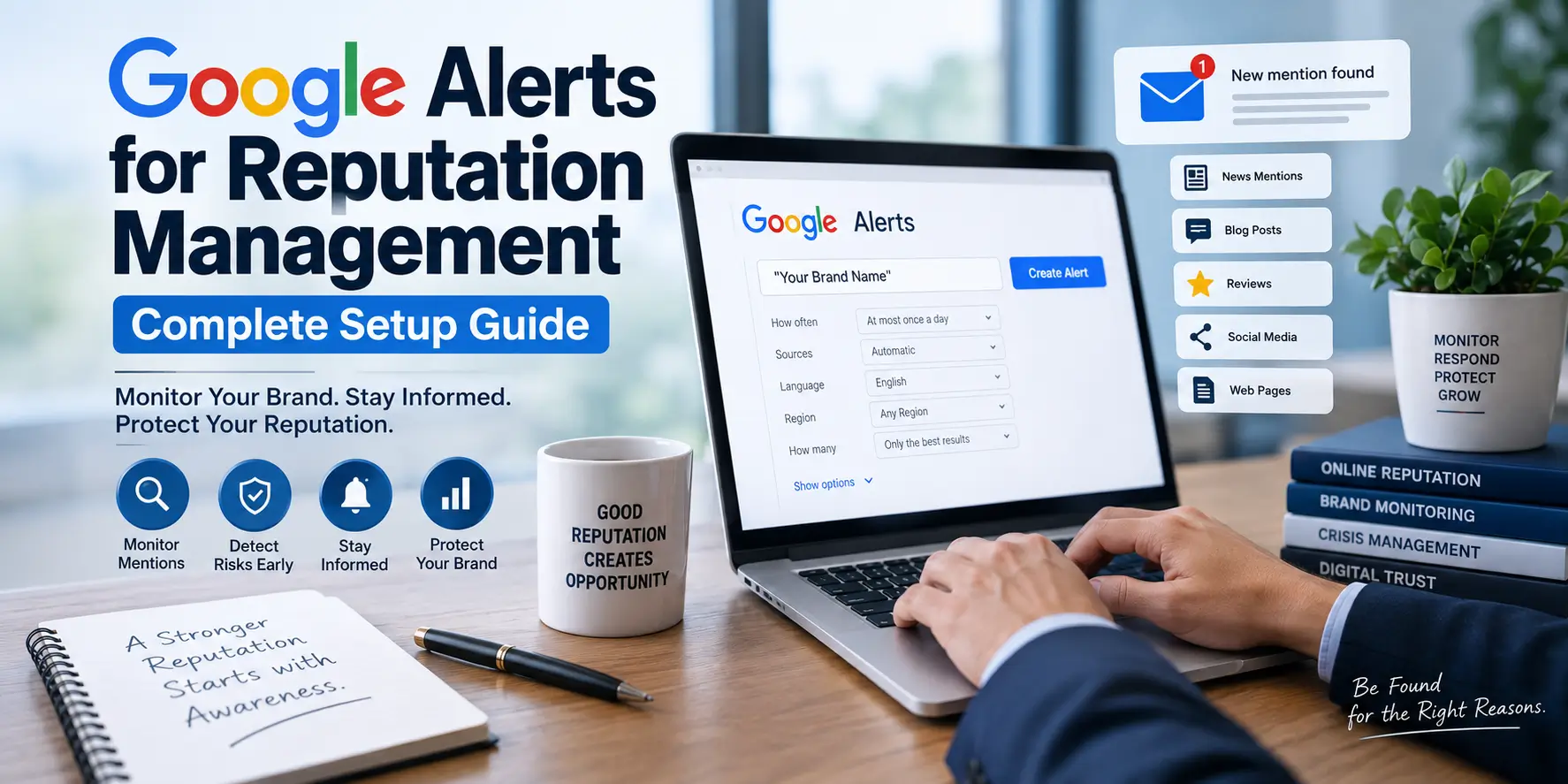
- Step 1 — Start monitoring: set Google Alerts, use professional monitoring for mention volume, and check search results weekly for the first 90 days.
- Step 2 — Measure: track ranking changes for key terms and visibility share between positive and negative links.
- Step 3 — Review quarterly: update suppression and content strategy according to outcomes.
- Short-term: immediate documentation, outreach, and platform reports.
- Medium-term: suppression campaign, targeted PR, possible legal notices (weeks to months).
- Long-term: monitoring and refreshes to protect gains (months to years).
Budgeting guidance
A small suppression program with publisher outreach might start in the low thousands; multi-channel campaigns with legal work and PR can run substantially higher. We provide an estimated range after assessment.
Specific timelines depend on the strength of the negative content and the authority of competing sources. Results vary and are not guaranteed.
Takedown vs. Suppression — Which to Prioritize
A quick comparison to help you decide where to focus resources first.
| Takedown (Publisher/Legal) | Suppression (SEO/Content) |
|---|---|
| Goal | Goal |
| Remove or correct the offending article | Reduce visibility by pushing content down in search |
| Typical timeline | Typical timeline |
| Days–months (publisher/legal dependent) | Weeks–months to see ranking movement |
| Cost profile | Cost profile |
| Variable; legal action increases cost | Predictable monthly SEO/content fees |
| Risk | Risk |
| Public litigation can amplify coverage | Requires ongoing maintenance; not permanent guarantee |
| Best use | Best use |
| For factual errors, privacy breaches, or illegal content | For lawful but damaging coverage you cannot remove |
Hypothetical: Anonymized End‑to‑End Example
A private-practice surgeon discovers a local news report alleging malpractice without citing the final hospital report. The article is indexed and appears in searches for the surgeon’s name. The surgeon wants the article gone before credentialing reviews.
This hypothetical illustrates steps that combine publisher outreach, legal assessment, suppression, and monitoring.
- Day 0–7: Catalog and preserve evidence; reach out to the publisher with a correction request.
- Day 7–30: If the publisher refuses, consult counsel about formal notice; simultaneously begin publishing corrected, authoritative content.
- Month 1–3: Launch SEO suppression — claim profiles, publish third-party endorsements, secure backlinks to positive pages.
- Month 3+: Monitor results; if no acceptable outcome and legal grounds exist, consider escalation with counsel.
- Collect internal records and the hospital’s final report summary to establish factual corrections.
- Send a calm correction request to the reporter and editor with evidence and a proposed correction.
- If the outlet declines to remove, publish a statement and authoritative pages (hospital clarification, professional profile) optimized for the surgeon’s name.
Common Mistakes People Make When Trying To Remove News Articles
Avoid these frequent missteps — each can reduce your chance of success or make the problem worse.
1) Treating removal as instant or guaranteed
Mistake: Expecting immediate removal or guaranteed success. Reality: Removal depends on publisher, law, and platform policy. Presenting removal as certain wastes time and funds.
What to do instead: Prioritize actions by likelihood of success and maintain parallel mitigation strategies.
2) Publicly threatening publishers or reviewers
Mistake: Making public threats or pushing an aggressive social-media campaign against a publisher. This often backfires and can make a story more visible.
What to do instead: Use private, documented outreach and involve counsel for formal notices only when appropriate.
3) Chasing vanity removals that have no legal basis
Mistake: Spending resources trying to remove truthful, lawful reporting purely because it’s unwanted. This rarely succeeds and diverts resources from suppression and PR.
What to do instead: Focus on correction where facts are wrong and suppression/PR where the reporting is lawful but harmful.
4) Ignoring monitoring after initial work
Mistake: Stopping monitoring after a short campaign and assuming the issue is resolved. Aggregators and secondary sites can re-index old stories.
What to do instead: Maintain ongoing alerts and quarterly reviews to catch reposts or resurfacing items.
5) Using deceptive or retaliatory tactics
Mistake: Using fake reviews, sock puppet content, or harassment to bury an article. These tactics are unethical, violate platform rules, and can cause legal and reputational damage.
What to do instead: Use legitimate SEO, accurate content, and lawful removals. We do not recommend or employ deceptive practices.
Best Practices When Dealing With Negative News Coverage
Follow a disciplined process that balances legal, technical, and reputational responses. Be evidence-driven and proportional.
1) Document Everything Immediately
Capture screenshots (desktop & mobile), save URLs, and collect internal documents that correct factual errors. Preservation matters if legal action becomes necessary.
We handle matters confidentially and apply appropriate privacy and security controls during evidence collection.
2) Start with publisher outreach
A calm, well-documented correction request to the reporter or editor is often the fastest route to correction or editor’s note. Keep the tone factual and provide clear evidence.
If outreach fails, escalate thoughtfully with counsel.
3) Combine suppression with remedial PR
While pursuing removal, publish authoritative content to occupy search real estate and communicate transparently with affected stakeholders (patients, clients, partners).
We develop SEO reputation strategies intended to improve the visibility of relevant and credible information.
4) Use legal escalation sparingly and with counsel
Legal remedies can be powerful but are not universally appropriate. A lawyer can determine whether a claim may be available and whether litigation risk (and potential publicity) is acceptable.
We coordinate with qualified legal professionals when a matter requires legal analysis.
5) Maintain long-term monitoring
Search results change; what’s suppressed today can reappear. Ongoing monitoring and periodic content refreshes protect outcomes.
An estimated timeline can be provided after an individual assessment.
Expert Tips
- Keep outreach messages factual and concise; emotional messaging invites pushback.
- Prioritize fixing demonstrable factual errors with the publisher before expensive legal steps.
- Claim and optimize authoritative profiles (LinkedIn, NPI registry, professional directories) first — they’re often quick wins.
- For images or private data, platform policy and copyright routes can be faster than defamation claims.
- Don’t ignore secondary sites and aggregators — they often re-index old stories and drive visibility.
- If you consult counsel, ask about the potential for defensive counterclaims before initiating litigation.
- Measure suppression success by visibility share for your name or brand, not by promises about rankings.
- Document every outreach and keep a central, secure record for potential legal use.
Conclusion
Removing a negative news article is rarely a single-step process. The most effective response is a prioritized combination of publisher outreach, legal review where appropriate, and targeted suppression backed by credible, authoritative content.
If removal is possible, publisher cooperation or a legal remedy may produce results. When removal is unlikely, well-executed SEO and PR work can reduce the article’s impact and help restore trust. We evaluate whether the content may qualify for removal or review and pursue the legal, technical, platform-based, and reputational options available.
Why Businesses Choose Your Reputation Agency
Managing your reputation takes more than monitoring reviews or publishing the occasional blog post. It takes a strategy built around your situation, your industry, and what is actually showing up in search.
Your Reputation Agency works with businesses, executives, healthcare professionals, attorneys and growing brands. Our services include:
- Remove defamatory content and false posts (news, blogs, listings)
- Remove or challenge negative reviews (Google, Yelp, TripAdvisor, industry sites)
- Mugshot and arrest record removal
- Remove videos, images, and other multimedia that damage reputation
- Remove personal data from people‑search and data‑broker sites (opt‑outs)
- Search result suppression (SEO to bury negative links)
- Social media takedowns and impersonation removal
- Rapid online crisis management and incident response
- Ongoing monitoring and alerting of reputation signals
- Coordination with legal counsel and use of legal tactics when required
Frequently Asked Questions
1. How do I get rid of unwanted news feed?
Identify which product or feed is displaying the story (Google News, app recommendations, social feeds), document the item, and use the platform’s reporting or corrections process. Start with publisher outreach for corrections; use platform reporting for privacy or policy violations.
2. How do I remove negative articles from Google search?
Options include publisher deletion, legal routes (rare and specific), and SEO suppression. Google will rarely remove truthful, lawfully published news simply because it is negative. Assess legal merit and simultaneously launch suppression if publisher removal is unlikely. See our detailed guidance on removing a negative article from Google: Negative article: How to Remove it from Google.
3. Is there a way to get a news article removed from the internet?
Sometimes — when content violates law, platform policy, or is subject to copyright. Otherwise removal depends on publisher cooperation or a court order. We evaluate whether the content may qualify for removal or review and coordinate with counsel when legal options are indicated.
4. How to get rid of a website that won’t go away?
When removal isn’t possible, mitigation and suppression are the primary paths: publish authoritative content optimized for the same search terms, use link-building to raise those pages, and monitor for reposts. Technical takedowns (copyright, privacy) are options only in specific circumstances.
5. How long do news articles stay online?
Indefinitely, unless the publisher removes them. News archives are often maintained for years. Search visibility may decline over time, but high-authority publishers can keep stories on page one for months or longer. Timing depends on the publisher, platform algorithms, and competing content.
6. Can I use a DMCA to remove a news article?
Only when the article contains your copyrighted material (text or images) and you can prove ownership. DMCA is not a tool for removing factual or negative reporting. Misuse of DMCA can have legal consequences; consult counsel if unsure.
7. When should I involve an attorney?
Consult an attorney when the article appears to contain demonstrably false factual allegations, private sensitive data, or material that may support a defamation claim. An attorney can advise on the merits and proportionality of legal escalation. We coordinate with qualified legal professionals when a matter requires legal analysis.
8. What can I do while takedown requests are pending?
Begin suppression: claim and optimize professional profiles, publish corrective content (detailed FAQs, institutional statements), and run targeted PR to address stakeholders. Monitor search results and set alerts for reposts.
9. Do you guarantee removal?
No reputable provider can guarantee removal or permanent suppression. Platform decisions, publisher choices, and search algorithms are outside our control. We develop SEO reputation strategies intended to improve the visibility of relevant and credible information and pursue the legal, technical, and platform-based options available.
This content provides general information and does not constitute legal advice. The available options and likely outcomes depend on the facts, evidence, platform policies, applicable law, jurisdiction, and public-interest considerations.
Past examples do not guarantee future results. Removal, correction, deindexing, and search-position changes depend on third parties and circumstances outside Your Reputation Agency’s control.