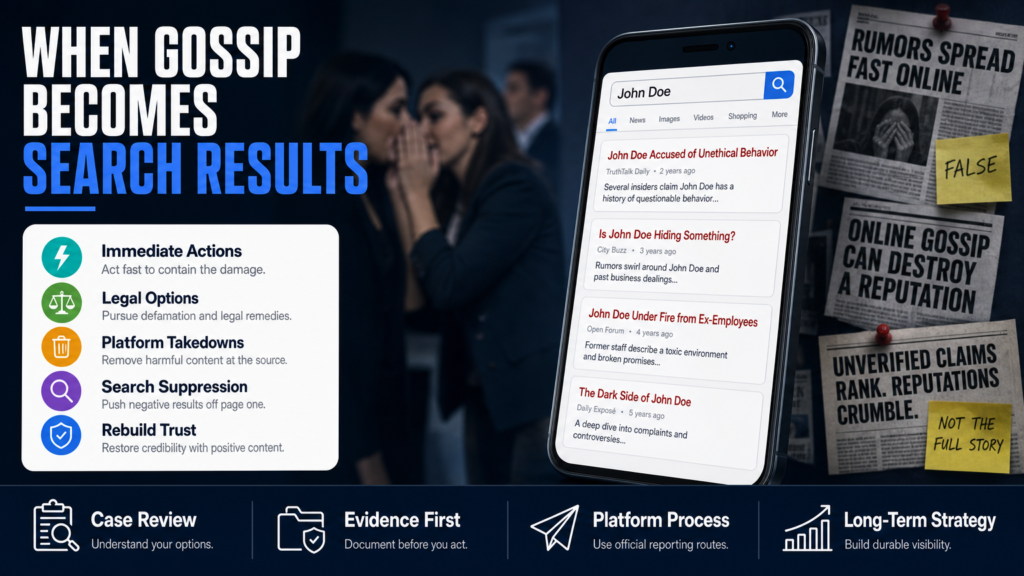
You just found a post, message thread, or local news item repeating a rumor about you — and it appears on page one of Google when clients, colleagues, or regulators search your name. If your reputation ruined by gossip, the stakes can include lost clients, damaged hiring chances, and even licensing risk.
This article lays out clear, practical steps to evaluate the content, act quickly to contain spread, and pursue removal, mitigation, or search‑engine suppression. It explains when gossip is merely harmful talk and when it might qualify as defamation or a platform policy violation.
You’ll get immediate actions to take in the first 48 hours, a realistic view of legal and platform options, what to do when removal isn’t available, and a long‑term plan to rebuild trust and monitor outcomes.
Read the sections that matter most to you: fast containment, legal review, takedown requests, SEO suppression, and internal communication for workplaces or practices threatened by rumor.
Table of Contents
- How Gossip Affects Individuals and Careers
- Who Spreads Rumors — Motives and Profiles
- What Harm Gossip Can Do To Your Practice or Business
- When Gossip Crosses Into Defamation
- Immediate Steps When Gossip Appears Online
- When Removal Is Not Available: Suppression and Repair
- Communicating Internally and With Clients
- Monitoring, Measurement, and Long-Term Repair
- Removal vs Suppression: A Practical Comparison
- Removal vs Suppression: Quick Comparison
- Hypothetical Example: Dr. L and the Viral Clinic Rumor
- Common Mistakes People Make After Gossip Spreads
- Best Practices For Recovering From Gossip
- Expert Tips
- Conclusion
- Why Businesses Choose Your Reputation Agency
- Frequently Asked Questions
How Gossip Affects Individuals and Careers
Gossip can erode professional credibility even when it contains no provable falsehoods. The first harm is reputational: prospective clients and employers make snap judgments from search results, social posts, and local message boards.
Psychologically, being the subject of gossip increases stress, reduces trust in colleagues, and can produce real workplace disruption. For licensed professionals, a widely shared allegation — even if unproven — can trigger complaints or inquiries that are time‑consuming and costly.
- Document the gossip: save screenshots, URLs, timestamps and any replies or shares.
- Identify the first publisher and the amplification channels (Facebook groups, Reddit threads, local news, review sites).
- Assess whether the content is opinion, factual allegation, or a privacy violation — this affects possible actions.
- Clients often stop contacting a professional after finding a negative post or rumor.
- Hiring committees and referral sources commonly perform a quick web search and rely on top results.
- Emotional and operational impacts: distraction, staff turnover, cancelled appointments or contracts.
Immediate documentation checklist
Create a secure folder (local and cloud) with the following items to preserve evidence.
- Full-page screenshots including timestamps and browser address bar.
- Permalinks to social posts, articles, or forum threads.
- Copies of any DMs, emails, or screenshots from third parties.
Who Spreads Rumors — Motives and Profiles
People spread rumors for many reasons: grievance (former employees, ex-clients), attention-seeking (social users chasing engagement), ideological conflict (activists), or simple miscommunication. Understanding motive helps choose the right response.
A single mistaken post often behaves differently from coordinated smear campaigns. The former may be resolved through correction or takedown; the latter typically requires a layered legal, technical, and PR approach.
- Map the actors: who posted, who shared, and which platforms amplified the content.
- Decide if a direct approach (ask for removal) or a formal request (platform report, legal notice) is appropriate.
- Former employees: may post out of revenge or to influence hiring decisions.
- Competitors or disgruntled clients: sometimes seed negative claims or fake reviews.
- Well‑meaning sharers: amplify gossip without verifying facts, often on Facebook groups, Nextdoor, or WhatsApp chains.
- Anonymous posters: on Reddit, YikYak, or some comment sections, these can be harder to trace.
When a former employee is involved
If a former employee is the origin, document employment records, performance reviews, and any post‑termination communications. That factual record helps both legal assessment and corrective messaging.
- Consider the employee’s motive and reach before escalating.
- See our guide for deeper steps when a past staffer becomes a public problem: When a Former Employee Becomes a Brand’s Biggest Search Result.
What Harm Gossip Can Do To Your Practice or Business
Gossip can create immediate revenue loss, referral breakdowns, pressure from partners or landlords, and in regulated professions, complaints to boards. Damage isn’t just about a single post — it’s about how that post changes behavior: fewer calls, missed hires, or lost contracts.
In small communities and specialty fields (medicine, law, finance), even modest rumors can have outsized effects because trust is a core purchase decision.
- Quantify impact where possible: track appointment cancellations, lost leads, and referral dropoff.
- Notify key stakeholders internally and prepare a factual, calm response plan to staff and partners.
- Short term: cancellations, client inquiries, staff demoralization.
- Medium term: lost hires, difficulty renewing vendor relationships, online review spikes.
- Long term: persistent first-page negative results that affect lead generation and valuations.
When a single review or post shifts behavior
Sometimes one high‑visibility item — a viral post or an influencer tweet — causes outsized harm. If you’re seeing immediate business effects, rapid containment is essential.
- Temporarily adjust scheduling and communications to address client questions.
- Use your website and owned channels to publish clear, factual statements if warranted (avoid defensive language).
- Review the article or review’s visibility: is it appearing in branded search results?
When Gossip Crosses Into Defamation
Not every false or harmful statement is defamation. In the U.S., defamation generally requires a false factual statement presented as fact, published to a third party, and causing demonstrable harm. Public-figure plaintiffs face higher proof standards.
We evaluate whether the content may qualify for removal or review, but the availability of a legal claim depends on the evidence, jurisdiction, and whether the publication is opinion or a verifiable factual claim.
- Collect evidence showing falsity (documents, timestamps, witnesses).
- Consult a qualified attorney to determine if a legal claim is available and practical.
- Coordinate legal options with platform reporting and reputational strategies; we pursue the legal, technical, platform-based, and reputational options available.
- Opinion or hyperbole is often protected speech and not actionable.
- Accusatory factual claims about illegal or unethical conduct are more likely to be actionable if false.
- Public-interest reporting or statements tied to legitimate news coverage may complicate legal remedies.
How platforms treat alleged defamation
Major platforms have different policies and processes. Google, Facebook, and Twitter/Meta/Threads evaluate removal requests under their own rules — their decisions remain under platform control.
- Some outlets require a court order for removal, others will review notices of false statements.
- We use the official reporting and review processes made available by platforms and coordinate with legal counsel when necessary.
Immediate Steps When Gossip Appears Online
Within the first 48 hours take actions that preserve options and slow spread. Fast, calm, and documented responses matter more than emotional replies.
These are triage steps: preserve evidence, limit amplification, and decide whether to pursue removal or suppression.
- 1) Document: Save screenshots and URLs with date/time information.
- 2) Report: Use platform-specific abuse or defamation reports for Facebook, Instagram, Twitter/X, YouTube, Reddit, Google (search and maps), Yelp, and industry review sites.
- 3) Decide: If the content appears to be illegal (doxxing, threats) or a clear policy violation, escalate immediately to platform abuse contacts and, if needed, law enforcement.
- Preserve screenshots, direct messages, and any communications from the poster.
- If the poster is a known individual, consider a polite direct request to remove or correct the content.
- Report clear platform policy violations (harassment, doxxing, impersonation) using the platform’s reporting tools.
Platform reporting shortcuts
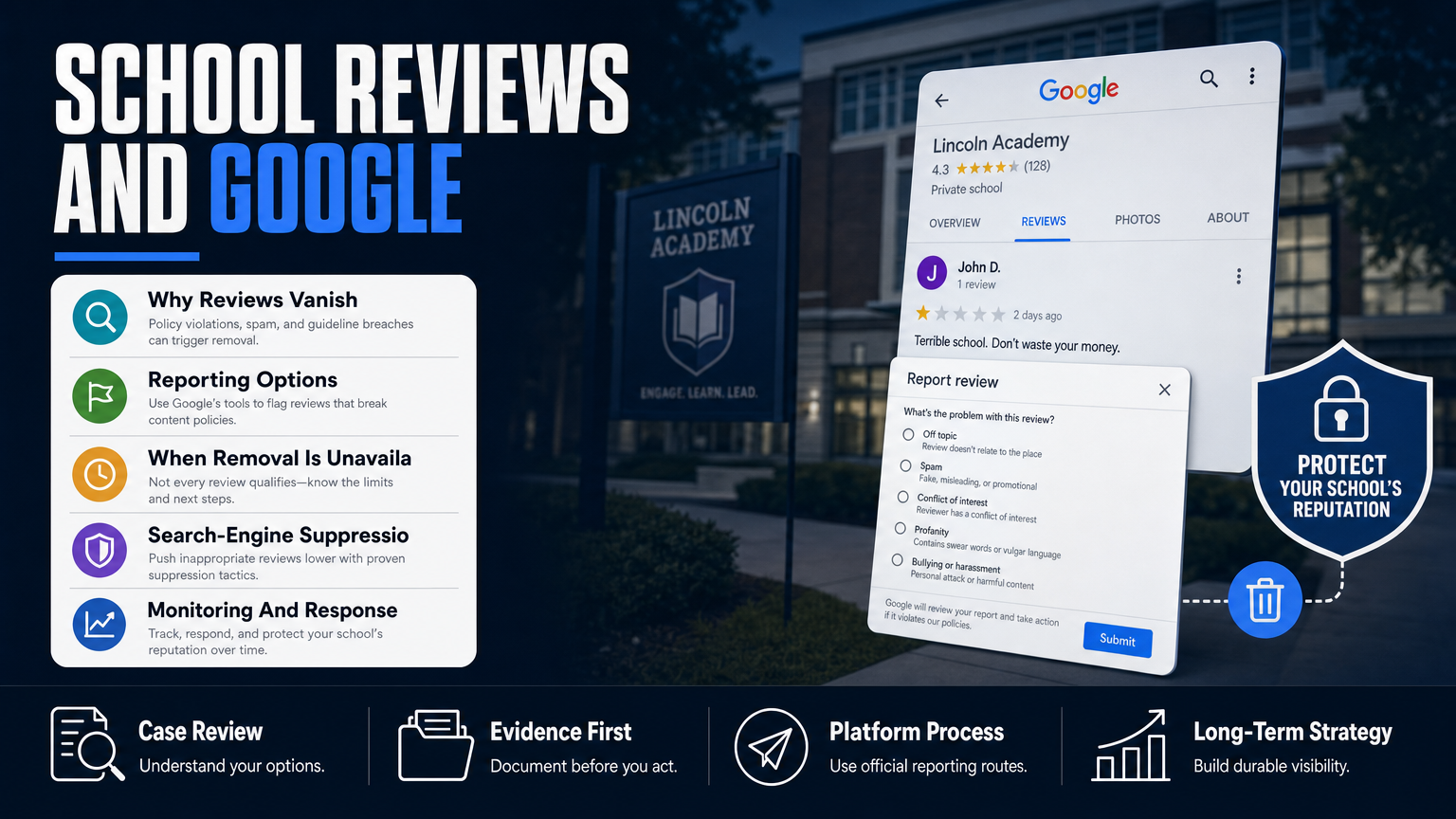
Use each platform’s formal tool. For search results, use Google’s removal requests for legal reasons and for removal of personal data; for reviews, use Google My Business and Yelp’s business owner tools.
- If a negative review is clearly false or violates platform policy, begin a dispute with the review platform promptly.
- For reputation problems that start with reviews, consider the business‑specific checklist in When One Review Threatens Your Practice: What To Do Next.
When Removal Is Not Available: Suppression and Repair
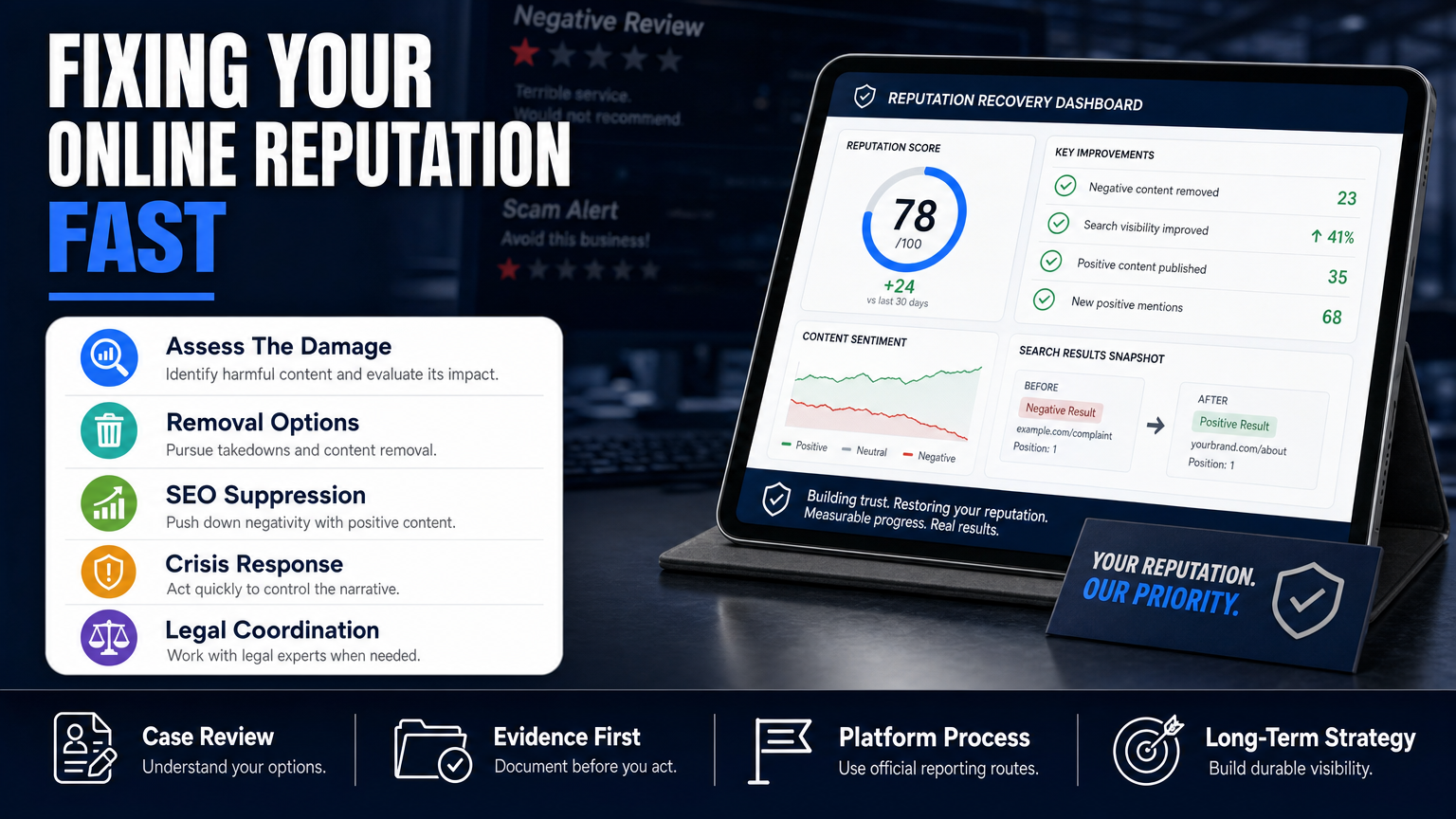
Sometimes removal is unavailable: the content doesn’t violate platform rules, it’s opinion, or the publisher refuses to act. In those cases we develop SEO reputation strategies intended to improve the visibility of relevant and credible information.
Search result changes depend on algorithms, competitors, publishers, and user behavior. Results vary according to the strength of the negative content and the authority of competing sources, so the aim is to reduce the negative item’s visibility rather than promise it will disappear.
- 1) Audit first page search results for branded queries and identify replaceable targets.
- 2) Prioritize high-authority pages you can control (your website, LinkedIn, institutional profiles).
- 3) Produce and promote evergreen content answering common concerns and emphasizing credentials and outcomes.
- 4) Monitor progress and iterate every 30–90 days; expect variation and no guaranteed timelines.
- Create authoritative, positive content (press releases, professional profiles, long-form pages) to rank for your name.
- Use targeted SEO (optimizing titles, metadata, and structured data) to promote relevant pages.
- Leverage owned properties: site pages, LinkedIn, and professional directories to push down negative links.
When to use suppression vs. direct removal
If removal options are weak (opinion, protected speech, or a cooperative publisher is absent), suppression is usually the practical route. Removal attempts are still pursued when possible because they can be faster, but suppression provides a durable mitigation strategy.
- Removal: faster if the publisher or platform cooperates — depends on policies and evidence.
- Suppression: slower, requires content creation and SEO, but doesn’t rely on another party’s consent.
Communicating Internally and With Clients
In many professional settings, how you communicate matters more than the rumor itself. A calm, factual internal message prevents speculation and preserves staff morale.
Externally, transparency balanced with legal caution is key. Avoid making public statements that could worsen the situation or be used against you legally.
- 1) Assemble an incident response team: operations lead, communications lead, legal counsel, and your reputation manager.
- 2) Draft an internal memo: facts, actions taken, and how employees should direct questions.
- 3) If appropriate, publish a concise public statement on your website or social channels that corrects factual errors without amplifying the rumor.
- Tell staff what you know, what you don’t, and how to respond to inquiries.
- Prepare a short external statement for clients and partners if the rumor has public visibility.
- Train front‑line staff on scripts for phone and email inquiries.
Examples of brief external wording
Keep public messaging short and focused on facts: who you are, steps you’re taking, and how clients can contact you privately for clarification.
- “We are aware of a post circulating about our practice. We dispute the accuracy of the claims and are addressing the matter.”
- “If you have questions about your care/contract, please contact our office directly at [phone/email].”
Monitoring, Measurement, and Long-Term Repair
Ongoing monitoring is essential. Rumors don’t die — they can resurface in new forums. Set up alerts and a periodic report to measure whether negative items are losing visibility and whether new mentions appear.
We handle matters confidentially and apply privacy and security controls while coordinating with legal counsel and PR when needed.
- 1) Implement a monitoring suite for search, social, and review sites.
- 2) Review metrics monthly: top negative URLs, referral impacts, and client feedback.
- 3) Update content and outreach plans based on data.
- Set Google Alerts, social listening streams for brand searches, and review monitoring for industry platforms.
- Track SERP position for branded queries and the sentiment of new mentions.
- Use periodic reputation audits (every 30–90 days) to adjust suppression and PR strategies.
When to bring in PR and legal counsel
Consider PR when the rumor reaches local or industry media; involve legal counsel for defamation, doxxing, or coordinated attacks. We coordinate with qualified legal professionals when a matter requires legal analysis.
- PR crafts narratives and places corrective coverage; legal counsel evaluates claims and potential takedown or court options.
- We develop SEO reputation strategies intended to improve the visibility of relevant and credible information while coordinating these efforts.
Removal vs Suppression: A Practical Comparison
Deciding between asking for removal and investing in suppression depends on content type, publisher cooperation, and your time horizon.
Removal vs Suppression: Quick Comparison
Use this table to choose an initial strategy based on content and publisher cooperation.
| Removal | Suppression (SEO & PR) |
|---|---|
| Best when publisher cooperates | Doesn’t require publisher consent |
| Can be fast if platform agrees | Slower; weeks to months |
| Depends on platform policies and evidence | Depends on content production and link authority |
| Higher success if content violates rules or is demonstrably false | Useful for opinion or protected speech that won’t be removed |
| May involve legal notices or court orders | Involves SEO, content, and outreach |
| Lower long‑term control if publisher reshares later | Creates durable positive assets you control |
Hypothetical Example: Dr. L and the Viral Clinic Rumor
Scenario: A mid‑sized clinic physician, “Dr. L,” discovers a Facebook post accusing them of misconduct. The post is shared into local parent and health groups and appears in Google results for their name.
Process: This example shows a multi‑track response combining documentation, platform reporting, targeted outreach, legal evaluation, and SEO suppression.
- 1) Contain — preserve evidence and stop amplification.
- 2) Report — use platform tools and request removals where policies are violated.
- 3) Evaluate — legal review to assess defamation or other claims.
- 4) Mitigate — begin SEO and PR work to push down the negative item.
- 5) Monitor — implement alerts and monthly review of progress.
- Day 0–2: Document everything — screenshots, shares, commenters. Ask the original poster for correction or removal via a polite private message.
- Day 2–7: File platform reports for harassment and privacy violation; submit Google removal requests if the content includes personal data.
- Week 2–4: Engage counsel to evaluate defamation risk; send a cease‑and‑desist only if advised. Begin SEO suppression by publishing authoritative pages: an updated practitioner bio, clinic FAQs, and a press statement.
- Month 1–3: Launch ongoing monitoring, reach out to local editors with correction requests where appropriate, and track SERP movement while maintaining calm public communication.
Common Mistakes People Make After Gossip Spreads
Avoid these frequent errors; each can worsen your situation or reduce future options.
Replying emotionally and publicly
Why it’s a mistake: Emotional replies increase engagement, cement the post’s presence, and create new screenshots. Public exchanges can also be used as evidence against you.
Fix: Use private, polite requests for removal and route public concerns through a controlled statement if necessary.
Assuming all negative content is removable
Why it’s a mistake: Many posts are opinion or protected speech and won’t meet platform removal criteria. Promising a removal you can’t deliver damages credibility.
Fix: Evaluate realistically and plan suppression and mitigation when removal is unlikely.
Ignoring documentation
Why it’s a mistake: Without preserved evidence you lose leverage for takedown requests or legal action. Platforms and lawyers rely on timely preservation.
Fix: Always save screenshots, URLs, and timestamps within 24–48 hours.
Using cheap or deceptive tactics
Why it’s a mistake: Fake accounts, false takedown claims, or paying for fake positive reviews are unethical and risk penalties or legal exposure.
Fix: Use legitimate reporting, quality content creation, and lawful outreach.
Neglecting internal communication
Why it’s a mistake: Staff may guess, spread inaccurate explanations, or behave inconsistently with the firm’s public messaging, worsening client reactions.
Fix: Prepare a concise internal memo and equip staff with a short response script.
Best Practices For Recovering From Gossip
Adopt these durable practices to protect reputation and recover more quickly if gossip appears again.
Document and preserve evidence immediately
Action: Use screenshots, archived URLs, and save any communications. Preservation keeps legal and platform options open.
Act quickly but strategically
Action: Prioritize rapid containment (ask for removal, report policy violations) and simultaneous mitigation (SEO, PR). Speed matters, but avoid knee‑jerk public rebuttals.
Coordinate legal, technical, and communications responses
Action: A unified team (reputation manager, counsel, communications lead) reduces conflicting messages and wasted effort.
Invest in owned, authoritative content
Action: Maintain an optimized professional website, active LinkedIn profile, and authoritative directory listings to occupy first-page real estate.
Monitor continuously and adapt
Action: Use alerts and monthly audits to detect resurgences and to measure the effectiveness of suppression and outreach tactics.
Expert Tips
- Do not delete your own defensive posts — they can be preserved and used as evidence later; instead, make a calm, factual correction in a controlled place.
- If a review or post is demonstrably false, document facts that disprove it before contacting the platform.
- Prioritize takedown requests for personally identifiable information (SSNs, medical records) because platforms treat privacy breaches seriously.
- Use LinkedIn articles and long-form posts on your site to push accurate context up the search results.
- When in doubt, consult a qualified attorney before issuing any public statement that could be construed as threatening or defamatory.
- Set up Google Alerts and social listening for brand variations (name + clinic, name + city) so you catch new mentions early.
- Avoid buying fake reviews or engaging in retaliatory posts — they risk platform penalties and harm credibility.
- If you work in a regulated field, notify your malpractice carrier and review reporting obligations before speaking publicly.
Conclusion
Gossip can feel small when it starts — a private post or a whispered conversation — but it becomes dangerous when it reaches search results or community channels that influence decision-makers. Your best outcomes come from a measured process: document, report, evaluate legal options, and pursue suppression alongside reputation repair.
We evaluate whether the content may qualify for removal or review and pursue the legal, technical, platform-based, and reputational options available. If removal is unavailable, focus on building credible, authoritative content and controlling your own narratives to reduce the visibility of harmful items.
When time or regulatory risk is high, assemble a team (internal lead, counsel, and a reputation professional) to coordinate rapid, professional action. If you want an initial assessment tailored to your situation, start with an evidence packet and a clear chronology — that’s how realistic timelines and strategies are built.
Why Businesses Choose Your Reputation Agency
Managing your reputation takes more than monitoring reviews or publishing the occasional blog post. It takes a strategy built around your situation, your industry, and what is actually showing up in search.
Your Reputation Agency works with businesses, executives, healthcare professionals, attorneys and growing brands. Our services include:
- Remove defamatory content and false posts (news, blogs, listings)
- Remove or challenge negative reviews (Google, Yelp, TripAdvisor, industry sites)
- Mugshot and arrest record removal
- Remove videos, images, and other multimedia that damage reputation
- Remove personal data from people‑search and data‑broker sites (opt‑outs)
- Search result suppression (SEO to bury negative links)
- Social media takedowns and impersonation removal
- Rapid online crisis management and incident response
- Ongoing monitoring and alerting of reputation signals
- Coordination with legal counsel and use of legal tactics when required
Frequently Asked Questions
1. What does gossiping do to a person?
Gossip can damage reputation, increase stress, and alter how others perceive competence and trustworthiness. For professionals, it may reduce client calls, harm referrals, and in some cases trigger regulatory inquiries.
2. What type of person spreads rumors?
People who spread rumors include disgruntled former employees, competitors, attention-seekers, or community members passing on unverified stories. Motive and reach vary; mapping who posted and who shared helps shape the response.
3. What damage can gossip cause?
Damage ranges from short‑term cancellations and lost leads to long‑term first‑page negative results that depress new business and hiring. In regulated professions, gossip can escalate into formal complaints or investigations.
4. Is gossip defamation?
Not always. Defamation generally requires a false factual claim presented as fact, published to a third party, and causing harm. Opinion and some speech are protected. A qualified attorney can determine whether a legal claim may be available based on evidence and jurisdiction.
5. How quickly should I act after finding a rumor online?
Act immediately to document evidence and slow spread. Preserve screenshots and URLs within 24–48 hours, report clear policy violations to platforms, and assemble a response team if the content is amplifying or affecting business.
6. Can I force a publisher to remove a false rumor?
Removal depends on the publisher, platform policies, and whether the statement is provably false or violates law. We evaluate whether the content may qualify for removal or review and pursue the legal, technical, platform-based, and reputational options available, but there are no guaranteed outcomes.
7. What if the publisher refuses to remove the content?
When removal isn’t available, suppression and mitigation are practical alternatives. That means creating and promoting authoritative content to push negative results lower on search pages while monitoring and pursuing other avenues where appropriate.
8. Should I respond publicly to correct the record?
Public responses risk amplifying the rumor. Prefer private, polite requests for correction, and use short, factual public statements only if necessary and after legal review. Coordinate messages with your internal team to avoid mixed signals.
9. How do I handle false reviews tied to gossip?
Document the review, compare it against records, and file disputes via the review platform’s business tools. For targeted review attacks, combine platform disputes with monitoring, owner responses, and SEO mitigation. For details on review‑specific tactics, see When a One-Star Google Review Redefines Your Practice.
This content provides general information and does not constitute legal advice. The available options and likely outcomes depend on the facts, evidence, platform policies, applicable law, jurisdiction, and public-interest considerations.
Past examples do not guarantee future results. Removal, correction, deindexing, and search-position changes depend on third parties and circumstances outside Your Reputation Agency’s control.