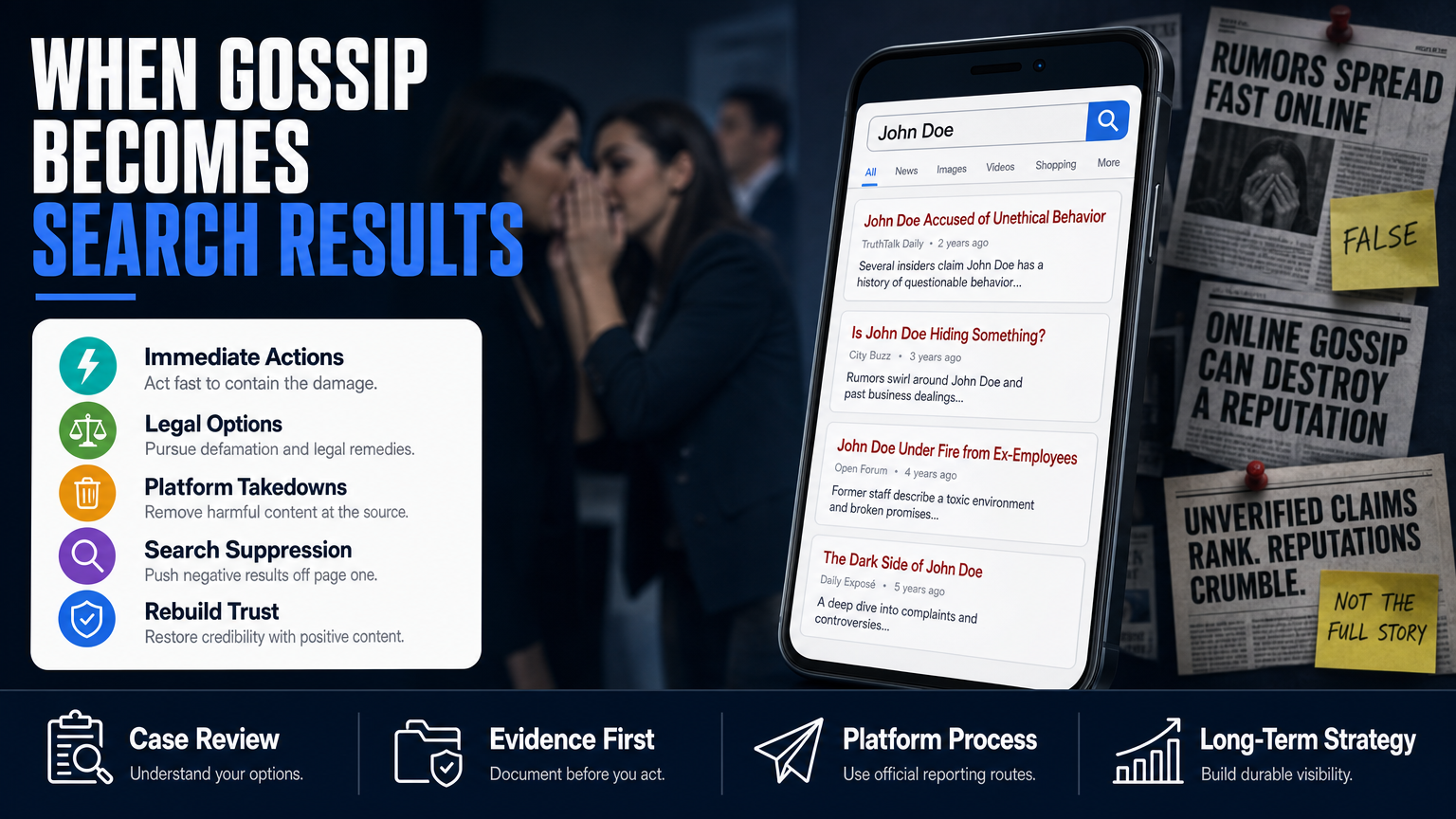
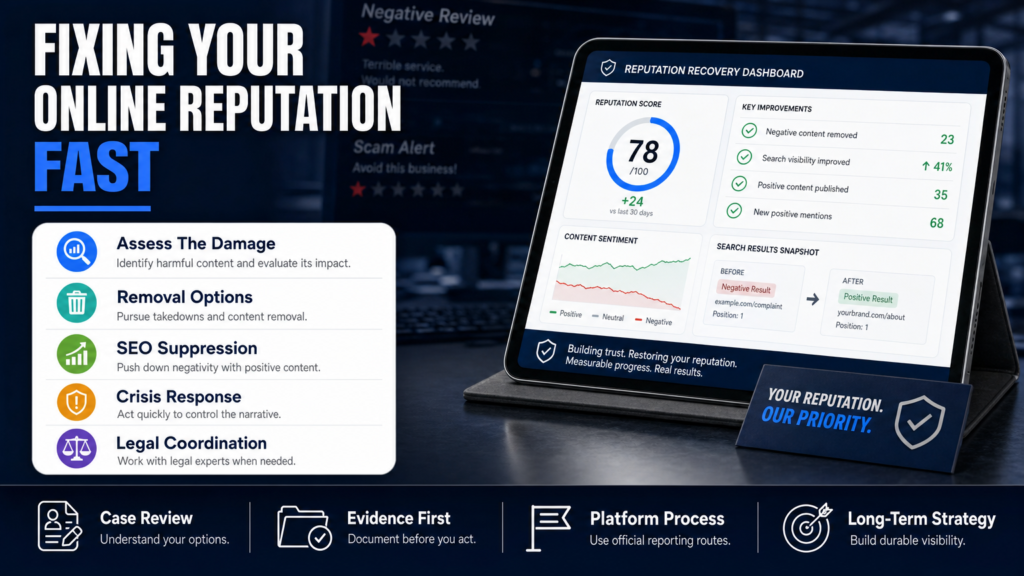
You searched for How do I fix my bad reputation? If you found a negative Google result, a damaging post, or a viral complaint about your practice, you’re not alone — and there are concrete steps you can take right now.
This article walks through what’s actually possible: how we evaluate whether content may qualify for removal, when suppression (SEO) is the realistic path, how to respond to reviews and viral incidents, and what to do when legal action might be appropriate.
You’ll get a priority checklist for immediate action, a decision framework for removal vs suppression, platform-specific guidance (Google, Yelp, Facebook, YouTube), and a realistic timeline that explains why outcomes vary.
Table of Contents
- Is it possible to fix a bad reputation?
- How can I regain lost reputation?
- What signs show your reputation is being destroyed?
- How do I improve my reputation?
- When removal is not available: mitigation and suppression
- Immediate steps after a viral incident
- Monitoring, recovery timelines, and long-term rebuilding
- Removal vs Suppression: Which Path Fits?
- Hypothetical scenario: A clinic hit by a viral complaint
- Common mistakes that make a bad situation worse
- Best practices for durable reputation recovery
- Expert Tips
- Conclusion
- Why Businesses Choose Your Reputation Agency
- Frequently Asked Questions
Is it possible to fix a bad reputation?
Short answer: yes — but ‘fix’ means different things depending on the problem. If the complaint is false or violates a platform’s rules, removal may be possible. If the content is factual, lawful, or published by a high-authority outlet, removal is unlikely and suppression or correction is usually the right path.
We evaluate whether the content may qualify for removal or review under platform policies, publisher rules, or applicable law. Removal depends on the content, publisher, platform policies, evidence, jurisdiction, and circumstances.
- Step 1: Inventory the damage — collect links, screenshots, dates, and audience reach estimates.
- Step 2: Categorize each item (defamation, review, privacy breach, factual report, opinion, impersonation).
- Step 3: For items that may violate rules, use the platform’s official reporting path while preparing evidence and legal review where appropriate.
- Defamatory falsehoods, doxxing, intimate images, impersonation, and clear platform policy violations are the strongest removal candidates.
- Negative-but-true reports, consumer complaints, and most reviews are usually not removable on that basis alone.
- Publisher size matters: a local blog is easier to convince than a national news outlet; platform moderation processes vary widely.
What removal looks like on major platforms
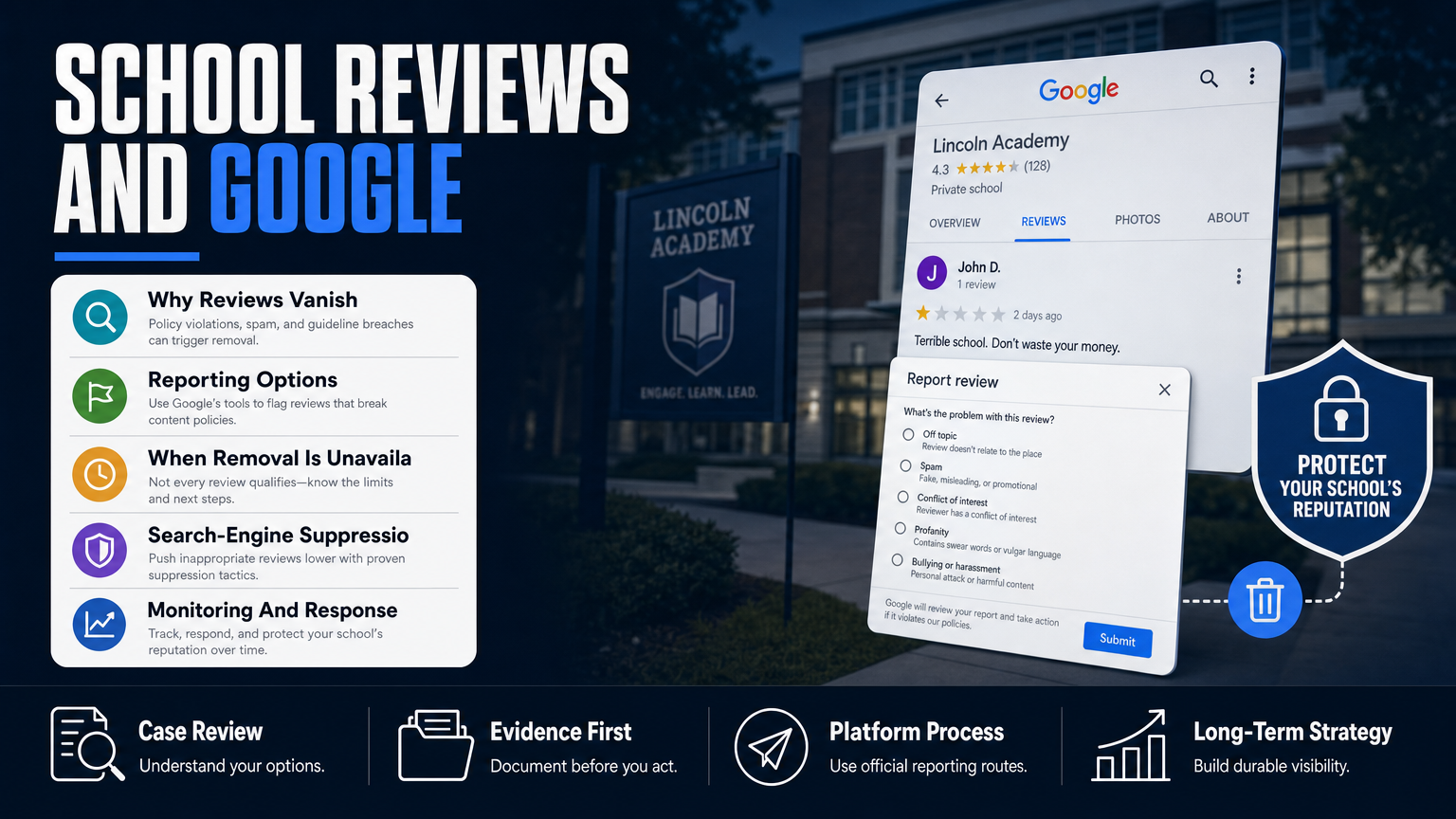
Google: Google does not remove content from the web; it de-indexes or removes specific Google-hosted items (e.g., cached pages, Google Maps listings, YouTube videos) when policy or law applies.
Yelp/TripAdvisor/Industry sites: These sites have review-removal or dispute processes but prioritize authenticity; factual disputes should be escalated with documentation.
Data brokers/people-search sites: Many offer opt-outs; removal is often possible but may require ongoing monitoring because these sites reappear or proliferate.
- YouTube: copyright, privacy, defamation and policy violations can trigger takedowns — but results vary and appeals exist.
- Facebook/Instagram/TikTok: impersonation and doxxing are actionable; simply negative posts usually are not.
How can I regain lost reputation?
Regaining reputation is a combination of removing what you can, reducing visibility of what you cannot, repairing trust with stakeholders, and changing the narrative through good content and outreach.
Tactics include takedown requests, SEO suppression (building authoritative positive content), targeted PR to correct the record, and direct stakeholder outreach (clients, partners, licensing bodies).
- Step 1: Contain — request removals, report impersonation, and lock down social accounts.
- Step 2: Respond — craft measured responses to reviews or posts where a reply helps; never post reactive or deceptive content.
- Step 3: Rebuild — publish authoritative pages (bio, press statements, positive coverage) and optimize them to outrank negatives.
- Immediate containment to limit further sharing.
- Corrective content that is factual, transparent, and optimized for search.
- Consistent evidence-backed communications with key audiences (patients, clients, regulators).
Dealing with negative reviews (Google and industry sites)
Respond publicly when it’s appropriate: acknowledge, offer to resolve offline, and avoid argumentative language. When a review is false or violates rules, we evaluate whether it may qualify for removal or challenge.
If you need a deeper read on the cost of negative reviews to a clinical practice and options for removal, see What a One-Star Review Really Costs Your Practice.
- A calm, corrective public reply can reduce damage for prospective clients reading the review.
- For verifiably false reviews, assemble documentation (appointments records, correspondence) before filing an institutional challenge.
What signs show your reputation is being destroyed?
Recognizing the warning signs early improves your odds of effective action. ‘Destroyed’ is subjective, but certain patterns are objectively harmful to revenue, hiring, licensure, or relationships.
Track these signals and set thresholds that trigger immediate response.
- Step 1: Set alerts for your name, business name, and critical keywords (brand + ‘lawsuit’, ‘complaint’, ‘fraud’).
- Step 2: When you detect clusters, preserve evidence: screenshots, timestamps, and links.
- Step 3: Assess whether the pattern looks organic, coordinated, or initiated by a single source (former employee, competitor, patient).
- A sustained spike in negative search results for your name or business.
- A cluster of negative reviews across multiple platforms within a short period (review-bombing).
- Media coverage, especially in local or trade press, repeating the same allegation.
- Sudden drops in bookings, client inquiries, or recruitment responses tied to online exposure.
Recognizing review-bombing and coordinated attacks
A sudden influx of one-star reviews across multiple platforms, similar wording, or timing within hours is often coordinated. We analyze IP patterns, review timestamps, and reviewer histories when available.
For a technical look at how these attacks are structured and how to respond for local businesses, read The Anatomy of a Review-Bombing Attack on Local Businesses.
- Coordinated reviews often use generic accounts and single-sentence complaints.
- Platforms like Google and Yelp have systems to detect and remove suspicious review patterns, but detection is imperfect.
How do I improve my reputation?
Improving reputation is tactical and strategic: short-term containment plus medium- and long-term trust-building. It is not a single action but a program of consistent, verifiable steps.
You should combine technical SEO, content creation, public relations, and operational fixes to remove friction points that create complaints.
- Step 1: Create or update a central, authoritative homepage and About page that search engines prefer to surface.
- Step 2: Build a mix of owned content (blog posts, FAQs), earned content (press, interviews), and third-party profiles (healthgrades, Avvo) that rank for your name.
- Step 3: Operate a continuous monitoring program to detect and respond quickly to new negatives.
- Publish accurate, high-authority pages (professional bio, services, policies) and optimize for your name and brand.
- Collect and display verified positive reviews by making review workflows frictionless for satisfied clients.
- Use proactive PR to correct factual errors in the press and to tell your side with evidence-backed messaging.
Optimizing search presence with SEO suppression
We develop SEO reputation strategies intended to improve the visibility of relevant and credible information. The goal is to push harmful links lower in search results by increasing the authority of positive or neutral pages.
Search results may change because algorithms, competitors, publishers, and user behavior are outside our control; results vary according to the strength of negative content and the authority of competing sources.
- Create pages for every professional profile (LinkedIn, institutional bio, specialty directories).
- Publish timely press statements or corrections on reputable outlets when appropriate.
- Use targeted content and backlinks to help priority pages rank above negatives.
When removal is not available: mitigation and suppression
Sometimes removal is not an option: truthful reporting, public records, or strong publisher resistance can make takedown impossible. In those cases your objective shifts to mitigation and visibility control.
Mitigation can include corrections, context, and reputation-building content; suppression uses SEO and platform strategy to reduce the visibility of damaging items.
- Step 1: Prioritize which links must be suppressed based on traffic and decision impact (licensing boards, prospective clients).
- Step 2: Build or improve pages you control (site, press release, professional directories) and optimize them for the same search terms as the negative links.
- Step 3: Monitor performance and adjust content and backlink strategies over time.
- File corrections or update requests with publishers when factual errors exist; some editors will publish corrections when presented with evidence.
- Use well-optimized positive content and third-party profiles to outrank negatives.
- Consider paid media or earned placements to create neutral or positive search results quickly.
When legal options are worth pursuing
The content may warrant legal review. A qualified attorney can determine whether a defamation claim or other legal remedy may be available. We coordinate with qualified legal professionals when a matter requires legal analysis.
Legal options depend on the evidence, applicable law, jurisdiction, and public-interest considerations; litigation should be weighed against publicity risk and cost.
- Preserve evidence early — screenshots, timestamps, access logs.
- Legal threats can sometimes persuade publishers to remove content, but they also can escalate visibility.
Immediate steps after a viral incident
Act fast, but deliberately. A clumsy or defensive public response will amplify the problem. Your first 24–72 hours set the tone for containment.
Prioritize safety, evidence preservation, and clear internal roles for communication.
- Step 1 (0–24h): Preserve evidence, secure accounts, and notify your lawyer or advisor if the incident involves threats, doxxing, or legal exposure.
- Step 2 (24–72h): Use platform reporting for impersonation, privacy violations, or policy breaches; prepare a neutral public statement if needed.
- Step 3 (days 3–14): Launch corrective outreach (press, partners, regulators) and begin SEO suppression work to limit discovery.
- Take screenshots and archive URLs; platforms and publishers change content.
- Temporarily lock down or restrict comments on channels you control to prevent further spread of identifiable personal information.
- Assign a single spokesperson and draft short, factual messaging for stakeholders.
Coordinating PR and legal response
Public relations and legal strategies must be coordinated to avoid contradictory messaging. For rebuilding reputation after negative publicity, see our recommendations in Rebuilding Trust: Reputation Repair Strategies After Negative Publicity.
Controlled, transparent communication with affected clients and stakeholders reduces secondary damage and shows accountability.
- Never advise clients to post fake reviews or use deceptive tactics — this is both unethical and often violates platform terms.
- Balance transparency and confidentiality: provide enough information to reassure stakeholders without disclosing sensitive legal details.
Monitoring, recovery timelines, and long-term rebuilding
Reputation work is ongoing. After immediate containment and the first suppression or removal attempts, you need a monitoring cadence and a content plan to rebuild credibility.
Timing depends on platform, publisher, search ranking dynamics, and the strength of the negative content. Some changes may be visible in weeks; others require months of sustained effort.
- Step 1: Implement monitoring and weekly reporting on search positions for priority links.
- Step 2: Schedule quarterly audits to identify new threats and opportunities for fresh content or outreach.
- Step 3: Keep a legal review line open for recurring or escalating threats.
- Set automated alerts (Google Alerts, Mention, Brandwatch) for names, brand terms, and key phrases.
- Review search results monthly for priority terms and adjust SEO and content tactics accordingly.
- Maintain a steady cadence of positive, factual content — accumulated authority protects against future hits.
When to escalate to paid strategies
Paid media (sponsored content, promoted posts) and optimized landing pages can accelerate suppression of a damaging result. Paid strategies should be combined with organic SEO for lasting effect.
Paid placement is not a substitute for accurate messaging and operational corrections; it is a tactical accelerant for visibility.
- Use targeted ads that point to authoritative content (press statements, bios) to push priority pages to the top for specific searches.
- Measure impact: track impressions, click-through, and whether paid clicks reduce the discovery of negative items.
Removal vs Suppression: Which Path Fits?
A short comparison to help decide whether to pursue takedown or visibility control.
| Removal | Suppression (SEO & PR) |
|---|---|
| Goal | Goal |
| Eliminate the offending item from a platform or search index | Reduce discovery by outranking the item with positive content |
| Best when content violates policy or is demonstrably false | Best when content is lawful, factual, or a high-authority source |
| Process: report, publisher contact, or legal action | Process: content creation, link-building, directory optimization |
| Timing: may be quick or slow; platform decisions vary | Timing: generally weeks to months of sustained work |
| Risk: potential escalation or appeals | Risk: costs and ongoing maintenance; no guaranteed ranking |
Hypothetical scenario: A clinic hit by a viral complaint
Situation: A local clinic received a widely shared social post alleging poor care. The post included photos and a one-star review on Google and Yelp. The clinic’s bookings dropped 30% over two weeks.
Approach: This is a hypothetical example to illustrate our process — it is not a client case study.
- 1) Inventory: list every negative URL and rank by potential harm (licensing board searches, patient intake searches).
- 2) Removal attempts: report impersonation and doxxing; request review removal where reviewers violate terms.
- 3) Suppression: create and optimize authoritative pages (clinic profile, provider bios, Google My Business posts), collect legitimate positive reviews, and place a corrective op-ed in the local paper.
- 4) Monitor: weekly reporting showing movement in search results; adjust backlink strategy to favor high-authority domains.
- Outcome expectation: Some platform removals may occur within days to weeks; measurable suppression of priority links often takes several weeks to months and requires ongoing work.
- Day 0–2: Preserve evidence (screenshots, share metrics), lock social accounts, and brief counsel.
- Day 2–7: Submit platform policy reports for privacy/doxxing if applicable, and file review disputes with documentation.
- Week 2–12: Publish a factual public statement on the clinic site, optimize professional bios and directory listings, and earn local press coverage explaining corrective steps.
Common mistakes that make a bad situation worse
Avoid predictable errors. They waste time, escalate the issue, or permanently damage credibility.
1. Responding emotionally and publicly
A defensive or attacking reply on social media or in a review thread will be screenshotted and recirculated. Keep public replies short, factual, and offer a path to resolve offline.
2. Using fake reviews or sockpuppet accounts
Buying or creating fake reviews violates platform terms and risks suspension and further reputational damage. It’s both unethical and likely to backfire.
3. Ignoring evidence preservation
Failing to take screenshots and preserve timestamps ruins legal and platform-removal options. Platforms and publishers change content; preserve the record immediately.
4. Over-relying on takedown threats
Threatening legal action without counsel can escalate publicity. Sometimes a measured legal letter is appropriate, but it should be used after assessing publicity risk and legal merits.
5. Treating reputation as a one-time fix
Reputation is ongoing. Without monitoring and continued content work, old problems can resurface or copycats can appear.
Best practices for durable reputation recovery
Follow systems, not impulses. Durable recovery requires straightforward processes executed consistently.
Document Everything
Keep a central, timestamped folder with screenshots, correspondence, and reporting tickets. This protects legal options and streamlines platform disputes.
Use Measured Public Messaging
Prepare short, factual statements and designate a single spokesperson. Avoid speculative or defensive language; correct errors but don’t litigate the court of public opinion.
Prioritize High-Impact Links
Focus efforts on items that appear on the first page of search results or on sites decision-makers use. Not all negatives are equally harmful.
Combine Technical and Human Responses
Use platform reporting, SEO work, and PR in parallel. Technical suppression alone is slower without authoritative content and outreach.
Set Ongoing Monitoring
Automate alerts and schedule regular audits. Early detection reduces cost and complexity.
Expert Tips
- Preserve evidence immediately — screenshots with timestamps are essential for platform and legal processes.
- Prioritize the first page of Google: moving one critical link off page one often restores most lost trust.
- When replying to reviews, lead with empathy, offer remediation offline, and close the loop publicly when resolved.
- Use professional bios and reputable directory profiles as anchor pages for suppression.
- Coordinate PR and legal steps so messaging is consistent and does not unintentionally create more coverage.
- Automate alerts for brand and professional names to catch issues before they spread.
- Document every takedown request and platform response to create a clear audit trail.
- Don’t spend equal effort on every negative item — triage by impact and intent.
Conclusion
Fixing a bad reputation is rarely a single action. It’s a program: rapid containment, a careful assessment of what can be removed, and a sustained effort to replace harmful search results with authoritative, accurate content.
If removal is available we pursue those avenues; when it’s not, suppression and trust-building are realistic, provable strategies. The exact path depends on the content, the platform, and the audience you must reach — which is why a clear, evidence-based plan and reliable monitoring matter more than one-off fixes.
Why Businesses Choose Your Reputation Agency
Managing your reputation takes more than monitoring reviews or publishing the occasional blog post. It takes a strategy built around your situation, your industry, and what is actually showing up in search.
Your Reputation Agency works with businesses, executives, healthcare professionals, attorneys and growing brands. Our services include:
- Remove defamatory content and false posts (news, blogs, listings)
- Remove or challenge negative reviews (Google, Yelp, TripAdvisor, industry sites)
- Mugshot and arrest record removal
- Remove videos, images, and other multimedia that damage reputation
- Remove personal data from people‑search and data‑broker sites (opt‑outs)
- Search result suppression (SEO to bury negative links)
- Social media takedowns and impersonation removal
- Rapid online crisis management and incident response
- Ongoing monitoring and alerting of reputation signals
- Coordination with legal counsel and use of legal tactics when required
Frequently Asked Questions
1. Is it possible to fix a bad reputation?
Yes, but outcomes vary. Some content qualifies for platform removal or correction; other items require suppression and reputation rebuilding. We assess each item for policy violations, legal merit, and practical impact before recommending next steps.
2. How to regain lost reputation?
Regaining reputation combines containment (removal requests, reporting policy violations), correction (publisher edits or responses), and proactive work (SEO, authoritative content, PR, and direct outreach to stakeholders). It’s a staged process that blends short-term and long-term tactics.
3. What are the signs that your reputation is being destroyed?
Warning signs include multiple negative results on the first page for your name, a sudden cluster of negative reviews across platforms, sustained media coverage of an allegation, and measurable drops in inquiries or bookings tied to online exposure.
4. How do I improve my reputation?
Improve reputation by publishing accurate authoritative pages, collecting legitimate positive reviews, responding professionally to complaints, using PR to correct the record, and implementing an SEO program to prioritize trusted content for your name.
5. How long does reputation repair take?
Timing depends on the platform, the authority of negative sources, and the tactics used. Some takedowns can occur in days if they clearly violate policies; measurable suppression and trust rebuilding typically take weeks to months. No outcome can be guaranteed.
6. When should I involve an attorney?
Consult an attorney if the content is potentially defamatory, involves doxxing or threats, or if you are considering a formal legal demand. Legal routes depend on evidence, jurisdiction, and publicity risk, so they should be used selectively and in coordination with communications.
7. Can I remove old public records or arrest photos?
Mugshots and arrest records are often publicly accessible; some sites will remove or de-index images under specific policies or opt-out procedures, and some states have laws that affect availability. We evaluate the specific publisher, applicable law, and platform policies before recommending action.
8. What if removal requests are denied?
If removal is denied, mitigation becomes the priority: publish authoritative corrective content, optimize it for search, pursue PR placements, and maintain monitoring. Over time, sustained SEO and content work can reduce the visibility of the denied item.
9. Should I respond to negative reviews?
Yes, but do so strategically. A calm, corrective public reply that offers to resolve the issue offline often helps. Avoid sharing private details publicly and never post retaliatory or false information.
This content provides general information and does not constitute legal advice. The available options and likely outcomes depend on the facts, evidence, platform policies, applicable law, jurisdiction, and public-interest considerations.
Past examples do not guarantee future results. Removal, correction, deindexing, and search-position changes depend on third parties and circumstances outside Your Reputation Agency’s control.