You found a negative article, a brutal review, or a public complaint tied to ServiceTitan that now ranks on page one of Google for your name or company. That single result is costing calls, interviews, or clients—and you need options that actually work.
This article shows what a reputation management service titan can realistically evaluate and pursue: whether the content may qualify for removal or review, the platform and legal levers to try, and practical suppression (SEO) tactics when takedown isn’t available. It uses ServiceTitan as a concrete example because many field service businesses rely on it.
Read on for clear answers to common questions—Is ServiceTitan legitimate? Who uses it? Does it record calls?—plus step-by-step actions for removal, suppression, and crisis response, and what to do when deletion isn’t an option.
Table of Contents
- Is ServiceTitan Legit?
- Who Uses ServiceTitan?
- Does ServiceTitan Record Calls?
- What Does Reputation Management Do?
- When Removal Is Not Available — Mitigation and Suppression
- DIY vs Agency: Which Route for a ServiceTitan Reputation Problem?
- Rapid Response Checklist For Viral Incidents Involving ServiceTitan
- Removal vs Suppression: Quick Comparison
- Hypothetical Scenario: An HVAC Contractor and a Viral Recording
- Common Mistakes People Make
- Best Practices For Managing a ServiceTitan-Related Hit
- Expert Tips
- Conclusion
- Why Businesses Choose Your Reputation Agency
- Frequently Asked Questions
Is ServiceTitan Legit?
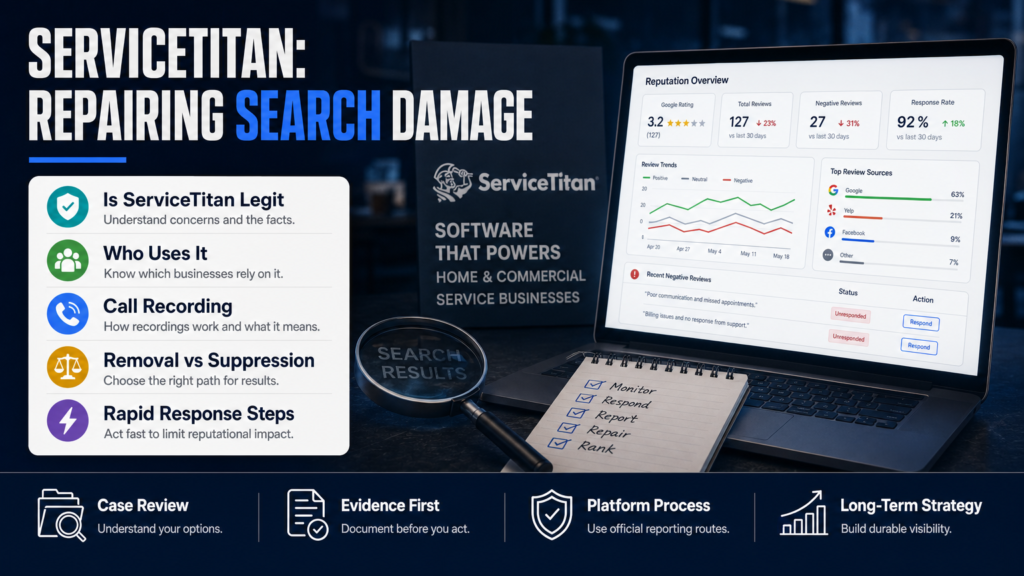
Short answer: Yes—ServiceTitan is a legitimate, widely used field‑service management SaaS provider. It’s a commercial company that offers dispatch, scheduling, billing, and marketing tools to contractors and service businesses.
Legitimacy in this context means ServiceTitan is a real vendor with enterprise customers, public information about funding and leadership, and commercial contracts. That status matters because platform disputes or negative posts about ServiceTitan usage are treated differently than anonymous scam pages or fake domains.
- Document the allegation or content you found (screenshots, URLs, timestamps).
- Check whether the content references ServiceTitan as a vendor, or alleges wrongdoing by an individual or company using ServiceTitan.
- Evaluate whether the content is opinion, factual allegation, harassment, or a privacy violation—each category has different remediation options.
- ServiceTitan is not a consumer review site—complaints about its product or your use of it are often published on third‑party sites (Google Reviews, Reddit, industry blogs).
- Because it’s a commercial provider, contractual or data‑security questions may be escalated to ServiceTitan’s support or legal team depending on the issue.
What to do first
Preserve evidence immediately: take full‑page screenshots, note the URL, capture any associated social media IDs, and save metadata when possible.
If customers or employees are involved, stop direct replies that could escalate the matter. Document any direct messages or emails—they may be relevant to platform reports or legal counsel.
- Preserve before you ask the poster to remove content.
- Avoid public arguments—these often amplify the content.
Who Uses ServiceTitan?
ServiceTitan’s customer base is primarily home‑service businesses: HVAC companies, plumbers, electricians, roofing contractors, and other field service providers. Larger multi‑location operations and enterprise contractors also use it for scheduling, dispatch, and payment processing.
Understanding the types of companies that use ServiceTitan helps narrow where reputation problems originate—industry forums, trade groups, Yelp/Google business listings, and contractor review sites are common sources of public complaints.
- Check industry review sites and niche forums first if the complaint references contractor experiences.
- Review your own ServiceTitan settings (if you control the account) for automated review requests or public profile links that may be amplifying exposure.
- Typical users: small-to-mid sized trade businesses with field technicians.
- Higher‑volume customers often pair ServiceTitan with marketing add‑ons that include review solicitation and automated messaging.
When a vendor relationship matters
If a dispute is actually with ServiceTitan (billing, data access), use their official support channels and preserve communication. If the complaint is about one of their customers, remediation will likely be directed at the publisher of the complaint rather than ServiceTitan itself.
- Vendor issues: escalate via ServiceTitan support and document responses.
- Customer complaints: address publicly appropriate corrections or removals with the publishing platform.
Does ServiceTitan Record Calls?
Many ServiceTitan customers enable call recording through integrations or within the platform’s communication tools. Whether calls are recorded depends on account settings and local laws.
If a disputed recording appears online, the immediate questions are: who recorded it, did the recording violate state‑level consent laws, and where was it published? Those factors drive removal options and potential legal remedies.
- If a recording is public, identify the publisher and how it was obtained.
- Preserve the recording, note the timestamp and linking account, and consult with legal counsel if the recording appears to violate consent laws.
- Report the content to the hosting platform for privacy or harassment violations where applicable.
- Recording is configuration‑dependent: account owners control whether recordings occur.
- State consent laws matter (one‑party vs two‑party consent). The legality of a posted recording affects platform policy enforcement and legal options.
If you find a recorded call online
First preserve the evidence. Second, check whether the recording displays metadata that identifies the recorder and the context. Third, determine whether the recording was published on a site that has a takedown policy for private recordings or if it violates platform rules.
- Platforms have different thresholds for removal—some remove private recordings when consent laws are implicated, others require a court order.
- We evaluate whether the content may qualify for removal or review and coordinate with counsel when legal options are available.
What Does Reputation Management Do?
Reputation management blends legal, technical, platform, and SEO tactics to reduce visibility or correct harmful information. It is not a single action; it’s an assessment of the available levers and a prioritized plan.
A reputation management service titan evaluates whether content may qualify for removal or review, pursues platform reporting routes, engages publishers, uses targeted SEO to suppress harmful results, and coordinates legal or PR when needed.
- Assess: classify the content (defamatory, opinion, factual, privacy breach, impersonation).
- Preserve: capture evidence, URLs, and relevant communications.
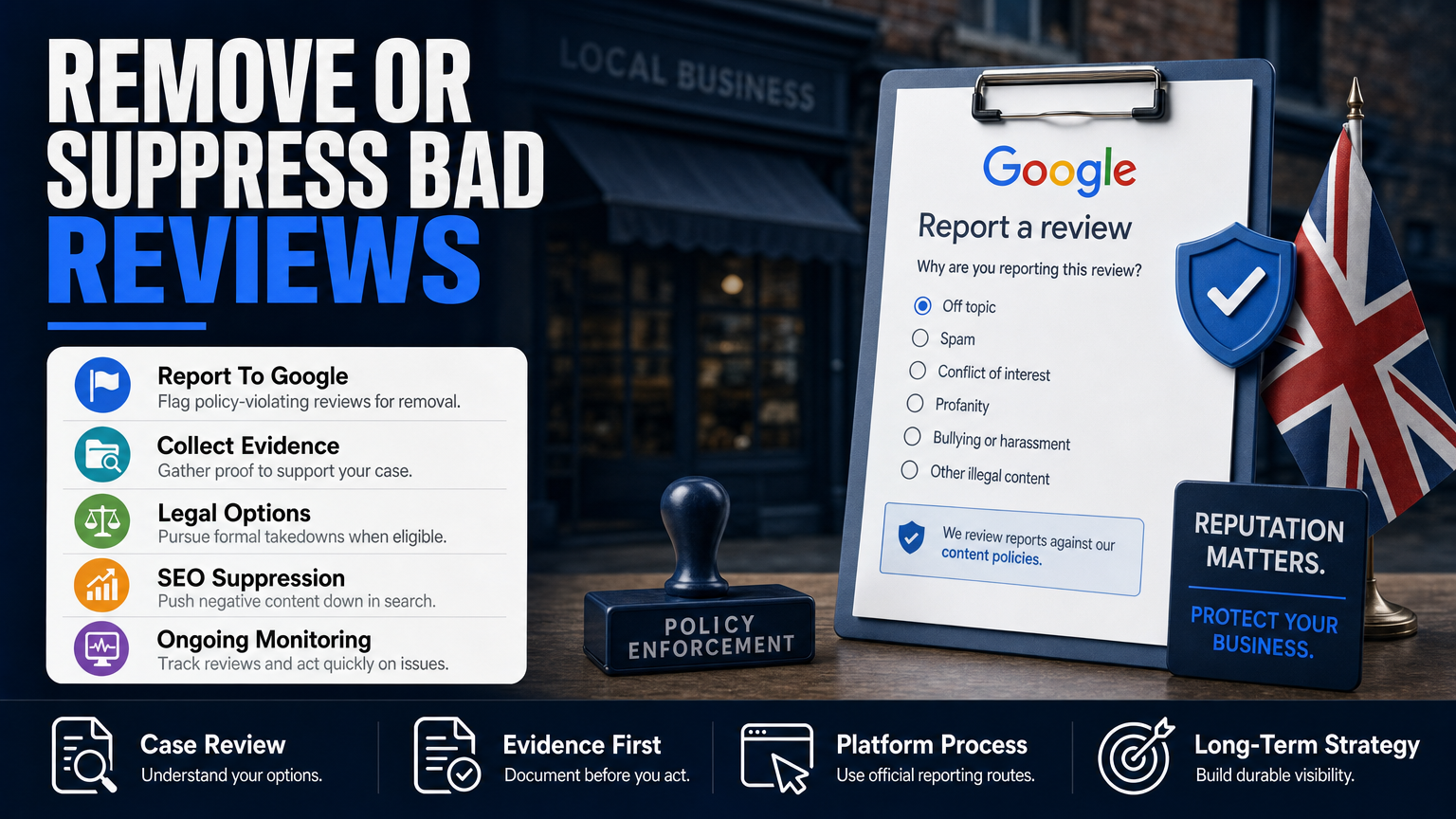
- Action: report to platform, request removal from publisher, pursue legal notice if applicable, and launch suppression content if removal isn’t achievable.
- Removal pathways: platform reports, publisher outreach, DMCA or privacy claims, and legal notices—outcome depends on platform policy and evidence.
- Suppression tactics: create authoritative content (press, profiles, content pages) to push negative items lower in search results.
- Monitoring and incident response: continuous alerts to catch new content early and shape public messaging.
When reviews are the central problem
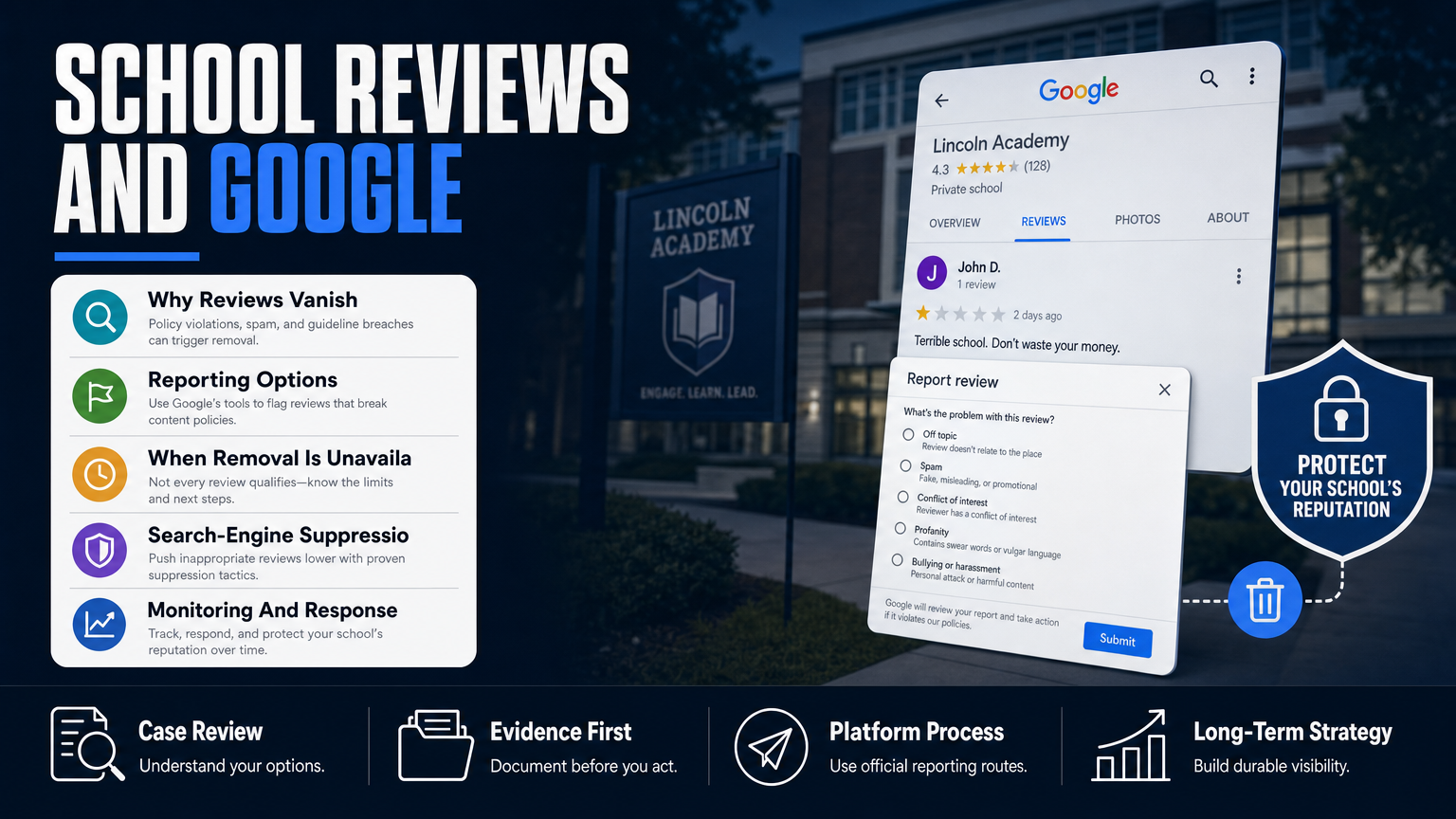
If Google, Yelp or industry reviews are the main issue, the strategy includes review responses, flagging policy violations, and building positive, verified content to improve rankings. For a deep dive on when reviews escalate, see When Google Reviews Become a Brand’s Biggest Crisis.
- Never attempt to fabricate reviews or offer incentives for false reviews—this risks policy sanctions.
- We pursue the legal, technical, platform‑based, and reputational options available; timing and success depend on platform policies and evidence.
When Removal Is Not Available — Mitigation and Suppression
Sometimes content cannot be removed: the publisher is anonymous, the platform denies the request, or the material is lawful speech or a public record. In those cases, the practical option is mitigation—reduce the visibility and impact of the material.
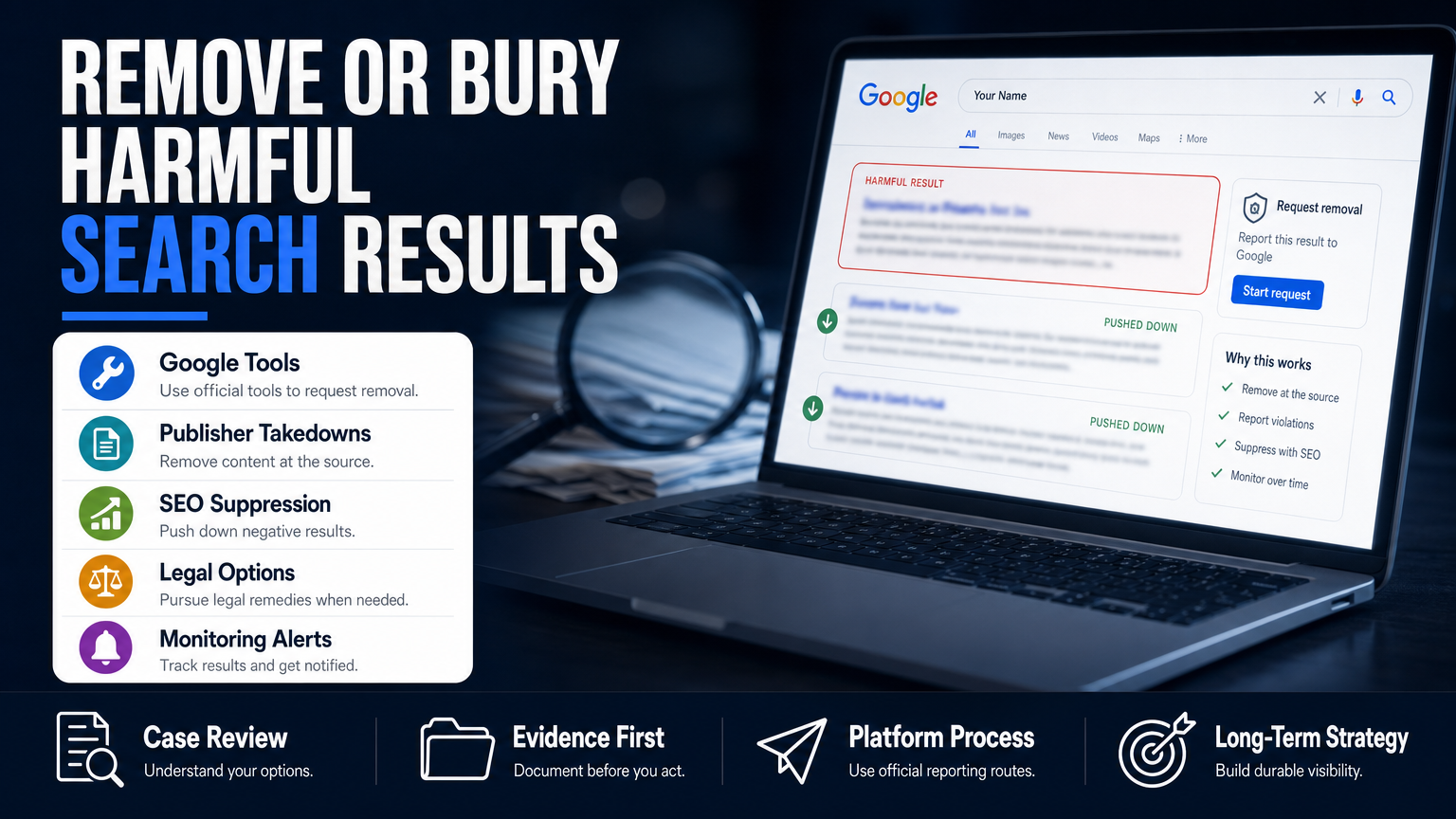
Mitigation includes search‑engine suppression, correction and context content, reputation pages, and targeted amplification of authoritative sources so the negative result falls off the first page for relevant queries.
- Identify the exact search queries that surface the negative content.
- Build or optimise owned assets: About pages, staff bios, LinkedIn, business profiles, and targeted blog or news content.
- Acquire authoritative citations: local business directories, earned media, partner pages, and relevant industry sites.
- Monitor SERPs and adjust content strategy monthly until the most damaging results move down.
- Suppression is an SEO process that relies on publishing credible, optimised assets and acquiring signals (links, citations) that rank above the negative item.
- Correction and context use fact‑checked pages, press releases, or regulatory records where appropriate to supply balanced information.
- Monitoring continues to detect re‑publication or new incidents so you can respond quickly.
When one result threatens the business
If one search result threatens revenue or licensure, mitigation must be fast and focused: prioritise high‑authority placements (news outlets, industry associations, legal notices) and paid channels as a temporary measure. For a detailed look at single-result threats, see When One Search Result Threatens Your Entire Business.
- Paid ads can temporarily mask a negative result while suppression takes effect.
- Public relations and corrective content must be factual and documented; avoid statements that could be construed as legal admissions.
DIY vs Agency: Which Route for a ServiceTitan Reputation Problem?
Small problems—an isolated bad review or a correctable listing—can often be handled in‑house. Larger issues—defamatory articles, doxxing, viral recordings—benefit from agency coordination because they require multichannel action, technical SEO, and potential legal escalation.
A reputable agency will evaluate whether the content may qualify for removal or review, propose a suppression plan, and coordinate with counsel when evidence suggests legal options.
- List your resources and constraints (time, staff, legal counsel).
- Ask potential vendors for a tailored assessment, not a canned promise.
- Check that an agency will use platform reporting processes and coordinate legal counsel when needed; avoid firms promising guaranteed removals or rankings.
- DIY is appropriate when you can: document evidence, follow platform reporting, and consistently publish corrective content.
- Hire an agency when the case requires: publisher outreach at scale, coordinated SEO across many domains, or rapid incident response.
- Costs vary: DIY labour vs agency retainers or project fees—ask for an itemised scope and measurable milestones.
Questions to ask any provider
How do you classify and prioritise content? Which concrete tactics will you use (publisher outreach, DMCA, Google policy reports, SEO)? How do you measure progress and over what timeframe?
- Request real workflows, not guarantees.
- Confirm they will coordinate with your attorney when legal options are being considered.
Rapid Response Checklist For Viral Incidents Involving ServiceTitan
If a complaint or recording involving ServiceTitan goes viral—social posts, a Reddit thread, or a news piece—act fast to limit spread and prepare a controlled response.
Avoid improvisation: use a checklist so legal, technical, and PR tasks happen in parallel rather than sequentially.
- Triage: classify the event (harassment, defamation, privacy breach, factual complaint).
- Contain: request removal via platform processes and ask publishers to take down or correct false statements.
- Correct: publish factual, evidence‑based content on owned channels.
- Suppress: begin targeted SEO to push the harmful item down the results that matter most.
- Preserve evidence and capture metrics (shares, impressions, SERP position).
- Engage legal counsel early if there’s a privacy, defamation, or data‑security angle.
- Prepare a concise public statement, or refuse comment if advised by counsel; never improvise an apology on TikTok without strategy.
Why public apologies need strategy
An apology or explanation can help—but performed poorly it amplifies the incident. For research on why these videos often backfire, see Why An Apology Video On TikTok Often Makes Crises Worse.
Work with PR counsel to craft concise messaging, own facts you can prove, and avoid repeating false claims that then gain new search traction.
- Avoid lengthy personal defenses on public platforms during an active incident.
- Prepare Q&A and a holding statement for staff to ensure consistent responses.
Removal vs Suppression: Quick Comparison
When you’re deciding whether to pursue takedown or suppression, consider these practical differences.
| Removal | Suppression |
|---|---|
| Goal | Goal |
| Eliminate content from a platform or publisher | Reduce visibility by outranking the negative item |
| Depends on publisher/platform policy or legal order | Depends on SEO, content authority, and links |
| Faster if publisher cooperates | Slower—weeks to months typical |
| May require legal notices | Requires content creation and link building |
| Binary outcome (removed or not) | Gradual ranking improvements, not guaranteed |
Hypothetical Scenario: An HVAC Contractor and a Viral Recording
Situation: An HVAC company finds a recording of a technician’s customer call (alleging poor service) posted on a niche forum and ranking for the company’s name. The company uses ServiceTitan for call handling and wants the recording removed and the search result buried.
Process: The agency preserves the recording and captures SERP positions, checks whether the recording violates platform policies or state consent laws, reports to the forum for privacy violation, contacts the poster requesting removal, briefs the company’s attorney, and launches a targeted suppression campaign with authoritative local press and optimized business profiles.
- Step 1: Capture screenshots, URLs, and note search queries where the recording appears.
- Step 2: Use platform reporting and publisher outreach to seek removal or correction.
- Step 3: Engage legal counsel if the recording appears to violate consent laws; consider a cease-and-desist only under counsel guidance.
- Step 4: Launch suppression: publish press coverage, update and optimise Google Business Profile, push LinkedIn posts, create a long‑form corrective article and earn links from local associations.
- Preserve evidence and timeline.
- Report to the hosting platform citing privacy and doxxing policies.
- Coordinate with counsel to assess legal options around consent and privacy.
- Build and publish corrective/authoritative content: local news release, company statement, optimized staff pages, and industry citations.
Common Mistakes People Make
Below are frequent errors we see that make reputation problems worse or slow resolution.
Mistake 1 — Publicly arguing with the poster
Answering in anger or admitting fault publicly often creates a record that attracts more attention. Every reply can be screenshotted and re‑shared, extending the life of the complaint.
- Pause before responding.
- Route replies through PR or legal counsel when appropriate.
Mistake 2 — Chasing guaranteed removals
Avoid vendors who promise guaranteed removal or instant suppression. Platform decisions and search ranking are controlled by third parties and algorithms outside any vendor’s direct control.
- Ask for documented processes and case workflows instead of promises.
- Insist on written assessments that explain likely options and dependencies.
Mistake 3 — Publishing defensive content without evidence
Posting long rebuttals that name individuals or restate accusations can create fresh, indexable content repeating the harmful claims. Corrections should be factual, documented, and limited in scope.
- Provide evidence in a factual format (statements, timelines, court documents if relevant).
- Work with PR to craft measured statements.
Mistake 4 — Ignoring monitoring after a takedown
Content often resurfaces—screenshots, reposts, mirror sites. Without monitoring, you won’t know when a new copy appears and you’ll lose time.
- Set up SERP and social alerts for your name, business, and key phrases.
- Schedule regular audits for high‑risk queries.
Mistake 5 — Using shady or retaliatory tactics
Do not use false reviews, fake DMCA notices, or doxxing in response. These tactics risk sanctions, legal liability, and worsen public perception.
- Always use legitimate platform procedures and legal counsel.
- Retaliation can escalate liability and public exposure.
Best Practices For Managing a ServiceTitan-Related Hit
These durable actions reduce risk and improve your ability to recover from reputation incidents.
Document Everything Immediately
Collect screenshots, URLs, server headers where possible, and timestamps. Preserve a copy of the content and the context in which it appeared—comments, shares, and replies.
- Preservation helps platform reports and legal assessment.
- Record the impact: lost calls, cancelled jobs, or licensing inquiries.
Use Platform Reporting Before Escalation
Most platforms have defined reporting and review processes. Use them—document your reports and the platform’s responses. We use the official reporting and review processes made available by platforms.
- Follow the platform’s evidence checklist closely to improve review chances.
- Keep an audit of all correspondence with the platform and publisher.
Coordinate SEO Suppression Thoughtfully
Suppression requires authoritative, optimised assets. Focus on high‑trust destinations: your domain, legal or regulatory filings, industry profiles, and reputable press.
- Prioritise assets for the queries that drive lost business.
- Track rankings for those exact queries and adjust content based on progress.
Work With Counsel When Legal Questions Arise
A qualified attorney can determine whether a legal claim may be available. We coordinate with qualified legal professionals when a matter requires legal analysis.
- Legal routes are evidence‑dependent and jurisdictional.
- Do not rely on legal threats without counsel—poorly worded notices can backfire.
Prepare Communication and Staff Guidance
Set a single point of contact for media and customer communication. Provide staff with a holding statement and guidance on what to say and what not to say in public.
- Consistent messaging prevents accidental admissions or escalation.
- Train staff to refer media or angry customers to the designated contact.
Expert Tips
- Preserve evidence first—platforms and courts treat captured screenshots differently than memory.
- Always classify content precisely: opinion, factual allegation, privacy violation, or impersonation—each requires a different tactic.
- If a recording is involved, check your state’s consent laws before assuming removal is automatic.
- Use targeted paid search ads as a temporary shield while suppression takes effect.
- Monitor both branded and non‑branded queries—negative content sometimes ranks for unexpected combinations.
- Avoid emotional public replies; they produce new indexable content that often outranks corrections.
- Ask a potential vendor for a written plan and measurable milestones, not guarantees.
- Coordinate PR and legal steps so messaging and evidence gathering happen together.
Conclusion
A ServiceTitan‑related reputation problem is solvable in many cases, but the right path depends on the content, publisher, platform policies, and applicable law. We evaluate whether the content may qualify for removal or review and pursue the combination of platform reporting, publisher outreach, legal coordination, and suppression that fits the case.
If deletion isn’t available, suppression and rapid, factual communication can meaningfully reduce the damage. Prepare evidence, restrict public escalation, and consider professional help when the incident affects revenue, licensure, or hiring—an orchestrated response is faster and less risky than ad hoc attempts.
Why Businesses Choose Your Reputation Agency
Managing your reputation takes more than monitoring reviews or publishing the occasional blog post. It takes a strategy built around your situation, your industry, and what is actually showing up in search.
Your Reputation Agency works with businesses, executives, healthcare professionals, attorneys and growing brands. Our services include:
- Remove defamatory content and false posts (news, blogs, listings)
- Remove or challenge negative reviews (Google, Yelp, TripAdvisor, industry sites)
- Mugshot and arrest record removal
- Remove videos, images, and other multimedia that damage reputation
- Remove personal data from people‑search and data‑broker sites (opt‑outs)
- Search result suppression (SEO to bury negative links)
- Social media takedowns and impersonation removal
- Rapid online crisis management and incident response
- Ongoing monitoring and alerting of reputation signals
- Coordination with legal counsel and use of legal tactics when required
Frequently Asked Questions
1. Is ServiceTitan a legit company?
Yes. ServiceTitan is a commercial field‑service management platform used by many HVAC, plumbing, and contracting companies. ‘Legit’ in this context means it’s a real, funded software provider; it is not a consumer review platform.
2. What does reputation management do?
Reputation management assesses the problem, preserves evidence, pursues platform removal where policies or legal grounds exist, and uses SEO, PR, and monitoring to suppress or correct harmful search results. We develop SEO reputation strategies intended to improve the visibility of relevant and credible information.
3. What companies use ServiceTitan?
ServiceTitan primarily serves home‑service businesses—HVAC, plumbers, electricians, roofers—and mid‑sized contractors and multi‑location operations that need dispatch, billing, and marketing automation.
4. Does ServiceTitan record calls?
Call recording depends on account settings and integrations. Some ServiceTitan customers enable recording; others do not. Whether a published recording can be removed depends on consent laws, how it was obtained, and the hosting platform’s policies.
5. How long does reputation work take?
Timing varies. Some platform reviews produce results in days, legal processes can take weeks to months, and SEO suppression typically takes weeks to several months. Timing depends on the platform, publisher cooperation, legal complexity, and search‑engine behavior.
6. Can you guarantee removal or improved rankings?
No—no reputable provider can promise guaranteed removal or specific rankings. We evaluate whether the content may qualify for removal or review and pursue the available legal, technical, and platform options while executing suppression strategies intended to improve visibility.
7. What if removal is denied?
When removal is unavailable, the plan shifts to mitigation: build authoritative pages, targeted SEO to push the item down, PR to supply accurate context, and monitoring to catch re‑publication. Results vary according to the strength of the negative content and the authority of competing sources.
8. Should I respond publicly to a negative post about ServiceTitan?
It depends. A brief, factual correction can help when the post contains clear errors. But long, emotional responses or apology videos without counsel can amplify the issue. Coordinate with PR and legal when the incident could affect licensing, revenue, or litigation.
9. When should I involve an attorney?
Involve counsel when allegations are false and damaging, when privacy or data breaches are involved, or when a publisher refuses to comply after documented requests. A qualified attorney can determine whether a legal claim may be available and advise on notices or litigation.
This content provides general information and does not constitute legal advice. The available options and likely outcomes depend on the facts, evidence, platform policies, applicable law, jurisdiction, and public-interest considerations.
Past examples do not guarantee future results. Removal, correction, deindexing, and search-position changes depend on third parties and circumstances outside Your Reputation Agency’s control.