You just woke to dozens—or hundreds—of new one-star reviews that you didn’t earn. Your bookings are falling, staff are getting calls, and the search results now show a pattern of negative ratings. Can Google remove review bombs? That’s the urgent question every business owner asks first.
This article explains what a review bomb looks like, when Google will consider removing reviews, and what a business can realistically expect. We evaluate whether the content may qualify for removal or review and show the practical reporting, evidence-gathering and mitigation steps that improve your chances.
You’ll get platform-specific actions for Google Maps and Google Business Profiles, step-by-step reporting checklists, a crisis playbook for rapid response, and fallback strategies—SEO, PR, and legal routes—when removal isn’t possible.
Table of Contents
- What Is A Review Bomb (And How It Differs From Normal Complaints)
- Can Google Remove Review Bombs?
- How To Flag And Report Negative Google Reviews Yourself
- What Evidence Improves Your Chance Of Removal
- When Removal Isn’t Available: Suppression, SEO And PR
- Rapid Response Playbook For A Review-Bomb Attack
- Long-Term Prevention: Monitoring, Policies And Response Drills
- DIY vs Hiring a Reputation Agency
- Hypothetical Scenario: Local Dentist Hit by a Review Bomb
- Common Mistakes Businesses Make During Review Bombs
- Best Practices To Recover From A Review Bomb
- Expert Tips
- Conclusion
- Why Businesses Choose Your Reputation Agency
- Frequently Asked Questions
What Is A Review Bomb (And How It Differs From Normal Complaints)
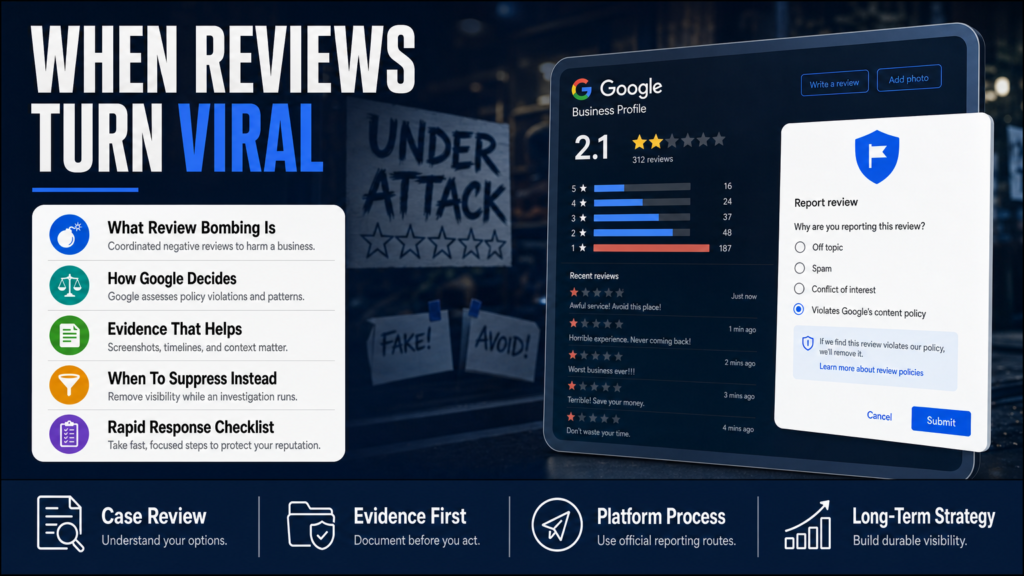
A review bomb is a rapid, coordinated surge of negative reviews aimed at damaging a business’s ratings rather than reflecting independent customer experiences. It can be triggered by politics, a viral social post, a disgruntled ex-employee, or organized groups.
Not every cluster of bad reviews is a review bomb. Organic complaints are typically specific, describe real transactions, and arrive in small numbers over time. Review bombs are characterized by spikes, repeating language or timing, and reviewer profiles with little or no prior activity.
- Typical signals of review bombing: large volume in hours or days; many accounts with no history; identical or near-identical language; off-topic or politically-charged content.
- Why it matters: coordinated attacks can trigger algorithmic visibility drops and hurt conversion even if some reviews are later removed.
- Platforms treat spam and coordinated activity differently from negative but genuine customer feedback.
Can Google Remove Review Bombs?
Short answer: sometimes. Google’s removal decisions depend on platform policy, the nature of the content, and the evidence you can provide. Google may remove reviews that violate its policies (spam, fake accounts, conflicts of interest, hate speech, impersonation, or unlawful content).
We pursue the legal, technical, platform-based, and reputational options available, but platform decisions remain under Google’s control. Removal depends on the content, publisher, platform policies, evidence, jurisdiction, and circumstances.
- Document the surge (dates, screenshots, CSV of reviewers) before reporting.
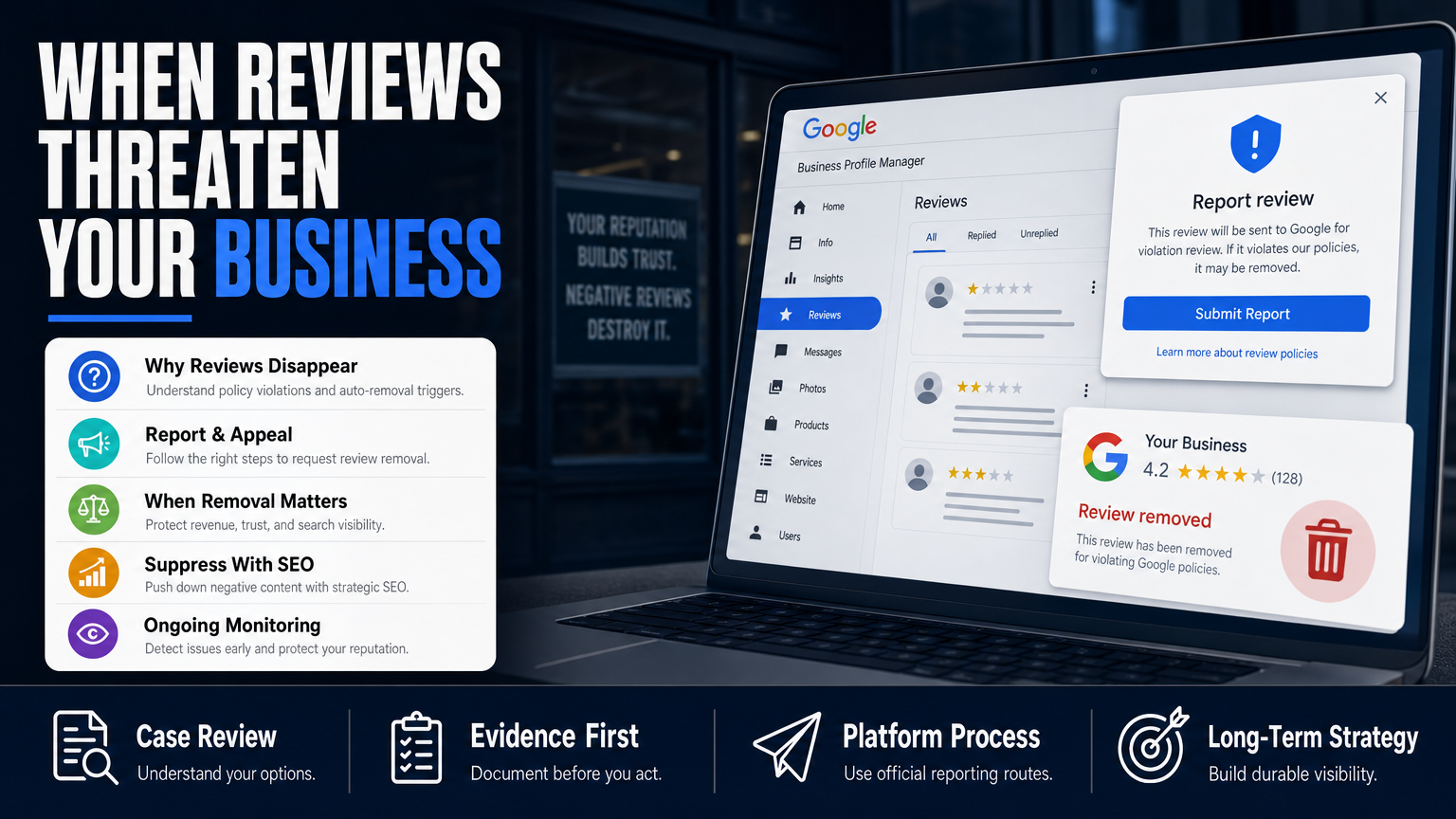
- Use Google Business Profile’s “Flag as inappropriate” option for each review that violates policy.
- Submit an escalation via Google Business Profile support with a bundled report and evidence.
- If the attack targets Google Maps specifically, use the Maps review-report flow and attach pattern evidence.
- Google’s main grounds to remove reviews: spam/fake content, conflict of interest (owner/relevant party writing reviews), impersonation, policy violations (harassment, hate, illegal content).
- Reviews that are simply negative or truthful complaints usually do not qualify for removal.
- Even when Google removes problematic reviews, replacement or repeated attacks can occur; monitoring is essential.
How Google Evaluates Reports
Google uses automated signals and manual review. High-volume, repeat or clearly coordinated patterns are more likely to be flagged by their systems or a human reviewer.
Expect Google to ask for specific examples rather than mass claims; include representative samples showing the pattern.
- Automation looks for repeated language, account age, and IP/geolocation anomalies.
- Human review applies when automated filters don’t make a clear decision.
How To Flag And Report Negative Google Reviews Yourself
Start with careful documentation, then use Google’s reporting tools. If you’re trying to remove or limit the damage from a single review or a cluster, follow these steps closely.
If you need a deeper strategy for a review that dominates your search results, see When A Single Review Becomes Your Biggest Problem.
- Sign into your Google Business Profile (formerly GMB).
- Find the review and click the three dots > Flag as inappropriate.
- Follow the prompts and give a concise reason tied to Google policy (e.g., “This review appears to be spam and created by a fake account”).
- In Business Profile support, open a case and paste a list of flagged reviews and evidence.
- If support provides a ticket number, keep it and follow up weekly until resolved.
- Keep a time-stamped log: when the reviews appeared, screenshots, and links to reviewer profiles.
- Don’t respond impulsively to every review—some responses can escalate visibility or be used against you.
When To Respond Publicly
If the review is genuine or ambiguous, respond calmly and professionally to limit reputational harm. If it’s clearly fake or malicious, avoid lengthy public disputes—focus on reporting and escalation.
Public responses should correct factual errors, offer to resolve, and invite offline contact without admitting fault.
- Use templated, measured responses to save time during a mass attack.
- Don’t ask for reviews in response to negative posts; that can violate policies and backfire.
What Evidence Improves Your Chance Of Removal
Google needs signals that reviews are fake, coordinated, or violate policy. The stronger and clearer your evidence, the better the chance of a favorable platform action.
Collect evidence objectively and preserve it. Automated systems and human reviewers often require examples and patterns rather than assertions.
- Step 1 — Capture: Immediately take full-page screenshots (desktop and mobile) and note the UTC timestamp.
- Step 2 — Export: Copy reviewer links into a spreadsheet and identify clusters and shared language.
- Step 3 — Correlate: Search social channels and forums for evidence of coordination (calls-to-action, hashtags, URLs).
- Step 4 — Package: Create a one-page summary with representative examples and attach it to your Google Business Profile support case.
- Screenshots of multiple reviews with timestamps.
- CSV or spreadsheet with reviewer names, profile links, rating, and copy of the review text.
- Patterns: identical phrasing, same grammatical mistakes, or common photo attachments.
- Account-level evidence: reviewers with no friends, no review history, or repeat activity across unrelated businesses.
- External triggers: a public post or social media call-to-action that links to your business and solicits negative ratings.
When Removal Isn’t Available: Suppression, SEO And PR
If Google determines the reviews do not violate policy, or if platform rules limit removal, you still have options: suppression through positive content, targeted SEO to push negative results lower, and PR messaging to control the narrative.
We develop SEO reputation strategies intended to improve the visibility of relevant and credible information. Search results may change because algorithms, competitors, publishers, and user behavior are outside our control.
- Assess which results are removable versus suppressible and prioritize by impact.
- Deploy SEO assets: service pages, local landing pages, expert bios, video content, and backlink building.
- Coordinate PR to publish factual clarifications or corrective pieces on reputable outlets.
- Monitor continuously and adjust content based on search visibility and user behavior.
- Create authoritative content (site pages, FAQ, press releases) targeted to the keywords showing the negative reviews.
- Earn and promote legitimate positive reviews to rebalance ratings over time.
- Use press outreach and local citations to build competing, higher-authority pages.
- Legal options may be available for defamation, impersonation, or unlawful publication; the content may warrant legal review and a qualified attorney can determine whether a legal claim may be available.
Why Reputational Suppression Takes Time
Search-engine reputation repair depends on content authority and user behavior; there are no guarantees or fixed timelines. An estimated timeline can be provided after an individual assessment.
For high-stakes practices—like medical providers—visibility problems can have real revenue impact; see What One-Star on Google Can Cost a Medical Practice.
- Content must be high-quality and discoverable to compete.
- Authority signals (backlinks, mentions, social engagement) matter to rankings.
Rapid Response Playbook For A Review-Bomb Attack
Time matters. A fast, structured response limits damage and preserves evidence. Use a triage approach: contain, document, report, then restore.
See our specific breakdown of Google Maps review attacks and recovery steps in The Anatomy of a Google Maps Review Attack and Recovery.
- Hour 0–12: Capture evidence (screenshots, reviewer list), notify internal stakeholders, and add monitoring alerts.
- Day 1–3: Flag reviews in Google Business Profile and open support tickets with documented evidence.
- Week 1–4: Build and launch priority content and contact legal counsel if the attack includes impersonation, doxxing, or defamation.
- Month 1–3: Monitor for repeat activity and adjust suppression and outreach tactics.
- Immediate actions: snapshot, pause paid campaigns if needed, lock down employee-facing messaging.
- Short-term repair: report to Google, respond on-platform when appropriate, publish a short factual statement if the attack is public.
- Medium-term: implement suppression SEO, request reviews from verified customers, and coordinate PR if the attack is newsworthy.
Long-Term Prevention: Monitoring, Policies And Response Drills
You can reduce future risk by combining monitoring, verified review processes, staff training, and clear incident playbooks. Businesses that prepare recover faster and with less reputational damage.
Implement controls with measurable triggers so you detect surges early.
- Install monitoring tools and create alerts for abrupt rating variance.
- Quarterly tabletop exercises on review-attack scenarios.
- Regularly request reviews from verified customers to maintain a steady flow of legitimate ratings.
- Set up Google Business Profile and third-party monitoring alerts for sudden rating changes.
- Require staff to escalate suspicious reviews to a single response coordinator.
- Keep a standing incident-response packet: screenshots template, spreadsheet, copy templates for platform reports and public responses.
- Train front-line staff and spokespeople on consistent, non-combative messaging.
DIY vs Hiring a Reputation Agency
A quick comparison to help decide whether to handle a review-bomb yourself or engage specialists.
| DIY | Reputation Agency |
|---|---|
| Cost | Higher upfront, predictable retainer |
| Speed | Depends on owner bandwidth |
| Platform escalation | Experienced escalation and packaging |
| Evidence handling | Structured forensic documentation |
| Ongoing monitoring | 24/7 alerts and surveillance options |
| SEO & content | Dedicated SEO and content teams |
| Legal coordination | Established relationships with counsel |
Hypothetical Scenario: Local Dentist Hit by a Review Bomb
Situation: A community social post accused a clinic of unfair billing. Within 48 hours the dentist’s Google rating dropped from 4.6 to 3.1 after ~120 one-star reviews flooded the profile. The clinic wanted the reviews removed and bookings restored.
This is a fictional, anonymized walkthrough of steps the clinic took and the realistic outcomes you can expect when coordinating evidence, platform reports, SEO and PR.
- Day 0–2: Snapshot evidence, identify social trigger (the post), and notify stakeholders.
- Day 2–7: Submit evidence to Google Business Profile support and flag the most egregious reviews individually.
- Week 2–6: Launch targeted SEO pages (FAQ, billing policy) and request verified patient reviews to balance ratings.
- Month 2–4: If the platform declines removal, engage counsel to evaluate legal options for impersonation or extortion; meanwhile continue suppression and PR outreach.
- Capture: Staff captured timestamps, full-page screenshots, reviewer profile links and a CSV exported to a spreadsheet.
- Report: The clinic flagged representative reviews in Google Business Profile and opened a single support ticket with a one-page summary showing coordination signals.
- Monitor: They set up alerts for new reviews and temporarily paused promotion that could funnel more attention to the incident.
Common Mistakes Businesses Make During Review Bombs
Avoid these pitfalls—each one increases risk or decreases your chance of a favorable outcome.
Reacting Emotionally Publicly
Posting angry replies or inflammatory statements can amplify the attack and be preserved as further negative content. Keep public responses calm, factual, and brief.
Failing To Preserve Evidence
Deletion or delayed capture of screenshots removes critical context that platform reviewers or legal counsel may need. Take screenshots immediately and export reviewer data.
Reporting Every Review Individually Without A Package
Flagging reviews without demonstrating a pattern wastes reviewer attention. Bundle representative examples, timelines, and correlated social evidence when escalating to support.
Assuming All Negative Reviews Are Removable
Google does not remove truthful negative feedback. Treat legitimate criticism as an opportunity to respond and improve rather than something platforms must delete.
Chasing Quick Fixes Or Black-Hat Tactics
Buying removal via shady services, fake positive reviews, or requesting takedowns through false claims can violate policies and backfire. Use legitimate, documented channels.
Best Practices To Recover From A Review Bomb
These are durable actions that reduce damage and speed recovery.
Document Immediately and Systematically
Create a template spreadsheet for reviewer data and store time-stamped screenshots in a secure folder. Quick documentation preserves evidence for platform escalation or legal review.
Use Platform Tools Properly
Flag reviews for policy violations, open support cases in Google Business Profile, and request manual review when automation fails. Be concise and evidence-based in every support message.
Prioritize High-Impact Results For Suppression
Identify the pages and snippets most affecting customer decisions and create authoritative content to outrank them—profiles, service pages, press statements, and video content.
Coordinate PR, SEO And Legal Where Needed
A combined approach reduces single-point failure: PR reduces narrative risk, SEO improves visibility, and legal options address unlawful conduct. The content may warrant legal review.
Maintain Ongoing Monitoring
Set up alerts and run monthly audits of your profiles and local citations. Continuous monitoring detects new attacks early and helps prevent escalation.
Expert Tips
- Take screenshots immediately—platforms change pages and content can disappear before you report it.
- Bundle representative samples when escalating to Google support; don’t expect a single-flag report to convey a pattern.
- If a review includes threats, doxxing or personal data, contact law enforcement and counsel in addition to platform reporting.
- Deploy a short factual public statement on your own channels if the attack is trending publicly, but avoid emotional language.
- Ask verified customers to leave reviews after the incident to restore a steady flow of authentic feedback.
- Keep a single point person responsible for platform escalation to avoid duplicated or conflicting reports.
- Use a spreadsheet to track ticket numbers, dates of contact, and outcomes for each escalation.
- If you suspect a former employee is involved, preserve HR records and consult counsel before taking disciplinary or legal action.
Conclusion
Review bombs are distressing but not necessarily permanent. Google will remove reviews that violate policy, but many attacks fall into gray areas where platform action is limited. We evaluate whether the content may qualify for removal or review, and we pursue platform, technical, and legal options where appropriate.
If platform removal is not available, targeted suppression, steady legitimate review acquisition, SEO, and careful PR can restore your business’s search presence over time. An estimated timeline can be provided after an individual assessment—there are no universal guarantees, and outcomes vary with evidence, platform decisions, and search dynamics.
Why Businesses Choose Your Reputation Agency
Managing your reputation takes more than monitoring reviews or publishing the occasional blog post. It takes a strategy built around your situation, your industry, and what is actually showing up in search.
Your Reputation Agency works with businesses, executives, healthcare professionals, attorneys and growing brands. Our services include:
- Remove or suppress negative Google search results and news articles
- Take down or mitigate negative reviews (Google, Yelp, Trustpilot, industry sites)
- Remove defamatory content, false posts and impersonation accounts
- Remove personal data from people-search and data-broker sites (opt-outs)
- Mugshot and arrest-record removal or suppression
- YouTube and negative video removal / demotion
- Rapid crisis response for viral incidents and online smear campaigns
- Social media impersonation and fake account removal
- Reputation monitoring, alerts and ongoing surveillance
- Search engine reputation repair (SEO to bury negative results)
Frequently Asked Questions
1. Can Google remove a review if it’s just mean or unfair?
Not usually. Google removes reviews that violate explicit policies—spam, fake accounts, conflicts of interest, impersonation, harassment, or illegal content. Unfavorable but truthful opinions typically stay, so focus on factual responses and mitigation if removal isn’t an option.
2. How long does Google take to remove fake reviews?
Timing varies. Automated filters can remove obvious spam quickly, but manual reviews take longer and depend on workload and evidence quality. Timing depends on the platform, publisher, evidence, legal complexity, and search-engine behavior; no fixed timeline can be promised.
3. What evidence should I include when reporting a review bomb?
Collect screenshots, reviewer profile links, timestamps, identical phrases or images, and any external social posts calling for the attack. A concise one-page summary of the pattern helps reviewers and support agents understand the scope.
4. Can a reputation agency guarantee removal?
No. No reputable agency or provider can guarantee removal. We evaluate whether the content may qualify for removal or review and pursue the legal, technical, platform-based, and reputational options available, but platform decisions remain under the platform’s control.
5. Should I respond to each negative review during an attack?
Not necessarily. For genuine complaints, respond professionally. For obviously fake or coordinated attacks, prioritize reporting and escalation. When you do respond, keep replies factual, brief, and focused on resolution without admitting liability.
6. What are my legal options if the attack includes threats or doxxing?
Threats, doxxing, impersonation and extortion can involve criminal or civil remedies. The content may warrant legal review and a qualified attorney can determine whether a legal claim may be available. Preserve all evidence and consult counsel promptly.
7. How can I prevent future review bombs?
Put monitoring and alerting in place, maintain steady legitimate review collection, train staff to escalate suspicious activity, and develop an incident-response playbook. Quarterly tabletop exercises help keep the process sharp.
8. Is it better to hire an agency or try to fix it myself?
If you have bandwidth, some issues can be handled DIY using platform tools and documentation. For large-scale or recurring attacks, an agency provides structured escalation, continuous monitoring, coordinated SEO and PR, and legal relationships—helpful when time and expertise are constrained.
9. Will removing reviews improve my Google ranking?
Removing illegitimate reviews can improve perception and conversion, but search rankings depend on many factors. We develop SEO reputation strategies intended to improve the visibility of relevant and credible information; results vary and are never guaranteed.
This content provides general information and does not constitute legal advice. The available options and likely outcomes depend on the facts, evidence, platform policies, applicable law, jurisdiction, and public-interest considerations.
Past examples do not guarantee future results. Removal, correction, deindexing, and search-position changes depend on third parties and circumstances outside Your Reputation Agency’s control.