You typed “Is reputation a legit company?” because you found a firm name in your search results, a seller in an outreach email, or a vendor on a platform and want to know whether to trust them with a sensitive problem. That question matters — you may be deciding whether to hire help after a damaging review, an embarrassing article, or a data-broker exposure.
This article answers the practical question: Is reputation a legit company? It also explains how to tell legitimate reputation-management providers from bad actors, what services reputable firms typically offer, and what to expect from removal, suppression, and monitoring work.
Below you’ll find concrete vetting steps, realistic timelines and outcomes, a comparison of removal versus suppression, and a hypothetical scenario showing how a case moves from intake to resolution. Read fast or bookmark: this is the checklist you need if your online presence is under immediate threat.
Table of Contents
- Is reputation a legit company?
- Is reputation a good company?
- Is this brand real or fake?
- Is Reputation Resolutions a legitimate company?
- What does a reputation company do?
- When removal is not available: mitigation and suppression strategies
- How to vet and hire a reputation company
- Costs, timelines, and realistic outcomes
- Removal vs Suppression: Quick Comparison
- Hypothetical: A Local Surgeon and a Viral Complaint
- Common Mistakes People Make When Choosing a Reputation Company
- Best Practices When Working With a Reputation Firm
- Expert Tips
- Conclusion
- Why Businesses Choose Your Reputation Agency
- Frequently Asked Questions
Is reputation a legit company?
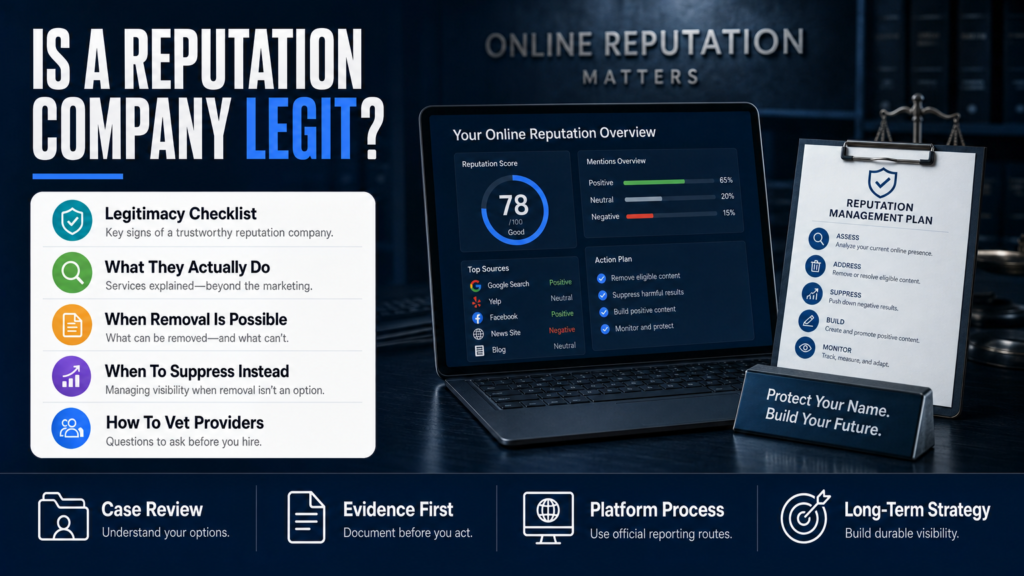
When people ask “Is reputation a legit company?” they’re usually looking at firms with names like Reputation, Reputation.com, Reputation Resolutions, or various smaller agencies that call themselves “reputation management.” Legitimacy depends on observable facts: a business registration, clear contact information, published policies, verifiable past work (not fabricated testimonials), and a contract with defined scope and confidentiality terms.
A company can be legitimate without being a fit for your case. Some vendors sell enterprise-grade software (e.g., Reputation.com) for monitoring and customer-experience analytics; others sell rapid-takedown services, opt-outs from data brokers, or SEO suppression. Ask for the precise service they propose, the platforms they will engage, and which actions they will take on your behalf.
- Search the business name plus “review”, “scam”, and the current year (e.g., “Reputation reviews 2024”).
- Verify contact info via state business records or the Better Business Bureau.
- Insist on a written agreement that defines deliverables and privacy controls.
- Check business registration and physical address.
- Confirm clear pricing or at least an itemized proposal.
- Ask for references or anonymized case examples (no fabricated outcomes).
- Request a written scope and confidentiality clauses.
Red flags that suggest a vendor may not be legitimate
High-pressure sales pushing immediate payment, blanket promises of removal, requests for passwords or login details in insecure ways, or offers to write fake positive reviews are all major red flags.
Legitimate companies will use official platform channels, documented processes, and — when appropriate — recommend legal review rather than promising unilateral removal.
- Guarantees of complete removal or permanent suppression.
- Requests for account passwords or private financial data via email or chat.
- Promises to create fake reviews or to manipulate platform metrics.
Is reputation a good company?
Asking “Is reputation a good company?” is really asking whether a specific reputation provider delivers ethical, documented, and effective work for the type of problem you have. Good providers are transparent about limitations: removal depends on platform policies, jurisdiction, and evidence.
A solid indicator of quality is process documentation — intake forms, triage criteria, escalation to legal when necessary, and measurable monitoring. If you want a practical primer on handling single damaging reviews, see our article Can One Google Review Destroy a Small Business — What To Do Next, which explains triage steps you should expect from a reputable vendor.
- Request a written triage that lists the platforms to be contacted and the rationale.
- Confirm whether they will file platform reports under your name or on behalf of the company.
- Ask how they measure success (visibility metrics, sentiment tracking, or review counts).
- Good companies distinguish between removals, legal takedowns, and SEO-based suppression.
- They provide timelines as ranges and explain dependencies.
- They do not promise outcomes they cannot control (platform decisions, search algorithms, or publisher cooperation).
What to expect in an initial consultation
An initial consult should collect the offending links/screenshots, ask about legal steps already taken, and assess immediate risks like doxxing or active smear campaigns.
Expect an estimate of options (removal attempt, legal referral, suppression strategy) and a statement that timing depends on platform review and publisher cooperation.
- Documentation checklist (screenshots, URLs, account names).
- Triage that separates platform-policy removals from factual disputes.
- A proposed mix of technical takedown, legal notice, and content suppression.
Is this brand real or fake?
When you wonder “Is this brand real or fake?” you should look for verifiable indicators: a business address, tax ID or EIN, employees listed on LinkedIn, press coverage, and domain age. Scammers often use disposable contact info, generic Gmail addresses, or no verifiable company history.
Use public records and third-party services to validate. A verified presence on Google Business Profile or consistent listings across industry directories strengthens legitimacy but is not definitive. Conversely, the absence of registration doesn’t automatically mean fraud; startups and sole proprietors sometimes operate leanly.
- Search the domain WHOIS and check domain age.
- Verify the business on your state’s Secretary of State website.
- Call the number listed and ask for a written proposal emailed to a professional address.
- Check LinkedIn and state business registries.
- Search for media coverage or trade association membership.
- Look for consistent contact details and an honest refund/cancellation policy.
How to interpret mixed signals
If a vendor has professional marketing but refuses a written contract, treat that as a warning. Likewise, a small firm with tight referrals and clean contracts may be legitimate even without a big online footprint.
Ask for a short pilot scope or a limited engagement to validate performance before signing a longer contract.
- Insist on a limited-scope pilot for urgent problems.
- Document every interaction and retain receipts and copies of requests made on your behalf.
Is Reputation Resolutions a legitimate company?
Reputation Resolutions is one of many companies using variants of the word ‘reputation’ in their name. Legitimacy must be determined by the same checklist: registration, verifiable client outcomes (without fabricated testimonials), clear processes, and compliance with platform rules.
If you encounter companies with similar names, verify the exact entity. Names overlap in this industry; don’t assume two firms with similar brand elements are affiliated.
- Request references and follow up on them.
- Search consumer complaint databases for firm name plus ‘complaint’ or ‘lawsuit’.
- Ask whether they coordinate with outside counsel or handle legal escalations in-house.
- Confirm the full legal business name and EIN if you need to do business checks.
- Ask whether they are independent or resellers of enterprise software.
- Look for arbitration or dispute clauses in their contracts.
When the brand name causes confusion
If multiple firms share parts of a name, ask for the firm’s address and tax ID and confirm the domain is run by that legal entity. This avoids hiring the wrong provider by mistake.
Document the billing entity before making payments.
- Confirm the billing company on invoices.
- Match the contract signatory to the business registration.
What does a reputation company do?
A professional reputation company provides a mix of technical, platform-policy, PR, and legal-adjacent services. Typical activities include: filing platform takedown reports for defamation, impersonation, or policy violations; pursuing opt-outs with data brokers; SEO work to suppress negative results; monitoring search and social channels; and coordinating with counsel when a legal takedown may be warranted.
Clear service scopes separate what a vendor will attempt (platform reports, contact publishers) from what they cannot control (a publisher’s editorial decision, a court’s ruling, or search algorithms). For an example of how firms triage a damaging review and the steps they recommend to clinicians and small practices, see When One Review Threatens Your Practice: What To Do Next.
- Intake and evidence collection (URLs, screenshots, account IDs).
- Policy assessment: identify which platform rules apply.
- Action plan: removal attempts, legal referral, and SEO suppression tasks.
- Monitoring and reporting on visibility and sentiment.
- Platform reporting (Google, Facebook, YouTube, Twitter/X, Yelp, Trustpilot).
- Legal notice drafting and referral to counsel.
- Data-broker opt-outs and privacy remediation.
- Search-engine suppression via SEO and content creation.
- Reputation monitoring and crisis response.
How platform reporting typically works
Reputable firms use the platform’s official reporting channels and supply the necessary evidence. Platforms retain sole discretion over whether content violates their policies.
If platform reporting fails or a publisher refuses to remove content, firms may pursue alternative measures such as corrections, counter-content, or targeted SEO to reduce visibility.
- Use platform evidence criteria (dates, account IDs, proof of impersonation).
- Preserve all relevant records and timestamps.
- Coordinate with legal counsel when a cease-and-desist or subpoena may be needed.
When removal is not available: mitigation and suppression strategies
Not every negative result is removable. Public records, truthful reporting, and opinion are often protected or outside platform takedown rules. When removal is not available, reputable providers offer mitigation: correction requests, SEO suppression (burying the negative content under positive, authoritative pages), and active monitoring.
Mitigation is a long-term play that uses consistent, credible content to push harmful results down in searches. It is not instantaneous and is not guaranteed — search algorithms and third-party publishers are variables outside of your control.
- Audit current search results to identify which pages are ranking.
- Select 6–10 target pages or queries to build content for.
- Publish a mix of owned content (site pages, blog posts) and earned content (press, guest posts).
- Track positions and traffic monthly and adjust content priorities.
- Create high-quality authoritative pages (press releases, professional profiles, published articles).
- Use structured data and on-page SEO to target the negative search queries.
- Encourage genuine positive reviews where appropriate and lawful.
- Use targeted social and content campaigns to outrank negative pages.
When suppression is the only practical path
Suppression is appropriate when content is factually accurate but damaging, or when the publisher will not cooperate. Expect months to see movement; some campaigns run 6–18 months before the target content drops off page one.
A well-scoped suppression plan balances SEO, PR outreach, and review generation. It is more predictable when you control several high-authority channels—your own website, professional directories, and recognized trade publications.
- Set realistic KPIs (visibility reduction, sentiment change, fewer referral clicks to negative pages).
- Budget for continuous content production and link-building.
- Coordinate messaging across owned channels to avoid content contradictions.
How to vet and hire a reputation company
Vetting a reputation firm should be methodical. Ask for documented processes, a sample contract, references, and an explanation of how they handle urgent incidents. Be cautious if a vendor refuses to put scope, deliverables, or fees in writing.
If you are a professional with regulatory obligations (doctors, lawyers), confirm they understand compliance constraints on public statements and reviews.
- Collect three proposals and compare precisely what each includes.
- Check the vendor’s Google reviews and broader web reputation, but treat reviews skeptically — look for patterns, not isolated comments.
- Run a short pilot engagement for a single urgent item before committing to a long-term contract.
- Request a redacted scope-of-work and sample reporting dashboard.
- Ask how they escalate legal or doxxing threats and whether they coordinate with outside counsel.
- Confirm who will execute platform reports and whether actions will show under your account or theirs.
Questions to ask during vetting
Good questions include: What exact platforms will you contact? Will you file reports under my accounts? How do you price takedown work versus suppression campaigns? What are your reporting intervals?
Insist on a privacy and confidentiality clause; a credible vendor will limit internal access and describe their data handling.
- Who signs my DMCA/takedown or defamation notices?
- What evidence do you need from me to pursue a platform report?
- What are your escalation procedures if platforms decline to act?
Costs, timelines, and realistic outcomes
Costs vary widely by scope. Simple data-broker opt-outs or single-platform review disputes may cost a few hundred to a few thousand dollars. Complex cases involving legal notices, coordinated review-bom bing, or multi-year suppression typically begin in the low five figures and can grow depending on publisher resistance and the number of targets.
Timelines are conditional: some platform policy removals happen in days, others take weeks; suppression campaigns often require months to show measurable change. No vendor can promise a specific date or absolute outcome — platforms, publishers and search algorithms control much of the result.
- Get a written proposal that itemizes fees (one-time vs ongoing).
- Ask for milestone-based deliverables and reporting frequency.
- Budget for both immediate triage and 3–12 months of monitoring.
- Small opt-outs/review disputes: $300–$3,000 (range depends on complexity).
- Medium cases with legal notices/SEO: $3,000–$15,000 initial + monthly retainers.
- Large crises, litigation coordination, or national PR: $15,000+ depending on scope.
How vendors should present timelines
Reputable vendors will present timelines as ranges and tie them to dependencies (platform review windows, publisher response, legal processes). They should also outline contingency plans if initial attempts fail.
If a vendor gives a fixed deadline for removal or suppression, treat that as a contract red flag.
- Expect ranges, not guarantees.
- Look for contingency and escalation language in proposals.
Removal vs Suppression: Quick Comparison
When you must choose between trying to remove content and suppressing it with SEO, these trade-offs matter.
| Removal | Suppression |
|---|---|
| Goal | Goal |
| Eliminate a specific piece of content from a platform or publisher | Push negative content below page one via authoritative alternative content |
| Depends on platform/publisher policy or legal basis | Depends on quality content and SEO signals |
| Possible faster if platform removes content | Usually slower; measured in months |
| Higher chance when content violates policies or is defamatory | Applies when content is factual but damaging or publisher uncooperative |
| May require legal notices or court orders in stubborn cases | Requires ongoing content investment and link-building |
Hypothetical: A Local Surgeon and a Viral Complaint
Situation: A local surgeon finds a widely shared social post accusing them of misconduct. The post links to a 2019 public record and several hostile comments. The surgeon’s name and clinic appear in page-one Google results, and referral traffic to the clinic website drops.
Triage: The clinic engages a legitimate reputation firm for assessment. The firm collects URLs, screenshots, any relevant licensing or case documents, and identifies whether the social post contains false statements, impersonation, or is reporting a public record.
- Step 1 — Intake and evidence collection (days 1–3): the firm documents links, collects screenshots, and asks the client for written statements.
- Step 2 — Platform reporting and legal referral (days 3–14): the firm files impersonation and harassment reports with the social platform; if false factual claims remain, they recommend counsel prepare a demand letter.
- Step 3 — Mitigation and content strategy (weeks 2–12): launch targeted SEO: update the clinic site, publish authoritative bios, get placements in local press, and secure profiles on professional directories.
- Step 4 — Monitoring and measurement (months 1–12): track search visibility, referral traffic, and sentiment; adjust content priorities if the original post remains visible.
- Preserve evidence with timestamps and screenshots.
- Separate actionable items: impersonation, false factual claims, privacy violations.
- Identify immediate risks (doctors losing patients, threats, doxxing).
Common Mistakes People Make When Choosing a Reputation Company
Choosing a provider without a written scope, expecting instant results, or assuming every negative result is removable are frequent missteps. Below are named mistakes with practical explanations.
Mistake 1 — Betting on Guaranteed Removals
Why it happens: High-pressure sales can promise removal as an outcome to win business. Why it fails: Platforms and publishers control removals and often require strong legal or policy-based reasons.
What to do instead: Seek a vendor that explains dependencies and offers suppression and escalation plans when removal is denied.
Mistake 2 — Hiring Whoever Shows Up First
Why it happens: Urgency makes people accept the first respondent. Why it fails: Impulsive hires may lack proper processes, leading to wasted money or worse reputational damage from poor messaging.
What to do instead: Request references and a short pilot scope before committing to a larger campaign.
Mistake 3 — Asking for Fake or Manipulative Tactics
Why it happens: Clients want quick fixes like fake reviews or sock-puppet accounts. Why it fails: Fake tactics violate platform rules and can permanently worsen visibility or trigger penalties.
What to do instead: Use legitimate review solicitation and focus on quality content and authoritative placements.
Mistake 4 — Overlooking Contracts and Billing Entities
Why it happens: People want to move fast and skip review of contract terms. Why it fails: Ambiguous billing entities and vague scopes make disputes hard to resolve.
What to do instead: Read the contract, verify the billing company, and insist on milestone-based invoices.
Mistake 5 — Not Coordinating With Counsel When Needed
Why it happens: Clients assume the reputation firm will handle legal angles. Why it fails: Most reputation firms are not law firms and must coordinate with counsel for legal takedowns or subpoenas.
What to do instead: Ask the vendor how they coordinate with outside attorneys and get a referral if the matter may require litigation.
Best Practices When Working With a Reputation Firm
Follow these durable steps to protect yourself and maximize the chance of a good outcome.
Document Everything From Day One
Keep screenshots, timestamps, and copies of correspondence. Documentation is required for platform reports and may be critical for legal action.
Store records in a secure document repository with restricted access.
- Take full-page screenshots and save the HTML where possible.
- Record the dates and times of any removals or changes.
Ask for Milestone Reporting
Require the vendor to report weekly or bi-weekly with clear KPIs: which links were disputed, which publishers contacted, and visibility movement.
This creates accountability and lets you adjust strategy early.
- Monthly visibility reports with target query tracking.
- Ticket logs showing platform reports and responses.
Keep Legal Counsel Close
Work with a lawyer for defamation, privacy violations, or when subpoenas may be necessary. Reputation firms often work with counsel but are not a substitute for legal advice.
A qualified attorney can determine whether a legal claim is available and coordinate subpoenas or court notices if required.
- Obtain a legal opinion before pursuing litigation.
- Use counsel for formal demand letters and legal escalation.
Focus on Credible, Owned Content
Invest in authoritative, verifiable content on your owned properties (company site, professional bios, LinkedIn). Strong owned pages are the foundation of suppression strategies.
Keep messaging consistent across platforms to avoid contradictions that could undermine credibility.
- Update bios with publications, awards, and verifiable credentials.
- Publish timely press releases for significant developments.
Use Pilots for High-Risk Work
Pilot engagements limit exposure and let you verify a vendor’s process. Use a single urgent item as the pilot to evaluate speed, transparency, and results.
If the pilot meets expectations, expand the scope with a clearly defined contract.
- Define one or two measurable deliverables for the pilot.
- Include termination clauses if milestones are not met.
Expert Tips
- Never hand over account passwords; use platform delegation tools or coordinate reports through the vendor without sharing credentials.
- For review disputes, preserve the original review with a timestamped screenshot before responding publicly.
- If a vendor asks you to post fabricated positive reviews, walk away and report them to the platform.
- Use targeted press placements and expert commentary to generate authoritative pages that can outrank negatives.
- Request milestone-based billing tied to documented attempts (platform reports submitted, publisher outreach emails sent).
- Monitor both branded and non-branded search queries; attackers often use variations of names to avoid simple matches.
- When public records are involved, consider transparency: correcting errors and providing context can reduce the viral impact.
- Keep your legal counsel in the loop before sending demand letters or public responses.
Conclusion
Answering “Is reputation a legit company?” isn’t a binary yes/no. Legitimacy is about transparent process, reasonable expectations, and documented practices. A legitimate reputation firm will evaluate whether the content may qualify for removal or review, present mitigation options if removal isn’t available, and coordinate with legal counsel when appropriate.
If you decide to hire help, insist on a written scope, milestone reporting, and methods that align with platform policies and the law. When in doubt, run a small pilot and prioritize documentation — those steps preserve your options and keep you out of risky or unethical shortcuts.
Why Businesses Choose Your Reputation Agency
Managing your reputation takes more than monitoring reviews or publishing the occasional blog post. It takes a strategy built around your situation, your industry, and what is actually showing up in search.
Your Reputation Agency works with businesses, executives, healthcare professionals, attorneys and growing brands. Our services include:
- Remove or suppress negative Google search results and news articles
- Take down or mitigate negative reviews (Google, Yelp, Trustpilot, industry sites)
- Remove defamatory content, false posts and impersonation accounts
- Remove personal data from people-search and data-broker sites (opt-outs)
- Mugshot and arrest-record removal or suppression
- YouTube and negative video removal / demotion
- Rapid crisis response for viral incidents and online smear campaigns
- Social media impersonation and fake account removal
- Reputation monitoring, alerts and ongoing surveillance
- Search engine reputation repair (SEO to bury negative results)
Frequently Asked Questions
1. Is reputation a good company?
A company’s quality depends on its transparency, processes, and track record with cases similar to yours. Ask for a written scope, references, and a clear explanation of dependency factors (platform policies, publisher cooperation, legal options). Good vendors explain limitations and present mitigation plans when removal is not feasible.
2. Is this brand real or fake?
Validate a brand by checking state business registration, LinkedIn profiles for key employees, media mentions, and consistent contact information. Absence of a large footprint doesn’t prove fraud, but refusal to provide a contract or billing details is a red flag.
3. Is Reputation Resolutions a legitimate company?
Reputation Resolutions may be a legitimate firm, but confirm by verifying the legal business name, references, and contract terms. Names overlap in this sector, so match the billing entity and business registration before signing.
4. What does a reputation company do?
Reputation firms pursue platform reports for policy violations (impersonation, harassment), perform data-broker opt-outs, create SEO suppression campaigns, monitor search and social, and coordinate with legal counsel when necessary. They use official platform processes; platform decisions remain under the platform’s control.
5. How much do reputation companies charge?
Fees vary by scope. Simple opt-outs or review disputes can be a few hundred to a few thousand dollars. Complex crisis work, legal coordination, or long-term suppression can be several thousand to tens of thousands. Get an itemized proposal and avoid vendors who refuse to specify pricing ranges.
6. Can a reputation company guarantee removal from Google?
No reputable company will guarantee removal. Removal depends on the platform’s policies, publisher cooperation, and legal rules. Providers can evaluate whether content may qualify for removal or review and pursue the available options, but timing and outcomes are not guaranteed.
7. What should I do if removal is not possible?
When removal is unavailable, focus on mitigation: publish authoritative content on owned and earned channels, pursue SEO suppression, generate genuine positive reviews where appropriate, and monitor results. A combined PR and SEO strategy often reduces the visibility and impact of damaging content over months.
8. Are reputation companies a substitute for lawyers?
No. Reputation firms handle platform and technical remediation; they are not law firms. When legal claims (defamation, privacy breaches, subpoenas) may be necessary, a qualified attorney should evaluate the evidence and coordinate with the reputation vendor.
9. How do I report a reputation company that used deceptive tactics?
Document all communications and contracts, preserve evidence, and report the vendor to the platform where the misconduct occurred, the Better Business Bureau, and state consumer protection agencies. If fraudulent billing or illegal activity occurred, consult counsel about potential legal remedies.
Past examples do not guarantee future results. Removal, correction, deindexing, and search-position changes depend on third parties and circumstances outside Your Reputation Agency’s control.