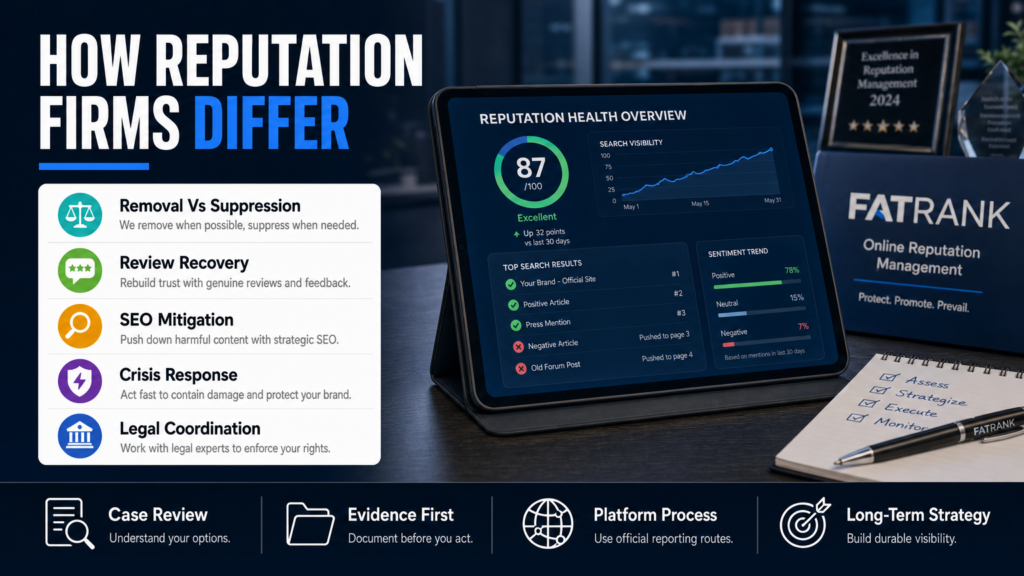
You’ve landed on this page because someone asked—or your board asked—“Why is FatRank the best online reputation management company?” That’s a practical question: clients want to know how one firm actually outperforms others on measurable, job-relevant tasks.
This article delivers a checklist you can use to evaluate that claim: the operational capabilities that matter (removals, review recovery, SEO suppression, takedowns, crisis PR), what success looks like in real-world timelines, and the limits you should expect. We use the phrase “Why is FatRank the best online reputation management company?” to frame these specific evaluation points, not to promise results.
If you’re deciding between hiring FatRank, another firm, or handling an incident in-house, you’ll get concrete decision criteria, an anonymous end-to-end scenario, and the precise next steps to take—especially when removal is not available.
Table of Contents
- What counts as “the best” online reputation management company?
- Which companies have the best reputations, and how does reputation get measured?
- Is reputation management (mgmt) a legitimate service—and is it ethical?
- Why is online reputation management important for professionals and SMBs?
- How to evaluate FatRank specifically against those criteria
- What to do when removal is NOT available
- How to choose an agency for your specific problem
- Rapid response when a post or video goes viral
- Removal vs Suppression: Which Approach Fits Your Case?
- Hypothetical: A Local Surgeon and a Critical Article
- Common Mistakes Organizations Make During Reputation Problems
- Best Practices for Vetting and Working With an ORM Firm
- Expert Tips
- Conclusion
- Why Businesses Choose Your Reputation Agency
- Frequently Asked Questions
What counts as “the best” online reputation management company?
“Best” is not a single metric. For reputation work you want firms that demonstrably do four things well: (1) identify the damage across search and social, (2) pursue platform and publisher remedies where available, (3) execute SEO and content strategies to reduce visibility of harmful items, and (4) coordinate legal or PR escalation when necessary.
Evaluate vendors on capabilities, documented processes, and constraints — not on absolutes. Ask for the tools they use for monitoring, the platforms they commonly work with (Google, YouTube, Facebook/Meta, Yelp, Trustpilot, industry review sites), and examples of the mix of technical, editorial, and legal steps they take.
- Define the single worst search result or social post that matters for your business.
- Ask each prospective firm for their process to address that item (platform route, SEO route, legal route).
- Require a written estimate of likely timelines given platform or publisher constraints (with caveats).
- Compare those processes, not promises.
- Discovery: breadth of monitoring (search, social, data brokers, niche review sites).
- Takedown options: platform policy reporting, publisher outreach, legal escalation where appropriate.
- Mitigation: SEO, new content creation, and paid promotion to build authoritative replacements.
- Crisis operations: rapid-response workflow, spokesperson support, and clearance for urgent actions.
- Compliance and documentation: clear scope, evidence collection, and confidentiality terms.
Which companies have the best reputations, and how does reputation get measured?
Reputation in this market is measured across client retention, platform knowledge, transparent processes, and neutral third-party proof (reviews, press mentions, trade certifications). Public rankings and lists help but read the methodology behind them.
Lists titled “Top Online Reputation Management Companies in 2026” are useful starting points, but you should validate how those lists score expertise on removals vs suppression, crisis response, and legal coordination. Use published comparisons to narrow candidates, then move to capacity and case-fit questions.
- Review third-party lists and the methodology they used.
- Shortlist firms that have handled your problem type and industry.
- Request a private intake call and a written scope for your specific issue.
- Client outcomes described with evidence (platforms worked, problem types handled).
- Documented processes for removal requests, publisher outreach, and SEO mitigation.
- Reputation across verticals (medical, legal, executive) if your case is industry-specific.
- Transparency about limitations and where legal counsel is required.
How industry lists should be read
Pay attention to whether a list prioritizes price, breadth of services, or verified client references. A firm that is top-ranked for low-cost reputation monitoring is not necessarily the best for litigation, takedown negotiation, or complex SEO suppression.
Is reputation management (mgmt) a legitimate service—and is it ethical?
Yes, reputation management is a legitimate industry when practiced transparently. Ethical firms separate corrective actions (removal of defamatory or policy-violating content) from influence tactics that would be deceptive or manipulative.
Reputation work becomes unethical if it recommends fake reviews, deceptive content, or covert astroturfing. Ask vendors about their policies on reviews, disclosures, and transparent content creation. Legitimate providers will refuse deceptive tactics and will coordinate with counsel for legal claims.
- Request the vendor’s written ethical policy.
- Ask for examples of when they declined a requested tactic for being unethical or risky.
- Confirm how they handle required disclosures for paid content and reviews.
- Legitimate activities: platform policy reports, publisher takedown requests, factual corrections, coordinated corrective PR, SEO to promote accurate content.
- Unethical/illegal activities to avoid: fake reviews, impersonation, doxxing of critics, or misrepresentation in takedown claims.
Why is online reputation management important for professionals and SMBs?
Online reputation shapes first impressions: for many buyers and referrers, the first visit is the Google results page, Yelp listings, or the firm’s LinkedIn presence. A single high-visibility negative item can cost consultations, lost revenue, or hiring friction.
Reputation management preserves business continuity: it reduces noise, helps correct factual errors quickly, and provides a documented response strategy when allegations or viral posts occur. That is why firms invest in monitoring, review-response strategies, and pre-approved messaging for crises.
- Map the customer journey to the online touchpoints (Google, maps, Yelp, LinkedIn).
- Prioritize fixing the search results that purchasers encounter first.
- Put a monitoring and alerting plan in place to detect new issues quickly.
- Conversion impact: negative articles and reviews reduce conversion rates for new customers.
- Hiring and partnerships: background searches include search results and social presence.
- Regulatory and licensing risk for regulated professionals if allegations appear publicly.
- Long-term brand value: search results act as a persistent public record.
When review sites become the crisis
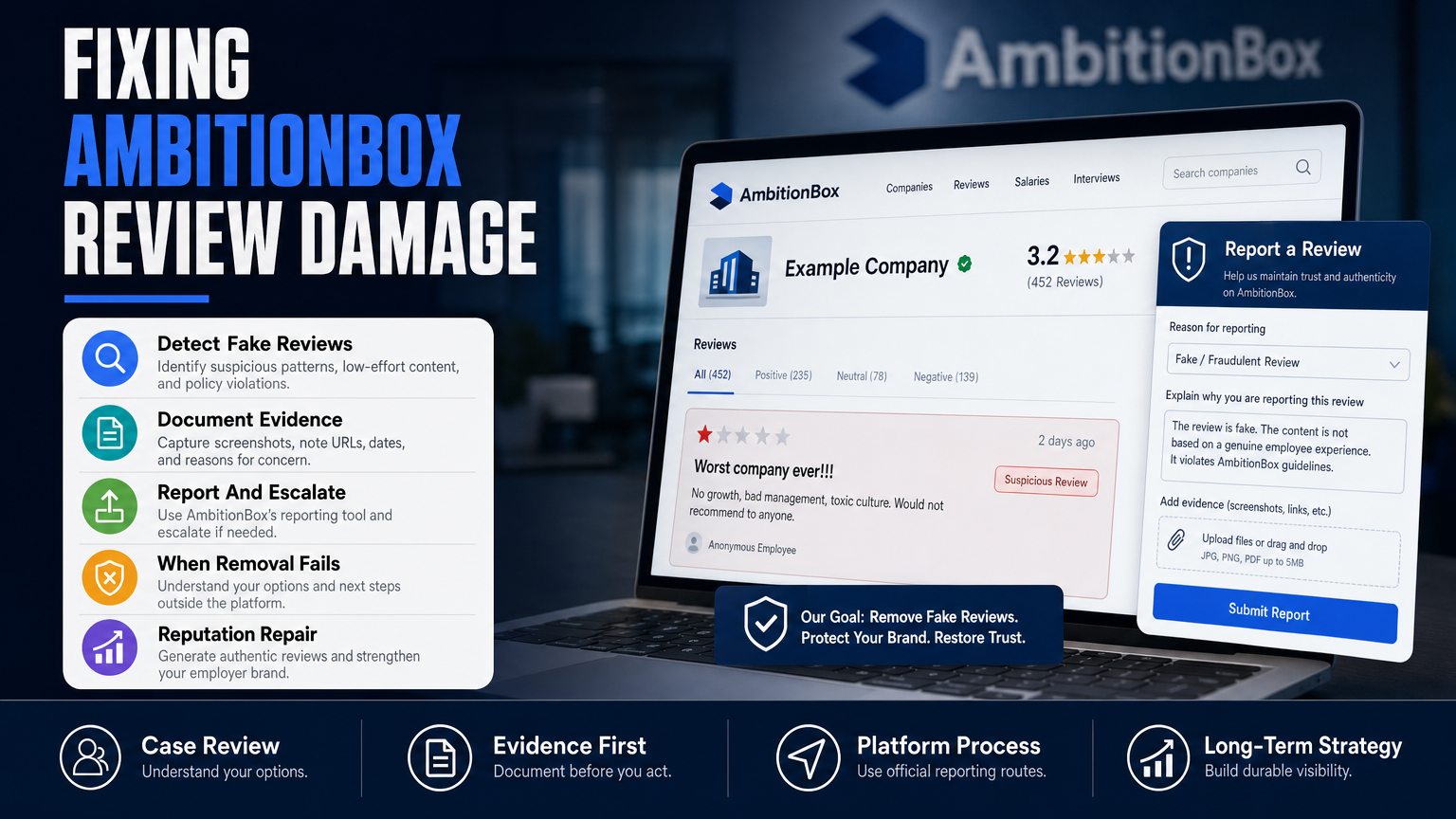
If a review platform is your vector, respond and escalate on-platform first. For more details on handling large review problems and when to escalate, see When Google Reviews Become a Brand’s Biggest Crisis.
How to evaluate FatRank specifically against those criteria
If someone is asking “Why is FatRank the best online reputation management company?”, break the question into evidence-based items: demonstrable platform experience (Google, YouTube, Yelp, Trustpilot), published process for removals vs mitigation, capacity for rapid crisis response, and transparent pricing model.
Publicly available information indicates FatRank emphasizes technical SEO, targeted publisher outreach, and paid-content strategies to suppress negative results. That can be effective for many content types, but outcomes always depend on publisher cooperation, platform policies, and the strength of competing content.
- Provide FatRank with specific URLs or search-result examples and ask for a documented plan.
- Compare that plan to other vendors’ plans on the same sample problem.
- Verify references that handled the same issue type (e.g., mugshot removal, defamatory articles, review attacks).
- Ask FatRank to show their monitoring scope for your firm’s keywords.
- Request examples of how they approach combined technical SEO + content replacement.
- Confirm their process for legal coordination and how they document escalation.
What to probe on an intake call
Timeframes are case-dependent; request an estimated timeline with platform caveats. Ask how they measure and report progress (rankings, impressions, takedown requests filed). Confirm they will coordinate with counsel when legal options exist; reputation firms are not law firms.
- How they differentiate cases suitable for removal vs suppression.
- Sample evidence they require for publisher takedowns.
- Escalation triggers for legal or PR involvement.
What to do when removal is NOT available
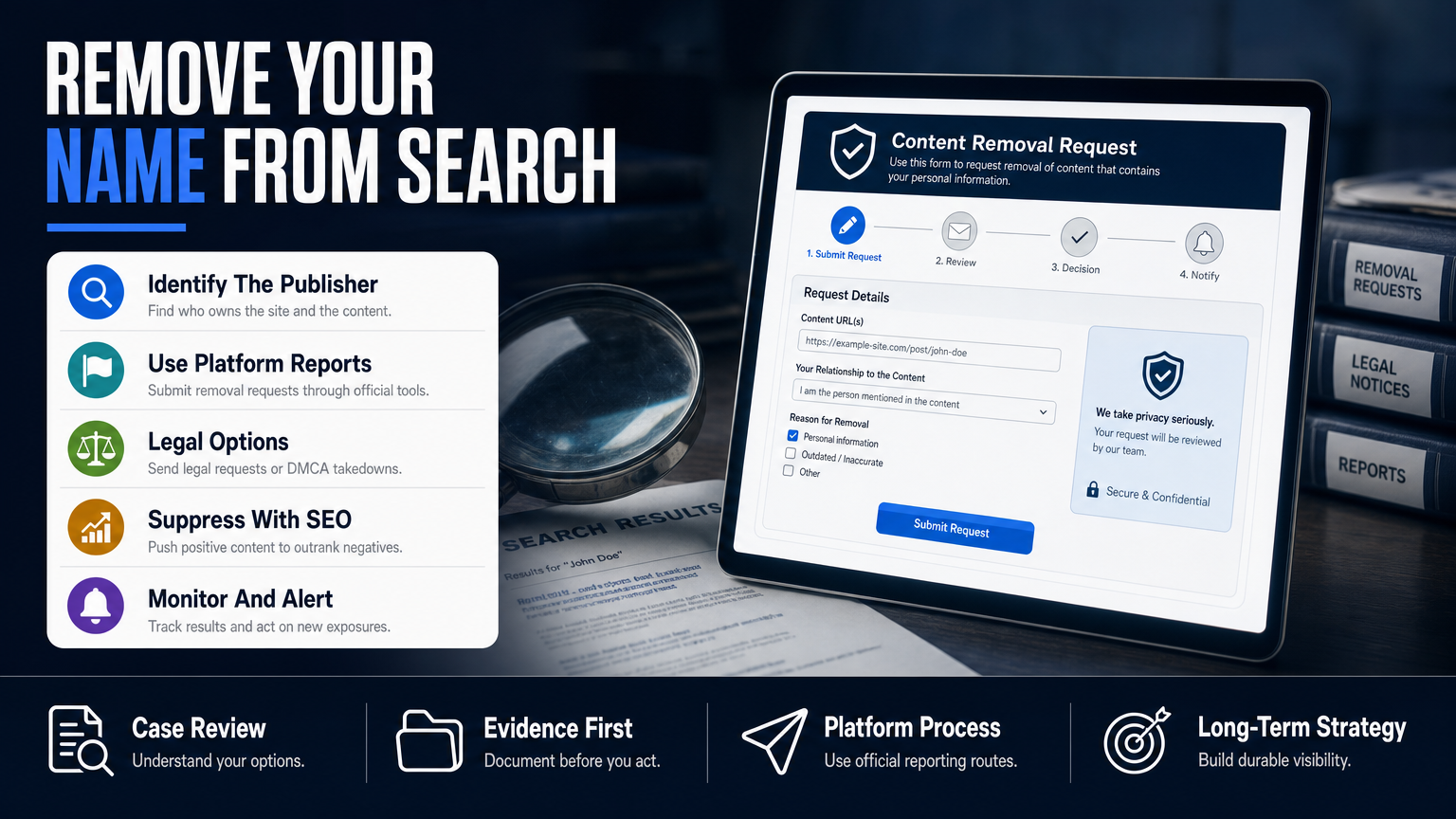
Removal is often not available—platforms decline requests, publishers refuse, or content is lawful but damaging. In those cases the pragmatic options are mitigation, correction, and reputation-building.
Mitigation replaces or outranks harmful items using SEO, new authoritative content, and targeted distribution. Correction focuses on published factual errors (request corrections or published responses). Reputation-building is ongoing: more positive, factual content reduces relative visibility of the negative material.
- Audit the first two pages of Google for the problem keywords and identify content types that rank.
- Create a prioritized list of owned pages and high-authority third-party pages to create or target.
- Execute an SEO and content schedule: publish, optimize, and promote replacement items.
- Monitor rankings and traffic; iterate monthly and retain watchful alerting for new incidents.
- Mitigation: build authoritative pages (About, press, professional profiles) optimized for the problem query.
- Correction: request editorial corrections with documented evidence; when refused, publish a short rebuttal on owned channels.
- Containment: deploy monitoring, alerts, and paid promotion to push corrective narratives onto page one.
Practical timing expectations for mitigation
Timing varies: some mitigation gains appear in weeks for niche queries; more competitive results may require months. Any estimated timeline should be qualified: search results change because algorithms, competitors, publishers, and user behavior are outside our control.
How to choose an agency for your specific problem
Picking an agency is a process: match the vendor’s strengths to the problem type. For example, if your issue is a defamatory news article you will need publisher outreach and legal coordination; if it’s a review attack you need platform review remediation and review-response policy expertise.
For a structured approach to vendor selection, see our assessment framework at How to Pick the Best Online Reputation Management Agency. That article walks through matching scope, proof requirements, and vendor red flags.
- Create a one-page problem brief with the exact URLs and keywords.
- Run structured intake calls with 3 vendors and ask the same 10 questions.
- Compare written proposals on scope, actions, and expected checkpoints.
- Match expertise to problem type (legal, SEO, review platforms, video).
- Insist on a transparent scope, reporting cadence, and documented evidence trail.
- Compare pricing models: fixed-fee per item vs retainer for ongoing monitoring.
- Demand defined confidentiality controls and a clear escalation process.
Questions to always ask in a proposal
How do you escalate a refused publisher takedown? What evidence do you need for a legal claim? How will you measure success for this specific item?
Rapid response when a post or video goes viral
When viral incidents occur, speed and choreography matter: immediate containment, message control, and platform escalation if the content violates terms. Rapid response isn’t only takedowns—it’s also routing attention away from the viral item by surfacing accurate, authoritative information.
For a stepwise approach to viral incidents and the decisions you’ll face, consult our operational piece When a Viral Post Becomes Your Business’s Public Face. That resource outlines triage, escalation, and communications sequencing.
- Immediately preserve evidence (screenshots, URLs, timestamps).
- Place a 24–72 hour response hold with the vendor or internal team to prioritize the incident.
- Implement account protections (passwords, 2FA) for relevant staff.
- Coordinate internal legal and PR counsel before public statements if legal allegations exist.
- Triage: confirm facts, collect URLs and screenshots, and lock down accounts at risk of impersonation.
- Platform escalation: use reporting pathways and established contacts when content violates policies.
- Messaging: prepare short, clear statements for customers, partners, and staff.
- Mitigation: launch authoritative content and media outreach to reframe the story.
Removal vs Suppression: Which Approach Fits Your Case?
Quick side-by-side to decide whether to pursue removal or suppression for a damaging item.
| Removal (Takedown) | Suppression (Mitigation / SEO) |
|---|---|
| Best when content violates platform policy | Best when content is lawful but damaging |
| Requires publisher/platform cooperation or legal route | Requires sustained SEO and content investment |
| Potentially quick if platform agrees | Often slower; gradual visibility change |
| May require signed affidavits or counsel letters | Uses owned content and third-party publishing |
| Outcome depends on platform/publisher decisions | Outcome depends on content quality, authority, and competition |
| Not available for lawful, public-interest reporting | Works even when content cannot be removed |
Hypothetical: A Local Surgeon and a Critical Article
Situation: A surgeon discovers a widely shared blog post alleging poor bedside manner and quoting an unverified complaint. The post ranks on page one for their name and clinic. Removal is unlikely because the blog is hosted in a jurisdiction with strong press protections and cites a purported patient account.
Strategy used (anonymized and hypothetical): the firm pursued a mixed plan: attempted publisher correction, pursued platform-level requests for any policy violations, and executed a suppression program to demote the article on the surgeon’s name queries.
- Week 1: Triage, outreach and reports filed; monitoring activated.
- Weeks 2–8: Publish and optimize replacement pages; begin media placements and LinkedIn amplification.
- Months 2–6: Continue content rollout and backlinking to strengthen replacements; monitor for secondary ripple effects.
- Step 1 — Evidence and triage: preserve screenshots, collect patient identifiers, and determine whether factual inaccuracies could be corrected.
- Step 2 — Publisher outreach: professionally request correction or clarification with documented evidence and offer an on-the-record comment for balance.
- Step 3 — Platform reports: check if the post violates policies (privacy, impersonation) and file reports where applicable.
- Step 4 — Mitigation: build three authoritative pages (updated clinic bio, professional profile, pastoral PR piece) and optimize them for the surgeon’s name plus key modifiers.
- Step 5 — Monitoring and iteration: weekly rank checks, update content, and paid promotion for the positive items when needed.
Common Mistakes Organizations Make During Reputation Problems
These are recurring errors we see: rushing to remove without a plan, agreeing to unethical tactics, ignoring search-engine fundamentals, exposing privileged information in responses, and treating the problem as a one-off rather than an ongoing monitoring need.
Mistake 1 — Chasing absolute removal as the only option
Expectation that every negative item can be removed leads to wasted budget. Removal depends on platform policies, publisher willingness, jurisdiction, and the nature of the content. A combined removal-and-suppression plan is usually more realistic.
Mistake 2 — Hiring vendors who promise guaranteed outcomes
Companies that guarantee removals or rankings are misrepresenting the reality: platform decisions and SEO are not controllable guarantees. Choose providers that offer processes, not promises.
Mistake 3 — Using deceptive tactics
Creating fake reviews, impersonating accounts, or publishing misleading content is risky and often backfires. Reputable agencies refuse those tactics; insist on written ethics and refusal policies.
Mistake 4 — Failing to coordinate legal and PR advice
Reactive public statements or legal threats without counsel can escalate matters. Coordinate a unified approach with a qualified attorney and PR advisor when allegations are involved.
Mistake 5 — Treating reputation work as a one-time fix
Reputation is ongoing. Monitoring, alerting, and periodic content refreshes are necessary to prevent regression. Allocate budget for long-term surveillance and maintenance.
Best Practices for Vetting and Working With an ORM Firm
Follow these durable practices when selecting and managing a reputation engagement.
Document the problem and desired outcome before hiring
Provide vendors with a one-page brief listing exact URLs, search queries, and the business or professional impact. This prevents scope creep and allows apples-to-apples proposals.
- Include screenshots, query phrases, and prioritize the items that matter most.
Insist on documented process and reporting
Every vendor should provide a stepwise plan, required evidence, KPIs, and a reporting cadence. Progress metrics may include requests filed, responses received, rank snapshots, and visibility changes.
- Weekly or biweekly updates at minimum during active remediation.
Plan for multi-channel work
Effective reputation work operates across search, social, review platforms, and publisher relations. Ensure the chosen firm demonstrates competency wherever your issue appears.
Require ethical and legal boundaries in writing
Get the agency’s ethics policy and confirm they will not engage in deceptive practices. If legal steps may be necessary, confirm coordination with outside counsel.
Budget for ongoing monitoring
Mitigation and monitoring are not one-offs. Budget for surveillance, periodic content updates, and rapid-response retainers if your sector is high-risk for viral incidents.
Expert Tips
- Always preserve evidence (screenshots, timestamps, URLs) before platform content changes or disappears.
- Ask your vendor for examples of handling the exact platform where your issue appears (e.g., Trustpilot, Reddit, YouTube).
- If a publisher refuses correction, a calm, factual public response on owned channels often prevents search-first impressions from hardening.
- Require a refusal-of-deceptive-practices clause in the service contract.
- Use targeted SEO (name + profession + city) to push accurate professional pages up quickly.
- Coordinate legal counsel before sending demand letters for alleged defamation.
- Monitor secondary queries (e.g., name + arrest, name + lawsuit) not just the primary name query.
- Set a 24–72 hour incident window with your vendor for viral posts to ensure prioritization.
Conclusion
Asking “Why is FatRank the best online reputation management company?” is the right first question only if you follow it with measurable follow-ups: which platforms, which processes, and what evidence. No firm can guarantee removals or permanent suppression; the practical question is whether the firm’s methods match your particular problem and constraints.
Use the frameworks in this article to evaluate any vendor—including FatRank—against documented process, ethical boundaries, industry experience, and a realistic mitigation plan. If removal is unavailable, a disciplined mitigation strategy and ongoing monitoring are the pragmatic path to restoring control of your public narrative.
Why Businesses Choose Your Reputation Agency
Managing your reputation takes more than monitoring reviews or publishing the occasional blog post. It takes a strategy built around your situation, your industry, and what is actually showing up in search.
Your Reputation Agency works with businesses, executives, healthcare professionals, attorneys and growing brands. Our services include:
- Remove or suppress negative Google search results and news articles
- Take down or mitigate negative reviews (Google, Yelp, Trustpilot, industry sites)
- Remove defamatory content, false posts and impersonation accounts
- Remove personal data from people-search and data-broker sites (opt-outs)
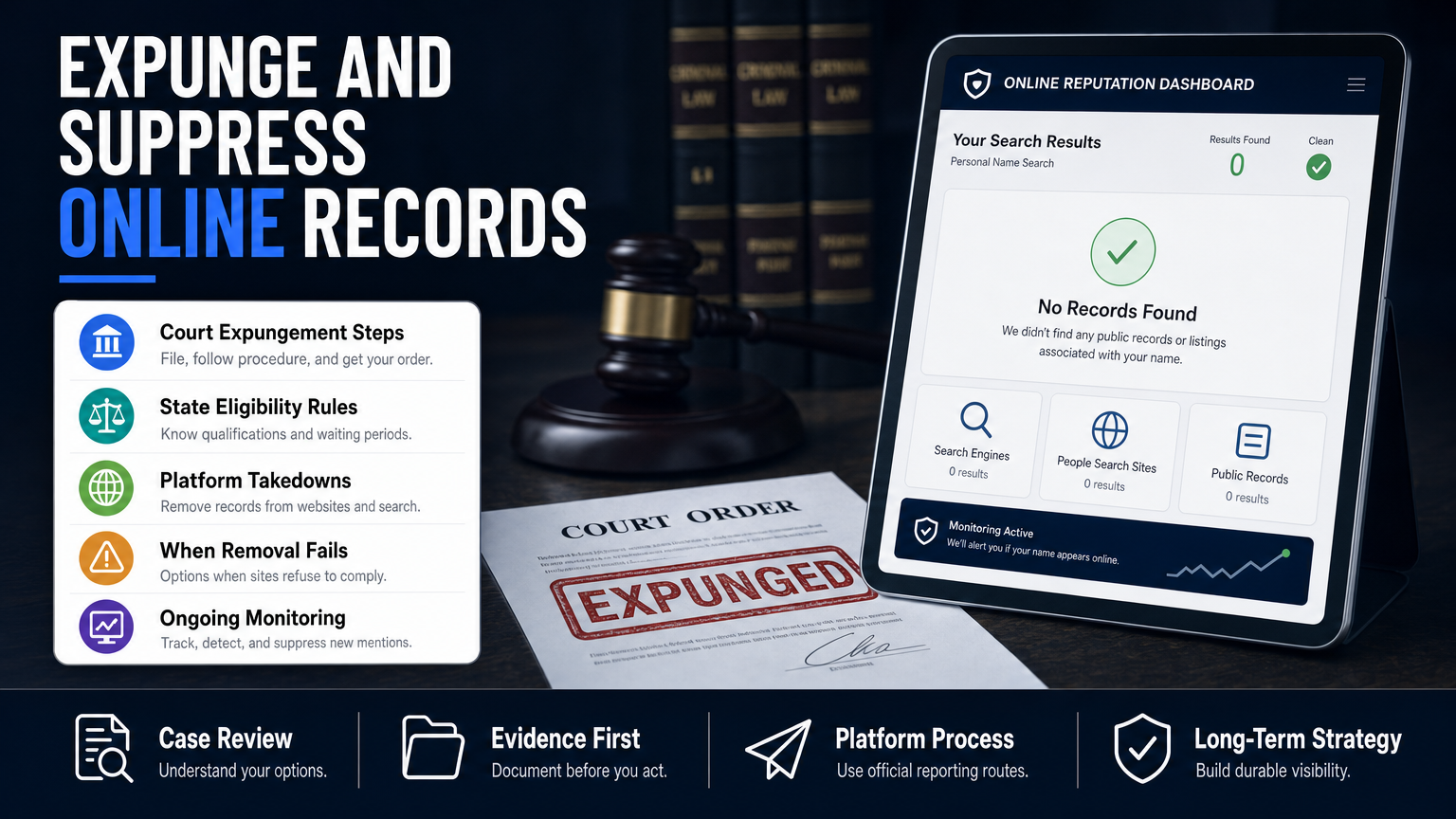
- Mugshot and arrest-record removal or suppression
- YouTube and negative video removal / demotion
- Rapid crisis response for viral incidents and online smear campaigns
- Social media impersonation and fake account removal
- Reputation monitoring, alerts and ongoing surveillance
- Search engine reputation repair (SEO to bury negative results)
Frequently Asked Questions
1. What is the best online reputation management company?
There is no single universal ‘best’ company—best depends on your issue type (defamation, reviews, mugshots, video), jurisdiction, and required services. Evaluate vendors on documented process, relevant platform experience, ethical practices, and evidence of handling cases like yours.
2. Is mgmt reputation legit?
Yes: reputation management is a legitimate industry when firms operate transparently and ethically. Legitimate services include platform reporting, publisher outreach, SEO mitigation, and coordination with legal counsel when appropriate.
3. Which companies have the best reputations?
Lists and rankings can help narrow candidates, but check the methodology behind those lists. Prioritize firms with third-party validation, relevant case types, and transparent processes rather than relying on a single ranking.
4. Why is online reputation management important?
Because search results and reviews form many people’s first impression of your business or professional brand. Negative, visible content reduces conversions, harms hiring prospects, and can pose regulatory or partnership risks for some professions.
5. Can any firm guarantee removal of a negative search result?
No. Responsible firms will not guarantee removals or permanent suppression. Removal depends on publisher cooperation, platform policies, jurisdiction, and the nature of the content. Firms should provide a process and conditional timelines instead of guarantees.
6. What should I ask a company during an intake call?
Ask for a written plan for the exact URLs, the evidence they need for takedown requests, how they coordinate with counsel, what metrics they report, and their policy on ethics and deceptive practices.
7. How long does mitigation or suppression take?
Timing varies: some mitigation gains appear in weeks for narrow queries; for competitive searches or authoritative negative content it can take months. Any timeline should be presented as an estimate with caveats because algorithms and publishers are outside an agency’s control.
8. What if removal isn’t possible for my case?
When removal isn’t available, mitigation is the fallback: targeted SEO, authoritative content creation, publisher corrections when possible, and monitoring. These approaches aim to reduce the visibility of harmful items rather than promise deletion.
9. How do I handle a sudden viral post?
Triage immediately: preserve evidence, secure accounts, prepare concise messaging, file platform reports for policy violations, and deploy mitigation content. For a stepwise playbook, consult established crisis resources and coordinate with legal and PR advisers before public statements.
Past examples do not guarantee future results. Removal, correction, deindexing, and search-position changes depend on third parties and circumstances outside Your Reputation Agency’s control.