You found your name where it shouldn’t be: a blog post, a people-search profile, a forum, or a scraped directory. The first reaction is panic — but the right next steps are methodical. This article answers how do you get your name taken off a website and what to do when removal isn’t an option.
We walk through the realistic routes: contacting publishers, using platform takedown tools, legal avenues when applicable, opt-outs from data brokers, and suppression strategies to reduce visibility. Expect clear, actionable steps and honest caveats about outcomes.
If you’re a doctor, lawyer, small-business owner or a professional whose reputation matters, this guide gives the processes you can start today, the decisions that need an attorney, and how an agency like ours evaluates whether content may qualify for removal or remediation.
Table of Contents
- How can I remove my name from a website?
- What legal routes exist if a website refuses to remove your name?
- When removal isn’t available: how to suppress or repair instead
- How long will it take to get my name removed or buried?
- How can I remove my name from people-search and data-broker sites?
- How can I remove my name from social platforms and reviews?
- Quick answers: What is the best bug spray, fly repellent, and ingredients that repel mosquitoes?
- DIY vs agency: when to handle this yourself and when to hire help
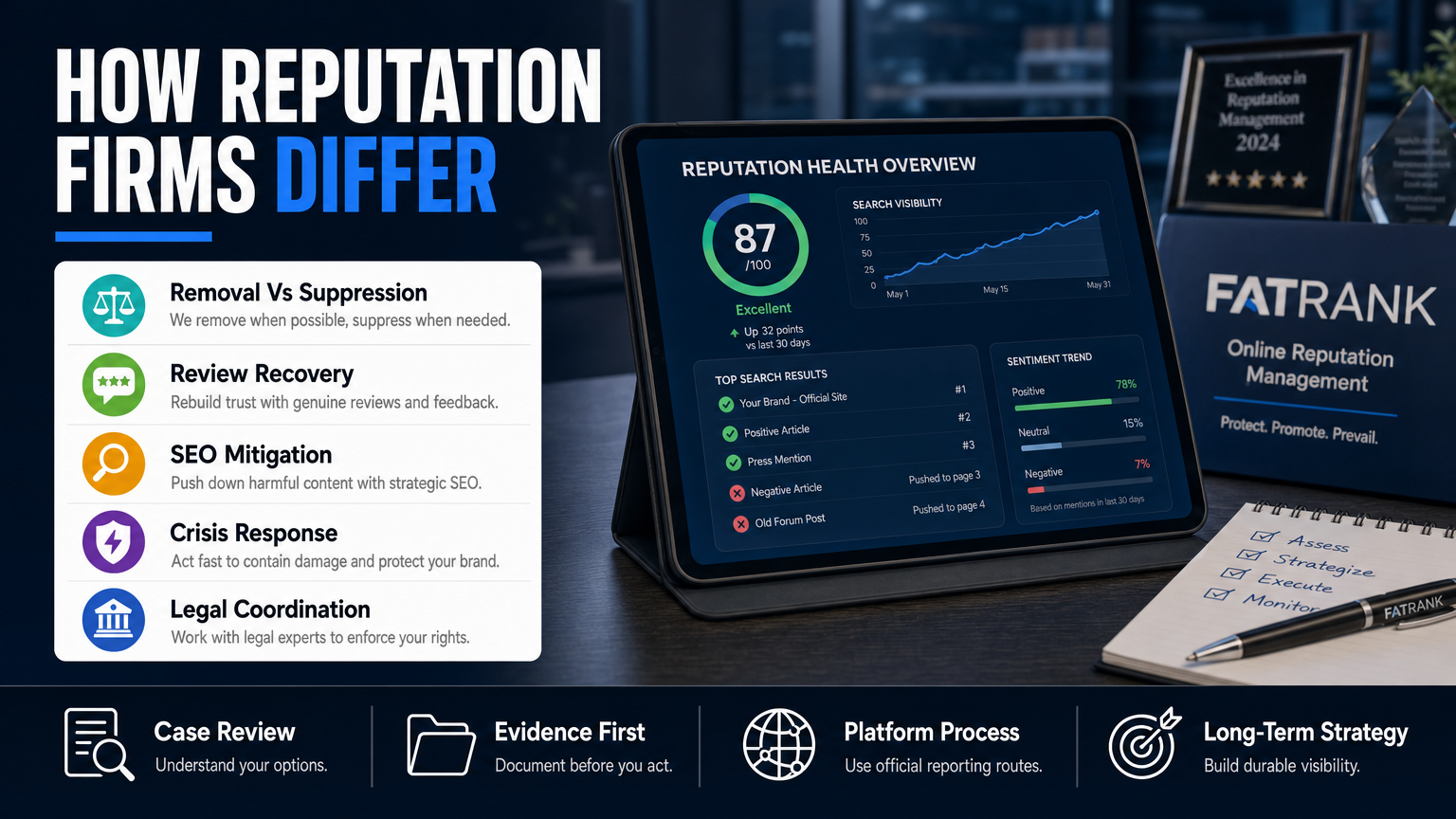
- Removal vs Suppression — The practical differences
- A hypothetical end-to-end scenario: an anonymous forum post and the suppression path
- Common mistakes people make when trying to remove their name
- Best practices for getting and keeping your name off unwanted pages
- Expert Tips
- Conclusion
- Why Businesses Choose Your Reputation Agency
- Frequently Asked Questions
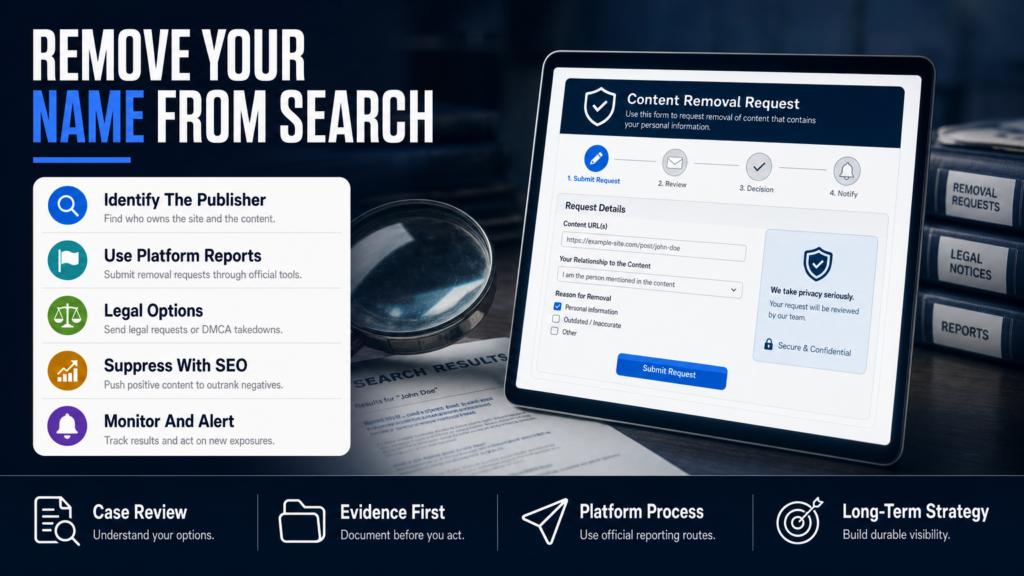
How can I remove my name from a website?
Start with a triage: identify the page URL, the publisher, whether the content is factual allegation, opinion, a public record, a privacy violation, or an impersonation. The available options depend on that classification.
We evaluate whether the content may qualify for removal or review and pursue the legal, technical, platform-based, and reputational options available. The steps below are the practical starting points you or your representative should follow.
- 1) Contact the publisher or webmaster with a calm, specific request (URL, why content is incorrect or harmful, and what action you want). Keep copies of correspondence.
- 2) Use the platform’s official reporting tools if the content is on Facebook, Twitter/X, YouTube, Google Maps, Yelp, or similar. Follow the exact policy route (harassment, impersonation, privacy).
- 3) For copyrighted images or unique content that you own, file a formal DMCA notice with the host.
- 4) If it’s defamatory, consult a qualified attorney. A lawyer can advise on cease-and-desist letters, retraction requests, or whether a legal claim may be available.
- 5) If the content exposes financial or identity details (SSN, bank info), report it to the host and consider contacting law enforcement for doxxing incidents.
- Capture evidence: save screenshots (with timestamps), note cached versions, and archive the page (archive.org or a PDF).
- Check who publishes the site: a local newspaper, forum, blog, data broker, or a hosted platform (Medium, WordPress.com, Reddit).
- Classify the problem: defamatory allegation, doxxing/exposed personal data, impersonation, copyright/privacy violation, or a negative review/opinion.
If the page lists your address or contact details
An address or phone number on a public directory may be eligible for an opt-out depending on the publisher. Start with the publisher’s privacy or contact pages and request removal under their policies. If your address is the first search result, suppressing accurate but harmful placement is also an option.
If you need a walkthrough for address results and opt-outs, see When Your Address Becomes the First Result on Google.
What legal routes exist if a website refuses to remove your name?
Legal options depend on whether the content is false and defamatory, whether a private fact was disclosed, or whether the content violates an explicit statutory privacy right in your jurisdiction. In the U.S., there is no general right to be forgotten, so legal relief is case-specific.
A qualified attorney can determine whether a defamation claim or privacy claim may be available. We coordinate with attorneys when a case requires legal analysis, but legal action is often costly and results vary.
- 1) Gather evidence and documentation (screenshots, witness statements, communications).
- 2) Ask an attorney for an initial assessment before sending legal letters.
- 3) If advised, proceed with targeted, proportionate legal steps rather than broad threats that can backfire publicly.
- Defamation: must prove a false statement presented as fact that caused harm (standards vary for public figures).
- Injunctions/retractions: sometimes achievable but require court proceedings and evidence.
- Statutory claims: limited situations (e.g., certain states’ biometric or data-privacy laws) may provide leverage.
- Preservation and subpoenas: for serious legal claims, an attorney can seek the publisher’s records and contact details.
When removal isn’t available: how to suppress or repair instead
Removal is the ideal outcome but often unavailable—publishers refuse, the content is truthful public record, or the platform’s policies don’t apply. When removal is unavailable, we may recommend mitigation, correction, or reduced visibility through search-engine reputation repair.
We develop SEO reputation strategies intended to improve the visibility of relevant and credible information. Search results may change because algorithms, competitors, publishers, and user behavior are outside our control.
- 1) Build or claim high-authority profiles (LinkedIn, institutional pages, professional directories) and ensure consistent NAP (name, address, phone).
- 2) Publish fresh, keyword-optimized content tied to your name and professional brand.
- 3) Use link-building and PR to increase authority of the positive pages you control.
- 4) Monitor results and adjust: suppression is an ongoing process, not a single action.
- Create authoritative, positive pages (personal website, LinkedIn, professional bios) and optimize them for your name.
- Use content diversification: articles, press releases, profiles, interviews, and video to occupy search results.
- Ask publishers for corrections or annotated updates when the original content is inaccurate.
- Consider paid media placements or Google Ads for short-term control of top-of-search presence.
When a people-search listing damages business
People-search profiles can cost leads and trust. Those sites often have opt-outs but also re-list from public sources. For a targeted approach to reclaiming leads and correcting listings see When A People-Search Listing Costs You Clients.
Opt-outs are a starting point; suppression through authoritative pages and consistent SEO work is often required to reduce visibility permanently.
How long will it take to get my name removed or buried?
Timing depends on the platform, publisher responsiveness, legal complexity, and search-engine behavior. There is no universal timeframe.
Some platform removals can happen in days if they violate clear policy; other matters—legal or SEO suppression—may take weeks to many months. We provide estimated timelines after an assessment, but results vary.
- 1) Request an initial platform review and track reference numbers.
- 2) If no action, escalate to publisher contact or legal review.
- 3) Begin parallel suppression work immediately; don’t wait for a perfect removal.
- Content removed by a host: days to weeks (host review queues and manual checks vary).
- Legal takedowns or court orders: weeks to months, depending on filings and jurisdiction.
- Search suppression via SEO and PR: often measurable progress in 3–6 months, but full visibility shifts can take longer.
How can I remove my name from people-search and data-broker sites?
Data brokers (Whitepages, Spokeo, BeenVerified, Intelius, etc.) aggregate public records and often provide opt-out forms. Removal requires separate requests for each broker, and records may reappear if the underlying public record repopulates it.
We pursue the legal, technical, platform-based, and reputational options available to reduce exposure. For a practical guide on aggressive identity exposures and their cost to professionals, see What An Exposed Identity Costs a Doctor’s Career.
- 1) Collect the exact URLs and data entries you want removed.
- 2) Visit each broker’s opt-out or privacy policy page and submit removal requests.
- 3) Track submissions in a spreadsheet (site, date submitted, confirmation, follow-up).
- 4) Use monitoring to detect re-listings and repeat opt-outs as needed.
- Start with a prioritized list of the biggest data brokers by traffic and influence.
- Follow the broker’s published opt-out process exactly—some need email verification or a signed form.
- For automated re-listing, set up ongoing monitoring and periodic opt-out resubmissions.
How can I remove my name from social platforms and reviews?
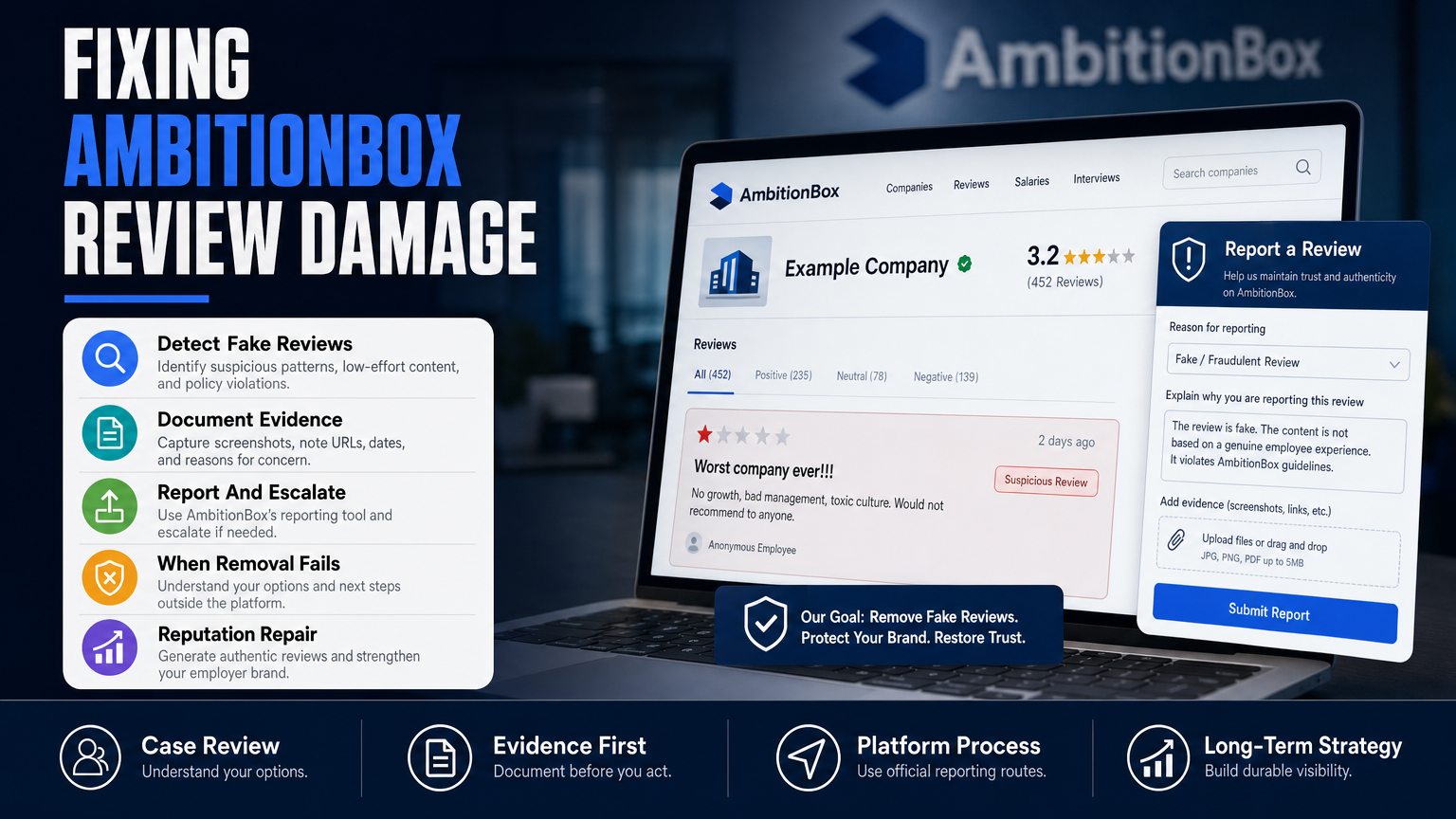
Different platforms have different policies: LinkedIn allows you to control your profile; Facebook and Instagram require either account removal or reporting for impersonation/privacy; Google Business Profile, Yelp, Trustpilot and industry-specific review sites have formal review-removal processes tied to policy violations.
We use the official reporting and review processes made available by platforms. Platform decisions remain under the platform’s control.
- 1) For each platform, identify the specific policy the content may violate (impersonation, privacy, harassment, false information).
- 2) File a detailed report with the exact policy citation, supporting evidence, and your contact information.
- 3) If a review is false, request a factual correction and provide documentation where the platform allows it.
- 4) Monitor resolution and escalate to the platform’s legal or business support if needed (some platforms have paid customer-support channels for businesses).
- Impersonation: report using platform forms and supply proof of identity when required.
- Privacy violations: many platforms remove doxxing or exposed bank/SSN data when reported.
- Negative reviews: respond calmly, request mediation or removal when reviews violate site policy or are demonstrably false.
Quick answers: What is the best bug spray, fly repellent, and ingredients that repel mosquitoes?
These ‘People also ask’ questions appear for the same search term online; answering them directly provides practical value. They are unrelated to removal workflows but commonly surfaced, so here are concise, evidence-based answers.
- 1) Read the product label for concentration and duration of protection.
- 2) For children, choose products labelled as safe for kids and follow pediatric guidance.
- 3) Combine repellents with physical measures: screens, nets, long clothing, and source control (standing water removal).
- Best bug spray: choose an EPA-registered repellent with an effective active ingredient (DEET, Picaridin, IR3535, or oil of lemon eucalyptus (PMD)). Product examples often recommended include OFF! Deep Woods (DEET) and picaridin formulations for a balance of protection and material safety.
- Best fly repellent for humans: DEET or picaridin applied to skin is effective; permethrin-treated clothing provides additional protection for outdoor workers. For immediate fly annoyance control, topical repellents or wearable repellent patches can help.
- Ingredients that repel mosquitoes: DEET, Picaridin, IR3535, oil of lemon eucalyptus (PMD), and permethrin for fabric treatment are the primary ingredients supported by public-health authorities.
DIY vs agency: when to handle this yourself and when to hire help
Some straightforward takedowns and opt-outs are reasonable to do yourself. More complex problems—defamation, repeated doxxing, coordinated smear campaigns, or high-profile cases—often require experienced support.
We evaluate whether the content may qualify for removal or review and advise when legal coordination or professional SEO/PR is advisable. If you decide to hire help, prioritize firms that explain processes clearly and don’t promise guaranteed removals.
- 1) Triage the urgency and impact (client loss, licensing risk, criminal exposure).
- 2) Start low-cost DIY steps immediately (evidence capture, platform reports, opt-outs).
- 3) If the response is inadequate or the threat escalates, engage counsel and an experienced reputation team.
- Do-it-yourself: one-off publisher contacts, platform reports, single broker opt-outs, and basic SEO for positive profiles.
- Hire an agency when the case involves legal risk, coordinated attacks, recurring re-listings, or when you need sustained SEO suppression and monitoring.
- Ask any vendor for a clear scope of work, measurable milestones, and how they handle evidence and confidentiality.
Removal vs Suppression — The practical differences
Choose removal when it’s possible and appropriate; choose suppression when removal is impossible or impractical.
| Removal | Suppression |
|---|---|
| Goal | Reduce visibility; push negative results off page one |
| Typical methods | SEO, content creation, PR, link building |
| When it works best | When content is true but lower-authority than new pages you control |
| Speed | Often slower—measurable over months |
| Risks | Requires ongoing maintenance; competitors can outrank you |
| Cost profile | Ongoing marketing/SEO and content costs |
| Certainty | No guarantees—depends on algorithm and publisher behavior |
A hypothetical end-to-end scenario: an anonymous forum post and the suppression path
Hypothetical situation: A mid-sized law firm partner discovers an anonymous forum post alleging misconduct that names them and ranks highly in search results. The post is opinionated, lacks verifiable evidence, and the forum host declines to remove it citing free-speech policies.
Step-by-step approach taken in this hypothetical example: the firm documents the post, requests moderation with evidence of false facts, engages an attorney to evaluate defamation risk, and begins a suppression campaign to push the forum post lower in search results.
- 1) Day 1–7: Document, contact forum, file platform report, begin monitoring.
- 2) Week 2–4: Legal intake; decision to pursue neutral correction rather than court action.
- 3) Month 1–3: Publish authoritative content optimized for name-targeted queries; outreach to get links from legal directories.
- 4) Month 3–6: Review search rankings; adjust keywords; continue outreach and monitoring.
- Outcome (hypothetical): The firm reduced visibility of the forum post on page one search results for target name queries within several months. Results vary and no specific outcome was guaranteed at the outset.
- Evidence capture: screenshots, archive, note of when it first appeared.
- Publisher contact: polite, precise takedown/corrections request submitted and recorded.
- Legal review: attorney assessed whether a plausible defamation claim existed and advised against immediate litigation due to public-interest and opinion defenses.
- Suppression strategy: claimed and optimized professional profiles, published three bylined articles on authoritative sites, issued a factual statement on the firm website, and used targeted PR to amplify authoritative content.
Common mistakes people make when trying to remove their name
Below are frequent errors that slow down or derail mitigation efforts. Avoid these to preserve options and reduce escalation risk.
1. Threatening public retaliation
Sending aggressive legal threats, insulting publishers publicly, or trying to silence critics on social channels often backfires and draws more attention (the Streisand effect). Use calm, documented requests and legal counsel when appropriate.
2. Chasing every data broker at once without a plan
Submitting ad-hoc opt-outs to dozens of sites without tracking re-listing wastes time. Prioritize brokers by traffic and legal exposure, and implement an ongoing monitoring plan.
3. Deleting your entire online presence
Removing all profiles can look suspicious and means you lose control over accurate information prospective clients seek. Instead, keep authoritative, up-to-date professional pages and correct errors publicly when possible.
4. Believing removal is guaranteed
There is no universal right to remove content in the U.S. Platform decisions and publisher choices vary—avoid vendors who promise guaranteed outcomes.
5. Ignoring monitoring after an initial cleanup
Content can reappear, be mirrored, or be republished. Regular monitoring and rapid response prevent small problems from becoming crises.
Best practices for getting and keeping your name off unwanted pages
Follow these durable practices to maximize your chances of removing or suppressing unwanted online mentions and to reduce future exposures.
1. Act quickly and document everything
Capture evidence (screenshots, caches), timestamp when you first saw the content, and record all communications with publishers or platforms. Documentation is essential for legal or escalation steps.
2. Use the platform’s own policies and forms
Platforms have specific reporting routes for impersonation, privacy violations, and harassment—use those forms and reference the exact policy language to increase the chance of review.
3. Prioritize high-impact removals and opt-outs
Focus first on pages that rank on page one for your name, high-traffic broker listings, and review pages that influence clients or credentialing bodies. Small, targeted wins move the needle.
4. Combine removal attempts with suppression
Parallel SEO and PR work is efficient: while you pursue removal or correction, simultaneously build authoritative content to push down negative results.
5. Maintain monitoring and a repeatable playbook
Set up alerts, run weekly checks on name searches, and keep a documented process for opt-outs, platform reports, and escalation so recurring listings are handled promptly.
Expert Tips
- Always begin by preserving evidence—screenshots and cached URLs are your most important asset.
- Be specific in every publisher request: include the exact URL, the offending text, and the action you seek.
- When dealing with reviews, respond publicly first and professionally—platforms value attempts at remediation.
- Use structured data on your professional website so search engines associate your name with authoritative content.
- Set up Google Alerts and a low-cost monitoring service to catch re-listings early.
- If identity theft or doxxing occurred, involve law enforcement and notify credit bureaus where appropriate.
- Avoid schemes that promise instant removal—legitimate work requires documentation and time.
- Keep copies of opt-out confirmations and any correspondence in a secure, timestamped folder.
Conclusion
Removing your name from a website is often a multi-track effort: publisher outreach and platform reports first, legal review when necessary, and suppression and reputational work when removal isn’t possible. There are no guaranteed outcomes, but a methodical approach improves your options.
Start with triage and documentation, prioritize high-impact sources, and combine removal attempts with consistent SEO and monitoring. When the risk to your practice or business is high, coordinate with counsel and experienced reputation professionals to create a defensible, documented plan.
Why Businesses Choose Your Reputation Agency
Managing your reputation takes more than monitoring reviews or publishing the occasional blog post. It takes a strategy built around your situation, your industry, and what is actually showing up in search.
Your Reputation Agency works with businesses, executives, healthcare professionals, attorneys and growing brands. Our services include:
- Remove or suppress negative Google search results and news articles
- Take down or mitigate negative reviews (Google, Yelp, Trustpilot, industry sites)
- Remove defamatory content, false posts and impersonation accounts
- Remove personal data from people-search and data-broker sites (opt-outs)
- Mugshot and arrest-record removal or suppression
- YouTube and negative video removal / demotion
- Rapid crisis response for viral incidents and online smear campaigns
- Social media impersonation and fake account removal
- Reputation monitoring, alerts and ongoing surveillance
- Search engine reputation repair (SEO to bury negative results)
Frequently Asked Questions
1. How can I remove my name from a website?
Identify the URL and publisher, capture evidence, and contact the publisher politely asking for removal or correction. Use platform reporting tools if the content is on a hosted service. If the content is defamatory or a privacy violation, consult a qualified attorney. Removal depends on publisher policy, platform rules, jurisdiction, and whether the content qualifies for takedown.
2. What is the best bug spray?
The most effective repellents are those with EPA-registered active ingredients: DEET, Picaridin, IR3535, or oil of lemon eucalyptus (PMD). Choose a concentration appropriate for your exposure duration; for heavy mosquito zones, higher DEET concentrations provide longer protection. Products like OFF! Deep Woods (DEET) are commonly recommended for dense foliage, but choose based on label instructions and personal needs.
3. What is the best fly repellent for humans?
DEET and picaridin applied to exposed skin are effective against flies as well as mosquitoes. For extended outdoor work, permethrin-treated clothing significantly reduces fly landings. Use repellents labeled for the target insect and follow safety guidance for children and pregnant people.
4. What ingredients repel mosquitoes?
Common active ingredients that repel mosquitoes are DEET, Picaridin, IR3535, oil of lemon eucalyptus (PMD), and permethrin for fabrics. Each has trade-offs in longevity, material compatibility, and age restrictions; read labels and public-health guidance before choosing.
5. What do I do if a publisher refuses to take down damaging content?
If a publisher refuses, document the refusal, consult a qualified attorney to evaluate legal options, and begin suppression work to reduce the content’s visibility. Legal remedies are situation-dependent and require careful assessment; do not assume litigation is always the best first move.
6. Can data-broker opt-outs stop re-listings?
Opt-outs reduce visibility on specific broker sites, but re-listings can occur when brokers re-scrape public records. Ongoing monitoring and repeated opt-outs, combined with suppression strategies, are usually necessary to maintain reduced exposure.
7. Will deleting my entire web presence help?
Deleting everything is rarely the right move. It removes your ability to present accurate, authoritative information to clients and may look suspicious. Maintain and optimize key professional profiles and sites you control while addressing problematic pages.
8. How do I remove my name from Google search results?
You cannot directly remove a name from Google search—it indexes publisher content. You can request removal of specific URLs under Google’s policies (e.g., personal information exposed, doxxing, or legal removals), request publisher takedowns, or use suppression strategies (SEO and content creation) to push unwanted results lower.
9. When should I hire a reputation agency?
Hire professional help when the issue is high-stakes (licensing risk, loss of clients, repeated attacks), when the content is international or on many platforms, or when you need sustained suppression and monitoring. A reputable agency will explain options, coordinate with counsel, and not promise guaranteed removals.
This content provides general information and does not constitute legal advice. The available options and likely outcomes depend on the facts, evidence, platform policies, applicable law, jurisdiction, and public-interest considerations.
Past examples do not guarantee future results. Removal, correction, deindexing, and search-position changes depend on third parties and circumstances outside Your Reputation Agency’s control.