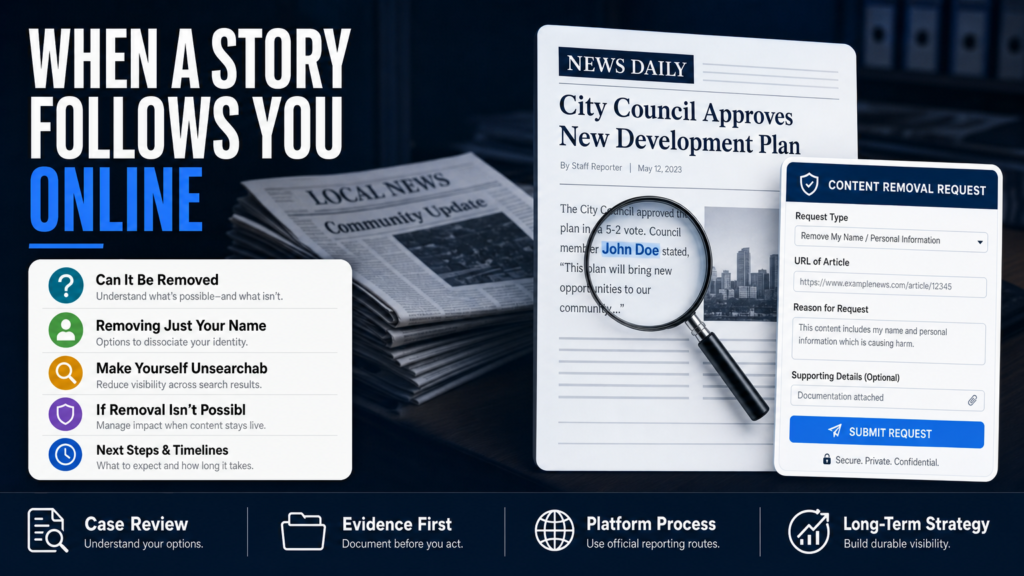
You’ve found your name in a news article and it’s showing up when colleagues, clients, or hiring managers search you. That discovery can feel urgent, invasive, and career-threatening — and you’re asking exactly the right question: how to remove your name from a news article.
This article gives a realistic, step-by-step roadmap: who can remove or redact a name, which legal and platform paths are available, how to ask publishers for corrections or anonymization, and what to do when removal isn’t possible. We describe technical, editorial, and legal options and the evidence that helps each one.
We won’t promise guaranteed deletion or fixed timelines. Instead you’ll get the specific actions that give you the best chance of removal or, if that fails, practical mitigation strategies to reduce visibility and protect your career.
Table of Contents
- Can I Get My Name Removed From A News Article?
- Can You Remove Just Your Name From A News Article?
- What Does ### Mean In Journalism?
- How Do I Make My Name Unsearchable?
- How Do I Get My Name Removed From A Website?
- If Removal Isn’t Available: Mitigation And Suppression
- How Platforms, Publishers And Courts Decide — Timelines And Evidence
- Quick Checklist: What To Do Next
- DIY vs Agency: Which Route For Removing A Name
- Hypothetical Example: A Local Article And A Surgeon’s Name
- Common Mistakes People Make When Trying To Remove Their Name
- Best Practices For Managing A Name In An Article
- Expert Tips
- Conclusion
- Why Businesses Choose Your Reputation Agency
- Frequently Asked Questions
Can I Get My Name Removed From A News Article?
Short answer: sometimes. Whether you can remove your name from a news article depends on the publisher’s editorial policies, the nature of the content (privacy, defamation, factual error), applicable law, and the evidence you can provide. In the United States there is no automatic “right to be forgotten,” so removal is decided case by case.
We evaluate whether the content may qualify for removal or review. Removal depends on the content, publisher, platform policies, evidence, jurisdiction, and circumstances. The options are typically: editorial redaction/correction by the publisher, a publisher takedown, platform-delivery removals (like Google News removal requests), or legal remedies where appropriate.
- Document the article URL, publication date, and specific lines where your name appears.
- Collect supporting evidence (e.g., factual inaccuracies, proof of identity theft or impersonation, or confidential records published in error).
- Contact the editor or the publisher’s corrections desk with a concise request and supporting evidence.
- If needed, escalate to the publisher’s formal complaints process or consult an attorney for a legal takedown review.
- Ask the publisher for an anonymization, correction, or retraction if the article contains factual errors or privacy violations.
- File platform-level removal requests when the article breaks platform policy (for example doxxing or intimate-image violations).
- Consider legal review if the article contains defamatory falsehoods — a qualified attorney can advise whether a legal claim may be available.
- When removal isn’t available, mitigation and search-result suppression are standard alternatives.
How to open the initial request
Start with a short, professional email to the editor: identify the article, the specific paragraph that harms you, and a clear remedy you seek (redaction of your name, correction, or retraction). Attach evidence if you claim factual error or privacy breach.
Keep the tone factual and avoid threats. Publishers respond better to precise, documented requests than broad demands.
- Subject line: Correction request — [Article title], [date]
- Include a URL, timestamps/screenshots, and one-paragraph summary of requested change
- Attach documents that substantiate factual corrections where applicable
Can You Remove Just Your Name From A News Article?
Removing only a name — leaving the rest of the article intact — is possible in some cases, but it’s at the publisher’s discretion. Many newsrooms will redact or anonymize a name when the person is a victim, a minor, or when publication creates a significant privacy harm. They’re less likely to redact a name from an article that reports on matters of legitimate public interest.
Publishers weigh public interest, editorial standards, and legal risk. Even when they agree to remove a name from the article on their site, copies, syndication partners, or cached versions may remain accessible and searchable.
- Identify the reporter and the corrections editor for the publication.
- Explain why redaction is necessary, referencing privacy harm or factual errors.
- Ask if they will anonymize the article and whether they will update syndicated copies or only their own site.
- Victim privacy requests, minors, and sensitive personal data are the strongest cases for name redaction.
- If the article contains factual errors about you, request a correction rather than a blind redaction.
- Some publishers will replace a name with initials or a job title; others refuse any edits to historical reporting.
If the publisher declines
If the publisher declines to redact or remove your name, you can: (a) request a prominent correction if the article is factually wrong; (b) ask for an editor’s note explaining context; (c) pursue platform-level remedies (search engine requests or social takedowns) when policies are violated.
When removal is refused, suppression strategies (SEO, new authoritative content, and link-building) are the pragmatic fallback.
- Request a written denial so you have a record for escalation.
- Document any subsequent harassment or harm and consider legal review.
What Does ### Mean In Journalism?
The symbol “###” is a newsroom convention indicating the end of a story in copy-editing and wire distribution. It’s a typesetting or editing marker that doesn’t affect publication decisions or legal rights.
If you find “###” inside an article or in filenames, it’s an editorial artifact — not a signal that your name can be automatically removed or redacted.
- If you see ### in a published piece, ignore it for removal purposes; focus on who the editor or corrections desk is and follow the standard correction request process.
- ### = End of story / marker for editors
- It’s a formatting/production signal, not a removal instruction
- Do not base a removal request on the presence of editorial markers
How Do I Make My Name Unsearchable?
Making your name completely unsearchable is rarely achievable on the open web. We use the phrase ‘make unsearchable’ to mean reduce or remove direct search results that link to identifying content. Search visibility can be lowered through removal requests, data-broker opt-outs, privacy settings, and proactive suppression via authoritative positive content.
We develop SEO reputation strategies intended to improve the visibility of relevant and credible information. Results vary according to the strength of the negative content and the authority of competing sources.
- Run searches for exact name in quotes and combinations (e.g., “Jane Q. Public” + city).
- List URLs and categorize by removal likelihood (high: doxxing/privacy violations; medium: factual errors; low: truthful public records).
- Prioritize removals, send requests, and begin content-suppression SEO for the most damaging results.
- Audit all places your name appears (news, social, public records, data brokers).
- Submit opt-out requests to data-brokers and people-search sites (expect manual steps and repeat submissions).
- Request removal or correction from publishers where content is inaccurate or violates privacy.
- Create and promote authoritative content (LinkedIn, personal website, professional bios) to push negative links lower in search results.
Use privacy and platform tools
Lock down social profiles: make them private when possible, remove personal details, and set strict privacy settings. Delete irrelevant public posts that rank for your name.
For news items you don’t control, you can still reduce their visibility. See our step-by-step coverage in When a Google Result Becomes Your First Interview — How to Fix It Fast for tactics to reframe what appears in searches about you.
- Turn off search indexing on personal web pages (robots.txt, meta noindex) if you control them
- Use consistent name formatting on professional profiles to consolidate authoritative results
How Do I Get My Name Removed From A Website?
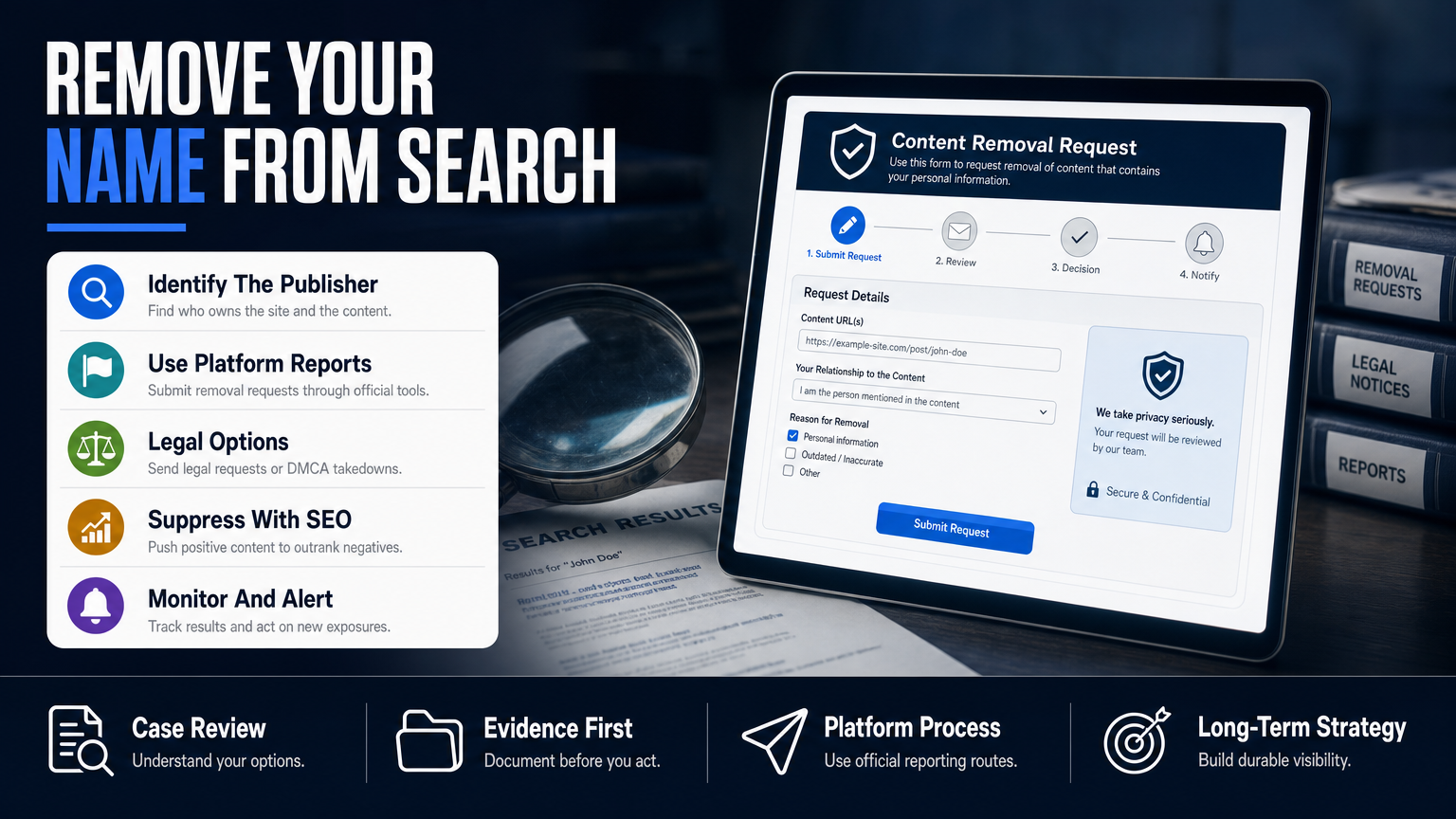
Removing your name from a website is a publisher-level request. The site owner or editor controls their content. Your first step is to identify the correct point of contact: corrections editor, content manager, or published contact information. Explain the specific harm and provide supporting evidence.
If the site is a platform (e.g., Facebook, Twitter/X, YouTube) use the platform’s abuse, impersonation, or privacy-reporting forms. For mainstream news outlets, follow their corrections/retraction policy. We evaluate whether the content may qualify for removal or review and pursue the legal, technical, platform-based, and reputational options available.
- Prepare a removal packet: concise explanation, URL(s), screenshots, and evidence supporting your claim.
- Send a polite, documented request to the publisher and request a timeframe for reply.
- If the publisher declines, escalate to platform-level complaints (if syndicated) or consult counsel for legal options.
- For publisher sites: locate corrections@, editor email, or the complaints form.
- For platforms: use the official reporting channels (impersonation, doxxing, privacy).
- If the site republishes public records (arrest logs, court dockets) the ability to remove may be limited.
Specific resources
If you need detailed steps for removing your name or content from a variety of websites, our article When a Google Result Becomes Your First Interview — How to Fix It Fast walks through search-focused remediation, and will help you prioritize which sites to approach first.
If Removal Isn’t Available: Mitigation And Suppression
Sometimes publishers decline to remove or redact, or the content is lawful and part of public records. When removal is unavailable, the next best approach is mitigation: reduce visibility, add context, and control the narrative where you can.
Mitigation blends SEO, authoritative content creation, monitored outreach, and PR. We develop SEO reputation strategies intended to improve the visibility of relevant and credible information so that the most damaging links appear lower in search results.
- Inventory existing assets you control (LinkedIn, personal site, professional associations) and optimize them for your name.
- Draft 3–5 pieces of long-form content that address the issue with neutral, factual language; publish them to domains you can control or reputable third-party sites.
- Use ongoing monitoring and link-building to increase the authority of those pages.
- Create authoritative profiles and a personal website with your preferred biography and keywords.
- Publish factual, verifiable content (press releases, contributed articles, professional bios) to outrank the harmful article.
- Use link-building, social signals, and content refreshes to accelerate positive pages into top search slots.
- Monitor results and repeat content pushes when necessary.
When local coverage threatens a practice
Local news stories often carry outsized weight in local searches. If a local article threatens client trust or patient flow, combine local SEO with targeted communications. For immediate, operational steps tailored to healthcare providers or small practices see When a Local News Story Threatens Your Practice — Fast Steps to Fix It.
How Platforms, Publishers And Courts Decide — Timelines And Evidence
Timing depends on the platform, publisher, evidence, legal complexity, and search-engine behavior. Some editorial corrections can appear in days; platform policy reviews may take days to weeks; legal processes take months. We can provide estimated timelines after assessment, but no universal timeframe applies.
Helpful evidence includes documentation of factual errors, proof of identity for impersonation claims, police or court documents showing misuse of records, and screenshots proving doxxing or policies violations.
- Gather evidence before contacting publishers or platforms.
- Keep written records of all correspondence.
- If you consider legal action, consult a qualified attorney early to identify the proper jurisdiction and remedy.
- Editorial corrections: often days–weeks depending on the publication’s process.
- Platform removals for policy violations: typically days–weeks, sometimes longer if appeals are filed.
- Legal action: months to years and depends on court schedules and jurisdiction.
Quick Checklist: What To Do Next
Use this checklist to act fast and methodically — urgency should not replace documentation.
Every step you take should be recorded. That record helps whether you later need to escalate to legal counsel or demonstrate harm to a publisher.
- Immediate (0–48 hours): document, notify your team, secure social accounts.
- Short term (3–21 days): send publisher and platform requests; begin content creation for suppression.
- Medium term (1–3 months): monitor search results, continue SEO work, evaluate need for legal review.
- Save the URL and take timestamped screenshots (desktop and mobile).
- Categorize the content (defamatory, privacy-violating, public record, opinion).
- Send a concise, evidence-backed correction/anonymization request to the publisher.
- File platform reports where applicable (impersonation, doxxing, privacy breaches).
- Begin suppression: update professional profiles and publish authoritative content.
- Set up monitoring and alerts for your name and the offending URL.
DIY vs Agency: Which Route For Removing A Name
A short comparison to help choose between handling removal yourself or hiring a reputation agency.
| DIY | Agency |
|---|---|
| Cost | Higher upfront; monthly service fees |
| Control | Professional project management |
| Expertise | Access to platform contacts and SEO specialists |
| Workload | Minimal once engaged |
| Speed | Often faster for complex suppression |
| Legal coordination | Coordinates with attorneys when needed |
Hypothetical Example: A Local Article And A Surgeon’s Name
Situation: A local paper published an article naming an attending surgeon in a complaint against a hospital. The surgeon disputes factual errors and fears patient cancellations.
Process followed: documented the article, gathered hospital attachment notices and scheduling records showing dates were misstated, emailed the corrections editor with a concise packet, and requested a correction or anonymization of the surgeon’s name citing factual errors and patient-safety concerns.
Outcome pathway: The publisher agreed to a correction and to anonymize the surgeon’s name in the online article after reviewing the documents. The agency then published authoritative content (professional bios, a statement from the hospital with corrected facts) and used SEO to reduce the article’s relative visibility in local searches. Search visibility improved over months, though archived syndicated copies remained reachable for some time.
- 1) Document and categorize the article’s errors.
- 2) Submit evidence and a clear correction request to the corrections desk.
- 3) If the publisher cooperates, confirm whether syndicated copies will be updated.
- 4) Launch a suppression campaign using professional web pages and earned media.
- Document before you ask: screenshots, records, and timestamps are essential.
- Editors respond better to narrow, evidence-backed requests than emotional appeals.
- Mitigation often complements removal: corrections + proactive content produced the best practical result.
Common Mistakes People Make When Trying To Remove Their Name
Avoid these frequent errors — they waste time and can harden a publisher’s position.
Mistake: Demanding removal without evidence
Why it fails: Publishers expect a factual basis for corrections. Vague threats or emotional pleas are unlikely to persuade an editor.
Fix: Provide specific, verifiable documentation and a clear proposed remedy.
Mistake: Publicly attacking the reporter or publication
Why it fails: Public attacks escalate conflict and reduce the chance a publisher will collaborate. They also create new negative search content.
Fix: Use private, documented communications and keep the tone professional.
Mistake: Assuming Google can physically delete publisher content
Why it fails: Google doesn’t own the content; it indexes it. Google can remove links from results in narrow circumstances, but it cannot delete the original article.
Fix: Request removal from the publisher first and use search-engine requests only for policy-based cases (e.g., doxxing, privacy violations).
Mistake: Chasing every data-broker at once
Why it fails: People-search opt-outs are manual and time-consuming; doing them without a plan wastes effort and offers temporary relief.
Fix: Prioritize the highest-impact sites and schedule repeat submissions.
Mistake: Expecting instant results
Why it fails: Editorial and platform processes take time; legal routes run longer. Impatience can lead to poor decisions.
Fix: Track progress, set realistic checkpoints, and escalate only after documented denials.
Best Practices For Managing A Name In An Article
Follow these durable practices to maximize the chance of a good outcome and protect your professional standing.
Be factual, concise, and evidence-driven
Editors and platform reviewers respond to clear facts. Attach documents, point to exact sentences, and propose the simplest remedy (e.g., redact name, correct the date).
If you claim defamation, have your lawyer review language before sending it to avoid admissions or statements that complicate matters.
Prioritize high-impact items
Start with the article and sites that most frequently appear for your name in searches. Use monitoring tools to see which pages drive impressions and prioritize them.
A targeted approach conserves resources and speeds results.
Keep a contemporaneous record
Store emails, screenshots, timestamps, and correspondence in a secure folder. A clear record helps when escalating to platforms, publishers, or counsel.
Records are also useful if you later need to demonstrate harm to a prospective employer or regulator.
Coordinate PR and SEO with any legal action
Legal proceedings can generate more publicity. Coordinate communications to minimize unintended amplification.
If you retain outside counsel, ensure reputation and communications teams align on statements and timing.
Use monitoring and alerts
Set up Google Alerts and a monitoring service for your name and key URLs. Rapid detection lets you act quickly if the article is republished or resurfaces.
Monitoring also helps track the effectiveness of suppression work.
Expert Tips
- Always request a written decision from a publisher if they decline a removal — it helps with escalation.
- When asking for anonymization, propose a specific substitution (e.g., initials or ‘a hospital employee’).
- Take screenshots of everything before you contact anyone; some sites change or push updates quickly.
- If a story is factual but harmful, focus on context and correction rather than deletion.
- Use authoritative third-party sites (professional associations, trade outlets) to publish corrective context.
- Avoid publishing emotional responses on social media; they can become permanent search results.
- Prioritize fixes that remove private data (SSNs, home address, medical details) because platforms act faster on privacy violations.
- If the article is syndicated, ask the original publisher whether they will notify partners to remove or correct copies.
Conclusion
Removing your name from a news article is feasible in some circumstances, but it requires a methodical approach: evidence, respectful communication with publishers, platform-level reporting when policies apply, and realistic expectations about timelines and outcomes.
When removal isn’t available, mitigation — thoughtful SEO, authoritative content, monitoring, and targeted PR — is an effective and defensible strategy to protect your career and reduce the practical harm of the article. If the matter raises legal questions, consult qualified counsel early to identify any judicial options.
Why Businesses Choose Your Reputation Agency
Managing your reputation takes more than monitoring reviews or publishing the occasional blog post. It takes a strategy built around your situation, your industry, and what is actually showing up in search.
Your Reputation Agency works with businesses, executives, healthcare professionals, attorneys and growing brands. Our services include:
- Remove or suppress negative Google search results and news articles
- Take down or mitigate negative reviews (Google, Yelp, Trustpilot, industry sites)
- Remove defamatory content, false posts and impersonation accounts
- Remove personal data from people-search and data-broker sites (opt-outs)
- Mugshot and arrest-record removal or suppression
- YouTube and negative video removal / demotion
- Rapid crisis response for viral incidents and online smear campaigns
- Social media impersonation and fake account removal
- Reputation monitoring, alerts and ongoing surveillance
- Search engine reputation repair (SEO to bury negative results)
Frequently Asked Questions
1. Can I get my name removed from a news article?
Sometimes. Publishers can redact or correct names in cases of privacy harm, factual error, or other valid editorial reasons; platform removals are possible when content violates policies. There is no automatic right to be forgotten in the U.S., so each request is decided on its merits.
2. Can You Remove Just Your Name From A News Article?
Possibly, but it’s up to the publisher. Newsrooms may anonymize victims, minors, or people harmed by publication, but they are less likely to remove names from articles they consider in the public interest. Always request a specific remedy and provide supporting evidence.
3. What does ### mean in journalism?
### is an editorial marker that signals the end of a story for production or wire distribution. It does not indicate removability or any legal status — it’s simply a formatting convention used by editors.
4. How do I make my name unsearchable?
Making a name completely unsearchable is rarely possible. Instead, reduce visibility by requesting removals where allowed, opting out of people-search sites, locking down social accounts, and publishing authoritative content to outrank harmful results. Results vary and may take weeks to months.
5. How do I get my name removed from a website?
Contact the site owner or editor with a concise, evidence-backed request for anonymization or correction. For platforms, use official reporting tools. If a site refuses and the content is unlawful, consult an attorney. For guidance on search-focused remediation, see When a Google Result Becomes Your First Interview — How to Fix It Fast.
6. How long does removal or suppression usually take?
Timelines vary: editorial corrections can take days to weeks, platform policy reviews often take days to weeks, and legal processes take months. An estimated timeline can be provided after an individual assessment because timing depends on platform, publisher, and legal complexity.
7. What if a local news story is harming my practice?
Combine immediate operational steps (client communications, front-desk scripts) with reputation work — corrections requests, local SEO, and targeted messaging. For practical, sector-specific steps, see When a Local News Story Threatens Your Practice — Fast Steps to Fix It.
8. Should I hire an agency or handle this myself?
If the issue is a single factual error, reaching out to the publisher yourself can work. For syndicated articles, complex suppression, or coordinated attacks, agencies offer project management, SEO, and platform expertise. See the DIY vs Agency comparison above to decide.
9. Can legal action force a publisher to remove my name?
Legal remedies depend on the nature of the content and jurisdiction. A qualified attorney can determine whether a defamation, privacy, or other claim may be available. Legal action can be effective but also time-consuming and potentially amplifying — coordinate legal and communications strategies carefully.
This content provides general information and does not constitute legal advice. The available options and likely outcomes depend on the facts, evidence, platform policies, applicable law, jurisdiction, and public-interest considerations.
Past examples do not guarantee future results. Removal, correction, deindexing, and search-position changes depend on third parties and circumstances outside Your Reputation Agency’s control.